China Thyristor Market Top 5 Importing Countries and Market Competition (HHI) Analysis
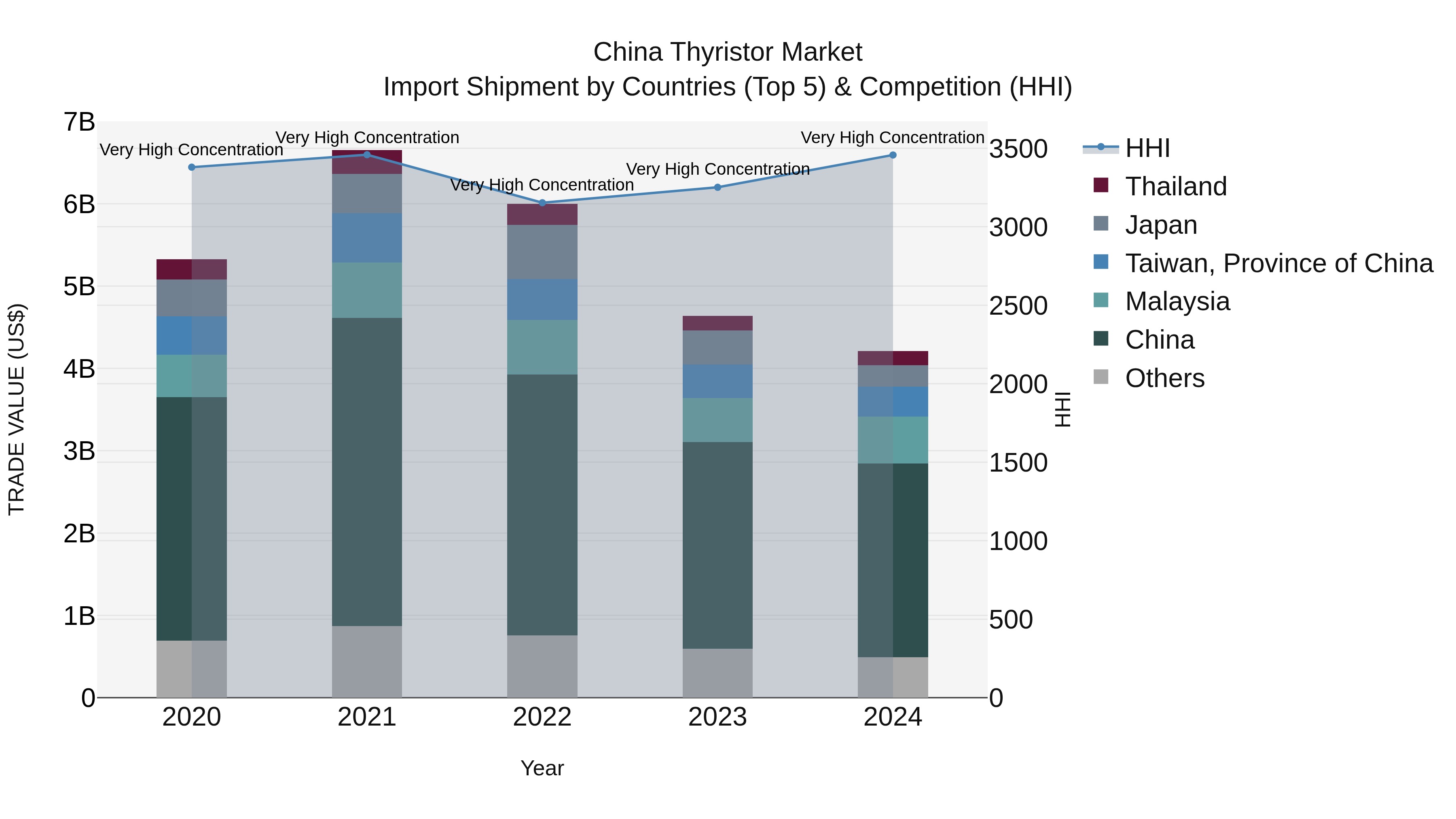
In 2024, China continued to lead in importing thyristors, followed by Malaysia, Taiwan, Japan, and Thailand. Despite a high Herfindahl-Hirschman Index (HHI) indicating market concentration, the sector experienced a negative compound annual growth rate (CAGR) of -5.69% from 2020 to 2024. The growth rate declined further in 2024, with a -9.21% rate. This trend suggests a challenging market environment for thyristor import shipments in China, requiring strategic adaptations by industry players to navigate the shifting landscape.
China Thyristor Market Overview
The China Thyristor Market is witnessing significant growth due to the increasing demand for power electronics in various industries such as telecommunications, automotive, and consumer electronics. Thyristors are widely used in power control and conversion applications, driving the market expansion. The country`s focus on renewable energy sources like wind and solar power is also bolstering the demand for thyristors in power generation and distribution systems. Additionally, the rise in infrastructure development projects and the growing adoption of electric vehicles are further fueling market growth. Key players in the China Thyristor Market include Infineon Technologies AG, STMicroelectronics, and ON Semiconductor, among others, who are continuously innovating to meet the evolving needs of the market.
China Thyristor Market Trends
The China Thyristor Market is experiencing several key trends. Firstly, there is a growing demand for high-power thyristors in industries such as power transmission and distribution, renewable energy, and electric vehicles. This is driven by the increasing emphasis on energy efficiency and the transition towards clean energy sources. Additionally, the adoption of advanced technologies such as silicon carbide (SiC) and gallium nitride (GaN) thyristors is on the rise, as they offer higher performance and efficiency compared to traditional silicon-based thyristors. Furthermore, the market is witnessing a trend towards the development of compact and lightweight thyristors to meet the requirements of modern electronic devices and systems. Overall, the China Thyristor Market is poised for growth with a focus on high-power applications, advanced technologies, and compact designs.
China Thyristor Market Challenges
In the China Thyristor Market, one of the key challenges faced is increasing competition from international manufacturers offering lower-priced products. This has put pressure on domestic thyristor companies to innovate and improve the quality of their products to remain competitive. Additionally, fluctuations in raw material prices and changing government regulations regarding environmental standards have added complexity to the market environment. Another challenge is the rapid technological advancements in the semiconductor industry, which require continuous investment in research and development to keep pace with evolving customer demands. Overall, navigating these challenges while maintaining profitability and market share poses a significant hurdle for thyristor companies operating in China.
China Thyristor Market Investment Opportunities
The China Thyristor market presents several investment opportunities due to the increasing demand for power electronics in various sectors such as automotive, industrial, and consumer electronics. With China`s focus on expanding its renewable energy capacity and transitioning towards electric vehicles, the demand for thyristors for power control and conversion is expected to rise significantly. Additionally, the ongoing digitalization of industries and the adoption of smart grid technologies further drive the demand for thyristors. Investing in Chinese thyristor manufacturers or suppliers could be lucrative, especially those focusing on innovations in efficiency, reliability, and cost-effectiveness. Collaborating with local partners or participating in joint ventures can provide access to the rapidly growing market and help capitalize on the opportunities presented by China`s evolving energy landscape.
China Thyristor Market Government Policy
The Chinese government has implemented various policies to support the Thyristor Market in the country. These policies include tax incentives, subsidies for research and development activities, and initiatives to promote the growth of the semiconductor industry. Additionally, the government has emphasized the importance of indigenous innovation and technology development to reduce reliance on foreign suppliers. Regulations on intellectual property protection and cybersecurity have also been strengthened to safeguard domestic companies operating in the Thyristor Market. Overall, the government`s policies aim to foster a competitive and innovative environment for the Thyristor Market in China while ensuring national security and technological advancement.
China Thyristor Market Future Outlook
The China Thyristor Market is expected to witness significant growth in the coming years, driven by increasing demand for power electronics in various industries such as automotive, telecommunications, and consumer electronics. The growing adoption of electric vehicles and renewable energy sources is also expected to propel the market forward. Additionally, government initiatives to promote energy efficiency and the development of smart grids will further fuel the demand for thyristors in the country. Technological advancements, such as the development of high-power thyristors and integration of thyristors in advanced electronic devices, are likely to create new opportunities for market growth. Overall, the China Thyristor Market is poised for steady expansion due to the increasing need for reliable and efficient power control solutions across various sectors.
Key Highlights of the Report:
- China Thyristor Market Outlook
- Market Size of China Thyristor Market, 2021
- Forecast of China Thyristor Market, 2031
- Historical Data and Forecast of China Thyristor Revenues & Volume for the Period 2018 - 2031
- China Thyristor Market Trend Evolution
- China Thyristor Market Drivers and Challenges
- China Thyristor Price Trends
- China Thyristor Porter's Five Forces
- China Thyristor Industry Life Cycle
- Historical Data and Forecast of China Thyristor Market Revenues & Volume By Power Rating for the Period 2018 - 2031
- Historical Data and Forecast of China Thyristor Market Revenues & Volume By Below 5OO MW for the Period 2018 - 2031
- Historical Data and Forecast of China Thyristor Market Revenues & Volume By 500 MW-999 MW for the Period 2018 - 2031
- Historical Data and Forecast of China Thyristor Market Revenues & Volume By 1000 MW and above for the Period 2018 - 2031
- Historical Data and Forecast of China Thyristor Market Revenues & Volume By Industry Vertical for the Period 2018 - 2031
- Historical Data and Forecast of China Thyristor Market Revenues & Volume By Consumer Electronics for the Period 2018 - 2031
- Historical Data and Forecast of China Thyristor Market Revenues & Volume By Industrial for the Period 2018 - 2031
- Historical Data and Forecast of China Thyristor Market Revenues & Volume By Telecommunication & Networking for the Period 2018 - 2031
- Historical Data and Forecast of China Thyristor Market Revenues & Volume By Automotive for the Period 2018 - 2031
- Historical Data and Forecast of China Thyristor Market Revenues & Volume By Aerospace & Defense for the Period 2018 - 2031
- Historical Data and Forecast of China Thyristor Market Revenues & Volume By Healthcare for the Period 2018 - 2031
- China Thyristor Import Export Trade Statistics
- Market Opportunity Assessment By Power Rating
- Market Opportunity Assessment By Industry Vertical
- China Thyristor Top Companies Market Share
- China Thyristor Competitive Benchmarking By Technical and Operational Parameters
- China Thyristor Company Profiles
- China Thyristor Key Strategic Recommendations






































