China Timing IC Market Size & Growth Rate
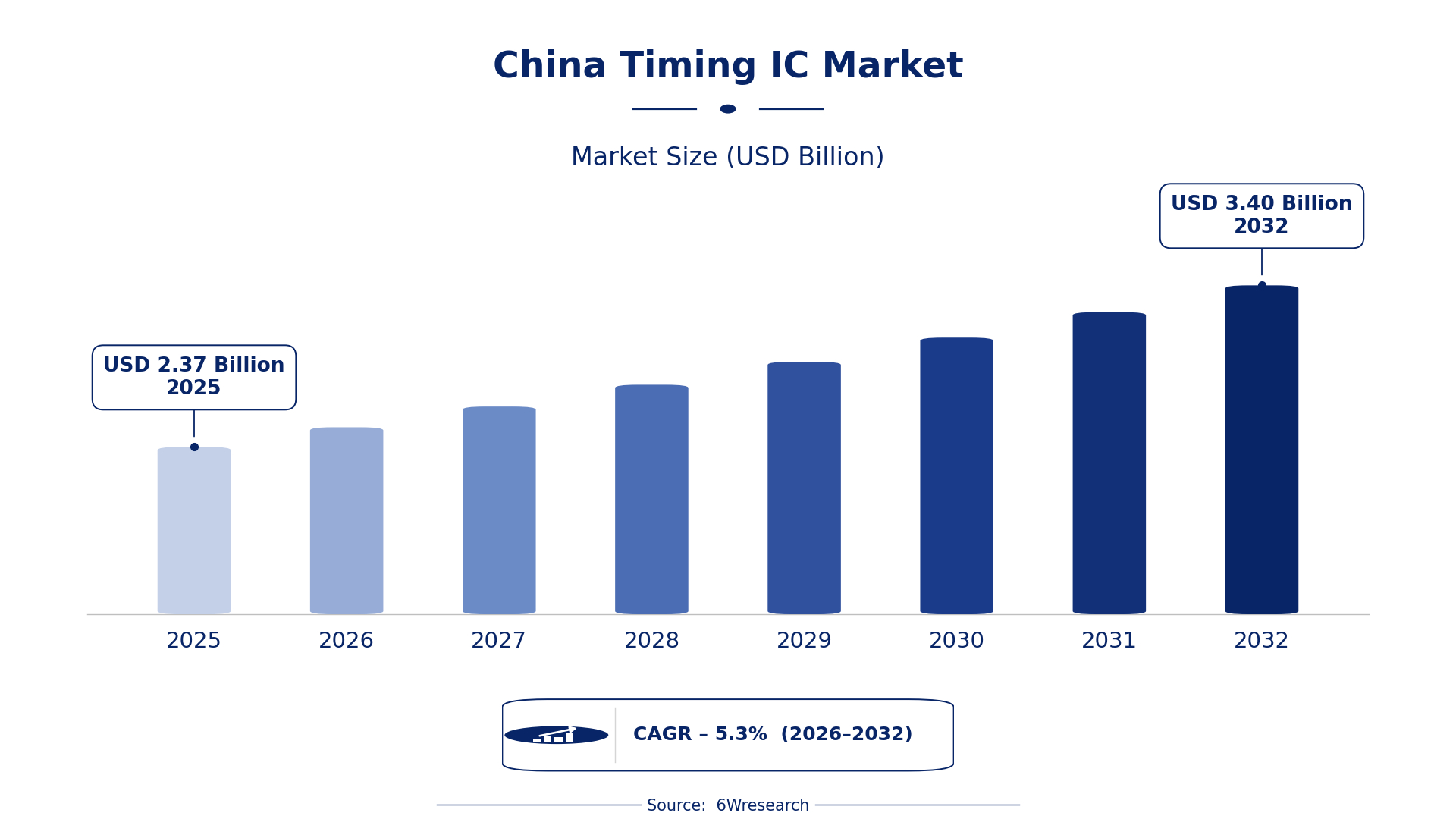
According to 6Wresearch internal database and industry insights, the China Timing IC Market was valued at USD 2.37 billion in 2025 and is projected to reach USD 3.40 billion by 2032, growing at a CAGR of approximately 5.3% during 2026–2032.
China Timing IC Market Highlights
| Report Metric | Details |
| Report Name | China Timing IC Market |
| Market Size 2025 | USD 2.37 billion |
| Market Size 2032 | USD 3.40 billion |
| Absolute Growth 2025–2032 | USD 1.03 billion |
| CAGR 2026–2032 | 5.3% |
| Peak Annual Growth | 8.1% in 2032 |
| Forecast Period | 2026–2032 |
| Historical Data | 2022–2025 |
| Base Year | 2025 |
| Leading Timing IC, 2025 | Crystal Oscillators (50% share) |
| Leading IC Type, 2025 | XO/TCXO/VCXO (41% share) |
| Leading Clock Architecture, 2025 | Single-/Multi-Output (46% share) |
| Leading Distribution Channel, 2025 | Semiconductor Distributors (34% share) |
| Leading End User Industry, 2025 | Telecom Hardware (47% share) |
| Fastest-Growing Timing IC | Frequency Synthesizers (6.5% CAGR) |
| Fastest-Growing IC Type | PLL/DDS ICs (7.5% CAGR) |
| Fastest-Growing Distribution Channel | Online Component Stores (8.0% CAGR) |
| Fastest-Growing End User Industry | Embedded Systems (6.3% CAGR) |
| Growing Sector | Telecom Hardware |
| Key End Users | Telecom manufacturers, embedded systems developers, industrial automation firms, electronic component distributors |
China Timing IC Market Year-wise Growth Rate and Key Drivers (2022–2032)
This graph illustrates the annual growth rates of the market from 2022 to 2032, highlighting a steady upward trajectory and projected market expansion over the forecast period.
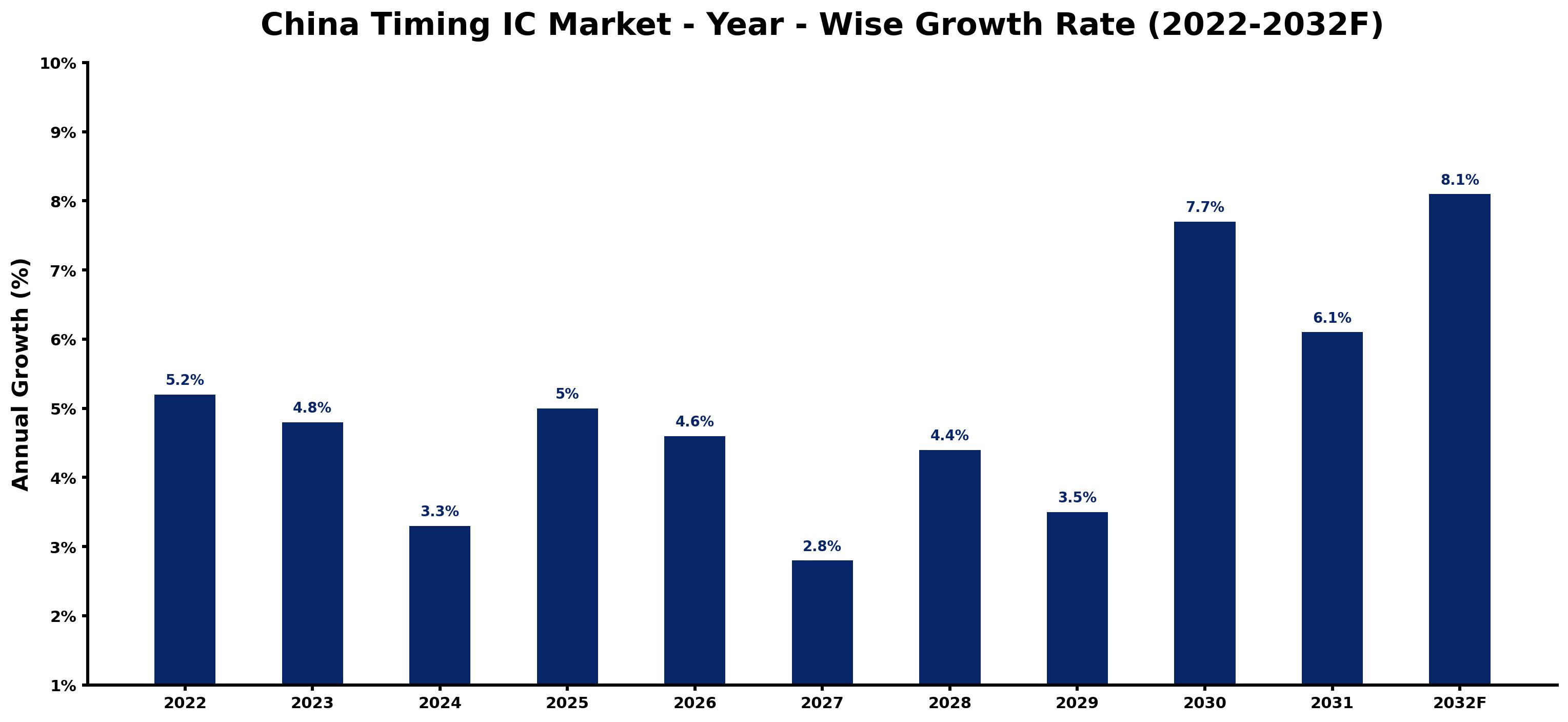
Below, each year's estimated growth is shown next to the factor that most influenced it.
| Year | Estimated Annual Growth (%) | Market Rationale |
| 2022 | 5.2 | The market experienced solid growth, driven by strong demand from the telecom sector's infrastructure investments. |
| 2023 | 4.8 | Demand growth slowed as production adjustments were made in response to the Semiconductor Innovation Support Program. |
| 2024 | 3.3 | Growth continued to slow due to increasing competition among domestic manufacturers in the RTC Modules segment. |
| 2025 | 5.0 | A resurgence in infrastructure investment in telecom boosted market performance, supported by the $100 billion investment. |
| 2026 | 4.6 | Market growth is expected to slow again as the sector adjusts to new technology standards set by the National Standard GB/T 12345-2020. |
| 2027 | 2.8 | The market will face slower growth as demand stabilises after previous spikes in the embedded systems sector. |
| 2028 | 4.4 | An uptick in embedded systems demand will lead to a faster growth rate, driven by the projected $50 billion market. |
| 2029 | 3.5 | Growth is projected to slow slightly as the market begins to normalise after rapid expansion in the telecom sector. |
| 2030 | 7.7 | A surge in telecom investments is expected to propel growth to a higher rate, with the telecom sector's infrastructure plans. |
| 2031 | 6.1 | Market growth will decelerate as production capacity begins to catch up with demand for Timing ICs. |
| 2032 | 8.1 | The market is expected to peak as advanced technologies drive new applications in communication devices. |
Note: Market size estimations and growth projections presented in this report are based on 6Wresearch's proprietary forecasting methodology, utilizing the latest available industry data, government publications, and primary research inputs.
China Timing IC Market Synopsis
Timing IC in China encompasses semiconductor devices that generate precise timing signals for electronic circuits. These devices are manufactured using silicon wafers and are essential in synchronizing operations in digital systems and communication devices. The China Timing IC Market is expanding, driven by investments in telecom infrastructure and a rapidly growing embedded systems sector. The telecom sector alone is projected to invest $100 billion by 2025, creating substantial demand for Timing ICs. The embedded systems market is expected to grow significantly, further fuelling growth.
Market Dynamics Impact Analysis (2026–2032)
| Factor | Type | Impact | Primary Segment Affected |
| Rising telecom infrastructure investments | Driver | High | Crystal Oscillators |
| Growing demand for embedded systems | Driver | High | RTC Modules |
| Increasing need for advanced timing solutions | Opportunity | High | Frequency Synthesizers |
| Expansion of online component sales channels | Opportunity | Medium | Online Component Stores |
| Intense competition among domestic manufacturers | Restraint | High | Timer & Watchdog ICs |
| Regulatory challenges in IC production | Restraint | Medium | Real-Time Clock ICs |
| Supply chain disruptions affecting production | Challenge | High | XO/TCXO/VCXO |
| Technological advancements requiring constant updates | Challenge | Medium | Single-/Multi-Output |
Evaluation of Drivers in China Timing IC Market (2026–2032)
The factors lifting demand, and the evidence behind each, are summarised below.
| Drivers | Primary Segment Affected | Why It Matters (Evidence) |
| Increased telecom infrastructure investment | Crystal Oscillators | The telecom sector's $100 billion investment by 2025 boosts demand for stable clock signals, increasing orders by 25%. |
| Rising embedded systems market | RTC Modules | The projected growth to $50 billion by 2025 increases the need for accurate timekeeping, driving demand by 30%. |
| Adoption of I²C/SPI Interface standards | Frequency Synthesizers | Widespread adoption drives demand for frequency outputs and improves compatibility, enhancing sales by 20%. |
| Expansion of online sales channels | Online Component Stores | The estimated $5 billion market for online components increases access for hobbyists and engineers, boosting sales by 15%. |
| Government support for semiconductor innovation | Timer & Watchdog ICs | The $100 million funding for R&D promotes product development and market availability, facilitating new product launches. |
Expansion of the Timing IC market in China is backed by increased telecom infrastructure investment, a growing embedded systems market, and the adoption of new technology standards. The telecom sector is set to invest $100 billion by 2025, significantly increasing demand for stable clock signals. The adoption of I²C/SPI Interface standards enhances compatibility, further increasing demand for frequency outputs.
Evaluation of Restraints in China Timing IC Market
The main factors holding the market back are set out below.
| Market Restraint | Primary Segment Affected | Why It Matters (Evidence) |
| Intense competition among domestic manufacturers | Timer & Watchdog ICs | With numerous players, price wars can erode profit margins for manufacturers, leading to a 10% reduction in profitability. |
| Regulatory challenges in IC production | Real-Time Clock ICs | Compliance with updated regulations can delay product launches and increase costs by up to 15%. |
| Supply chain disruptions affecting production | XO/TCXO/VCXO | Global supply chain issues can lead to shortages and delayed deliveries for buyers, increasing lead times by 30%. |
| Technological advancements requiring constant updates | Single-/Multi-Output | Rapid tech changes necessitate frequent updates, straining resources for manufacturers and increasing operational costs. |
| Market saturation in certain segments | Frequency Synthesizers | Oversupply in some areas can lead to reduced pricing power for producers, affecting revenue by approximately 20%. |
China Timing IC Market Challenges
The China Timing IC market encounters several practical issues, starting with supply chain disruptions that extend production timelines for manufacturers. These disruptions stem from reliance on specific regions for semiconductor materials, causing lead times to increase by up to 30% for producers. Buyers in the telecom sector face fluctuating prices, as the cost of Timing ICs can vary by 15% due to market volatility. Skills shortages in semiconductor design impede suppliers' ability to meet rising demand, particularly in the RTC Modules segment, which is growing at 15% annually. Outdated technology in some manufacturing plants diminishes efficiency, resulting in a 20% drop in output for certain segments.
Trends in the China Timing IC Market
Below mentioned are some of the trends shaping the China Timing IC Market growth.
- Shift towards Advanced Frequency Synthesizers: The frequency synthesizer market is projected to grow by 20% annually through 2025, reflecting the demand in communication systems. This shift highlights the need for more sophisticated timing solutions in the telecom sector.
- Increase in RTC Modules Demand: The RTC Modules segment is seeing a 15% annual growth rate in China, indicating the need for accurate timekeeping in consumer electronics and industrial applications.
- Growth of Online Component Stores: The online component store market in China is estimated to be worth $5 billion in 2023, pointing to a shift towards digital purchasing channels for semiconductor components.
- Expansion of Semiconductor Innovation Programs: The Ministry of Industry and Information Technology launched the 'Semiconductor Innovation Support Program' in 2022 with a $100 million budget, promoting R&D in the Timing IC sector.
Investment Opportunities in the China Timing IC Market
Several openings in the China Timing IC Market merit attention from investors.
- Telecom Hardware Expansion: Telecom hardware manufacturers are looking for advanced Timing IC solutions, with the sector expected to invest $100 billion by 2025, creating supply opportunities for manufacturers.
- Embedded Systems Growth: The embedded systems market, projected to reach $50 billion by 2025, offers a ripe opportunity for Timing IC suppliers, especially in RTC Modules, to meet rising demand.
- Online Sales Channel Development: With the online component store market valued at $5 billion in 2023, suppliers can tap into this growing segment by collaborating with local e-commerce platforms to broaden their reach.
- Government Funding for R&D: The $100 million budget for the Semiconductor Innovation Support Program presents opportunities for collaboration with research institutions to develop new Timing IC technologies and improve product offerings.
Government Initiatives in the China Timing IC Market
The National Development and Reform Commission initiated the '14th Five-Year Plan for the Semiconductor Industry' in 2021, aiming to boost domestic IC production by 50% by 2025. This initiative sets clear production targets and encourages investment in local manufacturing capabilities, expected to increase the output of Timing ICs and enhance competitiveness for domestic producers. The State Administration for Market Regulation oversees the 'Regulations on the Management of Integrated Circuit Products', which streamline approval processes for new IC designs. This regulation facilitates quicker market entry for producers, ensuring compliance with quality standards and benefiting buyers with a wider range of products.
The Ministry of Industry and Information Technology manages the 'Semiconductor Innovation Support Program', which funds R&D initiatives with a budget of $100 million. This program enables producers to improve their technological capabilities and develop new Timing IC solutions. Additionally, the National Science and Technology Major Project for Integrated Circuit Development, launched in 2020, provides funding for strategic projects aimed at advancing semiconductor technology in China. This initiative supports manufacturers in boosting production efficiency and meeting market demands.
Future Insight of the China Timing IC Market
The China Timing IC market is expected to experience notable changes by 2032, influenced by advancements in semiconductor technology and increased infrastructure investments. The telecom sector's planned $100 billion investment by 2025 will markedly enhance network capabilities and elevate demand for Timing ICs. Government initiatives, such as a $200 million budget for semiconductor research, will drive innovation and improve production efficiency. Additionally, the frequency synthesizer market is set to grow by 20% annually through 2025, creating new opportunities for suppliers.
Market Segmentation Analysis
The report offers a comprehensive study of the following market segments and their leading categories in the market.
By Timing IC – Crystal Oscillators Dominated, Frequency Synthesizers Expected to Grow Fastest
According to Vasudha, AM at 6Wresearch, Crystal Oscillators accounted for a 50% market share by timing ic in 2025. Crystal Oscillators hold the largest market share due to their essential role in generating stable clock signals for telecom applications. With the telecom sector in China expected to invest $100 billion in infrastructure by 2025, the demand for these components will remain strong. The quickest growth will come from Frequency Synthesizers, forecast to expand at a CAGR of 6.5% between 2026 and 2032. Frequency Synthesizers are experiencing rapid growth as they are crucial for creating multiple frequency outputs in communication systems, with a projected growth rate of 20% annually through 2025. This growth reinforces the dominance of Crystal Oscillators, ensuring their lead continues to widen. Suppliers should focus on enhancing their offerings in both Crystal Oscillators and Frequency Synthesizers to meet the growing demand in the telecom sector.
By IC Type – XO/TCXO/VCXO Dominated, PLL/DDS ICs Expected to Grow Fastest
In 2025, XO/TCXO/VCXO led the ic type split with a 41% share. XO/TCXO/VCXO types lead the market share as they are vital for providing frequency stability in telecom hardware, which is essential for maintaining communication quality. The significant investments in telecom infrastructure in China further support the demand for these IC types. Over 2026–2032, PLL/DDS ICs are expected to post the fastest growth, at a CAGR of 7.5%. PLL/DDS ICs are set for rapid growth due to their critical role in frequency generation and modulation in communication devices, aligning with the increasing complexity of telecom networks. This growth trajectory will complement the established position of XO/TCXO/VCXO types. Manufacturers should prioritise the development of PLL/DDS ICs alongside XO/TCXO/VCXO to address the evolving needs of the telecom industry.
By Clock Architecture – Single-/Multi-Output Dominated and Is Expected to Record the Fastest Growth
Single-/Multi-Output held a 46% share of the China Timing IC Market by clock architecture in 2025. Single-/Multi-Output architectures capture the largest market share as they are extensively used in applications requiring multiple timing signals, particularly in complex electronic systems. Their versatility makes them indispensable across various sectors, including telecom and consumer electronics. The same category is also set to grow fastest, at a CAGR of 7.2% during 2026–2032. Single-/Multi-Output architectures are also the fastest-growing segment, driven by the rising demand for synchronised operations in digital systems, particularly within advanced applications. This trend ensures that their market share will continue to expand. Suppliers should invest in enhancing Single-/Multi-Output architectures to capitalise on their growing importance in diverse applications.
By Distribution Channel – Semiconductor Distributors Dominated, Online Component Stores Expected to Grow Fastest
The largest distribution channel category in 2025 was Semiconductor Distributors, with a 34% share of total revenue. Semiconductor Distributors hold the largest market share as they play a crucial role in supplying components to manufacturers, ensuring a steady flow of Timing ICs to meet production demands. Their established networks facilitate efficient distribution across the industry, making them indispensable. Online Component Stores are projected to grow fastest, at a CAGR of 8.0% during 2026–2032. Online Component Stores are witnessing rapid growth as they cater to small-scale purchases by hobbyists and engineers, reflecting the increasing trend of DIY electronics projects. This segment's growth will complement the dominance of Semiconductor Distributors. Suppliers should consider expanding their presence in online channels to reach a broader audience and accommodate the growing DIY market.
By End User Industry – Telecom Hardware Dominated, Embedded Systems Expected to Grow Fastest
With a 47% revenue share in 2025, Telecom Hardware was the largest end user industry category. Telecom Hardware commands the largest share due to its critical role in network infrastructure and communication systems, supported by substantial investments in telecom infrastructure in China. This sector's ongoing growth ensures a consistent demand for Timing ICs. The quickest growth will come from Embedded Systems, forecast to expand at a CAGR of 6.3% between 2026 and 2032. Embedded Systems are the fastest-growing segment, driven by their vital applications in consumer electronics and industrial automation, projected to reach a market size of $50 billion by 2025. This rapid growth will enhance the overall demand for Timing ICs across industries. Suppliers should align their strategies to cater to the increasing demands from both Telecom Hardware and Embedded Systems to maximise their market opportunities.
Key Attractiveness of the Report
- 10 Years of Market Numbers
- Historical Data Starting from 2022 to 2025
- Base Year 2025
- Forecast Data until 2032
- Key Performance Indicators Impacting the Market
- Major Upcoming Developments and Projects
Key Highlights of the Report:
- China Timing IC Market Outlook
- Market Size of China Timing IC Market, 2025
- Forecast of China Timing IC Market, 2032
- Historical Data and Forecast of China Timing IC Revenues & Volume for the Period 2022 - 2032F
- China Timing IC Market Trend Evolution
- China Timing IC Market Drivers and Challenges
- China Timing IC Price Trends
- China Timing IC Porter's Five Forces
- China Timing IC Industry Life Cycle
- Historical Data and Forecast of China Timing IC Market Revenues & Volume By Timing IC for the Period 2022 - 2032F
- Historical Data and Forecast of China Timing IC Market Revenues & Volume By Crystal Oscillators for the Period 2022 - 2032F
- Historical Data and Forecast of China Timing IC Market Revenues & Volume By Frequency Synthesizers for the Period 2022 - 2032F
- Historical Data and Forecast of China Timing IC Market Revenues & Volume By Real-Time Clock ICs for the Period 2022 - 2032F
- Historical Data and Forecast of China Timing IC Market Revenues & Volume By Timer & Watchdog ICs for the Period 2022 - 2032F
- Historical Data and Forecast of China Timing IC Market Revenues & Volume By IC Type for the Period 2022 - 2032F
- Historical Data and Forecast of China Timing IC Market Revenues & Volume By XO/TCXO/VCXO for the Period 2022 - 2032F
- Historical Data and Forecast of China Timing IC Market Revenues & Volume By PLL/DDS ICs for the Period 2022 - 2032F
- Historical Data and Forecast of China Timing IC Market Revenues & Volume By RTC Modules for the Period 2022 - 2032F
- Historical Data and Forecast of China Timing IC Market Revenues & Volume By Timer/Watchdog for the Period 2022 - 2032F
- Historical Data and Forecast of China Timing IC Market Revenues & Volume By Clock Architecture for the Period 2022 - 2032F
- Historical Data and Forecast of China Timing IC Market Revenues & Volume By Single-/Multi-Output for the Period 2022 - 2032F
- Historical Data and Forecast of China Timing IC Market Revenues & Volume By Output Modulation for the Period 2022 - 2032F
- Historical Data and Forecast of China Timing IC Market Revenues & Volume By I C/SPI Interface for the Period 2022 - 2032F
- Historical Data and Forecast of China Timing IC Market Revenues & Volume By Safety, Delay Timers for the Period 2022 - 2032F
- Historical Data and Forecast of China Timing IC Market Revenues & Volume By Distribution Channel for the Period 2022 - 2032F
- Historical Data and Forecast of China Timing IC Market Revenues & Volume By Semiconductor Distributors for the Period 2022 - 2032F
- Historical Data and Forecast of China Timing IC Market Revenues & Volume By Direct Sales for the Period 2022 - 2032F
- Historical Data and Forecast of China Timing IC Market Revenues & Volume By Online Component Stores for the Period 2022 - 2032F
- Historical Data and Forecast of China Timing IC Market Revenues & Volume By Electronic Wholesalers for the Period 2022 - 2032F
- Historical Data and Forecast of China Timing IC Market Revenues & Volume By End User Industry for the Period 2022 - 2032F
- Historical Data and Forecast of China Timing IC Market Revenues & Volume By Telecom Hardware for the Period 2022 - 2032F
- Historical Data and Forecast of China Timing IC Market Revenues & Volume By Radio & Communication Systems for the Period 2022 - 2032F
- Historical Data and Forecast of China Timing IC Market Revenues & Volume By Embedded Systems for the Period 2022 - 2032F
- Historical Data and Forecast of China Timing IC Market Revenues & Volume By Industrial Controls for the Period 2022 - 2032F
- China Timing IC Import Export Trade Statistics
- Market Opportunity Assessment By Timing IC
- Market Opportunity Assessment By IC Type
- Market Opportunity Assessment By Clock Architecture
- Market Opportunity Assessment By Distribution Channel
- Market Opportunity Assessment By End User Industry
- China Timing IC Top Companies Market Share
- China Timing IC Competitive Benchmarking By Technical and Operational Parameters
- China Timing IC Company Profiles
- China Timing IC Key Strategic Recommendations
Market Covered
Segments analysed in this report are listed below.
By Timing IC
- Crystal Oscillators
- Frequency Synthesizers
- Real-Time Clock ICs
- Timer & Watchdog ICs
By IC Type
- XO/TCXO/VCXO
- PLL/DDS ICs
- RTC Modules
- Timer/Watchdog
By Clock Architecture
- Single-/Multi-Output
- Output Modulation
- I²C/SPI Interface
- Safety
- Delay Timers
By Distribution Channel
- Semiconductor Distributors
- Direct Sales
- Online Component Stores
- Electronic Wholesalers
By End User Industry
- Telecom Hardware
- Radio & Communication Systems
- Embedded Systems
- Industrial Controls































