India Timing IC Market Size & Growth Rate
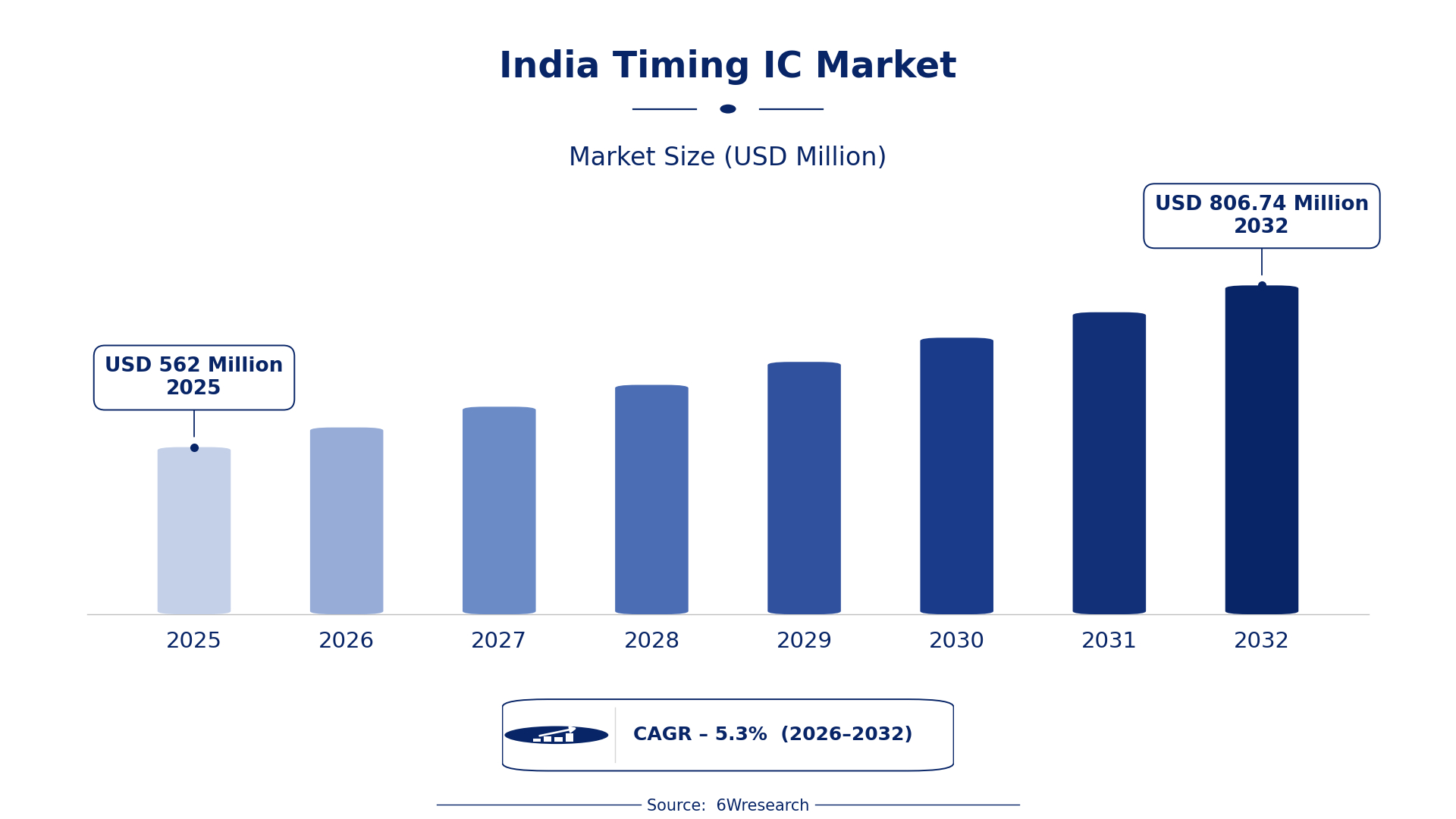
According to 6Wresearch internal database and industry insights, the India Timing IC Market was valued at USD 562.0 million in 2025 and is projected to reach USD 806.74 million by 2032, growing at a CAGR of approximately 5.3% during 2026–2032.
India Timing IC Market Highlights
| Report Metric | Details |
| Report Name | India Timing IC Market |
| Market Size 2025 | USD 562.0 million |
| Market Size 2032 | USD 806.74 million |
| Absolute Growth 2025–2032 | USD 244.74 million |
| CAGR 2026–2032 | 5.3% |
| Peak Annual Growth | 7.3% in 2032 |
| Forecast Period | 2026–2032 |
| Historical Data | 2022–2025 |
| Base Year | 2025 |
| Leading Timing IC, 2025 | Crystal Oscillators (42% share) |
| Leading IC Type, 2025 | XO/TCXO/VCXO (45% share) |
| Leading Clock Architecture, 2025 | Single-/Multi-Output (34% share) |
| Leading Distribution Channel, 2025 | Direct Sales (45% share) |
| Leading End User Industry, 2025 | Telecom Hardware (46% share) |
| Fastest-Growing Timing IC | Frequency Synthesizers (6.8% CAGR) |
| Fastest-Growing IC Type | PLL/DDS ICs (7.5% CAGR) |
| Fastest-Growing Distribution Channel | Online Component Stores (6.8% CAGR) |
| Fastest-Growing End User Industry | Embedded Systems (7.3% CAGR) |
| Growing Sector | Telecom Hardware |
| Key End Users | Telecom Equipment Manufacturers, Embedded Systems Developers, Industrial Automation Firms |
India Timing IC Market Year-wise Growth Rate and Key Drivers (2022–2032)
This graph illustrates the annual growth rates of the market from 2022 to 2032, highlighting a steady upward trajectory and projected market expansion over the forecast period.
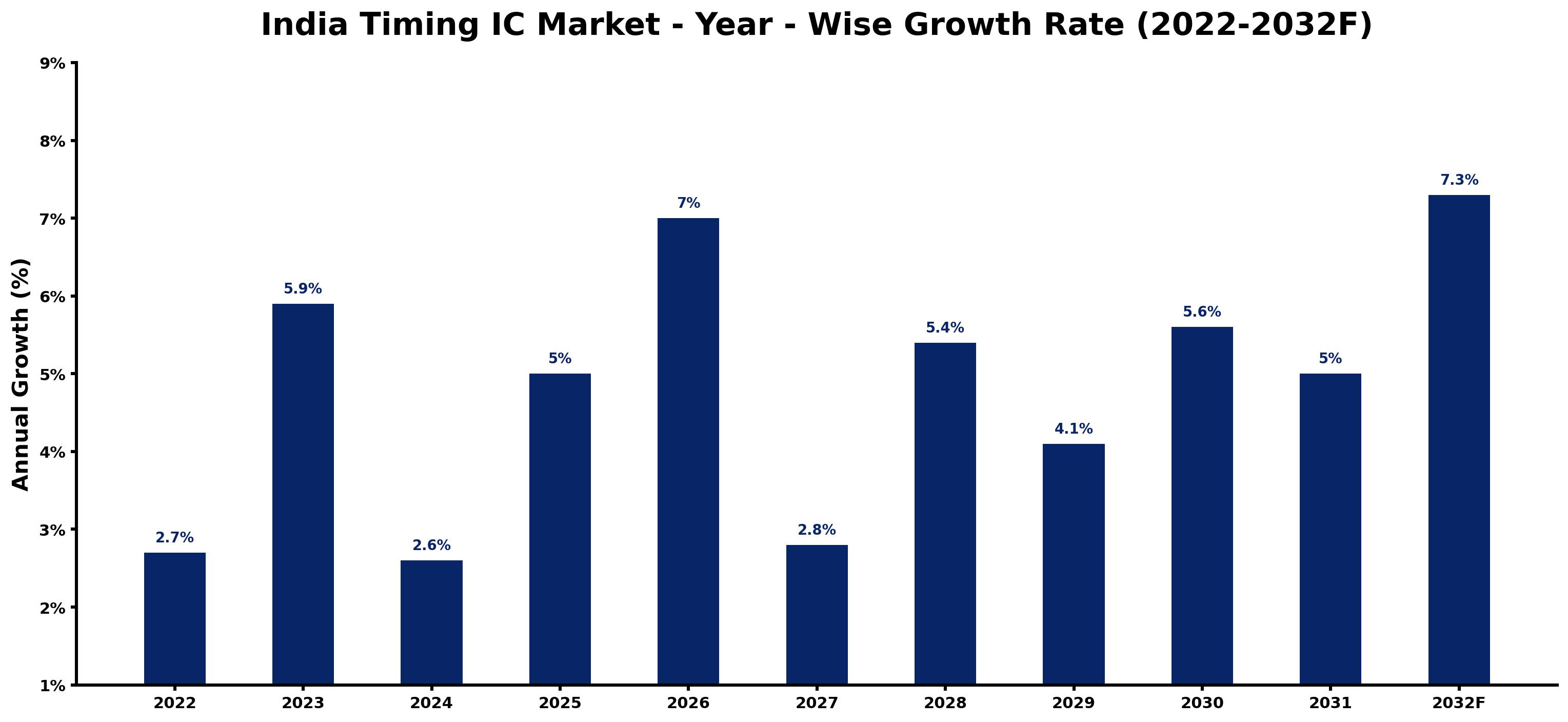
Each row of the following table gives one year's estimated growth and the event or demand shift that explains it.
| Year | Estimated Annual Growth (%) | Market Rationale |
| 2022 | 2.7 | The market experienced steady growth, supported by increasing demand for electronic devices. |
| 2023 | 5.9 | Growth accelerated due to a surge in telecom infrastructure investments and local manufacturing initiatives. |
| 2024 | 2.6 | A slight slowdown occurred as demand stabilised after the previous year's peak. |
| 2025 | 5.0 | Growth rebounded with renewed investments in the electronics manufacturing sector and infrastructure. |
| 2026 | 7.0 | Demand surged as the market is expected to benefit from the Production Linked Incentive Scheme. |
| 2027 | 2.8 | A slowdown in growth is expected as the market adjusts to previous expansions. |
| 2028 | 5.4 | Growth is projected to resume, driven by rising demand in the embedded systems sector. |
| 2029 | 4.1 | The market is expected to experience a slowdown as growth rates normalise after rapid expansions. |
| 2030 | 5.6 | Growth will pick up again, supported by ongoing investments in telecom infrastructure. |
| 2031 | 5.0 | The market will see a slight slowdown as growth rates stabilise after previous peaks. |
| 2032 | 7.3 | The market is expected to experience a strong surge due to increasing investments in semiconductor manufacturing. |
Note: Market size estimations and growth projections presented in this report are based on 6Wresearch's proprietary forecasting methodology, utilizing the latest available industry data, government publications, and primary research inputs.
India Timing IC Market Synopsis
Timing ICs in India are integrated circuits that generate precise timing signals for electronic devices. They are produced using semiconductor technology and find applications in telecommunications, embedded systems, and industrial controls. The India Timing IC Market is expanding due to rising demand from domestic users and investments in local manufacturing. Government initiatives like the National Policy on Electronics 2019 are driving growth in this sector, with the telecom industry planning to invest $10 billion in infrastructure by 2025.
Market Dynamics Impact Analysis (2026–2032)
| Factor | Type | Impact | Primary Segment Affected |
| Growing domestic manufacturing capabilities | Driver | High | Crystal Oscillators |
| Increasing demand for telecommunications infrastructure | Driver | High | Telecom Hardware |
| Expansion of electronics manufacturing clusters | Opportunity | High | Embedded Systems |
| Rising investments in semiconductor technology | Opportunity | High | Frequency Synthesizers |
| High competition from foreign manufacturers | Restraint | Medium | Timer & Watchdog ICs |
| Limited skilled workforce in semiconductor technologies | Restraint | Medium | Real-Time Clock ICs |
| Challenges in meeting international standards | Challenge | High | XO/TCXO/VCXO |
| Dependence on imported raw materials | Challenge | Medium | PLL/DDS ICs |
Evaluation of Drivers in India Timing IC Market (2026–2032)
Below mentioned are some major drivers and their influence on market dynamics.
| Drivers | Primary Segment Affected | Why It Matters (Evidence) |
| Increased government investment in electronics manufacturing | Crystal Oscillators | The government allocated ₹76,000 crores for the semiconductor sector, boosting local production and demand. |
| Surge in telecom infrastructure investments | Telecom Hardware | The Indian telecom sector plans to invest $10 billion in infrastructure by 2025, driving demand for timing ICs. |
| Establishment of electronics manufacturing clusters | Embedded Systems | Clusters in Karnataka and Tamil Nadu are improving local production capabilities, increasing demand for timing ICs. |
| Adoption of the Production Linked Incentive Scheme | Frequency Synthesizers | This scheme incentivises local manufacturing, leading to increased demand for various timing ICs. |
| Growth in consumer electronics | Timer & Watchdog ICs | The expanding electronics market, projected to reach $300 billion by 2025, fuels demand for timing ICs. |
The telecom sector's planned investment of $10 billion in infrastructure by 2025 is creating demand for timing ICs. Manufacturing clusters in Karnataka and Tamil Nadu improve local production, while the Production Linked Incentive Scheme encourages domestic manufacturing. The consumer electronics market, expected to reach $300 billion by 2025, further fuels demand for these integrated circuits.
Evaluation of Restraints in India Timing IC Market
The following restraints limit how fast demand can grow.
| Market Restraint | Primary Segment Affected | Why It Matters (Evidence) |
| Intense competition from international manufacturers | Timer & Watchdog ICs | Local manufacturers face pressure from established foreign brands, limiting market share. |
| Shortage of skilled workforce in semiconductor technologies | Real-Time Clock ICs | The Electronics Sector Skills Council aims to skill 1 million people by 2025, but shortages persist. |
| Challenges in meeting international quality standards | XO/TCXO/VCXO | Compliance with Bureau of Indian Standards can delay product approvals and market entry. |
| Dependence on imported raw materials | PLL/DDS ICs | Supply chain disruptions can lead to delays and increased costs for local manufacturers. |
| Limited access to advanced manufacturing technologies | Frequency Synthesizers | Many local firms lack the capital to invest in modern production equipment. |
India Timing IC Market Challenges
The India Timing IC market still has to solve a few problems, and one key issue is intense competition from imported components, which can lead to price undercutting and reduced margins for local producers. Buyers often face challenges in sourcing reliable local suppliers, causing project delays that can extend timelines by up to three months. Supply chain disruptions frequently occur, as fluctuations in semiconductor availability can lead to missed delivery deadlines, impacting manufacturers' ability to fulfil orders on time. Skills shortages in semiconductor technology are a growing concern, with the Electronics Sector Skills Council aiming to train 1 million people by 2025, potentially leaving local firms short of qualified workers.
Trends in the India Timing IC Market
Four trends stand out in the India Timing IC Market.
- Shift from Traditional to Smart Electronics: Since 2022, the demand for smart electronics has surged. The National Policy on Electronics 2019 supports this transition, with the electronics manufacturing sector targeting $400 billion by 2025.
- Transition from Manual to Automated Production: In 2023, numerous manufacturers began embracing automation technologies. The Electronics Manufacturing Clusters Scheme offers financial support for establishing automated facilities.
- Emergence of New Semiconductor Startups: In 2021, the Semiconductor Manufacturing and Design Incubation Program was launched, providing ₹1,500 crores to support startups. This initiative is encouraging innovation and increasing competition in the market.
- Growing Preference for Online Component Sales: Since 2022, there has been a marked increase in online component purchases. Online Component Stores are growing at a rate of 6.8%, reflecting changing buying habits among consumers.
Investment Opportunities in the India Timing IC Market
Below are the investment opportunities with the strongest case in the India Timing IC Market.
- Electronics Manufacturing Clusters in Karnataka: Investing in manufacturing facilities in Karnataka offers a key opportunity for growth, with the electronics manufacturing sector expected to reach $300 billion by 2025.
- Partnerships with Local Startups: The Semiconductor Manufacturing and Design Incubation Program presents a chance to collaborate with emerging startups, improving product offerings and market reach.
- Growing Demand from Telecom Hardware Sector: The telecom sector's planned $10 billion investment by 2025 creates an opportunity for suppliers to address the rising demand for timing ICs.
- Investment in Skill Development Programs: The Electronics Sector Skills Council aims to train 1 million people by 2025, providing an opportunity for companies to invest in training initiatives.
Government Initiatives in the India Timing IC Market
The National Policy on Electronics 2019 aims to achieve $400 billion in electronics manufacturing by 2025, reinforcing the framework for local production. This policy builds on previous initiatives, ensuring a thorough approach to boosting the sector. It encourages investments in semiconductor manufacturing and strengthens the domestic supply chain for timing ICs.
The Electronics Sector Skills Council oversees various initiatives, including the Production Linked Incentive Scheme. This scheme offers financial incentives to manufacturers, promoting local production and ensuring that buyers have access to competitively priced timing ICs. The initiative aims to improve local manufacturing capabilities, benefiting both producers and buyers.
Future Insight of the India Timing IC Market
Several factors should support the India Timing IC market in the coming years. The National Policy on Electronics 2019 is set to improve domestic manufacturing capabilities, enabling local producers to meet the growing demand for electronic devices. By 2025, the Indian telecom sector is projected to invest $10 billion in infrastructure, creating a substantial need for timing ICs. The establishment of electronics manufacturing clusters in states like Karnataka and Tamil Nadu will streamline production processes. Additionally, the Bureau of Indian Standards is implementing quality benchmarks for electronic components, which will enhance buyer confidence.
Market Segmentation Analysis
Each segment group is reviewed below, with the leader by share and the fastest grower by CAGR.
By Timing IC – Crystal Oscillators Dominated, Frequency Synthesizers Expected to Grow Fastest
According to Vasudha, AM at 6Wresearch, with a 42% revenue share in 2025, Crystal Oscillators was the largest timing ic category. Crystal oscillators hold the largest share in the India Timing IC market as they are crucial for generating stable clock signals across a range of electronic devices. Their extensive use in the telecom sector, which has an installed base of over 1 billion units, underscores their vital role. Over 2026–2032, Frequency Synthesizers are expected to post the fastest growth, at a CAGR of 6.8%. Frequency synthesizers are set to experience rapid growth due to their importance in producing various frequencies for communication systems. The projected $10 billion investment in telecom infrastructure by 2025 will significantly drive this segment's expansion. Suppliers should focus on frequency synthesizers to capitalise on the anticipated growth in telecom investments.
By IC Type – XO/TCXO/VCXO Dominated, PLL/DDS ICs Expected to Grow Fastest
XO/TCXO/VCXO took a 45% share of ic type in 2025, more than any other category. XO/TCXO/VCXO types dominate the market because they are essential for precision timing applications in a wide array of electronic devices. Their reliability and performance make them the preferred choice among manufacturers in the growing electronics sector. PLL/DDS ICs are set to record the highest CAGR in this split, 7.5% over 2026–2032. PLL/DDS ICs are projected to grow the fastest as they are critical for frequency generation and modulation, which are key in modern communication technologies. The increasing complexity of electronic systems is driving a rising demand for these integrated circuits. Buyers should prioritise investment in PLL/DDS ICs to stay competitive in the fast-paced electronics market.
By Clock Architecture – Single-/Multi-Output Dominated and Is Expected to Record the Fastest Growth
The largest clock architecture category in 2025 was Single-/Multi-Output, with a 34% share of total revenue. Single-/multi-output clock architectures lead the market as they offer flexibility in clock signal distribution, essential for complex electronic systems. Their adaptability makes them suitable for various applications, reinforcing their dominant position. Single-/Multi-Output is also forecast to expand faster than any other category, at a CAGR of 6.5% over 2026–2032. The single-/multi-output architecture is also the fastest-growing segment, as its versatility meets the increasing demands for customisation in electronic designs. This dual role ensures that its market share will continue to expand. Suppliers must prioritise innovations in single-/multi-output architectures to meet the evolving needs of electronic manufacturers.
By Distribution Channel – Direct Sales Dominated, Online Component Stores Expected to Grow Fastest
In 2025, Direct Sales led the distribution channel split with a 45% share. Direct sales capture the largest share of the distribution channel for timing ICs, as they are preferred for major contracts and bulk purchases by large manufacturers. This method ensures better communication and tailored solutions for clients. The quickest growth will come from Online Component Stores, forecast to expand at a CAGR of 6.8% between 2026 and 2032. Online component stores are growing rapidly, catering to the needs of smaller orders and individual buyers who seek convenience and accessibility. As more consumers turn to online shopping, this segment's growth is expected to accelerate. Suppliers should strengthen their online presence to tap into the expanding market of smaller-scale buyers.
By End User Industry – Telecom Hardware Dominated, Embedded Systems Expected to Grow Fastest
Telecom Hardware accounted for a 46% market share by end user industry in 2025. Telecom hardware is the predominant end-user industry for timing ICs, propelled by the extensive deployment of communication infrastructure throughout India. The sector's substantial investment in technology solidifies its leading market share. Over 2026–2032, Embedded Systems are expected to post the fastest growth, at a CAGR of 7.3%. Embedded systems are the fastest-growing end-user segment, as they are extensively used in consumer electronics, which are experiencing a notable surge in demand. The growing integration of smart technologies in everyday devices fuels this segment's growth. Manufacturers should align their product development with trends in embedded systems to seize emerging market opportunities.
Key Attractiveness of the Report
- 10 Years of Market Numbers
- Historical Data Starting from 2022 to 2025
- Base Year 2025
- Forecast Data until 2032
- Key Performance Indicators Impacting the Market
- Major Upcoming Developments and Projects
Key Highlights of the Report:
- India Timing IC Market Outlook
- Market Size of India Timing IC Market, 2025
- Forecast of India Timing IC Market, 2032
- Historical Data and Forecast of India Timing IC Revenues & Volume for the Period 2022 - 2032F
- India Timing IC Market Trend Evolution
- India Timing IC Market Drivers and Challenges
- India Timing IC Price Trends
- India Timing IC Porter's Five Forces
- India Timing IC Industry Life Cycle
- Historical Data and Forecast of India Timing IC Market Revenues & Volume By Timing IC for the Period 2022 - 2032F
- Historical Data and Forecast of India Timing IC Market Revenues & Volume By Crystal Oscillators for the Period 2022 - 2032F
- Historical Data and Forecast of India Timing IC Market Revenues & Volume By Frequency Synthesizers for the Period 2022 - 2032F
- Historical Data and Forecast of India Timing IC Market Revenues & Volume By Real-Time Clock ICs for the Period 2022 - 2032F
- Historical Data and Forecast of India Timing IC Market Revenues & Volume By Timer & Watchdog ICs for the Period 2022 - 2032F
- Historical Data and Forecast of India Timing IC Market Revenues & Volume By IC Type for the Period 2022 - 2032F
- Historical Data and Forecast of India Timing IC Market Revenues & Volume By XO/TCXO/VCXO for the Period 2022 - 2032F
- Historical Data and Forecast of India Timing IC Market Revenues & Volume By PLL/DDS ICs for the Period 2022 - 2032F
- Historical Data and Forecast of India Timing IC Market Revenues & Volume By RTC Modules for the Period 2022 - 2032F
- Historical Data and Forecast of India Timing IC Market Revenues & Volume By Timer/Watchdog for the Period 2022 - 2032F
- Historical Data and Forecast of India Timing IC Market Revenues & Volume By Clock Architecture for the Period 2022 - 2032F
- Historical Data and Forecast of India Timing IC Market Revenues & Volume By Single-/Multi-Output for the Period 2022 - 2032F
- Historical Data and Forecast of India Timing IC Market Revenues & Volume By Output Modulation for the Period 2022 - 2032F
- Historical Data and Forecast of India Timing IC Market Revenues & Volume By I C/SPI Interface for the Period 2022 - 2032F
- Historical Data and Forecast of India Timing IC Market Revenues & Volume By Safety, Delay Timers for the Period 2022 - 2032F
- Historical Data and Forecast of India Timing IC Market Revenues & Volume By Distribution Channel for the Period 2022 - 2032F
- Historical Data and Forecast of India Timing IC Market Revenues & Volume By Semiconductor Distributors for the Period 2022 - 2032F
- Historical Data and Forecast of India Timing IC Market Revenues & Volume By Direct Sales for the Period 2022 - 2032F
- Historical Data and Forecast of India Timing IC Market Revenues & Volume By Online Component Stores for the Period 2022 - 2032F
- Historical Data and Forecast of India Timing IC Market Revenues & Volume By Electronic Wholesalers for the Period 2022 - 2032F
- Historical Data and Forecast of India Timing IC Market Revenues & Volume By End User Industry for the Period 2022 - 2032F
- Historical Data and Forecast of India Timing IC Market Revenues & Volume By Telecom Hardware for the Period 2022 - 2032F
- Historical Data and Forecast of India Timing IC Market Revenues & Volume By Radio & Communication Systems for the Period 2022 - 2032F
- Historical Data and Forecast of India Timing IC Market Revenues & Volume By Embedded Systems for the Period 2022 - 2032F
- Historical Data and Forecast of India Timing IC Market Revenues & Volume By Industrial Controls for the Period 2022 - 2032F
- India Timing IC Import Export Trade Statistics
- Market Opportunity Assessment By Timing IC
- Market Opportunity Assessment By IC Type
- Market Opportunity Assessment By Clock Architecture
- Market Opportunity Assessment By Distribution Channel
- Market Opportunity Assessment By End User Industry
- India Timing IC Top Companies Market Share
- India Timing IC Competitive Benchmarking By Technical and Operational Parameters
- India Timing IC Company Profiles
- India Timing IC Key Strategic Recommendations
Market Covered
The report offers an extensive study of the following market segments.
By Timing IC
- Crystal Oscillators
- Frequency Synthesizers
- Real-Time Clock ICs
- Timer & Watchdog ICs
By IC Type
- XO/TCXO/VCXO
- PLL/DDS ICs
- RTC Modules
- Timer/Watchdog
By Clock Architecture
- Single-/Multi-Output
- Output Modulation
- I²C/SPI Interface
- Safety
- Delay Timers
By Distribution Channel
- Semiconductor Distributors
- Direct Sales
- Online Component Stores
- Electronic Wholesalers
By End User Industry
- Telecom Hardware
- Radio & Communication Systems
- Embedded Systems
- Industrial Controls































