China Titanium Printing Market Size & Growth Rate
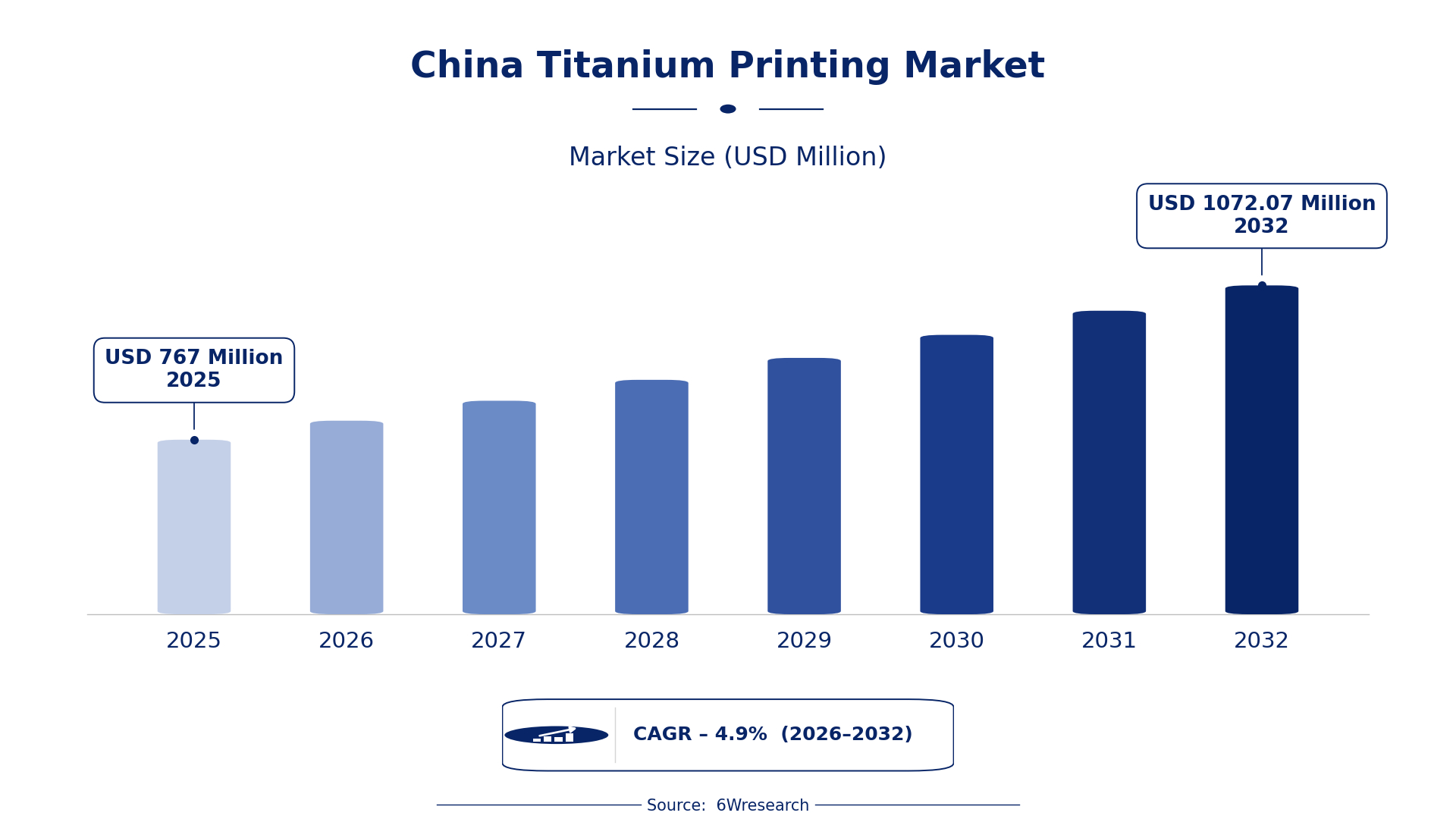
According to 6Wresearch internal database and industry insights, the China Titanium Printing Market was valued at USD 767.0 million in 2025 and is projected to reach USD 1,072.07 million by 2032, growing at a CAGR of approximately 4.9% during 2026–2032.
China Titanium Printing Market Highlights
| Report Metric | Details |
| Report Name | China Titanium Printing Market |
| Market Size 2025 | USD 767.0 million |
| Market Size 2032 | USD 1,072.07 million |
| Absolute Growth 2025–2032 | USD 305.07 million |
| CAGR 2026–2032 | 4.9% |
| Peak Annual Growth | 7.4% in 2029 |
| Forecast Period | 2026–2032 |
| Historical Data | 2022–2025 |
| Base Year | 2025 |
| Leading Printing Type, 2025 | 3D Printing (47% share) |
| Leading Technique Used, 2025 | Laser Powder Bed Fusion (44% share) |
| Leading Application Sector, 2025 | Aerospace Components (42% share) |
| Leading End User, 2025 | Custom Prosthetics Labs (43% share) |
| Fastest-Growing Printing Type | Additive Manufacturing (7.3% CAGR) |
| Fastest-Growing Technique Used | DMLS/EBM (6.2% CAGR) |
| Fastest-Growing Application Sector | Dental/Medical Devices (6.5% CAGR) |
| Growing Sector | Dental/Medical Devices |
| Key End Users | Aerospace Components, Dental/Medical Devices, Industrial Tools, Flexible Electronics |
China Titanium Printing Market Year-wise Growth Rate and Key Drivers (2022–2032)
This graph illustrates the annual growth rates of the market from 2022 to 2032, highlighting a steady upward trajectory and projected market expansion over the forecast period.
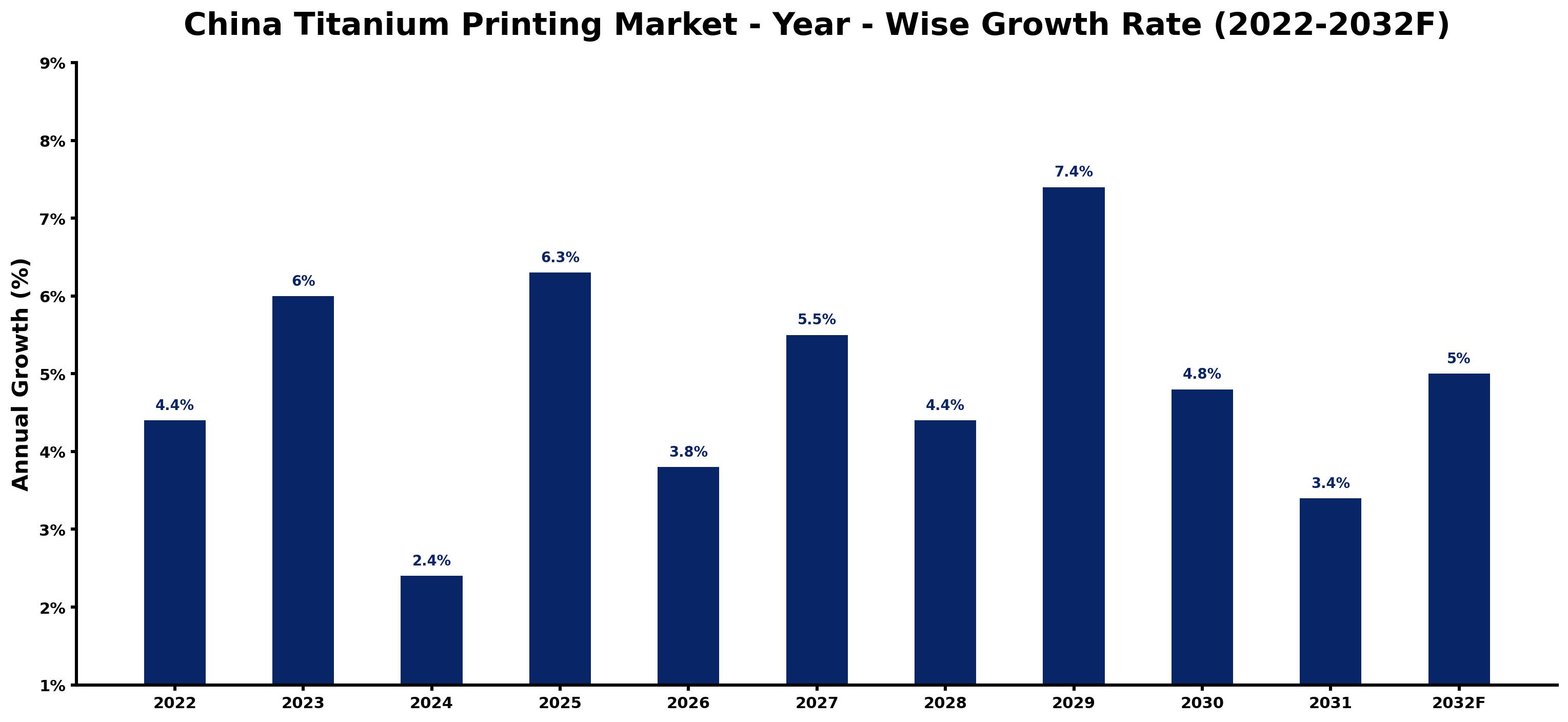
Each row of the following table gives one year's estimated growth and the event or demand shift that explains it.
| Year | Estimated Annual Growth (%) | Market Rationale |
| 2022 | 4.4 | The market experienced moderate growth due to increased awareness of titanium printing applications. |
| 2023 | 6.0 | Demand surged as the aerospace sector expanded, leading to higher adoption of advanced manufacturing technologies. |
| 2024 | 2.4 | Growth slowed as the market adjusted to previous rapid expansions and faced supply chain challenges. |
| 2025 | 6.3 | The aerospace sector's robust performance drove a resurgence in titanium printing demand. |
| 2026 | 3.8 | A slight slowdown occurred as the market began to stabilise after previous peaks in growth. |
| 2027 | 5.5 | Growth picked up again, supported by rising investments in medical devices and aerospace components. |
| 2028 | 4.4 | The market faced a slowdown as demand stabilised after several years of rapid growth. |
| 2029 | 7.4 | A significant growth surge was driven by increased investments in aerospace and medical applications. |
| 2030 | 4.8 | Growth moderated as the market adjusted to the rapid expansion of the previous year. |
| 2031 | 3.4 | A further slowdown occurred as the market stabilised, reflecting a more mature phase of growth. |
| 2032 | 5.0 | Demand is expected to rise again, driven by ongoing innovations in titanium printing technologies. |
Note: Market size estimations and growth projections presented in this report are based on 6Wresearch's proprietary forecasting methodology, utilizing the latest available industry data, government publications, and primary research inputs.
China Titanium Printing Market Synopsis
Titanium Printing in China utilises titanium powder to fabricate intricate geometries in 3D models, primarily through additive manufacturing techniques. This technology plays a crucial part in producing aerospace components and medical devices. The China Titanium Printing Market is expanding due to substantial investments in advanced manufacturing technologies and a booming aerospace sector, which is projected to reach $1 trillion by 2035. Furthermore, the medical device market was valued at approximately $70 billion in 2022, further driving demand. The ongoing establishment of additive manufacturing innovation centres since 2020 supports this trend.
Market Dynamics Impact Analysis (2026–2032)
| Factor | Type | Impact | Primary Segment Affected |
| Growing investments in advanced manufacturing technologies | Driver | High | Additive Manufacturing |
| Increasing demand for lightweight and high-strength aerospace components | Driver | High | Aerospace Components |
| Rising demand for custom medical solutions | Opportunity | High | Custom Prosthetics Labs |
| Expansion of dental labs adopting titanium printing technologies | Opportunity | High | Dental/Medical Devices |
| Quality management challenges in meeting new standards | Restraint | Medium | 3D Printing |
| Limited awareness of titanium printing benefits among smaller manufacturers | Restraint | Medium | 3D Printing |
| High initial investment costs for advanced printing technologies | Challenge | High | Additive Manufacturing |
| Competition from alternative manufacturing materials and methods | Challenge | Medium | Aerospace Components |
Evaluation of Drivers in China Titanium Printing Market (2026–2032)
The factors lifting demand, and the evidence behind each, are summarised below.
| Drivers | Primary Segment Affected | Why It Matters (Evidence) |
| Increased government funding for advanced manufacturing initiatives | Additive Manufacturing | The total investment in additive manufacturing technologies in China reached $2 billion by 2022, encouraging manufacturers to adopt titanium printing. |
| Growing aerospace sector demand for lightweight components | Aerospace Components | The aerospace sector in China is projected to reach $1 trillion by 2035, driving higher purchases of titanium printed parts. |
| Expansion of the medical device market | Dental/Medical Devices | In 2022, the medical device market in China was valued at approximately $70 billion, leading to increased demand for custom implants. |
| Rising adoption of titanium printing in dental labs | Custom Prosthetics Labs | By 2023, over 50% of dental labs in China adopted titanium printing technologies, boosting demand for personalized solutions. |
| Establishment of additive manufacturing innovation centers | 3D Printing | Since 2020, several innovation centers have been established, improving the capabilities and awareness of titanium printing. |
The aerospace sector, projected to reach $1 trillion by 2035, drives demand for lightweight components, prompting manufacturers to purchase more titanium printed parts. The medical device market, valued at approximately $70 billion in 2022, further fuels demand for custom implants. Over 50% of dental labs adopted titanium printing technologies by 2023, reflecting a shift towards personalized solutions. The establishment of several additive manufacturing innovation centers since 2020 improves capabilities and awareness of titanium printing applications.
Evaluation of Restraints in China Titanium Printing Market
The key brakes on demand, and where they bite hardest, are shown below.
| Market Restraint | Primary Segment Affected | Why It Matters (Evidence) |
| Regulatory compliance challenges | 3D Printing | The National Standard GB/T 19001-2016 applies to titanium printing quality management, creating hurdles for suppliers who must invest time and resources to meet these standards. |
| Skills shortages in the workforce | 3D Printing | The rapid growth of the market demands skilled technicians, yet training programs have not kept pace, leading to increased hiring costs for producers by 30%. |
| Technological limitations in existing printers | 3D Printing | Many existing printers are outdated, restricting capabilities and pushing buyers to seek alternatives, which can slow down project timelines. |
| Fluctuating material costs | 3D Printing | The price of titanium powder can vary significantly, impacting budgets for medical device manufacturers and aerospace companies alike. |
| Supply chain disruptions | 3D Printing | Recent global supply chain challenges have affected the availability of raw materials and components necessary for titanium printing. |
China Titanium Printing Market Challenges
The China Titanium Printing market faces a few practical problems, and the first is regulatory compliance. The National Standard GB/T 19001-2016 mandates rigorous quality management for titanium printing, which delays suppliers as they invest time and resources to comply. A lack of skilled technicians also poses a challenge; the rapid expansion of the market requires expertise, but training programs lag behind, increasing hiring costs for producers by 30%. Technological limitations hinder innovation; many existing printers are outdated, forcing buyers to look for alternatives and potentially extending project timelines. Furthermore, fluctuating titanium powder prices complicate budgeting for medical device manufacturers and aerospace companies, affecting their financial planning.
Trends in the China Titanium Printing Market
Several trends are reshaping the China Titanium Printing Market; the most important are set out below.
- Shift Towards Aerospace Applications: Since 2020, there has been a notable shift in demand towards aerospace applications, with the aerospace sector projected to reach $1 trillion by 2035. This trend is driving manufacturers to invest more in titanium printing technologies.
- Growing Adoption in Medical Devices: The adoption of titanium printing in medical devices has surged, with over 50% of dental labs in China utilizing these technologies by 2023. This shift supports the demand for custom implants and prosthetics.
- Emergence of Innovation Centers: The establishment of additive manufacturing innovation centers since 2020 has improved capabilities in titanium printing. These centers are vital for fostering research and development in advanced manufacturing technologies.
- Increased Focus on Custom Solutions: The trend towards personalized medical solutions is evident, with custom prosthetics labs leading the way. This segment is expected to grow as more labs adopt titanium printing technologies.
Investment Opportunities in the China Titanium Printing Market
Some of the investment opportunities in the China Titanium Printing Market are mentioned below.
- Investment in Additive Manufacturing: Now is an opportune moment to invest in additive manufacturing technologies, as total investment reached $2 billion by 2022. Companies can collaborate with innovation centres to enhance their capabilities.
- Supply of Titanium Powder: The demand for titanium powder is rising, particularly in aerospace and medical sectors. Suppliers can enter the market by forming partnerships with manufacturers in regions like Shanghai.
- Development of Custom Prosthetics: The increasing need for personalised medical solutions presents an opportunity for companies to create custom prosthetics. Collaborating with custom prosthetics labs can facilitate market entry.
- Expansion into Aerospace Components: With the aerospace sector projected to reach $1 trillion by 2035, there is a substantial opportunity for suppliers of titanium printed components. Engaging with aerospace manufacturers can lead to fruitful partnerships.
Government Initiatives in the China Titanium Printing Market
The '14th Five-Year Plan for Advanced Manufacturing' launched by the Ministry of Industry and Information Technology in 2021 aims to boost the adoption of titanium printing technologies by 30% by 2025. This plan highlights the importance of advanced materials in manufacturing processes, providing a framework for producers to improve their capabilities and product quality.
In 2022, the Ministry of Science and Technology initiated the 'National Key Research and Development Program' with a budget of $300 million to fund projects in additive manufacturing. This programme supports research and development efforts, enabling producers to innovate and enhance their offerings in titanium printing.
Future Insight of the China Titanium Printing Market
The China Titanium Printing market is set for growth by 2032, supported by several key factors. The aerospace sector is expected to expand, driving demand for advanced manufacturing technologies. Government initiatives, such as 'Made in China 2025', will strengthen high-tech production capabilities, while new standards from the Standardization Administration of China will improve quality assurance. By 2025, investments in titanium printing technologies are projected to reach $2 billion, reflecting a strong commitment to innovation across various industries.
Market Segmentation Analysis
The report offers a comprehensive study of the following market segments and their leading categories in the market.
By Printing Type – 3D Printing Dominated, Additive Manufacturing Expected to Grow Fastest
According to Vasudha, AM at 6Wresearch, 3D Printing took a 47% share of printing type in 2025, more than any other category. 3D printing holds the largest market share in China as it is widely used for creating prototypes and end-use parts in various industries. This technique is particularly crucial in the aerospace sector, where precision is vital, supported by substantial investments in advanced manufacturing technologies. Additive Manufacturing is set to record the highest CAGR in this split, 7.3% over 2026–2032. Additive manufacturing is experiencing rapid growth because it is essential for producing complex titanium structures, especially in high-demand sectors like aerospace and medical devices. The ongoing government initiatives and investments are further propelling this segment's expansion. Suppliers should focus on enhancing their offerings in 3D printing technologies to meet the increasing demand across diverse sectors.
By Technique Used – Laser Powder Bed Fusion Dominated, DMLS/EBM Expected to Grow Fastest
With a 44% revenue share in 2025, Laser Powder Bed Fusion was the largest technique used category. Laser powder bed fusion commands the largest share in the market as it is commonly used for high-precision aerospace parts that require stringent quality standards. This technique is vital for meeting the exacting requirements of the aerospace sector, particularly in key manufacturing regions like Shanghai. Over 2026–2032, DMLS/EBM is expected to post the fastest growth, at a CAGR of 6.2%. DMLS/EBM is witnessing the fastest growth due to its popularity in producing medical implants and aerospace components, fuelled by the rising demand for customised solutions. The increase in healthcare applications is a key factor contributing to this segment's rapid growth. For suppliers, focusing on DMLS/EBM technology could unlock new opportunities in the expanding medical device market.
By Application Sector – Aerospace Components Dominated, Dental/Medical Devices Expected to Grow Fastest
Aerospace Components held a 42% share of the China Titanium Printing Market by application sector in 2025. Aerospace components dominate the market share as they are critical for lightweight, high-strength parts essential in the rapidly growing aerospace industry. The projected growth of China's aerospace sector to $1 trillion by 2035 underscores the significance of this application. Dental/Medical Devices are projected to grow fastest, at a CAGR of 6.5% during 2026–2032. Dental and medical devices are the fastest-growing application sector, driven by substantial demand for custom implants and tools. The increasing adoption of titanium printing technologies in dental labs illustrates this segment's swift growth. Suppliers should prioritise innovations in dental and medical device applications to capitalise on this expanding market.
By End User – Custom Prosthetics Labs Dominated and Is Expected to Record the Fastest Growth
Custom Prosthetics Labs accounted for a 43% market share by end user in 2025. Custom prosthetics labs lead the market share due to the rising demand for personalised medical solutions, increasingly sought after in China's healthcare landscape. This segment benefits from advancements in 3D printing technologies that enable tailored solutions for patients. The same category are also set to grow fastest, at a CAGR of 6.0% during 2026–2032. Custom prosthetics labs are also the fastest-growing end user segment, as the need for personalised medical solutions continues to rise. The convergence of technology and healthcare is likely to widen this segment's lead even further. Suppliers should enhance their partnerships with custom prosthetics labs to leverage the increasing demand for personalised solutions.
Key Attractiveness of the Report
- 10 Years of Market Numbers
- Historical Data Starting from 2022 to 2025
- Base Year 2025
- Forecast Data until 2032
- Key Performance Indicators Impacting the Market
- Major Upcoming Developments and Projects
Key Highlights of the Report:
- China Titanium Printing Market Outlook
- Market Size of China Titanium Printing Market, 2025
- Forecast of China Titanium Printing Market, 2032
- Historical Data and Forecast of China Titanium Printing Revenues & Volume for the Period 2022 - 2032F
- China Titanium Printing Market Trend Evolution
- China Titanium Printing Market Drivers and Challenges
- China Titanium Printing Price Trends
- China Titanium Printing Porter's Five Forces
- China Titanium Printing Industry Life Cycle
- Historical Data and Forecast of China Titanium Printing Market Revenues & Volume By Printing Type for the Period 2022 - 2032F
- Historical Data and Forecast of China Titanium Printing Market Revenues & Volume By 3D Printing for the Period 2022 - 2032F
- Historical Data and Forecast of China Titanium Printing Market Revenues & Volume By Additive Manufacturing for the Period 2022 - 2032F
- Historical Data and Forecast of China Titanium Printing Market Revenues & Volume By Inkjet Printing for the Period 2022 - 2032F
- Historical Data and Forecast of China Titanium Printing Market Revenues & Volume By Binder Jetting for the Period 2022 - 2032F
- Historical Data and Forecast of China Titanium Printing Market Revenues & Volume By Technique Used for the Period 2022 - 2032F
- Historical Data and Forecast of China Titanium Printing Market Revenues & Volume By Laser Powder Bed Fusion for the Period 2022 - 2032F
- Historical Data and Forecast of China Titanium Printing Market Revenues & Volume By DMLS/EBM for the Period 2022 - 2032F
- Historical Data and Forecast of China Titanium Printing Market Revenues & Volume By Titanium Ink Formulation for the Period 2022 - 2032F
- Historical Data and Forecast of China Titanium Printing Market Revenues & Volume By Powder-Based for the Period 2022 - 2032F
- Historical Data and Forecast of China Titanium Printing Market Revenues & Volume By Application Sector for the Period 2022 - 2032F
- Historical Data and Forecast of China Titanium Printing Market Revenues & Volume By Dental/Medical Devices for the Period 2022 - 2032F
- Historical Data and Forecast of China Titanium Printing Market Revenues & Volume By Aerospace Components for the Period 2022 - 2032F
- Historical Data and Forecast of China Titanium Printing Market Revenues & Volume By Flexible Electronics for the Period 2022 - 2032F
- Historical Data and Forecast of China Titanium Printing Market Revenues & Volume By Industrial Tools for the Period 2022 - 2032F
- Historical Data and Forecast of China Titanium Printing Market Revenues & Volume By End User for the Period 2022 - 2032F
- Historical Data and Forecast of China Titanium Printing Market Revenues & Volume By Custom Prosthetics Labs for the Period 2022 - 2032F
- Historical Data and Forecast of China Titanium Printing Market Revenues & Volume By Space Startups for the Period 2022 - 2032F
- Historical Data and Forecast of China Titanium Printing Market Revenues & Volume By Printed Circuit Firms for the Period 2022 - 2032F
- Historical Data and Forecast of China Titanium Printing Market Revenues & Volume By Prototyping Units for the Period 2022 - 2032F
- China Titanium Printing Import Export Trade Statistics
- Market Opportunity Assessment By Printing Type
- Market Opportunity Assessment By Technique Used
- Market Opportunity Assessment By Application Sector
- Market Opportunity Assessment By End User
- China Titanium Printing Top Companies Market Share
- China Titanium Printing Competitive Benchmarking By Technical and Operational Parameters
- China Titanium Printing Company Profiles
- China Titanium Printing Key Strategic Recommendations
Market Covered
Segments analysed in this report are listed below.
By Printing Type
- 3D Printing
- Additive Manufacturing
- Inkjet Printing
- Binder Jetting
By Technique Used
- Laser Powder Bed Fusion
- DMLS/EBM
- Titanium Ink Formulation
- Powder-Based
By Application Sector
- Dental/Medical Devices
- Aerospace Components
- Flexible Electronics
- Industrial Tools
By End User
- Custom Prosthetics Labs
- Space Startups
- Printed Circuit Firms
- Prototyping Units































