China Topical Cosmetic Creams & Dermatology Market Size & Growth Rate
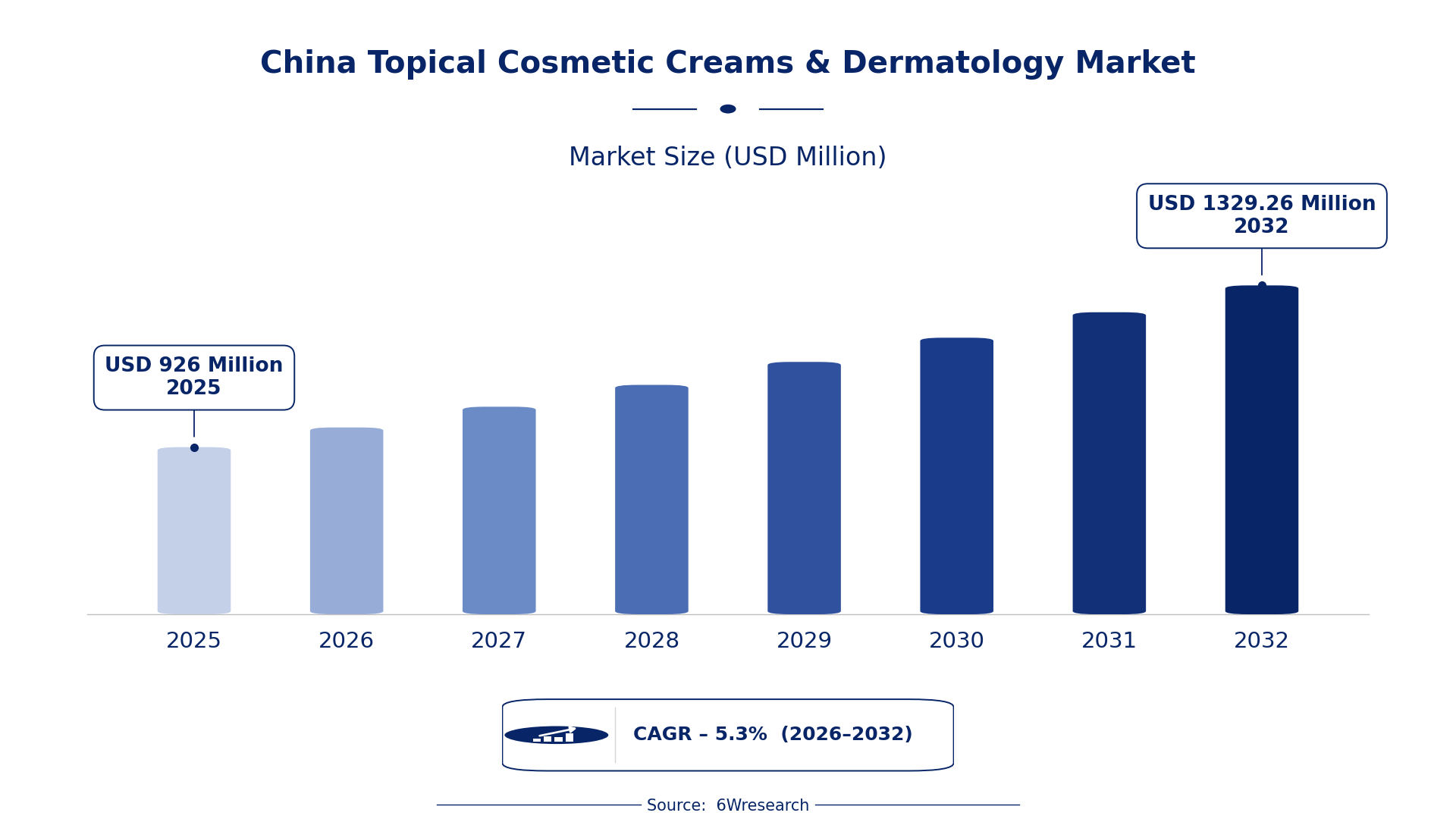
According to 6Wresearch internal database and industry insights, the China Topical Cosmetic Creams & Dermatology Market was valued at USD 926.0 million in 2025 and is projected to reach USD 1,329.26 million by 2032, growing at a CAGR of approximately 5.3% during 2026–2032.
China Topical Cosmetic Creams & Dermatology Market Highlights
| Report Metric | Details |
| Report Name | China Topical Cosmetic Creams & Dermatology Market |
| Market Size 2025 | USD 926.0 million |
| Market Size 2032 | USD 1,329.26 million |
| Absolute Growth 2025–2032 | USD 403.26 million |
| CAGR 2026–2032 | 5.3% |
| Peak Annual Growth | 7.7% in 2028 |
| Forecast Period | 2026–2032 |
| Historical Data | 2022–2025 |
| Base Year | 2025 |
| Leading Topical Dermatology/Cosmetic, 2025 | Anti-Aging Creams (43% share) |
| Leading Product Type, 2025 | SPF Lotions (35% share) |
| Leading Active Ingredient, 2025 | Retinol (41% share) |
| Leading Distribution Channel, 2025 | Beauty Stores (38% share) |
| Leading End User Industry, 2025 | Women 25+ (46% share) |
| Fastest-Growing Topical Dermatology/Cosmetic | Scar/Stretch Mark Creams (7.9% CAGR) |
| Fastest-Growing Product Type | Retinoids (7.6% CAGR) |
| Fastest-Growing Active Ingredient | Peptides (7.2% CAGR) |
| Fastest-Growing Distribution Channel | Medical Clinics (6.5% CAGR) |
| Fastest-Growing End User Industry | Eczema (7.0% CAGR) |
| Growing Sector | Topical Dermatology |
| Key End Users | Women 25+, Dermatologists, Beauty Stores, Pharmacies |
China Topical Cosmetic Creams & Dermatology Market Year-wise Growth Rate and Key Drivers (2022–2032)
This graph illustrates the annual growth rates of the market from 2022 to 2032, highlighting a steady upward trajectory and projected market expansion over the forecast period.
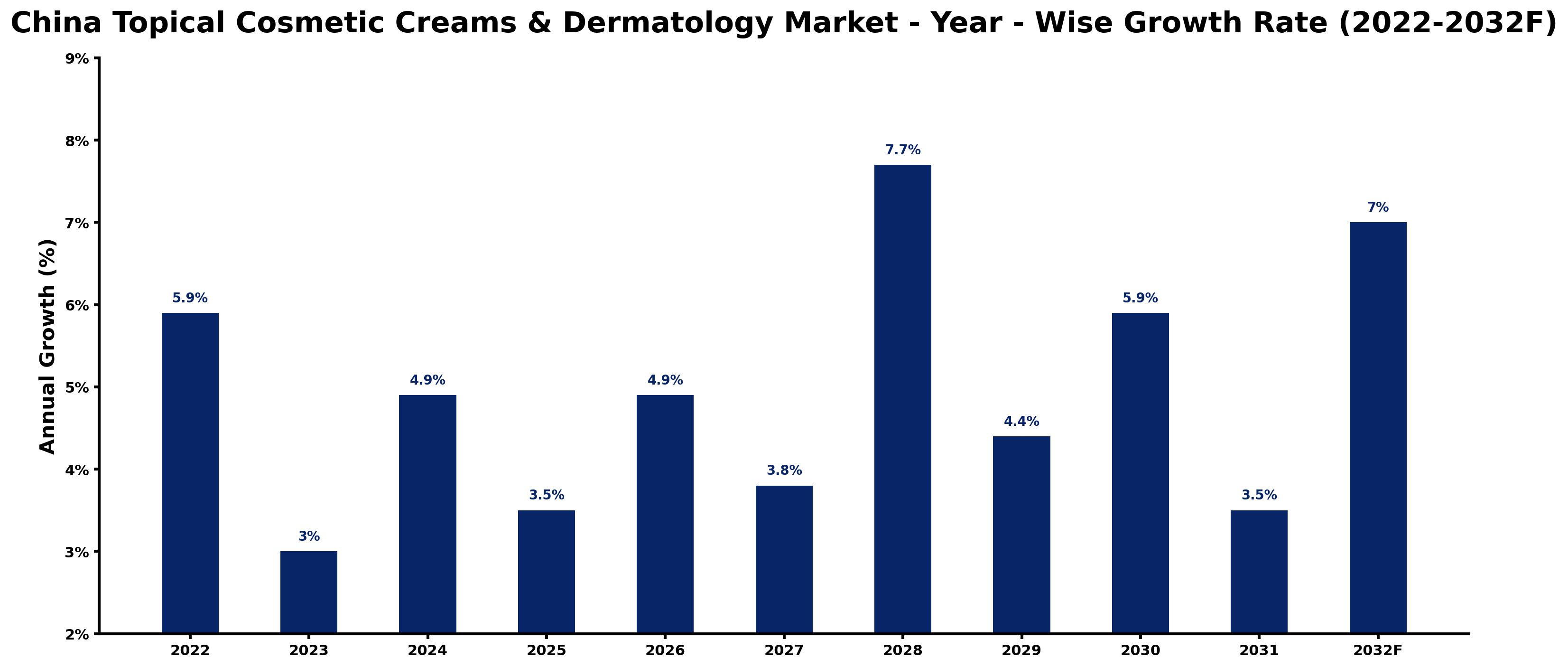
Below, each year's estimated growth is shown next to the factor that most influenced it.
| Year | Estimated Annual Growth (%) | Market Rationale |
| 2022 | 5.9 | The market showed strong demand, particularly for anti-aging products in urban areas. |
| 2023 | 3.0 | Growth slowed due to the launch of the "Healthy China 2030" initiative, which shifted consumer preferences. |
| 2024 | 4.9 | A resurgence in demand for sunscreens and skin treatments boosted growth rates, driven by increased awareness. |
| 2025 | 3.5 | The market continued to grow as awareness of skin health increased among consumers, particularly in urban settings. |
| 2026 | 4.9 | Demand for topical creams rose as urban women focused on skincare routines, influenced by rising incomes. |
| 2027 | 3.8 | Growth slowed as market saturation began to affect new product introductions, particularly in urban areas. |
| 2028 | 7.7 | The market peaked with heightened demand for anti-aging solutions, spurred by the aging population. |
| 2029 | 4.4 | Growth slowed as consumer spending stabilised amid economic uncertainties, impacting discretionary purchases. |
| 2030 | 5.9 | Demand for dermatological products rose again as skin health awareness campaigns expanded, particularly in cities. |
| 2031 | 3.5 | Growth slowed as the market adjusted to evolving consumer preferences, particularly towards natural ingredients. |
| 2032 | 7.0 | The market is expected to grow rapidly as new skincare technologies emerge, enhancing product offerings. |
Note: Market size estimations and growth projections presented in this report are based on 6Wresearch's proprietary forecasting methodology, utilizing the latest available industry data, government publications, and primary research inputs.
China Topical Cosmetic Creams & Dermatology Market Synopsis
Topical Cosmetic Creams & Dermatology in China includes formulations designed for skin treatment and care, such as anti-aging and sun protection products. These creams utilise active ingredients and emollients, primarily targeting women aged 25 and older. The China Topical Cosmetic Creams & Dermatology Market is expanding due to a strong emphasis on skincare, supported by a population of around 300 million women. Initiatives like the "Healthy China 2030" programme promote skincare education, further driving demand. The market showcases a robust consumer commitment to skin health.
Market Dynamics Impact Analysis (2026–2032)
| Factor | Type | Impact | Primary Segment Affected |
| Growing awareness of skin health and beauty standards drives demand for anti-aging creams. | Driver | High | Anti-Aging Creams |
| The increasing number of dermatologists enhances access to prescription dermatology products. | Driver | High | Prescription Dermatology |
| The demand for sunscreens is rising due to increased skin cancer awareness. | Opportunity | High | Sunscreens |
| The expanding urban population creates a larger market for skincare products. | Opportunity | High | Anti-Aging Creams |
| Regulatory changes can complicate compliance for manufacturers of topical creams. | Restraint | Medium | Anti-Aging Creams |
| Consumer preference shifts towards natural ingredients may limit traditional product sales. | Restraint | Medium | Anti-Aging Creams |
| The market faces challenges from rising raw material costs affecting pricing strategies. | Challenge | High | Sunscreens |
| Competition from international brands can pressure local producers to innovate. | Challenge | Medium | Anti-Aging Creams |
Evaluation of Drivers in China Topical Cosmetic Creams & Dermatology Market (2026–2032)
Below mentioned are some major drivers and their influence on market dynamics.
| Drivers | Primary Segment Affected | Why It Matters (Evidence) |
| Increased urbanisation leads to higher disposable incomes, boosting skincare spending. | Anti-Aging Creams | The average spending on skincare products among urban women is around 1,500 CNY annually. |
| The rising number of dermatology clinics improves consumer access to specialized products. | Prescription Dermatology | As of 2023, there are over 1,000 registered dermatologists in major cities, enhancing treatment access. |
| Growing skin concerns among consumers drive demand for protective creams. | Sunscreens | In 2022, the market for sunscreens in China was valued at over 20 billion CNY, reflecting increasing awareness. |
| Government initiatives promote awareness and education around skincare and dermatology. | Anti-Aging Creams | The Ministry of Health has initiated programs for skin disease awareness and prevention, boosting demand. |
| The trend towards anti-aging products is fuelled by an aging population and beauty standards. | Anti-Aging Creams | China has a growing demand for anti-aging creams, particularly in urban areas, influencing purchasing habits. |
Market growth in China for Topical Cosmetic Creams & Dermatology rests on rising disposable incomes, increased consumer awareness of skin health, and investment in dermatological services. The average spending on skincare products among urban women is around 1,500 CNY annually, leading to higher purchases of topical creams. The number of registered dermatologists in major cities exceeds 1,000, improving access to prescription dermatology products. The market for sunscreens was valued at over 20 billion CNY in 2022, reflecting growing concerns about UV protection.
Evaluation of Restraints in China Topical Cosmetic Creams & Dermatology Market
The main factors holding the market back are set out below.
| Market Restraint | Primary Segment Affected | Why It Matters (Evidence) |
| Regulatory compliance challenges can delay product launches and increase costs. | Anti-Aging Creams | The National Medical Products Administration launched the "Cosmetic Safety Supervision Plan" in 2022, requiring strict adherence to safety protocols. |
| Shifting consumer preferences towards natural ingredients may limit traditional product sales. | Anti-Aging Creams | The average price of a quality anti-aging cream in China ranges from 200 to 800 CNY, influencing purchasing decisions. |
| Increased competition from international brands pressures local manufacturers to innovate. | Sunscreens | Rising skin concerns are driving growth in the dermatology market, leading to heightened competition. |
| Rising raw material costs can affect pricing strategies for topical creams. | Prescription Dermatology | The Chinese government supports local production of cosmetic products through subsidies, impacting pricing. |
| Market saturation in urban areas can slow growth for new product introductions. | Beauty Stores | Beauty stores account for over 40% of retail sales in the cosmetic sector, limiting new entries. |
China Topical Cosmetic Creams & Dermatology Market Challenges
The China Topical Cosmetic Creams & Dermatology market faces notable challenges, starting with consumers overwhelmed by the vast array of available products. This saturation creates confusion and dissatisfaction, resulting in return rates that can reach 20% for certain items. Regulatory compliance presents another obstacle, as the National Medical Products Administration enforces strict guidelines, causing delays in product launches for suppliers of up to six months. A shortage of qualified dermatologists complicates matters, with only 1,000 practitioners available for a population of 300 million women aged 25 and above, limiting access to essential treatments. Intense competition among brands also drives prices down, forcing producers to compromise on quality to retain market share.
Trends in the China Topical Cosmetic Creams & Dermatology Market
Buyers and suppliers in the China Topical Cosmetic Creams & Dermatology Market are adjusting to the following trends.
- Women 25+ Focusing More on Anti-Aging Products: Women aged 25 and above are prioritising anti-aging products in their skincare routines. In 2022, this demographic accounted for approximately 300 million women in China, driving demand for effective solutions.
- Shift Towards Natural Ingredients in Skincare: Consumers are increasingly drawn to products featuring natural ingredients, influenced by health trends. The rising demand for natural formulations is evident, with many brands adjusting their offerings to meet this preference.
- Expansion of Dermatology Clinics: The number of dermatology clinics is on the rise in major cities, addressing the growing demand for skin treatments. As of 2023, over 1,000 registered dermatologists are available, improving access to care.
- Increased Focus on Sunscreen Usage: Awareness of skin cancer risks is driving higher sunscreen usage among consumers. The sunscreen market in China was valued at over 20 billion CNY in 2022, reflecting this growing trend.
Investment Opportunities in the China Topical Cosmetic Creams & Dermatology Market
Investors looking at the China Topical Cosmetic Creams & Dermatology Market should consider the following areas.
- Investment in Anti-Aging Creams: With the average price of quality anti-aging creams ranging from 200 to 800 CNY, there is a clear opportunity to invest in this segment. Urban women, particularly those aged 25 and above, are the primary buyers.
- Supply of Sunscreens: The sunscreen market, valued at over 20 billion CNY in 2022, offers a strong opportunity for suppliers. The increasing awareness of skin protection among consumers supports this demand.
- Development of Natural Ingredient Products: The shift towards natural ingredients in skincare creates a gap for new product development. Brands targeting health-conscious consumers can effectively tap into this trend.
- Expansion of Dermatology Services: The growing number of dermatology clinics presents opportunities for suppliers of prescription dermatology products. With over 1,000 registered dermatologists, access to these services is expanding.
Government Initiatives in the China Topical Cosmetic Creams & Dermatology Market
The "Cosmetic Safety Supervision Plan" launched by the National Medical Products Administration in 2022 requires manufacturers to comply with stringent safety protocols, ensuring consumer protection. Additionally, the "National Skin Health Initiative" introduced by the Ministry of Health in 2021 aims to raise awareness about skin diseases and promote dermatological care, targeting a reduction in skin condition incidence by 2025. These measures collectively improve the safety and quality of topical cosmetic creams.
The National Health Commission oversees the "Healthy Skin Programme," which aims to improve access to dermatological services and reduce skin disease prevalence through public education. This initiative supports the growth of the topical cosmetic creams and dermatology market by increasing consumer awareness. The State Administration for Market Regulation ensures compliance with safety standards and has updated the "Regulation on the Supervision of Cosmetics" in 2023 to improve labeling and ingredient transparency, benefiting both producers and buyers.
Future Insight of the China Topical Cosmetic Creams & Dermatology Market
The China Topical Cosmetic Creams & Dermatology market is poised for transformative changes by 2032, driven by several key factors. The "Healthy China 2030" initiative will enhance skincare education, cultivating a more informed consumer base. Dermatology clinics will continue to expand, addressing the rising demand for skin treatments. The average spending on skincare products among urban women is projected to increase significantly, reflecting an evolving consumer mindset. Furthermore, the implementation of ISO 22716 standards will ensure higher manufacturing quality, benefiting both buyers and suppliers.
Market Segmentation Analysis
The report offers a comprehensive study of the following market segments and their leading categories in the market.
By Topical Dermatology/Cosmetic – Anti-Aging Creams Dominated, Scar/Stretch Mark Creams Expected to Grow Fastest
According to Vasudha, AM at 6Wresearch, Anti-Aging Creams accounted for a 43% market share by topical dermatology/cosmetic in 2025. Anti-aging creams dominate the market share due to the large population of women aged 25 and above in China, estimated at around 300 million. This demographic prioritises skin rejuvenation, particularly in urban areas where skincare is a significant focus. Scar/Stretch Mark Creams are projected to grow fastest, at a CAGR of 7.9% during 2026–2032. Scar and stretch mark creams are experiencing rapid growth, driven by heightened awareness of skin health and government initiatives promoting skin disease prevention. The prevalence of conditions like eczema, affecting about 10% of the urban population, further fuels the demand for these products. Suppliers should focus on enhancing their offerings in anti-aging and scar treatment segments to align with the increasing consumer interest.
By Product Type – SPF Lotions Dominated, Retinoids Expected to Grow Fastest
SPF Lotions held a 35% share of the China Topical Cosmetic Creams & Dermatology Market by product type in 2025. SPF lotions hold a substantial market share as they are vital for daily sun protection, especially in urban areas where skincare awareness is on the rise. The average annual spending of urban women on skincare, around 1,500 CNY, underscores the importance of sun protection in their routines. The quickest growth will come from Retinoids, forecast to expand at a CAGR of 7.6% between 2026 and 2032. Retinoids are rapidly gaining popularity due to their effectiveness in treating anti-aging and acne, appealing to a broad consumer base. Increased government emphasis on skincare education is likely to further elevate interest in these products. Buyers will increasingly seek products with proven efficacy, prompting suppliers to innovate in SPF and retinoid formulations.
By Active Ingredient – Retinol Dominated, Peptides Expected to Grow Fastest
With a 41% revenue share in 2025, Retinol was the largest active ingredient category. Retinol leads the market due to its well-recognised anti-aging properties, making it a preferred choice among consumers. Its popularity is supported by the growing number of dermatologists in major cities recommending retinol-based products for skin rejuvenation. Over 2026–2032, Peptides are expected to post the fastest growth, at a CAGR of 7.2%. Peptides are quickly gaining popularity for their skin repair and anti-aging effects, attracting consumers looking for effective skincare solutions. This trend is likely to persist as more peptide-infused products become available in the market. Suppliers should invest in developing retinol and peptide formulations to cater to the increasing demand for effective skincare ingredients.
By Distribution Channel – Beauty Stores Dominated, Medical Clinics Expected to Grow Fastest
The largest distribution channel category in 2025 was Beauty Stores, with a 38% share of total revenue. Beauty stores lead the market, accounting for over 40% of retail sales in the cosmetic sector, establishing them as the primary retail channel for topical dermatology products. Their specialised focus enables better consumer education and tailored product offerings. Medical Clinics are set to record the highest CAGR in this split, 6.5% over 2026–2032. Medical clinics are becoming increasingly important as they serve as the main source for prescription dermatology products, indicating a shift towards professional recommendations. This trend is expected to accelerate as dermatology clinics expand to meet the rising demand for skin treatments. Suppliers should strengthen partnerships with beauty stores and medical clinics to improve distribution and effectively reach targeted consumer segments.
By End User Industry – Women 25+ Dominated, Eczema Expected to Grow Fastest
Women 25+ took a 46% share of end user industry in 2025, more than any other category. Women aged 25 and above represent the largest consumer group for anti-aging products, reflecting the demographic's focus on skincare and beauty. This segment's substantial size ensures a consistent demand for topical dermatology products. Eczema is projected to grow fastest, at a CAGR of 7.0% during 2026–2032. Eczema is driving growth in the market as products specifically targeting this skin condition gain traction among consumers. The increasing prevalence of eczema in urban areas highlights the need for effective solutions, propelling market expansion. Suppliers should tailor their product offerings to address the specific needs of women aged 25 and above and those managing eczema.
Key Attractiveness of the Report
- 10 Years of Market Numbers
- Historical Data Starting from 2022 to 2025
- Base Year 2025
- Forecast Data until 2032
- Key Performance Indicators Impacting the Market
- Major Upcoming Developments and Projects
Key Highlights of the Report:
- China Topical Cosmetic Creams & Dermatology Market Outlook
- Market Size of China Topical Cosmetic Creams & Dermatology Market, 2025
- Forecast of China Topical Cosmetic Creams & Dermatology Market, 2032
- Historical Data and Forecast of China Topical Cosmetic Creams & Dermatology Revenues & Volume for the Period 2022 - 2032F
- China Topical Cosmetic Creams & Dermatology Market Trend Evolution
- China Topical Cosmetic Creams & Dermatology Market Drivers and Challenges
- China Topical Cosmetic Creams & Dermatology Price Trends
- China Topical Cosmetic Creams & Dermatology Porter's Five Forces
- China Topical Cosmetic Creams & Dermatology Industry Life Cycle
- Historical Data and Forecast of China Topical Cosmetic Creams & Dermatology Market Revenues & Volume By Topical Dermatology/Cosmetic for the Period 2022 - 2032F
- Historical Data and Forecast of China Topical Cosmetic Creams & Dermatology Market Revenues & Volume By Anti-Aging Creams for the Period 2022 - 2032F
- Historical Data and Forecast of China Topical Cosmetic Creams & Dermatology Market Revenues & Volume By Sunscreens for the Period 2022 - 2032F
- Historical Data and Forecast of China Topical Cosmetic Creams & Dermatology Market Revenues & Volume By Scar/Stretch Mark Creams for the Period 2022 - 2032F
- Historical Data and Forecast of China Topical Cosmetic Creams & Dermatology Market Revenues & Volume By Prescription Dermatology for the Period 2022 - 2032F
- Historical Data and Forecast of China Topical Cosmetic Creams & Dermatology Market Revenues & Volume By Product Type for the Period 2022 - 2032F
- Historical Data and Forecast of China Topical Cosmetic Creams & Dermatology Market Revenues & Volume By Retinoids for the Period 2022 - 2032F
- Historical Data and Forecast of China Topical Cosmetic Creams & Dermatology Market Revenues & Volume By SPF Lotions for the Period 2022 - 2032F
- Historical Data and Forecast of China Topical Cosmetic Creams & Dermatology Market Revenues & Volume By Silicone Gels for the Period 2022 - 2032F
- Historical Data and Forecast of China Topical Cosmetic Creams & Dermatology Market Revenues & Volume By Corticosteroid Creams for the Period 2022 - 2032F
- Historical Data and Forecast of China Topical Cosmetic Creams & Dermatology Market Revenues & Volume By Active Ingredient for the Period 2022 - 2032F
- Historical Data and Forecast of China Topical Cosmetic Creams & Dermatology Market Revenues & Volume By Retinol, Peptides for the Period 2022 - 2032F
- Historical Data and Forecast of China Topical Cosmetic Creams & Dermatology Market Revenues & Volume By Titanium/Zinc Oxide for the Period 2022 - 2032F
- Historical Data and Forecast of China Topical Cosmetic Creams & Dermatology Market Revenues & Volume By Silicone Gel for the Period 2022 - 2032F
- Historical Data and Forecast of China Topical Cosmetic Creams & Dermatology Market Revenues & Volume By Hydrocortisone for the Period 2022 - 2032F
- Historical Data and Forecast of China Topical Cosmetic Creams & Dermatology Market Revenues & Volume By Distribution Channel for the Period 2022 - 2032F
- Historical Data and Forecast of China Topical Cosmetic Creams & Dermatology Market Revenues & Volume By Beauty Stores for the Period 2022 - 2032F
- Historical Data and Forecast of China Topical Cosmetic Creams & Dermatology Market Revenues & Volume By Supermarkets for the Period 2022 - 2032F
- Historical Data and Forecast of China Topical Cosmetic Creams & Dermatology Market Revenues & Volume By Pharmacies for the Period 2022 - 2032F
- Historical Data and Forecast of China Topical Cosmetic Creams & Dermatology Market Revenues & Volume By Medical Clinics for the Period 2022 - 2032F
- Historical Data and Forecast of China Topical Cosmetic Creams & Dermatology Market Revenues & Volume By End User Industry for the Period 2022 - 2032F
- Historical Data and Forecast of China Topical Cosmetic Creams & Dermatology Market Revenues & Volume By Women 25+ for the Period 2022 - 2032F
- Historical Data and Forecast of China Topical Cosmetic Creams & Dermatology Market Revenues & Volume By All Skin Types for the Period 2022 - 2032F
- Historical Data and Forecast of China Topical Cosmetic Creams & Dermatology Market Revenues & Volume By Postpartum/Scar Care for the Period 2022 - 2032F
- Historical Data and Forecast of China Topical Cosmetic Creams & Dermatology Market Revenues & Volume By Eczema, Psoriasis for the Period 2022 - 2032F
- China Topical Cosmetic Creams & Dermatology Import Export Trade Statistics
- Market Opportunity Assessment By Topical Dermatology/Cosmetic
- Market Opportunity Assessment By Product Type
- Market Opportunity Assessment By Active Ingredient
- Market Opportunity Assessment By Distribution Channel
- Market Opportunity Assessment By End User Industry
- China Topical Cosmetic Creams & Dermatology Top Companies Market Share
- China Topical Cosmetic Creams & Dermatology Competitive Benchmarking By Technical and Operational Parameters
- China Topical Cosmetic Creams & Dermatology Company Profiles
- China Topical Cosmetic Creams & Dermatology Key Strategic Recommendations
Market Covered
This report examines the market across the segments below.
By Topical Dermatology/Cosmetic
- Anti-Aging Creams
- Sunscreens
- Scar/Stretch Mark Creams
- Prescription Dermatology
By Product Type
- Retinoids
- SPF Lotions
- Silicone Gels
- Corticosteroid Creams
By Active Ingredient
- Retinol
- Peptides
- Titanium/Zinc Oxide
- Silicone Gel
- Hydrocortisone
By Distribution Channel
- Beauty Stores
- Supermarkets
- Pharmacies
- Medical Clinics
By End User Industry
- Women 25+
- All Skin Types
- Postpartum/Scar Care
- Eczema
- Psoriasis































