China Transfusion Services Market Size & Growth Rate
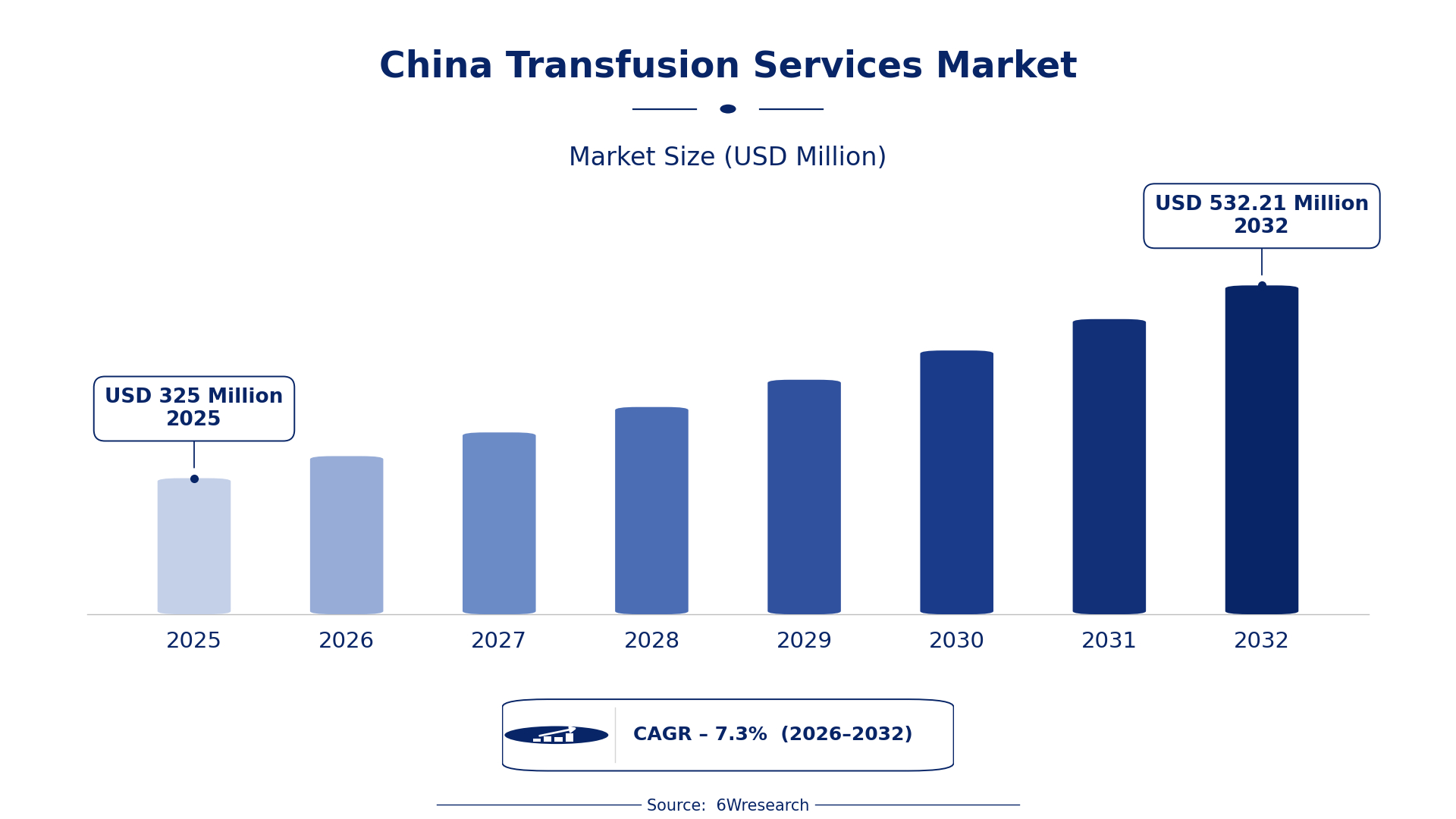
According to 6Wresearch internal database and industry insights, the China Transfusion Services Market was valued at USD 325.0 million in 2025 and is projected to reach USD 532.21 million by 2032, growing at a CAGR of approximately 7.3% during 2026–2032.
China Transfusion Services Market Highlights
| Report Metric | Details |
| Report Name | China Transfusion Services Market |
| Market Size 2025 | USD 325.0 million |
| Market Size 2032 | USD 532.21 million |
| Absolute Growth 2025–2032 | USD 207.21 million |
| CAGR 2026–2032 | 7.3% |
| Peak Annual Growth | 9.1% in 2029 |
| Forecast Period | 2026–2032 |
| Historical Data | 2022–2025 |
| Base Year | 2025 |
| Leading Service Type, 2025 | Blood Collection (43% share) |
| Leading Blood Product Type, 2025 | Whole Blood (39% share) |
| Leading Facility Type, 2025 | Hospitals (44% share) |
| Leading End User, 2025 | Healthcare Facilities (38% share) |
| Fastest-Growing Service Type | Component Separation (8.5% CAGR) |
| Fastest-Growing Blood Product Type | Plasma (8.8% CAGR) |
| Fastest-Growing Facility Type | Blood Banks (9.0% CAGR) |
| Growing Sector | Healthcare Facilities |
| Key End Users | Hospitals, Blood Banks, Emergency Services, Healthcare Facilities |
China Transfusion Services Market Year-wise Growth Rate and Key Drivers (2022–2032)
This graph illustrates the annual growth rates of the market from 2022 to 2032, highlighting a steady upward trajectory and projected market expansion over the forecast period.
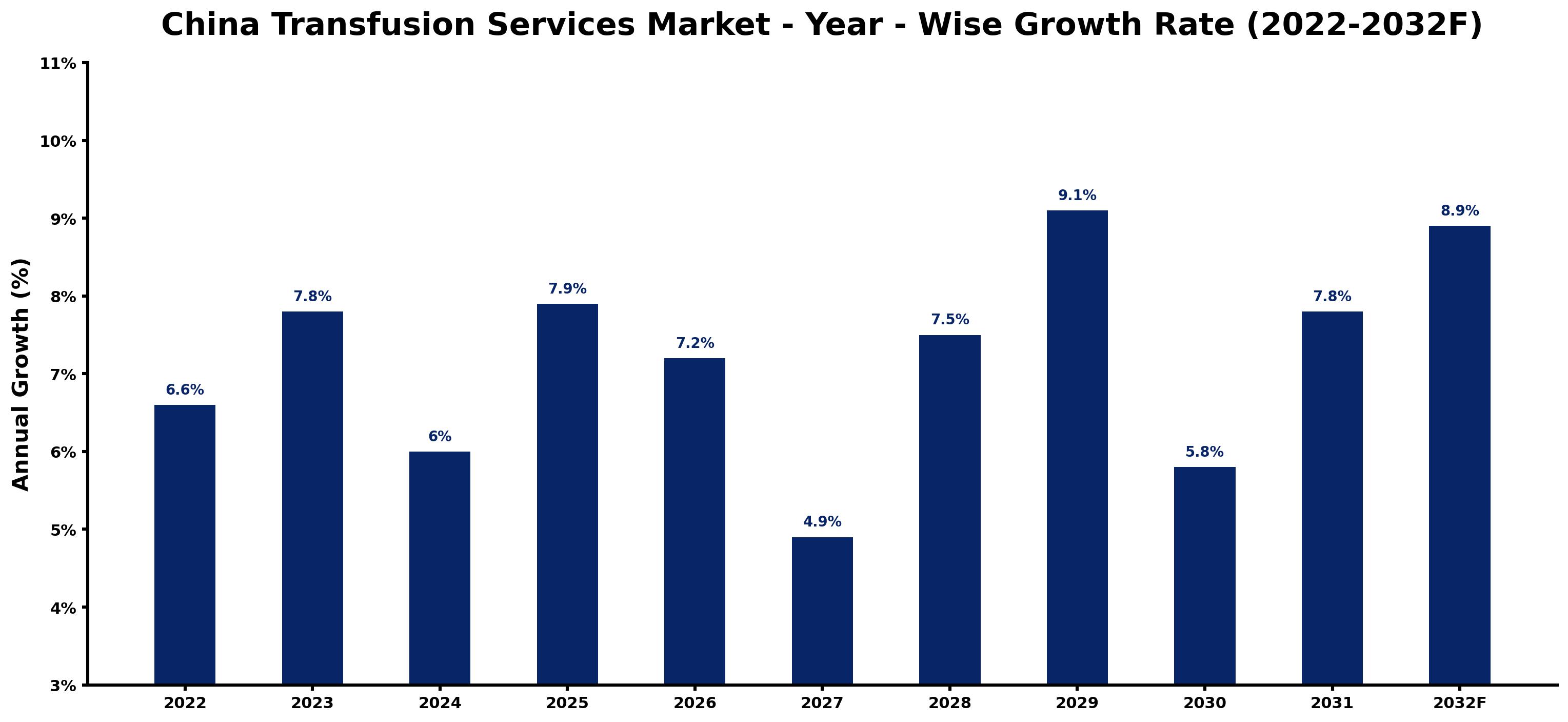
Below, each year's estimated growth is shown next to the factor that most influenced it.
| Year | Estimated Annual Growth (%) | Market Rationale |
| 2022 | 6.6 | The market showed steady growth, supported by increased blood donation awareness campaigns. |
| 2023 | 7.8 | Growth accelerated due to the Ministry of Health's campaign to boost voluntary blood donations by 20%. |
| 2024 | 6.0 | The growth rate slowed as hospitals adjusted to new blood safety protocols and standards. |
| 2025 | 7.9 | Demand surged as hospitals reported increased usage of transfusion services for surgeries and trauma care. |
| 2026 | 7.2 | Growth is expected to decelerate as hospitals face challenges in maintaining adequate blood supplies. |
| 2027 | 4.9 | The market is projected to continue growing, driven by an aging population's needs for transfusion services. |
| 2028 | 7.5 | A rebound in growth is expected as blood banks improve their storage capabilities. |
| 2029 | 9.1 | Peak growth will be reached, driven by rising demand from healthcare facilities and hospitals. |
| 2030 | 5.8 | Growth is projected to slow again as blood donation rates stabilise and awareness campaigns mature. |
| 2031 | 7.8 | The market will see renewed growth as healthcare facilities expand their services to meet demand. |
| 2032 | 8.9 | Growth is expected to remain strong, supported by ongoing improvements in blood safety protocols. |
Note: Market size estimations and growth projections presented in this report are based on 6Wresearch's proprietary forecasting methodology, utilizing the latest available industry data, government publications, and primary research inputs.
China Transfusion Services Market Synopsis
Transfusion Services in China involve the collection, testing, processing, and distribution of blood and its components. These services are crucial for surgeries, trauma treatments, and support for blood disorders. The China Transfusion Services Market is growing due to rising demand from hospitals and healthcare facilities, with around 15 million blood donations recorded in 2022. An aging population and efforts to promote voluntary donations are propelling this growth, along with advancements in blood safety protocols.
Market Dynamics Impact Analysis (2026–2032)
| Factor | Type | Impact | Primary Segment Affected |
| Increasing demand for blood products due to an aging population | Driver | High | Blood Collection |
| Enhanced blood safety protocols improving public trust in transfusions | Driver | High | Compatibility Testing |
| Growing urbanisation leading to higher healthcare facility needs | Opportunity | High | Healthcare Facilities |
| Investment in advanced storage facilities to meet rising demand | Opportunity | High | Blood Banks |
| Inadequate public awareness about blood donation importance | Restraint | High | Blood Collection |
| Challenges in maintaining sufficient blood supply during peak demand | Restraint | High | Storage & Transport |
| The Transfusion Services market in China faces significant regulatory hurdles | Challenge | High | Component Separation |
| Competition for donations from various health campaigns complicates supply | Challenge | Medium | Blood Collection |
Evaluation of Drivers in China Transfusion Services Market (2026–2032)
The factors lifting demand, and the evidence behind each, are summarised below.
| Drivers | Primary Segment Affected | Why It Matters (Evidence) |
| Rising blood donation rates due to awareness campaigns | Blood Collection | In 2022, approximately 15 million blood donations were recorded, increasing supply for hospitals. |
| Growing healthcare facility requirements for transfusion services | Healthcare Facilities | Over 80% of hospitals reported regular use of transfusion services in 2022. |
| Investment in blood safety protocols to build public trust | Compatibility Testing | The 2023 Blood Safety Improvement Program aims to reduce complications by 15% over five years. |
| Expansion of blood banks in urban areas to meet demand | Blood Banks | Blood banks are equipped with advanced storage facilities to ensure blood viability for patients. |
| Increased focus on voluntary blood donations | Component Separation | The Ministry of Health's campaign aims to increase voluntary donations by 20%. |
The Transfusion Services market in China is growing on the back of rising blood donation rates, increasing healthcare facility requirements, and investments in blood safety protocols. Approximately 15 million blood donations were recorded in 2022, which increased supply for hospitals. Over 80% of hospitals reported regular use of transfusion services, reflecting the growing demand. Blood banks are also expanding in urban areas, equipped with advanced storage facilities to maintain blood viability for patients.
Evaluation of Restraints in China Transfusion Services Market
The key brakes on demand, and where they bite hardest, are shown below.
| Market Restraint | Primary Segment Affected | Why It Matters (Evidence) |
| Inadequate public awareness about the importance of blood donation | Blood Collection | Despite campaigns, the average annual blood donation per capita is only about 0.1 units. |
| Challenges in maintaining sufficient blood supply during peak demand | Storage & Transport | The average wait time for blood transfusions in major hospitals is about 30 minutes. |
| Regulatory hurdles complicating the transfusion process | Component Separation | Compatibility testing is mandated by national standards for all transfusions. |
| Competition for donations from various health campaigns | Blood Collection | Multiple initiatives compete for the same donor base, affecting overall donations and supply levels. |
| Limited funding for blood donation infrastructure improvements | Blood Banks | Funding for upgrades has been insufficient, hindering expansion and capability. |
China Transfusion Services Market Challenges
The China transfusion services market struggles with a low rate of voluntary blood donations, as the average annual donation per capita is only 0.1 units. This shortfall limits hospitals' capacity to supply blood for surgeries and trauma care, leading to potential delays in treatment for patients. Competition among over 2,000 blood donation centers creates inconsistent supply levels, which can hinder timely transfusions. Compliance with national safety protocols increases operational costs for suppliers, complicating service delivery for blood banks. A shortage of trained personnel in blood testing and processing further reduces the efficiency of transfusion services across healthcare facilities.
Trends in the China Transfusion Services Market
Below mentioned are some of the trends shaping the China Transfusion Services Market growth.
- Shift towards Improved Blood Safety Protocols: In 2023, a new national plan was introduced to improve blood safety protocols, aiming to reduce complications by 15%. This shift is essential for hospitals and healthcare facilities, ensuring safer transfusions for patients.
- Transition to Advanced Storage Facilities: Blood banks are increasingly adopting advanced storage technologies to maintain blood viability. In urban areas, these upgrades are necessary to meet rising demand, with many banks reporting improved storage capabilities.
- Emergence of Voluntary Blood Donation Campaigns: The Ministry of Health launched a campaign in 2023 to increase voluntary blood donations by 20%. This initiative has already led to a noticeable increase in donation rates across the country.
- Growing Demand from Healthcare Facilities: Healthcare facilities are expanding their services, with a projected 38% share in 2025. This growth is driven by the increasing need for transfusion services in surgeries and trauma care.
Investment Opportunities in the China Transfusion Services Market
Below are the investment opportunities with the strongest case in the China Transfusion Services Market.
- Investment in Blood Collection Centers: With over 2,000 blood donation centres across China, there is a strong opportunity to enhance collection capabilities. Partnering with local health authorities can facilitate this expansion and improve donation rates.
- Upgrade of Blood Storage Facilities: The Ministry of Health allocated 500 million yuan in 2021 to upgrade blood storage facilities. Investing in these upgrades can meet the growing demand from urban healthcare facilities for safe blood storage.
- Expansion of Compatibility Testing Services: Healthcare facilities are increasingly prioritising compatibility testing to ensure safe transfusions. Investing in testing infrastructure can cater to this growing need and improve patient outcomes.
- Development of Public Awareness Programs: Increased public awareness about blood donation can significantly boost donation rates. Collaborating with NGOs and health agencies can improve outreach efforts and encourage more voluntary donations.
Government Initiatives in the China Transfusion Services Market
The Blood Donation Law of 2020, implemented by the National Health Commission, aims to improve voluntary blood donation rates and ensure safety in blood transfusions. This law mandates regular reporting and monitoring of blood donation activities, which helps maintain a safe blood supply. Additionally, the National Blood Safety Plan (2021-2025) focuses on improving blood collection, testing, and distribution infrastructure across China. This plan includes specific targets for increasing donation rates and improving public awareness about blood donation.
In 2021, the Ministry of Health initiated a program to upgrade blood storage facilities with a budget of 500 million yuan. The National Health Commission oversees this initiative, ensuring that blood banks receive the necessary funding and resources to improve their capabilities. Furthermore, the 2023 Blood Safety Improvement Program aims to reduce transfusion-related complications by 15% over the next five years. This program is supported by the National Health Commission, which monitors compliance with safety standards.
Future Insight of the China Transfusion Services Market
The China transfusion services market is set to evolve significantly by 2032, driven by several key initiatives. The national plan introduced in 2023 aims to improve blood safety protocols, enhancing quality standards for transfusions. The Ministry of Health's campaign to increase voluntary blood donations by 20% is projected to boost overall supply, benefiting hospitals and blood banks. Advances in blood storage technology will streamline product management, ensuring better availability for patients. These factors will strengthen the market's capacity to meet the rising healthcare demands.
Market Segmentation Analysis
The report offers a comprehensive study of the following market segments and their leading categories in the market.
By Service Type – Blood Collection Dominated, Component Separation Expected to Grow Fastest
According to Vasudha, AM at 6Wresearch, the largest service type category in 2025 was Blood Collection, with a 43% share of total revenue. Blood Collection holds the largest share in the China Transfusion Services Market because it is essential for obtaining blood donations from the public. With approximately 15 million blood donations recorded in 2022, this segment plays a critical role in supporting healthcare facilities across the country. Component Separation is set to record the highest CAGR in this split, 8.5% over 2026–2032. Component Separation is growing rapidly due to the increasing need for specific blood components, particularly for patients with blood disorders. The Ministry of Health's 2023 initiative to improve blood safety protocols is further driving this segment's demand. Suppliers should focus on enhancing blood collection and component separation capabilities to effectively meet the rising market demand.
By Blood Product Type – Whole Blood Dominated, Plasma Expected to Grow Fastest
With a 39% revenue share in 2025, Whole Blood was the largest blood product type category. Whole Blood commands the largest share in the market because it is widely used in various medical treatments, including surgeries and trauma care. Its broad applicability makes it a staple in hospitals and healthcare facilities throughout China. The quickest growth will come from Plasma, forecast to expand at a CAGR of 8.8% between 2026 and 2032. Plasma is growing quickly as it is increasingly utilized in therapies for clotting disorders, addressing a specific medical need. The rising awareness of plasma's therapeutic benefits is driving this growth. Buyers should ensure a steady supply of whole blood while also considering the growing importance of plasma in treatment protocols.
By Facility Type – Hospitals Dominated, Blood Banks Expected to Grow Fastest
Hospitals held a 44% share of the China Transfusion Services Market by facility type in 2025. Hospitals dominate the market share as they are the primary users of transfusion services, relying heavily on blood for surgeries and emergency treatments. With over 80% of hospitals in China regularly utilising these services, their significant demand shapes the overall market landscape. Over 2026–2032, Blood Banks are expected to post the fastest growth, at a CAGR of 9.0%. Blood Banks are experiencing rapid growth as they are vital for blood collection and distribution, especially in urban areas with advanced storage facilities. The increasing demand for blood products, driven by an aging population, is propelling this segment forward. Suppliers must establish strong partnerships with hospitals and blood banks to ensure efficient service delivery and address the growing demand.
By End User – Healthcare Facilities Dominated and Is Expected to Record the Fastest Growth
Healthcare Facilities accounted for a 38% market share by end user in 2025. Healthcare Facilities lead the market share as they are the primary users of transfusion services, crucial for patient care across various medical conditions. Their extensive reliance on these services underscores their dominant position within the market. The same category are also set to grow fastest, at a CAGR of 9.4% during 2026–2032. Healthcare Facilities are also the fastest-growing segment, as the rising patient population and demand for transfusions boost their usage. This dual role as both leader and fastest indicates a robust and expanding market for transfusion services. Suppliers should tailor their offerings to meet the specific needs of healthcare facilities, ensuring they can accommodate the increasing patient demands.
Key Attractiveness of the Report
- 10 Years of Market Numbers
- Historical Data Starting from 2022 to 2025
- Base Year 2025
- Forecast Data until 2032
- Key Performance Indicators Impacting the Market
- Major Upcoming Developments and Projects
Key Highlights of the Report:
- China Transfusion Services Market Outlook
- Market Size of China Transfusion Services Market, 2025
- Forecast of China Transfusion Services Market, 2032
- Historical Data and Forecast of China Transfusion Services Revenues & Volume for the Period 2022 - 2032F
- China Transfusion Services Market Trend Evolution
- China Transfusion Services Market Drivers and Challenges
- China Transfusion Services Price Trends
- China Transfusion Services Porter's Five Forces
- China Transfusion Services Industry Life Cycle
- Historical Data and Forecast of China Transfusion Services Market Revenues & Volume By Service Type for the Period 2022 - 2032F
- Historical Data and Forecast of China Transfusion Services Market Revenues & Volume By Blood Collection for the Period 2022 - 2032F
- Historical Data and Forecast of China Transfusion Services Market Revenues & Volume By Component Separation for the Period 2022 - 2032F
- Historical Data and Forecast of China Transfusion Services Market Revenues & Volume By Storage & Transport for the Period 2022 - 2032F
- Historical Data and Forecast of China Transfusion Services Market Revenues & Volume By Compatibility Testing for the Period 2022 - 2032F
- Historical Data and Forecast of China Transfusion Services Market Revenues & Volume By Blood Product Type for the Period 2022 - 2032F
- Historical Data and Forecast of China Transfusion Services Market Revenues & Volume By Whole Blood for the Period 2022 - 2032F
- Historical Data and Forecast of China Transfusion Services Market Revenues & Volume By Plasma, Platelets for the Period 2022 - 2032F
- Historical Data and Forecast of China Transfusion Services Market Revenues & Volume By RBC, Plasma for the Period 2022 - 2032F
- Historical Data and Forecast of China Transfusion Services Market Revenues & Volume By Antigen/Antibody for the Period 2022 - 2032F
- Historical Data and Forecast of China Transfusion Services Market Revenues & Volume By Facility Type for the Period 2022 - 2032F
- Historical Data and Forecast of China Transfusion Services Market Revenues & Volume By Hospitals for the Period 2022 - 2032F
- Historical Data and Forecast of China Transfusion Services Market Revenues & Volume By Blood Banks for the Period 2022 - 2032F
- Historical Data and Forecast of China Transfusion Services Market Revenues & Volume By Emergency Services for the Period 2022 - 2032F
- Historical Data and Forecast of China Transfusion Services Market Revenues & Volume By Diagnostic Centers for the Period 2022 - 2032F
- Historical Data and Forecast of China Transfusion Services Market Revenues & Volume By End User for the Period 2022 - 2032F
- Historical Data and Forecast of China Transfusion Services Market Revenues & Volume By Healthcare Facilities for the Period 2022 - 2032F
- Historical Data and Forecast of China Transfusion Services Market Revenues & Volume By Clinics for the Period 2022 - 2032F
- Historical Data and Forecast of China Transfusion Services Market Revenues & Volume By Ambulance Services for the Period 2022 - 2032F
- Historical Data and Forecast of China Transfusion Services Market Revenues & Volume By Labs for the Period 2022 - 2032F
- China Transfusion Services Import Export Trade Statistics
- Market Opportunity Assessment By Service Type
- Market Opportunity Assessment By Blood Product Type
- Market Opportunity Assessment By Facility Type
- Market Opportunity Assessment By End User
- China Transfusion Services Top Companies Market Share
- China Transfusion Services Competitive Benchmarking By Technical and Operational Parameters
- China Transfusion Services Company Profiles
- China Transfusion Services Key Strategic Recommendations
Market Covered
Segments analysed in this report are listed below.
By Service Type
- Blood Collection
- Component Separation
- Storage & Transport
- Compatibility Testing
By Blood Product Type
- Whole Blood
- Plasma
- Platelets
- RBC
- Antigen/Antibody
By Facility Type
- Hospitals
- Blood Banks
- Emergency Services
- Diagnostic Centers
By End User
- Healthcare Facilities
- Clinics
- Ambulance Services
- Labs































