China Transit Advertising Market Size & Growth Rate
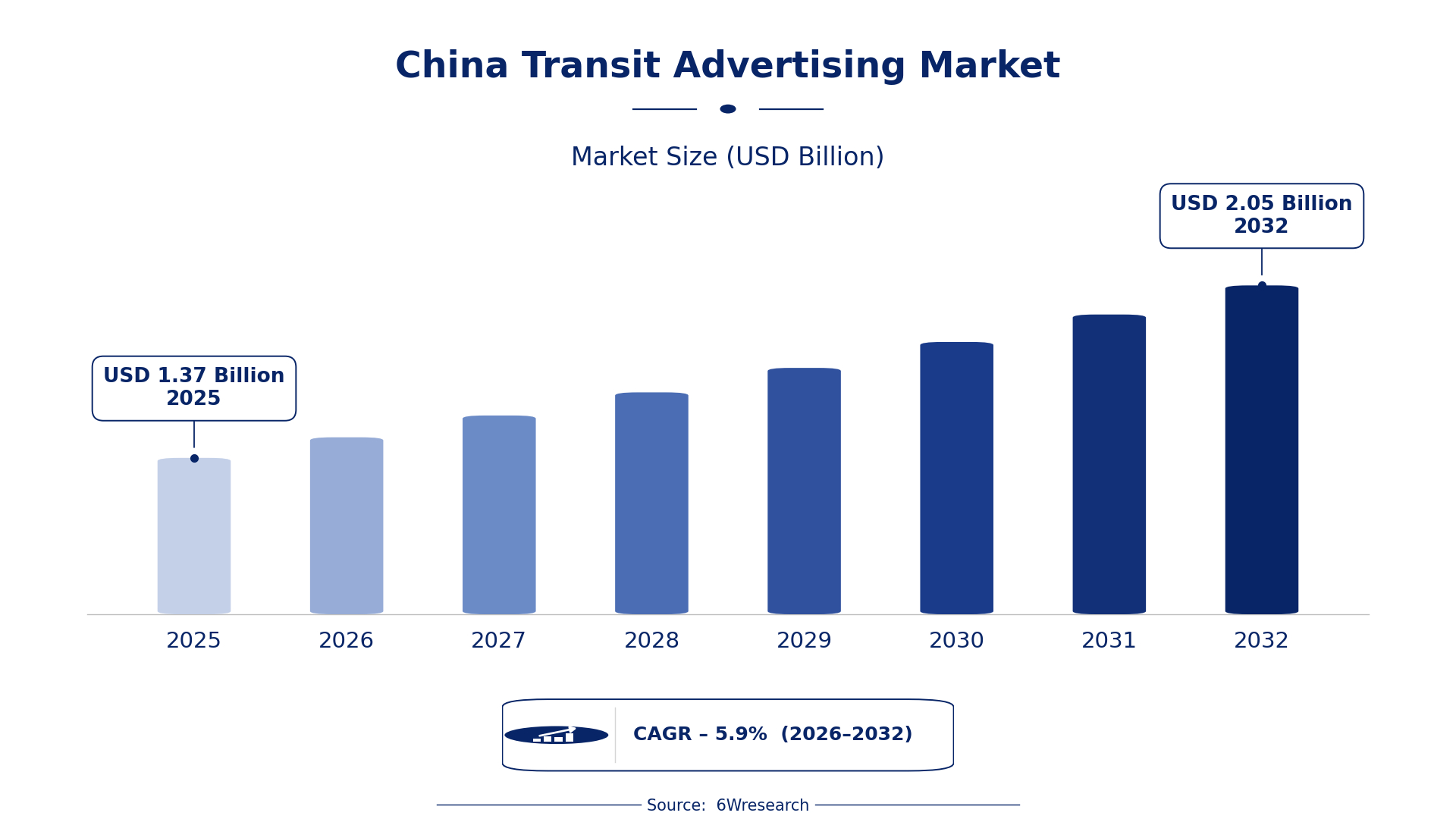
According to 6Wresearch internal database and industry insights, the China Transit Advertising Market was valued at USD 1.37 billion in 2025 and is projected to reach USD 2.05 billion by 2032, growing at a CAGR of approximately 5.9% during 2026–2032.
China Transit Advertising Market Highlights
| Report Metric | Details |
| Report Name | China Transit Advertising Market |
| Market Size 2025 | USD 1.37 billion |
| Market Size 2032 | USD 2.05 billion |
| Absolute Growth 2025–2032 | USD 0.68 billion |
| CAGR 2026–2032 | 5.9% |
| Peak Annual Growth | 8.0% in 2031 |
| Forecast Period | 2026–2032 |
| Historical Data | 2022–2025 |
| Base Year | 2025 |
| Leading Advertising Type, 2025 | Digital Screens (50% share) |
| Leading Medium Used, 2025 | Digital & Static (52% share) |
| Leading Transit Mode, 2025 | Metro/Subways (53% share) |
| Leading End User, 2025 | Retail Brands (33% share) |
| Fastest-Growing Medium Used | Interactive Display (7.7% CAGR) |
| Fastest-Growing Transit Mode | Public Buses (7.0% CAGR) |
| Fastest-Growing End User | Local Businesses (8.2% CAGR) |
| Growing Sector | Local Businesses |
| Key End Users | Retail Brands, FMCG Companies, Local Businesses, OTT Platforms |
China Transit Advertising Market Year-wise Growth Rate and Key Drivers (2022–2032)
This graph illustrates the annual growth rates of the market from 2022 to 2032, highlighting a steady upward trajectory and projected market expansion over the forecast period.
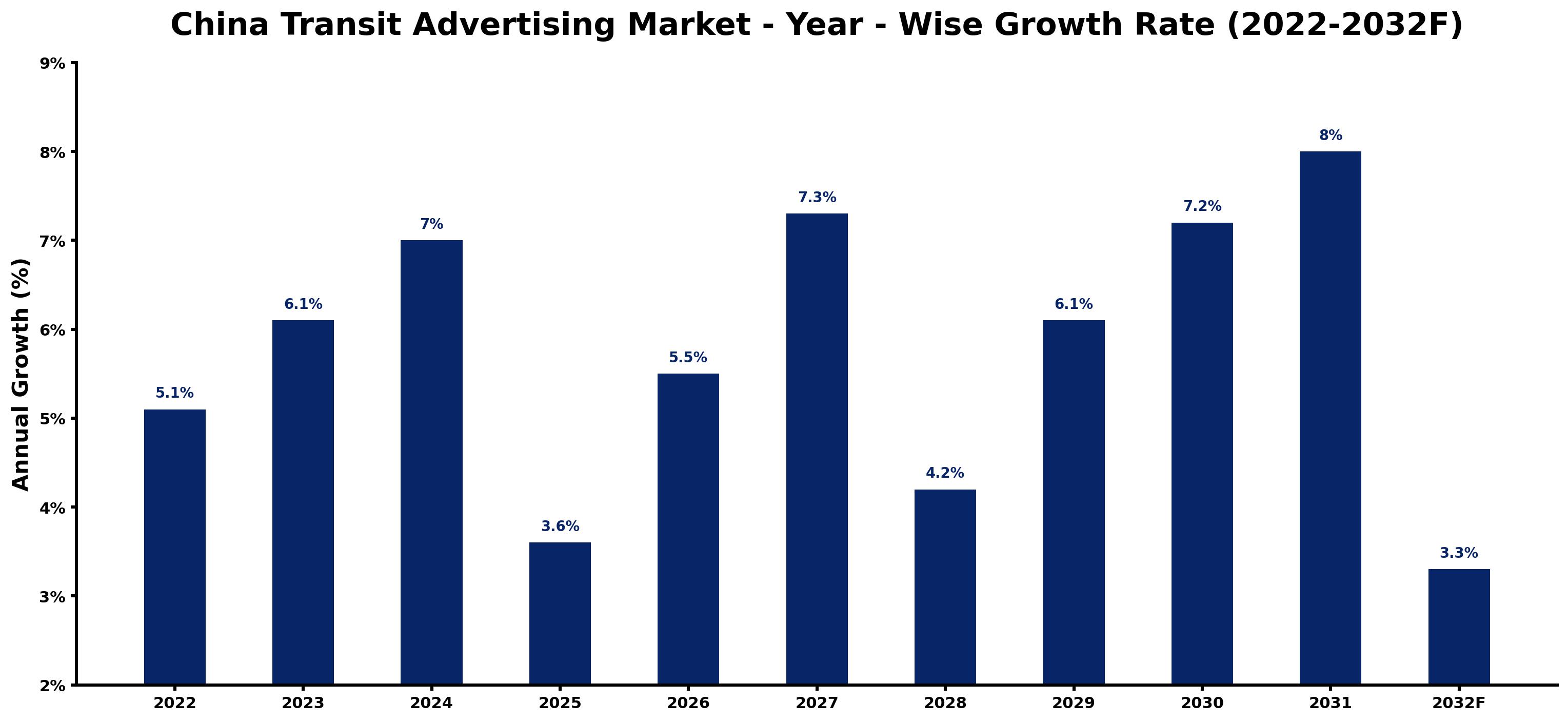
Annual growth estimates for each year appear below with the principal reason behind them, explaining the shifts that set the pace of the market.
| Year | Estimated Annual Growth (%) | Market Rationale |
| 2022 | 5.1 | The market experienced steady growth due to increased advertising spending by local businesses in urban areas. |
| 2023 | 6.1 | Demand surged as international brands sought to engage with Chinese consumers in high-traffic transit environments. |
| 2024 | 7.0 | Growth continued with the introduction of new digital advertising formats in transit systems, enhancing visibility. |
| 2025 | 3.6 | A slowdown occurred as the market adjusted to new advertising regulations and formats introduced by the Ministry of Transport. |
| 2026 | 5.5 | Investment in digital technologies revitalised demand, boosting advertising visibility in transit systems across major cities. |
| 2027 | 7.3 | The market grew as public transport ridership increased, driving ad exposure in metro systems. |
| 2028 | 4.2 | A slowdown was noted as competition intensified among various advertising formats in urban areas. |
| 2029 | 6.1 | Demand rose again as local businesses expanded their advertising budgets in transit environments, seeking more visibility. |
| 2030 | 7.2 | Growth accelerated with the introduction of new advertising technologies in transit systems, enhancing engagement. |
| 2031 | 8.0 | The market peaked with high investment in digital screens across major cities, significantly increasing ad visibility. |
| 2032 | 3.3 | A slowdown is anticipated as the market stabilises after rapid growth and increased competition. |
Note: Market size estimations and growth projections presented in this report are based on 6Wresearch's proprietary forecasting methodology, utilizing the latest available industry data, government publications, and primary research inputs.
China Transit Advertising Market Synopsis
Transit Advertising in China encompasses various mediums used to promote brands within public transport settings. This includes digital screens, bus wraps, and train interior ads, primarily produced through printing and digital technologies. The China Transit Advertising Market is expanding due to increasing domestic demand from local businesses and retail sectors, alongside international brands seeking to connect with Chinese consumers. By 2025, the digital advertising market in public transport is projected to reach 20 billion CNY, reflecting a growing commitment to advertising visibility.
Market Dynamics Impact Analysis (2026–2032)
| Factor | Type | Impact | Primary Segment Affected |
| Increasing investment in digital advertising technologies | Driver | High | Digital Screens |
| High passenger traffic in metro systems | Driver | High | Metro/Subways |
| Growing advertising space in urban transit systems | Opportunity | Medium | Public Buses |
| Emerging trend of interactive displays | Opportunity | Medium | Interactive Display |
| Tightening regulations on misleading ads | Restraint | High | Digital Screens |
| Competition from other advertising channels | Restraint | Medium | Digital Screens |
| Transit Advertising in China faces regulatory challenges that slow down approvals | Challenge | High | Digital Screens |
| Limited adoption of interactive displays in transit | Challenge | Medium | Interactive Display |
Evaluation of Drivers in China Transit Advertising Market (2026–2032)
Below mentioned are some major drivers and their influence on market dynamics.
| Drivers | Primary Segment Affected | Why It Matters (Evidence) |
| Investment in digital screens | Digital Screens | The digital advertising market in public transport is expected to reach 20 billion CNY by 2025, prompting increased demand from advertisers seeking visibility. |
| High passenger volumes in metro systems | Metro/Subways | In 2022, over 1.4 billion passenger trips were made on public buses, significantly increasing visibility for ads placed in transit. |
| Growth of local businesses | Public Buses | Local businesses account for 30% of transit advertising spend in tier-2 cities, driving demand for targeted advertising solutions to reach consumers. |
| Introduction of new ad formats | Digital & Static | The Ministry of Transport's updated regulations streamline approval processes, encouraging innovation in advertising formats and attracting more advertisers. |
| Increased dwell time for passengers | Train Interior Ads | The average dwell time for passengers in metros is 15 minutes, providing ample opportunity for effective advertising placements. |
Market growth for Transit Advertising in China is driven by rising investment in digital screens and high passenger volumes in metro systems. The digital advertising market in public transport is anticipated to reach 20 billion CNY by 2025, spurring demand from advertisers eager to improve visibility. In 2022, public buses recorded over 1.4 billion passenger trips, significantly boosting ad exposure. Growth among local businesses in tier-2 cities adds to transit advertising expenditure, increasing the need for targeted campaigns. Passengers in metros typically spend an average of 15 minutes, creating effective advertising opportunities that engage commuters.
Evaluation of Restraints in China Transit Advertising Market
Below mentioned are some major restraints and their influence on market dynamics.
| Market Restraint | Primary Segment Affected | Why It Matters (Evidence) |
| Tightening regulations on misleading ads | Digital Screens | The State Administration for Market Regulation's Advertising Law Amendment in 2021 tightened rules, complicating ad approvals for producers and increasing compliance costs. |
| Competition from other advertising channels | Digital Screens | Transit advertising contributes to only 5% of total advertising revenue in urban areas, making competition fierce for ad space and reducing margins for suppliers. |
| Limited adoption of interactive displays | Interactive Display | Despite emerging trends, interactive displays are not yet widely adopted in transit systems, limiting their market impact and growth potential. |
| Slow approval processes for new ad formats | Digital & Static | The updated regulations from the Ministry of Transport in 2022 have made it more difficult for advertisers to introduce new formats, causing delays in campaigns. |
| Market saturation in major cities | Metro/Subways | Beijing and Shanghai are the top cities for transit advertising spend, leading to increased competition and saturation in available ad space. |
China Transit Advertising Market Challenges
The China Transit Advertising Market faces intense competition, with countless local businesses vying for limited advertising space, which drives down prices and reduces profit margins for suppliers. High installation costs for digital advertising technologies, often exceeding 500,000 CNY, discourage smaller companies from entering the market, limiting options for buyers and stifling innovation. Regulatory hurdles imposed by the Ministry of Transport lead to compliance challenges, causing delays in campaign launches for advertisers, which can extend timelines by up to three months. Buyers struggle with a fragmented market, where local businesses account for only 30% of transit advertising spend in tier-2 cities, making it difficult to achieve consistent visibility across regions.
Trends in the China Transit Advertising Market
Buyers and suppliers in the China Transit Advertising Market are adjusting to the following trends.
- Shift to Digital Advertising: In 2023, the Shanghai Metro introduced new digital screens for advertising, reflecting a shift towards more dynamic ad formats that enhance engagement. This change is expected to improve visibility for brands and attract more advertisers.
- Increase in Advertising Space: Guangzhou's public transport system has increased its advertising space by 15% since 2021, allowing for more brands to engage with commuters. This expansion is vital for local businesses aiming to increase visibility in high-traffic areas.
- Emergence of Interactive Displays: The introduction of interactive displays is gaining traction, with the Shanghai Advertising Association establishing guidelines for sustainable practices in 2020. This trend is likely to attract tech-savvy consumers and enhance brand engagement.
- Focus on Local Businesses: Local businesses are increasingly utilising transit advertising to target nearby customers, accounting for 30% of transit advertising spend in tier-2 cities. This trend highlights the importance of local outreach in advertising strategies.
Investment Opportunities in the China Transit Advertising Market
The following opportunities in the China Transit Advertising Market pair current demand with a clear way in.
- Sustainable Advertising Practices: As the Shanghai Advertising Association promotes sustainable practices, there is an opportunity for suppliers to develop eco-friendly advertising materials and solutions. This aligns with the growing consumer preference for sustainability in advertising.
- Expansion of Digital Advertising: With the digital advertising market expected to reach 20 billion CNY by 2025, suppliers can invest in digital solutions to meet rising demand from advertisers in urban areas seeking visibility.
- Targeting Tier-2 Cities: Local businesses in tier-2 cities are increasingly utilising transit advertising, representing an opportunity for suppliers to cater to this growing market segment. This shift is supported by the 30% share of transit advertising spend in these regions.
- Integration of Interactive Displays: The rise of interactive displays presents an opportunity for suppliers to create engaging advertising solutions. As guidelines are established, there is potential for growth in this emerging segment, attracting more advertisers.
Government Initiatives in the China Transit Advertising Market
The 'Public Transport Development Plan (2021-2025)' was launched by the National Development and Reform Commission to improve advertising opportunities in transit systems, promoting local businesses and ensuring compliance with regulations. This plan aims to increase the visibility of ads while facilitating integration of new technologies. In 2022, the Ministry of Transport updated the 'Regulations on Advertising in Public Transport' to streamline approval processes for new ad formats, enabling advertisers to implement innovative strategies. Additionally, the State Administration for Market Regulation implemented the 'Advertising Law Amendment' in 2021, tightening regulations on misleading ads to protect consumers and enhance transparency in advertising practices.
The Ministry of Transport oversees regulations for advertising in public transport, ensuring compliance with national standards. The Beijing Municipal Government initiated the 'Smart Public Transport Initiative' in 2023, integrating digital advertising technologies in transit systems to improve visibility and effectiveness of ads. The China Advertising Association promotes best practices in transit advertising, providing guidelines for advertisers to follow, which helps maintain industry standards. In 2022, the association reported a 15% increase in compliance among advertisers, reflecting improved adherence to regulations.
Future Insight of the China Transit Advertising Market
The China Transit Advertising Market is set to transform by 2032, driven by advancements in digital technologies and enhanced passenger engagement. New digital screens in public transport systems will boost ad visibility and attract more advertisers, while the digital advertising market in public transport is expected to reach 20 billion CNY by 2025, creating fresh opportunities for suppliers. Increased advertising space in cities like Guangzhou will enable buyers to maximise brand exposure in high-traffic areas, enhancing overall effectiveness in reaching consumers.
Market Segmentation Analysis
Each segment group is reviewed below, with the leader by share and the fastest grower by CAGR.
By Advertising Type – Digital Screens Dominated and Is Expected to Record the Fastest Growth
According to Vasudha, AM at 6Wresearch, in 2025, Digital Screens led the advertising type split with a 50% share. Digital screens dominate the advertising type segment due to their capacity for delivering captivating and interactive content. For instance, the recent deployment of advanced digital screens in the Shanghai Metro showcases their effectiveness in engaging millions of daily passengers. Digital Screens are also forecast to expand faster than any other category, at a CAGR of 7.5% over 2026–2032. The digital screens segment is set for continued growth as transit systems increasingly acknowledge the benefits of dynamic advertising. This is highlighted by the projected expansion of the digital advertising market in public transport, expected to reach 20 billion CNY by 2025, reinforcing its leading position. Suppliers must focus on enhancing digital advertising solutions to meet the rising demand from advertisers seeking impactful visibility.
By Medium Used – Digital & Static Dominated, Interactive Display Expected to Grow Fastest
Digital & Static took a 52% share of medium used in 2025, more than any other category. The digital and static mediums together capture a significant share of the market, appealing to a broad spectrum of advertisers. This blend allows for the integration of traditional and contemporary advertising methods, effectively reaching diverse consumer groups. Interactive Display is projected to grow fastest, at a CAGR of 7.7% during 2026–2032. Interactive displays are gaining traction as an appealing option, providing a more engaging experience for transit audiences. While still emerging, their potential for growth is substantial as brands look to create more interactive consumer experiences in transit settings. Advertisers should consider incorporating interactive displays into their strategies to enhance consumer engagement and attention.
By Transit Mode – Metro/Subways Dominated, Public Buses Expected to Grow Fastest
The largest transit mode category in 2025 was Metro/Subways, with a 53% share of total revenue. Metro and subways hold the largest share in the transit mode segment due to their high visibility and substantial foot traffic. With over 1.4 billion passenger trips made on public buses in 2022, metros serve as prime locations for impactful advertising. Over 2026–2032, Public Buses are expected to post the fastest growth, at a CAGR of 7.0%. Public buses are experiencing faster growth as they serve as the primary mode of transit for advertising campaigns, particularly in tier-2 cities. The increase in advertising space in Guangzhou's public transport system highlights the expanding opportunities in this segment. Advertisers should diversify their strategies to include public buses, tapping into the growing audience in urban areas.
By End User – Retail Brands Dominated, Local Businesses Expected to Grow Fastest
Retail Brands accounted for a 33% market share by end user in 2025. Retail brands account for the largest share of the end user segment, utilising transit advertising to boost their local visibility and outreach. Their significant investment in advertising within public transport underscores the importance of engaging consumers in high-traffic areas. Local Businesses are set to record the highest CAGR in this split, 8.2% over 2026–2032. Local businesses are swiftly increasing their expenditure on transit advertising to better connect with customers nearby. This trend indicates a growing focus on local market engagement, as these businesses aim to effectively attract nearby consumers. Suppliers should tailor their offerings to help local businesses optimise the effectiveness of transit advertising for improved customer connections.
Key Attractiveness of the Report
- 10 Years of Market Numbers
- Historical Data Starting from 2022 to 2025
- Base Year 2025
- Forecast Data until 2032
- Key Performance Indicators Impacting the Market
- Major Upcoming Developments and Projects
Key Highlights of the Report:
- China Transit Advertising Market Outlook
- Market Size of China Transit Advertising Market, 2025
- Forecast of China Transit Advertising Market, 2032
- Historical Data and Forecast of China Transit Advertising Revenues & Volume for the Period 2022 - 2032F
- China Transit Advertising Market Trend Evolution
- China Transit Advertising Market Drivers and Challenges
- China Transit Advertising Price Trends
- China Transit Advertising Porter's Five Forces
- China Transit Advertising Industry Life Cycle
- Historical Data and Forecast of China Transit Advertising Market Revenues & Volume By Advertising Type for the Period 2022 - 2032F
- Historical Data and Forecast of China Transit Advertising Market Revenues & Volume By Bus Wraps for the Period 2022 - 2032F
- Historical Data and Forecast of China Transit Advertising Market Revenues & Volume By Train Interior Ads for the Period 2022 - 2032F
- Historical Data and Forecast of China Transit Advertising Market Revenues & Volume By Billboard Panels for the Period 2022 - 2032F
- Historical Data and Forecast of China Transit Advertising Market Revenues & Volume By Digital Screens for the Period 2022 - 2032F
- Historical Data and Forecast of China Transit Advertising Market Revenues & Volume By Medium Used for the Period 2022 - 2032F
- Historical Data and Forecast of China Transit Advertising Market Revenues & Volume By Vinyl Graphics for the Period 2022 - 2032F
- Historical Data and Forecast of China Transit Advertising Market Revenues & Volume By Digital & Static for the Period 2022 - 2032F
- Historical Data and Forecast of China Transit Advertising Market Revenues & Volume By Static Hoardings for the Period 2022 - 2032F
- Historical Data and Forecast of China Transit Advertising Market Revenues & Volume By Interactive Display for the Period 2022 - 2032F
- Historical Data and Forecast of China Transit Advertising Market Revenues & Volume By Transit Mode for the Period 2022 - 2032F
- Historical Data and Forecast of China Transit Advertising Market Revenues & Volume By Public Buses for the Period 2022 - 2032F
- Historical Data and Forecast of China Transit Advertising Market Revenues & Volume By Metro/Subways for the Period 2022 - 2032F
- Historical Data and Forecast of China Transit Advertising Market Revenues & Volume By Bus Shelters for the Period 2022 - 2032F
- Historical Data and Forecast of China Transit Advertising Market Revenues & Volume By Airports/Stations for the Period 2022 - 2032F
- Historical Data and Forecast of China Transit Advertising Market Revenues & Volume By End User for the Period 2022 - 2032F
- Historical Data and Forecast of China Transit Advertising Market Revenues & Volume By Retail Brands for the Period 2022 - 2032F
- Historical Data and Forecast of China Transit Advertising Market Revenues & Volume By FMCG Companies for the Period 2022 - 2032F
- Historical Data and Forecast of China Transit Advertising Market Revenues & Volume By Local Businesses for the Period 2022 - 2032F
- Historical Data and Forecast of China Transit Advertising Market Revenues & Volume By OTT Platforms for the Period 2022 - 2032F
- China Transit Advertising Import Export Trade Statistics
- Market Opportunity Assessment By Advertising Type
- Market Opportunity Assessment By Medium Used
- Market Opportunity Assessment By Transit Mode
- Market Opportunity Assessment By End User
- China Transit Advertising Top Companies Market Share
- China Transit Advertising Competitive Benchmarking By Technical and Operational Parameters
- China Transit Advertising Company Profiles
- China Transit Advertising Key Strategic Recommendations
Market Covered
This report examines the market across the segments below.
By Advertising Type
- Bus Wraps
- Train Interior Ads
- Billboard Panels
- Digital Screens
By Medium Used
- Vinyl Graphics
- Digital & Static
- Static Hoardings
- Interactive Display
By Transit Mode
- Public Buses
- Metro/Subways
- Bus Shelters
- Airports/Stations
By End User
- Retail Brands
- FMCG Companies
- Local Businesses
- OTT Platforms































