China Tumor Board Decision AI Market Size & Growth Rate
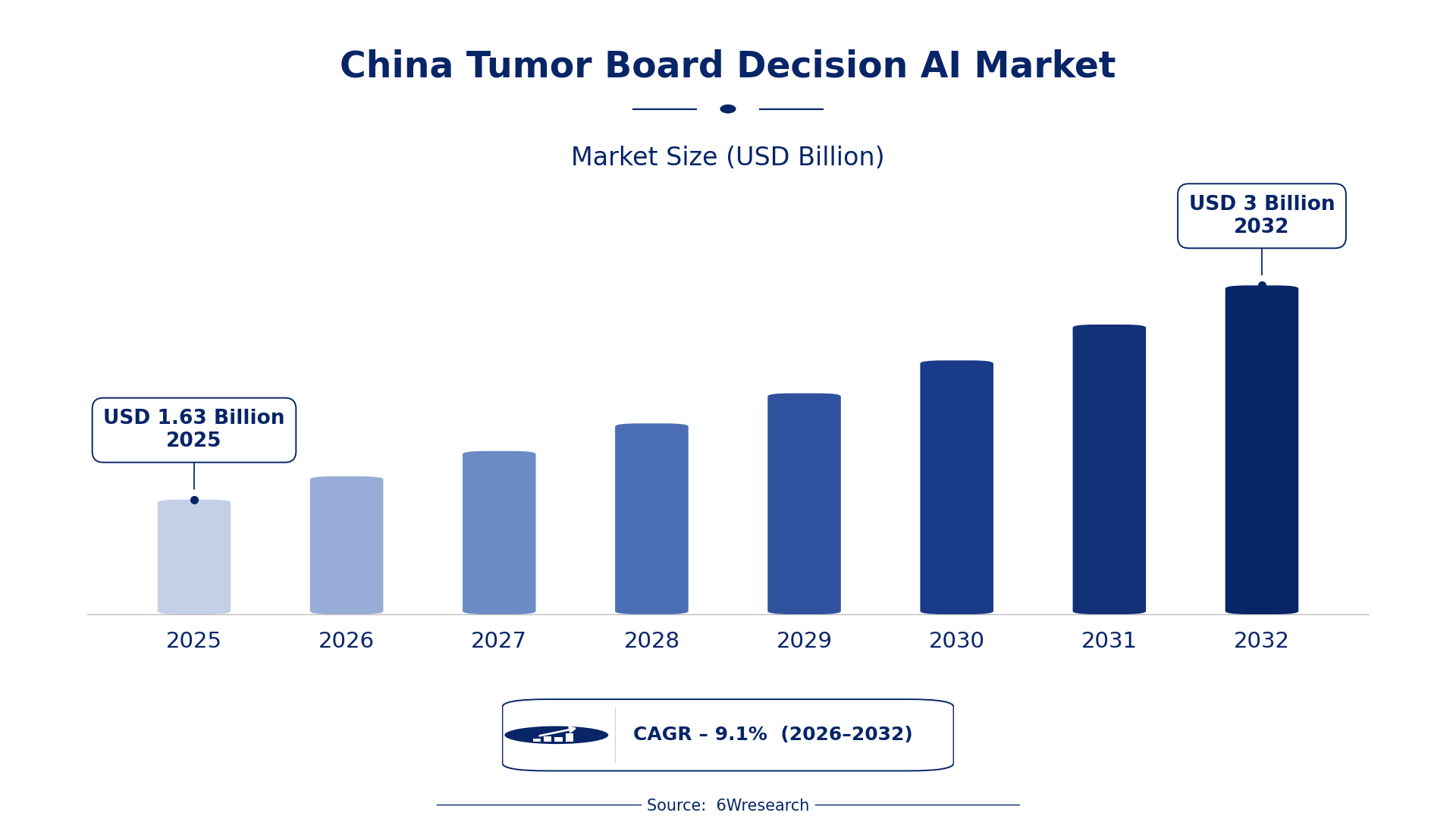
According to 6Wresearch internal database and industry insights, the China Tumor Board Decision AI Market was valued at USD 1.63 billion in 2025 and is projected to reach USD 3 billion by 2032, growing at a CAGR of approximately 9.1% during 2026–2032.
China Tumor Board Decision AI Market Highlights
| Report Metric | Details |
| Report Name | China Tumor Board Decision AI Market |
| Market Size 2025 | USD 1.63 billion |
| Market Size 2032 | USD 3 billion |
| Absolute Growth 2025–2032 | USD 1.37 billion |
| CAGR 2026–2032 | 9.1% |
| Peak Annual Growth | 11.3% in 2030 |
| Forecast Period | 2026–2032 |
| Historical Data | 2022–2025 |
| Base Year | 2025 |
| Leading AI Capability, 2025 | Treatment Planning AI (44% share) |
| Leading Data Input Source, 2025 | Pathology + Radiology (49% share) |
| Leading Use Case, 2025 | Oncology Board Support (48% share) |
| Leading End User, 2025 | Cancer Centers (41% share) |
| Fastest-Growing AI Capability | Prognosis Prediction AI (10.8% CAGR) |
| Fastest-Growing Data Input Source | EHR + Genomic Data (11.4% CAGR) |
| Fastest-Growing Use Case | Patient Risk Assessment (11.4% CAGR) |
| Fastest-Growing End User | Research Hospitals (11.5% CAGR) |
| Growing Sector | oncology |
| Key End Users | Cancer Centers, Hospitals, Research Hospitals, Tumor Boards |
China Tumor Board Decision AI Market Year-wise Growth Rate and Key Drivers (2022–2032)
This graph illustrates the annual growth rates of the market from 2022 to 2032, highlighting a steady upward trajectory and projected market expansion over the forecast period.
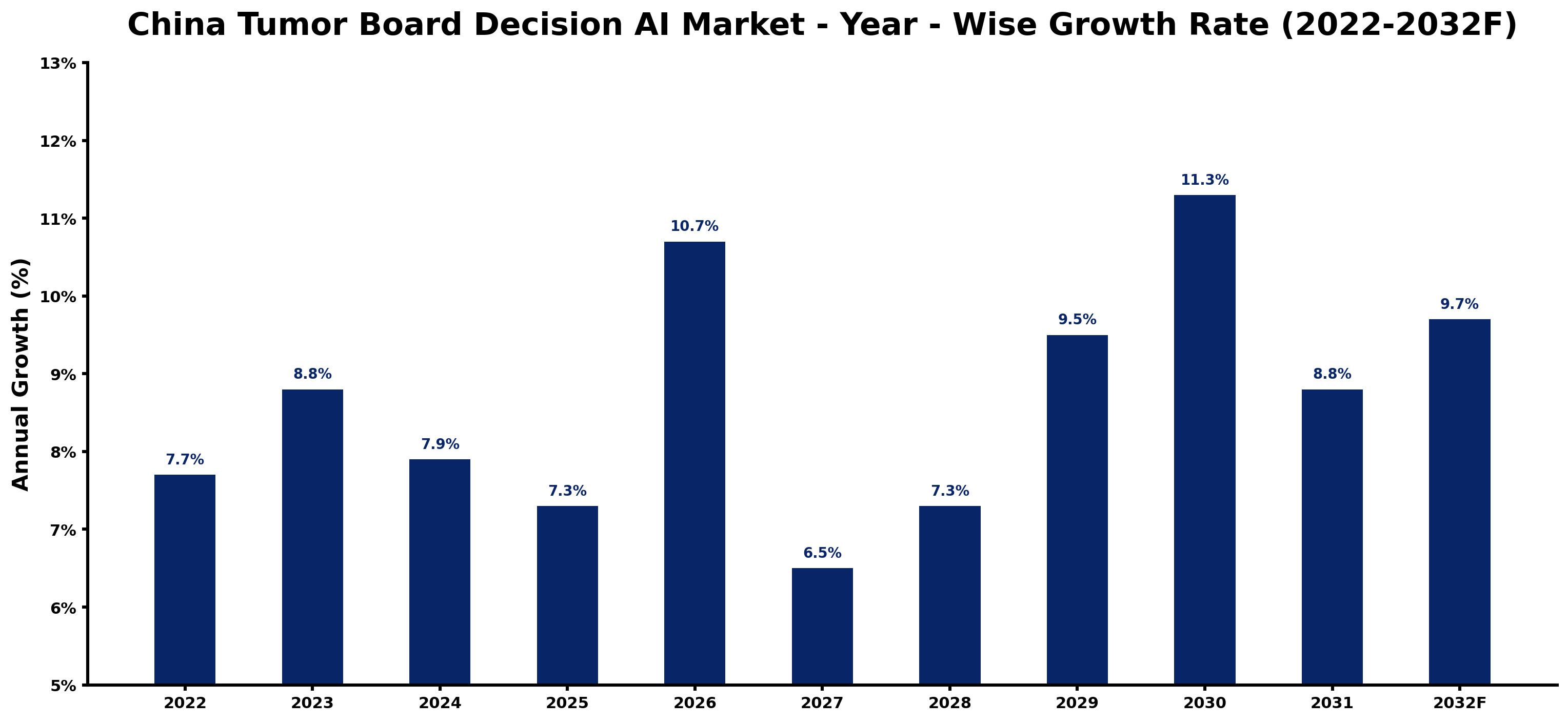
Annual growth estimates for each year appear below with the principal reason behind them, explaining the shifts that set the pace of the market.
| Year | Estimated Annual Growth (%) | Market Rationale |
| 2022 | 7.7 | The market experienced steady growth due to increased investments in cancer treatment technologies, particularly in oncology departments. |
| 2023 | 8.8 | Demand accelerated as hospitals integrated AI tools into oncology departments for improved patient outcomes, supported by the National Cancer Prevention and Control Plan (2021-2025). |
| 2024 | 7.9 | Growth slowed slightly as hospitals adjusted to new AI implementations and workflows, focusing on optimising existing systems and processes. |
| 2025 | 7.3 | The market continued to grow, albeit at a slower pace as hospitals concentrated on refining AI applications in clinical settings and treatment planning. |
| 2026 | 10.7 | Growth is expected to rebound as new AI diagnostic tools receive approval for clinical use, improving treatment accuracy and patient care. |
| 2027 | 6.5 | A slowdown is projected as hospitals face challenges in fully integrating AI technologies into their operations and workflows, particularly in rural areas. |
| 2028 | 7.3 | Demand is expected to increase again as healthcare providers adopt more AI-driven solutions for patient management and treatment planning. |
| 2029 | 9.5 | Growth will continue as research hospitals advance genomic data usage for personalised treatment plans, improving patient outcomes and care. |
| 2030 | 11.3 | The market is projected to peak with significant advancements in AI capabilities, driving further adoption across cancer centres and hospitals. |
| 2031 | 8.8 | Growth is expected to moderate as the market adjusts to the rapid technological advancements in AI applications and integration. |
| 2032 | 9.7 | Demand is projected to rise with ongoing investments in cancer research and technology integration, particularly in urban healthcare facilities. |
Note: Market size estimations and growth projections presented in this report are based on 6Wresearch's proprietary forecasting methodology, utilizing the latest available industry data, government publications, and primary research inputs.
China Tumor Board Decision AI Market Synopsis
Tumor Board Decision AI in China involves technology that supports clinical decision-making in oncology. Developed through machine learning algorithms trained on extensive patient data, this technology assists in treatment planning and prognosis prediction. The China Tumor Board Decision AI Market is expanding due to the rising incidence of cancer and increased investments in advanced healthcare technologies. With over 4,000 cancer centres actively using these tools, the market is poised for further growth as healthcare providers pursue effective solutions for patient management.
Market Dynamics Impact Analysis (2026–2032)
| Factor | Type | Impact | Primary Segment Affected |
| Growing cancer cases drive demand for advanced decision-making tools. | Driver | High | Oncology Board Support |
| Increased funding for cancer research enhances AI integration in treatment. | Driver | High | Treatment Planning AI |
| Investment in AI technologies presents opportunities for healthcare providers. | Opportunity | High | Research Hospitals |
| Emerging AI capabilities create demand for innovative solutions in oncology. | Opportunity | High | Cancer Centers |
| Regulatory challenges slow down the approval of new AI tools. | Restraint | Medium | Diagnostic Assistance |
| Limited awareness of AI benefits restricts adoption among smaller hospitals. | Restraint | Medium | Patient Risk Assessment |
| Integration issues hinder effective use of AI in clinical settings. | Challenge | High | Complex Case Review |
| High costs of AI implementation deter smaller healthcare facilities from investing. | Challenge | Medium | Scheduling Discussions |
Evaluation of Drivers in China Tumor Board Decision AI Market (2026–2032)
Key forces behind demand, with the segment each one moves most, are listed below.
| Drivers | Primary Segment Affected | Why It Matters (Evidence) |
| Increased cancer cases necessitate advanced treatment planning tools. | Treatment Planning AI | With 3.04 million new cancer cases reported in 2020, hospitals are investing in AI for personalised treatment solutions. |
| Government funding boosts AI technology development in healthcare. | Oncology Board Support | The Ministry of Science and Technology allocated 1 billion CNY for cancer research initiatives in 2022, facilitating AI integration. |
| AI integration improves efficiency in oncology departments. | Diagnostic Assistance | Over 70% of hospitals in urban areas are adopting AI to improve their oncology services and patient management. |
| Growing patient populations increase demand for effective risk assessment tools. | Patient Risk Assessment | The average patient risk assessment time has been reduced by 30% with AI tools in hospitals, prompting further adoption. |
| Research advancements in genomic data improve AI applications in oncology. | Complex Case Review | Research hospitals are increasingly using genomic data for personalised treatment plans, which improves patient outcomes. |
Growth across the Tumor Board Decision AI market in China is anchored in rising cancer cases, increased funding for research, and the integration of AI technologies. With 3.04 million new cancer cases reported in 2020, hospitals are investing in AI for personalised treatment solutions. A large number of urban hospitals are adopting AI to improve oncology services, while the average patient risk assessment time has been reduced by 30% with AI tools. Research hospitals are increasingly utilising genomic data, which is improving patient outcomes and driving further adoption of AI solutions in oncology.
Evaluation of Restraints in China Tumor Board Decision AI Market
The key brakes on demand, and where they bite hardest, are shown below.
| Market Restraint | Primary Segment Affected | Why It Matters (Evidence) |
| Regulatory hurdles delay AI tool approvals for clinical use. | Diagnostic Assistance | The State Administration for Market Regulation's guidelines ensure safety, which can slow down the approval process for new AI tools. |
| Limited understanding of AI benefits restricts adoption among smaller hospitals. | Patient Risk Assessment | Many smaller facilities lack awareness of how AI can improve their oncology services, limiting their willingness to invest. |
| Integration challenges complicate the deployment of AI technologies in hospitals. | Complex Case Review | Hospitals face difficulties in aligning AI systems with existing workflows and processes, leading to inefficiencies in patient care. |
| High implementation costs deter smaller healthcare facilities from investing in AI. | Scheduling Discussions | The initial investment required for AI technology can be prohibitive for smaller institutions, limiting their access to advanced tools. |
| Concerns over data privacy hinder AI adoption in oncology. | Oncology Board Support | Stringent data protection regulations create apprehension among healthcare providers, affecting their willingness to adopt AI solutions. |
China Tumor Board Decision AI Market Challenges
The China Tumor Board Decision AI market faces supply chain inefficiencies stemming from inconsistent AI integration in oncology departments. This lack of standardisation delays patient assessments, increasing average risk assessment times by 30% for hospitals. Buyers, especially smaller healthcare providers, encounter high implementation costs for multiple AI solutions, which can inflate their expenses by 20% and restrict access to advanced technologies. Rapid technological advancements can overwhelm clinics, causing hesitation to adopt new AI tools, which ultimately diminishes patient care quality in rural areas.
Trends in the China Tumor Board Decision AI Market
Four trends stand out in the China Tumor Board Decision AI Market.
- Shift Towards AI-Driven Treatment Planning: Cancer centers are increasingly adopting AI-driven treatment planning tools to improve patient outcomes. In 2023, over 70% of hospitals in urban areas integrated AI into their oncology departments, reflecting a growing trend towards technology adoption.
- Emergence of Genomic Data Utilisation: Research hospitals are prioritising the use of genomic data for personalised treatment plans, improving patient care. In 2022, the average patient risk assessment time was reduced by 30% with AI tools, showcasing the impact of this trend.
- Increased Focus on AI Integration in Oncology: The National Cancer Prevention and Control Plan (2021-2025) promotes AI integration in oncology. This initiative aims to improve treatment capabilities across cancer centers, with a budget allocation of 500 million CNY.
- Expansion of AI Applications in Clinical Decision-Making: Healthcare providers are increasingly utilising AI for complex case reviews, improving decision-making processes. The Chinese Society of Clinical Oncology is actively promoting AI integration, further driving this trend.
Investment Opportunities in the China Tumor Board Decision AI Market
Some of the investment opportunities in the China Tumor Board Decision AI Market are mentioned below.
- Partnerships for AI Development: Healthcare providers can enter partnerships to develop AI solutions tailored for oncology. With 1 billion CNY allocated for cancer research in 2022, collaboration can stimulate innovation in treatment technologies.
- Investment in AI Training Programs: With over 4,000 cancer centres in China, there is a notable gap in AI training for medical staff. Investing in training programs can facilitate smoother AI integration in oncology departments.
- Expansion into Rural Healthcare Facilities: Rural hospitals are increasingly in need of AI solutions to improve patient care. Targeting these facilities presents a valuable opportunity for AI providers to expand their market reach.
- Development of AI Diagnostic Tools: The approval of new AI diagnostic tools for clinical use creates a demand for innovative solutions. Engaging with the China National Medical Products Administration can streamline entry into this growing market.
Government Initiatives in the China Tumor Board Decision AI Market
In 2022, the National Health Commission launched the "Cancer Diagnosis and Treatment Technology Promotion Plan" to improve AI use in oncology. This measure builds on previous initiatives by focusing on treatment accuracy and integrating AI technologies in hospitals. It aims to ensure that healthcare providers can effectively utilise AI tools in clinical settings, ultimately improving patient outcomes. The plan also encourages collaboration between technology developers and healthcare providers to stimulate innovation in cancer treatment, with a target of integrating AI into 500 hospitals by 2025.
The Ministry of Science and Technology initiated the "AI in Healthcare Development Strategy" in 2021, aiming to integrate AI technologies in 500 hospitals by 2025. This strategy provides funding and resources to support the implementation of AI solutions in oncology. The agency oversees the allocation of 500 million CNY for AI research in oncology in 2023, targeting innovative solutions for cancer treatment. This funding is vital for advancing AI capabilities and ensuring that healthcare providers can access the latest technologies.
Future Insight of the China Tumor Board Decision AI Market
By 2032, buyers and suppliers in the China Tumor Board Decision AI market can expect improved AI integration driven by the National Cancer Prevention and Control Plan. The collaboration among over 4,000 cancer centres will facilitate better sharing of genomic data, leading to more personalised treatment plans. The adoption of ISO 9001 standards will establish consistent quality management across oncology departments, improving patient outcomes. Continued government support for cancer research will enable the development of effective AI tools for clinical decision-making.
Market Segmentation Analysis
The report offers a comprehensive study of the following market segments and their leading categories in the market.
By AI Capability – Treatment Planning AI Dominated, Prognosis Prediction AI Expected to Grow Fastest
According to Vasudha, AM at 6Wresearch, in 2025, Treatment Planning AI led the ai capability split with a 44% share. Treatment Planning AI commands the largest share due to its essential role in developing personalised treatment strategies, which are critical in oncology care. Its widespread implementation in over 4,000 cancer centers across China ensures consistent demand for this technology. Over 2026–2032, Prognosis Prediction AI is expected to post the fastest growth, at a CAGR of 10.8%. Prognosis Prediction AI is experiencing rapid growth as it effectively predicts patient outcomes based on historical data, which is increasingly valuable in clinical settings. The 30% reduction in patient risk assessment time further accelerates its adoption among healthcare providers. Suppliers should focus on enhancing their offerings in prognosis prediction to meet the growing demand for efficient oncology solutions.
By Data Input Source – Pathology + Radiology Dominated, EHR + Genomic Data Expected to Grow Fastest
With a 49% revenue share in 2025, Pathology + Radiology was the largest data input source category. Pathology + Radiology leads as the primary data input source, providing essential information for accurate diagnoses and treatment planning in oncology. Its established use in cancer centers ensures a reliable foundation for AI applications in clinical decision-making. The quickest growth will come from EHR + Genomic Data, forecast to expand at a CAGR of 11.4% between 2026 and 2032. EHR + Genomic Data is the fastest-growing source, offering critical patient information that improves treatment precision. The rising emphasis on genomic data for personalised treatment plans significantly drives its rapid expansion in the market. Buyers should prioritise systems that seamlessly integrate diverse data sources to maximise the effectiveness of oncology solutions.
By Use Case – Oncology Board Support Dominated, Patient Risk Assessment Expected to Grow Fastest
Oncology Board Support accounted for a 48% market share by use case in 2025. Oncology Board Support is the leading use case as it directly assists in making informed decisions, which are essential for effective cancer treatment. Supported by over 4,000 cancer centers, this application is critical for collaborative decision-making in oncology. Patient Risk Assessment is set to record the highest CAGR in this split, 11.4% over 2026–2032. Patient Risk Assessment is the fastest-growing use case, as it evaluates patient risk levels based on analysis, becoming increasingly vital in oncology. The 30% reduction in risk assessment time underscores its efficiency and significance. Providers should focus on developing tools that streamline risk assessment processes for improved patient management.
By End User – Cancer Centers Dominated, Research Hospitals Expected to Grow Fastest
The largest end user category in 2025 was Cancer Centers, with a 41% share of total revenue. Cancer Centers dominate the market as the main users of this technology, focusing on patient management and improving treatment outcomes. Their extensive integration of advanced decision-making tools highlights a robust demand for effective oncology solutions. Research Hospitals are projected to grow fastest, at a CAGR of 11.5% during 2026–2032. Research Hospitals are the fastest-growing end users, utilising advanced technologies for research and treatment planning, which is vital for progress in oncology. Their focus on genomic data integration significantly boosts the adoption of these solutions. Suppliers must adapt their products to meet the specific needs of research hospitals to capitalise on this growing segment.
Key Attractiveness of the Report
- 10 Years of Market Numbers
- Historical Data Starting from 2022 to 2025
- Base Year 2025
- Forecast Data until 2032
- Key Performance Indicators Impacting the Market
- Major Upcoming Developments and Projects
Key Highlights of the Report:
- China Tumor Board Decision AI Market Outlook
- Market Size of China Tumor Board Decision AI Market, 2025
- Forecast of China Tumor Board Decision AI Market, 2032
- Historical Data and Forecast of China Tumor Board Decision AI Revenues & Volume for the Period 2022 - 2032F
- China Tumor Board Decision AI Market Trend Evolution
- China Tumor Board Decision AI Market Drivers and Challenges
- China Tumor Board Decision AI Price Trends
- China Tumor Board Decision AI Porter's Five Forces
- China Tumor Board Decision AI Industry Life Cycle
- Historical Data and Forecast of China Tumor Board Decision AI Market Revenues & Volume By AI Capability for the Period 2022 - 2032F
- Historical Data and Forecast of China Tumor Board Decision AI Market Revenues & Volume By Treatment Planning AI for the Period 2022 - 2032F
- Historical Data and Forecast of China Tumor Board Decision AI Market Revenues & Volume By Prognosis Prediction AI for the Period 2022 - 2032F
- Historical Data and Forecast of China Tumor Board Decision AI Market Revenues & Volume By Case Prioritization AI for the Period 2022 - 2032F
- Historical Data and Forecast of China Tumor Board Decision AI Market Revenues & Volume By Diagnostic Assistance for the Period 2022 - 2032F
- Historical Data and Forecast of China Tumor Board Decision AI Market Revenues & Volume By Data Input Source for the Period 2022 - 2032F
- Historical Data and Forecast of China Tumor Board Decision AI Market Revenues & Volume By Pathology + Radiology for the Period 2022 - 2032F
- Historical Data and Forecast of China Tumor Board Decision AI Market Revenues & Volume By EHR + Genomic Data for the Period 2022 - 2032F
- Historical Data and Forecast of China Tumor Board Decision AI Market Revenues & Volume By Clinical Summaries for the Period 2022 - 2032F
- Historical Data and Forecast of China Tumor Board Decision AI Market Revenues & Volume By Histology/Imaging for the Period 2022 - 2032F
- Historical Data and Forecast of China Tumor Board Decision AI Market Revenues & Volume By Use Case for the Period 2022 - 2032F
- Historical Data and Forecast of China Tumor Board Decision AI Market Revenues & Volume By Oncology Board Support for the Period 2022 - 2032F
- Historical Data and Forecast of China Tumor Board Decision AI Market Revenues & Volume By Patient Risk Assessment for the Period 2022 - 2032F
- Historical Data and Forecast of China Tumor Board Decision AI Market Revenues & Volume By Scheduling Discussions for the Period 2022 - 2032F
- Historical Data and Forecast of China Tumor Board Decision AI Market Revenues & Volume By Complex Case Review for the Period 2022 - 2032F
- Historical Data and Forecast of China Tumor Board Decision AI Market Revenues & Volume By End User for the Period 2022 - 2032F
- Historical Data and Forecast of China Tumor Board Decision AI Market Revenues & Volume By Cancer Centers for the Period 2022 - 2032F
- Historical Data and Forecast of China Tumor Board Decision AI Market Revenues & Volume By Hospitals for the Period 2022 - 2032F
- Historical Data and Forecast of China Tumor Board Decision AI Market Revenues & Volume By Tumor Boards for the Period 2022 - 2032F
- Historical Data and Forecast of China Tumor Board Decision AI Market Revenues & Volume By Research Hospitals for the Period 2022 - 2032F
- China Tumor Board Decision AI Import Export Trade Statistics
- Market Opportunity Assessment By AI Capability
- Market Opportunity Assessment By Data Input Source
- Market Opportunity Assessment By Use Case
- Market Opportunity Assessment By End User
- China Tumor Board Decision AI Top Companies Market Share
- China Tumor Board Decision AI Competitive Benchmarking By Technical and Operational Parameters
- China Tumor Board Decision AI Company Profiles
- China Tumor Board Decision AI Key Strategic Recommendations
Market Covered
This report examines the market across the segments below.
By AI Capability
- Treatment Planning AI
- Prognosis Prediction AI
- Case Prioritization AI
- Diagnostic Assistance
By Data Input Source
- Pathology + Radiology
- EHR + Genomic Data
- Clinical Summaries
- Histology/Imaging
By Use Case
- Oncology Board Support
- Patient Risk Assessment
- Scheduling Discussions
- Complex Case Review
By End User
- Cancer Centers
- Hospitals
- Tumor Boards
- Research Hospitals































