China Two-Wheeler EV Market Size & Growth Rate
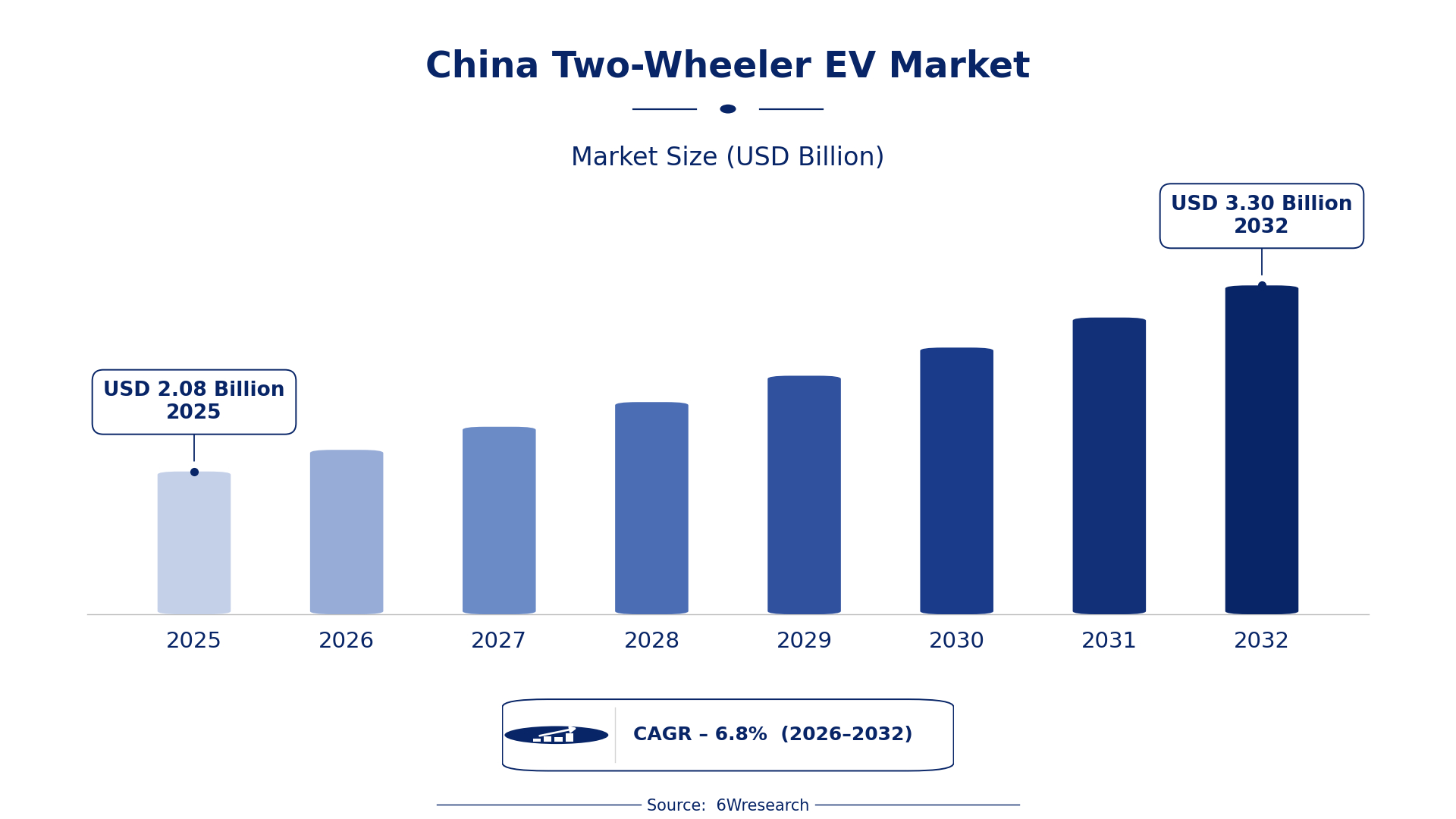
According to 6Wresearch internal database and industry insights, the China Two-Wheeler EV Market was valued at USD 2.08 billion in 2025 and is projected to reach USD 3.30 billion by 2032, growing at a CAGR of approximately 6.8% during 2026–2032.
China Two-Wheeler EV Market Highlights
| Report Metric | Details |
| Report Name | China Two-Wheeler EV Market |
| Market Size 2025 | USD 2.08 billion |
| Market Size 2032 | USD 3.30 billion |
| Absolute Growth 2025–2032 | USD 1.22 billion |
| CAGR 2026–2032 | 6.8% |
| Peak Annual Growth | 9.3% in 2028 |
| Forecast Period | 2026–2032 |
| Historical Data | 2022–2025 |
| Base Year | 2025 |
| Leading Two‑Wheeler EV Type, 2025 | Electric Scooters (41% share) |
| Leading Vehicle Type, 2025 | Urban Commuter (41% share) |
| Leading Powertrain, 2025 | Hub-Motor (33% share) |
| Leading Distribution Channel, 2025 | OEM Dealerships (49% share) |
| Leading End User Industry, 2025 | City Riders (47% share) |
| Fastest-Growing Two‑Wheeler EV Type | Cargo E-Bikes (8.5% CAGR) |
| Fastest-Growing Vehicle Type | Delivery E-Bikes (8.0% CAGR) |
| Fastest-Growing Powertrain | Mid-Drive (9.5% CAGR) |
| Fastest-Growing Distribution Channel | Online E-Commerce (9.0% CAGR) |
| Fastest-Growing End User Industry | Last-mile Delivery (9.1% CAGR) |
| Growing Sector | Last-mile Delivery |
| Key End Users | City Riders, Last-mile Delivery, Enthusiast Riders, DIY Riders |
China Two-Wheeler EV Market Year-wise Growth Rate and Key Drivers (2022–2032)
This graph illustrates the annual growth rates of the market from 2022 to 2032, highlighting a steady upward trajectory and projected market expansion over the forecast period.
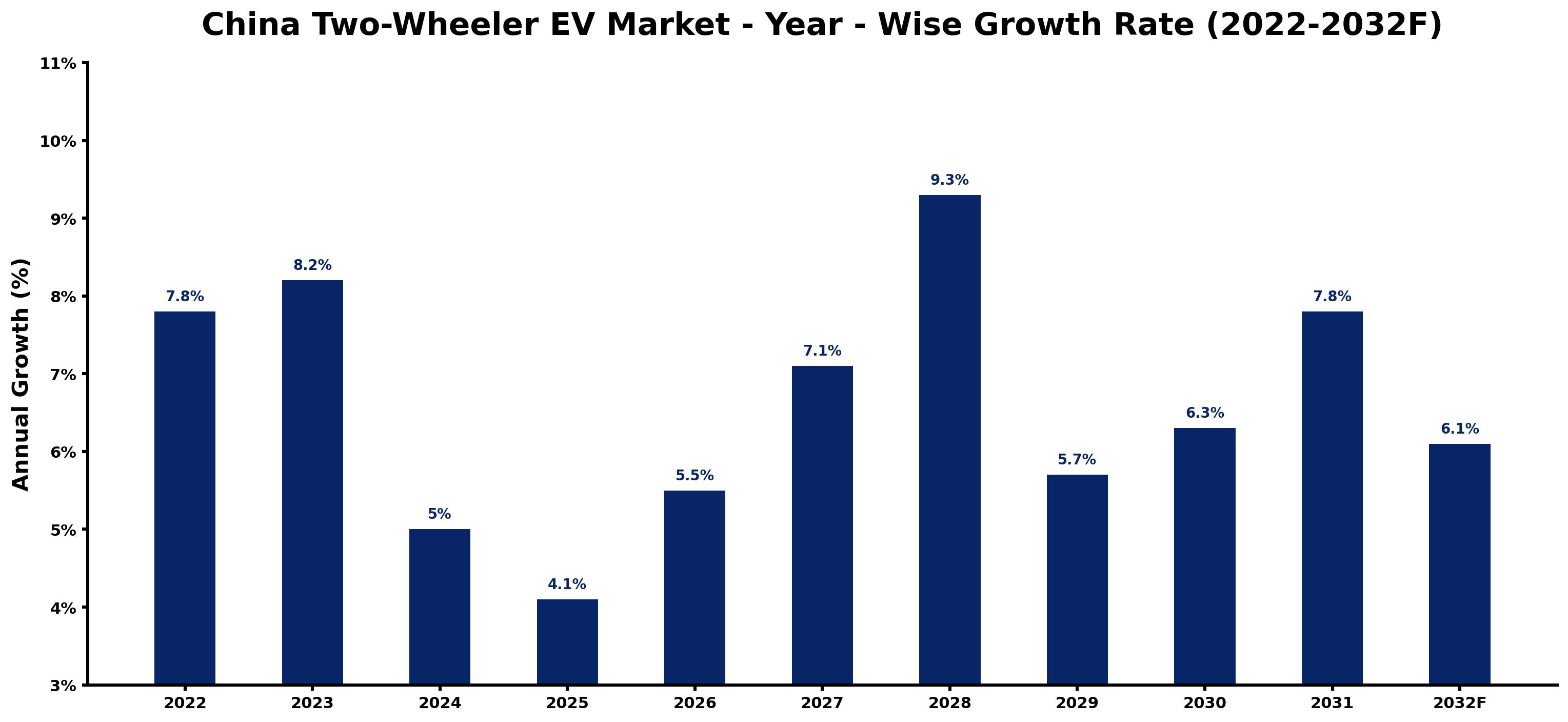
Each row of the following table gives one year's estimated growth and the event or demand shift that explains it.
| Year | Estimated Annual Growth (%) | Market Rationale |
| 2022 | 7.8 | The market experienced solid demand from urban commuters seeking eco-friendly transport options. |
| 2023 | 8.2 | Government initiatives for electric vehicle adoption spurred higher sales and consumer interest. |
| 2024 | 5.0 | Growth slowed as the market adjusted to new vehicle technologies and options. |
| 2025 | 4.1 | Demand continued to decelerate as consumers adapted to evolving electric vehicle choices. |
| 2026 | 5.5 | The market is expected to see renewed growth driven by improved infrastructure and incentives. |
| 2027 | 7.1 | Increased production capacity is projected to support rising consumer demand for electric two-wheelers. |
| 2028 | 9.3 | The peak growth year will benefit from heightened urban adoption and government support. |
| 2029 | 5.7 | Growth is anticipated to slow as the market begins to stabilise after rapid expansion. |
| 2030 | 6.3 | A resurgence in demand is expected as new models and features attract buyers once more. |
| 2031 | 7.8 | Sales are projected to increase as urban areas continue to prioritise electric mobility solutions. |
| 2032 | 6.1 | The market will grow at a slower rate as it matures and competition intensifies. |
Note: Market size estimations and growth projections presented in this report are based on 6Wresearch's proprietary forecasting methodology, utilizing the latest available industry data, government publications, and primary research inputs.
China Two-Wheeler EV Market Synopsis
The Two-Wheeler EV market in China encompasses electric scooters and motorcycles tailored for personal and commercial use. These vehicles utilise advanced electric motors and batteries, addressing urban commuting and last-mile delivery requirements. Strong domestic demand and government backing for sustainable transport are driving market expansion, with over 300 million registered electric scooters in 2022. By 2025, the government aims for 20% of all vehicles on the road to be electric, further encouraging adoption. This growth reflects a transition towards eco-friendly transport solutions among urban commuters and logistics providers.
Market Dynamics Impact Analysis (2026–2032)
| Factor | Type | Impact | Primary Segment Affected |
| Government incentives for electric vehicle purchases boost consumer interest and sales. | Driver | High | Electric Scooters |
| Urban commuters increasingly prefer electric scooters for daily travel due to convenience. | Driver | High | Urban Commuter |
| Rising demand for last-mile delivery solutions creates opportunities for cargo e-bikes. | Opportunity | High | Cargo E-Bikes |
| Online sales of two-wheeler EVs are growing, driven by changing consumer purchasing habits. | Opportunity | Medium | Online E-Commerce |
| High initial costs of electric two-wheelers may deter some potential buyers. | Restraint | High | Electric Motorcycles |
| Limited charging infrastructure in certain regions can hinder adoption rates. | Restraint | Medium | Electric Scooters |
| Competition from traditional petrol-powered vehicles remains a challenge for market penetration. | Challenge | High | Electric Motorcycles |
| Technological advancements in battery efficiency create pressure to innovate rapidly. | Challenge | Medium | Electric Scooters |
Evaluation of Drivers in China Two-Wheeler EV Market (2026–2032)
Below mentioned are some major drivers and their influence on market dynamics.
| Drivers | Primary Segment Affected | Why It Matters (Evidence) |
| Government subsidies for electric two-wheeler purchases encourage consumer adoption. | Electric Scooters | In 2021, the Ministry of Finance initiated a subsidy program providing up to 1,500 RMB per vehicle. |
| Urban commuting trends favour electric scooters for their convenience and efficiency. | Urban Commuter | Over 50% of urban commuters in Beijing prefer electric scooters for daily travel. |
| The logistics sector is increasingly adopting cargo e-bikes for last-mile delivery. | Cargo E-Bikes | Cargo e-bikes are essential for logistics in densely populated cities, with significant demand. |
| Online sales channels are expanding, making electric two-wheelers more accessible. | Online E-Commerce | Online sales of two-wheeler EVs increased by 25% in the last year. |
| Technological advancements in battery capacity improve vehicle performance and range. | Electric Motorcycles | The battery capacity for most electric motorcycles ranges from 48V to 72V. |
Urban commuters favour electric scooters for their convenience, with over 50% of city dwellers choosing them for daily travel. The logistics sector is adopting cargo e-bikes, essential for last-mile delivery in urban areas. Online sales channels have expanded by 25% in the last year, making two-wheeler EVs more accessible to consumers.
Evaluation of Restraints in China Two-Wheeler EV Market
The table below lists the restraints and the evidence behind each.
| Market Restraint | Primary Segment Affected | Why It Matters (Evidence) |
| High upfront costs of electric two-wheelers can limit market growth. | Electric Motorcycles | The average price of a mid-range electric scooter in China is around 3,000 RMB. |
| Limited charging infrastructure can hinder the adoption of electric two-wheelers. | Electric Scooters | The installed base of electric two-wheelers in China is expected to exceed 400 million by 2025. |
| Consumer hesitation due to performance concerns compared to petrol-powered vehicles. | Electric Motorcycles | Many buyers remain cautious due to performance perceptions of electric models, impacting sales. |
| Battery lifespan issues can affect long-term ownership satisfaction. | Electric Scooters | The average lifespan of an electric scooter battery is around 3-5 years, leading to replacement costs. |
| Technological advancements may create pressure to innovate rapidly, affecting stability. | Electric Motorcycles | Rapid advancements in battery technology require constant updates to existing models, straining manufacturers. |
China Two-Wheeler EV Market Challenges
The China Two-Wheeler EV market still has to solve a few problems, starting with technology limitations. Many scooters have a range of only 60-80 km per charge, which restricts their usability for urban commuters who require longer distances for daily travel. Competition is intense, with over 300 million registered electric scooters leading to price wars that can erode profit margins for producers. Buyers face challenges with battery lifespan, as the average scooter battery lasts only 3-5 years, resulting in additional replacement costs. Supply chain issues arise from reliance on specific regions like Zhejiang for manufacturing, which can delay production and affect availability for retailers.
Trends in the China Two-Wheeler EV Market
Buyers and suppliers in the China Two-Wheeler EV Market are adjusting to the following trends.
- Shift towards Electric Scooters in Urban Areas: Cities like Shanghai are seeing a shift towards electric scooters, with over 1 million electric bikes currently in use. This trend mirrors a growing preference for sustainable transport solutions.
- Rise of Cargo E-Bikes for Delivery Services: Cargo e-bikes are increasingly being adopted in logistics, especially in densely populated cities. Their role in last-mile delivery services is expanding, addressing urban logistics challenges.
- Increased Online Sales of Two-Wheeler EVs: Online E-Commerce is becoming an important distribution channel for two-wheeler EVs, with a 25% rise in sales last year. This shift underscores changing consumer purchasing behaviours.
- Government Support for Electric Vehicle Recycling: The Ministry of Industry and Information Technology initiated a programme in 2023 to promote electric vehicle recycling. This effort aims to improve sustainability within the two-wheeler EV market.
Investment Opportunities in the China Two-Wheeler EV Market
Investors looking at the China Two-Wheeler EV Market should consider the following areas.
- Urban Commuters Seeking Eco-Friendly Options: With over 300 million registered electric scooters, urban commuters are increasingly in search of eco-friendly transport options. Suppliers can target this expanding market segment through partnerships with local dealerships.
- Investment in Charging Infrastructure: The government has allocated 10 billion RMB for EV infrastructure development through 2025. This funding presents an opportunity for companies to enter the charging station market.
- Growing Demand for Delivery E-Bikes: As logistics companies pursue efficient delivery solutions, the demand for delivery e-bikes is on the rise. Suppliers can capitalise on this trend by offering tailored electric two-wheeler solutions.
- Expansion of Online Sales Channels: The 25% increase in online sales indicates a growing market for e-commerce in two-wheeler EVs. Companies can explore this space by developing user-friendly platforms for consumers.
Government Initiatives in the China Two-Wheeler EV Market
The 'New Energy Vehicle Industry Development Plan' approved by the State Council in 2020 aims to increase production capacity and infrastructure for electric vehicles, including two-wheelers. This initiative assists manufacturers in scaling operations to meet rising demand. In 2021, the Ministry of Transport launched the 'Green Transportation Development Plan', targeting 30% of new vehicles to be electric by 2025, which encourages buyers to transition to electric models. The plan promotes the establishment of charging stations, enhancing the usability of electric two-wheelers. Furthermore, the 'Electric Vehicle Promotion Program' introduced by the Ministry of Industry and Information Technology in 2023 allocates 5 billion RMB to enhance EV adoption, providing financial support for both producers and consumers.
Buyers in the electric two-wheeler segment benefit from the subsidy programme initiated by the Ministry of Finance in 2021, which offers up to 1,500 RMB per vehicle purchased. This financial incentive encourages consumers to opt for electric scooters and motorcycles, boosting sales in the market. The National Development and Reform Commission's updated 'Electric Vehicle Charging Infrastructure Construction Guidelines' in 2022 streamline the installation processes for charging stations, facilitating easier access for users. These measures support the growth of the electric two-wheeler market by making it more appealing and accessible for urban commuters and logistics providers.
Future Insight of the China Two-Wheeler EV Market
The Two-Wheeler EV market in China will experience notable changes by 2032, primarily driven by advancements in battery technology and supportive government initiatives. The installed base of electric two-wheelers is projected to exceed 400 million by 2025, indicating a robust shift that will benefit both buyers and suppliers. Increased government subsidies for vehicle purchases will encourage more consumers to adopt electric models. The promotion of electric vehicle recycling will strengthen sustainability efforts, appealing to environmentally conscious buyers and ensuring a more circular economy for suppliers.
Market Segmentation Analysis
Each segment group is reviewed below, with the leader by share and the fastest grower by CAGR.
By Two‑Wheeler EV Type – Electric Scooters Dominated, Cargo E-Bikes Expected to Grow Fastest
According to Vasudha, AM at 6Wresearch, with a 41% revenue share in 2025, Electric Scooters was the largest two‑wheeler ev type category. Electric scooters dominate the market share due to their widespread use for urban commuting, with over 300 million registered in China. Their affordability and convenience make them the preferred choice for daily transport in urban environments. Cargo E-Bikes are projected to grow fastest, at a CAGR of 8.5% during 2026–2032. Cargo e-bikes are experiencing rapid growth as they become vital for last-mile delivery services, particularly in densely populated areas. The increasing demand for efficient logistics solutions in urban settings is driving this segment's expansion. Suppliers should focus on enhancing cargo e-bike offerings to capitalise on the growing logistics market.
By Vehicle Type – Urban Commuter Dominated, Delivery E-Bikes Expected to Grow Fastest
The largest vehicle type category in 2025 was Urban Commuter, with a 41% share of total revenue. Urban commuters form the largest user group, heavily relying on electric scooters for daily travel, with over 50% of urban commuters in Beijing opting for this mode. This strong demand signifies a notable shift towards sustainable urban mobility solutions. Delivery E-Bikes are set to record the highest CAGR in this split, 8.0% over 2026–2032. Delivery e-bikes are the fastest-growing segment, fuelled by the rise in e-commerce and the increasing need for efficient delivery solutions. Their essential role in logistics is accelerating this segment's rapid growth. Buyers in the logistics sector should consider investing in delivery e-bikes to enhance operational efficiency.
By Powertrain – Hub-Motor Dominated, Mid-Drive Expected to Grow Fastest
In 2025, Hub-Motor led the powertrain split with a 33% share. Hub-motor systems hold the largest market share as they are the standard for most electric scooters and bikes, providing reliable performance for urban commuting. Their established presence in the market contributes to their dominance. Over 2026–2032, Mid-Drive is expected to post the fastest growth, at a CAGR of 9.5%. Mid-drive systems are gaining traction due to their superior performance characteristics, appealing to performance-oriented electric bike users. This trend indicates a shift towards more advanced powertrain technologies in the market. Manufacturers should invest in mid-drive technology to meet the increasing demand for high-performance electric bikes.
By Distribution Channel – OEM Dealerships Dominated, Online E-Commerce Expected to Grow Fastest
OEM Dealerships accounted for a 49% market share by distribution channel in 2025. OEM dealerships lead the market share as the primary sales channel for new two-wheeler EVs, offering customers direct access to the latest models. Their established networks and consumer trust significantly support their leading position. The quickest growth will come from Online E-Commerce, forecast to expand at a CAGR of 9.0% between 2026 and 2032. Online e-commerce is quickly becoming a preferred distribution channel, with a remarkable 25% increase in online sales of two-wheeler EVs over the past year. This trend highlights the shift in consumer behaviour towards digital purchasing platforms. Suppliers must strengthen their online presence to capture the expanding segment of e-commerce buyers.
By End User Industry – City Riders Dominated, Last-mile Delivery Expected to Grow Fastest
City Riders took a 47% share of end user industry in 2025, more than any other category. City riders constitute the largest user group for two-wheeler EVs, driven by the need for convenient urban transport solutions. Their substantial presence in the market highlights the importance of catering to urban commuting needs effectively. Last-mile Delivery is projected to grow fastest, at a CAGR of 9.1% during 2026–2032. Last-mile delivery is the fastest-growing segment, as cargo e-bikes become increasingly vital for logistics in urban environments. The rise of e-commerce is fuelling this growth, creating new opportunities for suppliers. Suppliers should tailor their products to meet the specific needs of last-mile delivery services.
Key Attractiveness of the Report
- 10 Years of Market Numbers
- Historical Data Starting from 2022 to 2025
- Base Year 2025
- Forecast Data until 2032
- Key Performance Indicators Impacting the Market
- Major Upcoming Developments and Projects
Key Highlights of the Report:
- China Two-Wheeler EV Market Outlook
- Market Size of China Two-Wheeler EV Market, 2025
- Forecast of China Two-Wheeler EV Market, 2032
- Historical Data and Forecast of China Two-Wheeler EV Revenues & Volume for the Period 2022 - 2032F
- China Two-Wheeler EV Market Trend Evolution
- China Two-Wheeler EV Market Drivers and Challenges
- China Two-Wheeler EV Price Trends
- China Two-Wheeler EV Porter's Five Forces
- China Two-Wheeler EV Industry Life Cycle
- Historical Data and Forecast of China Two-Wheeler EV Market Revenues & Volume By Two Wheeler EV Type for the Period 2022 - 2032F
- Historical Data and Forecast of China Two-Wheeler EV Market Revenues & Volume By Electric Scooters for the Period 2022 - 2032F
- Historical Data and Forecast of China Two-Wheeler EV Market Revenues & Volume By Electric Motorcycles for the Period 2022 - 2032F
- Historical Data and Forecast of China Two-Wheeler EV Market Revenues & Volume By Cargo E-Bikes for the Period 2022 - 2032F
- Historical Data and Forecast of China Two-Wheeler EV Market Revenues & Volume By E-Bike Kits for the Period 2022 - 2032F
- Historical Data and Forecast of China Two-Wheeler EV Market Revenues & Volume By Vehicle Type for the Period 2022 - 2032F
- Historical Data and Forecast of China Two-Wheeler EV Market Revenues & Volume By Urban Commuter for the Period 2022 - 2032F
- Historical Data and Forecast of China Two-Wheeler EV Market Revenues & Volume By Mid-Large Bikes for the Period 2022 - 2032F
- Historical Data and Forecast of China Two-Wheeler EV Market Revenues & Volume By Delivery E-Bikes for the Period 2022 - 2032F
- Historical Data and Forecast of China Two-Wheeler EV Market Revenues & Volume By Retrofit Kits for the Period 2022 - 2032F
- Historical Data and Forecast of China Two-Wheeler EV Market Revenues & Volume By Powertrain for the Period 2022 - 2032F
- Historical Data and Forecast of China Two-Wheeler EV Market Revenues & Volume By Hub-Motor for the Period 2022 - 2032F
- Historical Data and Forecast of China Two-Wheeler EV Market Revenues & Volume By Mid-Drive for the Period 2022 - 2032F
- Historical Data and Forecast of China Two-Wheeler EV Market Revenues & Volume By Mid-Drive Motor for the Period 2022 - 2032F
- Historical Data and Forecast of China Two-Wheeler EV Market Revenues & Volume By Battery Motor Combo for the Period 2022 - 2032F
- Historical Data and Forecast of China Two-Wheeler EV Market Revenues & Volume By Distribution Channel for the Period 2022 - 2032F
- Historical Data and Forecast of China Two-Wheeler EV Market Revenues & Volume By OEM Dealerships for the Period 2022 - 2032F
- Historical Data and Forecast of China Two-Wheeler EV Market Revenues & Volume By OEM Brand Stores for the Period 2022 - 2032F
- Historical Data and Forecast of China Two-Wheeler EV Market Revenues & Volume By Fleet Suppliers for the Period 2022 - 2032F
- Historical Data and Forecast of China Two-Wheeler EV Market Revenues & Volume By Online E-Commerce for the Period 2022 - 2032F
- Historical Data and Forecast of China Two-Wheeler EV Market Revenues & Volume By End User Industry for the Period 2022 - 2032F
- Historical Data and Forecast of China Two-Wheeler EV Market Revenues & Volume By City Riders for the Period 2022 - 2032F
- Historical Data and Forecast of China Two-Wheeler EV Market Revenues & Volume By Enthusiast Riders for the Period 2022 - 2032F
- Historical Data and Forecast of China Two-Wheeler EV Market Revenues & Volume By Last-mile Delivery for the Period 2022 - 2032F
- Historical Data and Forecast of China Two-Wheeler EV Market Revenues & Volume By DIY Riders for the Period 2022 - 2032F
- China Two-Wheeler EV Import Export Trade Statistics
- Market Opportunity Assessment By Two Wheeler EV Type
- Market Opportunity Assessment By Vehicle Type
- Market Opportunity Assessment By Powertrain
- Market Opportunity Assessment By Distribution Channel
- Market Opportunity Assessment By End User Industry
- China Two-Wheeler EV Top Companies Market Share
- China Two-Wheeler EV Competitive Benchmarking By Technical and Operational Parameters
- China Two-Wheeler EV Company Profiles
- China Two-Wheeler EV Key Strategic Recommendations
Market Covered
The report offers an extensive study of the following market segments.
By Two‑Wheeler EV Type
- Electric Scooters
- Electric Motorcycles
- Cargo E-Bikes
- E-Bike Kits
By Vehicle Type
- Urban Commuter
- Mid-Large Bikes
- Delivery E-Bikes
- Retrofit Kits
By Powertrain
- Hub-Motor
- Mid-Drive
- Mid-Drive Motor
- Battery + Motor Combo
By Distribution Channel
- OEM Dealerships
- OEM Brand Stores
- Fleet Suppliers
- Online E-Commerce
By End User Industry
- City Riders
- Enthusiast Riders
- Last-mile Delivery
- DIY Riders































