India Two-Wheeler EV Market Size & Growth Rate
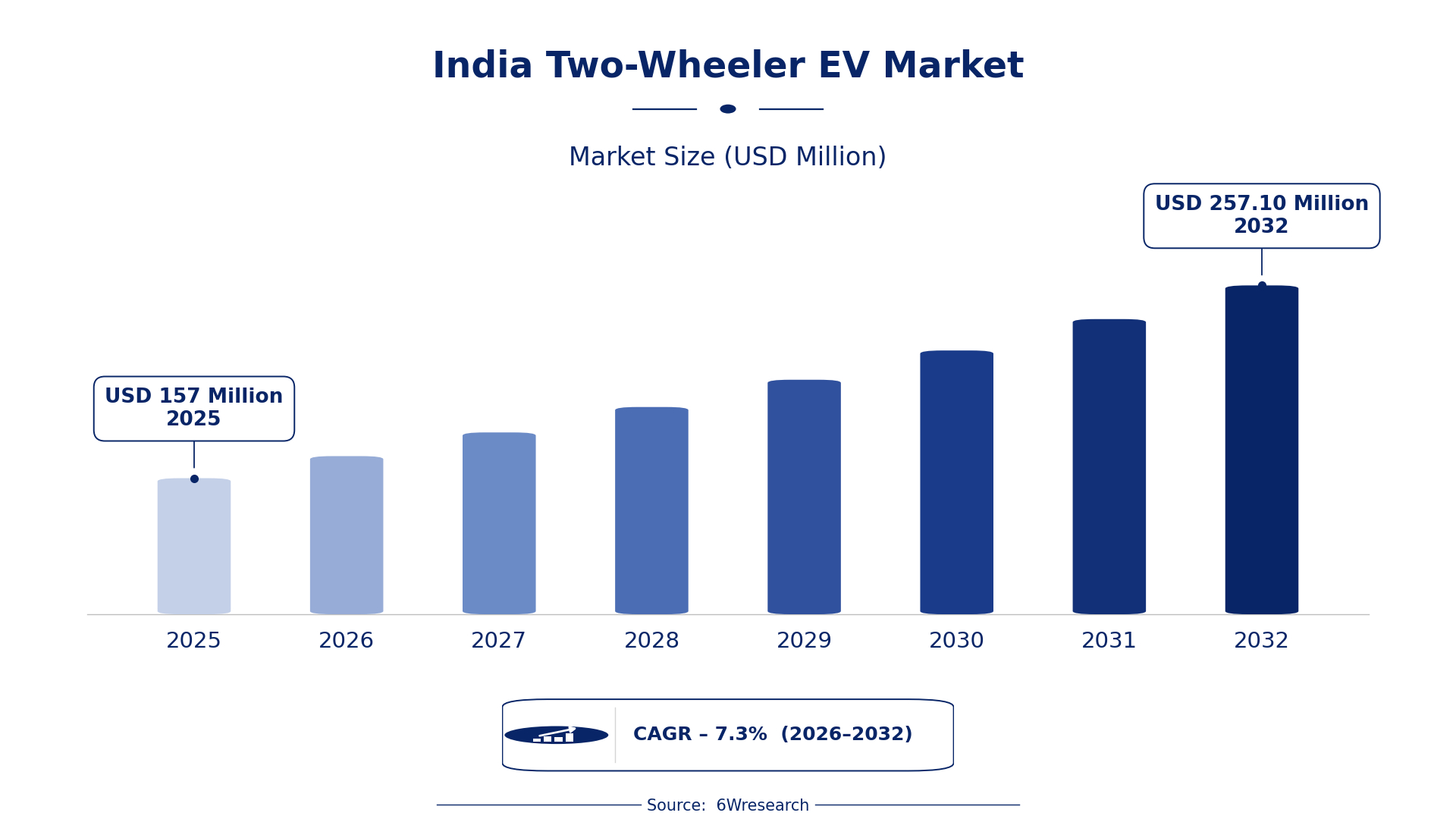
According to 6Wresearch internal database and industry insights, the India Two-Wheeler EV Market was valued at USD 157.0 million in 2025 and is projected to reach USD 257.10 million by 2032, growing at a CAGR of approximately 7.3% during 2026–2032.
India Two-Wheeler EV Market Highlights
| Report Metric | Details |
| Report Name | India Two-Wheeler EV Market |
| Market Size 2025 | USD 157.0 million |
| Market Size 2032 | USD 257.10 million |
| Absolute Growth 2025–2032 | USD 100.10 million |
| CAGR 2026–2032 | 7.3% |
| Peak Annual Growth | 9.2% in 2031 |
| Forecast Period | 2026–2032 |
| Historical Data | 2022–2025 |
| Base Year | 2025 |
| Leading Two‑Wheeler EV Type, 2025 | Electric Scooters (46% share) |
| Leading Vehicle Type, 2025 | Urban Commuter (44% share) |
| Leading Powertrain, 2025 | Hub-Motor (39% share) |
| Leading Distribution Channel, 2025 | OEM Dealerships (47% share) |
| Leading End User Industry, 2025 | City Riders (53% share) |
| Fastest-Growing Two‑Wheeler EV Type | Cargo E-Bikes (8.5% CAGR) |
| Fastest-Growing Vehicle Type | Delivery E-Bikes (9.0% CAGR) |
| Fastest-Growing Powertrain | Mid-Drive (10.0% CAGR) |
| Fastest-Growing Distribution Channel | Online E-Commerce (9.7% CAGR) |
| Fastest-Growing End User Industry | Last-mile Delivery (9.4% CAGR) |
| Growing Sector | Urban Commuting |
| Key End Users | City Riders, Delivery Services, Enthusiast Riders, Fleet Suppliers |
India Two-Wheeler EV Market Year-wise Growth Rate and Key Drivers (2022–2032)
This graph illustrates the annual growth rates of the market from 2022 to 2032, highlighting a steady upward trajectory and projected market expansion over the forecast period.
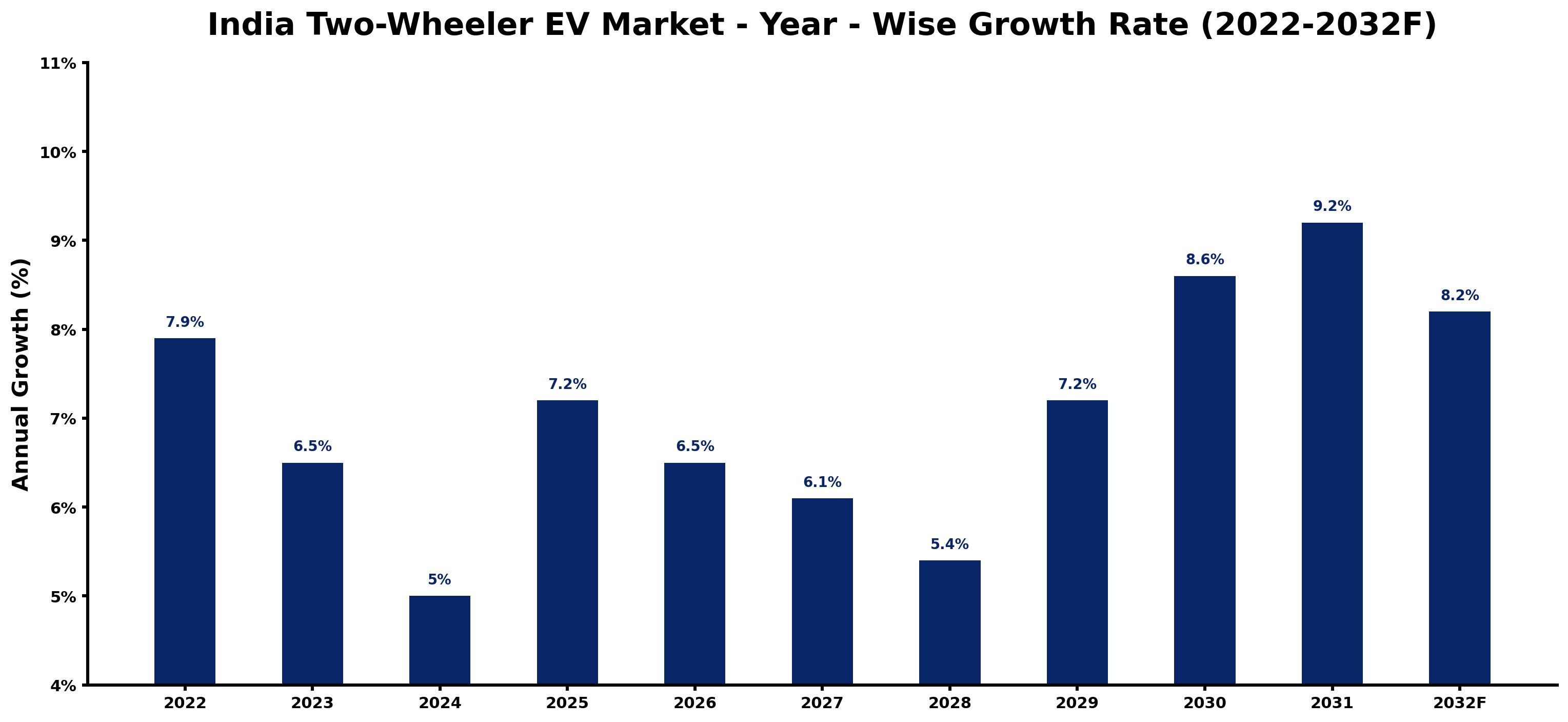
Each row of the following table gives one year's estimated growth and the event or demand shift that explains it.
| Year | Estimated Annual Growth (%) | Market Rationale |
| 2022 | 7.9 | The market showed strong performance due to increasing urban commuting needs. |
| 2023 | 6.5 | Growth slowed as buyers adjusted to rising electric vehicle prices. |
| 2024 | 5.0 | Demand continued to decelerate as supply chain issues persisted. |
| 2025 | 7.2 | A resurgence in growth occurred as government incentives gained traction. |
| 2026 | 6.5 | Growth slowed again as competition intensified in the market. |
| 2027 | 6.1 | Demand remained steady as urban infrastructure improved for EVs. |
| 2028 | 5.4 | The market experienced a slowdown as consumer preferences shifted. |
| 2029 | 7.2 | Growth accelerated with the rise of last-mile delivery services. |
| 2030 | 8.6 | A significant increase in demand occurred due to urban pollution concerns. |
| 2031 | 9.2 | The market peaked as electric vehicle adoption reached new heights. |
| 2032 | 8.2 | Growth slowed slightly as the market matured and competition increased. |
Note: Market size estimations and growth projections presented in this report are based on 6Wresearch's proprietary forecasting methodology, utilizing the latest available industry data, government publications, and primary research inputs.
India Two-Wheeler EV Market Synopsis
The Two-Wheeler EV Market in India includes battery-powered vehicles intended for both personal and commercial use. These vehicles utilise electric motors and batteries, primarily catering to urban commuting and last-mile delivery needs. The market is growing, propelled by government incentives and increasing urban demand. With a target of 30% electric vehicle adoption by 2030, substantial investments are being directed towards infrastructure and charging stations. States such as Maharashtra and Karnataka are at the forefront of this adoption, further accelerating market growth.
Market Dynamics Impact Analysis (2026–2032)
| Factor | Type | Impact | Primary Segment Affected |
| Government incentives and subsidies for electric two-wheelers encourage consumer purchases. | Driver | High | Urban Commuter |
| Growing urbanisation and environmental concerns drive demand for electric vehicles. | Driver | High | City Riders |
| Increased investment in EV infrastructure creates opportunities for manufacturers. | Opportunity | High | OEM Dealerships |
| Rising demand for delivery services boosts the cargo e-bike segment. | Opportunity | High | Delivery E-Bikes |
| High initial costs of electric vehicles deter some potential buyers. | Restraint | High | Electric Scooters |
| Limited charging infrastructure in rural areas hampers market growth. | Restraint | Medium | Electric Motorcycles |
| Supply chain disruptions can delay production and delivery timelines. | Challenge | High | Cargo E-Bikes |
| Competition from traditional fuel-powered two-wheelers remains a challenge. | Challenge | Medium | Electric Motorcycles |
Evaluation of Drivers in India Two-Wheeler EV Market (2026–2032)
The factors lifting demand, and the evidence behind each, are summarised below.
| Drivers | Primary Segment Affected | Why It Matters (Evidence) |
| Government subsidies under the FAME II scheme promote electric vehicle adoption. | Electric Scooters | This initiative provides financial incentives, making electric scooters more affordable for consumers. |
| Urbanisation increases the demand for efficient commuting solutions. | Urban Commuter | As cities expand, more people seek convenient transport options, boosting electric scooter sales. |
| Investment in charging infrastructure boosts consumer confidence in EVs. | OEM Dealerships | Over 200 charging stations installed in major cities encourage buyers to consider electric vehicles for daily use. |
| The rise of e-commerce boosts demand for delivery e-bikes. | Delivery E-Bikes | Logistics companies are increasingly adopting electric bikes for last-mile delivery, driving sales. |
| Technological advancements in battery efficiency improve vehicle performance. | Electric Motorcycles | Better battery technology increases range and reduces charging times, attracting more buyers. |
Growth across the Two-Wheeler EV market in India is anchored in increasing urbanisation, investment in infrastructure and technological advancements. The FAME II scheme, with a budget of INR 10,000 crore, incentivises electric vehicle purchases, making them more accessible. The demand for delivery e-bikes is rising, driven by the growth of e-commerce logistics, which is projected to increase by 9.0% from 2026 to 2032. The installation of over 200 charging stations in major cities boosts consumer confidence, leading to higher adoption rates. The average price of electric scooters ranges from INR 50,000 to INR 1,50,000, making them attractive for urban commuters.
Evaluation of Restraints in India Two-Wheeler EV Market
The table below lists the restraints and the evidence behind each.
| Market Restraint | Primary Segment Affected | Why It Matters (Evidence) |
| High upfront costs of electric two-wheelers limit market accessibility. | Electric Scooters | Many consumers find the initial investment prohibitive, affecting sales. |
| Inadequate charging infrastructure in rural areas restricts market reach. | Electric Motorcycles | Limited charging options deter potential buyers in less urbanised regions. |
| Supply chain disruptions can lead to delays in vehicle availability. | Cargo E-Bikes | Manufacturers face challenges in sourcing components, impacting production timelines. |
| Consumer preference for traditional fuel-powered vehicles remains strong. | Electric Motorcycles | Many buyers are hesitant to switch due to familiarity with conventional bikes. |
| Limited awareness about the benefits of electric vehicles hinders growth. | Delivery E-Bikes | Potential buyers may not fully understand the advantages of EVs over traditional options. |
India Two-Wheeler EV Market Challenges
The India Two-Wheeler EV Market encounters several challenges, starting with supply chain disruptions that hinder production timelines. These issues stem from dependence on imported components, causing delays of up to six months for producers in fulfilling orders. Competition is intense, as new entrants lower prices, potentially leading to a 20% reduction in profit margins for established manufacturers. A shortage of skilled workers limits the advancement of EV technologies, which could cost producers their competitive advantage. High battery costs, averaging between INR 50,000 and INR 1,50,000, inflate the overall price of electric scooters, prompting buyers to reconsider their purchasing decisions.
Trends in the India Two-Wheeler EV Market
The trends below show where the India Two-Wheeler EV Market is heading.
- Shift towards Electric Scooters for Urban Commuting: Sales of electric scooters reached 1.5 million units in 2022, indicating a growing preference for sustainable transport solutions among urban commuters.
- Rise of Delivery E-Bikes in Logistics: The demand for delivery e-bikes surged as e-commerce expanded, with a projected CAGR of 9.0% from 2026 to 2032. This shift highlights the need for efficient last-mile delivery solutions.
- Increased Investment in Charging Infrastructure: Investment in charging stations is accelerating, with over 200 installations in major cities by 2023. This development supports the growing electric vehicle market by improving accessibility.
- Government Incentives Driving Adoption: The Delhi Electric Vehicle Policy 2020 provides subsidies of up to INR 30,000 per vehicle, significantly boosting electric two-wheeler sales. This initiative demonstrates the government's commitment to EV adoption.
Investment Opportunities in the India Two-Wheeler EV Market
Some of the investment opportunities in the India Two-Wheeler EV Market are mentioned below.
- Urban Commuters Seeking Affordable Solutions: With rising urbanisation, there is a growing need for affordable electric scooters. The average price ranges from INR 50,000 to INR 1,50,000, making this segment attractive for manufacturers.
- Last-Mile Delivery Services Expanding: The demand for delivery e-bikes is increasing, driven by the growth of e-commerce. Companies can invest in this segment to meet rising logistics needs, particularly in urban areas.
- Investment in Charging Infrastructure: Now is the time to invest in charging stations, as the government aims for one every 3 km in urban areas. Collaborating with local authorities can facilitate entry into this market.
- Growing Online Sales Channel: Online sales of two-wheeler EVs increased by 40% in 2022, indicating a shift in consumer purchasing behaviour. Establishing an online presence can capture this growing market segment.
Government Initiatives in the India Two-Wheeler EV Market
The Faster Adoption and Manufacturing of Hybrid and Electric Vehicles (FAME II) scheme, launched in 2021, allocates INR 10,000 crore to promote electric vehicle adoption. This measure provides incentives for buyers, making electric two-wheelers more affordable and accessible. The National Electric Mobility Mission Plan (NEMMP) 2020 aims for 6-7 million electric vehicle sales by 2025, focusing on two-wheelers. These initiatives support the growth of the two-wheeler EV market by encouraging consumer purchases and expanding infrastructure.
The Bureau of Indian Standards (BIS) oversees the implementation of EV standards, ensuring manufacturers comply with safety and performance requirements. Additionally, the Ministry of Power issued guidelines in 2022 for the installation of EV charging stations. This initiative aims to establish a charging station every 3 km in urban areas, improving the infrastructure necessary for electric vehicles. These measures are essential for supporting the growth of the two-wheeler EV market in India.
Future Insight of the India Two-Wheeler EV Market
The India Two-Wheeler EV Market is set for substantial growth by 2032, driven by several pivotal factors. The government's goal of achieving 30% electric vehicle adoption by 2030 under the FAME II scheme will significantly boost infrastructure development, including plans for extensive charging networks. Battery swapping stations will improve convenience for users, reducing charging time and promoting wider adoption. With the expectation of creating over 1 million jobs by 2025, the workforce supporting this market will expand, encouraging innovation and enhancing overall market potential.
Market Segmentation Analysis
The analysis below covers each segmentation, its leading category in 2025 and its fastest-growing category through 2032.
By Two‑Wheeler EV Type – Electric Scooters Dominated, Cargo E-Bikes Expected to Grow Fastest
According to Vasudha, AM at 6Wresearch, Electric Scooters held a 46% share of the India Two-Wheeler EV Market by two‑wheeler ev type in 2025. Electric scooters dominate the market as they cater to the vast urban commuting segment, appealing to daily riders seeking efficient transport solutions. Their strong presence is evidenced by the 1.5 million units sold in 2022, highlighting robust consumer demand. Over 2026–2032, Cargo E-Bikes are expected to post the fastest growth, at a CAGR of 8.5%. Cargo e-bikes are rapidly gaining traction due to the increasing need for last-mile delivery solutions, especially in urban areas where logistics efficiency is paramount. The 40% increase in online sales in 2022 signifies a shift towards effective delivery methods, propelling this segment's growth. Suppliers should focus on enhancing cargo e-bike features to meet the rising demands of delivery services.
By Vehicle Type – Urban Commuter Dominated, Delivery E-Bikes Expected to Grow Fastest
Urban Commuter took a 44% share of vehicle type in 2025, more than any other category. Urban commuters form the largest user segment for two-wheeler EVs, driven by the necessity for efficient transport in congested cities. This demographic's significant contribution to market share makes urban commuting a primary focus for manufacturers. Delivery E-Bikes are projected to grow fastest, at a CAGR of 9.0% during 2026–2032. Delivery e-bikes are quickly gaining popularity as logistics companies seek efficient solutions for urban deliveries, particularly with the rise of e-commerce. Continued investment in EV infrastructure is essential to support this segment's rapid growth. Buyers in the delivery sector should invest in e-bikes to enhance operational efficiency and reduce costs.
By Powertrain – Hub-Motor Dominated, Mid-Drive Expected to Grow Fastest
Hub-Motor accounted for a 39% market share by powertrain in 2025. The hub-motor powertrain is prevalent in electric scooters, providing reliable performance and efficiency for urban commuting. Its established market presence ensures a strong share among consumers prioritising practicality and ease of use. Mid-Drive is set to record the highest CAGR in this split, 10.0% over 2026–2032. Mid-drive systems are increasingly preferred for performance-oriented electric motorcycles, appealing to riders seeking superior speed and handling. As consumer preferences shift towards high-performance options, this segment is well-positioned for rapid growth. Manufacturers should concentrate on advancing mid-drive technology to cater to the performance-driven segment of the market.
By Distribution Channel – OEM Dealerships Dominated, Online E-Commerce Expected to Grow Fastest
With a 47% revenue share in 2025, OEM Dealerships was the largest distribution channel category. OEM dealerships are the primary sales channel for new two-wheeler EVs, offering consumers direct access to various models and expert guidance. This trusted channel maintains a strong market share due to its established reputation among buyers. The quickest growth will come from Online E-Commerce, forecast to expand at a CAGR of 9.7% between 2026 and 2032. Online e-commerce is emerging as the fastest-growing channel, driven by the convenience of purchasing vehicles and accessories from home. This trend reflects changing consumer preferences towards accessible purchasing options. Suppliers should enhance their online presence to capture the growing segment of consumers who prefer e-commerce for their purchases.
By End User Industry – City Riders Dominated, Last-mile Delivery Expected to Grow Fastest
In 2025, City Riders led the end user industry split with a 53% share. City riders represent a substantial user base for two-wheeler EVs, utilising them for daily commuting in urban environments. Their large demographic significantly contributes to market share, making them a critical focus for manufacturers. Over 2026–2032, Last-mile Delivery is expected to post the fastest growth, at a CAGR of 9.4%. Last-mile delivery is expanding rapidly as businesses seek efficient solutions for transporting goods in urban areas, especially with the surge in e-commerce. This segment's growth is fuelled by the increasing demand for quick and reliable delivery services. Suppliers should tailor their offerings to meet the specific requirements of last-mile delivery services, ensuring competitiveness in this growing sector.
Key Attractiveness of the Report
- 10 Years of Market Numbers
- Historical Data Starting from 2022 to 2025
- Base Year 2025
- Forecast Data until 2032
- Key Performance Indicators Impacting the Market
- Major Upcoming Developments and Projects
Key Highlights of the Report:
- India Two-Wheeler EV Market Outlook
- Market Size of India Two-Wheeler EV Market, 2025
- Forecast of India Two-Wheeler EV Market, 2032
- Historical Data and Forecast of India Two-Wheeler EV Revenues & Volume for the Period 2022 - 2032F
- India Two-Wheeler EV Market Trend Evolution
- India Two-Wheeler EV Market Drivers and Challenges
- India Two-Wheeler EV Price Trends
- India Two-Wheeler EV Porter's Five Forces
- India Two-Wheeler EV Industry Life Cycle
- Historical Data and Forecast of India Two-Wheeler EV Market Revenues & Volume By Two Wheeler EV Type for the Period 2022 - 2032F
- Historical Data and Forecast of India Two-Wheeler EV Market Revenues & Volume By Electric Scooters for the Period 2022 - 2032F
- Historical Data and Forecast of India Two-Wheeler EV Market Revenues & Volume By Electric Motorcycles for the Period 2022 - 2032F
- Historical Data and Forecast of India Two-Wheeler EV Market Revenues & Volume By Cargo E-Bikes for the Period 2022 - 2032F
- Historical Data and Forecast of India Two-Wheeler EV Market Revenues & Volume By E-Bike Kits for the Period 2022 - 2032F
- Historical Data and Forecast of India Two-Wheeler EV Market Revenues & Volume By Vehicle Type for the Period 2022 - 2032F
- Historical Data and Forecast of India Two-Wheeler EV Market Revenues & Volume By Urban Commuter for the Period 2022 - 2032F
- Historical Data and Forecast of India Two-Wheeler EV Market Revenues & Volume By Mid-Large Bikes for the Period 2022 - 2032F
- Historical Data and Forecast of India Two-Wheeler EV Market Revenues & Volume By Delivery E-Bikes for the Period 2022 - 2032F
- Historical Data and Forecast of India Two-Wheeler EV Market Revenues & Volume By Retrofit Kits for the Period 2022 - 2032F
- Historical Data and Forecast of India Two-Wheeler EV Market Revenues & Volume By Powertrain for the Period 2022 - 2032F
- Historical Data and Forecast of India Two-Wheeler EV Market Revenues & Volume By Hub-Motor for the Period 2022 - 2032F
- Historical Data and Forecast of India Two-Wheeler EV Market Revenues & Volume By Mid-Drive for the Period 2022 - 2032F
- Historical Data and Forecast of India Two-Wheeler EV Market Revenues & Volume By Mid-Drive Motor for the Period 2022 - 2032F
- Historical Data and Forecast of India Two-Wheeler EV Market Revenues & Volume By Battery Motor Combo for the Period 2022 - 2032F
- Historical Data and Forecast of India Two-Wheeler EV Market Revenues & Volume By Distribution Channel for the Period 2022 - 2032F
- Historical Data and Forecast of India Two-Wheeler EV Market Revenues & Volume By OEM Dealerships for the Period 2022 - 2032F
- Historical Data and Forecast of India Two-Wheeler EV Market Revenues & Volume By OEM Brand Stores for the Period 2022 - 2032F
- Historical Data and Forecast of India Two-Wheeler EV Market Revenues & Volume By Fleet Suppliers for the Period 2022 - 2032F
- Historical Data and Forecast of India Two-Wheeler EV Market Revenues & Volume By Online E-Commerce for the Period 2022 - 2032F
- Historical Data and Forecast of India Two-Wheeler EV Market Revenues & Volume By End User Industry for the Period 2022 - 2032F
- Historical Data and Forecast of India Two-Wheeler EV Market Revenues & Volume By City Riders for the Period 2022 - 2032F
- Historical Data and Forecast of India Two-Wheeler EV Market Revenues & Volume By Enthusiast Riders for the Period 2022 - 2032F
- Historical Data and Forecast of India Two-Wheeler EV Market Revenues & Volume By Last-mile Delivery for the Period 2022 - 2032F
- Historical Data and Forecast of India Two-Wheeler EV Market Revenues & Volume By DIY Riders for the Period 2022 - 2032F
- India Two-Wheeler EV Import Export Trade Statistics
- Market Opportunity Assessment By Two Wheeler EV Type
- Market Opportunity Assessment By Vehicle Type
- Market Opportunity Assessment By Powertrain
- Market Opportunity Assessment By Distribution Channel
- Market Opportunity Assessment By End User Industry
- India Two-Wheeler EV Top Companies Market Share
- India Two-Wheeler EV Competitive Benchmarking By Technical and Operational Parameters
- India Two-Wheeler EV Company Profiles
- India Two-Wheeler EV Key Strategic Recommendations
Market Covered
The report offers an extensive study of the following market segments.
By Two‑Wheeler EV Type
- Electric Scooters
- Electric Motorcycles
- Cargo E-Bikes
- E-Bike Kits
By Vehicle Type
- Urban Commuter
- Mid-Large Bikes
- Delivery E-Bikes
- Retrofit Kits
By Powertrain
- Hub-Motor
- Mid-Drive
- Mid-Drive Motor
- Battery + Motor Combo
By Distribution Channel
- OEM Dealerships
- OEM Brand Stores
- Fleet Suppliers
- Online E-Commerce
By End User Industry
- City Riders
- Enthusiast Riders
- Last-mile Delivery
- DIY Riders































