China Ultrasound AI Software Market Size & Growth Rate
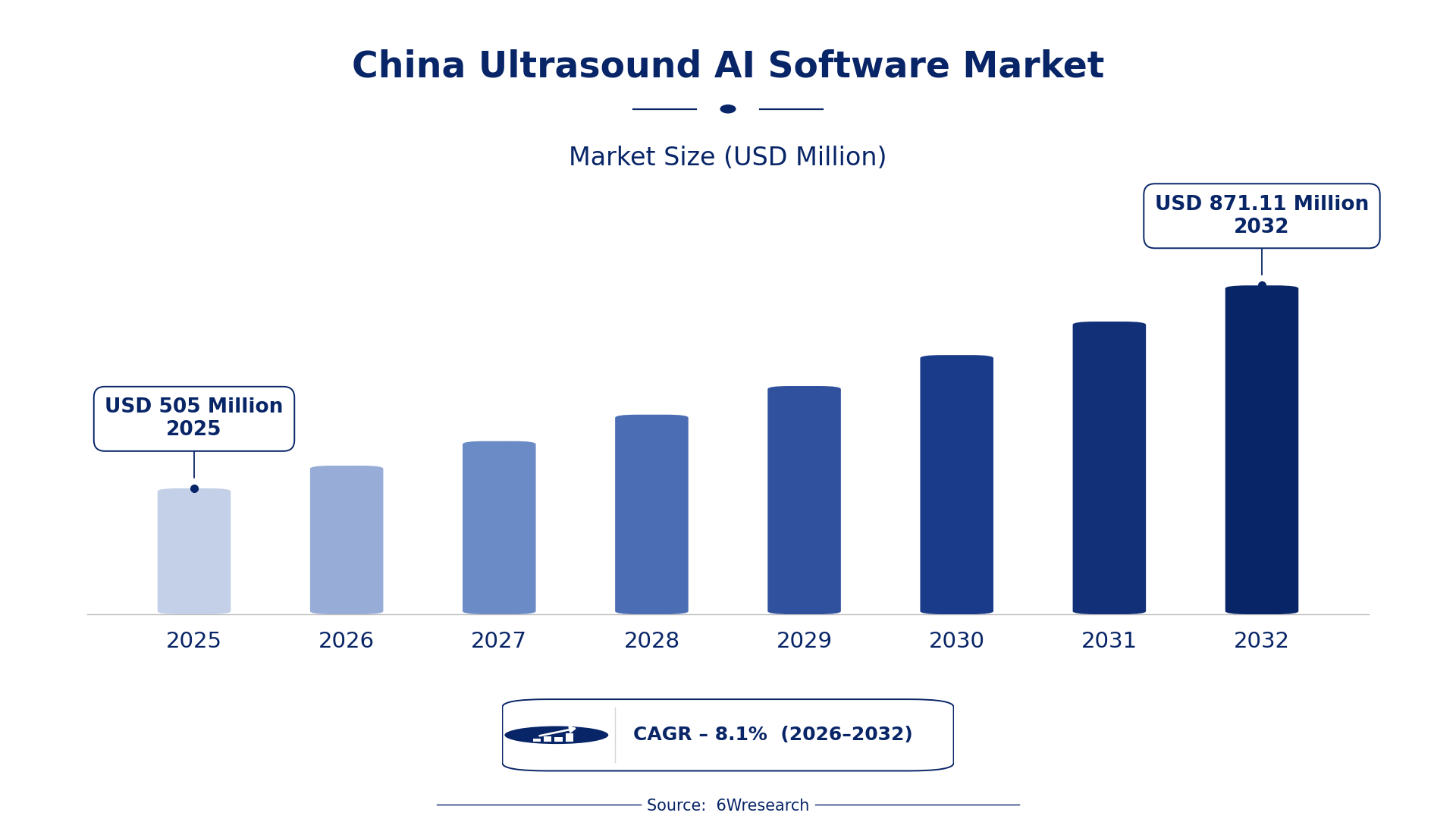
According to 6Wresearch internal database and industry insights, the China Ultrasound AI Software Market was valued at USD 505.0 million in 2025 and is projected to reach USD 871.11 million by 2032, growing at a CAGR of approximately 8.1% during 2026–2032.
China Ultrasound AI Software Market Highlights
| Report Metric | Details |
| Report Name | China Ultrasound AI Software Market |
| Market Size 2025 | USD 505.0 million |
| Market Size 2032 | USD 871.11 million |
| Absolute Growth 2025–2032 | USD 366.11 million |
| CAGR 2026–2032 | 8.1% |
| Peak Annual Growth | 10.0% in 2032 |
| Forecast Period | 2026–2032 |
| Historical Data | 2022–2025 |
| Base Year | 2025 |
| Leading Software Type, 2025 | Real-Time Detection (34% share) |
| Leading Use Case, 2025 | Tumor Identification (39% share) |
| Leading Integration Platform, 2025 | Ultrasound Machines (46% share) |
| Leading End User, 2025 | Hospitals (44% share) |
| Fastest-Growing Software Type | Image Segmentation (10.2% CAGR) |
| Fastest-Growing Use Case | Risk Stratification (10.8% CAGR) |
| Fastest-Growing Integration Platform | Cloud API (9.4% CAGR) |
| Fastest-Growing End User | Healthcare IT Firms (10.4% CAGR) |
| Growing Sector | Healthcare IT |
| Key End Users | Hospitals, Radiology Centers, Healthcare IT Firms, Clinics |
China Ultrasound AI Software Market Year-wise Growth Rate and Key Drivers (2022–2032)
This graph illustrates the annual growth rates of the market from 2022 to 2032, highlighting a steady upward trajectory and projected market expansion over the forecast period.
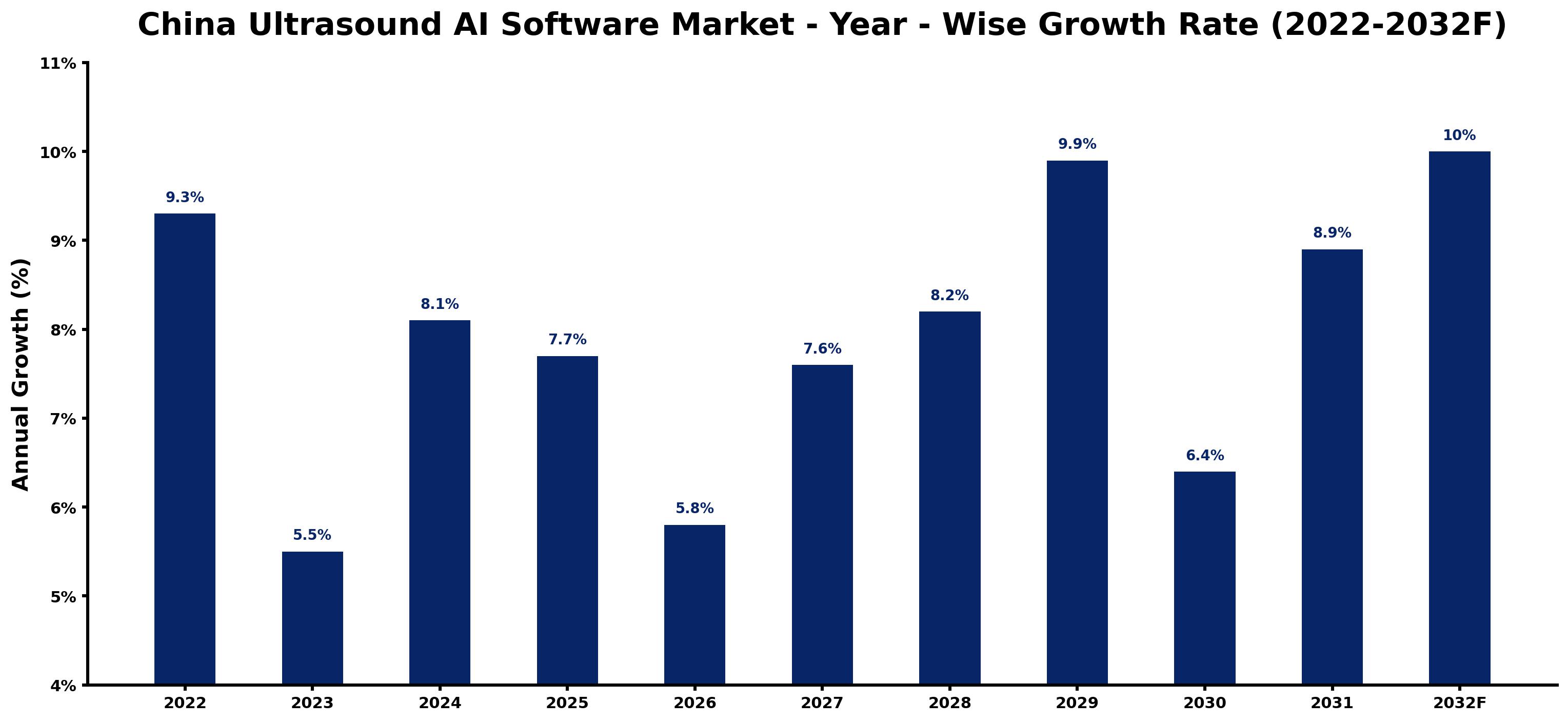
Year by year, the estimates below pair each growth rate with the development that shaped it.
| Year | Estimated Annual Growth (%) | Market Rationale |
| 2022 | 9.3 | The market experienced strong demand due to increased adoption of AI technologies in healthcare. |
| 2023 | 5.5 | Growth slowed as hospitals adjusted to new technologies and patient management practices. |
| 2024 | 8.1 | Demand picked up as more hospitals integrated ultrasound AI software for diagnostics. |
| 2025 | 7.7 | A slight slowdown occurred as hospitals focused on optimising existing systems. |
| 2026 | 5.8 | Growth is expected to decelerate as the market matures and competition intensifies among providers. |
| 2027 | 7.6 | Increased investments in healthcare IT are projected to spur a resurgence in demand for AI software. |
| 2028 | 8.2 | Demand is anticipated to rise as hospitals seek advanced imaging solutions to improve patient outcomes. |
| 2029 | 9.9 | The market is expected to expand as more radiology centers adopt AI-based ultrasound technologies. |
| 2030 | 6.4 | Growth is projected to slow as the market stabilises and reaches a more mature phase. |
| 2031 | 8.9 | Demand will increase as healthcare facilities aim to meet evolving diagnostic standards. |
| 2032 | 10.0 | The peak growth rate is expected to be achieved as the integration of AI becomes widespread. |
Note: Market size estimations and growth projections presented in this report are based on 6Wresearch's proprietary forecasting methodology, utilizing the latest available industry data, government publications, and primary research inputs.
China Ultrasound AI Software Market Synopsis
The China Ultrasound AI Software Market showcases a remarkable evolution in diagnostic imaging technology. This software enhances diagnostic precision and elevates patient care through real-time detection of abnormalities and predictive analytics. The market is expanding due to increased investments in healthcare IT and a growing demand from hospitals and radiology centres. In 2022, the healthcare IT market was valued at approximately 50 billion USD, underscoring the importance of this technology in the sector. The integration of AI into ultrasound applications is anticipated to improve healthcare delivery across the nation.
Market Dynamics Impact Analysis (2026–2032)
| Factor | Type | Impact | Primary Segment Affected |
| Growing investments in healthcare IT infrastructure | Driver | High | Real-Time Detection |
| Increasing demand for accurate diagnostics in hospitals | Driver | High | Tumor Identification |
| Emerging opportunities in healthcare IT innovation | Opportunity | High | Healthcare IT Firms |
| Rising demand for predictive analytics in diagnostics | Opportunity | High | Predictive Analytics |
| Challenges in integrating AI with existing systems | Restraint | Medium | Workflow Optimization |
| Limited awareness among smaller clinics about AI benefits | Restraint | Medium | Clinics |
| Market players face regulatory hurdles in product approvals | Challenge | High | Real-Time Detection |
| Competition from traditional imaging methods remains strong | Challenge | Medium | Radiology Centers |
Evaluation of Drivers in China Ultrasound AI Software Market (2026–2032)
The main growth drivers and the segments they affect most are set out below.
| Drivers | Primary Segment Affected | Why It Matters (Evidence) |
| Increased funding for healthcare IT projects | Real-Time Detection | In 2023, 200 million CNY was allocated for AI technology development, driving demand for ultrasound AI solutions. |
| Growing number of ultrasound procedures performed annually | Tumor Identification | With around 10 million ultrasound procedures conducted each year, hospitals are adopting AI software to improve diagnostic accuracy. |
| Rising standards for diagnostic imaging technologies | Predictive Analytics | The National Health Commission's standards for ultrasound imaging technologies encourage hospitals to invest in AI solutions, improving overall quality. |
| Expansion of radiology centers across the nation | Radiology Centers | China has over 1,000 radiology centers, creating strong demand for advanced ultrasound AI software to meet patient needs. |
| Integration of AI in medical imaging by 2025 | Healthcare IT Firms | The healthcare system aims to integrate AI into 80% of medical imaging by 2025, boosting demand for ultrasound AI software. |
Market growth for Ultrasound AI Software in China is underpinned by increased funding for healthcare IT projects and a growing number of ultrasound procedures performed annually. In 2023, 200 million CNY was allocated for AI technology development, driving demand for ultrasound AI solutions. Approximately 10 million ultrasound procedures are performed each year, leading hospitals to adopt AI software for improved diagnostic accuracy. Rising standards for diagnostic imaging technologies encourage hospitals to invest in AI solutions, while the expansion of radiology centers creates strong demand for advanced software. With over 1,000 radiology centers in China, the need for effective ultrasound AI solutions continues to rise.
Evaluation of Restraints in China Ultrasound AI Software Market
The following restraints limit how fast demand can grow.
| Market Restraint | Primary Segment Affected | Why It Matters (Evidence) |
| Integration challenges with existing healthcare systems | Workflow Optimization | Many healthcare facilities face difficulties in integrating AI with their current systems, delaying implementation by up to six months. |
| Limited awareness of AI benefits among smaller clinics | Clinics | Smaller clinics often lack the resources to invest in AI technologies, hindering market growth by limiting adoption rates. |
| Regulatory hurdles in product approvals | Real-Time Detection | Market players encounter stringent regulations that slow down the approval process for new AI products, extending time to market. |
| Competition from traditional imaging methods | Radiology Centers | Traditional imaging methods remain popular, making it challenging for AI solutions to gain market share and slowing adoption. |
| High initial costs of implementing AI technologies | Hospitals | The upfront investment required for AI integration can deter hospitals from adopting these technologies, limiting overall market growth. |
China Ultrasound AI Software Market Challenges
China's ultrasound AI software market still has to solve a few problems, and the first is cost. High development expenses for producers result in software pricing that can exceed 100,000 CNY, making it challenging for smaller hospitals to adopt. A shortage of skilled personnel in AI technology hampers progress; this skills gap leads to inefficiencies for distributors, delaying software deployment by up to six months. Buyers face difficulties in integrating these advanced systems into existing workflows, which can disrupt operations and increase costs by 15% during the transition. Supply chain issues arise from reliance on specific components, causing delays that can extend project timelines by three months for many healthcare providers.
Trends in the China Ultrasound AI Software Market
Several trends are reshaping the China Ultrasound AI Software Market; the most important are set out below.
- Shift from Traditional Imaging to AI-Driven Solutions: In 2023, over 100 hospitals in Beijing adopted ultrasound AI software, reflecting a growing trend towards advanced imaging technologies. This shift is expected to improve diagnostic accuracy and patient outcomes.
- Transition from Manual Analysis to Automated Diagnostics: Since 2021, the integration of AI in ultrasound imaging has gained momentum, particularly in major cities. Hospitals are increasingly relying on AI for real-time detection and analysis.
- Emergence of Cloud-Based Solutions in Ultrasound AI: The rise of cloud API integration has transformed ultrasound AI software capabilities, enabling better data management. In 2023, this segment is projected to grow at a CAGR of 9.4%.
- Prioritisation of Predictive Analytics in Diagnostics: As of 2023, there is a notable focus on predictive analytics within ultrasound AI software, with hospitals seeking to enhance patient risk assessment capabilities.
Investment Opportunities in the China Ultrasound AI Software Market
Investors looking at the China Ultrasound AI Software Market should consider the following areas.
- Current Investment in AI Technologies: With the Chinese government allocating 200 million CNY for AI development in 2023, there is an opportunity for suppliers to develop innovative ultrasound AI solutions that meet emerging standards.
- Partnerships with Healthcare IT Firms: Now is an ideal time for companies to form partnerships with healthcare IT firms to enhance AI integration in hospitals, particularly as demand for predictive analytics grows.
- Gap in AI Adoption Among Smaller Clinics: As smaller clinics lag in AI adoption, there is a market gap to supply affordable ultrasound AI solutions that cater to their needs, particularly in rural areas.
- Expansion of Radiology Centers: The growth of radiology centres presents an opportunity to supply advanced ultrasound AI software, especially in regions with high patient volumes.
Government Initiatives in the China Ultrasound AI Software Market
In 2021, the National Health Commission launched the 'Digital Health Development Plan' to improve AI integration in healthcare, focusing on ultrasound technologies. This initiative aims to enhance diagnostic accuracy and patient outcomes through the adoption of advanced imaging solutions. The Ministry of Industry and Information Technology introduced the 'AI in Healthcare Initiative' in 2022, promoting the adoption of AI in diagnostic imaging with a budget of 500 million CNY. This funding supports the development and implementation of ultrasound AI software across healthcare facilities. In 2022, the Chinese government initiated the 'Smart Healthcare Strategy' to improve healthcare delivery through technology, including ultrasound AI software.
The National Medical Products Administration has updated guidelines for AI software in medical devices, ensuring safety and efficacy. In 2023, the State Administration for Market Regulation facilitated faster market entry for ultrasound AI software products. This regulatory support encourages innovation and expedites the integration of AI technologies in healthcare settings. The Ministry of Industry and Information Technology oversees the implementation of various funding schemes, which support the development of AI technologies in healthcare, benefiting producers and buyers alike.
Future Insight of the China Ultrasound AI Software Market
The ultrasound AI software market in China is set to evolve by 2032, driven by several key factors. The government’s commitment to integrating AI into 80% of medical imaging by 2025 will support software adoption across various healthcare settings. Advances in machine learning techniques will improve diagnostic accuracy, benefiting the approximately 10 million ultrasound procedures performed annually. The establishment of national standards by the National Health Commission will ensure consistent quality, fostering trust among buyers and suppliers.
Market Segmentation Analysis
Each segment group is reviewed below, with the leader by share and the fastest grower by CAGR.
By Software Type – Real-Time Detection Dominated, Image Segmentation Expected to Grow Fastest
According to Bhawna Singh, Assistant Manager at 6Wresearch, Real-Time Detection took a 34% share of software type in 2025, more than any other category. Real-Time Detection holds the largest share as it directly improves diagnostic accuracy in ultrasound imaging, making it essential for healthcare providers. The integration of this technology in over 100 hospitals in Beijing illustrates its critical role in enhancing patient care. Image Segmentation is set to record the highest CAGR in this split, 10.2% over 2026–2032. Image Segmentation is experiencing rapid growth due to its ability to provide clearer images for better analysis, which is increasingly sought after in modern diagnostics. The push for advanced imaging techniques in healthcare facilities is driving this segment's rapid expansion. Suppliers should focus on enhancing real-time detection features to meet the growing demand from hospitals.
By Use Case – Tumor Identification Dominated, Risk Stratification Expected to Grow Fastest
With a 39% revenue share in 2025, Tumor Identification was the largest use case category. Tumor Identification is the leading use case as it is crucial for detecting tumors during ultrasound scans, a primary concern for healthcare providers. The emphasis on early detection in the Chinese healthcare system significantly boosts this segment's share. The quickest growth will come from Risk Stratification, forecast to expand at a CAGR of 10.8% between 2026 and 2032. Risk Stratification is witnessing the fastest growth because it plays a vital role in evaluating patient risk levels, which is increasingly important for personalised medicine. As healthcare providers aim to optimise patient outcomes, this use case is gaining traction. Buyers should prioritise solutions that enhance risk stratification capabilities to improve patient management.
By Integration Platform – Ultrasound Machines Dominated, Cloud API Expected to Grow Fastest
Ultrasound Machines accounted for a 46% market share by integration platform in 2025. Ultrasound Machines dominate this segment as they are directly integrated with ultrasound software, enhancing functionality and diagnostic capabilities. The direct application in hospitals ensures a robust installed base, solidifying its market share. Over 2026–2032, Cloud API is expected to post the fastest growth, at a CAGR of 9.4%. Cloud API is growing swiftly as it allows for indirect access to ultrasound data via cloud services, catering to the increasing demand for remote healthcare solutions. The shift towards digital health solutions is propelling this integration platform's rapid adoption. Suppliers must invest in cloud-based solutions to align with the industry's digital transformation.
By End User – Hospitals Dominated, Healthcare IT Firms Expected to Grow Fastest
Hospitals held a 44% share of the China Ultrasound AI Software Market by end user in 2025. Hospitals represent the largest share of end users as they directly implement ultrasound technology for improved patient care. The substantial number of ultrasound procedures performed annually in China highlights the critical role hospitals play in this market. Healthcare IT Firms are projected to grow fastest, at a CAGR of 10.4% during 2026–2032. Healthcare IT Firms are the fastest-growing segment as they indirectly support the integration of ultrasound software into healthcare systems, responding to the increasing demand for advanced healthcare IT solutions. Their role in facilitating technology adoption is becoming increasingly vital. Suppliers should engage with healthcare IT firms to enhance software integration and expand their market reach.
Key Attractiveness of the Report
- 10 Years of Market Numbers
- Historical Data Starting from 2022 to 2025
- Base Year 2025
- Forecast Data until 2032
- Key Performance Indicators Impacting the Market
- Major Upcoming Developments and Projects
Key Highlights of the Report:
- China Ultrasound AI Software Market Outlook
- Market Size of China Ultrasound AI Software Market, 2025
- Forecast of China Ultrasound AI Software Market, 2032
- Historical Data and Forecast of China Ultrasound AI Software Revenues & Volume for the Period 2022 - 2032F
- China Ultrasound AI Software Market Trend Evolution
- China Ultrasound AI Software Market Drivers and Challenges
- China Ultrasound AI Software Price Trends
- China Ultrasound AI Software Porter's Five Forces
- China Ultrasound AI Software Industry Life Cycle
- Historical Data and Forecast of China Ultrasound AI Software Market Revenues & Volume By Software Type for the Period 2022 - 2032F
- Historical Data and Forecast of China Ultrasound AI Software Market Revenues & Volume By Real-Time Detection for the Period 2022 - 2032F
- Historical Data and Forecast of China Ultrasound AI Software Market Revenues & Volume By Image Segmentation for the Period 2022 - 2032F
- Historical Data and Forecast of China Ultrasound AI Software Market Revenues & Volume By Predictive Analytics for the Period 2022 - 2032F
- Historical Data and Forecast of China Ultrasound AI Software Market Revenues & Volume By Workflow Optimization for the Period 2022 - 2032F
- Historical Data and Forecast of China Ultrasound AI Software Market Revenues & Volume By Use Case for the Period 2022 - 2032F
- Historical Data and Forecast of China Ultrasound AI Software Market Revenues & Volume By Tumor Identification for the Period 2022 - 2032F
- Historical Data and Forecast of China Ultrasound AI Software Market Revenues & Volume By Cardiac Imaging for the Period 2022 - 2032F
- Historical Data and Forecast of China Ultrasound AI Software Market Revenues & Volume By Risk Stratification for the Period 2022 - 2032F
- Historical Data and Forecast of China Ultrasound AI Software Market Revenues & Volume By Scan Time Reduction for the Period 2022 - 2032F
- Historical Data and Forecast of China Ultrasound AI Software Market Revenues & Volume By Integration Platform for the Period 2022 - 2032F
- Historical Data and Forecast of China Ultrasound AI Software Market Revenues & Volume By Ultrasound Machines for the Period 2022 - 2032F
- Historical Data and Forecast of China Ultrasound AI Software Market Revenues & Volume By PACS / RIS for the Period 2022 - 2032F
- Historical Data and Forecast of China Ultrasound AI Software Market Revenues & Volume By Cloud API for the Period 2022 - 2032F
- Historical Data and Forecast of China Ultrasound AI Software Market Revenues & Volume By EMR Systems for the Period 2022 - 2032F
- Historical Data and Forecast of China Ultrasound AI Software Market Revenues & Volume By End User for the Period 2022 - 2032F
- Historical Data and Forecast of China Ultrasound AI Software Market Revenues & Volume By Radiology Centers for the Period 2022 - 2032F
- Historical Data and Forecast of China Ultrasound AI Software Market Revenues & Volume By Hospitals for the Period 2022 - 2032F
- Historical Data and Forecast of China Ultrasound AI Software Market Revenues & Volume By Healthcare IT Firms for the Period 2022 - 2032F
- Historical Data and Forecast of China Ultrasound AI Software Market Revenues & Volume By Clinics for the Period 2022 - 2032F
- China Ultrasound AI Software Import Export Trade Statistics
- Market Opportunity Assessment By Software Type
- Market Opportunity Assessment By Use Case
- Market Opportunity Assessment By Integration Platform
- Market Opportunity Assessment By End User
- China Ultrasound AI Software Top Companies Market Share
- China Ultrasound AI Software Competitive Benchmarking By Technical and Operational Parameters
- China Ultrasound AI Software Company Profiles
- China Ultrasound AI Software Key Strategic Recommendations
Market Covered
The report offers an extensive study of the following market segments.
By Software Type
- Real-Time Detection
- Image Segmentation
- Predictive Analytics
- Workflow Optimization
By Use Case
- Tumor Identification
- Cardiac Imaging
- Risk Stratification
- Scan Time Reduction
By Integration Platform
- Ultrasound Machines
- PACS / RIS
- Cloud API
- EMR Systems
By End User
- Radiology Centers
- Hospitals
- Healthcare IT Firms
- Clinics































