China Underground Waste Collection Systems Market Size & Growth Rate
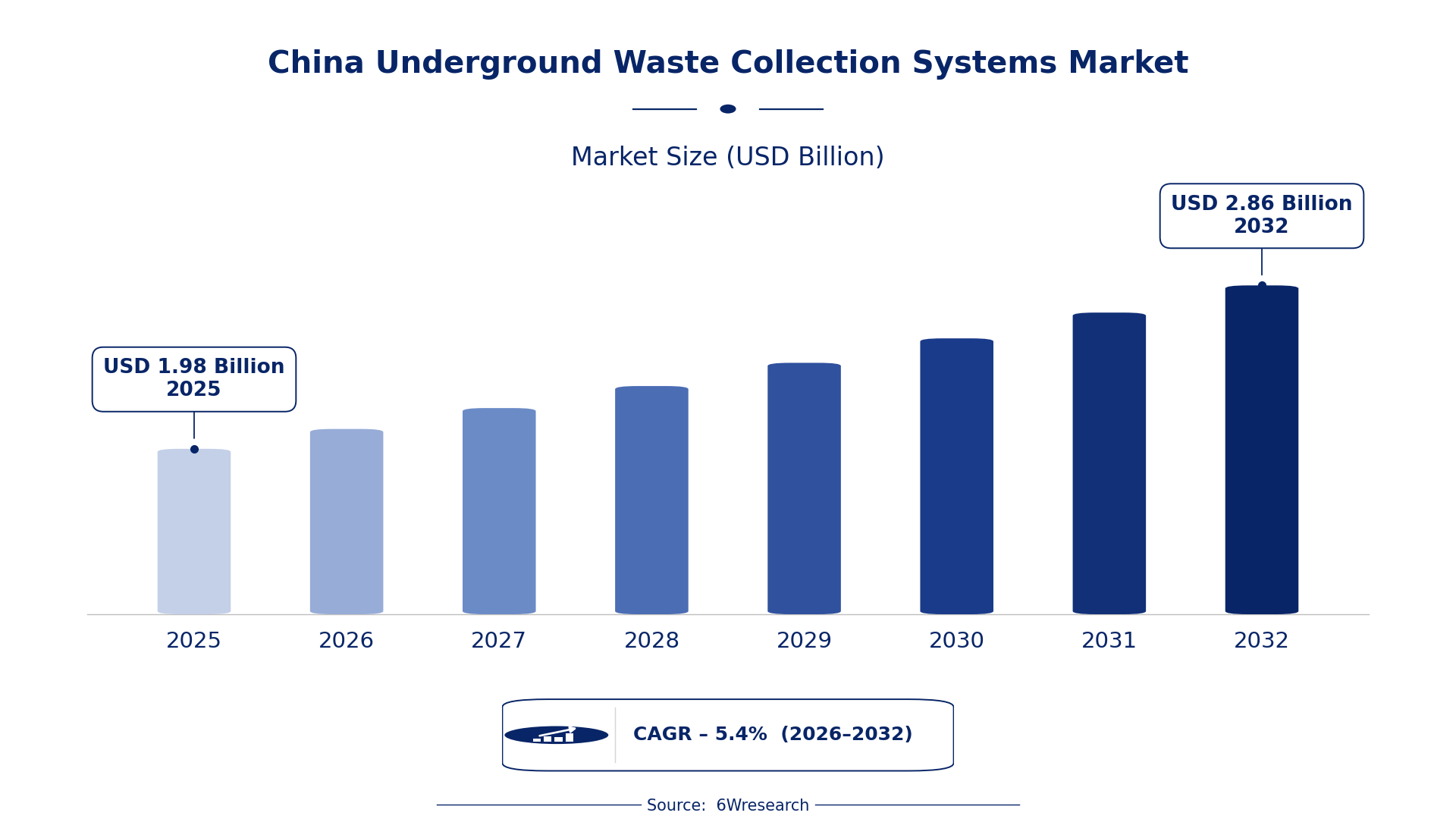
According to 6Wresearch internal database and industry insights, the China Underground Waste Collection Systems Market was valued at USD 1.98 billion in 2025 and is projected to reach USD 2.86 billion by 2032, growing at a CAGR of approximately 5.4% during 2026–2032.
China Underground Waste Collection Systems Market Highlights
| Report Metric | Details |
| Report Name | China Underground Waste Collection Systems Market |
| Market Size 2025 | USD 1.98 billion |
| Market Size 2032 | USD 2.86 billion |
| Absolute Growth 2025–2032 | USD 0.88 billion |
| CAGR 2026–2032 | 5.4% |
| Peak Annual Growth | 7.1% in 2027 |
| Forecast Period | 2026–2032 |
| Historical Data | 2022–2025 |
| Base Year | 2025 |
| Leading System Type, 2025 | Pneumatic Collection (38% share) |
| Leading Waste Type, 2025 | Household Waste (45% share) |
| Leading Installation Site, 2025 | Urban Areas (53% share) |
| Leading End User, 2025 | City Municipalities (52% share) |
| Fastest-Growing System Type | Hybrid Underground Bins (8.0% CAGR) |
| Fastest-Growing Waste Type | Organic/Plastic (6.7% CAGR) |
| Fastest-Growing Installation Site | Residential Projects (7.9% CAGR) |
| Fastest-Growing End User | Smart Cities (7.1% CAGR) |
| Growing Sector | Municipal a leading supplier. |
| Key End Users | City Municipalities, Urban Planners, Real Estate Developers |
China Underground Waste Collection Systems Market Year-wise Growth Rate and Key Drivers (2022–2032)
This graph illustrates the annual growth rates of the market from 2022 to 2032, highlighting a steady upward trajectory and projected market expansion over the forecast period.
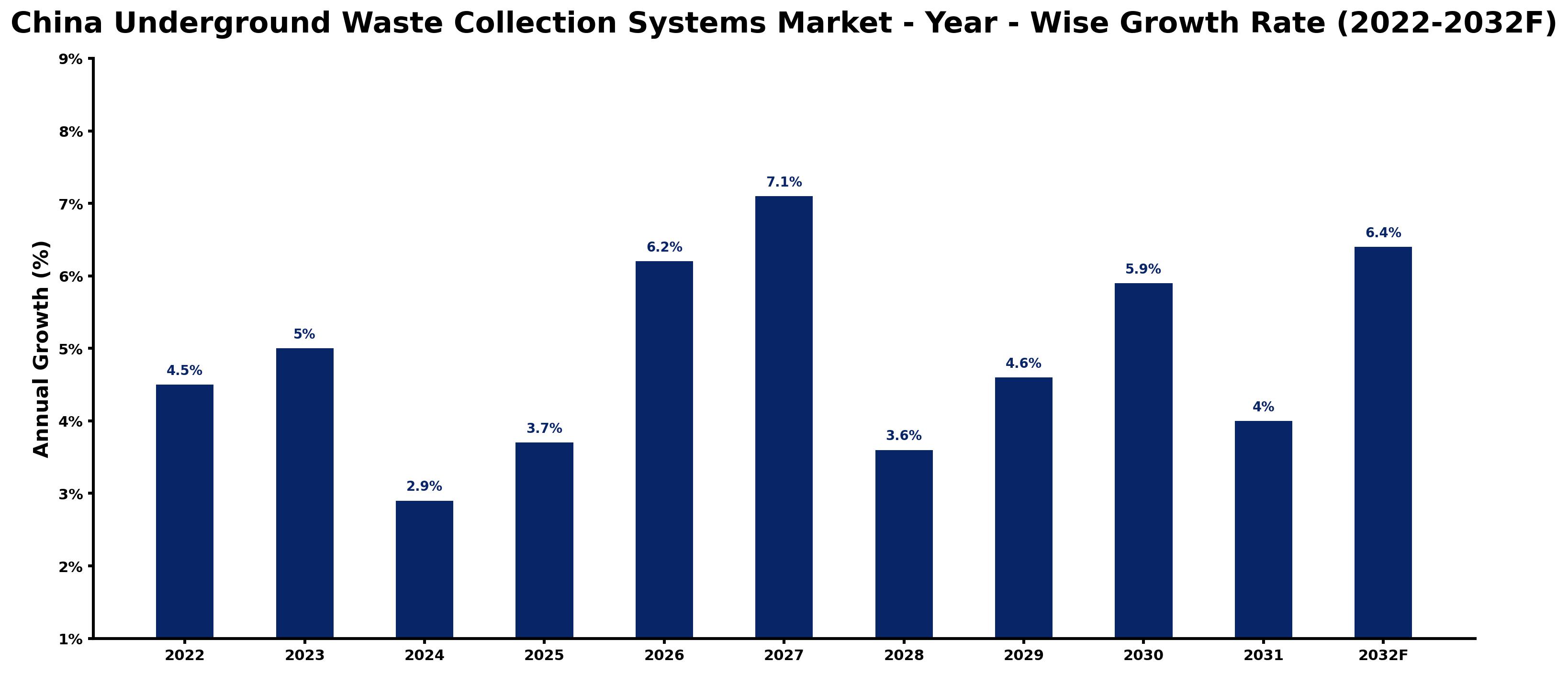
Below, each year's estimated growth is shown next to the factor that most influenced it.
| Year | Estimated Annual Growth (%) | Market Rationale |
| 2022 | 4.5 | The market experienced steady growth due to increasing urbanisation and demand for efficient waste management solutions. |
| 2023 | 5.0 | Growth accelerated as urban areas expanded, driving the need for advanced waste collection systems. |
| 2024 | 2.9 | Growth slowed as some cities faced challenges in implementing new waste management technologies. |
| 2025 | 3.7 | A resurgence in growth occurred as municipalities increased budgets for waste management infrastructure improvements. |
| 2026 | 6.2 | Demand surged with the introduction of new waste management initiatives and funding support from the government. |
| 2027 | 7.1 | The market peaked with significant investments in underground waste collection systems across major cities. |
| 2028 | 3.6 | Growth moderated as the market adjusted to the high levels of investment and implementation seen in previous years. |
| 2029 | 4.6 | An uptick in growth was noted as cities continued to adopt innovative waste management solutions. |
| 2030 | 5.9 | Growth remained strong as urbanisation and sustainability initiatives continued to drive demand for efficient systems. |
| 2031 | 4.0 | Growth slowed as the market began to stabilise after years of rapid expansion and investment. |
| 2032 | 6.4 | A renewed growth phase is expected as cities focus on modernising waste management systems. |
Note: Market size estimations and growth projections presented in this report are based on 6Wresearch's proprietary forecasting methodology, utilizing the latest available industry data, government publications, and primary research inputs.
China Underground Waste Collection Systems Market Synopsis
Underground Waste Collection Systems in China represent sophisticated solutions for efficient waste disposal, utilising pneumatic or gravity-based technologies. These systems primarily serve municipal waste management, improving sanitation in urban areas. The Underground Waste Collection Systems Market is expanding due to urbanisation and government initiatives focused on sustainable waste management. In 2023, China's urban population reached 1.4 billion, driving the need for effective waste management solutions. The Smart City Development Plan encourages the incorporation of these systems into urban planning, further propelling market growth.
Market Dynamics Impact Analysis (2026–2032)
| Factor | Type | Impact | Primary Segment Affected |
| Increasing urban population driving demand for efficient waste management solutions. | Driver | High | Household Waste |
| Government initiatives promoting sustainable waste management technologies. | Driver | High | Pneumatic Collection |
| Growing need for improved waste segregation in urban areas. | Opportunity | High | Hybrid Underground Bins |
| Investment in waste management infrastructure by municipalities. | Opportunity | High | City Municipalities |
| High initial investment costs for underground waste collection systems. | Restraint | High | Gravity-Based Systems |
| Complex installation processes in densely populated urban areas. | Restraint | Medium | Urban Areas |
| Buyers face challenges in securing funding for new waste management projects. | Challenge | High | City Municipalities |
| Suppliers encounter delays due to regulatory approvals for new technologies. | Challenge | Medium | Pneumatic Collection |
Evaluation of Drivers in China Underground Waste Collection Systems Market (2026–2032)
The table below links each growth driver to the segment it affects and the evidence for it.
| Drivers | Primary Segment Affected | Why It Matters (Evidence) |
| Rising urban population increases demand for efficient waste management solutions. | Household Waste | As urban areas grow, the average waste generation reaches approximately 1.2 kg per person per day. |
| Government funding supports the installation of advanced waste management systems. | Pneumatic Collection | In 2021, the government allocated 5 billion RMB for waste management infrastructure improvements. |
| Implementation of the Smart City Development Plan integrates waste systems into urban planning. | Hybrid Underground Bins | This plan promotes the adoption of advanced waste management technologies in over 50 cities. |
| Municipalities are investing in waste management infrastructure to improve collection efficiency. | City Municipalities | In 2023, Shenzhen reported a 30% increase in waste collection efficiency with underground systems. |
| The Circular Economy Promotion Law encourages the use of advanced waste collection technologies. | Gravity-Based Systems | This law supports sustainable waste management practices across urban areas. |
The urban population reached 1.4 billion in 2023, generating substantial waste that necessitates advanced systems. Municipalities are investing heavily in waste management infrastructure, with 5 billion RMB allocated for upgrades. The integration of advanced technologies in over 50 cities exemplifies the positive impact of these systems on urban waste management.
Evaluation of Restraints in China Underground Waste Collection Systems Market
The following restraints limit how fast demand can grow.
| Market Restraint | Primary Segment Affected | Why It Matters (Evidence) |
| High initial investment costs hinder widespread adoption of underground waste systems. | Gravity-Based Systems | The cost of installation can be prohibitive for smaller municipalities, limiting their implementation. |
| Complex installation processes in densely populated areas can delay project timelines. | Urban Areas | Navigating existing infrastructure and regulations complicates the installation of new systems. |
| Limited awareness among city planners about the benefits of advanced waste systems. | Pneumatic Collection | This lack of knowledge can result in underinvestment in necessary waste management technologies. |
| Regulatory hurdles can slow down the approval process for new technologies. | Hybrid Underground Bins | Compliance with national standards can delay project initiation and increase costs. |
| Competition from traditional waste management methods may impede market growth. | Household Waste | Established practices in waste collection can resist change to new underground systems. |
China Underground Waste Collection Systems Market Challenges
High initial installation costs in the China Underground Waste Collection Systems market can exceed 1 million RMB per system, limiting adoption among smaller municipalities. Urban areas face challenges with inefficient waste management; the average waste generation of 1.2 kg per person per day strains existing collection methods, leading to delays for residents. Many cities encounter difficulties with technology integration, as inadequate infrastructure hampers the implementation of advanced pneumatic systems, complicating waste segregation efforts for producers. A skills gap exists in the workforce, with insufficient training programmes resulting in increased downtime for operators and higher maintenance costs for suppliers.
Trends in the China Underground Waste Collection Systems Market
Buyers and suppliers in the China Underground Waste Collection Systems Market are adjusting to the following trends.
- Shift Towards Smart City Integration: Chinese cities are increasingly incorporating underground waste collection systems into smart city initiatives. The Smart City Development Plan, published in 2023, highlights the importance of these systems in urban infrastructure projects, improving waste management efficiency.
- Growing Adoption of Hybrid Underground Bins: Municipalities are progressively adopting hybrid underground bins for waste segregation. In urban settings, residential projects are integrating these systems, reflecting advancements in waste management practices.
- Focus on Sustainable a leading supplier Practices: The Circular Economy Promotion Law encourages cities to embrace advanced waste management technologies. This law, updated in 2020, drives municipalities to invest in systems that support sustainability.
- Expansion of Pneumatic Collection Systems: Pneumatic collection systems are gaining popularity in densely populated cities like Beijing and Shanghai. With a notable share in urban waste management, these systems are becoming crucial for efficient waste transport.
Investment Opportunities in the China Underground Waste Collection Systems Market
Below are the investment opportunities with the strongest case in the China Underground Waste Collection Systems Market.
- 5 billion RMB allocated for waste management improvements: With a substantial budget allocated for waste management infrastructure, municipalities are seeking advanced solutions. City Municipalities can invest in underground waste collection systems to improve efficiency.
- Growing need for efficient waste segregation: As urban areas expand, the demand for hybrid underground bins is rising. Residential projects in urban settings can adopt these systems to enhance waste management practices.
- Integration of waste systems in smart city projects: The Smart City Development Plan promotes the use of advanced waste management technologies. Urban Areas can utilise this initiative to improve their waste collection systems.
- Successful implementation in Shenzhen: The successful implementation of underground waste systems in Shenzhen presents a model for other cities. Municipalities can replicate this success by investing in similar technologies.
Government Initiatives in the China Underground Waste Collection Systems Market
The 'Circular Economy Promotion Law', updated in 2020, greatly influences buyers by promoting the adoption of sustainable waste management practices and technologies. This law requires urban areas to implement advanced waste collection systems, ensuring compliance with national standards. Additionally, the 'Smart City Development Plan' published in 2023 outlines strategies for integrating these systems into urban infrastructure, improving waste management efficiency across cities. Consequently, municipalities are encouraged to invest in underground waste collection systems, aligning with government sustainability objectives. The updated 'National Urban Waste Classification Standard' also facilitates better waste management practices, aiding the implementation of these systems.
The Ministry of Ecology and Environment supervises the execution of the 'Urban Waste Reduction Initiative', which aims to cut waste generation in major cities by 20% by 2025. This initiative provides funding for the installation of underground waste collection systems, ensuring municipalities have the necessary resources for effective waste management. Furthermore, the National Development and Reform Commission announced a funding programme in 2023 to support the installation of these systems in 100 cities by 2025, promoting widespread adoption. These measures collectively improve the operational capacity of waste management systems, benefiting both producers and buyers.
Future Insight of the China Underground Waste Collection Systems Market
The China Underground Waste Collection Systems market is set to evolve by 2032, driven by urbanisation and supportive government initiatives. The 'Smart City Development Plan' will encourage the integration of these systems into urban planning, enhancing waste management efficiency. Municipalities will increasingly adopt advanced technologies, bolstered by the updated 'National Urban Waste Classification Standard' to improve waste segregation processes. In 2023, the city of Shenzhen reported a 30% increase in waste collection efficiency with underground systems, reflecting a strong trend towards sustainable waste management practices.
Market Segmentation Analysis
The analysis below covers each segmentation, its leading category in 2025 and its fastest-growing category through 2032.
By System Type – Pneumatic Collection Dominated, Hybrid Underground Bins Expected to Grow Fastest
According to Bhawna Singh, Assistant Manager at 6Wresearch, in 2025, Pneumatic Collection led the system type split with a 38% share. Pneumatic Collection systems dominate the market due to their ability to efficiently transport waste through underground pipelines, essential for high-density cities like Beijing and Shanghai. This widespread adoption reflects the increasing demand for effective waste management solutions among urban populations, particularly given China's urban population of 1.4 billion. Hybrid Underground Bins are projected to grow fastest, at a CAGR of 8.0% during 2026–2032. Hybrid Underground Bins are experiencing rapid growth as they gain traction in residential projects aimed at improving waste segregation. The government's budget of 5 billion RMB for waste management infrastructure is accelerating this trend, indicating a shift towards more versatile waste collection methods. Suppliers should focus on enhancing their pneumatic system offerings while also considering the growing market for hybrid solutions to meet urban waste management needs.
By Waste Type – Household Waste Dominated, Organic/Plastic Expected to Grow Fastest
Household Waste accounted for a 45% market share by waste type in 2025. Household Waste constitutes the largest share as it is the primary focus of underground systems in urban environments, catering to the needs of China's 1.4 billion urban dwellers. This consistent generation of household waste underscores its critical role in effective waste management solutions. Over 2026–2032, Organic/Plastic is expected to post the fastest growth, at a CAGR of 6.7%. The Organic/Plastic waste segment is rapidly expanding, driven by increased awareness and supportive government initiatives like the 'Circular Economy Promotion Law' that advocate for advanced waste collection technologies. Urban areas are prioritising improvements in recycling processes and waste segregation, further propelling this growth. Buyers should prioritise solutions that effectively handle household waste while being mindful of the increasing significance of organic and plastic waste management.
By Installation Site – Urban Areas Dominated, Residential Projects Expected to Grow Fastest
With a 53% revenue share in 2025, Urban Areas was the largest installation site category. Urban Areas dominate the market as underground waste collection systems are primarily deployed in densely populated settings where efficient waste management is essential. The implementation of these systems in over 50 cities illustrates their necessity in urban planning and infrastructure. The quickest growth will come from Residential Projects, forecast to expand at a CAGR of 7.9% between 2026 and 2032. Residential Projects are experiencing the fastest growth, with new developments increasingly incorporating underground waste systems for effective waste management. This trend aligns with urbanisation efforts and the demand for sustainable waste solutions in residential settings. Suppliers must focus on urban developments and residential projects to capture the rising demand for efficient waste management systems.
By End User – City Municipalities Dominated, Smart Cities Expected to Grow Fastest
City Municipalities took a 52% share of end user in 2025, more than any other category. City Municipalities hold the largest market share as they implement underground waste collection systems to effectively manage urban waste. This is crucial for addressing the waste generated by the rapidly increasing urban population in China. Smart Cities are set to record the highest CAGR in this split, 7.1% over 2026–2032. Smart Cities are the fastest-growing segment, driven by the integration of advanced waste management solutions into their urban infrastructure. This trend is supported by government initiatives that promote smart city development, which enhances overall operational efficiency in waste management. Suppliers should pursue collaborations with city municipalities while also exploring opportunities within the smart city sector to stay competitive.
Key Attractiveness of the Report
- 10 Years of Market Numbers
- Historical Data Starting from 2022 to 2025
- Base Year 2025
- Forecast Data until 2032
- Key Performance Indicators Impacting the Market
- Major Upcoming Developments and Projects
Key Highlights of the Report:
- China Underground Waste Collection Systems Market Outlook
- Market Size of China Underground Waste Collection Systems Market, 2025
- Forecast of China Underground Waste Collection Systems Market, 2032
- Historical Data and Forecast of China Underground Waste Collection Systems Revenues & Volume for the Period 2022 - 2032F
- China Underground Waste Collection Systems Market Trend Evolution
- China Underground Waste Collection Systems Market Drivers and Challenges
- China Underground Waste Collection Systems Price Trends
- China Underground Waste Collection Systems Porter's Five Forces
- China Underground Waste Collection Systems Industry Life Cycle
- Historical Data and Forecast of China Underground Waste Collection Systems Market Revenues & Volume By System Type for the Period 2022 - 2032F
- Historical Data and Forecast of China Underground Waste Collection Systems Market Revenues & Volume By Pneumatic Collection for the Period 2022 - 2032F
- Historical Data and Forecast of China Underground Waste Collection Systems Market Revenues & Volume By Gravity-Based Systems for the Period 2022 - 2032F
- Historical Data and Forecast of China Underground Waste Collection Systems Market Revenues & Volume By Hybrid Underground Bins for the Period 2022 - 2032F
- Historical Data and Forecast of China Underground Waste Collection Systems Market Revenues & Volume By Industrial Systems for the Period 2022 - 2032F
- Historical Data and Forecast of China Underground Waste Collection Systems Market Revenues & Volume By Waste Type for the Period 2022 - 2032F
- Historical Data and Forecast of China Underground Waste Collection Systems Market Revenues & Volume By Household Waste for the Period 2022 - 2032F
- Historical Data and Forecast of China Underground Waste Collection Systems Market Revenues & Volume By Mixed Waste for the Period 2022 - 2032F
- Historical Data and Forecast of China Underground Waste Collection Systems Market Revenues & Volume By Organic/Plastic for the Period 2022 - 2032F
- Historical Data and Forecast of China Underground Waste Collection Systems Market Revenues & Volume By Bulk Waste for the Period 2022 - 2032F
- Historical Data and Forecast of China Underground Waste Collection Systems Market Revenues & Volume By Installation Site for the Period 2022 - 2032F
- Historical Data and Forecast of China Underground Waste Collection Systems Market Revenues & Volume By Urban Areas for the Period 2022 - 2032F
- Historical Data and Forecast of China Underground Waste Collection Systems Market Revenues & Volume By Commercial Complexes for the Period 2022 - 2032F
- Historical Data and Forecast of China Underground Waste Collection Systems Market Revenues & Volume By Residential Projects for the Period 2022 - 2032F
- Historical Data and Forecast of China Underground Waste Collection Systems Market Revenues & Volume By Manufacturing Zones for the Period 2022 - 2032F
- Historical Data and Forecast of China Underground Waste Collection Systems Market Revenues & Volume By End User for the Period 2022 - 2032F
- Historical Data and Forecast of China Underground Waste Collection Systems Market Revenues & Volume By Smart Cities for the Period 2022 - 2032F
- Historical Data and Forecast of China Underground Waste Collection Systems Market Revenues & Volume By City Municipalities for the Period 2022 - 2032F
- Historical Data and Forecast of China Underground Waste Collection Systems Market Revenues & Volume By Real Estate Builders for the Period 2022 - 2032F
- Historical Data and Forecast of China Underground Waste Collection Systems Market Revenues & Volume By Facility Managers for the Period 2022 - 2032F
- China Underground Waste Collection Systems Import Export Trade Statistics
- Market Opportunity Assessment By System Type
- Market Opportunity Assessment By Waste Type
- Market Opportunity Assessment By Installation Site
- Market Opportunity Assessment By End User
- China Underground Waste Collection Systems Top Companies Market Share
- China Underground Waste Collection Systems Competitive Benchmarking By Technical and Operational Parameters
- China Underground Waste Collection Systems Company Profiles
- China Underground Waste Collection Systems Key Strategic Recommendations
Market Covered
The report offers an extensive study of the following market segments.
By System Type
- Pneumatic Collection
- Gravity-Based Systems
- Hybrid Underground Bins
- Industrial Systems
By Waste Type
- Household Waste
- Mixed Waste
- Organic/Plastic
- Bulk Waste
By Installation Site
- Urban Areas
- Commercial Complexes
- Residential Projects
- Manufacturing Zones
By End User
- Smart Cities
- City Municipalities
- Real Estate Builders
- Facility Managers































