China Unmanned Retail Store Market Size & Growth Rate
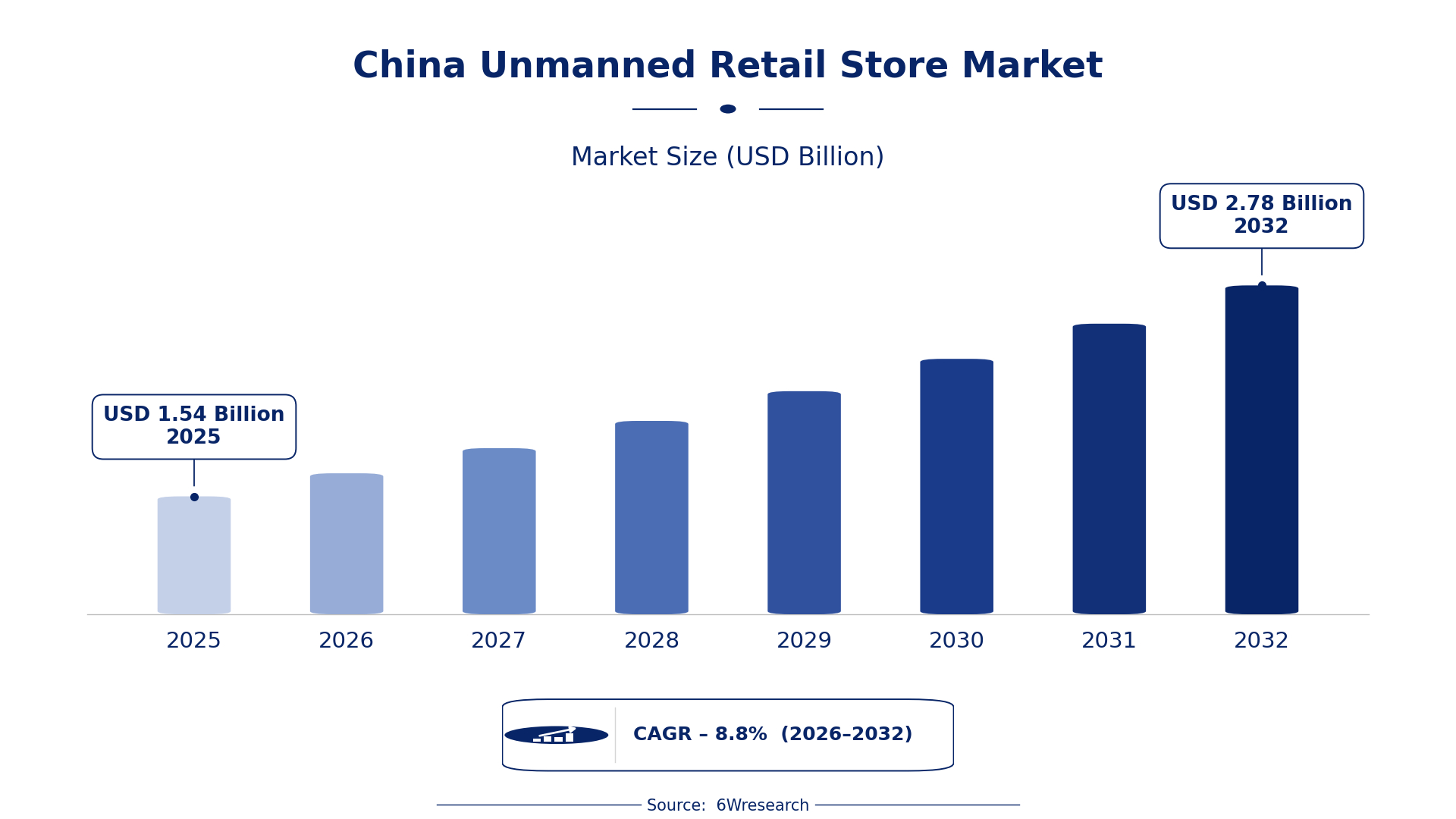
According to 6Wresearch internal database and industry insights, the China Unmanned Retail Store Market was valued at USD 1.54 billion in 2025 and is projected to reach USD 2.78 billion by 2032, growing at a CAGR of approximately 8.8% during 2026–2032.
China Unmanned Retail Store Market Highlights
| Report Metric | Details |
| Report Name | China Unmanned Retail Store Market |
| Market Size 2025 | USD 1.54 billion |
| Market Size 2032 | USD 2.78 billion |
| Absolute Growth 2025–2032 | USD 1.24 billion |
| CAGR 2026–2032 | 8.8% |
| Peak Annual Growth | 11.4% in 2031 |
| Forecast Period | 2026–2032 |
| Historical Data | 2022–2025 |
| Base Year | 2025 |
| Leading Store Format, 2025 | Fully Automated Store (36% share) |
| Leading Technology Used, 2025 | RFID + Computer Vision (41% share) |
| Leading Product Category, 2025 | Snacks & Beverages (38% share) |
| Leading End User, 2025 | Urban Consumers (34% share) |
| Fastest-Growing Store Format | Smart Vending Units (10.0% CAGR) |
| Fastest-Growing Technology Used | Mobile App Control (10.7% CAGR) |
| Fastest-Growing Product Category | Ready-to-Eat Meals (11.4% CAGR) |
| Fastest-Growing End User | Smart Cities (10.2% CAGR) |
| Growing Sector | automated retail solutions |
| Key End Users | urban consumers, office campuses, event venues, smart cities |
China Unmanned Retail Store Market Year-wise Growth Rate and Key Drivers (2022–2032)
This graph illustrates the annual growth rates of the market from 2022 to 2032, highlighting a steady upward trajectory and projected market expansion over the forecast period.
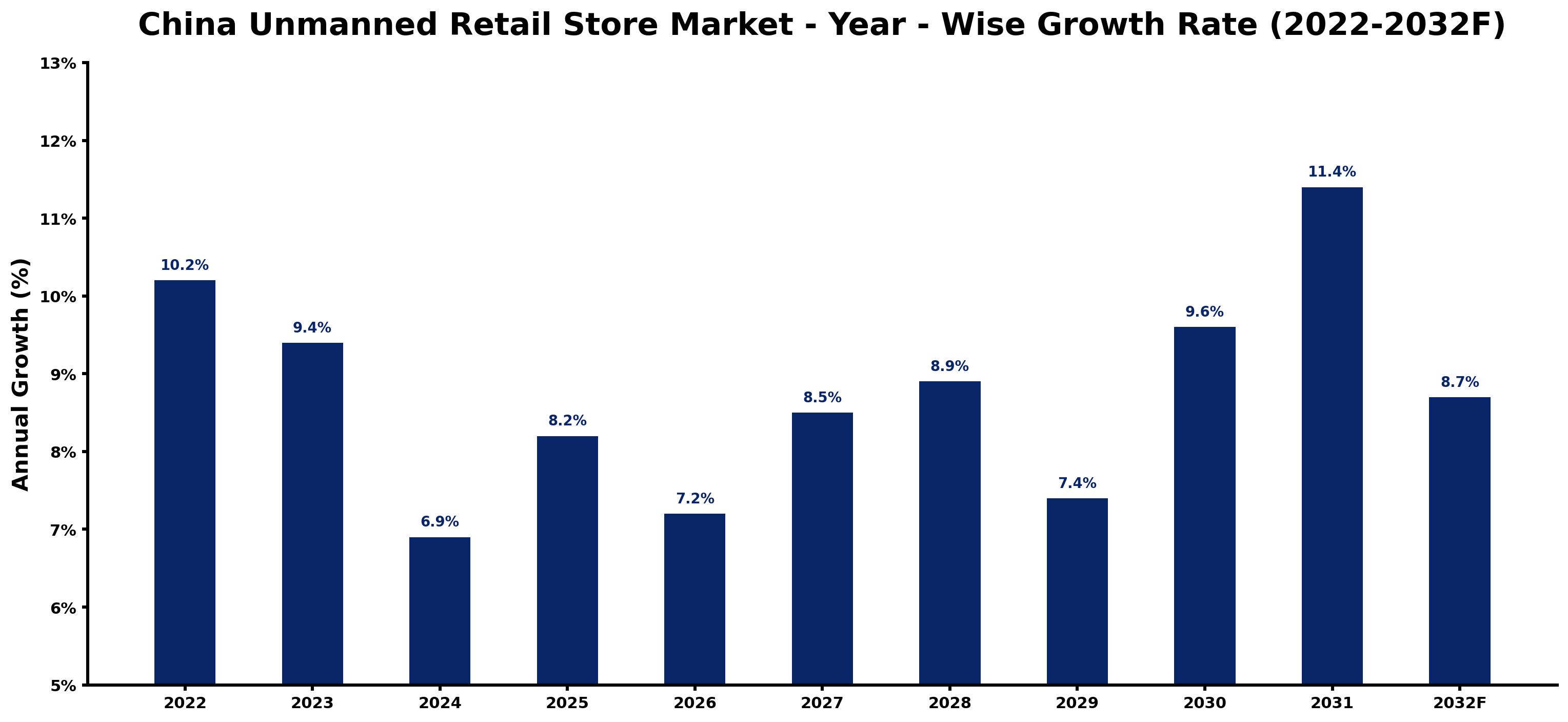
Year by year, the estimates below pair each growth rate with the development that shaped it.
| Year | Estimated Annual Growth (%) | Market Rationale |
| 2022 | 10.2 | The market experienced strong demand from urban consumers seeking convenient shopping options. |
| 2023 | 9.4 | Growth slowed due to the impact of the Smart Retail Development Plan launched in 2021. |
| 2024 | 6.9 | The market continued to grow as consumer habits stabilised following previous rapid expansion. |
| 2025 | 8.2 | Demand increased as more unmanned retail solutions became available in urban areas. |
| 2026 | 7.2 | Growth slowed again as the market began to normalise after previous peaks. |
| 2027 | 8.5 | Renewed interest was driven by the integration of AI technologies in retail. |
| 2028 | 8.9 | Demand rose as urban consumers embraced new shopping experiences enabled by technology. |
| 2029 | 7.4 | Growth slowed as competition intensified among unmanned retail solutions in urban centres. |
| 2030 | 9.6 | The market gained momentum with the introduction of new automated retail technologies. |
| 2031 | 11.4 | Peak growth occurred as urbanisation and smart city initiatives accelerated demand. |
| 2032 | 8.7 | Growth slowed slightly as the market reached a more mature stage. |
Note: Market size estimations and growth projections presented in this report are based on 6Wresearch's proprietary forecasting methodology, utilizing the latest available industry data, government publications, and primary research inputs.
China Unmanned Retail Store Market Synopsis
The China Unmanned Retail Store Market includes automated retail environments that use advanced technologies for customer interaction and inventory management. These stores offer 24/7 access to products, which lowers operational costs for retailers. The market is expanding as urban consumers and office campuses seek efficient shopping solutions. In 2023, over 1,000 unmanned retail stores operated across major cities, propelled by smart city initiatives and consumer demand for convenience. This growth reflects a shift in consumer preferences towards automated shopping experiences.
Market Dynamics Impact Analysis (2026–2032)
| Factor | Type | Impact | Primary Segment Affected |
| Growing urban population driving demand for convenient shopping solutions. | Driver | High | Fully Automated Store |
| Increasing adoption of RFID technology for inventory management. | Driver | High | RFID + Computer Vision |
| Rising investment in smart city initiatives promoting automated retail. | Opportunity | High | Smart Cities |
| Growing demand for ready-to-eat meals from busy urban consumers. | Opportunity | High | Ready-to-Eat Meals |
| High initial investment costs for setting up unmanned stores. | Restraint | Medium | Smart Vending Units |
| Regulatory compliance requirements may hinder rapid deployment. | Restraint | Medium | AI Kiosks |
| Challenges in maintaining technology and inventory management systems. | Challenge | High | Fully Automated Store |
| Competition from traditional retail formats may limit growth potential. | Challenge | Medium | Pop-up Pods |
Evaluation of Drivers in China Unmanned Retail Store Market (2026–2032)
The table below links each growth driver to the segment it affects and the evidence for it.
| Drivers | Primary Segment Affected | Why It Matters (Evidence) |
| Rising urban population increases demand for convenient shopping. | Fully Automated Store | The urban population reached 900 million in 2023, driving more consumers to seek easy access to products. |
| Growing adoption of RFID technology improves inventory management. | RFID + Computer Vision | RFID technology adoption is expected to reach 70% by 2025, improving operational efficiency for retailers. |
| Smart city initiatives promote the integration of unmanned retail solutions. | Smart Cities | The Shenzhen smart cities initiative includes plans for 500 unmanned retail installations by 2025, expanding market reach. |
| Increased demand for ready-to-eat meals from busy consumers. | Ready-to-Eat Meals | Urban consumers make an average of 3 purchases per week from unmanned stores, boosting demand for convenient meal options. |
| Investment in technology for automated retail solutions is rising. | Mobile App Control | The Shanghai government allocated 50 million RMB in 2023 to support innovations in unmanned retail. |
Expansion of the Unmanned Retail Store market in China is backed by rising urban population, increasing technology adoption and growing consumer demand for convenience. The urban population reached 900 million in 2023, leading to more consumers seeking easy access to products. Urban consumers make an average of 3 purchases per week from unmanned stores, further driving demand for convenient shopping solutions.
Evaluation of Restraints in China Unmanned Retail Store Market
The main factors holding the market back are set out below.
| Market Restraint | Primary Segment Affected | Why It Matters (Evidence) |
| High initial investment costs for setting up unmanned stores. | Smart Vending Units | Initial costs can exceed 1 million RMB, deterring potential investors from entering the market. |
| Regulatory compliance requirements may hinder rapid deployment. | AI Kiosks | Compliance with the National Standard for Automated Retail Systems requires significant investment in safety measures. |
| Challenges in maintaining technology and inventory management systems. | Fully Automated Store | Complex systems require ongoing technical support, increasing operational costs for retailers. |
| Limited consumer awareness of unmanned retail benefits. | Pop-up Pods | Many consumers remain unfamiliar with unmanned retail solutions, slowing adoption rates. |
| Competition from traditional retail formats may limit growth potential. | Smart Vending Units | Traditional stores still dominate consumer preferences in many urban areas. |
China Unmanned Retail Store Market Challenges
The China unmanned retail store market faces a critical technology challenge as many existing stores struggle to implement advanced systems like RFID, projected to reach 70% adoption by 2025. This shortfall leads to operational inefficiencies that hinder producers' competitiveness. Regulatory hurdles complicate market entry, as compliance with the National Standard for Automated Retail Systems established in 2022 delays new installations, increasing costs for producers. Buyers also face inconsistent consumer preferences, with urban consumers averaging only 3 purchases per week from unmanned stores, which can limit sales volume. High initial investment costs further deter new entrants, forcing suppliers to scale back expansion plans and slowing overall market growth.
Trends in the China Unmanned Retail Store Market
The trends below show where the China Unmanned Retail Store Market is heading.
- Shift towards Smart Vending Units: Smart Vending Units are increasingly replacing traditional vending machines in urban areas. In Guangdong province, there has been a 30% increase in smart vending units since 2022, reflecting a shift in consumer preferences for automated solutions.
- Integration of AI in Retail: The use of AI Kiosks is becoming more prevalent as retailers seek to improve customer engagement. The National Development and Reform Commission's strategy aims to deploy unmanned retail stores in urban areas, supporting this trend with advanced technology.
- Rise of Ready-to-Eat Meals: Ready-to-Eat Meals are gaining popularity among urban consumers seeking convenience. In 2023, the average consumer made 3 purchases per week from unmanned stores, highlighting the demand for quick meal options.
- Expansion of Smart City Initiatives: Smart city initiatives are driving the growth of unmanned retail solutions. The 'Digital Economy Development Plan' aims for 50% technology adoption in retail by 2025, facilitating the integration of automated solutions.
Investment Opportunities in the China Unmanned Retail Store Market
The following opportunities in the China Unmanned Retail Store Market pair current demand with a clear way in.
- Investing in Partnerships with Local Startups: Investing in partnerships with local startups developing unmanned retail technologies is essential. The Ministry of Industry and Information Technology announced a 100 million RMB subsidy program in 2023 to support such innovations.
- Targeting Urban Consumers: The growing urban population presents an opportunity for unmanned retail solutions. Urban consumers in major cities are increasingly seeking convenient shopping options, making this a prime market for investment.
- Timing for Expansion: Now is an ideal time to invest in unmanned retail due to the rising demand for convenience. The Shanghai government's allocation of 50 million RMB in 2023 for unmanned retail innovations supports this opportunity.
- Supply of Ready-to-Eat Meals: There is a growing need for ready-to-eat meals in unmanned stores. Retailers can capitalise on this trend by supplying convenient meal options to meet consumer demand.
Government Initiatives in the China Unmanned Retail Store Market
The 'Smart Retail Development Plan' launched by the Ministry of Commerce in 2021 focuses on promoting the integration of technology in retail operations, particularly unmanned solutions. This plan aims to enhance automated retail environments, ensuring that producers and retailers can access the latest technologies. The initiative encourages investment in unmanned retail, providing a framework for growth in this sector. Additionally, the 'National Standard for Automated Retail Systems' established in 2022 ensures safety and efficiency, mandating compliance for all automated retail operations.
The National Development and Reform Commission oversees a subsidy program introduced in 2023, aimed at supporting startups developing unmanned retail technologies. This program has a budget of 100 million RMB, providing financial assistance to innovative projects. The Ministry of Industry and Information Technology also approved a strategy to enhance smart city initiatives, which includes deploying unmanned retail stores across urban areas. These measures collectively aim to foster the growth of automated retail, ensuring that producers and retailers can thrive in a competitive market.
Future Insight of the China Unmanned Retail Store Market
The China unmanned retail store market will experience transformative changes by 2032, primarily due to technological advancements and strategic initiatives. The Smart Retail Development Plan initiated in 2021 will enhance automation, improving customer interactions and operational efficiency. By 2025, the Digital Economy Development Plan will integrate more technology into transactions and inventory management. The initiative in Shenzhen aims to establish 500 unmanned retail installations by 2025, increasing accessibility for consumers. These developments will create new opportunities for suppliers and elevate service quality for buyers.
Market Segmentation Analysis
The analysis below covers each segmentation, its leading category in 2025 and its fastest-growing category through 2032.
By Store Format – Fully Automated Store Dominated, Smart Vending Units Expected to Grow Fastest
According to Bhawna Singh, Assistant Manager at 6Wresearch, in 2025, Fully Automated Store led the store format split with a 36% share. The Fully Automated Store segment leads the market share as it delivers a completely self-service shopping experience, catering to the needs of busy urban consumers. Its prevalence in the Beijing-Tianjin-Hebei region highlights its role in meeting the growing demand for convenience in retail. Over 2026–2032, Smart Vending Units are expected to post the fastest growth, at a CAGR of 10.0%. Smart Vending Units are experiencing rapid growth due to their capability to dispense products automatically in various locations, making them highly appealing to consumers. The 30% increase in smart vending units in Guangdong province exemplifies their rising popularity among urban residents. Suppliers should focus on enhancing their offerings in fully automated stores to capture the growing urban consumer market.
By Technology Used – RFID + Computer Vision Dominated, Mobile App Control Expected to Grow Fastest
RFID + Computer Vision accounted for a 41% market share by technology used in 2025. RFID + Computer Vision technology captures the largest market share as it is vital for effective inventory tracking and loss prevention in unmanned retail settings. Its widespread implementation across major cities ensures operational efficiency and improves customer satisfaction. The quickest growth will come from Mobile App Control, forecast to expand at a CAGR of 10.7% between 2026 and 2032. Mobile App Control is the fastest-growing technology, enabling users to manage purchases and payments easily through their smartphones. The rise in smartphone usage among urban consumers is propelling this trend, indicating a strong demand for seamless shopping experiences. Buyers will benefit by investing in mobile app capabilities to enhance user experience and streamline their operations.
By Product Category – Snacks & Beverages Dominated, Ready-to-Eat Meals Expected to Grow Fastest
With a 38% revenue share in 2025, Snacks & Beverages was the largest product category category. Snacks & Beverages dominate the market share as the primary product category available in unmanned stores, aligning well with the quick purchase habits of urban consumers. The convenience of accessing snacks or drinks on the go has solidified their popularity among shoppers. Ready-to-Eat Meals are set to record the highest CAGR in this split, 11.4% over 2026–2032. Ready-to-Eat Meals are experiencing the fastest growth, driven by the rising demand for convenient meal options among busy consumers. This trend reflects the urban lifestyle, where quick and easy meal solutions are increasingly sought after. Retailers should consider expanding their ready-to-eat meal offerings to align with the evolving preferences of urban consumers.
By End User – Urban Consumers Dominated, Smart Cities Expected to Grow Fastest
Urban Consumers held a 34% share of the China Unmanned Retail Store Market by end user in 2025. Urban Consumers represent the largest user group for unmanned retail solutions, driven by their need for convenience and accessibility in densely populated areas. With China's urban population reaching 900 million in 2023, this demographic significantly fuels the demand for unmanned retail services. Smart Cities are projected to grow fastest, at a CAGR of 10.2% during 2026–2032. Smart Cities are the fastest-growing end user segment, as they integrate unmanned retail solutions into urban planning to improve consumer access. Initiatives in cities like Shenzhen, which plans for 500 unmanned retail installations by 2025, highlight this trend. Suppliers should align their strategies with smart city initiatives to effectively tap into the expanding market for unmanned retail solutions.
Key Attractiveness of the Report
- 10 Years of Market Numbers
- Historical Data Starting from 2022 to 2025
- Base Year 2025
- Forecast Data until 2032
- Key Performance Indicators Impacting the Market
- Major Upcoming Developments and Projects
Key Highlights of the Report:
- China Unmanned Retail Store Market Outlook
- Market Size of China Unmanned Retail Store Market, 2025
- Forecast of China Unmanned Retail Store Market, 2032
- Historical Data and Forecast of China Unmanned Retail Store Revenues & Volume for the Period 2022 - 2032F
- China Unmanned Retail Store Market Trend Evolution
- China Unmanned Retail Store Market Drivers and Challenges
- China Unmanned Retail Store Price Trends
- China Unmanned Retail Store Porter's Five Forces
- China Unmanned Retail Store Industry Life Cycle
- Historical Data and Forecast of China Unmanned Retail Store Market Revenues & Volume By Store Format for the Period 2022 - 2032F
- Historical Data and Forecast of China Unmanned Retail Store Market Revenues & Volume By Fully Automated Store for the Period 2022 - 2032F
- Historical Data and Forecast of China Unmanned Retail Store Market Revenues & Volume By Smart Vending Units for the Period 2022 - 2032F
- Historical Data and Forecast of China Unmanned Retail Store Market Revenues & Volume By Pop-up Pods for the Period 2022 - 2032F
- Historical Data and Forecast of China Unmanned Retail Store Market Revenues & Volume By AI Kiosks for the Period 2022 - 2032F
- Historical Data and Forecast of China Unmanned Retail Store Market Revenues & Volume By Technology Used for the Period 2022 - 2032F
- Historical Data and Forecast of China Unmanned Retail Store Market Revenues & Volume By RFID + Computer Vision for the Period 2022 - 2032F
- Historical Data and Forecast of China Unmanned Retail Store Market Revenues & Volume By Mobile App Control for the Period 2022 - 2032F
- Historical Data and Forecast of China Unmanned Retail Store Market Revenues & Volume By Cloud Inventory for the Period 2022 - 2032F
- Historical Data and Forecast of China Unmanned Retail Store Market Revenues & Volume By Voice + Face ID for the Period 2022 - 2032F
- Historical Data and Forecast of China Unmanned Retail Store Market Revenues & Volume By Product Category for the Period 2022 - 2032F
- Historical Data and Forecast of China Unmanned Retail Store Market Revenues & Volume By Snacks & Beverages for the Period 2022 - 2032F
- Historical Data and Forecast of China Unmanned Retail Store Market Revenues & Volume By Ready-to-Eat Meals for the Period 2022 - 2032F
- Historical Data and Forecast of China Unmanned Retail Store Market Revenues & Volume By Essentials for the Period 2022 - 2032F
- Historical Data and Forecast of China Unmanned Retail Store Market Revenues & Volume By Groceries for the Period 2022 - 2032F
- Historical Data and Forecast of China Unmanned Retail Store Market Revenues & Volume By End User for the Period 2022 - 2032F
- Historical Data and Forecast of China Unmanned Retail Store Market Revenues & Volume By Urban Consumers for the Period 2022 - 2032F
- Historical Data and Forecast of China Unmanned Retail Store Market Revenues & Volume By Office Campuses for the Period 2022 - 2032F
- Historical Data and Forecast of China Unmanned Retail Store Market Revenues & Volume By Event Venues for the Period 2022 - 2032F
- Historical Data and Forecast of China Unmanned Retail Store Market Revenues & Volume By Smart Cities for the Period 2022 - 2032F
- China Unmanned Retail Store Import Export Trade Statistics
- Market Opportunity Assessment By Store Format
- Market Opportunity Assessment By Technology Used
- Market Opportunity Assessment By Product Category
- Market Opportunity Assessment By End User
- China Unmanned Retail Store Top Companies Market Share
- China Unmanned Retail Store Competitive Benchmarking By Technical and Operational Parameters
- China Unmanned Retail Store Company Profiles
- China Unmanned Retail Store Key Strategic Recommendations
Market Covered
Segments analysed in this report are listed below.
By Store Format
- Fully Automated Store
- Smart Vending Units
- Pop-up Pods
- AI Kiosks
By Technology Used
- RFID + Computer Vision
- Mobile App Control
- Cloud Inventory
- Voice + Face ID
By Product Category
- Snacks & Beverages
- Ready-to-Eat Meals
- Essentials
- Groceries
By End User
- Urban Consumers
- Office Campuses
- Event Venues
- Smart Cities































