China Urban Logistics Automation Market Size & Growth Rate
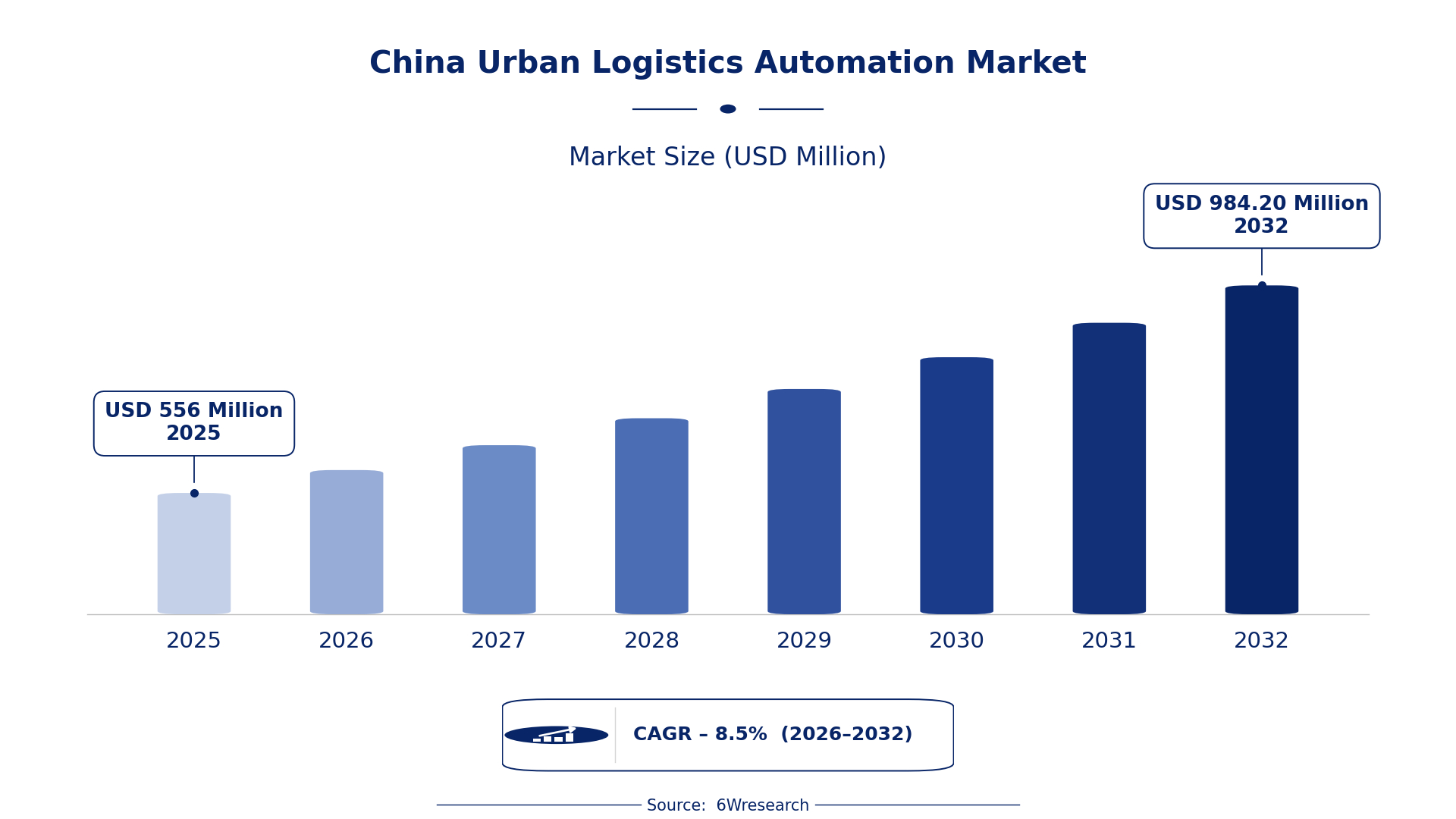
According to 6Wresearch internal database and industry insights, the China Urban Logistics Automation Market was valued at USD 556.0 million in 2025 and is projected to reach USD 984.20 million by 2032, growing at a CAGR of approximately 8.5% during 2026–2032.
China Urban Logistics Automation Market Highlights
| Report Metric | Details |
| Report Name | China Urban Logistics Automation Market |
| Market Size 2025 | USD 556.0 million |
| Market Size 2032 | USD 984.20 million |
| Absolute Growth 2025–2032 | USD 428.20 million |
| CAGR 2026–2032 | 8.5% |
| Peak Annual Growth | 10.2% in 2032 |
| Forecast Period | 2026–2032 |
| Historical Data | 2022–2025 |
| Base Year | 2025 |
| Leading Solution Type, 2025 | Autonomous Delivery Bots (37% share) |
| Leading Delivery Mode, 2025 | Last-Mile Delivery (49% share) |
| Leading Automation Feature, 2025 | AI Navigation (41% share) |
| Leading End User, 2025 | eCommerce Retailers (39% share) |
| Fastest-Growing Solution Type | Smart Sorting Systems (9.9% CAGR) |
| Fastest-Growing Delivery Mode | Fulfillment Centers (10.9% CAGR) |
| Fastest-Growing End User | Logistics Companies (9.7% CAGR) |
| Growing Sector | Logistics Companies |
| Key End Users | eCommerce Retailers, Logistics Companies, Warehousing Providers, Quick Commerce Startups |
China Urban Logistics Automation Market Year-wise Growth Rate and Key Drivers (2022–2032)
This graph illustrates the annual growth rates of the market from 2022 to 2032, highlighting a steady upward trajectory and projected market expansion over the forecast period.
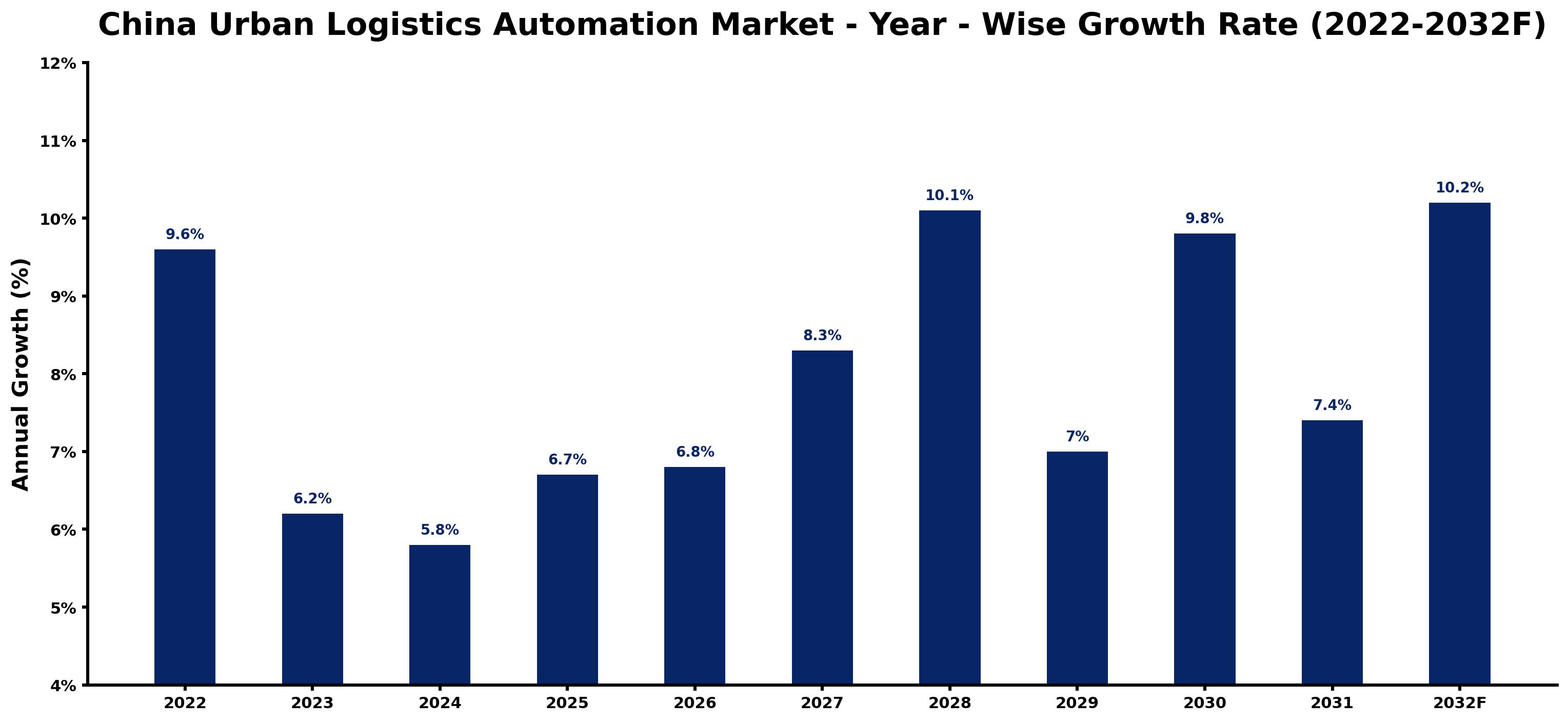
Each row of the following table gives one year's estimated growth and the event or demand shift that explains it.
| Year | Estimated Annual Growth (%) | Market Rationale |
| 2022 | 9.6 | The market exhibited strong growth due to rising eCommerce demand and automation investments. |
| 2023 | 6.2 | Growth slowed as companies adjusted to the previous year's rapid expansion and market dynamics. |
| 2024 | 5.8 | Continued investment in automation technologies contributed to slower growth compared to prior years. |
| 2025 | 6.7 | Demand for last-mile delivery solutions increased, driving faster growth in the market. |
| 2026 | 6.8 | The introduction of new automation technologies is expected to further accelerate market growth. |
| 2027 | 8.3 | Growing efficiency in logistics operations is projected to enhance demand for automation solutions. |
| 2028 | 10.1 | Increased urbanisation and eCommerce activity will contribute to a surge in market growth. |
| 2029 | 7.0 | A slowdown in growth is anticipated as market conditions normalise after rapid expansion. |
| 2030 | 9.8 | Rising urban logistics demands will support a rebound in growth rates in the market. |
| 2031 | 7.4 | Growth will slow as the market begins to stabilise after a period of rapid expansion. |
| 2032 | 10.2 | The market is projected to peak as technology adoption reaches new heights. |
Note: Market size estimations and growth projections presented in this report are based on 6Wresearch's proprietary forecasting methodology, utilizing the latest available industry data, government publications, and primary research inputs.
China Urban Logistics Automation Market Synopsis
Urban Logistics Automation in China involves integrating advanced technologies like AI and robotics to enhance logistics processes. This includes improving last-mile delivery efficiency and optimizing warehouse operations. The China Urban Logistics Automation Market is experiencing growth driven by significant investments in automation technologies and the expanding eCommerce sector, which accounts for over 30% of total retail sales. The 'Smart Logistics Development Plan' launched in 2023 is a key initiative supporting this trend. With the urban population expected to reach 1 billion by 2030, demand for efficient logistics solutions will continue to rise.
Market Dynamics Impact Analysis (2026–2032)
| Factor | Type | Impact | Primary Segment Affected |
| Growing eCommerce sector drives demand for efficient delivery solutions. | Driver | High | Last-Mile Delivery |
| Increased investment in AI technologies enhances logistics operations. | Driver | High | Smart Sorting Systems |
| Rising urban population creates a need for efficient logistics solutions. | Opportunity | High | Urban Warehouses |
| Expansion of fulfillment centers is driving demand for automation. | Opportunity | High | Fulfillment Centers |
| High initial investment costs can deter smaller logistics companies from adopting automation. | Restraint | Medium | Robotic Pickers |
| Limited infrastructure in some urban areas hampers the deployment of automation technologies. | Restraint | Medium | Drone Delivery |
| The Urban Logistics Automation market in China faces a few practical problems, including regulatory hurdles. | Challenge | High | Autonomous Delivery Bots |
| Competition among logistics firms can lead to price wars, affecting profitability. | Challenge | Medium | Logistics Companies |
Evaluation of Drivers in China Urban Logistics Automation Market (2026–2032)
The table below links each growth driver to the segment it affects and the evidence for it.
| Drivers | Primary Segment Affected | Why It Matters (Evidence) |
| Rising eCommerce sales drive demand for last-mile delivery solutions, with over 30% of retail sales coming from eCommerce. | Last-Mile Delivery | This leads to increased purchases of automation technologies to meet delivery expectations. |
| Investments in AI technologies improve sorting efficiency, with total investment in logistics automation technologies reaching $15 billion in 2023. | Smart Sorting Systems | This boosts demand for automated sorting solutions in warehouses. |
| The urban population growth in China is projected to reach 1 billion by 2030, increasing logistics demands. | Urban Warehouses | This creates a need for more efficient logistics solutions to serve urban areas. |
| The expansion of fulfillment centers is supported by a CAGR of 10.9% from 2026 to 2032. | Fulfillment Centers | This drives demand for automation technologies to improve operational efficiency. |
| The average delivery time for last-mile logistics in major cities is now under 2 hours, raising expectations. | Autonomous Delivery Bots | This compels logistics companies to invest in automation to meet consumer demands. |
The Urban Logistics Automation market in China is growing on the back of rising eCommerce sales, increased investment in AI technologies, and urban population growth. The eCommerce sector accounts for over 30% of total retail sales, driving demand for last-mile delivery solutions. In 2023, total investment in logistics automation technologies reached $15 billion, improving sorting efficiency. The urban population is expected to reach 1 billion by 2030, creating logistics demands. With the average delivery time for last-mile logistics now under 2 hours, companies are compelled to adopt automation technologies to meet consumer expectations.
Evaluation of Restraints in China Urban Logistics Automation Market
The following restraints limit how fast demand can grow.
| Market Restraint | Primary Segment Affected | Why It Matters (Evidence) |
| High initial investment costs deter smaller logistics companies from adopting automation, with many firms reporting budget constraints. | Robotic Pickers | This limits the market's growth potential as smaller players struggle to compete. |
| Limited infrastructure in some urban areas hampers the deployment of automation technologies, affecting overall efficiency. | Drone Delivery | This can delay the implementation of advanced logistics solutions. |
| Regulatory hurdles can slow down the approval process for new technologies, impacting market entry. | Autonomous Delivery Bots | This creates uncertainty for companies looking to invest in automation. |
| Concerns over data security and privacy can hinder the adoption of AI technologies in logistics operations. | Smart Sorting Systems | This creates reluctance among companies to fully embrace automation. |
| Competition among logistics firms can lead to price wars, affecting profitability and investment in new technologies. | Logistics Companies | This results in reduced budgets for automation investments. |
China Urban Logistics Automation Market Challenges
Buyers in the China Urban Logistics Automation market face rising costs due to the rapid integration of advanced technologies, which can increase operational expenses by up to 20%. Smaller logistics firms struggle with the substantial investment needed for automation systems, often exceeding their budgets. Many companies experience challenges in implementing AI and robotics effectively, leading to delays that reduce operational efficiency. Competition intensifies as larger firms adopt automation to capture market share, pushing smaller players to adapt quickly or risk losing clients, which can result in a 15% decline in customer retention rates during transitions.
Trends in the China Urban Logistics Automation Market
Several trends are reshaping the China Urban Logistics Automation Market; the most important are set out below.
- Shift from Manual to Automated Sorting Systems: In 2023, logistics companies in Shanghai began adopting automated sorting systems to boost efficiency. Over 60% of logistics firms reported enhanced efficiency due to automation, reflecting a shift in operational practices.
- Transition from Traditional Delivery to Drone Delivery: The China National Standardization Administration introduced new standards for drone operations in urban logistics in 2023, enhancing safety and operational efficiency. This regulatory support is paving the way for broader adoption of drone delivery solutions.
- Emergence of AI Navigation in Urban Logistics: Since 2021, AI Navigation has gained traction among logistics companies, with a 50% projected increase in AI use by 2025. This trend is transforming how deliveries are managed in urban settings.
- Growth of Fulfillment Centers in Urban Areas: The demand for fulfillment centers is on the rise, with a CAGR of 10.9% expected from 2026 to 2032. This growth stems from the need for efficient order processing in urban logistics.
Investment Opportunities in the China Urban Logistics Automation Market
Below are the investment opportunities with the strongest case in the China Urban Logistics Automation Market.
- Timing for Investment in Automation Solutions: With the urban population anticipated to reach 1 billion by 2030, there is a prime opportunity to invest in automation technologies for logistics. Companies can target eCommerce retailers in major cities like Shanghai, forming local partnerships to penetrate the market.
- Supply of AI Navigation Systems: The demand for AI Navigation systems is increasing, driven by the need for efficient delivery solutions. Suppliers can focus on logistics companies in urban areas, ensuring compliance with national standards for integration.
- Expansion of Fulfillment Centers: The rapid growth of fulfillment centers presents an opportunity for investment in automation technologies. Targeting logistics providers in Beijing can facilitate entry through joint ventures or partnerships.
- Development of Smart Sorting Systems: Investing in smart sorting systems is timely as over 60% of logistics firms report increased efficiency due to automation. Collaborating with warehousing providers in key urban regions can improve market access.
Government Initiatives in the China Urban Logistics Automation Market
In 2023, the National Development and Reform Commission launched the 'Smart Logistics Development Plan' to improve urban logistics efficiency through automation and technology integration. This initiative aims for a 30% increase in efficiency by 2025, encouraging logistics companies to adopt advanced technologies. Additionally, the 'Green Logistics Action Plan', approved in 2022, targets a 30% reduction in logistics emissions by 2030, promoting sustainable practices in the sector. These measures directly impact Urban Logistics Automation by facilitating investment and operational improvements.
The Ministry of Industry and Information Technology initiated the 'AI 2.0 Initiative' in 2021 to promote AI adoption in logistics. This initiative focuses on increasing efficiency and productivity within the sector, with funding allocated for research and development of AI technologies. The China Federation of Logistics and Purchasing actively supports this initiative, providing resources and guidance to logistics companies looking to integrate AI solutions into their operations. By facilitating access to funding and expertise, this initiative aims to accelerate the adoption of AI technologies across the logistics industry.
Future Insight of the China Urban Logistics Automation Market
Several forward-looking factors should support the China Urban Logistics Automation market in the coming years. The 'Smart Logistics Development Plan' will improve infrastructure, with investments in automation technologies projected to exceed $15 billion by 2025. By 2025, 70% of logistics operations are expected to be automated, boosting efficiency for buyers and suppliers. The establishment of national standards for drone operations will enhance delivery capabilities, while the 'Green Logistics Action Plan' aims to reduce carbon emissions in logistics by 30% by 2030. As urban populations grow, the demand for efficient logistics solutions will continue to rise.
Market Segmentation Analysis
The report offers a comprehensive study of the following market segments and their leading categories in the market.
By Solution Type – Autonomous Delivery Bots Dominated, Smart Sorting Systems Expected to Grow Fastest
According to Bhawna Singh, Assistant Manager at 6Wresearch, Autonomous Delivery Bots took a 37% share of solution type in 2025, more than any other category. Autonomous delivery bots dominate the market due to their tailored design for direct delivery in urban settings, effectively meeting the growing demand for efficient last-mile logistics. Their projected installed base exceeding 50,000 units by 2025 highlights their essential role in transforming urban logistics operations. Over 2026–2032, Smart Sorting Systems are expected to post the fastest growth, at a CAGR of 9.9%. Smart sorting systems are experiencing rapid growth as they respond to the need for improved efficiency in warehouse processes, with over 60% of logistics companies adopting automation. This trend reflects a strong commitment within the sector to streamline logistics operations and enhance productivity. Suppliers should focus on developing smart sorting systems to cater to the increasing demand in the urban logistics automation market.
By Delivery Mode – Last-Mile Delivery Dominated, Fulfillment Centers Expected to Grow Fastest
Last-Mile Delivery accounted for a 49% market share by delivery mode in 2025. Last-mile delivery holds the largest market share, driven by its critical importance in urban logistics automation, particularly with the booming eCommerce sector in China. The segment thrives on the necessity for swift delivery, as evidenced by average last-mile delivery times of under 2 hours in major cities. Fulfillment Centers are projected to grow fastest, at a CAGR of 10.9% during 2026–2032. Fulfillment centers are rapidly growing, primarily due to the rising reliance on automation for operational efficiency, with logistics firms reporting a 40% increase in efficiency. This growth reflects the industry's shift towards optimising logistics processes to meet consumer expectations. Buyers should invest in last-mile delivery solutions to maintain competitiveness in the fast-changing logistics landscape.
By Automation Feature – AI Navigation Dominated and Is Expected to Record the Fastest Growth
In 2025, AI Navigation led the automation feature split with a 41% share. AI navigation is a key feature in the market, vital for the effective functioning of autonomous vehicles and delivery systems, ensuring accurate routing and operational efficiency. The anticipated 50% increase in AI integration in logistics by 2025 underscores its critical role in the sector. Its lead should widen, with a projected CAGR of 9.9% during 2026–2032, the highest in this split. AI navigation is also the fastest-growing feature, significantly enhancing logistics operations while keeping pace with technological advancements. This dual status as both leader and fastest-growing feature indicates a deepening reliance on AI within logistics automation. Suppliers must prioritise advancements in AI navigation technologies to maintain a competitive edge in the logistics automation market.
By End User – eCommerce Retailers Dominated, Logistics Companies Expected to Grow Fastest
eCommerce Retailers held a 39% share of the China Urban Logistics Automation Market by end user in 2025. eCommerce retailers are the primary end users of urban logistics automation solutions, contributing significantly to over 30% of total retail sales in China. Their substantial demand for efficient logistics processes drives the widespread adoption of automation technologies across the sector. The quickest growth will come from Logistics Companies, forecast to expand at a CAGR of 9.7% between 2026 and 2032. Logistics companies are witnessing the fastest growth in automation adoption, utilising these technologies to enhance operational efficiency. This trend is supported by government initiatives targeting 70% automation in logistics operations by 2025. Buyers in the logistics sector should explore automation solutions to improve operational efficiency and meet the evolving demands of eCommerce retailers.
Key Attractiveness of the Report
- 10 Years of Market Numbers
- Historical Data Starting from 2022 to 2025
- Base Year 2025
- Forecast Data until 2032
- Key Performance Indicators Impacting the Market
- Major Upcoming Developments and Projects
Key Highlights of the Report:
- China Urban Logistics Automation Market Outlook
- Market Size of China Urban Logistics Automation Market, 2025
- Forecast of China Urban Logistics Automation Market, 2032
- Historical Data and Forecast of China Urban Logistics Automation Revenues & Volume for the Period 2022 - 2032F
- China Urban Logistics Automation Market Trend Evolution
- China Urban Logistics Automation Market Drivers and Challenges
- China Urban Logistics Automation Price Trends
- China Urban Logistics Automation Porter's Five Forces
- China Urban Logistics Automation Industry Life Cycle
- Historical Data and Forecast of China Urban Logistics Automation Market Revenues & Volume By Solution Type for the Period 2022 - 2032F
- Historical Data and Forecast of China Urban Logistics Automation Market Revenues & Volume By Autonomous Delivery Bots for the Period 2022 - 2032F
- Historical Data and Forecast of China Urban Logistics Automation Market Revenues & Volume By Smart Sorting Systems for the Period 2022 - 2032F
- Historical Data and Forecast of China Urban Logistics Automation Market Revenues & Volume By Drone Delivery for the Period 2022 - 2032F
- Historical Data and Forecast of China Urban Logistics Automation Market Revenues & Volume By Robotic Pickers for the Period 2022 - 2032F
- Historical Data and Forecast of China Urban Logistics Automation Market Revenues & Volume By Delivery Mode for the Period 2022 - 2032F
- Historical Data and Forecast of China Urban Logistics Automation Market Revenues & Volume By Last-Mile Delivery for the Period 2022 - 2032F
- Historical Data and Forecast of China Urban Logistics Automation Market Revenues & Volume By Fulfillment Centers for the Period 2022 - 2032F
- Historical Data and Forecast of China Urban Logistics Automation Market Revenues & Volume By Aerial Delivery for the Period 2022 - 2032F
- Historical Data and Forecast of China Urban Logistics Automation Market Revenues & Volume By Urban Warehouses for the Period 2022 - 2032F
- Historical Data and Forecast of China Urban Logistics Automation Market Revenues & Volume By Automation Feature for the Period 2022 - 2032F
- Historical Data and Forecast of China Urban Logistics Automation Market Revenues & Volume By AI Navigation for the Period 2022 - 2032F
- Historical Data and Forecast of China Urban Logistics Automation Market Revenues & Volume By Vision-Based Sorting for the Period 2022 - 2032F
- Historical Data and Forecast of China Urban Logistics Automation Market Revenues & Volume By GPS/AI Controlled for the Period 2022 - 2032F
- Historical Data and Forecast of China Urban Logistics Automation Market Revenues & Volume By Machine Learning for the Period 2022 - 2032F
- Historical Data and Forecast of China Urban Logistics Automation Market Revenues & Volume By End User for the Period 2022 - 2032F
- Historical Data and Forecast of China Urban Logistics Automation Market Revenues & Volume By eCommerce Retailers for the Period 2022 - 2032F
- Historical Data and Forecast of China Urban Logistics Automation Market Revenues & Volume By Warehousing Providers for the Period 2022 - 2032F
- Historical Data and Forecast of China Urban Logistics Automation Market Revenues & Volume By Quick Commerce Startups for the Period 2022 - 2032F
- Historical Data and Forecast of China Urban Logistics Automation Market Revenues & Volume By Logistics Companies for the Period 2022 - 2032F
- China Urban Logistics Automation Import Export Trade Statistics
- Market Opportunity Assessment By Solution Type
- Market Opportunity Assessment By Delivery Mode
- Market Opportunity Assessment By Automation Feature
- Market Opportunity Assessment By End User
- China Urban Logistics Automation Top Companies Market Share
- China Urban Logistics Automation Competitive Benchmarking By Technical and Operational Parameters
- China Urban Logistics Automation Company Profiles
- China Urban Logistics Automation Key Strategic Recommendations
Market Covered
Segments analysed in this report are listed below.
By Solution Type
- Autonomous Delivery Bots
- Smart Sorting Systems
- Drone Delivery
- Robotic Pickers
By Delivery Mode
- Last-Mile Delivery
- Fulfillment Centers
- Aerial Delivery
- Urban Warehouses
By Automation Feature
- AI Navigation
- Vision-Based Sorting
- GPS/AI Controlled
- Machine Learning
By End User
- eCommerce Retailers
- Warehousing Providers
- Quick Commerce Startups
- Logistics Companies































