China Urban Micro-Mobility Market Size & Growth Rate
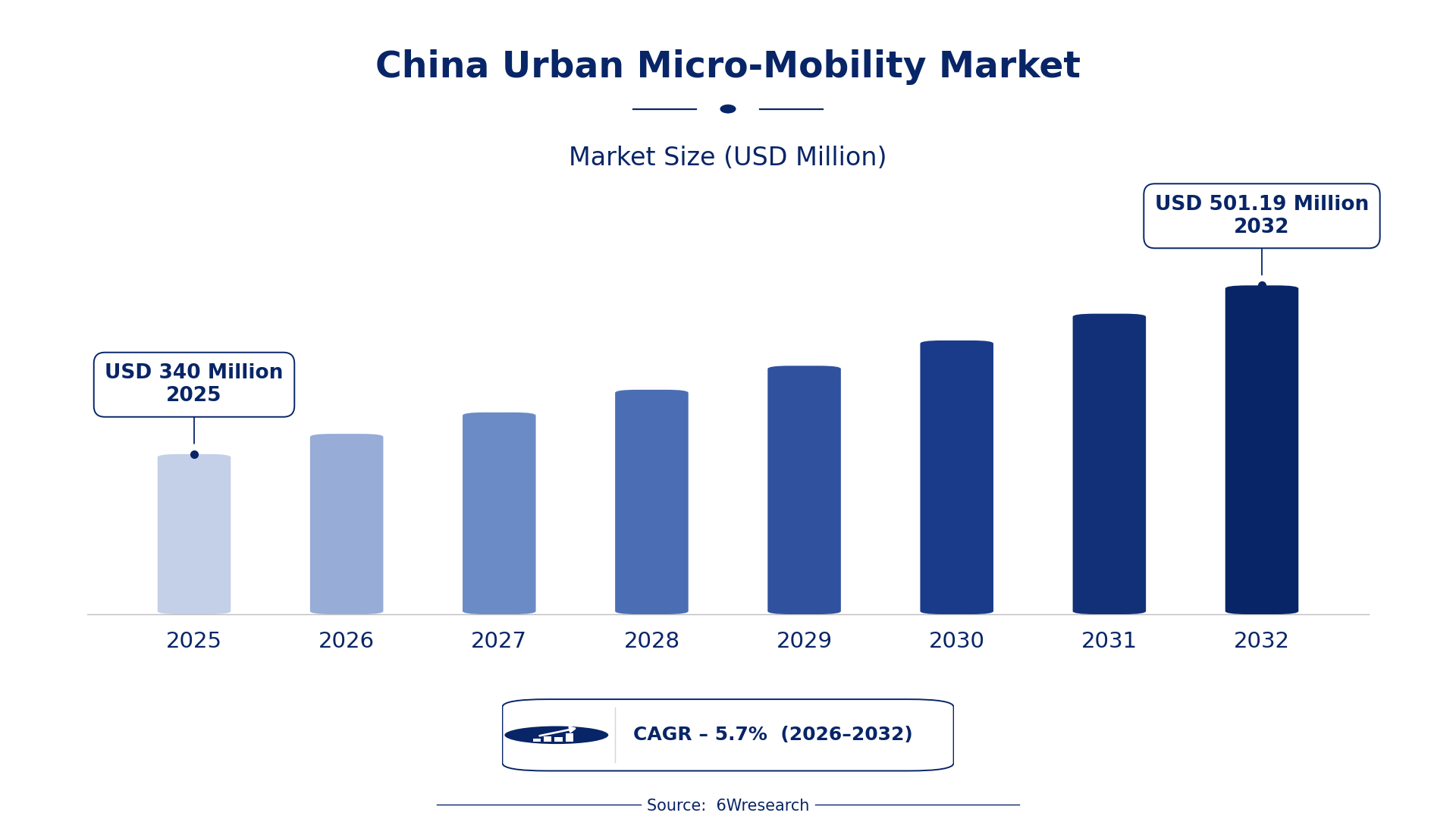
According to 6Wresearch internal database and industry insights, the China Urban Micro-Mobility Market was valued at USD 340.0 million in 2025 and is projected to reach USD 501.19 million by 2032, growing at a CAGR of approximately 5.7% during 2026–2032.
China Urban Micro-Mobility Market Highlights
| Report Metric | Details |
| Report Name | China Urban Micro-Mobility Market |
| Market Size 2025 | USD 340.0 million |
| Market Size 2032 | USD 501.19 million |
| Absolute Growth 2025–2032 | USD 161.19 million |
| CAGR 2026–2032 | 5.7% |
| Peak Annual Growth | 7.3% in 2026 |
| Forecast Period | 2026–2032 |
| Historical Data | 2022–2025 |
| Base Year | 2025 |
| Leading Vehicle Type, 2025 | e-Bikes (40% share) |
| Leading Energy Source, 2025 | Lithium-Ion (41% share) |
| Leading Sharing Type, 2025 | Dockless Sharing (38% share) |
| Leading End User, 2025 | Commuters (51% share) |
| Fastest-Growing Vehicle Type | e-Scooters (8.1% CAGR) |
| Fastest-Growing Energy Source | Electric Battery (7.3% CAGR) |
| Fastest-Growing End User | Urban Youth (8.4% CAGR) |
| Growing Sector | Urban Youth |
| Key End Users | Commuters, Urban Youth, College Students, City Transport Co. |
China Urban Micro-Mobility Market Year-wise Growth Rate and Key Drivers (2022–2032)
This graph illustrates the annual growth rates of the market from 2022 to 2032, highlighting a steady upward trajectory and projected market expansion over the forecast period.
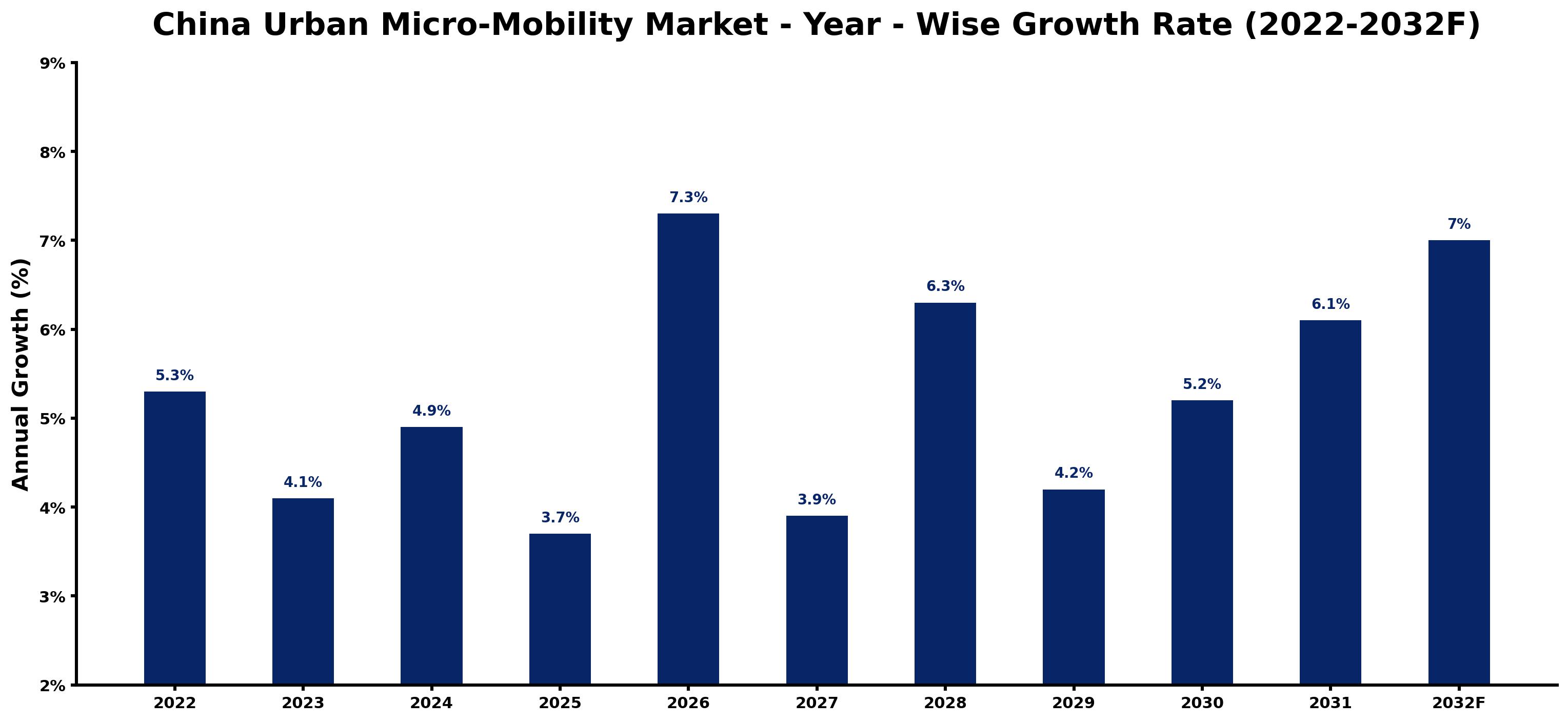
The following table presents the estimated annual growth rate for each year together with the principal factor influencing market performance.
| Year | Estimated Annual Growth (%) | Market Rationale |
| 2022 | 5.3 | Urban micro-mobility vehicles accounted for 15% of total urban transport in major cities. |
| 2023 | 4.1 | The market experienced slower growth due to the implementation of the Urban Micro-Mobility Development Guidelines. |
| 2024 | 4.9 | Demand increased as cities expanded dedicated bike lanes to support micro-mobility. |
| 2025 | 3.7 | Growth slowed as the market adjusted to new Electric Bicycle Safety Regulation standards. |
| 2026 | 7.3 | The introduction of new subsidies for electric bikes is expected to spur demand growth. |
| 2027 | 3.9 | A slight slowdown is projected as the market stabilises after rapid expansion in previous years. |
| 2028 | 6.3 | Growth is expected to accelerate with rising urban youth adoption of micro-mobility solutions. |
| 2029 | 4.2 | The market is projected to see slower growth as competition intensifies among service providers. |
| 2030 | 5.2 | Demand is expected to increase as urban infrastructure further improves to accommodate micro-mobility. |
| 2031 | 6.1 | Growth is anticipated to pick up as more cities implement supportive policies for e-scooters. |
| 2032 | 7.0 | A strong demand surge is projected as urban transport shifts towards eco-friendly options. |
Note: Market size estimations and growth projections presented in this report are based on 6Wresearch's proprietary forecasting methodology, utilizing the latest available industry data, government publications, and primary research inputs.
China Urban Micro-Mobility Market Synopsis
The China Urban Micro-Mobility Market includes lightweight electric vehicles designed for short-distance travel in urban areas. These vehicles, such as e-scooters and e-bikes, utilise advanced materials to improve performance and sustainability. The market is growing due to rising urbanisation, a greater demand for eco-friendly transport solutions, and government initiatives that support infrastructure development. In 2022, urban micro-mobility vehicles made up 15% of total urban transport in major cities, highlighting the increasing interest in sustainable commuting options.
Market Dynamics Impact Analysis (2026–2032)
| Factor | Type | Impact | Primary Segment Affected |
| Growing urban infrastructure supporting micro-mobility solutions | Driver | High | e-Scooters |
| Increased adoption of electric vehicles in urban transport | Driver | High | e-Bikes |
| Expansion of dedicated bike lanes in cities | Opportunity | High | e-Bikes |
| Rising demand for eco-friendly transport options | Opportunity | High | e-Scooters |
| Regulatory challenges affecting vehicle safety standards | Restraint | Medium | e-Bikes |
| Competition among service providers leading to price wars | Restraint | Medium | e-Scooters |
| Urban Micro-Mobility in China faces infrastructure limitations | Challenge | High | e-Bikes |
| Consumer hesitation due to safety concerns | Challenge | Medium | e-Scooters |
Evaluation of Drivers in China Urban Micro-Mobility Market (2026–2032)
Key forces behind demand, with the segment each one moves most, are listed below.
| Drivers | Primary Segment Affected | Why It Matters (Evidence) |
| Expansion of dedicated bike lanes in urban areas | e-Bikes | Beijing implemented over 200 km of dedicated bike lanes, encouraging more users to adopt e-bikes. |
| Government subsidies for electric bike purchases | e-Scooters | Hangzhou's subsidy program in 2023 incentivised consumers to purchase e-scooters. |
| Increasing urban population leading to higher commuting needs | e-Scooters | Urban Youth represent 40% of micro-mobility users, driving demand for convenient transport. |
| Focus on reducing urban traffic congestion | e-Bikes | The government aims to reduce congestion by 20% by 2025, promoting micro-mobility solutions. |
| Technological advancements in electric battery efficiency | Electric Battery | The installed base of electric batteries reached 150 million units in 2022, supporting vehicle performance. |
In 2022, urban micro-mobility vehicles accounted for 15% of total urban transport in major cities, demonstrating the rising demand for sustainable commuting options. The installed base of electric batteries reached 150 million units in 2022, supporting vehicle performance and sustainability. Urban youth represent a key user segment, driving demand for e-scooters and e-bikes.
Evaluation of Restraints in China Urban Micro-Mobility Market
The main factors holding the market back are set out below.
| Market Restraint | Primary Segment Affected | Why It Matters (Evidence) |
| Regulatory challenges affecting vehicle safety standards | e-Bikes | The updated Electric Bicycle Safety Regulation mandates stricter safety standards for manufacturers, impacting production timelines. |
| Competition among service providers leading to price wars | e-Scooters | Intense competition has driven down prices, affecting profitability for operators in urban markets. |
| Infrastructure limitations in less developed urban areas | e-Bikes | Many cities lack adequate infrastructure to support the growing demand for micro-mobility solutions. |
| Consumer hesitation due to safety concerns | e-Scooters | Safety concerns regarding e-scooter usage have led to slower adoption rates among potential users. |
| Limited awareness of micro-mobility benefits | e-Bikes | Many potential users remain unaware of the advantages of using e-bikes for urban commuting. |
China Urban Micro-Mobility Market Challenges
The China Urban Micro-Mobility market faces intense competition, as numerous local producers manufacture similar lightweight vehicles, which drives down prices and reduces profit margins for manufacturers. Supply chain disruptions arise from shortages of essential components like electric batteries, causing production delays that impact distributors reliant on consistent stock levels. Regulatory hurdles emerge from the updated National Standard for Electric Bicycles, enforcing stricter safety requirements that increase compliance costs for producers. Rising logistics and maintenance expenses further strain buyers, leading them to reconsider their investments in micro-mobility solutions.
Trends in the China Urban Micro-Mobility Market
Buyers and suppliers in the China Urban Micro-Mobility Market are adjusting to the following trends.
- Shift towards Eco-Friendly Transport Solutions: Urban Youth are increasingly adopting e-scooters and e-bikes as eco-friendly transport options. In 2022, urban micro-mobility vehicles accounted for 15% of total urban transport in major cities, reflecting this shift.
- Transition from Ownership to Shared Micro-Mobility: The rise of dockless sharing models has transformed urban transport in China. By 2025, dockless sharing is expected to hold a 38% market share, making it a convenient option for commuters.
- Emergence of Subsidy Programs for Electric Bikes: In 2023, Hangzhou introduced a subsidy program to encourage electric bike purchases. This initiative aims to promote eco-friendly transport, with a target of increasing e-bike adoption significantly.
- Growing Infrastructure for Micro-Mobility: Beijing has implemented over 200 km of dedicated bike lanes to support micro-mobility. This infrastructure development is essential for enhancing safety and encouraging more users to adopt these vehicles.
Investment Opportunities in the China Urban Micro-Mobility Market
Below are the investment opportunities with the strongest case in the China Urban Micro-Mobility Market.
- Urban Areas: With urban micro-mobility vehicles accounting for 15% of total urban transport, there is an opportunity to invest in electric bike and e-scooter fleets. Cities like Hangzhou are actively promoting eco-friendly transport solutions.
- Electric Bikes: The Chinese government aims to increase the share of electric vehicles in urban transport to 30% by 2025, creating a demand for electric bikes. Urban commuters represent a key buyer group for these vehicles.
- Infrastructure Development: The implementation of over 200 km of dedicated bike lanes in Beijing highlights the need for infrastructure investment. Local governments are seeking partnerships to improve micro-mobility accessibility.
- Subsidy Programs: The subsidy program for electric bikes in Hangzhou aims to boost eco-friendly transport adoption. This presents an opportunity for suppliers to engage with local governments and offer competitive products.
Government Initiatives in the China Urban Micro-Mobility Market
The 'National Plan for Promoting Electric Mobility', launched by the Ministry of Transport in 2021, aims to increase electric vehicle usage in urban areas by 25% by 2025. This initiative supports the development of urban micro-mobility by enhancing infrastructure and encouraging consumer adoption of electric vehicles. Additionally, the 'Urban Micro-Mobility Development Guidelines' issued in 2022 provide a framework for improving safety and performance standards, ensuring that manufacturers meet regulatory requirements.
The 'Subsidy Program for Electric Bicycles', reauthorized by the State Council in 2022, incentivises consumers to purchase electric bikes, thus promoting eco-friendly transport solutions. This program has led to increased sales and adoption rates among urban commuters, who benefit from financial assistance in acquiring electric bikes. Furthermore, local governments are implementing these subsidies to support their sustainability goals, enhancing the overall micro-mobility ecosystem.
Future Insight of the China Urban Micro-Mobility Market
The China Urban Micro-Mobility market will undergo substantial changes by 2032, driven by advancements in battery technology and the expansion of dedicated infrastructure. The government aims to increase the share of electric vehicles in urban transport to 30% by 2025, which will strengthen support for micro-mobility initiatives. By 2025, the total number of e-bikes in China is expected to reach approximately 350 million units, improving accessibility for users. New subsidy programs for electric bike purchases will incentivise buyers, making eco-friendly transport options more attractive and affordable.
Market Segmentation Analysis
The analysis below covers each segmentation, its leading category in 2025 and its fastest-growing category through 2032.
By Vehicle Type – e-Bikes Dominated, e-Scooters Expected to Grow Fastest
According to Bhawna Singh, Assistant Manager at 6Wresearch, e-Bikes held a 40% share of the China Urban Micro-Mobility Market by vehicle type in 2025. e-Bikes hold the largest market share in China as they are highly efficient and convenient for daily commutes, appealing to a wide range of users. Their popularity is evident in urban areas where they are frequently used, supported by a substantial installed base of electric batteries reaching 150 million units. Over 2026–2032, e-Scooters are expected to post the fastest growth, at a CAGR of 8.1%. e-Scooters are experiencing rapid growth due to their suitability for short urban trips, averaging 2-3 km per journey. The Ministry of Transport's initiative promoting shared micro-mobility solutions launched in 2022 is a key factor driving this trend. Suppliers should focus on enhancing e-scooter features to meet the increasing demand for efficient urban transport.
By Energy Source – Lithium-Ion Dominated, Electric Battery Expected to Grow Fastest
In 2025, Lithium-Ion led the energy source split with a 41% share. Lithium-Ion batteries dominate the energy source segment due to their efficiency and widespread use in e-vehicles, making them the preferred choice for manufacturers. Their established presence in the market is evidenced by the extensive installed base supporting micro-mobility vehicles. The quickest growth will come from Electric Battery, forecast to expand at a CAGR of 7.3% between 2026 and 2032. The Electric Battery segment is growing rapidly as it is essential for powering all micro-mobility vehicles, reflecting the broader shift towards electric transport solutions. This growth is further propelled by government initiatives aiming to increase electric vehicle share in urban transport. Buyers should prioritise sourcing vehicles with advanced battery technologies to ensure optimal performance and sustainability.
By Sharing Type – Dockless Sharing Dominated and Is Expected to Record the Fastest Growth
Dockless Sharing accounted for a 38% market share by sharing type in 2025. Dockless Sharing commands the largest market share as it offers unmatched convenience and accessibility, allowing users to easily locate and rent vehicles without the need for fixed stations. This model has gained traction in urban environments, significantly enhancing the overall user experience. Its lead should widen, with a projected CAGR of 6.9% during 2026–2032, the highest in this split. Dockless Sharing is also the fastest-growing segment, as its convenience resonates with the rising demand for flexible urban transport solutions. The widespread adoption of this model indicates a notable shift in consumer preferences towards more accessible mobility options. Suppliers should prioritise investments in dockless sharing technologies to effectively cater to the increasing consumer demand for flexible transportation solutions.
By End User – Commuters Dominated, Urban Youth Expected to Grow Fastest
The largest end user category in 2025 was Commuters, with a 51% share of total revenue. Commuters form the largest user group for micro-mobility in China, relying on these vehicles for daily travel to work and other activities. Their substantial share is driven by the need for efficient and eco-friendly transport options in congested urban environments. Urban Youth is projected to grow fastest, at a CAGR of 8.4% during 2026–2032. Urban Youth represent the fastest-growing segment, actively seeking affordable transport options that fit their lifestyle and commuting needs. Their increasing engagement with micro-mobility solutions indicates a shift towards more sustainable urban transport. Suppliers must tailor their offerings to attract the Urban Youth demographic, ensuring affordability and accessibility in their micro-mobility solutions.
Key Attractiveness of the Report
- 10 Years of Market Numbers
- Historical Data Starting from 2022 to 2025
- Base Year 2025
- Forecast Data until 2032
- Key Performance Indicators Impacting the Market
- Major Upcoming Developments and Projects
Key Highlights of the Report:
- China Urban Micro-Mobility Market Outlook
- Market Size of China Urban Micro-Mobility Market, 2025
- Forecast of China Urban Micro-Mobility Market, 2032
- Historical Data and Forecast of China Urban Micro-Mobility Revenues & Volume for the Period 2022 - 2032F
- China Urban Micro-Mobility Market Trend Evolution
- China Urban Micro-Mobility Market Drivers and Challenges
- China Urban Micro-Mobility Price Trends
- China Urban Micro-Mobility Porter's Five Forces
- China Urban Micro-Mobility Industry Life Cycle
- Historical Data and Forecast of China Urban Micro-Mobility Market Revenues & Volume By Vehicle Type for the Period 2022 - 2032F
- Historical Data and Forecast of China Urban Micro-Mobility Market Revenues & Volume By e-Scooters for the Period 2022 - 2032F
- Historical Data and Forecast of China Urban Micro-Mobility Market Revenues & Volume By e-Bikes for the Period 2022 - 2032F
- Historical Data and Forecast of China Urban Micro-Mobility Market Revenues & Volume By Compact EVs for the Period 2022 - 2032F
- Historical Data and Forecast of China Urban Micro-Mobility Market Revenues & Volume By Hoverboards for the Period 2022 - 2032F
- Historical Data and Forecast of China Urban Micro-Mobility Market Revenues & Volume By Energy Source for the Period 2022 - 2032F
- Historical Data and Forecast of China Urban Micro-Mobility Market Revenues & Volume By Electric Battery for the Period 2022 - 2032F
- Historical Data and Forecast of China Urban Micro-Mobility Market Revenues & Volume By Lithium-Ion for the Period 2022 - 2032F
- Historical Data and Forecast of China Urban Micro-Mobility Market Revenues & Volume By Solar Hybrid for the Period 2022 - 2032F
- Historical Data and Forecast of China Urban Micro-Mobility Market Revenues & Volume By Rechargeable Battery for the Period 2022 - 2032F
- Historical Data and Forecast of China Urban Micro-Mobility Market Revenues & Volume By Sharing Type for the Period 2022 - 2032F
- Historical Data and Forecast of China Urban Micro-Mobility Market Revenues & Volume By Dockless Sharing for the Period 2022 - 2032F
- Historical Data and Forecast of China Urban Micro-Mobility Market Revenues & Volume By Subscription Model for the Period 2022 - 2032F
- Historical Data and Forecast of China Urban Micro-Mobility Market Revenues & Volume By Fleet Ownership for the Period 2022 - 2032F
- Historical Data and Forecast of China Urban Micro-Mobility Market Revenues & Volume By Personal Ownership for the Period 2022 - 2032F
- Historical Data and Forecast of China Urban Micro-Mobility Market Revenues & Volume By End User for the Period 2022 - 2032F
- Historical Data and Forecast of China Urban Micro-Mobility Market Revenues & Volume By Commuters for the Period 2022 - 2032F
- Historical Data and Forecast of China Urban Micro-Mobility Market Revenues & Volume By College Students for the Period 2022 - 2032F
- Historical Data and Forecast of China Urban Micro-Mobility Market Revenues & Volume By City Transport Co. for the Period 2022 - 2032F
- Historical Data and Forecast of China Urban Micro-Mobility Market Revenues & Volume By Urban Youth for the Period 2022 - 2032F
- China Urban Micro-Mobility Import Export Trade Statistics
- Market Opportunity Assessment By Vehicle Type
- Market Opportunity Assessment By Energy Source
- Market Opportunity Assessment By Sharing Type
- Market Opportunity Assessment By End User
- China Urban Micro-Mobility Top Companies Market Share
- China Urban Micro-Mobility Competitive Benchmarking By Technical and Operational Parameters
- China Urban Micro-Mobility Company Profiles
- China Urban Micro-Mobility Key Strategic Recommendations
Market Covered
This report examines the market across the segments below.
By Vehicle Type
- e-Scooters
- e-Bikes
- Compact EVs
- Hoverboards
By Energy Source
- Electric Battery
- Lithium-Ion
- Solar Hybrid
- Rechargeable Battery
By Sharing Type
- Dockless Sharing
- Subscription Model
- Fleet Ownership
- Personal Ownership
By End User
- Commuters
- College Students
- City Transport Co.
- Urban Youth































