China Urban Mobility Solutions Market Size & Growth Rate
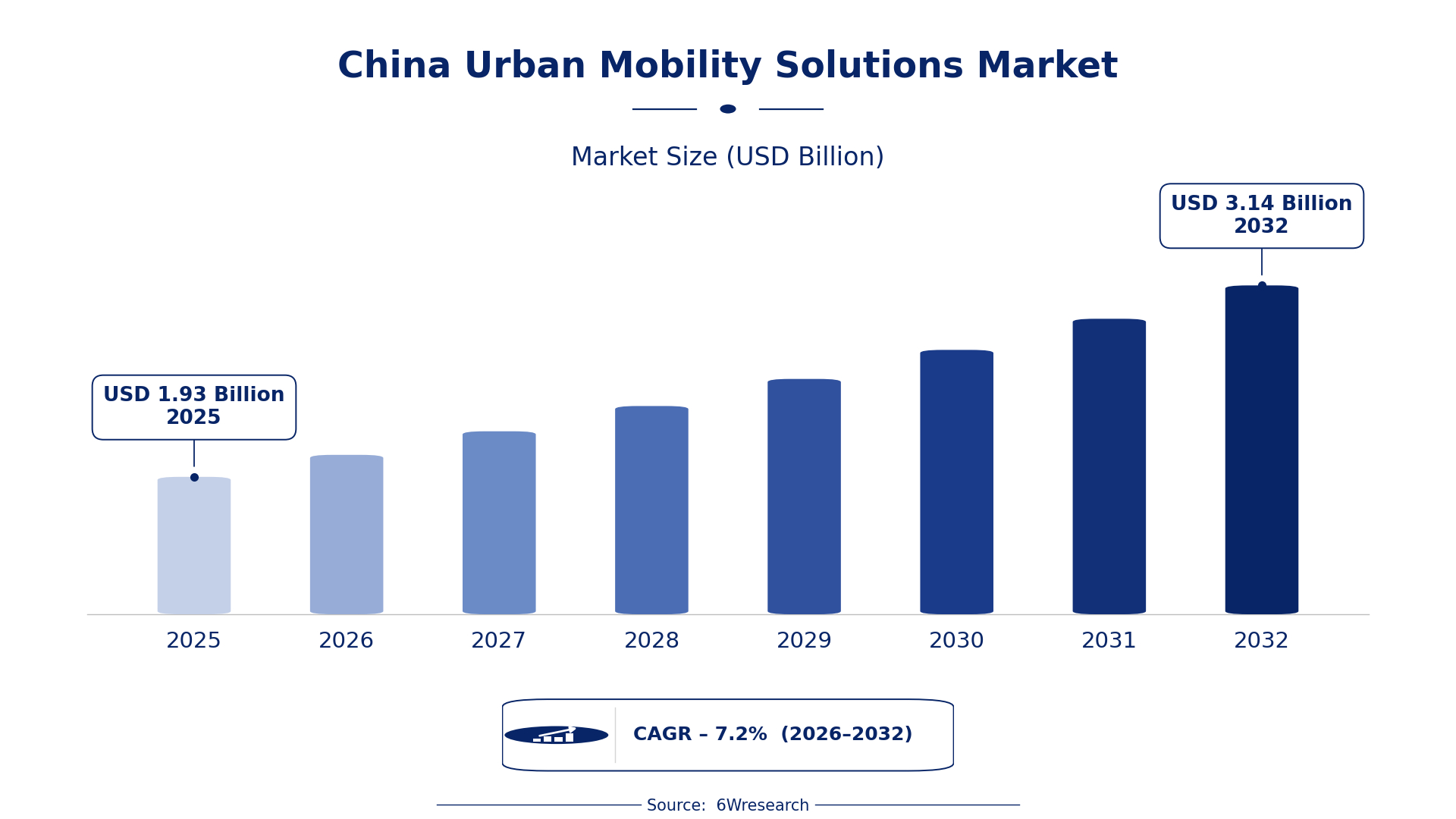
According to 6Wresearch internal database and industry insights, the China Urban Mobility Solutions Market was valued at USD 1.93 billion in 2025 and is projected to reach USD 3.14 billion by 2032, growing at a CAGR of approximately 7.2% during 2026–2032.
China Urban Mobility Solutions Market Highlights
| Report Metric | Details |
| Report Name | China Urban Mobility Solutions Market |
| Market Size 2025 | USD 1.93 billion |
| Market Size 2032 | USD 3.14 billion |
| Absolute Growth 2025–2032 | USD 1.21 billion |
| CAGR 2026–2032 | 7.2% |
| Peak Annual Growth | 9.0% in 2031 |
| Forecast Period | 2026–2032 |
| Historical Data | 2022–2025 |
| Base Year | 2025 |
| Leading Solution Type, 2025 | Mobility-as-a-Service (51% share) |
| Leading Platform Type, 2025 | App-Based (36% share) |
| Leading Deployment Model, 2025 | SaaS (44% share) |
| Leading End User, 2025 | Urban Consumers (52% share) |
| Fastest-Growing Solution Type | Fleet Management (9.9% CAGR) |
| Fastest-Growing Platform Type | Cloud-Based (9.1% CAGR) |
| Fastest-Growing End User | Mobility-as-a-Service Firms (9.8% CAGR) |
| Growing Sector | Urban Consumers |
| Key End Users | Urban Consumers, Fleet Operators, Ride-Sharing Companies, Mobility-as-a-Service Firms |
China Urban Mobility Solutions Market Year-wise Growth Rate and Key Drivers (2022–2032)
This graph illustrates the annual growth rates of the market from 2022 to 2032, highlighting a steady upward trajectory and projected market expansion over the forecast period.
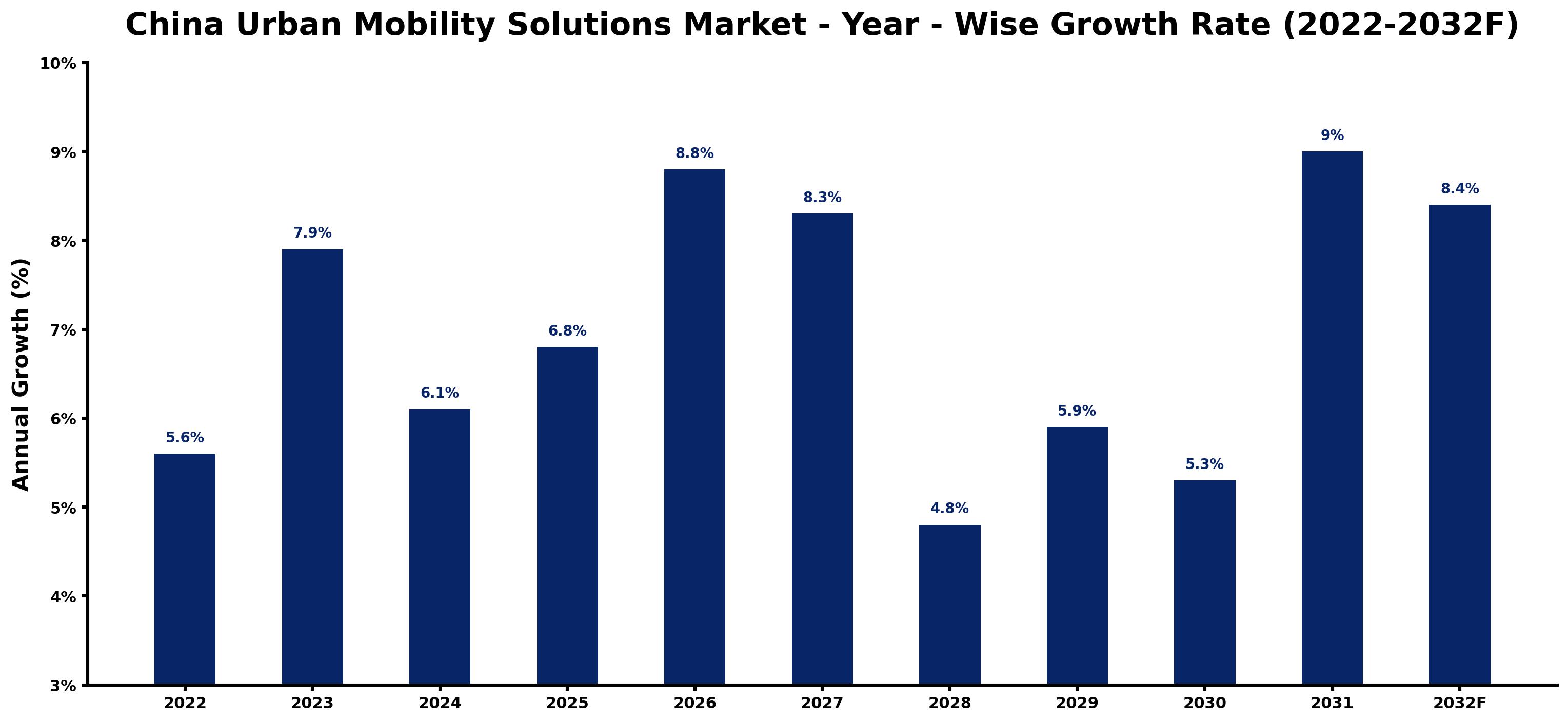
The following table presents the estimated annual growth rate for each year together with the principal factor influencing market performance.
| Year | Estimated Annual Growth (%) | Market Rationale |
| 2022 | 5.6 | The market experienced steady growth as urban consumers increasingly sought efficient transportation solutions. |
| 2023 | 7.9 | Demand surged due to the implementation of the Urban Mobility Improvement Plan, which improved infrastructure. |
| 2024 | 6.1 | Growth slowed slightly as urban mobility solutions became more integrated into existing systems. |
| 2025 | 6.8 | A renewed focus on electric vehicle infrastructure drove faster adoption of mobility solutions. |
| 2026 | 8.8 | The market is expected to expand as technology advancements improve service delivery and user experience. |
| 2027 | 8.3 | Growth is projected to moderate as the market adjusts to new operational efficiencies and user expectations. |
| 2028 | 4.8 | A further slowdown is expected as urban mobility solutions face integration challenges with legacy systems. |
| 2029 | 5.9 | Demand is anticipated to pick up again as urban consumers embrace new mobility options and services. |
| 2030 | 5.3 | Growth is forecasted to decelerate slightly as the market matures and competition intensifies. |
| 2031 | 9.0 | The market is expected to peak due to investments in smart mobility technologies and infrastructure. |
| 2032 | 8.4 | Growth is projected to slow as the market stabilises following rapid advancements and increased adoption. |
Note: Market size estimations and growth projections presented in this report are based on 6Wresearch's proprietary forecasting methodology, utilizing the latest available industry data, government publications, and primary research inputs.
China Urban Mobility Solutions Market Synopsis
Urban Mobility Solutions in China encompass technologies aimed at improving transportation efficiency in urban areas. These solutions utilise software integration, data analytics, and real-time communication systems to optimise routes and manage fleets. The market is expanding due to a burgeoning urban consumer base exceeding 900 million and substantial investments in infrastructure, including over 500,000 electric vehicle charging stations. The 'Urban Mobility Improvement Plan' launched in 2021 is a key driver of this growth, promoting efficiency and sustainability in urban transport.
Market Dynamics Impact Analysis (2026–2032)
| Factor | Type | Impact | Primary Segment Affected |
| Increased urbanisation and a growing population drive demand for efficient transportation solutions. | Driver | High | Urban Consumers |
| The rise of electric vehicles creates opportunities for charging infrastructure and related services. | Opportunity | High | EV Charging Integration |
| Integration challenges with existing systems can limit the growth of new mobility solutions. | Restraint | High | Mobility-as-a-Service |
| The need for real-time data processing creates demand for cloud-based platforms. | Driver | Medium | Cloud-Based |
| The growing number of ride-sharing companies indicates a demand for fleet management solutions. | Opportunity | Medium | Fleet Management |
| High competition among mobility service providers can lead to pricing pressures. | Challenge | High | Mobility-as-a-Service Firms |
| Regulatory compliance can delay the rollout of new urban mobility solutions. | Restraint | Medium | App-Based |
| Technological integration remains a challenge for many operators in the market. | Challenge | Medium | Fleet Operators |
Evaluation of Drivers in China Urban Mobility Solutions Market (2026–2032)
Key forces behind demand, with the segment each one moves most, are listed below.
| Drivers | Primary Segment Affected | Why It Matters (Evidence) |
| Rising urbanisation increases the need for efficient transportation solutions, with urban consumers driving demand. | Urban Consumers | The population of urban consumers in China exceeds 900 million, leading to higher demand for mobility solutions. |
| The push for electric vehicles enhances the need for EV charging infrastructure. | EV Charging Integration | China has over 500,000 electric vehicle charging stations as of 2023, supporting EV integration. |
| The growth of ride-sharing companies boosts demand for fleet management solutions. | Fleet Management | There are over 200 ride-sharing companies operating in major Chinese cities, increasing operational needs. |
| Cloud-based platforms improve service delivery and data management for urban mobility. | Cloud-Based | Cloud-based mobility platforms are projected to enhance service delivery in urban areas by 2024. |
| The Urban Mobility Improvement Plan promotes investments in transportation efficiency. | Mobility-as-a-Service | The National Development and Reform Commission launched the plan in 2021 to enhance urban transport. |
Growth in the Urban Mobility Solutions market in China comes from rising urbanisation, the push for electric vehicles, and the expansion of ride-sharing services. The population of urban consumers exceeds 900 million, driving demand for efficient transportation solutions. As of 2023, the number of electric vehicle charging stations has surpassed 500,000, supporting the integration of EVs into urban mobility. The Urban Mobility Improvement Plan launched in 2021 promotes investments in transportation efficiency, improving service delivery. The growth of over 200 ride-sharing companies operating in major cities increases the need for fleet management solutions, propelling demand for advanced mobility technologies.
Evaluation of Restraints in China Urban Mobility Solutions Market
The main factors holding the market back are set out below.
| Market Restraint | Primary Segment Affected | Why It Matters (Evidence) |
| Integration challenges with existing systems can hinder the adoption of new mobility solutions. | Mobility-as-a-Service | Urban mobility solutions must integrate seamlessly with legacy systems, which can delay implementation. |
| Regulatory compliance can slow down the rollout of new services. | App-Based | Operators must adhere to various regulations, which can extend project timelines. |
| High competition among service providers can lead to pricing pressures. | Mobility-as-a-Service Firms | Intense competition may force providers to lower prices, affecting profitability. |
| Technological integration remains a challenge for many operators in the market. | Fleet Operators | Many fleet operators struggle with integrating new technologies into their existing operations. |
| Limited infrastructure development can restrict service expansion. | EV Charging Integration | The growth of electric vehicle infrastructure is essential for supporting increased EV adoption. |
China Urban Mobility Solutions Market Challenges
Urban Mobility Solutions in China still have to solve a few pressing issues, beginning with a skills gap among workers. This gap exists because the rapid pace of technological change outstrips the availability of training programs, resulting in delays for fleet operators who need qualified personnel to manage over 1 million vehicles effectively. Supply chain disruptions also pose challenges; dependence on imported components can raise costs for producers, limiting their ability to provide timely services. Regulatory challenges are another concern, as adherence to standards like ISO 37120 can hinder municipalities from swiftly implementing improvements in urban transport efficiency. Lastly, technological integration remains a hurdle; many cities find it difficult to adopt smart mobility solutions, which contributes to inefficiencies in urban commuting, currently averaging 30 minutes per trip.
Trends in the China Urban Mobility Solutions Market
The trends below show where the China Urban Mobility Solutions Market is heading.
- Shift Towards Electric Vehicle Integration: Urban consumers are adopting electric vehicles at an increasing rate, with a 20% rise in EV usage expected by 2025. The Electric Vehicle Promotion Plan aims to boost market share, creating opportunities for charging infrastructure.
- Transition to Cloud-Based Solutions: The urban mobility sector is moving towards cloud-based platforms, with a projected annual growth rate of 9.1%. This shift is reflected in the increasing adoption of cloud technologies for real-time data processing in urban areas.
- Emergence of Mobility-as-a-Service: Mobility-as-a-Service firms are projected to grow by 10% annually through 2030. This growth reflects the rising demand for efficient transportation services, driven by urban consumers seeking convenience.
- Focus on Smart City Initiatives: The Smart City Initiative promotes IoT-enabled urban mobility solutions across 50 cities in China. This initiative aims to reduce traffic congestion by 25%, enhancing urban transportation efficiency.
Investment Opportunities in the China Urban Mobility Solutions Market
Several openings in the China Urban Mobility Solutions Market merit attention from investors.
- Investment in EV Charging Infrastructure: With over 500,000 charging stations in China, there is an opportunity to expand EV infrastructure. Urban consumers are increasingly adopting electric vehicles, creating demand for more charging points.
- Development of Fleet Management Solutions: The rise of over 200 ride-sharing companies presents an opportunity for fleet management solutions. Collaborating with local operators can facilitate market entry and service development.
- Cloud-Based Mobility Platforms: The increasing demand for real-time data processing creates opportunities for cloud-based mobility solutions. Urban consumers are adopting app-based services, making this a timely investment area.
- Mobility-as-a-Service Expansion: The projected growth of Mobility-as-a-Service firms offers opportunities for service providers. Urban consumers are looking for efficient transport solutions, creating a need for new offerings.
Government Initiatives in the China Urban Mobility Solutions Market
The 'Urban Mobility Improvement Plan' launched by the National Development and Reform Commission in 2021 aims to improve transportation efficiency in urban areas. This plan complements earlier initiatives, such as the 'Green Transportation Development Plan' initiated in 2022, which promotes sustainable mobility solutions. Together, these measures aim to enhance urban transport infrastructure and reduce congestion. The focus on electric vehicle integration and smart technologies is a notable addition to existing regulations, ensuring a more efficient urban mobility framework.
In 2023, the Beijing Municipal Government allocated 2 billion RMB for urban mobility infrastructure improvements, particularly in EV charging stations. The Ministry of Transport oversees this funding, ensuring that projects align with national mobility goals. Additionally, the updated 'Smart City Initiative' promotes advanced urban mobility technologies, facilitating better service delivery. These efforts aim to improve the overall efficiency of urban transport systems across major cities.
Future Insight of the China Urban Mobility Solutions Market
Several forward-looking factors should support the Urban Mobility Solutions market in China over the coming years. The 'Urban Mobility Improvement Plan' will enhance transportation efficiency, while the 'Smart City Initiative' will drive IoT-enabled solutions across 50 cities. By 2025, the 'Green Transportation Development Plan' aims to increase electric vehicle usage by 20%, which will elevate demand for integrated mobility options. Innovations in fleet management are expected to improve service delivery, fundamentally changing how urban transportation is approached.
Market Segmentation Analysis
The analysis below covers each segmentation, its leading category in 2025 and its fastest-growing category through 2032.
By Solution Type – Mobility-as-a-Service Dominated, Fleet Management Expected to Grow Fastest
According to Bhawna Singh, Assistant Manager at 6Wresearch, the largest solution type category in 2025 was Mobility-as-a-Service, with a 51% share of total revenue. Mobility-as-a-Service holds the largest market share due to its widespread adoption among urban consumers who seek seamless transportation options. With over 900 million urban residents in China, this solution effectively meets the demand for efficient mobility services. Fleet Management is projected to grow fastest, at a CAGR of 9.9% during 2026–2032. Fleet Management is experiencing rapid growth as urban fleet operators managing over 1 million vehicles increasingly embrace advanced solutions for operational efficiency. This trend suggests that the rising demand for effective vehicle management will accelerate the growth of this segment. Suppliers should focus on enhancing Mobility-as-a-Service offerings to meet the increasing urban demand for efficient transportation solutions.
By Platform Type – App-Based Dominated, Cloud-Based Expected to Grow Fastest
With a 36% revenue share in 2025, App-Based was the largest platform type category. App-Based platforms dominate the market as they are directly utilised by consumers to access mobility services, making them essential for urban transportation. The reported 40% increase in app usage highlights strong consumer engagement and reliance on these platforms. The quickest growth will come from Cloud-Based, forecast to expand at a CAGR of 9.1% between 2026 and 2032. Cloud-Based platforms are projected to grow swiftly, as they enable real-time data processing crucial for effective service delivery in urban areas. The increasing reliance on technology for mobility solutions will significantly drive demand for these platforms. Buyers should prioritise app-based solutions to align with the changing preferences of urban consumers seeking convenient transportation options.
By Deployment Model – SaaS Dominated and Is Expected to Record the Fastest Growth
In 2025, SaaS led the deployment model split with a 44% share. SaaS captures the largest market share because it provides scalable solutions vital for efficient urban mobility management. This model effectively addresses the growing needs of cities to implement flexible and responsive transportation systems. Its lead should widen, with a projected CAGR of 9.4% during 2026–2032, the highest in this split. SaaS is also the fastest-growing deployment model, as its scalability allows for quick adaptation to the complexities of urban mobility demands. This dual role will likely strengthen its market position further. Suppliers must enhance their SaaS offerings to capitalise on the rising demand for scalable urban mobility solutions.
By End User – Urban Consumers Dominated, Mobility-as-a-Service Firms Expected to Grow Fastest
Urban Consumers took a 52% share of end user in 2025, more than any other category. Urban Consumers represent the largest share as they are the primary beneficiaries of improved transportation options in densely populated areas. Their needs drive the development and adoption of various urban mobility solutions. Over 2026–2032, Mobility-as-a-Service Firms are expected to post the fastest growth, at a CAGR of 9.8%. Mobility-as-a-Service Firms are growing rapidly as they are core users of urban mobility technologies, responding to the needs of urban consumers. This segment's growth reflects the increasing reliance on integrated transportation solutions. Suppliers should focus on developing tailored solutions for Mobility-as-a-Service firms to capture the growing market.
Key Attractiveness of the Report
- 10 Years of Market Numbers
- Historical Data Starting from 2022 to 2025
- Base Year 2025
- Forecast Data until 2032
- Key Performance Indicators Impacting the Market
- Major Upcoming Developments and Projects
Key Highlights of the Report:
- China Urban Mobility Solutions Market Outlook
- Market Size of China Urban Mobility Solutions Market, 2025
- Forecast of China Urban Mobility Solutions Market, 2032
- Historical Data and Forecast of China Urban Mobility Solutions Revenues & Volume for the Period 2022 - 2032F
- China Urban Mobility Solutions Market Trend Evolution
- China Urban Mobility Solutions Market Drivers and Challenges
- China Urban Mobility Solutions Price Trends
- China Urban Mobility Solutions Porter's Five Forces
- China Urban Mobility Solutions Industry Life Cycle
- Historical Data and Forecast of China Urban Mobility Solutions Market Revenues & Volume By Solution Type for the Period 2022 - 2032F
- Historical Data and Forecast of China Urban Mobility Solutions Market Revenues & Volume By Route Optimization for the Period 2022 - 2032F
- Historical Data and Forecast of China Urban Mobility Solutions Market Revenues & Volume By Fleet Management for the Period 2022 - 2032F
- Historical Data and Forecast of China Urban Mobility Solutions Market Revenues & Volume By Mobility-as-a-Service for the Period 2022 - 2032F
- Historical Data and Forecast of China Urban Mobility Solutions Market Revenues & Volume By EV Charging Integration for the Period 2022 - 2032F
- Historical Data and Forecast of China Urban Mobility Solutions Market Revenues & Volume By Platform Type for the Period 2022 - 2032F
- Historical Data and Forecast of China Urban Mobility Solutions Market Revenues & Volume By App-Based for the Period 2022 - 2032F
- Historical Data and Forecast of China Urban Mobility Solutions Market Revenues & Volume By Cloud-Based for the Period 2022 - 2032F
- Historical Data and Forecast of China Urban Mobility Solutions Market Revenues & Volume By Web & Mobile App for the Period 2022 - 2032F
- Historical Data and Forecast of China Urban Mobility Solutions Market Revenues & Volume By Charging Stations for the Period 2022 - 2032F
- Historical Data and Forecast of China Urban Mobility Solutions Market Revenues & Volume By Deployment Model for the Period 2022 - 2032F
- Historical Data and Forecast of China Urban Mobility Solutions Market Revenues & Volume By SaaS for the Period 2022 - 2032F
- Historical Data and Forecast of China Urban Mobility Solutions Market Revenues & Volume By Hybrid for the Period 2022 - 2032F
- Historical Data and Forecast of China Urban Mobility Solutions Market Revenues & Volume By Subscription for the Period 2022 - 2032F
- Historical Data and Forecast of China Urban Mobility Solutions Market Revenues & Volume By IoT-Enabled for the Period 2022 - 2032F
- Historical Data and Forecast of China Urban Mobility Solutions Market Revenues & Volume By End User for the Period 2022 - 2032F
- Historical Data and Forecast of China Urban Mobility Solutions Market Revenues & Volume By Ride-Sharing Companies for the Period 2022 - 2032F
- Historical Data and Forecast of China Urban Mobility Solutions Market Revenues & Volume By Mobility-as-a-Service Firms for the Period 2022 - 2032F
- Historical Data and Forecast of China Urban Mobility Solutions Market Revenues & Volume By Urban Consumers for the Period 2022 - 2032F
- Historical Data and Forecast of China Urban Mobility Solutions Market Revenues & Volume By Fleet Operators for the Period 2022 - 2032F
- China Urban Mobility Solutions Import Export Trade Statistics
- Market Opportunity Assessment By Solution Type
- Market Opportunity Assessment By Platform Type
- Market Opportunity Assessment By Deployment Model
- Market Opportunity Assessment By End User
- China Urban Mobility Solutions Top Companies Market Share
- China Urban Mobility Solutions Competitive Benchmarking By Technical and Operational Parameters
- China Urban Mobility Solutions Company Profiles
- China Urban Mobility Solutions Key Strategic Recommendations
Market Covered
The report offers an extensive study of the following market segments.
By Solution Type
- Route Optimization
- Fleet Management
- Mobility-as-a-Service
- EV Charging Integration
By Platform Type
- App-Based
- Cloud-Based
- Web & Mobile App
- Charging Stations
By Deployment Model
- SaaS
- Hybrid
- Subscription
- IoT-Enabled
By End User
- Ride-Sharing Companies
- Mobility-as-a-Service Firms
- Urban Consumers
- Fleet Operators































