China Urban Planning Technology Market Size & Growth Rate
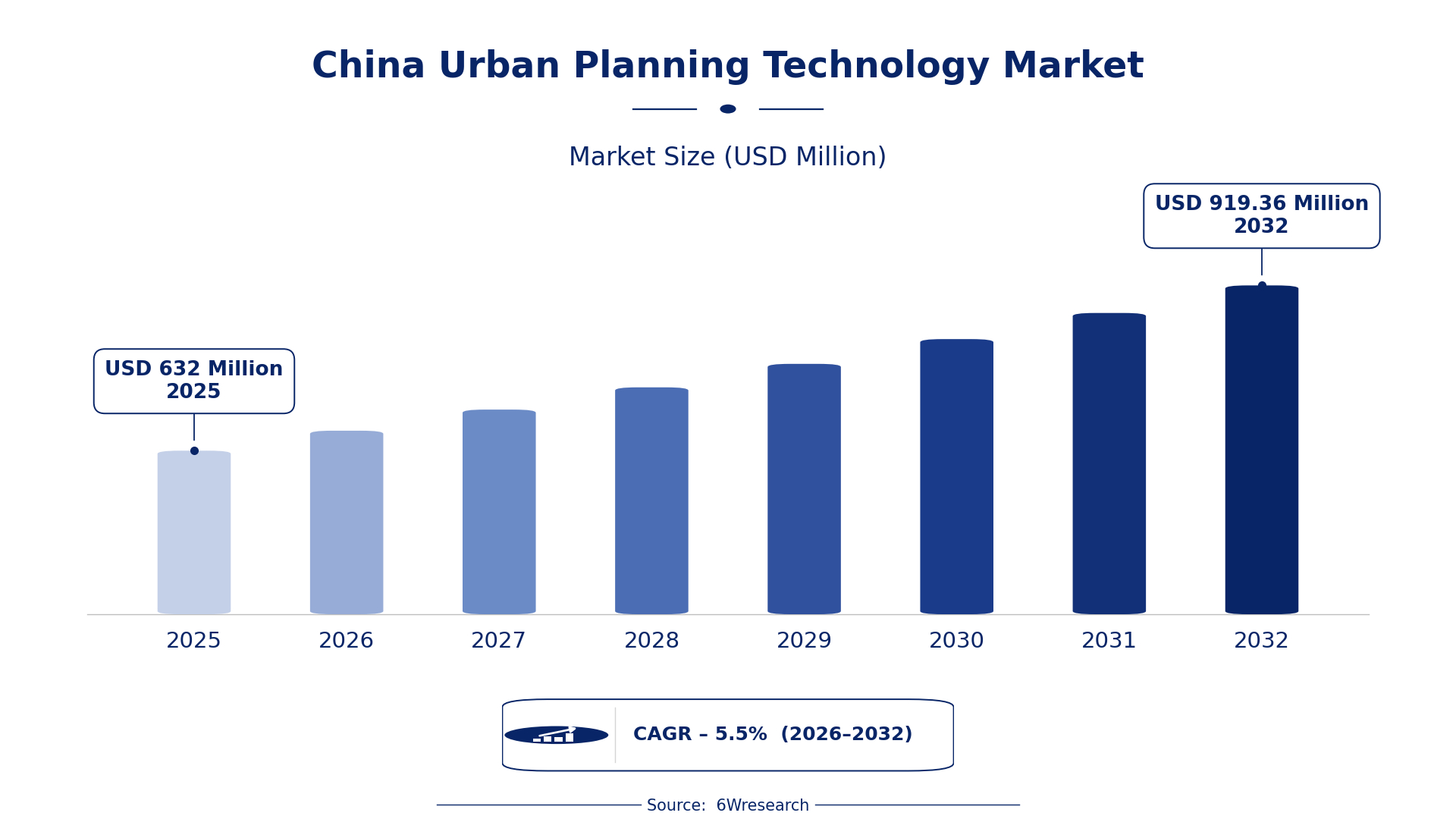
According to 6Wresearch internal database and industry insights, the China Urban Planning Technology Market was valued at USD 632.0 million in 2025 and is projected to reach USD 919.36 million by 2032, growing at a CAGR of approximately 5.5% during 2026–2032.
China Urban Planning Technology Market Highlights
| Report Metric | Details |
| Report Name | China Urban Planning Technology Market |
| Market Size 2025 | USD 632.0 million |
| Market Size 2032 | USD 919.36 million |
| Absolute Growth 2025–2032 | USD 287.36 million |
| CAGR 2026–2032 | 5.5% |
| Peak Annual Growth | 7.3% in 2032 |
| Forecast Period | 2026–2032 |
| Historical Data | 2022–2025 |
| Base Year | 2025 |
| Leading Planning Type, 2025 | Land-Use Planning (37% share) |
| Leading Tool Used, 2025 | BIM Software (44% share) |
| Leading Output Format, 2025 | Infrastructure Blueprints (42% share) |
| Leading End User, 2025 | Local Authorities (51% share) |
| Fastest-Growing Planning Type | Transport Simulation (7.5% CAGR) |
| Fastest-Growing Tool Used | AI-Driven Mobility Tools (7.6% CAGR) |
| Fastest-Growing Output Format | Predictive Traffic Maps (6.9% CAGR) |
| Fastest-Growing End User | Urban Designers (8.0% CAGR) |
| Growing Sector | Urban Designers |
| Key End Users | Local Authorities, Urban Designers, Engineering Firms, City Architects |
China Urban Planning Technology Market Year-wise Growth Rate and Key Drivers (2022–2032)
This graph illustrates the annual growth rates of the market from 2022 to 2032, highlighting a steady upward trajectory and projected market expansion over the forecast period.
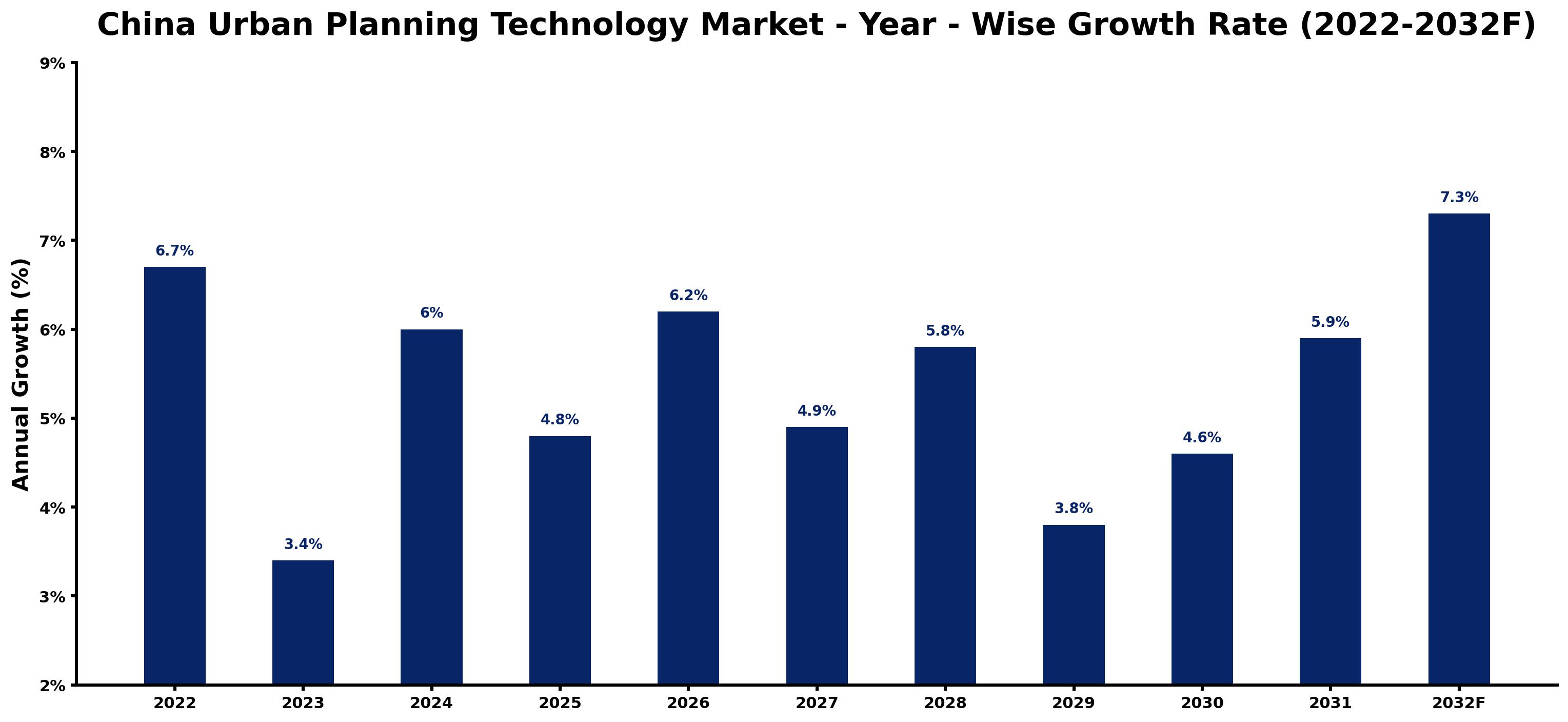
Annual growth estimates for each year appear below with the principal reason behind them, explaining the shifts that set the pace of the market.
| Year | Estimated Annual Growth (%) | Market Rationale |
| 2022 | 6.7 | The urban population reached 1.4 billion, increasing the need for efficient urban planning. |
| 2023 | 3.4 | Growth slowed as local authorities adjusted urban development strategies to meet new demands. |
| 2024 | 6.0 | Demand for BIM software rose as urban planners sought more collaborative tools for projects. |
| 2025 | 4.8 | Interest in transport simulation grew as cities focused on optimizing traffic patterns and mobility. |
| 2026 | 6.2 | The 14th Five-Year Plan emphasises sustainable urban development, boosting technology adoption across sectors. |
| 2027 | 4.9 | Investment in AI-driven mobility tools slowed as local authorities reassessed their priorities and budgets. |
| 2028 | 5.8 | Urban designers increasingly utilized 3D simulations to improve public engagement in urban projects. |
| 2029 | 3.8 | Growth slowed due to adjustments in compliance with new urban planning regulations and standards. |
| 2030 | 4.6 | The Ministry of Transport's predictive traffic maps will drive renewed interest in simulation tools for urban planning. |
| 2031 | 5.9 | Local authorities are ramping up investments in infrastructure design technologies to address urban challenges. |
| 2032 | 7.3 | The Urban Planning Society's initiative for smart cities will boost technology demand in urban planning. |
Note: Market size estimations and growth projections presented in this report are based on 6Wresearch's proprietary forecasting methodology, utilizing the latest available industry data, government publications, and primary research inputs.
China Urban Planning Technology Market Synopsis
Urban Planning Technology in China includes advanced methods for city development, utilising tools like GIS and BIM. This technology optimises land use, enhances transportation systems, and supports infrastructure design. The China Urban Planning Technology Market is growing due to increasing urbanisation and government initiatives. Local authorities are investing more in urban planning technologies, with over 70% planning to adopt AI-driven mobility tools by 2025. The 14th Five-Year Plan is a key driver for sustainable urban development initiatives.
Market Dynamics Impact Analysis (2026–2032)
| Factor | Type | Impact | Primary Segment Affected |
| Rising urban population drives demand for efficient urban planning solutions. | Driver | High | Land-Use Planning |
| Increased investment in smart city initiatives enhances technology adoption. | Driver | High | BIM Software |
| Growing need for traffic management solutions presents opportunities for simulation tools. | Opportunity | High | Transport Simulation |
| Urban designers are increasingly adopting 3D simulations for public engagement. | Opportunity | Medium | 3D Urban Modeling |
| Regulatory compliance requirements can slow down project timelines. | Restraint | High | Zoning Reports |
| High costs associated with advanced technology implementation can deter investment. | Restraint | Medium | Infrastructure Design |
| Local authorities face challenges in integrating new technologies into existing frameworks. | Challenge | High | Local Authorities |
| Limited skilled workforce in urban planning technologies affects project execution. | Challenge | Medium | Engineering Firms |
Evaluation of Drivers in China Urban Planning Technology Market (2026–2032)
The main growth drivers and the segments they affect most are set out below.
| Drivers | Primary Segment Affected | Why It Matters (Evidence) |
| Increased urbanisation leads to higher demand for efficient land-use planning. | Land-Use Planning | China's urban population reached 1.4 billion in 2023, prompting local authorities to seek effective solutions. |
| Growing investment in smart city initiatives boosts the adoption of BIM software. | BIM Software | The 14th Five-Year Plan emphasises sustainable urban development, encouraging technology integration across sectors. |
| Rising traffic congestion drives demand for transport simulation tools. | Transport Simulation | Local authorities are focusing on optimizing traffic patterns to improve urban mobility. |
| Urban designers increasingly use 3D simulations to engage the public in planning. | 3D Urban Modeling | Over 300 urban planning conferences in 2023 highlighted the importance of technology in public engagement. |
| Mandatory zoning reports create consistent demand for compliance-related technologies. | Zoning Reports | Zoning reports are required for all new urban development projects in major cities. |
In 2023, local authorities are in search of effective land-use planning tools to tackle urban challenges. The focus on sustainable urban development is prompting the adoption of BIM software, with 60% of urban planners reporting its use in 2022. Urban designers are increasingly employing 3D simulations to involve the public in planning processes, reflecting a shift towards more participatory approaches. As cities grapple with escalating traffic congestion, the need for transport simulation tools is expected to increase, improving urban mobility and planning efficiency.
Evaluation of Restraints in China Urban Planning Technology Market
Below mentioned are some major restraints and their influence on market dynamics.
| Market Restraint | Primary Segment Affected | Why It Matters (Evidence) |
| Regulatory compliance requirements can slow down project timelines. | Zoning Reports | Mandatory zoning reports for new urban developments can delay project approvals. |
| High costs associated with advanced technology implementation can deter investment. | Infrastructure Design | Budget constraints limit local authorities' ability to invest in new technologies. |
| Limited skilled workforce in urban planning technologies affects project execution. | Engineering Firms | A shortage of trained professionals hampers effective use of advanced urban planning tools. |
| Integration of new technologies into existing frameworks can be challenging. | Local Authorities | Local authorities often struggle to adapt to rapid technological advancements in urban planning practices. |
| Slow adoption of AI-driven tools may limit efficiency gains. | AI-Driven Mobility Tools | Over 70% of local authorities plan to invest in AI tools by 2025, but implementation may lag. |
China Urban Planning Technology Market Challenges
Buyers and suppliers in the China Urban Planning Technology market encounter rising costs associated with the urban population, which reached 1.4 billion in 2023. This increase compels producers to allocate more resources to software development, resulting in higher expenses for local authorities managing urban projects. Competition intensifies as 60% of urban planners utilise BIM software, urging buyers to invest in advanced tools to remain competitive. Regulatory requirements, such as mandatory zoning reports for new developments, can prolong project timelines for producers and inflate costs for local authorities overseeing urban initiatives.
Trends in the China Urban Planning Technology Market
Four trends stand out in the China Urban Planning Technology Market.
- Shift Towards Smart City Initiatives: The Smart City Development Strategy launched in 2022 promotes technology integration in urban planning. By 2025, over 70% of local authorities are expected to invest in AI-driven mobility tools, improving urban efficiency.
- Growing Use of 3D Simulations: In 2023, urban designers increasingly adopted 3D simulations to engage the public in planning processes. This trend is set to improve stakeholder participation in urban development projects.
- Increased Focus on Predictive Traffic Management: The Ministry of Transport's Urban Traffic Optimization Program, initiated in 2023, aims to improve traffic management through advanced simulation tools. By 2024, predictive traffic maps will be implemented in major cities.
- Rising Demand for BIM Software: In 2022, 60% of urban planners reported using BIM software for projects. This trend reflects the growing need for collaborative design and management in urban planning.
Investment Opportunities in the China Urban Planning Technology Market
Several openings in the China Urban Planning Technology Market merit attention from investors.
- Investment in AI-Driven Mobility Tools: With over 70% of local authorities planning to invest in AI tools by 2025, there is a strong opportunity for suppliers to provide these technologies. Local partnerships can facilitate market entry and implementation.
- Expansion of 3D Simulation Technologies: The growing use of 3D simulations presents an opportunity for technology providers. Urban designers in major cities are increasingly seeking tools that improve public engagement in planning processes.
- Development of Predictive Traffic Management Solutions: As cities face traffic congestion, the demand for predictive traffic maps is rising. Suppliers can enter this market by collaborating with local authorities and transportation agencies to provide effective solutions.
- Enhancing Infrastructure Design Capabilities: Investment in advanced infrastructure design technologies is essential for urban development. Local authorities are seeking innovative solutions to meet urban planning challenges and improve project outcomes.
Government Initiatives in the China Urban Planning Technology Market
The National Urban Planning Regulations, updated in 2021 by the Ministry of Housing and Urban-Rural Development, require local authorities to adopt advanced technologies in their planning processes, ensuring compliance with modern standards. The Smart City Development Strategy, launched by the State Council in 2022, aims to integrate technology into urban planning, focusing on efficiency and sustainability. This strategy encourages local governments to invest in innovative solutions for urban challenges, promoting a more sustainable urban environment.
In 2023, the Ministry of Transport initiated the Urban Traffic Optimization Program to improve traffic management through advanced simulation tools. This program supports local authorities in implementing predictive traffic maps by 2024, enhancing overall urban planning efficiency. The National Geographic Information System Development Plan promotes the use of GIS in urban planning across all provinces, ensuring comprehensive data integration.
Future Insight of the China Urban Planning Technology Market
The China Urban Planning Technology market will undergo notable changes by 2032, primarily driven by the 14th Five-Year Plan's focus on sustainable urban development. By 2025, over 70% of local authorities are expected to invest in advanced mobility tools, reshaping urban transport systems. The Ministry of Transport will implement predictive traffic maps by 2024, enhancing planning efficiency. Additionally, the Urban Planning Society of China's smart city initiative will promote technology integration, leading to improved infrastructure design and community engagement.
Market Segmentation Analysis
The analysis below covers each segmentation, its leading category in 2025 and its fastest-growing category through 2032.
By Planning Type – Land-Use Planning Dominated, Transport Simulation Expected to Grow Fastest
According to Bhawna Singh, Assistant Manager at 6Wresearch, Land-Use Planning held a 37% share of the China Urban Planning Technology Market by planning type in 2025. Land-Use Planning holds the largest share in China due to its essential role in the efficient allocation of urban space and resources. Local authorities, particularly in major cities like Shanghai and Beijing, rely on this planning type to address the needs of their rapidly urbanising populations. The quickest growth will come from Transport Simulation, forecast to expand at a CAGR of 7.5% between 2026 and 2032. Transport Simulation is experiencing rapid growth as urban planners increasingly adopt it to analyse traffic patterns and improve transport systems. The Ministry of Transport's initiative to implement predictive traffic maps by 2024 is a key factor driving this segment's expansion. Suppliers should focus on developing transport simulation tools to meet the rising demand from urban planners.
By Tool Used – BIM Software Dominated, AI-Driven Mobility Tools Expected to Grow Fastest
BIM Software accounted for a 44% market share by tool used in 2025. BIM Software commands the largest market share as it is crucial for collaborative design and management of building projects. The reported usage of BIM software by 60% of urban planners in 2022 underscores its vital role in urban planning practices. AI-Driven Mobility Tools are set to record the highest CAGR in this split, 7.6% over 2026–2032. AI-Driven Mobility Tools are growing quickly due to local authorities' investments in smart city initiatives. With over 70% of these authorities expected to invest in AI-driven tools by 2025, this segment shows strong potential for growth. Buyers should prioritise the integration of AI-driven mobility tools to enhance urban planning efficiency.
By Output Format – Infrastructure Blueprints Dominated, Predictive Traffic Maps Expected to Grow Fastest
In 2025, Infrastructure Blueprints led the output format split with a 42% share. Infrastructure Blueprints dominate the market share as they are essential for providing detailed planning and construction guidelines for urban projects. The numerous urban development initiatives across China highlight the critical need for robust infrastructure planning. Over 2026–2032, Predictive Traffic Maps are expected to post the fastest growth, at a CAGR of 6.9%. Predictive Traffic Maps are set to grow rapidly due to their ability to forecast traffic flow and inform planning decisions. The Ministry of Transport's upcoming implementation of these maps by 2024 indicates their increasing importance in urban planning. Suppliers must innovate predictive traffic mapping solutions to align with the evolving needs of urban planners.
By End User – Local Authorities Dominated, Urban Designers Expected to Grow Fastest
With a 51% revenue share in 2025, Local Authorities was the largest end user category. Local Authorities represent the largest share as they are the primary decision-makers in urban planning processes. Their active investment in urban planning technology is essential for addressing the challenges posed by China's expanding urban population. Urban Designers are projected to grow fastest, at a CAGR of 8.0% during 2026–2032. Urban Designers are rapidly increasing their utilisation of technology to create functional urban spaces, reflecting a shift towards more effective design practices. The numerous urban planning conferences held in 2023 demonstrate their commitment to integrating advanced tools. Suppliers should tailor their products to meet the specific needs of urban designers to capture this growing segment.
Key Attractiveness of the Report
- 10 Years of Market Numbers
- Historical Data Starting from 2022 to 2025
- Base Year 2025
- Forecast Data until 2032
- Key Performance Indicators Impacting the Market
- Major Upcoming Developments and Projects
Key Highlights of the Report:
- China Urban Planning Technology Market Outlook
- Market Size of China Urban Planning Technology Market, 2025
- Forecast of China Urban Planning Technology Market, 2032
- Historical Data and Forecast of China Urban Planning Technology Revenues & Volume for the Period 2022 - 2032F
- China Urban Planning Technology Market Trend Evolution
- China Urban Planning Technology Market Drivers and Challenges
- China Urban Planning Technology Price Trends
- China Urban Planning Technology Porter's Five Forces
- China Urban Planning Technology Industry Life Cycle
- Historical Data and Forecast of China Urban Planning Technology Market Revenues & Volume By Planning Type for the Period 2022 - 2032F
- Historical Data and Forecast of China Urban Planning Technology Market Revenues & Volume By 3D Urban Modeling for the Period 2022 - 2032F
- Historical Data and Forecast of China Urban Planning Technology Market Revenues & Volume By Transport Simulation for the Period 2022 - 2032F
- Historical Data and Forecast of China Urban Planning Technology Market Revenues & Volume By Land-Use Planning for the Period 2022 - 2032F
- Historical Data and Forecast of China Urban Planning Technology Market Revenues & Volume By Infrastructure Design for the Period 2022 - 2032F
- Historical Data and Forecast of China Urban Planning Technology Market Revenues & Volume By Tool Used for the Period 2022 - 2032F
- Historical Data and Forecast of China Urban Planning Technology Market Revenues & Volume By BIM Software for the Period 2022 - 2032F
- Historical Data and Forecast of China Urban Planning Technology Market Revenues & Volume By AI-Driven Mobility Tools for the Period 2022 - 2032F
- Historical Data and Forecast of China Urban Planning Technology Market Revenues & Volume By GIS Mapping for the Period 2022 - 2032F
- Historical Data and Forecast of China Urban Planning Technology Market Revenues & Volume By CAD/BIM Integration for the Period 2022 - 2032F
- Historical Data and Forecast of China Urban Planning Technology Market Revenues & Volume By Output Format for the Period 2022 - 2032F
- Historical Data and Forecast of China Urban Planning Technology Market Revenues & Volume By 3D Simulation for the Period 2022 - 2032F
- Historical Data and Forecast of China Urban Planning Technology Market Revenues & Volume By Predictive Traffic Maps for the Period 2022 - 2032F
- Historical Data and Forecast of China Urban Planning Technology Market Revenues & Volume By Zoning Reports for the Period 2022 - 2032F
- Historical Data and Forecast of China Urban Planning Technology Market Revenues & Volume By Infrastructure Blueprints for the Period 2022 - 2032F
- Historical Data and Forecast of China Urban Planning Technology Market Revenues & Volume By End User for the Period 2022 - 2032F
- Historical Data and Forecast of China Urban Planning Technology Market Revenues & Volume By City Architects for the Period 2022 - 2032F
- Historical Data and Forecast of China Urban Planning Technology Market Revenues & Volume By Urban Designers for the Period 2022 - 2032F
- Historical Data and Forecast of China Urban Planning Technology Market Revenues & Volume By Local Authorities for the Period 2022 - 2032F
- Historical Data and Forecast of China Urban Planning Technology Market Revenues & Volume By Engineering Firms for the Period 2022 - 2032F
- China Urban Planning Technology Import Export Trade Statistics
- Market Opportunity Assessment By Planning Type
- Market Opportunity Assessment By Tool Used
- Market Opportunity Assessment By Output Format
- Market Opportunity Assessment By End User
- China Urban Planning Technology Top Companies Market Share
- China Urban Planning Technology Competitive Benchmarking By Technical and Operational Parameters
- China Urban Planning Technology Company Profiles
- China Urban Planning Technology Key Strategic Recommendations
Market Covered
The report offers an extensive study of the following market segments.
By Planning Type
- 3D Urban Modeling
- Transport Simulation
- Land-Use Planning
- Infrastructure Design
By Tool Used
- BIM Software
- AI-Driven Mobility Tools
- GIS Mapping
- CAD/BIM Integration
By Output Format
- 3D Simulation
- Predictive Traffic Maps
- Zoning Reports
- Infrastructure Blueprints
By End User
- City Architects
- Urban Designers
- Local Authorities
- Engineering Firms































