China Urban Transportation Market Size & Growth Rate
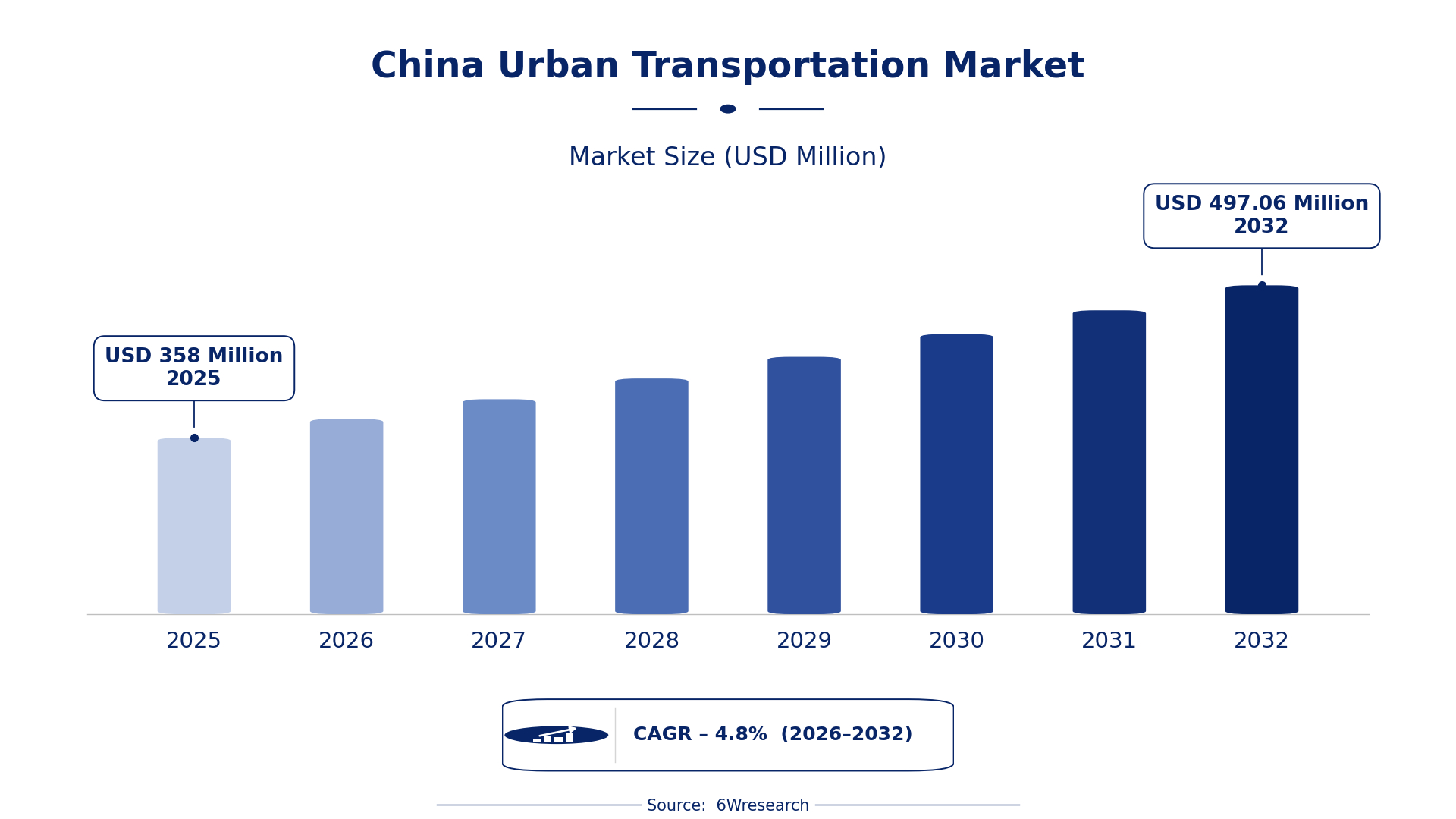
According to 6Wresearch internal database and industry insights, the China Urban Transportation Market was valued at USD 358.0 million in 2025 and is projected to reach USD 497.06 million by 2032, growing at a CAGR of approximately 4.8% during 2026–2032.
China Urban Transportation Market Highlights
| Report Metric | Details |
| Report Name | China Urban Transportation Market |
| Market Size 2025 | USD 358.0 million |
| Market Size 2032 | USD 497.06 million |
| Absolute Growth 2025–2032 | USD 139.06 million |
| CAGR 2026–2032 | 4.8% |
| Peak Annual Growth | 7.4% in 2030 |
| Forecast Period | 2026–2032 |
| Historical Data | 2022–2025 |
| Base Year | 2025 |
| Leading Transportation Mode, 2025 | Public Transit (39% share) |
| Leading Fuel Type, 2025 | Electric/Diesel (51% share) |
| Leading Network Type, 2025 | Fixed Routes (41% share) |
| Leading End User, 2025 | Commuters (38% share) |
| Fastest-Growing Transportation Mode | Micro-Mobility (6.7% CAGR) |
| Fastest-Growing Fuel Type | Battery (7.2% CAGR) |
| Fastest-Growing Network Type | Dynamic Routes (7.5% CAGR) |
| Fastest-Growing End User | App Users (6.2% CAGR) |
| Growing Sector | Public Transit |
| Key End Users | Commuters, App Users, Students, Workers |
China Urban Transportation Market Year-wise Growth Rate and Key Drivers (2022–2032)
This graph illustrates the annual growth rates of the market from 2022 to 2032, highlighting a steady upward trajectory and projected market expansion over the forecast period.
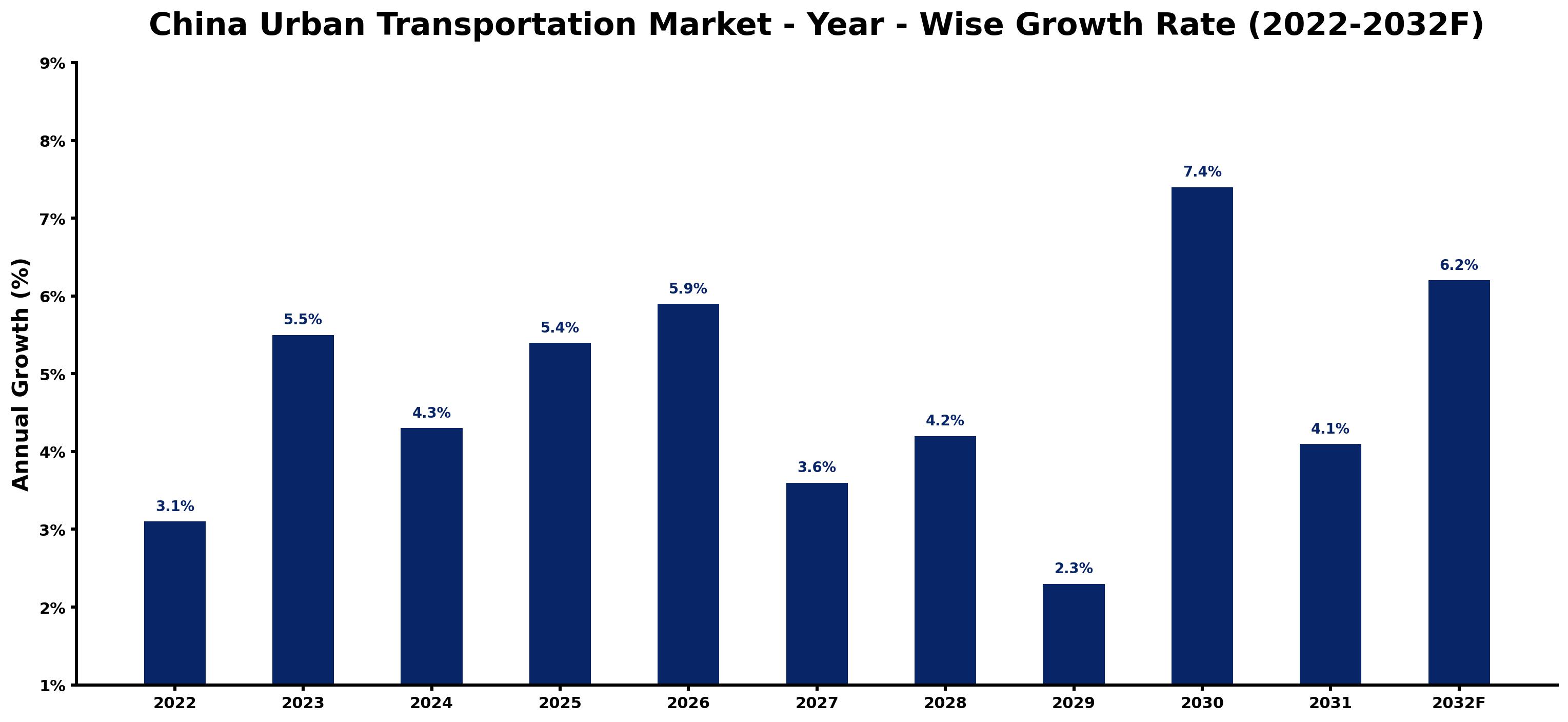
The table below sets out the estimated growth rate for each year and the main factor behind it.
| Year | Estimated Annual Growth (%) | Market Rationale |
| 2022 | 3.1 | Urban transportation demand was strong due to a growing urban population and infrastructure needs. |
| 2023 | 5.5 | Investment in public transit infrastructure, particularly in Beijing, drove growth in ridership. |
| 2024 | 4.3 | Growth slowed slightly as new projects began to stabilise, maintaining high demand for public transport. |
| 2025 | 5.4 | Investment in the Public Transport Development Fund led to a resurgence in market growth. |
| 2026 | 5.9 | Continued funding for the Urban Mobility Improvement Plan is expected to support further growth in transportation options. |
| 2027 | 3.6 | Market growth is projected to slow as infrastructure projects reach completion, but demand will remain strong. |
| 2028 | 4.2 | A rise in micro-mobility options is expected to contribute to renewed interest in urban transportation solutions. |
| 2029 | 2.3 | Growth is anticipated to decelerate as market adjustments take place, but public transit usage will remain high. |
| 2030 | 7.4 | Peak growth is expected due to the introduction of dynamic routes and new service options. |
| 2031 | 4.1 | Market growth is projected to slow as the focus shifts to maintaining existing infrastructure and services. |
| 2032 | 6.2 | A resurgence in urban mobility investments is expected to stimulate further growth in the market. |
Note: Market size estimations and growth projections presented in this report are based on 6Wresearch's proprietary forecasting methodology, utilizing the latest available industry data, government publications, and primary research inputs.
China Urban Transportation Market Synopsis
Urban Transportation in China encompasses various modes such as public transit, ride-hailing, and micro-mobility solutions. It is primarily developed through government initiatives and private investments aimed at reducing congestion and pollution. The China Urban Transportation Market is growing due to the increasing urban population and investments in infrastructure. In 2023, Beijing allocated 50 billion CNY for public transit improvements, while the number of ride-hailing app users exceeded 450 million. These developments are driving demand for efficient and sustainable urban transport solutions.
Market Dynamics Impact Analysis (2026–2032)
| Factor | Type | Impact | Primary Segment Affected |
| Growing urban population driving public transport demand | Driver | High | Public Transit |
| Increased investment in electric vehicle infrastructure | Driver | High | Electric/Diesel |
| Expansion of micro-mobility options in urban areas | Opportunity | Medium | Micro-Mobility |
| Investment in dynamic route systems for flexibility | Opportunity | Medium | Dynamic Routes |
| High initial costs for electric vehicle adoption | Restraint | High | Electric/Diesel |
| Regulatory hurdles for new transportation services | Restraint | Medium | Ride-Hailing |
| Infrastructure delays affecting service expansion | Challenge | High | Public Transit |
| Competition from private transport options | Challenge | Medium | Private Transport |
Evaluation of Drivers in China Urban Transportation Market (2026–2032)
The table below links each growth driver to the segment it affects and the evidence for it.
| Drivers | Primary Segment Affected | Why It Matters (Evidence) |
| Increased urban population | Public Transit | China's urban population reached 900 million in 2022, driving demand for public transport systems. |
| Significant investments in public transit | Electric/Diesel | Beijing's 50 billion CNY investment in public transit infrastructure enhances service availability. |
| Growth in ride-hailing app users | Ride-Hailing | The number of ride-hailing app users in China exceeded 450 million in 2023, increasing demand for flexible transport. |
| Expansion of electric vehicle adoption | Battery | China's battery electric vehicle sales reached 3 million units in 2022, boosting demand for charging infrastructure. |
| Development of micro-mobility solutions | Micro-Mobility | Micro-mobility options like e-scooters are now available in 30 major cities, catering to short-distance travel. |
The Urban Transportation market in China is growing on the back of rising urban population, public transit investments, and increasing adoption of micro-mobility solutions. In 2022, China's urban population reached 900 million, driving demand for efficient transport systems. Beijing's investment of 50 billion CNY in public transit infrastructure in 2023 improved service availability. The number of ride-hailing app users exceeded 450 million, indicating a shift towards flexible transport options. The introduction of micro-mobility options in 30 major cities further caters to urban commuters seeking convenient travel solutions.
Evaluation of Restraints in China Urban Transportation Market
The following restraints limit how fast demand can grow.
| Market Restraint | Primary Segment Affected | Why It Matters (Evidence) |
| High costs of electric vehicle adoption | Electric/Diesel | Initial investment for electric vehicles remains high, limiting widespread adoption among users. |
| Regulatory hurdles for new services | Ride-Hailing | New ride-hailing services face stringent regulations, delaying their entry into the market. |
| Infrastructure delays impacting service availability | Public Transit | Delays in infrastructure projects hinder the expansion of public transport services. |
| Competition from private transport options | Private Transport | Private transport remains a popular choice, diverting users from public transit systems. |
| Limited consumer awareness of micro-mobility options | Micro-Mobility | Consumers may not be fully aware of the benefits of micro-mobility solutions, slowing adoption. |
China Urban Transportation Market Challenges
Urban transportation producers in China face significant technological challenges, particularly in integrating smart systems across public transit and ride-hailing services. These issues arise from rapid urbanisation, which leads to infrastructure development lagging behind demand, inflating operational costs by 15% for transport operators. Cost pressures are exacerbated by the need for substantial investments; the 50 billion CNY allocated for public transit in Beijing may not cover all necessary upgrades, delaying essential improvements for local users. Regulatory compliance with strict sustainability standards adds further financial strain, potentially leading to penalties that impact budgets for local transport authorities. Skills shortages in the workforce hinder the adoption of new technologies, limiting companies' ability to innovate and meet the demands of urban commuters.
Trends in the China Urban Transportation Market
Below mentioned are some of the trends shaping the China Urban Transportation Market growth.
- Expansion of Electric Vehicle Charging Infrastructure: The National Electric Vehicle Charging Infrastructure Development Plan aims to expand charging networks by 2025, with over 1 million stations established by 2023. This growth supports the increasing adoption of electric vehicles in urban areas.
- Rise of Micro-Mobility Solutions: Micro-mobility options like e-scooters are now available in 30 major cities, catering to urban commuters. This trend reflects changing preferences for short-distance travel, promoting sustainable transport alternatives.
- Shift Towards Dynamic Routes: Dynamic routes are becoming increasingly popular, offering flexibility in urban transport. This change is supported by investments in technology and infrastructure, improving user experience and accessibility.
- Growth of Ride-Hailing Services: In 2023, the number of ride-hailing app users in China exceeded 450 million, indicating a shift towards flexible transport options. This trend is reshaping urban mobility patterns and increasing service demand.
Investment Opportunities in the China Urban Transportation Market
Investors looking at the China Urban Transportation Market should consider the following areas.
- Investment in Electric Vehicle Infrastructure: With over 1 million charging stations by 2023, there is an opportunity to invest in electric vehicle infrastructure. Urban commuters are increasingly adopting electric vehicles, creating demand for charging solutions.
- Expansion of Micro-Mobility Options: The growing popularity of micro-mobility solutions presents an opportunity for investment in e-scooter services. Urban areas are increasingly adopting these options, providing flexibility for short-distance travel.
- Development of Dynamic Route Systems: The shift towards dynamic routes creates opportunities for technology providers to develop routing solutions. Urban transport operators are seeking to enhance service flexibility and efficiency.
- Enhancement of Public Transit Services: Investment in public transit systems is essential, particularly in major cities like Beijing. The Public Transport Development Fund supports urban transit investments, creating opportunities for infrastructure development.
Government Initiatives in the China Urban Transportation Market
The 'Urban Mobility Improvement Plan' launched by the National Development and Reform Commission in 2021 aims to improve public transport efficiency and reduce congestion. This measure complements the 'Green Transport Development Plan' initiated in 2020, which promotes electric and hybrid vehicle adoption, further supporting sustainable transport goals. The 'National Electric Vehicle Charging Infrastructure Development Plan' approved in 2022 aims to expand charging networks by 2025, facilitating the adoption of electric vehicles.
The Public Transport Development Fund established in 2021 provides financial support for urban transit investments. Agencies like the Ministry of Transport oversee the allocation of these funds, ensuring that projects align with national transport goals. The Smart City Initiative encourages the integration of technology in urban transport systems, improving service delivery and user experience. In 2023, the fund allocated 100 billion CNY to support various urban transit projects.
Future Insight of the China Urban Transportation Market
The urban transportation market in China is set to evolve significantly by 2032, driven by government initiatives and technological advancements. The 'Urban Mobility Improvement Plan' will focus on upgrading infrastructure, benefiting millions of daily commuters. With electric buses making up 60% of public transport vehicles, the shift towards sustainable travel will continue to gain momentum. The growth of electric vehicle charging stations, surpassing 1 million in 2023, will further facilitate the transition to eco-friendly transport options, allowing both buyers and suppliers to respond effectively to changing market demands.
Market Segmentation Analysis
The report offers a comprehensive study of the following market segments and their leading categories in the market.
By Transportation Mode – Public Transit Dominated, Micro-Mobility Expected to Grow Fastest
According to Bhawna Singh, Assistant Manager at 6Wresearch, Public Transit held a 39% share of the China Urban Transportation Market by transportation mode in 2025. Public Transit holds the largest share in China due to its critical role in meeting the commuting needs of the 900 million urban residents. The substantial investment of 50 billion CNY by Beijing in 2023 further solidifies its dominance in the market. The quickest growth will come from Micro-Mobility, forecast to expand at a CAGR of 6.7% between 2026 and 2032. Micro-Mobility is experiencing rapid growth as a preferred choice for short distances, with services now operational in 30 major cities. This trend indicates a shift towards more adaptable travel options that align with urban users' preferences. Suppliers should focus on enhancing public transit services while also developing micro-mobility solutions to capture emerging demand.
By Fuel Type – Electric/Diesel Dominated, Battery Expected to Grow Fastest
With a 51% revenue share in 2025, Electric/Diesel was the largest fuel type category. Electric/Diesel fuels dominate the market as they are widely used in public transit vehicles, particularly in major cities where electric buses accounted for 60% of the fleet by 2022. This strong adoption reflects the commitment to sustainable transport initiatives. Battery is set to record the highest CAGR in this split, 7.2% over 2026–2032. Battery technology is growing rapidly, driven by the increasing sales of battery electric vehicles, which reached 3 million units in 2022. The expansion of charging infrastructure to over 1 million stations by 2023 supports this upward trend. Buyers should prepare for a shift towards battery-powered solutions as the market adapts to greener fuel options.
By Network Type – Fixed Routes Dominated, Dynamic Routes Expected to Grow Fastest
Fixed Routes accounted for a 41% market share by network type in 2025. Fixed Routes dominate the market as they provide a reliable framework for public transportation, essential for serving millions of daily commuters. This established structure is crucial for ensuring consistent service across urban areas. Over 2026–2032, Dynamic Routes are expected to post the fastest growth, at a CAGR of 7.5%. Dynamic Routes are becoming increasingly popular due to their ability to adapt to real-time demand, offering greater flexibility in urban transport. This trend reflects a growing preference for responsive and efficient transportation solutions. Suppliers need to incorporate dynamic routing features to stay competitive in the evolving urban transportation market.
By End User – Commuters Dominated, App Users Expected to Grow Fastest
In 2025, Commuters led the end user split with a 38% share. Commuters make up the largest user group in the urban transportation market, driven by the need for efficient travel solutions in densely populated areas. Their significant presence underscores the necessity for reliable public transit options to accommodate daily commuting requirements. App Users are projected to grow fastest, at a CAGR of 6.2% during 2026–2032. App Users are the fastest-growing segment, highlighting the increasing dependence on technology for transportation, with over 450 million users reported in 2023. This trend signifies a shift towards digital solutions for commuting needs. Suppliers should prioritise investments in technology-driven services to effectively engage the growing base of app users in urban transportation.
Key Attractiveness of the Report
- 10 Years of Market Numbers
- Historical Data Starting from 2022 to 2025
- Base Year 2025
- Forecast Data until 2032
- Key Performance Indicators Impacting the Market
- Major Upcoming Developments and Projects
Key Highlights of the Report:
- China Urban Transportation Market Outlook
- Market Size of China Urban Transportation Market, 2025
- Forecast of China Urban Transportation Market, 2032
- Historical Data and Forecast of China Urban Transportation Revenues & Volume for the Period 2022 - 2032F
- China Urban Transportation Market Trend Evolution
- China Urban Transportation Market Drivers and Challenges
- China Urban Transportation Price Trends
- China Urban Transportation Porter's Five Forces
- China Urban Transportation Industry Life Cycle
- Historical Data and Forecast of China Urban Transportation Market Revenues & Volume By Transportation Mode for the Period 2022 - 2032F
- Historical Data and Forecast of China Urban Transportation Market Revenues & Volume By Public Transit for the Period 2022 - 2032F
- Historical Data and Forecast of China Urban Transportation Market Revenues & Volume By Ride-Hailing for the Period 2022 - 2032F
- Historical Data and Forecast of China Urban Transportation Market Revenues & Volume By Micro-Mobility for the Period 2022 - 2032F
- Historical Data and Forecast of China Urban Transportation Market Revenues & Volume By Private Transport for the Period 2022 - 2032F
- Historical Data and Forecast of China Urban Transportation Market Revenues & Volume By Fuel Type for the Period 2022 - 2032F
- Historical Data and Forecast of China Urban Transportation Market Revenues & Volume By Electric/Diesel for the Period 2022 - 2032F
- Historical Data and Forecast of China Urban Transportation Market Revenues & Volume By Gasoline/Electric for the Period 2022 - 2032F
- Historical Data and Forecast of China Urban Transportation Market Revenues & Volume By Battery for the Period 2022 - 2032F
- Historical Data and Forecast of China Urban Transportation Market Revenues & Volume By Hybrid Vehicles for the Period 2022 - 2032F
- Historical Data and Forecast of China Urban Transportation Market Revenues & Volume By Network Type for the Period 2022 - 2032F
- Historical Data and Forecast of China Urban Transportation Market Revenues & Volume By Fixed Routes for the Period 2022 - 2032F
- Historical Data and Forecast of China Urban Transportation Market Revenues & Volume By Dynamic Routes for the Period 2022 - 2032F
- Historical Data and Forecast of China Urban Transportation Market Revenues & Volume By Shared for the Period 2022 - 2032F
- Historical Data and Forecast of China Urban Transportation Market Revenues & Volume By Self-Owned for the Period 2022 - 2032F
- Historical Data and Forecast of China Urban Transportation Market Revenues & Volume By End User for the Period 2022 - 2032F
- Historical Data and Forecast of China Urban Transportation Market Revenues & Volume By Commuters for the Period 2022 - 2032F
- Historical Data and Forecast of China Urban Transportation Market Revenues & Volume By App Users for the Period 2022 - 2032F
- Historical Data and Forecast of China Urban Transportation Market Revenues & Volume By Students, Workers for the Period 2022 - 2032F
- Historical Data and Forecast of China Urban Transportation Market Revenues & Volume By Households for the Period 2022 - 2032F
- China Urban Transportation Import Export Trade Statistics
- Market Opportunity Assessment By Transportation Mode
- Market Opportunity Assessment By Fuel Type
- Market Opportunity Assessment By Network Type
- Market Opportunity Assessment By End User
- China Urban Transportation Top Companies Market Share
- China Urban Transportation Competitive Benchmarking By Technical and Operational Parameters
- China Urban Transportation Company Profiles
- China Urban Transportation Key Strategic Recommendations
Market Covered
This report examines the market across the segments below.
By Transportation Mode
- Public Transit
- Ride-Hailing
- Micro-Mobility
- Private Transport
By Fuel Type
- Electric/Diesel
- Gasoline/Electric
- Battery
- Hybrid Vehicles
By Network Type
- Fixed Routes
- Dynamic Routes
- Shared
- Self-Owned
By End User
- Commuters
- App Users
- Students
- Workers
- Households































