China Urea & Ammonia-Based Fertilizer Market Size & Growth Rate
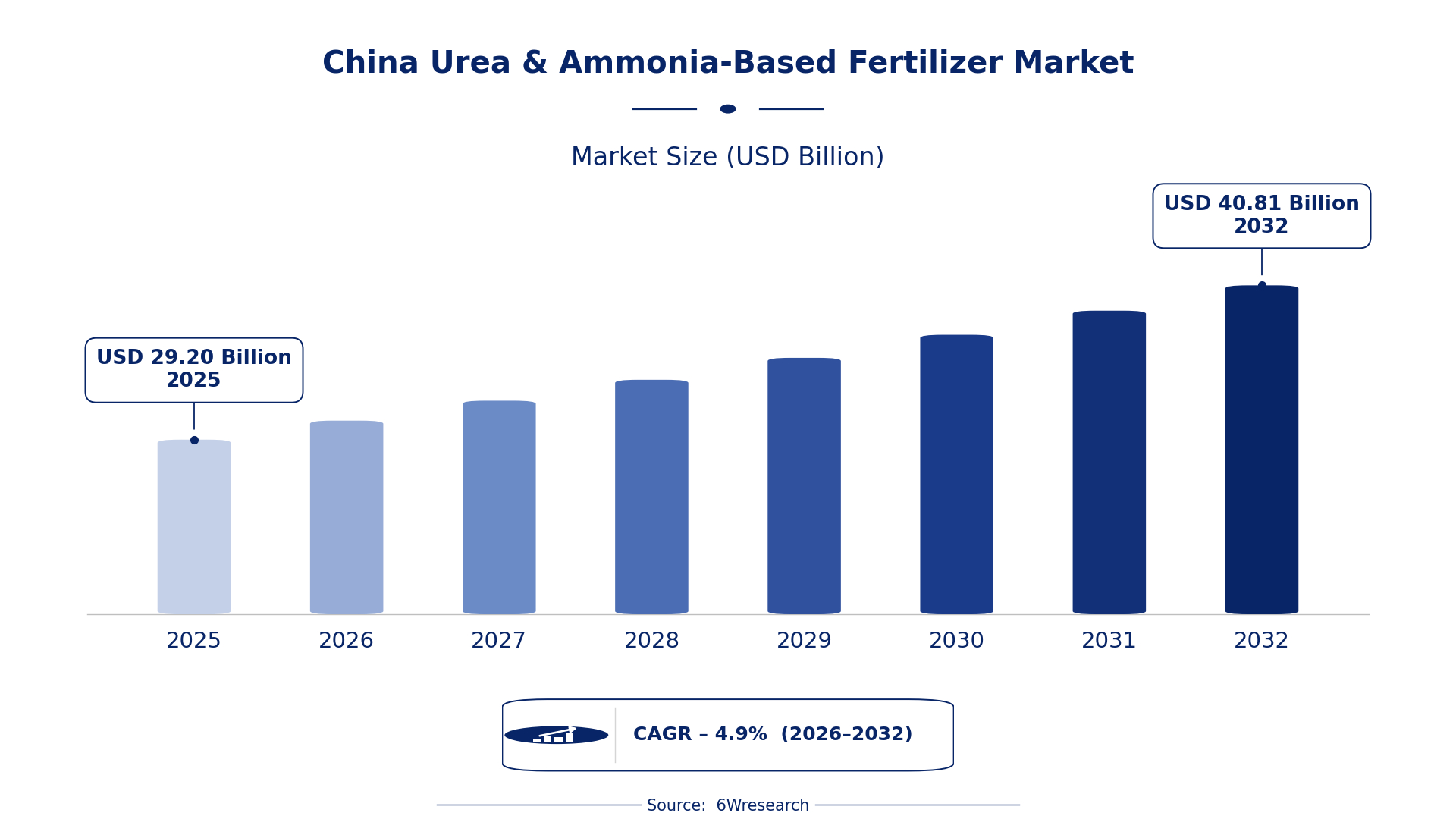
According to 6Wresearch internal database and industry insights, the China Urea & Ammonia-Based Fertilizer Market was valued at USD 29.20 billion in 2025 and is projected to reach USD 40.81 billion by 2032, growing at a CAGR of approximately 4.9% during 2026–2032.
China Urea & Ammonia-Based Fertilizer Market Highlights
| Report Metric | Details |
| Report Name | China Urea & Ammonia-Based Fertilizer Market |
| Market Size 2025 | USD 29.20 billion |
| Market Size 2032 | USD 40.81 billion |
| Absolute Growth 2025–2032 | USD 11.61 billion |
| CAGR 2026–2032 | 4.9% |
| Peak Annual Growth | 6.7% in 2032 |
| Forecast Period | 2026–2032 |
| Historical Data | 2022–2025 |
| Base Year | 2025 |
| Leading Fertilizer Type, 2025 | Urea Granules (39% share) |
| Leading Application Method, 2025 | Broadcast Spreading (43% share) |
| Leading Crop Type, 2025 | Cereal Crops (39% share) |
| Leading End User, 2025 | Large Farms (50% share) |
| Fastest-Growing Fertilizer Type | Ammonium Nitrate (6.5% CAGR) |
| Fastest-Growing Application Method | Spray Application (6.3% CAGR) |
| Fastest-Growing Crop Type | Horticultural Crops (6.6% CAGR) |
| Fastest-Growing End User | Greenhouse Growers (6.8% CAGR) |
| Growing Sector | Agricultural sector |
| Key End Users | Large Farms, Greenhouse Growers, Precision Farmers, Irrigated Farms |
China Urea & Ammonia-Based Fertilizer Market Year-wise Growth Rate and Key Drivers (2022–2032)
This graph illustrates the annual growth rates of the market from 2022 to 2032, highlighting a steady upward trajectory and projected market expansion over the forecast period.
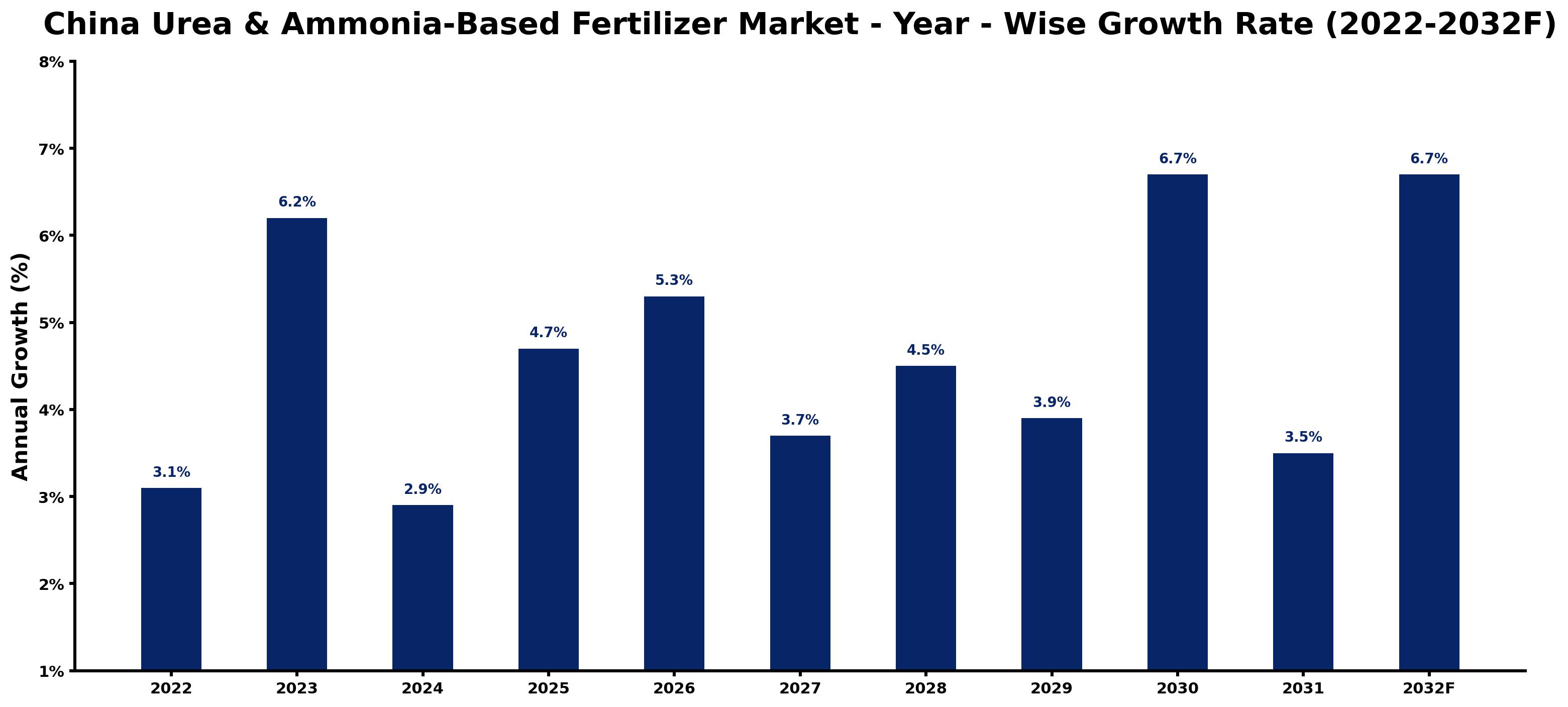
Below, each year's estimated growth is shown next to the factor that most influenced it.
| Year | Estimated Annual Growth (%) | Market Rationale |
| 2022 | 3.1 | Demand from large farms remained steady, supporting fertilizer use across China. |
| 2023 | 6.2 | Increased agricultural output and government support from the 'Green Agriculture Development Plan' boosted fertilizer consumption. |
| 2024 | 2.9 | The market experienced a slowdown as farmers adjusted to previous high input costs. |
| 2025 | 4.7 | Recovery in crop yields led to renewed interest in urea-based fertilizers among large farms. |
| 2026 | 5.3 | Sustained demand for cereal crops is expected to drive higher fertilizer application rates in agriculture. |
| 2027 | 3.7 | Growth slowed as farmers faced challenges in managing nutrient application efficiently. |
| 2028 | 4.5 | Rising demand for horticultural crops is projected to encourage more investment in fertilizer use. |
| 2029 | 3.9 | The market saw a slowdown as weather conditions affected crop yields and fertilizer needs. |
| 2030 | 6.7 | A surge in demand for efficient fertilizers coincides with initiatives promoting sustainability. |
| 2031 | 3.5 | The market experienced a slowdown as farmers adapted to new fertilizer regulations. |
| 2032 | 6.7 | Increased efficiency targets set by the government will spur further growth in fertilizer use. |
Note: Market size estimations and growth projections presented in this report are based on 6Wresearch's proprietary forecasting methodology, utilizing the latest available industry data, government publications, and primary research inputs.
China Urea & Ammonia-Based Fertilizer Market Synopsis
The Urea & Ammonia-Based Fertilizer Market in China encompasses a range of fertilizers used to improve soil fertility and crop yields. These fertilizers are primarily utilized in agriculture, boosting productivity for large farms, which account for over 60% of urea usage. The market is expanding due to rising domestic agricultural demand and the implementation of the 'Green Agriculture Development Plan' in 2023, which promotes sustainable fertilizer practices. With a projected size of USD 40.81 billion by 2032, the market is set for notable growth as agricultural practices modernise.
Market Dynamics Impact Analysis (2026–2032)
| Factor | Type | Impact | Primary Segment Affected |
| Increased agricultural output drives demand for fertilizers, particularly from large farms. | Driver | High | Urea Granules |
| Government initiatives promote sustainable fertilizer use, enhancing market growth. | Driver | High | Ammonium Nitrate |
| Growing demand for high-yield crops creates opportunities for fertilizer suppliers. | Opportunity | High | Cereal Crops |
| Investment in precision farming techniques opens new markets for efficient fertilizers. | Opportunity | Medium | Drip Fertigation |
| High input costs constrain farmers' purchasing power, limiting fertilizer use. | Restraint | High | Urea-Ammonium Nitrate (UAN) |
| Regulatory compliance can delay fertilizer approvals, impacting supply chains. | Restraint | Medium | Coated Urea |
| The Urea & Ammonia-Based Fertilizer Market faces challenges from fluctuating raw material prices. | Challenge | High | Broadcast Spreading |
| Adapting to new environmental regulations poses operational challenges for producers. | Challenge | Medium | Spray Application |
Evaluation of Drivers in China Urea & Ammonia-Based Fertilizer Market (2026–2032)
Below mentioned are some major drivers and their influence on market dynamics.
| Drivers | Primary Segment Affected | Why It Matters (Evidence) |
| Rising agricultural output increases fertilizer demand, with 30 million tons of urea produced in 2022. | Urea Granules | This high production level meets the needs of large farms, which are the primary consumers. |
| Government support for sustainable practices increases fertilizer usage efficiency, with the 'Green Agriculture Development Plan' launched in 2023. | Ammonium Nitrate | This plan promotes balanced fertilizer application, increasing demand. |
| High demand for cereal crops drives fertilizer application rates, averaging 200 kg/ha. | Cereal Crops | Farmers are investing more in fertilizers to meet food production targets. |
| Investment in irrigation systems boosts the need for efficient fertilizer application, with 69 million hectares of irrigated farmland. | Drip Fertigation | This area enhances productivity and drives demand for efficient application methods. |
| Growing interest in horticultural crops encourages the use of advanced fertilizers, with significant growth expected in this segment. | Horticultural Crops | This trend is driving demand for fertilizers tailored to specific crop needs. |
Market growth in China for Urea & Ammonia-Based Fertilizer rests on rising end-use demand from large farms and a responsive supply chain. The production of 30 million tons of urea in 2022 supports agricultural needs, particularly for cereal crops, where the average application rate is approximately 200 kg/ha. The total area of irrigated farmland, approximately 69 million hectares, drives demand for efficient application methods. Investment in horticultural crops is expected to increase, leading to higher consumption across the market.
Evaluation of Restraints in China Urea & Ammonia-Based Fertilizer Market
The table below lists the restraints and the evidence behind each.
| Market Restraint | Primary Segment Affected | Why It Matters (Evidence) |
| High input costs limit purchasing power for farmers, affecting fertilizer use. | Urea Granules | The rising costs of raw materials have made it difficult for many farmers to afford fertilizers. |
| Regulatory compliance delays can impact the timely availability of fertilizers. | Ammonium Nitrate | Producers must navigate complex approval processes, which can slow down supply. |
| Fluctuating raw material prices create uncertainty in the market, affecting planning. | Urea-Ammonium Nitrate (UAN) | Producers face challenges in maintaining stable pricing due to market volatility. |
| Environmental regulations require adjustments in production processes, increasing costs. | Coated Urea | Compliance with new standards can lead to higher operational expenses for manufacturers. |
| Limited access to advanced farming techniques restricts fertilizer application efficiency. | Broadcast Spreading | Many smaller farms lack the resources to invest in modern agricultural practices. |
China Urea & Ammonia-Based Fertilizer Market Challenges
The China Urea & Ammonia-Based Fertilizer Market encounters a notable skills gap, as many agricultural workers lack training in effective fertilizer application, potentially reducing crop yields by up to 15% for large farms. Supply chain challenges arise from production being concentrated in the North China region, resulting in increased logistics costs and delivery times extending by as much as 30% for farmers in remote areas. Intense competition among producers drives prices down, which may deter investment in quality improvements, ultimately affecting product quality available to buyers. Buyers also face fluctuating urea prices, complicating budgeting for large farms reliant on these fertilizers for consistent crop production.
Trends in the China Urea & Ammonia-Based Fertilizer Market
Four trends stand out in the China Urea & Ammonia-Based Fertilizer Market.
- Launch of the Green Agriculture Development Plan: The 'Green Agriculture Development Plan' launched in 2023 promotes sustainable fertilizer practices across China, aiming to improve soil health. This initiative is expected to increase the adoption of urea-based fertilizers by over 60% among large farms.
- Increase in Irrigated Farmland: As of 2022, approximately 69 million hectares of farmland in China are irrigated, improving fertilizer application efficiency. This trend is pushing farmers to invest more in urea and ammonia-based fertilizers to maximise crop yields.
- Shift towards Precision Farming Techniques: The adoption of precision farming techniques is on the rise, with a projected growth rate for Greenhouse Growers. This shift is driving demand for efficient fertilizers tailored to specific crop needs.
- Growing Interest in Horticultural Crops: Horticultural crops are gaining traction, with significant growth expected from 2026 to 2032. This trend is driving the need for advanced fertilizers that support high yield production.
Investment Opportunities in the China Urea & Ammonia-Based Fertilizer Market
The following opportunities in the China Urea & Ammonia-Based Fertilizer Market pair current demand with a clear way in.
- Partnerships for Sustainable Practices: Now is an opportune time for partnerships focused on sustainable fertilizer practices, especially with large farms. The 'Green Agriculture Development Plan' encourages collaboration, aiming for a 20% increase in fertilizer efficiency by 2025.
- Investment in Drip Fertigation Systems: With the area of irrigated farmland at 69 million hectares, there is strong demand for drip fertigation systems. Suppliers can enter this market by partnering with local agricultural cooperatives to improve efficiency.
- Focus on Horticultural Crop Fertilizers: The growing interest in horticultural crops presents a strong investment opportunity. Suppliers can target this segment, which is expected to grow significantly as demand increases.
- Expansion of Controlled Release Fertilizers: The need for controlled release fertilizers is increasing, particularly among precision farmers. Suppliers can explore this market by obtaining necessary certifications to meet regulatory standards.
Government Initiatives in the China Urea & Ammonia-Based Fertilizer Market
The National Fertilizer Standard (GB 10209-2008) regulates the quality of fertilizers in China, ensuring that products meet safety and performance benchmarks. This standard impacts producers by mandating quality testing and reporting, which is essential for maintaining market access. Additionally, the 'Soil Fertility Improvement Program' launched in 2023 aims to improve soil health through balanced fertilizer application, benefiting both producers and buyers by promoting sustainable practices.
The Ministry of Agriculture oversees the implementation of various agricultural programs, including the 'Green Agriculture Development Plan'. This agency funds initiatives aimed at improving fertilizer efficiency and sustainability, providing support to producers who comply with new regulations. The Fertilizer Industry Association of China promotes best practices and ensures compliance with national standards, further stabilising the market.
Future Insight of the China Urea & Ammonia-Based Fertilizer Market
The China Urea & Ammonia-Based Fertilizer Market is set to evolve by 2032, primarily influenced by the 'Green Agriculture Development Plan', which encourages sustainable fertilizer practices. The National Fertilizer Use Efficiency Improvement Plan aims for a 20% increase in efficiency by 2025, prompting suppliers to innovate in product formulations. Advances in soil health initiatives, such as the 'Soil Fertility Improvement Program', will improve fertilizer effectiveness for buyers. With over 60% of large farms already using urea-based fertilizers, agricultural practices will modernise, creating new opportunities for suppliers.
Market Segmentation Analysis
Each segment group is reviewed below, with the leader by share and the fastest grower by CAGR.
By Fertilizer Type – Urea Granules Dominated, Ammonium Nitrate Expected to Grow Fastest
According to Bhawna Singh, Assistant Manager at 6Wresearch, Urea Granules took a 39% share of fertilizer type in 2025, more than any other category. Urea Granules dominate the market due to their widespread application in agriculture, particularly among large-scale farms that require effective fertilisation solutions. Their production volume of 30 million tons in 2022 underscores their essential role in boosting crop yields across China. The quickest growth will come from Ammonium Nitrate, forecast to expand at a CAGR of 6.5% between 2026 and 2032. Ammonium Nitrate is rapidly gaining traction as it is increasingly preferred for various crops, attributed to its ability to enhance plant growth. The growing emphasis on agricultural efficiency is propelling its adoption, which will further expand its market share. Suppliers should focus on promoting Ammonium Nitrate to align with evolving agricultural practices and farmer preferences.
By Application Method – Broadcast Spreading Dominated, Spray Application Expected to Grow Fastest
The largest application method category in 2025 was Broadcast Spreading, with a 43% share of total revenue. Broadcast Spreading is the leading application method, valued for its conventional approach to distributing fertilizers over large areas. Its effectiveness and simplicity make it the go-to choice for numerous farming operations throughout China. Spray Application is set to record the highest CAGR in this split, 6.3% over 2026–2032. Spray Application is on the rise due to its effectiveness in delivering nutrients directly to plants, especially for foliar feeding. The increasing cultivation of horticultural crops is driving its swift adoption among growers, indicating a shift in application preferences. Suppliers need to develop products that cater to the increasing demand for efficient application methods like Spray Application.
By Crop Type – Cereal Crops Dominated, Horticultural Crops Expected to Grow Fastest
Cereal Crops accounted for a 39% market share by crop type in 2025. Cereal Crops hold the largest market share as they are the primary beneficiaries of fertilizers, essential for fulfilling the food requirements of China's extensive population. The average nitrogen fertilizer application rate of approximately 200 kg/ha for these crops highlights their dependence on fertilisation. Horticultural Crops are projected to grow fastest, at a CAGR of 6.6% during 2026–2032. Horticultural Crops are witnessing the fastest growth, driven by the rising demand for vegetables and flowers in urban areas. This segment's expansion is further supported by initiatives aimed at enhancing soil health and crop yields, ensuring sustained growth. This trend suggests that suppliers should adapt their product offerings to better serve the specific needs of horticultural crop producers.
By End User – Large Farms Dominated, Greenhouse Growers Expected to Grow Fastest
In 2025, Large Farms led the end user split with a 50% share. Large Farms are the main users of bulk fertilizers, utilising over 60% of urea-based fertilizers in China. Their scale of operation necessitates substantial fertilizer application to maximise crop yields effectively. Over 2026–2032, Greenhouse Growers are expected to post the fastest growth, at a CAGR of 6.8%. Greenhouse Growers are rapidly increasing their fertilizer usage to optimise growth conditions for plants in controlled environments. This trend is fuelled by the rising demand for fresh produce and ornamental plants, driving their market share upward. Suppliers should tailor their marketing strategies to meet the unique requirements of greenhouse growers, who are becoming increasingly important in the fertilizer market.
Key Attractiveness of the Report
- 10 Years of Market Numbers
- Historical Data Starting from 2022 to 2025
- Base Year 2025
- Forecast Data until 2032
- Key Performance Indicators Impacting the Market
- Major Upcoming Developments and Projects
Key Highlights of the Report:
- China Urea & Ammonia-Based Fertilizer Market Outlook
- Market Size of China Urea & Ammonia-Based Fertilizer Market, 2025
- Forecast of China Urea & Ammonia-Based Fertilizer Market, 2032
- Historical Data and Forecast of China Urea & Ammonia-Based Fertilizer Revenues & Volume for the Period 2022 - 2032F
- China Urea & Ammonia-Based Fertilizer Market Trend Evolution
- China Urea & Ammonia-Based Fertilizer Market Drivers and Challenges
- China Urea & Ammonia-Based Fertilizer Price Trends
- China Urea & Ammonia-Based Fertilizer Porter's Five Forces
- China Urea & Ammonia-Based Fertilizer Industry Life Cycle
- Historical Data and Forecast of China Urea & Ammonia-Based Fertilizer Market Revenues & Volume By Fertilizer Type for the Period 2022 - 2032F
- Historical Data and Forecast of China Urea & Ammonia-Based Fertilizer Market Revenues & Volume By Urea Granules for the Period 2022 - 2032F
- Historical Data and Forecast of China Urea & Ammonia-Based Fertilizer Market Revenues & Volume By Ammonium Nitrate for the Period 2022 - 2032F
- Historical Data and Forecast of China Urea & Ammonia-Based Fertilizer Market Revenues & Volume By Urea-Ammonium Nitrate (UAN) for the Period 2022 - 2032F
- Historical Data and Forecast of China Urea & Ammonia-Based Fertilizer Market Revenues & Volume By Coated Urea for the Period 2022 - 2032F
- Historical Data and Forecast of China Urea & Ammonia-Based Fertilizer Market Revenues & Volume By Application Method for the Period 2022 - 2032F
- Historical Data and Forecast of China Urea & Ammonia-Based Fertilizer Market Revenues & Volume By Broadcast Spreading for the Period 2022 - 2032F
- Historical Data and Forecast of China Urea & Ammonia-Based Fertilizer Market Revenues & Volume By Spray Application for the Period 2022 - 2032F
- Historical Data and Forecast of China Urea & Ammonia-Based Fertilizer Market Revenues & Volume By Drip Fertigation for the Period 2022 - 2032F
- Historical Data and Forecast of China Urea & Ammonia-Based Fertilizer Market Revenues & Volume By Controlled Release for the Period 2022 - 2032F
- Historical Data and Forecast of China Urea & Ammonia-Based Fertilizer Market Revenues & Volume By Crop Type for the Period 2022 - 2032F
- Historical Data and Forecast of China Urea & Ammonia-Based Fertilizer Market Revenues & Volume By Cereal Crops for the Period 2022 - 2032F
- Historical Data and Forecast of China Urea & Ammonia-Based Fertilizer Market Revenues & Volume By Horticultural Crops for the Period 2022 - 2032F
- Historical Data and Forecast of China Urea & Ammonia-Based Fertilizer Market Revenues & Volume By Fruits & Vegetables for the Period 2022 - 2032F
- Historical Data and Forecast of China Urea & Ammonia-Based Fertilizer Market Revenues & Volume By Rice & Paddy Fields for the Period 2022 - 2032F
- Historical Data and Forecast of China Urea & Ammonia-Based Fertilizer Market Revenues & Volume By End User for the Period 2022 - 2032F
- Historical Data and Forecast of China Urea & Ammonia-Based Fertilizer Market Revenues & Volume By Large Farms for the Period 2022 - 2032F
- Historical Data and Forecast of China Urea & Ammonia-Based Fertilizer Market Revenues & Volume By Greenhouse Growers for the Period 2022 - 2032F
- Historical Data and Forecast of China Urea & Ammonia-Based Fertilizer Market Revenues & Volume By Irrigated Farms for the Period 2022 - 2032F
- Historical Data and Forecast of China Urea & Ammonia-Based Fertilizer Market Revenues & Volume By Precision Farmers for the Period 2022 - 2032F
- China Urea & Ammonia-Based Fertilizer Import Export Trade Statistics
- Market Opportunity Assessment By Fertilizer Type
- Market Opportunity Assessment By Application Method
- Market Opportunity Assessment By Crop Type
- Market Opportunity Assessment By End User
- China Urea & Ammonia-Based Fertilizer Top Companies Market Share
- China Urea & Ammonia-Based Fertilizer Competitive Benchmarking By Technical and Operational Parameters
- China Urea & Ammonia-Based Fertilizer Company Profiles
- China Urea & Ammonia-Based Fertilizer Key Strategic Recommendations
Market Covered
Segments analysed in this report are listed below.
By Fertilizer Type
- Urea Granules
- Ammonium Nitrate
- Urea-Ammonium Nitrate (UAN)
- Coated Urea
By Application Method
- Broadcast Spreading
- Spray Application
- Drip Fertigation
- Controlled Release
By Crop Type
- Cereal Crops
- Horticultural Crops
- Fruits & Vegetables
- Rice & Paddy Fields
By End User
- Large Farms
- Greenhouse Growers
- Irrigated Farms
- Precision Farmers































