China Urologic Oncology Market Size & Growth Rate
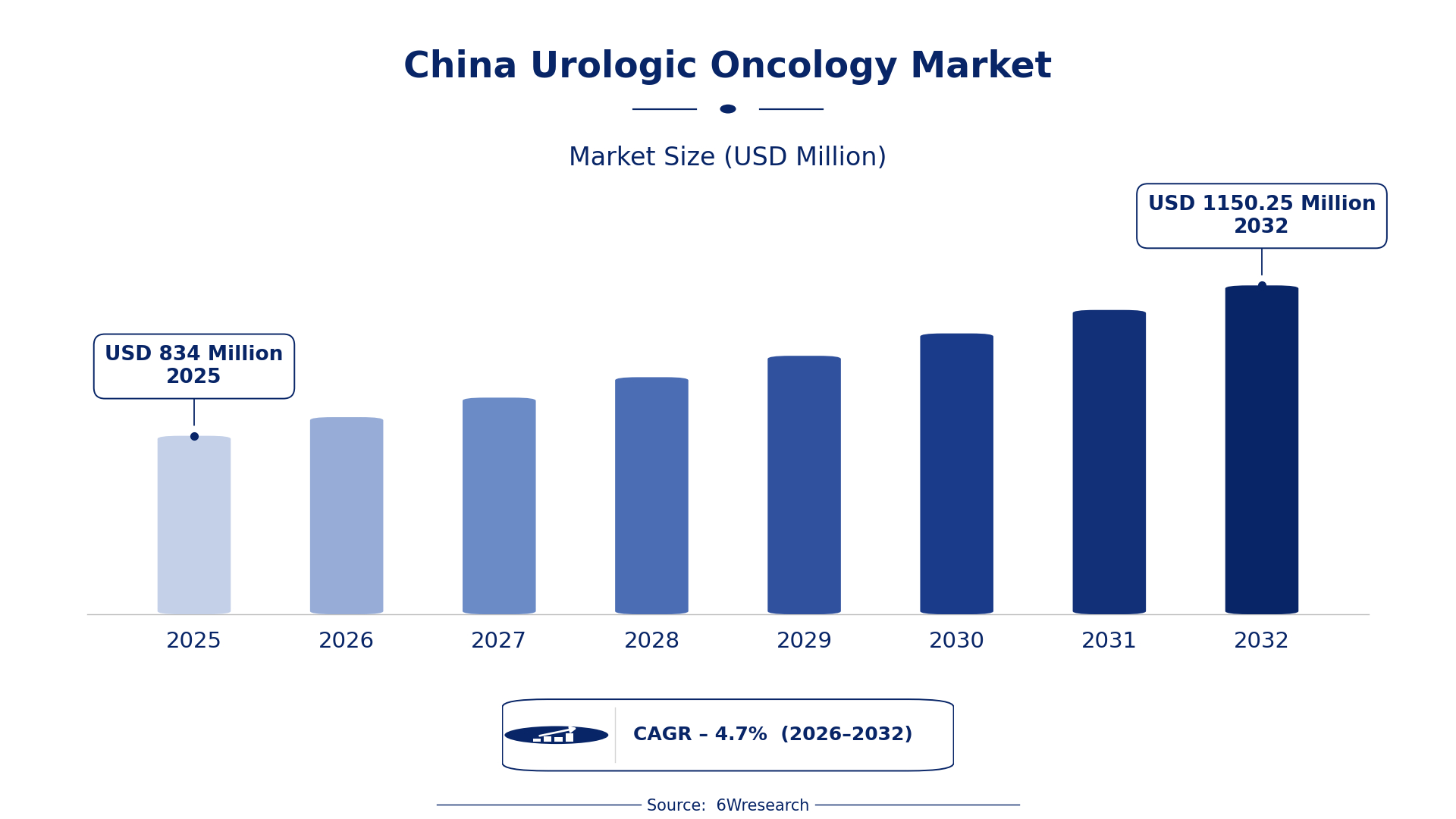
According to 6Wresearch internal database and industry insights, the China Urologic Oncology Market was valued at USD 834.0 million in 2025 and is projected to reach USD 1,150.25 million by 2032, growing at a CAGR of approximately 4.7% during 2026–2032.
China Urologic Oncology Market Highlights
| Report Metric | Details |
| Report Name | China Urologic Oncology Market |
| Market Size 2025 | USD 834.0 million |
| Market Size 2032 | USD 1,150.25 million |
| Absolute Growth 2025–2032 | USD 316.25 million |
| CAGR 2026–2032 | 4.7% |
| Peak Annual Growth | 7.5% in 2032 |
| Forecast Period | 2026–2032 |
| Historical Data | 2022–2025 |
| Base Year | 2025 |
| Leading Specialty Area, 2025 | Drug Therapy (38% share) |
| Leading Intervention Method, 2025 | Robotic Surgery (50% share) |
| Leading Technology Used, 2025 | Laparoscopic Systems (43% share) |
| Leading End User, 2025 | Hospitals (37% share) |
| Fastest-Growing Specialty Area | Advanced Imaging (6.8% CAGR) |
| Fastest-Growing Intervention Method | Targeted Drugs (7.4% CAGR) |
| Fastest-Growing Technology Used | AI-Enabled Diagnostics (5.7% CAGR) |
| Fastest-Growing End User | Oncology Centers (6.1% CAGR) |
| Growing Sector | Oncology Centers |
| Key End Users | Hospitals, Oncology Centers, Cancer Clinics, Urology Units |
China Urologic Oncology Market Year-wise Growth Rate and Key Drivers (2022–2032)
This graph illustrates the annual growth rates of the market from 2022 to 2032, highlighting a steady upward trajectory and projected market expansion over the forecast period.
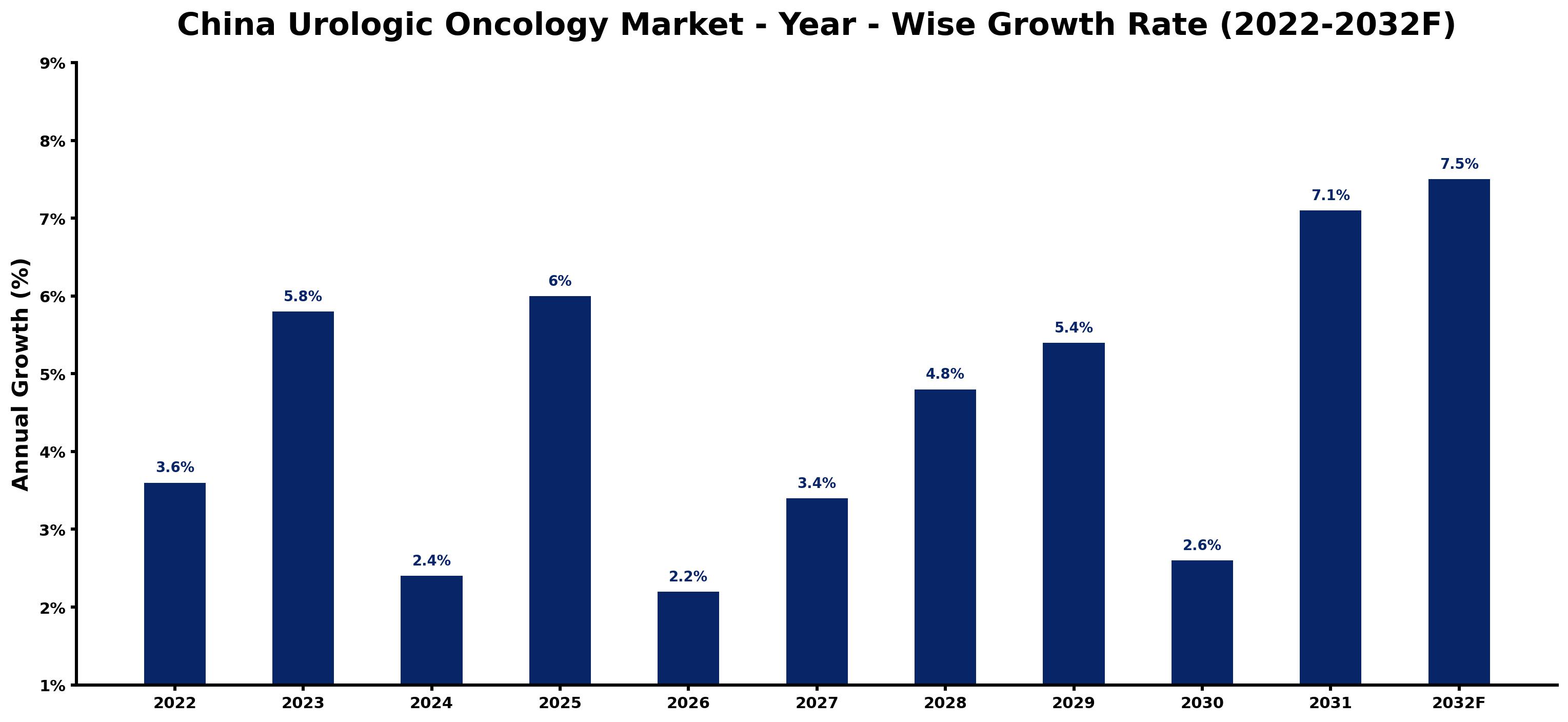
Annual growth estimates for each year appear below with the principal reason behind them, explaining the shifts that set the pace of the market.
| Year | Estimated Annual Growth (%) | Market Rationale |
| 2022 | 3.6 | The incidence of urologic cancers reached approximately 1.2 million cases in this year. |
| 2023 | 5.8 | A notable increase in cancer screening initiatives led to higher detection rates. |
| 2024 | 2.4 | Growth slowed as hospitals faced challenges in integrating advanced imaging technologies. |
| 2025 | 6.0 | The market experienced a resurgence driven by increased investments in the National Cancer Prevention and Control Plan. |
| 2026 | 2.2 | A slowdown occurred as hospitals adjusted to new treatment protocols and technologies. |
| 2027 | 3.4 | Demand rose due to expanding urology units in rural areas, improving access to care. |
| 2028 | 4.8 | Investment in advanced imaging methods boosted growth in urologic oncology services. |
| 2029 | 5.4 | A growing number of oncology centers adopted AI-enabled diagnostics, enhancing treatment accuracy. |
| 2030 | 2.6 | Growth slowed as hospitals faced resource allocation challenges amid rising patient volumes. |
| 2031 | 7.1 | Increased funding for cancer treatment programs spurred demand for urologic oncology services. |
| 2032 | 7.5 | The market peaked as the National Health Commission's initiatives improved screening rates. |
Note: Market size estimations and growth projections presented in this report are based on 6Wresearch's proprietary forecasting methodology, utilizing the latest available industry data, government publications, and primary research inputs.
China Urologic Oncology Market Synopsis
Urologic Oncology in China involves the diagnosis and treatment of cancers affecting the urinary tract and male reproductive organs. It incorporates various technologies such as minimally invasive surgical techniques and advanced imaging methods. The China Urologic Oncology Market is growing due to the rising incidence of cancer, with approximately 1.2 million cases reported in 2022. Key drivers include increased investments in cancer research and the implementation of national screening programs aimed at improving early detection and treatment access. Hospitals and oncology centres are the primary buyers, seeking advanced technologies to improve patient outcomes.
Market Dynamics Impact Analysis (2026–2032)
| Factor | Type | Impact | Primary Segment Affected |
| Rising cancer incidence rates drive demand for urologic oncology services. | Driver | High | Hospitals |
| Investment in advanced imaging technologies enhances diagnostic accuracy. | Driver | High | Advanced Imaging |
| Growing urban populations increase the need for specialized cancer treatment facilities. | Opportunity | High | Oncology Centers |
| Expansion of urology units in rural areas improves access to care. | Opportunity | Medium | Urology Units |
| Limited access to advanced treatment options in rural regions constrains growth. | Restraint | High | Hospitals |
| High costs associated with advanced therapies limit patient access. | Restraint | Medium | Drug Therapy |
| The Urologic Oncology market in China faces significant regulatory hurdles. | Challenge | High | Drug Therapy |
| Competition from alternative cancer treatments poses a challenge for market players. | Challenge | Medium | Drug Therapy |
Evaluation of Drivers in China Urologic Oncology Market (2026–2032)
The table below links each growth driver to the segment it affects and the evidence for it.
| Drivers | Primary Segment Affected | Why It Matters (Evidence) |
| Increased funding for cancer research and treatment technologies. | Drug Therapy | Investment exceeding 10 billion RMB in the last three years has expanded treatment options. |
| Growing urban populations are driving demand for cancer services. | Hospitals | Urban areas are experiencing increased patient volumes due to over 3,000 hospitals providing urologic oncology care. |
| Integration of AI-enabled diagnostics improves treatment outcomes. | Advanced Imaging | AI technologies are being integrated into over 200 oncology centers nationwide, improving diagnostic accuracy. |
| Rising awareness and screening programs boost early detection rates. | Oncology Centers | The National Health Commission aims to increase cancer screening rates by 30% by 2025. |
| Expansion of urology units enhances access to specialized care. | Urology Units | Rural areas are seeing more urology units to meet growing patient needs. |
Growth in the Urologic Oncology market in China comes from increased funding for cancer research and treatment technologies, with over 10 billion RMB invested in the last three years. The demand for services is rising as more than 3,000 hospitals provide urologic oncology care. Additionally, the expansion of urology units in rural areas is addressing the growing patient needs in these regions.
Evaluation of Restraints in China Urologic Oncology Market
The table below lists the restraints and the evidence behind each.
| Market Restraint | Primary Segment Affected | Why It Matters (Evidence) |
| Limited access to advanced treatment options in rural regions. | Hospitals | Many rural hospitals lack the necessary technology and resources to provide advanced care. |
| High costs associated with advanced therapies limit patient access. | Drug Therapy | Drug therapy accounts for 40% of treatment costs, making it less accessible for some patients. |
| Regulatory hurdles delay the introduction of new therapies. | Drug Therapy | Lengthy approval processes hinder timely access to new treatment options. |
| Insufficient training for healthcare professionals in advanced oncology practices. | Oncology Centers | The lack of trained personnel limits the effective implementation of new treatment protocols. |
| Competition from alternative cancer treatments affects market share. | Drug Therapy | Patients may opt for less expensive or more accessible treatment options. |
China Urologic Oncology Market Challenges
The China urologic oncology market faces notable supply chain challenges, particularly due to reliance on imported technologies, which can delay treatment availability by up to three months for hospitals. Intense competition exists among over 3,000 hospitals, leading to pricing pressures that can reduce profit margins for clinics and limit their ability to invest in new technologies. A shortage of skilled professionals in advanced surgical techniques extends training periods, restricting the number of qualified staff available to treat patients effectively. Buyers encounter rising costs, as drug therapy accounts for 40% of treatment expenses, making affordability a critical issue for individuals seeking care.
Trends in the China Urologic Oncology Market
Four trends stand out in the China Urologic Oncology Market.
- Shift from Traditional to Minimally Invasive Techniques: China is transitioning towards minimally invasive surgical techniques in urologic oncology. In 2022, laparoscopic systems were used in over 60% of urologic surgeries, improving recovery times and reducing complications.
- Emergence of AI in Diagnostic Procedures: Since 2022, AI-enabled diagnostics have been integrated into oncology centres. Over 200 centres are adopting these technologies, improving diagnostic accuracy and patient outcomes.
- Growth of Specialized Oncology Centers: The establishment of specialized oncology centres is on the rise, with urban areas seeing significant investments. These centres are expected to serve populations of around 500,000, enhancing access to care.
- Expansion of Urology Units in Rural Areas: Beginning in 2023, there has been a notable expansion of urology units in rural regions. This initiative aims to improve access to cancer care for underserved populations.
Investment Opportunities in the China Urologic Oncology Market
The following opportunities in the China Urologic Oncology Market pair current demand with a clear way in.
- Rising Demand for Advanced Imaging Technologies: With a projected increase in cancer cases, there is a strong demand for advanced imaging technologies. Hospitals are looking to invest in these systems to improve diagnostic capabilities, particularly in urban areas.
- Growing Need for Cancer Screening Programs: The National Cancer Screening Program aims to provide free screenings in 50 major cities by 2024. This initiative presents an opportunity for healthcare providers to expand their services and reach high-risk populations.
- Investment in Drug Therapy Innovations: The demand for new drug therapies is increasing, with drug therapy accounting for 40% of treatment costs. Hospitals can partner with research institutions to develop new therapies and improve treatment outcomes.
- Expansion of Urology Units in Urban Areas: As urban populations grow, there is a pressing need for more urology units. Healthcare providers can establish partnerships to expand their services and meet increasing patient demands.
Government Initiatives in the China Urologic Oncology Market
The 'National Cancer Prevention and Control Plan (2021-2025)' launched by the National Health Commission aims to improve cancer screening and treatment access for 200 million citizens. This initiative is expected to provide free screenings for high-risk populations in 50 major cities by 2024, enabling hospitals and clinics to identify urologic cancers at earlier stages. In 2022, the Ministry of Health approved the 'National Strategy for Cancer Research and Treatment', allocating 5 billion RMB for innovative cancer therapies, which will improve treatment options for patients. Additionally, the Chinese Society of Clinical Oncology initiated a program in 2022 to train over 10,000 healthcare professionals in advanced oncology practices by 2025, ensuring that medical staff are equipped with the latest knowledge and techniques in cancer management.
The National Cancer Screening Program allows healthcare providers to offer free screenings for high-risk populations, significantly improving early detection rates. This initiative enables hospitals and clinics to identify urologic cancers at earlier stages, improving treatment outcomes. The program is part of a broader strategy to increase cancer screening rates by 30% by 2025, ensuring that more patients have access to timely care. The integration of advanced training programs for healthcare professionals further supports this initiative, equipping them with the necessary skills to manage urologic oncology effectively.
Future Insight of the China Urologic Oncology Market
By 2032, the China urologic oncology market will likely see improved treatment accessibility driven by government initiatives aimed at significantly increasing cancer screening rates. The integration of AI-enabled diagnostics in over 200 oncology centres will enhance early detection capabilities, allowing for timely interventions. Investment in cancer research and treatment technologies is expected to exceed 15 billion RMB, promoting the development of new therapies. Expansion of urology units in rural areas will provide timely access to quality care for a broader segment of the population.
Market Segmentation Analysis
The analysis below covers each segmentation, its leading category in 2025 and its fastest-growing category through 2032.
By Specialty Area – Drug Therapy Dominated, Advanced Imaging Expected to Grow Fastest
According to Bhawna Singh, Assistant Manager at 6Wresearch, Drug Therapy held a 38% share of the China Urologic Oncology Market by specialty area in 2025. Drug therapy holds the largest share in the urologic oncology market due to its vital role in managing cancer progression and alleviating symptoms. With drug therapy accounting for 40% of treatment costs, its importance in urban hospitals across China is clear. Over 2026–2032, Advanced Imaging is expected to post the fastest growth, at a CAGR of 6.8%. Advanced imaging is experiencing rapid growth as it is crucial for accurate diagnosis and treatment planning. The increasing integration of advanced imaging technologies in cancer centres is significantly boosting its adoption rate. Suppliers should prioritise enhancing drug therapy offerings while also investing in advanced imaging technologies to meet market demands.
By Intervention Method – Robotic Surgery Dominated, Targeted Drugs Expected to Grow Fastest
Robotic Surgery took a 50% share of intervention method in 2025, more than any other category. Robotic surgery commands a substantial share of the market because it enhances precision in surgical interventions, making it a preferred choice in major hospitals. This method's growing acceptance is evident in urban healthcare facilities where advanced surgical techniques are increasingly sought after. The quickest growth will come from Targeted Drugs, forecast to expand at a CAGR of 7.4% between 2026 and 2032. Targeted drugs are witnessing the fastest growth as they are increasingly used for specific cancer types, reflecting a shift towards personalised medicine. The rise in prostate cancer cases has further spurred demand for these therapies. Buyers will benefit from advancements in robotic surgery and targeted drugs, leading to improved treatment outcomes.
By Technology Used – Laparoscopic Systems Dominated, AI-Enabled Diagnostics Expected to Grow Fastest
In 2025, Laparoscopic Systems led the technology used split with a 43% share. Laparoscopic systems dominate the market as they are commonly used for minimally invasive procedures, preferred by both surgeons and patients. Their widespread adoption in over 60% of urologic surgeries underscores their significance in the treatment landscape. AI-Enabled Diagnostics are set to record the highest CAGR in this split, 5.7% over 2026–2032. AI-enabled diagnostics are rapidly gaining traction due to their potential to improve diagnostic accuracy, with over 200 oncology centres integrating this technology. As healthcare facilities seek to enhance patient outcomes, this segment's growth is expected to accelerate. Suppliers should prioritise the development of laparoscopic systems while exploring AI-enabled diagnostics to capture emerging opportunities.
By End User – Hospitals Dominated, Oncology Centers Expected to Grow Fastest
Hospitals accounted for a 37% market share by end user in 2025. Hospitals represent the largest share of the market as they are the primary providers of urologic oncology services, catering to a vast patient population. With over 3,000 hospitals offering these services, their role is critical in addressing the rising incidence of urologic cancers. Oncology Centers are projected to grow fastest, at a CAGR of 6.1% during 2026–2032. Oncology centers are the fastest-growing segment, as they serve as specialised facilities for cancer treatment, reflecting a trend towards focused care. The increasing cancer screening initiatives are driving more patients to these centres for specialised services. Suppliers should align their strategies with hospitals and oncology centers to effectively address the growing demand for urologic oncology services.
Key Attractiveness of the Report
- 10 Years of Market Numbers
- Historical Data Starting from 2022 to 2025
- Base Year 2025
- Forecast Data until 2032
- Key Performance Indicators Impacting the Market
- Major Upcoming Developments and Projects
Key Highlights of the Report:
- China Urologic Oncology Market Outlook
- Market Size of China Urologic Oncology Market, 2025
- Forecast of China Urologic Oncology Market, 2032
- Historical Data and Forecast of China Urologic Oncology Revenues & Volume for the Period 2022 - 2032F
- China Urologic Oncology Market Trend Evolution
- China Urologic Oncology Market Drivers and Challenges
- China Urologic Oncology Price Trends
- China Urologic Oncology Porter's Five Forces
- China Urologic Oncology Industry Life Cycle
- Historical Data and Forecast of China Urologic Oncology Market Revenues & Volume By Specialty Area for the Period 2022 - 2032F
- Historical Data and Forecast of China Urologic Oncology Market Revenues & Volume By Minimally Invasive for the Period 2022 - 2032F
- Historical Data and Forecast of China Urologic Oncology Market Revenues & Volume By Advanced Imaging for the Period 2022 - 2032F
- Historical Data and Forecast of China Urologic Oncology Market Revenues & Volume By Drug Therapy for the Period 2022 - 2032F
- Historical Data and Forecast of China Urologic Oncology Market Revenues & Volume By Radiation Oncology for the Period 2022 - 2032F
- Historical Data and Forecast of China Urologic Oncology Market Revenues & Volume By Intervention Method for the Period 2022 - 2032F
- Historical Data and Forecast of China Urologic Oncology Market Revenues & Volume By Robotic Surgery for the Period 2022 - 2032F
- Historical Data and Forecast of China Urologic Oncology Market Revenues & Volume By PET/CT Scans for the Period 2022 - 2032F
- Historical Data and Forecast of China Urologic Oncology Market Revenues & Volume By Targeted Drugs for the Period 2022 - 2032F
- Historical Data and Forecast of China Urologic Oncology Market Revenues & Volume By External Beam Therapy for the Period 2022 - 2032F
- Historical Data and Forecast of China Urologic Oncology Market Revenues & Volume By Technology Used for the Period 2022 - 2032F
- Historical Data and Forecast of China Urologic Oncology Market Revenues & Volume By Laparoscopic Systems for the Period 2022 - 2032F
- Historical Data and Forecast of China Urologic Oncology Market Revenues & Volume By AI-Enabled Diagnostics for the Period 2022 - 2032F
- Historical Data and Forecast of China Urologic Oncology Market Revenues & Volume By Immuno-oncology Agents for the Period 2022 - 2032F
- Historical Data and Forecast of China Urologic Oncology Market Revenues & Volume By Proton Beam for the Period 2022 - 2032F
- Historical Data and Forecast of China Urologic Oncology Market Revenues & Volume By End User for the Period 2022 - 2032F
- Historical Data and Forecast of China Urologic Oncology Market Revenues & Volume By Hospitals for the Period 2022 - 2032F
- Historical Data and Forecast of China Urologic Oncology Market Revenues & Volume By Oncology Centers for the Period 2022 - 2032F
- Historical Data and Forecast of China Urologic Oncology Market Revenues & Volume By Cancer Clinics for the Period 2022 - 2032F
- Historical Data and Forecast of China Urologic Oncology Market Revenues & Volume By Urology Units for the Period 2022 - 2032F
- China Urologic Oncology Import Export Trade Statistics
- Market Opportunity Assessment By Specialty Area
- Market Opportunity Assessment By Intervention Method
- Market Opportunity Assessment By Technology Used
- Market Opportunity Assessment By End User
- China Urologic Oncology Top Companies Market Share
- China Urologic Oncology Competitive Benchmarking By Technical and Operational Parameters
- China Urologic Oncology Company Profiles
- China Urologic Oncology Key Strategic Recommendations
Market Covered
Segments analysed in this report are listed below.
By Specialty Area
- Minimally Invasive
- Advanced Imaging
- Drug Therapy
- Radiation Oncology
By Intervention Method
- Robotic Surgery
- PET/CT Scans
- Targeted Drugs
- External Beam Therapy
By Technology Used
- Laparoscopic Systems
- AI-Enabled Diagnostics
- Immuno-oncology Agents
- Proton Beam
By End User
- Hospitals
- Oncology Centers
- Cancer Clinics
- Urology Units































