China Utility Energy Management Market Size & Growth Rate
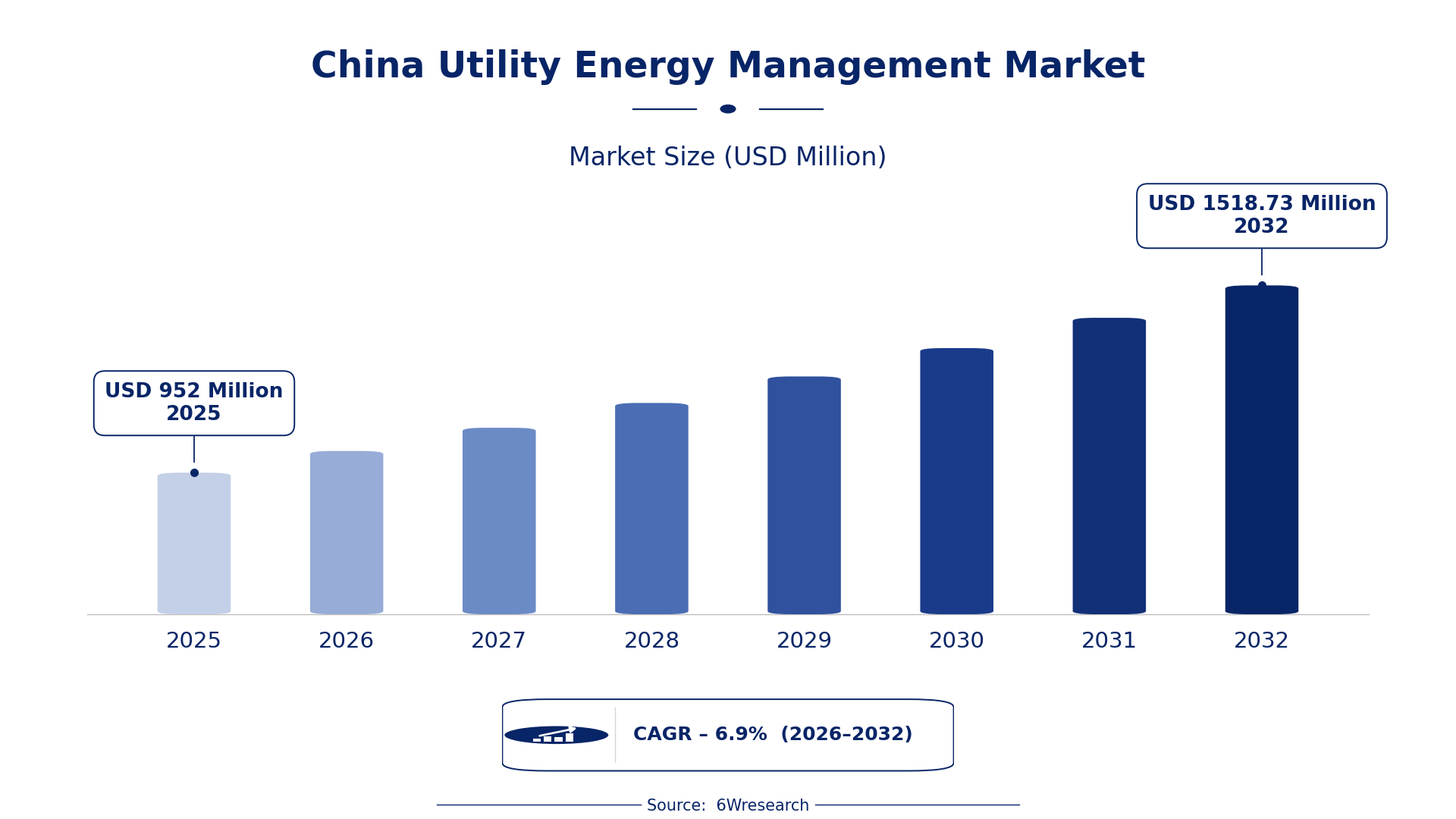
According to 6Wresearch internal database and industry insights, the China Utility Energy Management Market was valued at USD 952.0 million in 2025 and is projected to reach USD 1,518.73 million by 2032, growing at a CAGR of approximately 6.9% during 2026–2032.
China Utility Energy Management Market Highlights
| Report Metric | Details |
| Report Name | China Utility Energy Management Market |
| Market Size 2025 | USD 952.0 million |
| Market Size 2032 | USD 1,518.73 million |
| Absolute Growth 2025–2032 | USD 566.73 million |
| CAGR 2026–2032 | 6.9% |
| Peak Annual Growth | 9.3% in 2030 |
| Forecast Period | 2026–2032 |
| Historical Data | 2022–2025 |
| Base Year | 2025 |
| Leading Management Type, 2025 | Demand Response (44% share) |
| Leading Technology Used, 2025 | Smart Meters + AI (42% share) |
| Leading Implementation Model, 2025 | Centralized Control (49% share) |
| Leading End User, 2025 | Energy Utilities (55% share) |
| Fastest-Growing Management Type | Energy Efficiency Audit (8.7% CAGR) |
| Fastest-Growing Technology Used | Analytics Software (9.5% CAGR) |
| Fastest-Growing Implementation Model | Real-Time Monitoring (8.0% CAGR) |
| Fastest-Growing End User | Commercial Buildings (9.5% CAGR) |
| Growing Sector | Energy Utilities |
| Key End Users | Energy Utilities, Industrial Consumers, Commercial Buildings |
China Utility Energy Management Market Year-wise Growth Rate and Key Drivers (2022–2032)
This graph illustrates the annual growth rates of the market from 2022 to 2032, highlighting a steady upward trajectory and projected market expansion over the forecast period.
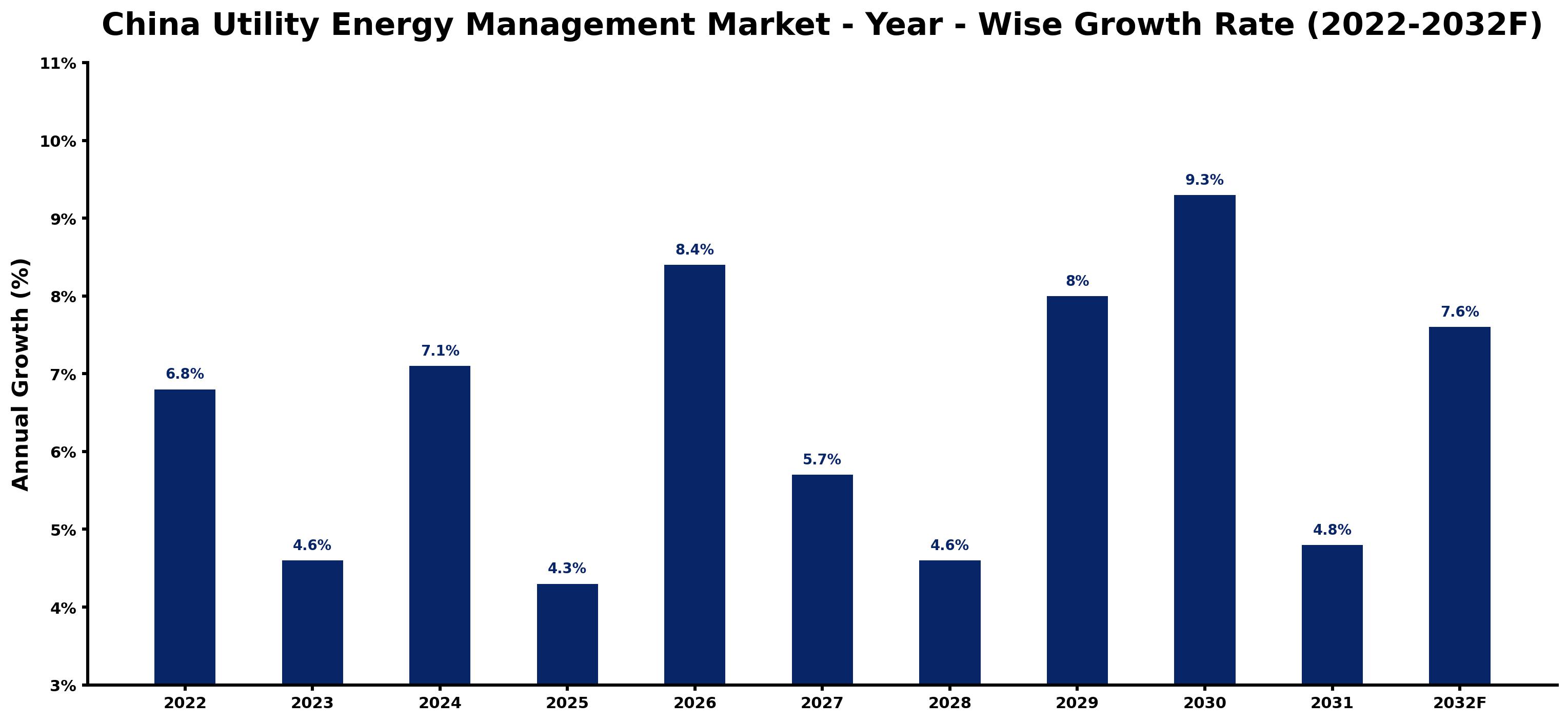
Year by year, the estimates below pair each growth rate with the development that shaped it.
| Year | Estimated Annual Growth (%) | Market Rationale |
| 2022 | 6.8 | Energy management solutions were increasingly adopted by utilities and industrial consumers. |
| 2023 | 4.6 | The market experienced slower growth due to the impact of global economic uncertainties. |
| 2024 | 7.1 | Demand surged as energy utilities adopted new technologies and improved their efficiency measures. |
| 2025 | 4.3 | Growth slowed again as the Energy Efficiency Action Plan 2021-2025 began to take effect. |
| 2026 | 8.4 | The introduction of advanced analytics software is expected to drive renewed interest in energy management solutions. |
| 2027 | 5.7 | A temporary slowdown is expected as energy utilities reassess their operational strategies. |
| 2028 | 4.6 | Market growth is projected to decelerate as the focus shifts to integrating renewable energy sources. |
| 2029 | 8.0 | Renewed interest in energy management is anticipated as commercial buildings seek operational cost reductions. |
| 2030 | 9.3 | The market is projected to peak as demand response programs gain traction among energy utilities. |
| 2031 | 4.8 | Growth is expected to moderate as market maturity sets in, with utilities refining their energy management practices. |
| 2032 | 7.6 | A resurgence in growth is anticipated as energy efficiency initiatives continue to expand. |
Note: Market size estimations and growth projections presented in this report are based on 6Wresearch's proprietary forecasting methodology, utilizing the latest available industry data, government publications, and primary research inputs.
China Utility Energy Management Market Synopsis
Utility Energy Management in China focuses on optimising energy consumption using advanced technologies and strategies. This includes smart technologies, data analytics, and real-time monitoring systems to improve efficiency. The China Utility Energy Management Market is expanding due to rising demand from energy utilities, industrial consumers, and commercial buildings. The Energy Efficiency Action Plan 2021-2025 promotes energy efficiency across sectors, while the total installed capacity of renewable energy reached 1,000 GW in 2023, increasing the need for effective energy management solutions.
Market Dynamics Impact Analysis (2026–2032)
| Factor | Type | Impact | Primary Segment Affected |
| Growing adoption of smart meters and AI technologies | Driver | High | Smart Meters + AI |
| Increased focus on demand response programs among utilities | Driver | High | Demand Response |
| Expansion of energy management systems in commercial buildings | Opportunity | High | Commercial Buildings |
| Rising investments in renewable energy integration technologies | Opportunity | High | Energy Utilities |
| Challenges in standardising energy management practices | Restraint | Medium | Energy Utilities |
| High initial costs of implementing advanced energy management systems | Restraint | Medium | Commercial Buildings |
| Limited awareness among smaller industrial consumers | Challenge | Medium | Industrial Consumers |
| Regulatory compliance complexities for energy utilities | Challenge | Medium | Energy Utilities |
Evaluation of Drivers in China Utility Energy Management Market (2026–2032)
Key forces behind demand, with the segment each one moves most, are listed below.
| Drivers | Primary Segment Affected | Why It Matters (Evidence) |
| Increased installations of smart meters | Smart Meters + AI | Over 300 million smart meters were installed in 2023, enabling real-time data collection and analysis. |
| Growing demand response initiatives | Demand Response | More than 70% of energy utilities are implementing demand response programs to manage peak loads. |
| Rising energy costs prompting efficiency measures | Commercial Buildings | Commercial buildings are investing in energy management solutions to reduce operational costs amid rising energy prices. |
| Technological advancements in energy analytics | Energy Utilities | The Energy Efficiency Action Plan 2021-2025 aims to reduce energy consumption per GDP unit by 13.5%. |
| Expansion of energy management practices in manufacturing | Industrial Consumers | The Green Manufacturing Program promotes energy management practices, encouraging industrial consumers to adopt efficient technologies. |
In 2023, over 300 million smart meters were installed, enabling real-time data collection and analysis essential for optimising energy use. Commercial buildings are investing in energy management solutions to lower operational costs due to rising energy prices. The adoption of advanced analytics software is projected to grow, driving further optimisation efforts in the energy management sector.
Evaluation of Restraints in China Utility Energy Management Market
The following restraints limit how fast demand can grow.
| Market Restraint | Primary Segment Affected | Why It Matters (Evidence) |
| High initial costs for implementing energy management systems | Commercial Buildings | The upfront investment required for advanced systems can deter smaller commercial entities from adopting these solutions. |
| Complex regulatory compliance requirements | Energy Utilities | Energy utilities face challenges in navigating regulatory frameworks, which can slow down the implementation of energy management practices. |
| Limited awareness of benefits among smaller industrial consumers | Industrial Consumers | Many smaller industrial consumers lack knowledge about energy management solutions, hindering market penetration. |
| Inconsistent energy management practices across regions | Energy Utilities | Variability in practices can create barriers to standardisation and scalability of energy management solutions. |
| Dependence on legacy systems | Energy Utilities | Existing infrastructure may not support the integration of new energy management technologies, limiting upgrades. |
China Utility Energy Management Market Challenges
In the China Utility Energy Management Market, over 70% of energy utilities struggle with high costs linked to demand response programs, which complicates energy optimisation for buyers. Regulatory compliance presents another challenge, as energy audits required by the Energy Conservation Law impose extra operational burdens on industrial consumers, delaying their efficiency gains. Suppliers face intense competition from new technologies, compelling them to invest heavily in innovation, which can drive up prices for buyers. The swift adoption of smart technologies often exceeds the capabilities of existing infrastructure, causing disruptions that limit the effectiveness of energy management systems.
Trends in the China Utility Energy Management Market
Four trends stand out in the China Utility Energy Management Market.
- Shift from Traditional to Smart Energy Management: Since 2022, energy utilities in China have increasingly adopted smart technologies for energy management. This shift is evidenced by over 300 million smart meters installed, which improve real-time monitoring capabilities.
- Emergence of Demand Response Programs: In 2023, energy utilities began implementing demand response programs more widely, with over 70% participation. This trend supports grid stability and optimises energy usage during peak times.
- Focus on Renewable Energy Integration: Beginning in 2022, the emphasis on integrating renewable energy sources has intensified. The total installed capacity of renewable energy in China reached 1,000 GW in 2023, driving demand for effective energy management solutions.
- Increased Adoption of Analytics Software: From 2026, the market is expected to see a rise in the adoption of analytics software, projected to grow at a rate of 9.5%. This trend reflects the need for better energy optimisation across various sectors.
Investment Opportunities in the China Utility Energy Management Market
Some of the investment opportunities in the China Utility Energy Management Market are mentioned below.
- Growing Need for Energy Efficiency Solutions: Now is the time for suppliers to invest in energy efficiency solutions as the market is projected to reach 1 trillion Yuan by 2025. Energy utilities are actively seeking technologies to improve efficiency.
- Investment in Smart Meter Technologies: With over 300 million smart meters installed, there is an opportunity to supply advanced smart meter technologies. Energy utilities are looking for local partners to enhance their offerings.
- Expansion of Energy Management in Commercial Buildings: Commercial buildings are increasingly adopting energy management solutions to reduce costs. Suppliers can enter this market by collaborating with local construction firms to provide tailored solutions.
- Focus on Demand Response Initiatives: The increasing implementation of demand response programs presents an opportunity for technology providers. Energy utilities are seeking partnerships to develop effective demand response systems.
Government Initiatives in the China Utility Energy Management Market
The Energy Efficiency Action Plan 2021-2025, issued by the National Energy Administration in 2021, aims to reduce energy consumption per unit of GDP by 13.5%. This policy encourages energy utilities to adopt more efficient practices and technologies. Additionally, the 14th Five-Year Plan for Energy Development, released in 2021, emphasises the importance of energy management technologies in achieving carbon neutrality by 2060. This long-term vision supports the growth of the energy management market in China.
Energy utilities benefit from various schemes, including the Smart Energy Development Strategy launched by the National Development and Reform Commission in 2022. This strategy improves energy efficiency across sectors by funding projects that implement advanced energy management systems. Furthermore, the Ministry of Industry and Information Technology's Green Manufacturing Program, introduced in 2020, promotes energy management practices in manufacturing industries, providing support for energy audits and efficiency improvements.
Future Insight of the China Utility Energy Management Market
Several forward-looking factors should support the Utility Energy Management Market in China over the coming years. The National Energy Administration's Energy Efficiency Action Plan 2021-2025 aims to enhance energy use across multiple sectors. By 2025, the market will reach a value of 1 trillion Yuan, driven by the substantial installed capacity of renewable energy, which reached 1,000 GW in 2023. The Green Energy Initiative, launched in 2022, will promote renewable energy integration, improving grid reliability for both suppliers and buyers.
Market Segmentation Analysis
Each segment group is reviewed below, with the leader by share and the fastest grower by CAGR.
By Management Type – Demand Response Dominated, Energy Efficiency Audit Expected to Grow Fastest
According to Bhawna Singh, Assistant Manager at 6Wresearch, with a 44% revenue share in 2025, Demand Response was the largest management type category. Demand Response holds the largest share because it allows utilities to effectively manage peak demand, which is crucial for maintaining grid stability. The implementation of demand response programs by over 70% of energy utilities in China underscores its importance in the energy management landscape. Energy Efficiency Audit is projected to grow fastest, at a CAGR of 8.7% during 2026–2032. Energy Efficiency Audits are growing rapidly due to mandatory energy audits for industrial consumers as stipulated by the Energy Conservation Law of China. This legal requirement significantly boosts the demand for audits, resulting in increased implementation rates across sectors. Suppliers should enhance their energy efficiency audit offerings to align with regulatory requirements and capture emerging market opportunities.
By Technology Used – Smart Meters + AI Dominated, Analytics Software Expected to Grow Fastest
Smart Meters + AI accounted for a 42% market share by technology used in 2025. Smart Meters combined with advanced technologies dominate the market share as they are essential for real-time data collection and analysis, enabling utilities to optimise energy management. The installation of over 300 million smart meters in China highlights their critical role in the energy management sector. The quickest growth will come from Analytics Software, forecast to expand at a CAGR of 9.5% between 2026 and 2032. Analytics Software is witnessing the fastest growth as it provides vital insights for optimising energy usage, increasingly sought after by energy managers. The rising demand for data-driven decision-making is propelling this segment's rapid advancement. Buyers should invest in advanced analytics software to leverage data for improved energy efficiency and cost savings.
By Implementation Model – Centralized Control Dominated, Real-Time Monitoring Expected to Grow Fastest
The largest implementation model category in 2025 was Centralized Control, with a 49% share of total revenue. Centralized Control leads the market due to its effectiveness in managing energy resources efficiently, which is essential for large-scale operations. This model is widely adopted across various sectors, ensuring streamlined energy management processes and resource allocation. Real-Time Monitoring is set to record the highest CAGR in this split, 8.0% over 2026–2032. Real-Time Monitoring is the fastest-growing model as it is crucial for immediate data access and response, which is vital in the fast-paced energy environment. The increasing need for instant insights drives the rapid expansion of this segment. Suppliers must enhance real-time monitoring capabilities to meet the growing demand for immediate data-driven energy management solutions.
By End User – Energy Utilities Dominated, Commercial Buildings Expected to Grow Fastest
In 2025, Energy Utilities led the end user split with a 55% share. Energy Utilities command the largest share as they are the primary users of energy management solutions, directly benefiting from improved efficiency and cost savings. Their central role in energy distribution and management makes them key players in the market. Over 2026–2032, Commercial Buildings are expected to post the fastest growth, at a CAGR of 9.5%. Commercial Buildings are experiencing the fastest growth in energy management adoption as they implement solutions to reduce operational costs and enhance sustainability. The increasing focus on greener buildings is accelerating this trend. Suppliers should tailor their products to address the specific needs of commercial buildings, focusing on cost reduction and sustainability.
Key Attractiveness of the Report
- 10 Years of Market Numbers
- Historical Data Starting from 2022 to 2025
- Base Year 2025
- Forecast Data until 2032
- Key Performance Indicators Impacting the Market
- Major Upcoming Developments and Projects
Key Highlights of the Report:
- China Utility Energy Management Market Outlook
- Market Size of China Utility Energy Management Market, 2025
- Forecast of China Utility Energy Management Market, 2032
- Historical Data and Forecast of China Utility Energy Management Revenues & Volume for the Period 2022 - 2032F
- China Utility Energy Management Market Trend Evolution
- China Utility Energy Management Market Drivers and Challenges
- China Utility Energy Management Price Trends
- China Utility Energy Management Porter's Five Forces
- China Utility Energy Management Industry Life Cycle
- Historical Data and Forecast of China Utility Energy Management Market Revenues & Volume By Management Type for the Period 2022 - 2032F
- Historical Data and Forecast of China Utility Energy Management Market Revenues & Volume By Demand Response for the Period 2022 - 2032F
- Historical Data and Forecast of China Utility Energy Management Market Revenues & Volume By Load Management for the Period 2022 - 2032F
- Historical Data and Forecast of China Utility Energy Management Market Revenues & Volume By Billing Optimization for the Period 2022 - 2032F
- Historical Data and Forecast of China Utility Energy Management Market Revenues & Volume By Energy Efficiency Audit for the Period 2022 - 2032F
- Historical Data and Forecast of China Utility Energy Management Market Revenues & Volume By Technology Used for the Period 2022 - 2032F
- Historical Data and Forecast of China Utility Energy Management Market Revenues & Volume By Smart Meters + AI for the Period 2022 - 2032F
- Historical Data and Forecast of China Utility Energy Management Market Revenues & Volume By EMS/SCADA for the Period 2022 - 2032F
- Historical Data and Forecast of China Utility Energy Management Market Revenues & Volume By Analytics Software for the Period 2022 - 2032F
- Historical Data and Forecast of China Utility Energy Management Market Revenues & Volume By Sensors + Smart Devices for the Period 2022 - 2032F
- Historical Data and Forecast of China Utility Energy Management Market Revenues & Volume By Implementation Model for the Period 2022 - 2032F
- Historical Data and Forecast of China Utility Energy Management Market Revenues & Volume By Centralized Control for the Period 2022 - 2032F
- Historical Data and Forecast of China Utility Energy Management Market Revenues & Volume By Real-Time Monitoring for the Period 2022 - 2032F
- Historical Data and Forecast of China Utility Energy Management Market Revenues & Volume By Cloud Hosted for the Period 2022 - 2032F
- Historical Data and Forecast of China Utility Energy Management Market Revenues & Volume By Manual + Automated for the Period 2022 - 2032F
- Historical Data and Forecast of China Utility Energy Management Market Revenues & Volume By End User for the Period 2022 - 2032F
- Historical Data and Forecast of China Utility Energy Management Market Revenues & Volume By Energy Utilities for the Period 2022 - 2032F
- Historical Data and Forecast of China Utility Energy Management Market Revenues & Volume By Industrial Consumers for the Period 2022 - 2032F
- Historical Data and Forecast of China Utility Energy Management Market Revenues & Volume By Retail Energy Providers for the Period 2022 - 2032F
- Historical Data and Forecast of China Utility Energy Management Market Revenues & Volume By Commercial Buildings for the Period 2022 - 2032F
- China Utility Energy Management Import Export Trade Statistics
- Market Opportunity Assessment By Management Type
- Market Opportunity Assessment By Technology Used
- Market Opportunity Assessment By Implementation Model
- Market Opportunity Assessment By End User
- China Utility Energy Management Top Companies Market Share
- China Utility Energy Management Competitive Benchmarking By Technical and Operational Parameters
- China Utility Energy Management Company Profiles
- China Utility Energy Management Key Strategic Recommendations
Market Covered
This report examines the market across the segments below.
By Management Type
- Demand Response
- Load Management
- Billing Optimization
- Energy Efficiency Audit
By Technology Used
- Smart Meters + AI
- EMS/SCADA
- Analytics Software
- Sensors + Smart Devices
By Implementation Model
- Centralized Control
- Real-Time Monitoring
- Cloud Hosted
- Manual + Automated
By End User
- Energy Utilities
- Industrial Consumers
- Retail Energy Providers
- Commercial Buildings































