China Utility Management Software Market Size & Growth Rate
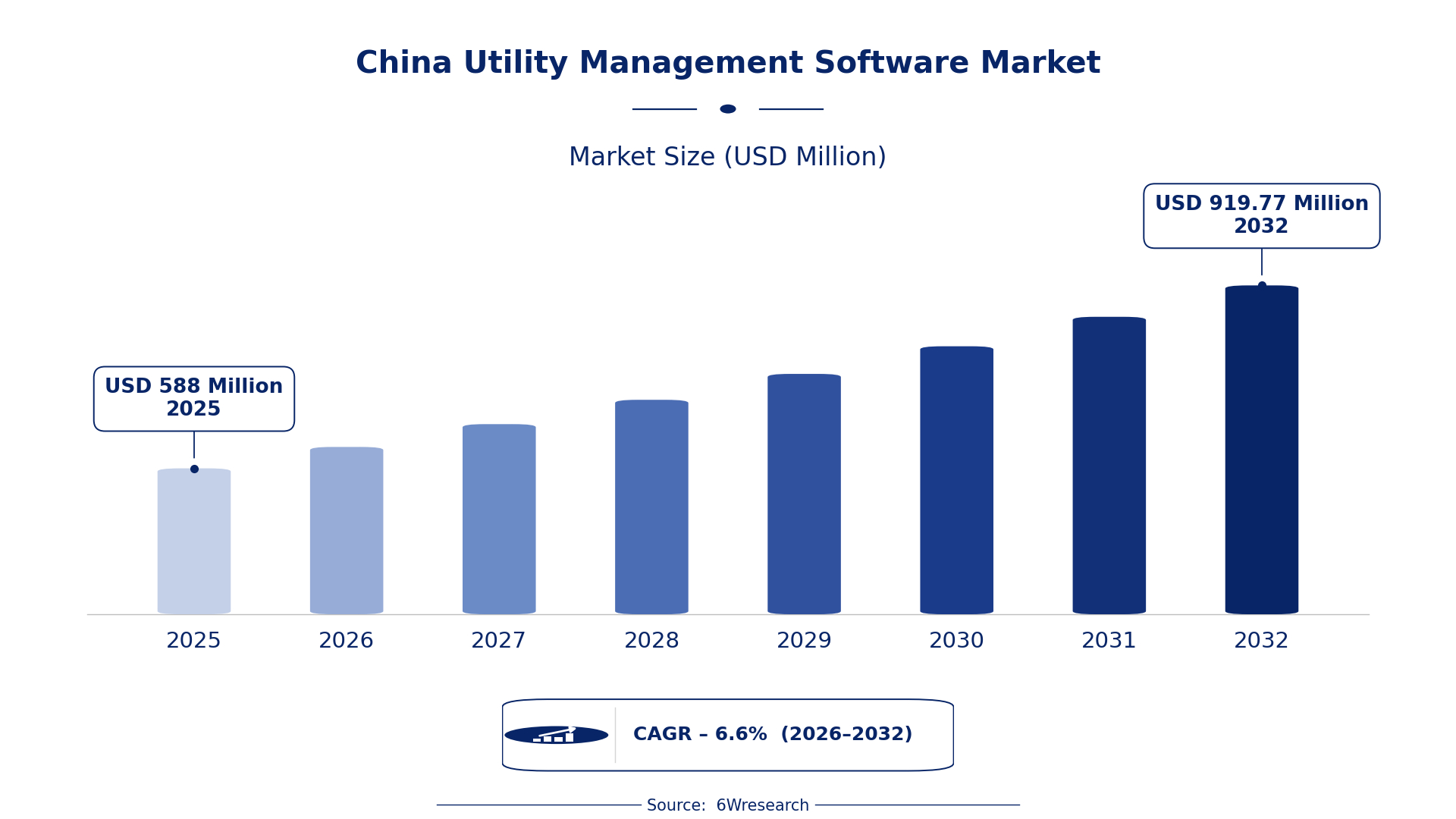
According to 6Wresearch internal database and industry insights, the China Utility Management Software Market was valued at USD 588.0 million in 2025 and is projected to reach USD 919.77 million by 2032, growing at a CAGR of approximately 6.6% during 2026–2032.
China Utility Management Software Market Highlights
| Report Metric | Details |
| Report Name | China Utility Management Software Market |
| Market Size 2025 | USD 588.0 million |
| Market Size 2032 | USD 919.77 million |
| Absolute Growth 2025–2032 | USD 331.77 million |
| CAGR 2026–2032 | 6.6% |
| Peak Annual Growth | 9.1% in 2031 |
| Forecast Period | 2026–2032 |
| Historical Data | 2022–2025 |
| Base Year | 2025 |
| Leading Software Type, 2025 | Billing & Customer Info (45% share) |
| Leading Deployment Model, 2025 | Cloud-Based (50% share) |
| Leading Utility Covered, 2025 | Electricity (42% share) |
| Leading End User, 2025 | Power Utilities (35% share) |
| Fastest-Growing Software Type | Energy Monitoring (8.0% CAGR) |
| Fastest-Growing Deployment Model | SaaS (8.8% CAGR) |
| Fastest-Growing Utility Covered | Multi-Utility (8.0% CAGR) |
| Fastest-Growing End User | Municipal Providers (9.0% CAGR) |
| Growing Sector | Utility Management |
| Key End Users | Power Utilities, Municipal Providers, Industrial Users |
China Utility Management Software Market Year-wise Growth Rate and Key Drivers (2022–2032)
This graph illustrates the annual growth rates of the market from 2022 to 2032, highlighting a steady upward trajectory and projected market expansion over the forecast period.
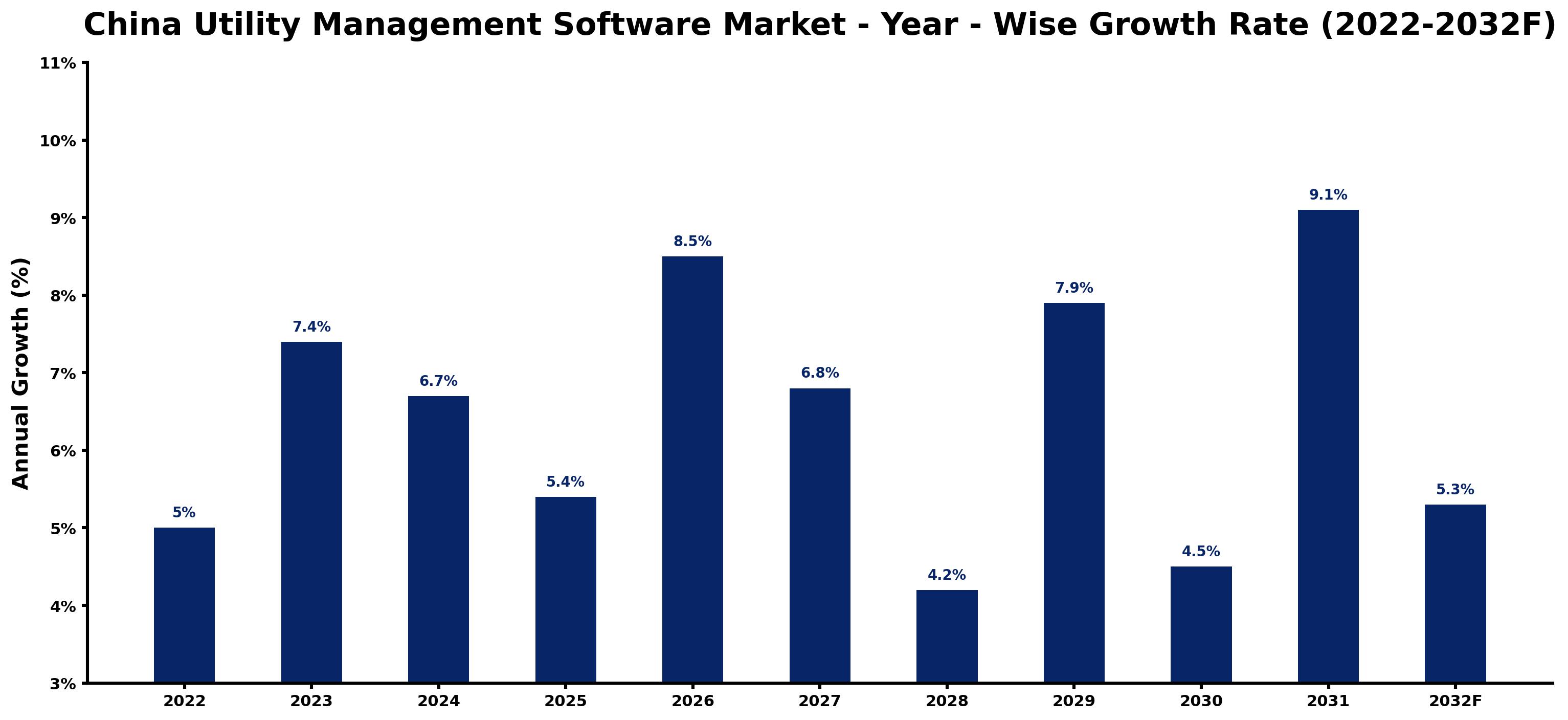
The table below sets out the estimated growth rate for each year and the main factor behind it.
| Year | Estimated Annual Growth (%) | Market Rationale |
| 2022 | 5.0 | The market showed steady growth due to ongoing infrastructure projects and urbanisation, particularly in electricity management. |
| 2023 | 7.4 | Demand surged as over 50% of power utilities adopted utility management software, driven by smart grid initiatives. |
| 2024 | 6.7 | Growth slowed as some utilities reassessed software investments amid budget constraints following economic uncertainties. |
| 2025 | 5.4 | The market continued to grow, supported by the implementation of smart grid initiatives enhancing operational efficiency. |
| 2026 | 8.5 | Adoption is expected to accelerate with the increasing integration of cloud-based solutions in utilities. |
| 2027 | 6.8 | Growth is projected to slow as utilities focus on optimising existing software rather than new purchases. |
| 2028 | 4.2 | The market is expected to experience a slowdown as utilities prioritise cost management in software spending. |
| 2029 | 7.9 | Demand is anticipated to rise again as municipalities adopt advanced energy monitoring systems to improve efficiency. |
| 2030 | 4.5 | Growth is projected to slow as utilities face challenges in effectively integrating new technologies into existing systems. |
| 2031 | 9.1 | A peak in growth is expected as utilities embrace advanced software capabilities for improved operational efficiency. |
| 2032 | 5.3 | The market will see slower growth due to saturation in urban areas limiting new software adoption. |
Note: Market size estimations and growth projections presented in this report are based on 6Wresearch's proprietary forecasting methodology, utilizing the latest available industry data, government publications, and primary research inputs.
China Utility Management Software Market Synopsis
Utility Management Software in China encompasses tools for managing utility services like billing and asset management. This software plays a crucial role in improving operational efficiency for utility companies, particularly in the electricity, water, and gas sectors. The China Utility Management Software Market is expanding due to high adoption rates among power utilities and ongoing smart grid initiatives. Urbanisation further fuels demand, with over 64% of the population residing in urban areas as of 2022.
Market Dynamics Impact Analysis (2026–2032)
| Factor | Type | Impact | Primary Segment Affected |
| Growing adoption of smart grid initiatives enhances software demand. | Driver | High | Energy Monitoring |
| Increasing urbanisation drives the need for efficient utility management solutions. | Driver | High | Billing & Customer Info |
| Significant investment in energy monitoring systems presents opportunities for suppliers. | Opportunity | High | Energy Monitoring |
| Municipal providers are increasingly seeking comprehensive utility management solutions. | Opportunity | High | Multi-Utility |
| Budget constraints limit software investments for some utilities. | Restraint | High | Billing & Customer Info |
| Integration challenges with existing systems hinder software adoption. | Restraint | Medium | Asset Management |
| Utilities face difficulties in keeping pace with rapid technological advancements. | Challenge | High | Energy Monitoring |
| The need for skilled personnel to manage sophisticated software systems is increasing. | Challenge | Medium | Billing & Customer Info |
Evaluation of Drivers in China Utility Management Software Market (2026–2032)
The main growth drivers and the segments they affect most are set out below.
| Drivers | Primary Segment Affected | Why It Matters (Evidence) |
| The National Energy Administration promotes smart grid initiatives, driving software demand. | Energy Monitoring | This initiative encourages utilities to adopt advanced monitoring systems, leading to increased software purchases. |
| Urbanisation has reached 64% in China, increasing demand for efficient utility management. | Billing & Customer Info | As urban populations grow, utilities need better systems to manage customer accounts and billing. |
| The average annual investment in utility software systems is estimated in the billions. | Asset Management | This investment drives demand for software solutions that track utility assets and maintenance. |
| The Ministry of Water Resources initiated programs to improve water utility management efficiency. | Outage Management | These programs lead to increased demand for software that manages service interruptions. |
| ISO 50001 standard for energy management is increasingly adopted by utilities. | Energy Monitoring | Adopting this standard necessitates advanced software to track energy consumption and efficiency. |
Over 50% of power utilities adopted some software by 2023, driving demand for advanced billing and asset management tools. The average annual investment in utility software systems is estimated to be in the billions, indicating strong financial backing for these solutions. As a result, utilities are increasingly purchasing software to improve operational efficiency and customer service.
Evaluation of Restraints in China Utility Management Software Market
The following restraints limit how fast demand can grow.
| Market Restraint | Primary Segment Affected | Why It Matters (Evidence) |
| Budget constraints limit software investments for some utilities. | Billing & Customer Info | Utilities are reassessing expenditures, which can delay software upgrades and new purchases. |
| Integration challenges with existing systems hinder software adoption. | Asset Management | Many utilities struggle to integrate new software with legacy systems, causing delays in implementation. |
| The need for skilled personnel to manage sophisticated software systems is increasing. | Billing & Customer Info | Utilities face difficulties hiring qualified staff, which can slow down software deployment. |
| Utilities are cautious about investing in new technologies due to economic uncertainties. | Energy Monitoring | This caution can limit the adoption of advanced monitoring systems and software. |
| Regulatory compliance requirements can complicate software implementation. | Outage Management | Utilities must ensure compliance with various standards, which can delay software integration. |
China Utility Management Software Market Challenges
The China Utility Management Software Market encounters several practical issues, starting with intense competition that drives down prices, compelling producers to compromise on quality, which ultimately impacts service reliability for utility companies. Many utilities face challenges with technological integration; outdated systems hinder the adoption of new software, leading to delays that waste time and resources for buyers. Regulatory changes, such as the adoption of ISO 50001, impose additional compliance costs on utilities, requiring them to adapt swiftly to avoid penalties. Urbanisation intensifies pressure on buyers, as the growing demand for efficient utility management surpasses current software capabilities, risking service disruptions for consumers.
Trends in the China Utility Management Software Market
Several trends are reshaping the China Utility Management Software Market; the most important are set out below.
- Shift towards Cloud-Based Solutions: Cloud-based utility management software is gaining traction among utilities in China, with 50% adoption anticipated by 2025. This shift allows for greater flexibility and remote access, driving efficiency in operations.
- Increasing Focus on Energy Monitoring: In 2023, the China Electricity Council launched a program to enhance energy monitoring systems. This initiative is expected to significantly boost the adoption of energy monitoring software.
- Municipal Providers Embracing Comprehensive Solutions: Municipal providers are increasingly adopting multi-utility management software, with a projected CAGR of 9.0% by 2032. This trend reflects the need for integrated solutions to manage diverse utility services.
- Rise of Smart City Initiatives: The Ministry of Housing and Urban-Rural Development is promoting smart city initiatives, impacting utility management software demand. By 2025, this is expected to lead to substantial software adoption across urban areas.
Investment Opportunities in the China Utility Management Software Market
Below are the investment opportunities with the strongest case in the China Utility Management Software Market.
- Investment Gap in Energy Monitoring: With the average annual investment in utility software systems in the billions, there exists a notable gap in energy monitoring solutions. Power utilities are seeking advanced software to enhance efficiency.
- Municipal Providers Seeking Comprehensive Solutions: Municipal providers are increasingly in search of multi-utility management software. The Guangdong province, with its industrial base, presents a prime opportunity for suppliers to enter this market.
- Timing for Cloud-Based Solutions: As the National Development and Reform Commission supports cloud integration, the demand for cloud-based utility management software is set to rise. Suppliers can partner with local utilities to provide these solutions.
- Growing Need for Outage Management Software: The Ministry of Water Resources' initiatives to improve water utility management create demand for outage management software. Suppliers can target municipal providers to meet this need.
Government Initiatives in the China Utility Management Software Market
The 'Smart Energy Development Plan' launched by the National Energy Administration in 2021 aims to modernise utility management through technology integration. This plan promotes the adoption of advanced software solutions, improving operational capabilities in utility companies. In 2022, the Ministry of Water Resources approved the 'Water Utility Management Improvement Program', focusing on software implementation in urban areas to enhance service delivery. By 2023, the National Development and Reform Commission updated the 'Energy Efficiency Action Plan' to include digital tools for utilities, ensuring compliance with modern standards. These measures collectively aim to improve service delivery and operational efficiency across the utility sector in China.
The 'Smart Utility Initiative' introduced by the Ministry of Industry and Information Technology in 2023 encourages innovation in utility management software. This initiative funds projects that develop new software technologies, improving the capabilities of utility providers. Additionally, the National Energy Administration provides approvals for various utility management software solutions, ensuring they meet national standards. By supporting these initiatives, the government aims to modernise the utility sector and improve service delivery across China.
Future Insight of the China Utility Management Software Market
The China Utility Management Software Market will undergo significant changes by 2032, driven by the National Energy Administration's smart grid initiatives that will improve software integration across utility sectors. The Ministry of Water Resources will enhance water management efficiency, allowing for better resource allocation. By 2025, over 50% of power utilities are expected to adopt advanced utility management tools, streamlining their operations. The National Development and Reform Commission's support for cloud solutions will fundamentally alter data management practices in utilities, offering advantages for both buyers and suppliers.
Market Segmentation Analysis
Each segment group is reviewed below, with the leader by share and the fastest grower by CAGR.
By Software Type – Billing & Customer Info Dominated, Energy Monitoring Expected to Grow Fastest
According to Bhawna Singh, Assistant Manager at 6Wresearch, with a 45% revenue share in 2025, Billing & Customer Info was the largest software type category. Billing and customer information software holds the largest share due to its critical role in managing customer accounts and billing processes for utilities. With over 50% of power utilities in China adopting this software, it is integral to their operational frameworks. The quickest growth will come from Energy Monitoring, forecast to expand at a CAGR of 8.0% between 2026 and 2032. Energy monitoring software is experiencing rapid growth as utilities increasingly focus on tracking energy consumption and enhancing efficiency. The recent initiative by the China Electricity Council to improve energy monitoring systems underscores this trend. Suppliers should prioritise the development of energy monitoring solutions to align with the increasing demand in the utility management software market.
By Deployment Model – Cloud-Based Dominated, SaaS Expected to Grow Fastest
Cloud-Based accounted for a 50% market share by deployment model in 2025. Cloud-based deployment leads the market because it offers flexibility and remote access, making it particularly attractive for utility companies. The substantial annual investment in cloud solutions reflects a strong industry shift towards modernising infrastructure. SaaS are set to record the highest CAGR in this split, 8.8% over 2026–2032. SaaS deployment is the fastest-growing model, appealing for its subscription-based approach and user-friendly design, which attracts utilities seeking cost-effective solutions. This trend is expected to continue as more utilities adopt cloud technologies. Buyers should consider SaaS options for their utility management needs to achieve cost savings and improve operational efficiency.
By Utility Covered – Electricity Dominated, Multi-Utility Expected to Grow Fastest
In 2025, Electricity led the utility covered split with a 42% share. Electricity is the primary utility addressed by management software, highlighting its central role within the sector. The widespread adoption of software by power utilities indicates a critical need for effective electricity management solutions. Multi-Utility is projected to grow fastest, at a CAGR of 8.0% during 2026–2032. The multi-utility segment is rapidly expanding as utilities diversify their services to include various resources. This growth is driven by the rising urban population and the demand for integrated management solutions. Suppliers must focus on developing multi-utility capabilities to meet the diverse demands of a changing utility landscape.
By End User – Power Utilities Dominated, Municipal Providers Expected to Grow Fastest
Power Utilities took a 35% share of end user in 2025, more than any other category. Power utilities represent the largest end user group for utility management software, relying on these tools to enhance operational efficiency. Their significant investments in software solutions demonstrate their commitment to modernising their infrastructure. Over 2026–2032, Municipal Providers are expected to post the fastest growth, at a CAGR of 9.0%. Municipal providers are the fastest-growing end user segment, as they manage public utility services and aim to improve efficiency through software. Their increasing focus on smart city initiatives is a key factor driving this growth. Suppliers should target municipal providers to capitalise on the expanding market for utility management solutions.
Key Attractiveness of the Report
- 10 Years of Market Numbers
- Historical Data Starting from 2022 to 2025
- Base Year 2025
- Forecast Data until 2032
- Key Performance Indicators Impacting the Market
- Major Upcoming Developments and Projects
Key Highlights of the Report:
- China Utility Management Software Market Outlook
- Market Size of China Utility Management Software Market, 2025
- Forecast of China Utility Management Software Market, 2032
- Historical Data and Forecast of China Utility Management Software Revenues & Volume for the Period 2022 - 2032F
- China Utility Management Software Market Trend Evolution
- China Utility Management Software Market Drivers and Challenges
- China Utility Management Software Price Trends
- China Utility Management Software Porter's Five Forces
- China Utility Management Software Industry Life Cycle
- Historical Data and Forecast of China Utility Management Software Market Revenues & Volume By Software Type for the Period 2022 - 2032F
- Historical Data and Forecast of China Utility Management Software Market Revenues & Volume By Asset Management for the Period 2022 - 2032F
- Historical Data and Forecast of China Utility Management Software Market Revenues & Volume By Billing & Customer Info for the Period 2022 - 2032F
- Historical Data and Forecast of China Utility Management Software Market Revenues & Volume By Energy Monitoring for the Period 2022 - 2032F
- Historical Data and Forecast of China Utility Management Software Market Revenues & Volume By Outage Management for the Period 2022 - 2032F
- Historical Data and Forecast of China Utility Management Software Market Revenues & Volume By Deployment Model for the Period 2022 - 2032F
- Historical Data and Forecast of China Utility Management Software Market Revenues & Volume By On-Premise for the Period 2022 - 2032F
- Historical Data and Forecast of China Utility Management Software Market Revenues & Volume By Cloud-Based for the Period 2022 - 2032F
- Historical Data and Forecast of China Utility Management Software Market Revenues & Volume By SaaS for the Period 2022 - 2032F
- Historical Data and Forecast of China Utility Management Software Market Revenues & Volume By Hybrid for the Period 2022 - 2032F
- Historical Data and Forecast of China Utility Management Software Market Revenues & Volume By Utility Covered for the Period 2022 - 2032F
- Historical Data and Forecast of China Utility Management Software Market Revenues & Volume By Electricity for the Period 2022 - 2032F
- Historical Data and Forecast of China Utility Management Software Market Revenues & Volume By Water/Gas for the Period 2022 - 2032F
- Historical Data and Forecast of China Utility Management Software Market Revenues & Volume By Multi-Utility for the Period 2022 - 2032F
- Historical Data and Forecast of China Utility Management Software Market Revenues & Volume By Electricity for the Period 2022 - 2032F
- Historical Data and Forecast of China Utility Management Software Market Revenues & Volume By End User for the Period 2022 - 2032F
- Historical Data and Forecast of China Utility Management Software Market Revenues & Volume By Power Utilities for the Period 2022 - 2032F
- Historical Data and Forecast of China Utility Management Software Market Revenues & Volume By Municipal Providers for the Period 2022 - 2032F
- Historical Data and Forecast of China Utility Management Software Market Revenues & Volume By Industrial Users for the Period 2022 - 2032F
- Historical Data and Forecast of China Utility Management Software Market Revenues & Volume By Grid Operators for the Period 2022 - 2032F
- China Utility Management Software Import Export Trade Statistics
- Market Opportunity Assessment By Software Type
- Market Opportunity Assessment By Deployment Model
- Market Opportunity Assessment By Utility Covered
- Market Opportunity Assessment By End User
- China Utility Management Software Top Companies Market Share
- China Utility Management Software Competitive Benchmarking By Technical and Operational Parameters
- China Utility Management Software Company Profiles
- China Utility Management Software Key Strategic Recommendations
Market Covered
Segments analysed in this report are listed below.
By Software Type
- Asset Management
- Billing & Customer Info
- Energy Monitoring
- Outage Management
By Deployment Model
- On-Premise
- Cloud-Based
- SaaS
- Hybrid
By Utility Covered
- Electricity
- Water/Gas
- Multi-Utility
By End User
- Power Utilities
- Municipal Providers
- Industrial Users
- Grid Operators































