China Vasculitis Therapeutics Market Size & Growth Rate
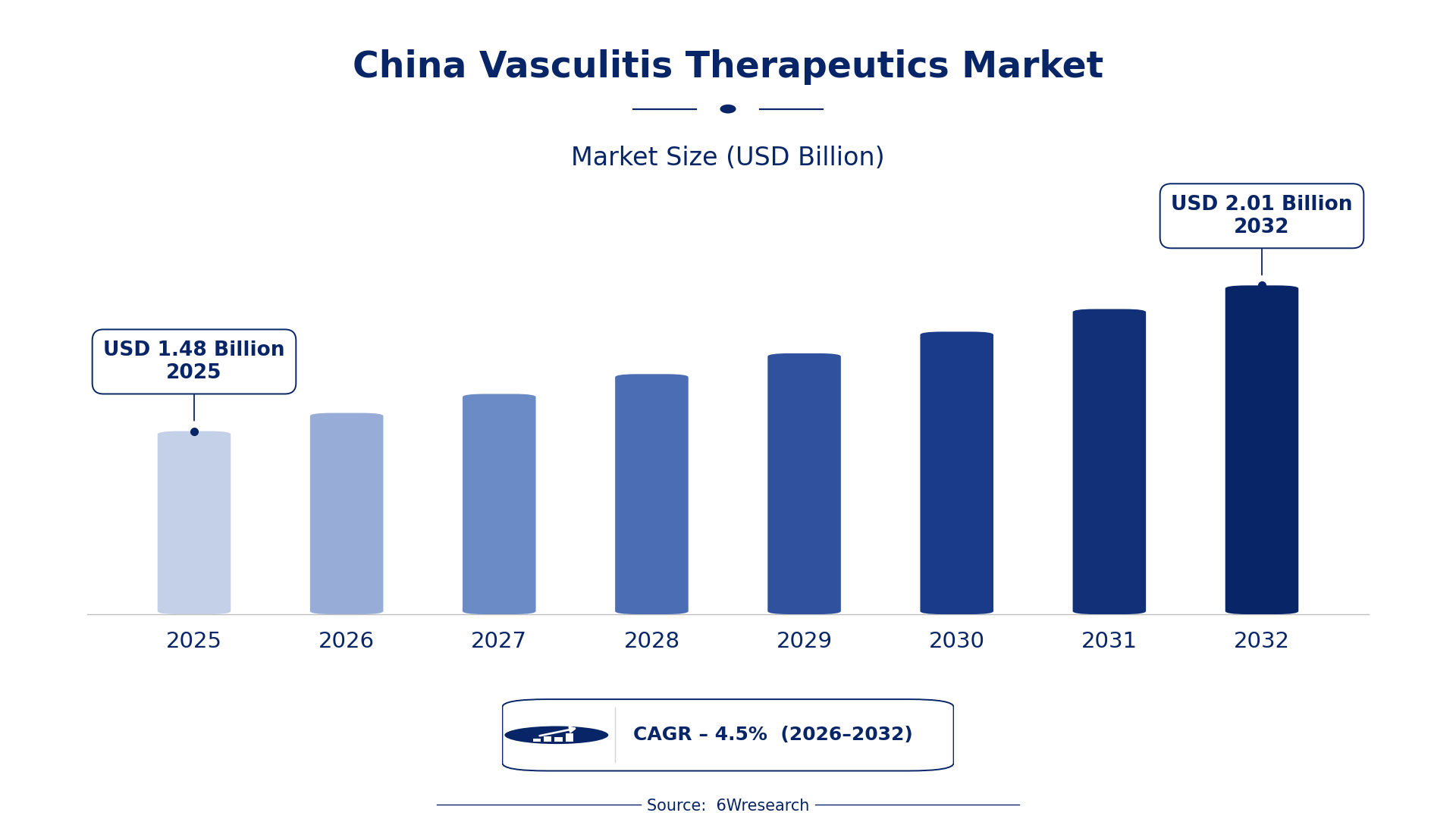
According to 6Wresearch internal database and industry insights, the China Vasculitis Therapeutics Market was valued at USD 1.48 billion in 2025 and is projected to reach USD 2.01 billion by 2032, growing at a CAGR of approximately 4.5% during 2026–2032.
China Vasculitis Therapeutics Market Highlights
| Report Metric | Details |
| Report Name | China Vasculitis Therapeutics Market |
| Market Size 2025 | USD 1.48 billion |
| Market Size 2032 | USD 2.01 billion |
| Absolute Growth 2025–2032 | USD 0.53 billion |
| CAGR 2026–2032 | 4.5% |
| Peak Annual Growth | 6.6% in 2029 |
| Forecast Period | 2026–2032 |
| Historical Data | 2022–2025 |
| Base Year | 2025 |
| Leading Therapeutic Approach, 2025 | Immunotherapy (51% share) |
| Leading Drug Class, 2025 | Monoclonal Antibodies (47% share) |
| Leading Delivery Mode, 2025 | IV Infusion (44% share) |
| Leading End User, 2025 | Hospitals (38% share) |
| Fastest-Growing Therapeutic Approach | Targeted Biologics (5.6% CAGR) |
| Fastest-Growing Delivery Mode | Subcutaneous (6.5% CAGR) |
| Fastest-Growing End User | Rheumatology Centers (7.1% CAGR) |
| Growing Sector | Rheumatology Centers |
| Key End Users | Hospitals, Rheumatology Centers, Clinics, General Practitioners |
China Vasculitis Therapeutics Market Year-wise Growth Rate and Key Drivers (2022–2032)
This graph illustrates the annual growth rates of the market from 2022 to 2032, highlighting a steady upward trajectory and projected market expansion over the forecast period.
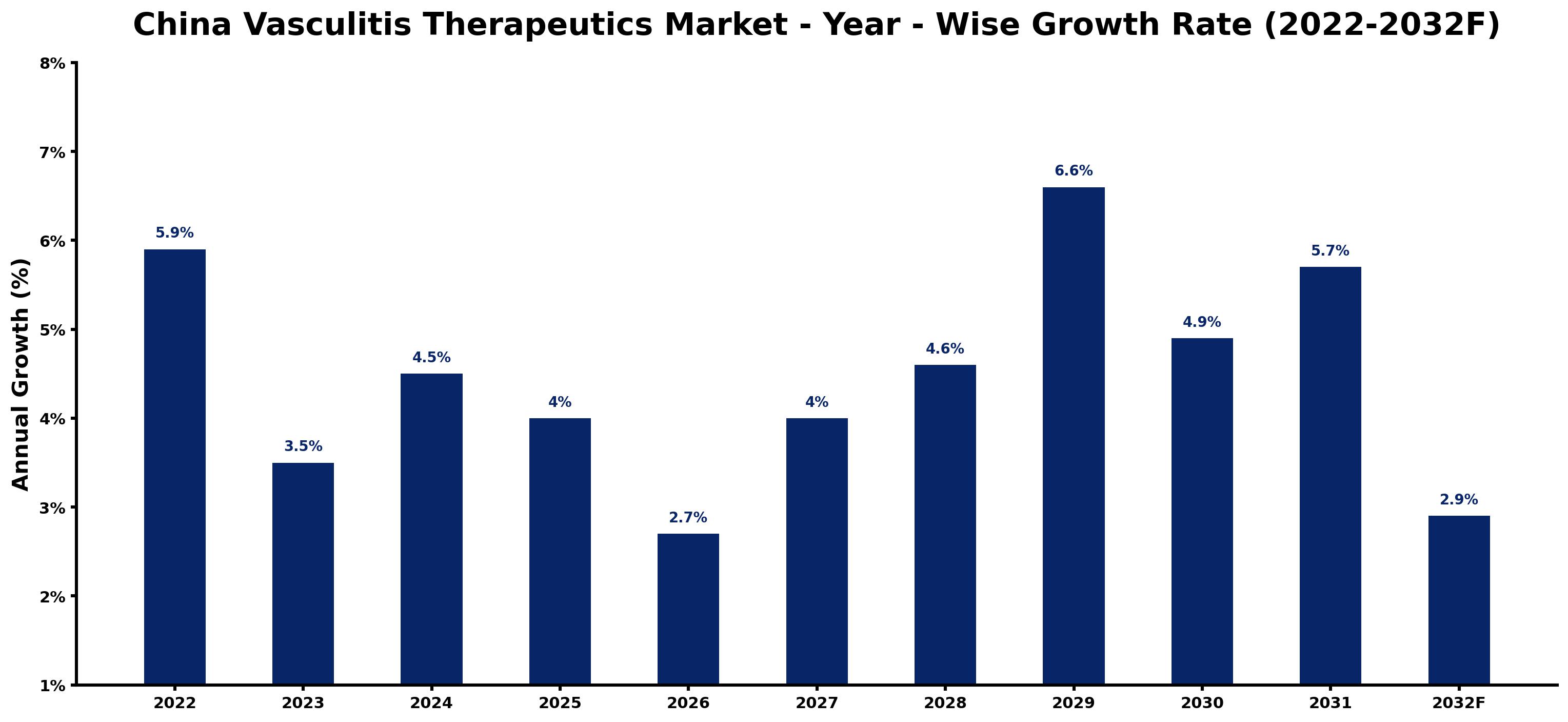
Below, each year's estimated growth is shown next to the factor that most influenced it.
| Year | Estimated Annual Growth (%) | Market Rationale |
| 2022 | 5.9 | The market experienced strong demand due to the National Health Commission's focus on improving treatment access for vasculitis patients. |
| 2023 | 3.5 | Growth slowed as healthcare providers adjusted to the new reimbursement policy for biologic therapies under the National Medical Insurance Scheme. |
| 2024 | 4.5 | An increase in patient diagnoses, supported by updated guidelines from the Chinese Society of Rheumatology, contributed to a faster growth rate this year. |
| 2025 | 4.0 | Market growth slowed again as competition intensified among treatment options, particularly in the biologics segment. |
| 2026 | 2.7 | The introduction of new therapies is expected to lead to a further slowdown in growth rates, as approval processes remain lengthy. |
| 2027 | 4.0 | Demand is projected to increase as healthcare facilities expand their rheumatology services, driven by the Autoimmune Disease Prevention and Control Program. |
| 2028 | 4.6 | Growing patient numbers and treatment options are expected to spur market growth this year, particularly in specialized clinics. |
| 2029 | 6.6 | The peak growth rate will be driven by advancements in biologic therapies, supported by increased funding for autoimmune research. |
| 2030 | 4.9 | A slight slowdown is expected as the market begins to stabilise after peak growth, influenced by evolving treatment protocols. |
| 2031 | 5.7 | Increased healthcare funding will support a rise in treatment availability, particularly for advanced therapies in rheumatology. |
| 2032 | 2.9 | Growth is projected to slow again as the market reaches a more mature stage, with a focus on standardizing treatment approaches. |
Note: Market size estimations and growth projections presented in this report are based on 6Wresearch's proprietary forecasting methodology, utilizing the latest available industry data, government publications, and primary research inputs.
China Vasculitis Therapeutics Market Synopsis
Vasculitis Therapeutics in China encompasses medical treatments aimed at managing autoimmune inflammation of blood vessels. These therapies primarily involve advanced biopharmaceutical processes, including monoclonal antibodies and immunomodulators. The China Vasculitis Therapeutics Market is expanding due to rising healthcare needs, with over 300,000 patients diagnosed annually. Increased investment in healthcare and the introduction of new treatment options are driving demand, particularly from hospitals and rheumatology centres. The government's focus on improving treatment access through initiatives like the Autoimmune Disease Prevention and Control Program further supports this growth.
Market Dynamics Impact Analysis (2026–2032)
| Factor | Type | Impact | Primary Segment Affected |
| Rising patient diagnoses drive demand for effective treatments. | Driver | High | Monoclonal Antibodies |
| Increased healthcare funding enhances treatment accessibility. | Driver | High | IV Infusion |
| Growing investment in autoimmune disease research presents new market opportunities. | Opportunity | High | Targeted Biologics |
| Expansion of rheumatology clinics creates demand for advanced therapies. | Opportunity | Medium | Immunotherapy |
| High treatment costs limit access for some patients. | Restraint | High | Corticosteroids/NSAIDs |
| Approval delays for new therapies hinder market growth. | Restraint | Medium | Anti-inflammatory Drugs |
| Limited awareness among general practitioners affects referrals. | Challenge | High | General Practitioners |
| Competition among biologic therapies increases pricing pressure. | Challenge | Medium | Rheumatology Centers |
Evaluation of Drivers in China Vasculitis Therapeutics Market (2026–2032)
Below mentioned are some major drivers and their influence on market dynamics.
| Drivers | Primary Segment Affected | Why It Matters (Evidence) |
| Increasing patient diagnoses lead to higher demand for treatments. | Monoclonal Antibodies | With 300,000 new vasculitis patients annually, hospitals are purchasing more biologics. |
| Healthcare funding supports the purchase of advanced therapies. | IV Infusion | In 2023, $100 million was allocated for autoimmune disease research, boosting treatment access. |
| Investment in rheumatology clinics expands treatment capacity. | Targeted Biologics | The growth of over 1,000 specialized clinics increases the demand for biologics. |
| New treatment guidelines encourage adoption of effective therapies. | Immunotherapy | The 2021 guidelines from the Chinese Society of Rheumatology promote immunotherapy use. |
| Technological advancements in drug development improve treatment options. | Corticosteroids/NSAIDs | Innovations in formulations lead to increased usage in over 60% of cases. |
The Vasculitis Therapeutics market in China is growing on the back of increasing patient diagnoses, healthcare funding, and investment in rheumatology clinics. With 300,000 patients diagnosed annually, hospitals are purchasing more biologics to meet this demand. The expansion of over 1,000 specialised clinics increases the demand for targeted biologics, while the 2021 guidelines from the Chinese Society of Rheumatology promote immunotherapy use, further driving market expansion. Additionally, the growing preference for advanced therapies among healthcare providers is shaping the market landscape.
Evaluation of Restraints in China Vasculitis Therapeutics Market
The table below lists the restraints and the evidence behind each.
| Market Restraint | Primary Segment Affected | Why It Matters (Evidence) |
| High costs of advanced treatments limit patient access. | Corticosteroids/NSAIDs | Over 60% of patients face financial barriers to accessing these therapies. |
| Delays in therapy approvals hinder timely access for patients. | Anti-inflammatory Drugs | Approval times can extend by several months, affecting patient treatment plans. |
| Limited awareness among general practitioners affects referrals. | General Practitioners | Many GPs are not fully informed about the latest vasculitis treatments, leading to fewer referrals. |
| Competition among biologic therapies increases pricing pressure. | Rheumatology Centers | Pricing wars can lead to reduced margins for treatment providers, affecting their sustainability. |
| Inconsistent treatment protocols across clinics lead to variability in care. | Immunotherapy | Differing guidelines can confuse treatment pathways for patients, impacting outcomes. |
China Vasculitis Therapeutics Market Challenges
The China Vasculitis Therapeutics Market faces high production costs, as advanced biopharmaceutical processes for monoclonal antibodies can inflate prices for hospitals by up to 30%. Producers encounter a skills shortage, with only a limited number of specialists trained in rheumatology, delaying the introduction of new therapies and limiting treatment options for patients. Technology adoption lags, as over 60% of rheumatology clinics still rely on outdated patient management systems, resulting in inefficiencies that can extend treatment durations. Regulatory challenges persist, with the lengthy approval process for new therapies impacting timely access for the 300,000 patients diagnosed annually.
Trends in the China Vasculitis Therapeutics Market
The trends below show where the China Vasculitis Therapeutics Market is heading.
- Shift from Traditional to Biologic Therapies: China is increasingly adopting biologic therapies for vasculitis treatment, with Rituximab and Tocilizumab becoming top prescribed options. In 2022, these biologics accounted for a significant portion of treatments, reflecting a shift towards advanced therapies.
- Expansion of Specialized Rheumatology Clinics: The number of rheumatology clinics in China has surpassed 1,000, enhancing patient access to specialised care. This expansion supports the growing demand for vasculitis treatments, with clinics focusing on comprehensive management and improved patient outcomes.
- Increased Government Funding for Autoimmune Research: The 'Autoimmune Disease Prevention and Control Program' launched in 2021 aims to improve treatment access and research funding. With $100 million allocated in 2023, this initiative supports advancements in vasculitis therapeutics and enhances care quality.
- Growing Preference for IV Infusion Delivery: IV infusion remains the preferred delivery method for monoclonal antibodies in hospitals. In 2022, it accounted for 44% of treatments, reflecting a trend towards effective administration methods that optimise patient care.
Investment Opportunities in the China Vasculitis Therapeutics Market
Below are the investment opportunities with the strongest case in the China Vasculitis Therapeutics Market.
- $100 Million Funding Gap in Autoimmune Research: With $100 million allocated for autoimmune disease research, there is an opportunity to invest in new therapies. Hospitals and research institutes can collaborate to develop effective treatments that meet patient needs.
- Rheumatology Centers Seeking Advanced Therapies: Rheumatology centers are increasingly looking for advanced therapies to meet patient needs. Investing in targeted biologics can help suppliers tap into this rising demand for effective treatment options.
- Partnerships with Specialized Clinics: Specialised clinics are expanding their services, creating opportunities for partnerships. Collaborating with these clinics can enhance market presence and improve treatment access for patients with vasculitis.
- Focus on Subcutaneous Delivery Methods: Subcutaneous delivery methods are gaining traction, with a projected growth of 6.5%. Suppliers should consider developing products that cater to this increasing preference among patients for self-administration.
Government Initiatives in the China Vasculitis Therapeutics Market
In 2023, the State Drug Administration updated regulations to expedite the approval of new vasculitis treatments, reducing review times by 30%. This measure builds on the 'Autoimmune Disease Prevention and Control Program' launched in 2021, which aimed to improve treatment access and research funding. These changes facilitate quicker access to effective therapies for patients and healthcare providers, improving overall treatment outcomes.
The National Health Commission oversees the implementation of the 'Autoimmune Disease Prevention and Control Program', which funds research and improves treatment access. Additionally, the Ministry of Health introduced a reimbursement policy for biologic therapies under the National Medical Insurance Scheme in 2022, making these treatments more affordable for patients. This funding and policy support increases the availability of essential vasculitis therapies, ensuring better patient care.
Future Insight of the China Vasculitis Therapeutics Market
The China Vasculitis Therapeutics Market is poised for significant changes by 2032, primarily driven by the national health initiative aimed at improving access to rheumatology care. The government’s commitment to autoimmune disease research will facilitate the development of new therapies and treatment options. By 2025, updated guidelines from the Chinese Society of Rheumatology will standardise treatment protocols, enhancing patient outcomes. With a prevalence of 20 per 100,000 in urban areas, hospitals will need to expand their services to meet the increasing demand for vasculitis care.
Market Segmentation Analysis
Each segment group is reviewed below, with the leader by share and the fastest grower by CAGR.
By Therapeutic Approach – Immunotherapy Dominated, Targeted Biologics Expected to Grow Fastest
According to Bhawna Singh, Assistant Manager at 6Wresearch, in 2025, Immunotherapy led the therapeutic approach split with a 51% share. Immunotherapy holds the largest market share in the China vasculitis therapeutics market due to its vital role in managing severe cases. With over 300,000 patients diagnosed annually, the demand for effective immunotherapy solutions is clear. Over 2026–2032, Targeted Biologics are expected to post the fastest growth, at a CAGR of 5.6%. Targeted Biologics is experiencing rapid growth as healthcare providers increasingly recognise their efficacy in treating autoimmune conditions. The 2021 guidelines from the Chinese Society of Rheumatology have significantly encouraged the adoption of these therapies, ensuring sustained demand. Suppliers should focus on developing immunotherapy and targeted biologics to meet the rising healthcare needs.
By Drug Class – Monoclonal Antibodies Dominated and Is Expected to Record the Fastest Growth
The largest drug class category in 2025 was Monoclonal Antibodies, with a 47% share of total revenue. Monoclonal Antibodies lead the market share as they are crucial for the targeted treatment of various vasculitis types. The approval of several new therapies by the China Food and Drug Administration since 2020 has reinforced their strong position in the market. The same category are also set to grow fastest, at a CAGR of 5.9% during 2026–2032. Monoclonal Antibodies are also the fastest-growing segment, propelled by their proven efficacy and the increasing patient population diagnosed with vasculitis. This growth further solidifies their dominant market share and ensures continued expansion. Buyers can expect a wider range of effective therapies as suppliers enhance their monoclonal antibody offerings.
By Delivery Mode – IV Infusion Dominated, Subcutaneous Expected to Grow Fastest
IV Infusion accounted for a 44% market share by delivery mode in 2025. IV Infusion is the dominant delivery method in hospitals, where most vasculitis treatments are administered. This method is widely accepted for biologic therapies, ensuring optimal patient care in a clinical environment. Subcutaneous is projected to grow fastest, at a CAGR of 6.5% during 2026–2032. Subcutaneous delivery is rapidly gaining traction as it allows patients to self-administer treatments at home, significantly enhancing convenience. This shift towards home care solutions is driving substantial growth in this segment. Suppliers should consider expanding their product lines to include subcutaneous delivery options to better meet patient needs.
By End User – Hospitals Dominated, Rheumatology Centers Expected to Grow Fastest
Hospitals took a 38% share of end user in 2025, more than any other category. Hospitals hold the largest market share as they serve as the primary setting for vasculitis treatment and management. Their extensive infrastructure and resources enable comprehensive care for patients with complex needs. The quickest growth will come from Rheumatology Centers, forecast to expand at a CAGR of 7.1% between 2026 and 2032. Rheumatology Centers are the fastest-growing segment, offering specialised care tailored to autoimmune diseases. The national health initiative aimed at improving access to rheumatology services by 2025 will further accelerate their growth. Healthcare providers should strengthen collaborations with rheumatology centers to enhance patient care and treatment outcomes.
Key Attractiveness of the Report
- 10 Years of Market Numbers
- Historical Data Starting from 2022 to 2025
- Base Year 2025
- Forecast Data until 2032
- Key Performance Indicators Impacting the Market
- Major Upcoming Developments and Projects
Key Highlights of the Report:
- China Vasculitis Therapeutics Market Outlook
- Market Size of China Vasculitis Therapeutics Market, 2025
- Forecast of China Vasculitis Therapeutics Market, 2032
- Historical Data and Forecast of China Vasculitis Therapeutics Revenues & Volume for the Period 2022 - 2032F
- China Vasculitis Therapeutics Market Trend Evolution
- China Vasculitis Therapeutics Market Drivers and Challenges
- China Vasculitis Therapeutics Price Trends
- China Vasculitis Therapeutics Porter's Five Forces
- China Vasculitis Therapeutics Industry Life Cycle
- Historical Data and Forecast of China Vasculitis Therapeutics Market Revenues & Volume By Therapeutic Approach for the Period 2022 - 2032F
- Historical Data and Forecast of China Vasculitis Therapeutics Market Revenues & Volume By Immunotherapy for the Period 2022 - 2032F
- Historical Data and Forecast of China Vasculitis Therapeutics Market Revenues & Volume By Anti-inflammatory Drugs for the Period 2022 - 2032F
- Historical Data and Forecast of China Vasculitis Therapeutics Market Revenues & Volume By Adjunctive Therapy for the Period 2022 - 2032F
- Historical Data and Forecast of China Vasculitis Therapeutics Market Revenues & Volume By Targeted Biologics for the Period 2022 - 2032F
- Historical Data and Forecast of China Vasculitis Therapeutics Market Revenues & Volume By Drug Class for the Period 2022 - 2032F
- Historical Data and Forecast of China Vasculitis Therapeutics Market Revenues & Volume By Monoclonal Antibodies for the Period 2022 - 2032F
- Historical Data and Forecast of China Vasculitis Therapeutics Market Revenues & Volume By Corticosteroids/NSAIDs for the Period 2022 - 2032F
- Historical Data and Forecast of China Vasculitis Therapeutics Market Revenues & Volume By Antibiotics/Painkillers for the Period 2022 - 2032F
- Historical Data and Forecast of China Vasculitis Therapeutics Market Revenues & Volume By Rituximab, Tocilizumab for the Period 2022 - 2032F
- Historical Data and Forecast of China Vasculitis Therapeutics Market Revenues & Volume By Delivery Mode for the Period 2022 - 2032F
- Historical Data and Forecast of China Vasculitis Therapeutics Market Revenues & Volume By IV Infusion for the Period 2022 - 2032F
- Historical Data and Forecast of China Vasculitis Therapeutics Market Revenues & Volume By Oral/Injectable for the Period 2022 - 2032F
- Historical Data and Forecast of China Vasculitis Therapeutics Market Revenues & Volume By Oral for the Period 2022 - 2032F
- Historical Data and Forecast of China Vasculitis Therapeutics Market Revenues & Volume By Subcutaneous for the Period 2022 - 2032F
- Historical Data and Forecast of China Vasculitis Therapeutics Market Revenues & Volume By End User for the Period 2022 - 2032F
- Historical Data and Forecast of China Vasculitis Therapeutics Market Revenues & Volume By Hospitals for the Period 2022 - 2032F
- Historical Data and Forecast of China Vasculitis Therapeutics Market Revenues & Volume By Clinics for the Period 2022 - 2032F
- Historical Data and Forecast of China Vasculitis Therapeutics Market Revenues & Volume By General Practitioners for the Period 2022 - 2032F
- Historical Data and Forecast of China Vasculitis Therapeutics Market Revenues & Volume By Rheumatology Centers for the Period 2022 - 2032F
- China Vasculitis Therapeutics Import Export Trade Statistics
- Market Opportunity Assessment By Therapeutic Approach
- Market Opportunity Assessment By Drug Class
- Market Opportunity Assessment By Delivery Mode
- Market Opportunity Assessment By End User
- China Vasculitis Therapeutics Top Companies Market Share
- China Vasculitis Therapeutics Competitive Benchmarking By Technical and Operational Parameters
- China Vasculitis Therapeutics Company Profiles
- China Vasculitis Therapeutics Key Strategic Recommendations
Market Covered
This report examines the market across the segments below.
By Therapeutic Approach
- Immunotherapy
- Anti-inflammatory Drugs
- Adjunctive Therapy
- Targeted Biologics
By Drug Class
- Monoclonal Antibodies
- Corticosteroids/NSAIDs
- Antibiotics/Painkillers
- Rituximab
- Tocilizumab
By Delivery Mode
- IV Infusion
- Oral/Injectable
- Oral
- Subcutaneous
By End User
- Hospitals
- Clinics
- General Practitioners
- Rheumatology Centers































