China Vegan Apparel Market Size & Growth Rate
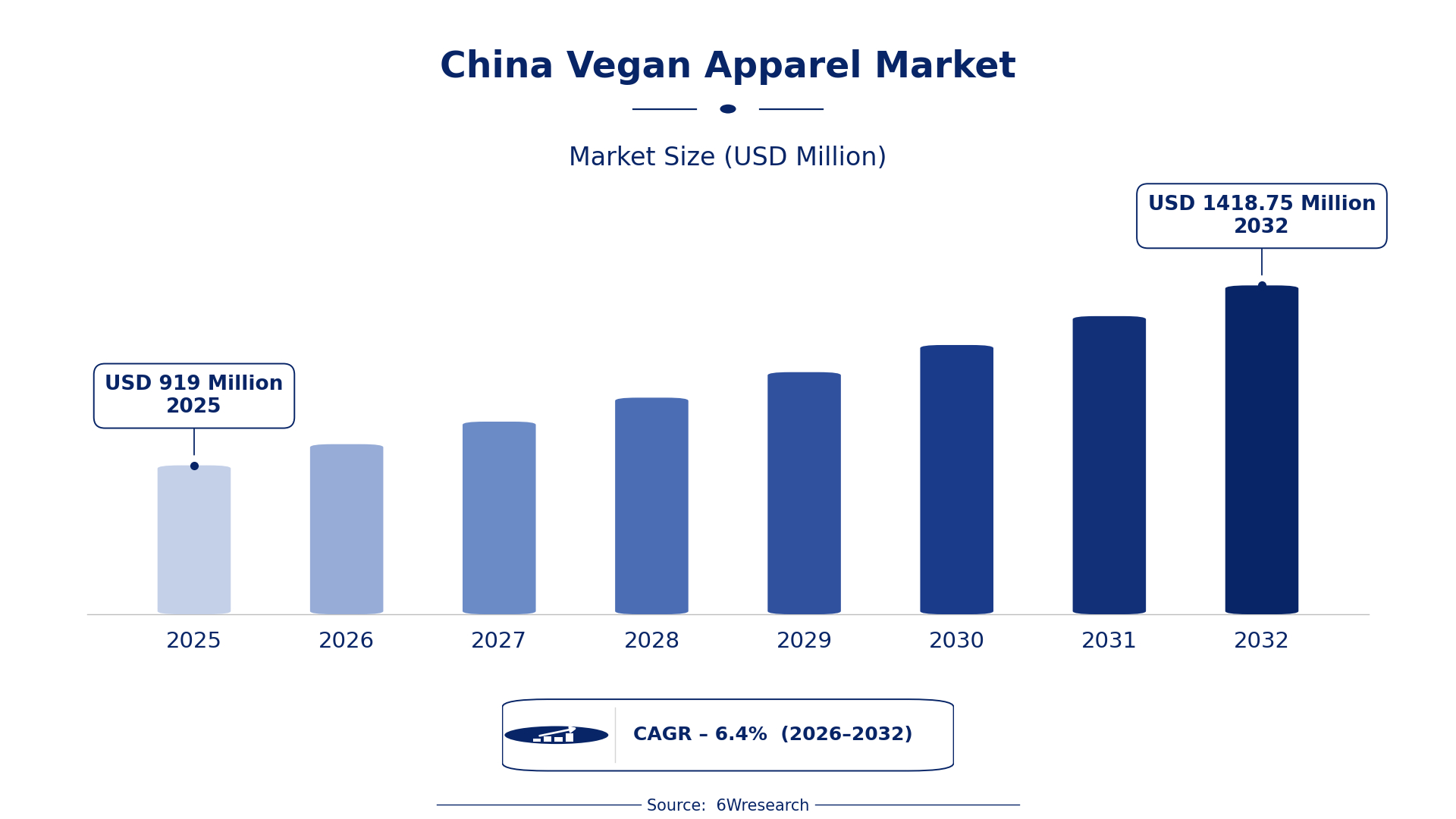
According to 6Wresearch internal database and industry insights, the China Vegan Apparel Market was valued at USD 919.0 million in 2025 and is projected to reach USD 1,418.75 million by 2032, growing at a CAGR of approximately 6.4% during 2026–2032.
China Vegan Apparel Market Highlights
| Report Metric | Details |
| Report Name | China Vegan Apparel Market |
| Market Size 2025 | USD 919.0 million |
| Market Size 2032 | USD 1,418.75 million |
| Absolute Growth 2025–2032 | USD 499.75 million |
| CAGR 2026–2032 | 6.4% |
| Peak Annual Growth | 9.0% in 2032 |
| Forecast Period | 2026–2032 |
| Historical Data | 2022–2025 |
| Base Year | 2025 |
| Leading Product Type, 2025 | Jackets (50% share) |
| Leading Material Source, 2025 | Plant-Based Leather (53% share) |
| Leading Sales Channel, 2025 | Online Stores (48% share) |
| Leading End User, 2025 | Eco-conscious Consumers (43% share) |
| Fastest-Growing Product Type | Shoes (8.7% CAGR) |
| Fastest-Growing Material Source | Recycled Polyester (7.5% CAGR) |
| Fastest-Growing Sales Channel | E-commerce (7.5% CAGR) |
| Fastest-Growing End User | Sustainable Brands (8.7% CAGR) |
| Growing Sector | Eco-conscious fashion |
| Key End Users | Eco-conscious Consumers, Vegan Population, Ethical Buyers, Sustainable Brands |
China Vegan Apparel Market Year-wise Growth Rate and Key Drivers (2022–2032)
This graph illustrates the annual growth rates of the market from 2022 to 2032, highlighting a steady upward trajectory and projected market expansion over the forecast period.
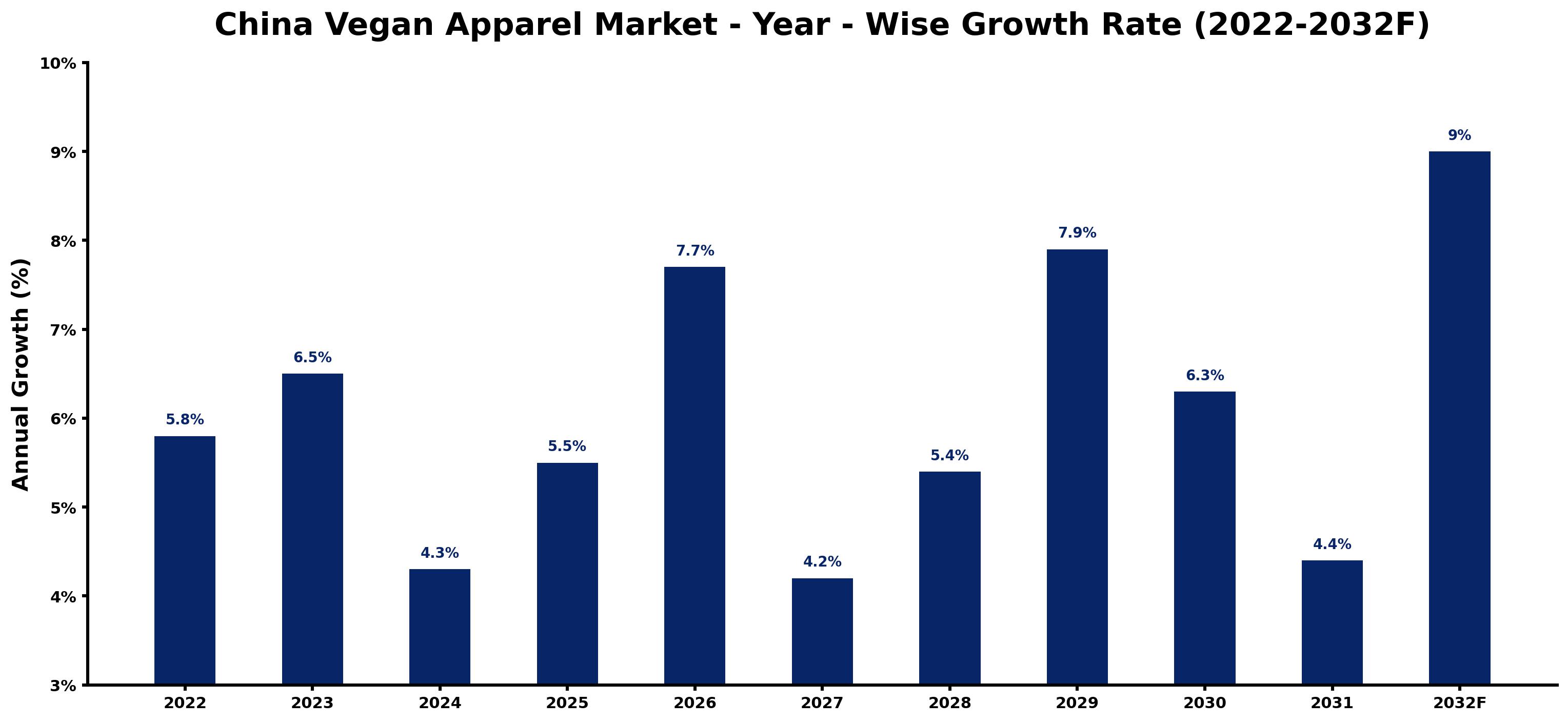
Below, each year's estimated growth is shown next to the factor that most influenced it.
| Year | Estimated Annual Growth (%) | Market Rationale |
| 2022 | 5.8 | The market experienced solid growth due to heightened consumer interest in sustainable fashion. |
| 2023 | 6.5 | Demand surged as eco-conscious consumers increasingly sought vegan apparel options. |
| 2024 | 4.3 | Growth slowed as the 'Green Fashion Initiative' began to influence production practices. |
| 2025 | 5.5 | The market rebounded with renewed interest in sustainable fashion initiatives. |
| 2026 | 7.7 | Increased adoption of plant-based materials drove demand in the apparel sector. |
| 2027 | 4.2 | Growth slowed as competition intensified among vegan apparel brands. |
| 2028 | 5.4 | The market saw a resurgence as consumer awareness of sustainability continued to rise. |
| 2029 | 7.9 | Demand accelerated with the introduction of new eco-friendly fashion lines. |
| 2030 | 6.3 | Growth moderated as producers adjusted to the updated national standards for sustainable textiles. |
| 2031 | 4.4 | The market continued to grow, albeit at a slower pace amid evolving consumer preferences. |
| 2032 | 9.0 | A peak in demand is anticipated as sustainability becomes a mainstream focus. |
Note: Market size estimations and growth projections presented in this report are based on 6Wresearch's proprietary forecasting methodology, utilizing the latest available industry data, government publications, and primary research inputs.
China Vegan Apparel Market Synopsis
Vegan Apparel in China encompasses clothing made without animal-derived materials, utilising sustainable alternatives like plant-based leather and recycled polyester. The market is projected to grow to USD 919.0 million by 2025, driven by a growing population of eco-conscious consumers, which reached approximately 300 million in 2022. The 'Green Fashion Initiative' launched in 2023 and the rising vegan population of around 50 million are influencing this growth. Eco-conscious consumers are increasingly prioritising cruelty-free fashion, further boosting demand for vegan apparel.
Market Dynamics Impact Analysis (2026–2032)
| Factor | Type | Impact | Primary Segment Affected |
| Rising consumer awareness of sustainability and ethical consumption. | Driver | High | Eco-conscious Consumers |
| Increasing availability of plant-based materials in production. | Driver | High | Plant-Based Leather |
| Growing demand for sustainable fashion options among urban populations. | Opportunity | High | Jackets |
| Expansion of online sales channels for vegan apparel. | Opportunity | High | Online Stores |
| Higher production costs associated with sustainable materials. | Restraint | Medium | Jackets |
| Limited consumer knowledge about vegan materials and their benefits. | Restraint | Medium | Jackets |
| Competition from traditional apparel brands adopting sustainable practices. | Challenge | High | Fashion Retailers |
| Supply chain complexities in sourcing sustainable materials. | Challenge | Medium | Plant-Based Leather |
Evaluation of Drivers in China Vegan Apparel Market (2026–2032)
Key forces behind demand, with the segment each one moves most, are listed below.
| Drivers | Primary Segment Affected | Why It Matters (Evidence) |
| Increased consumer interest in sustainable fashion choices. | Eco-conscious Consumers | Approximately 300 million eco-conscious consumers are driving demand for vegan apparel. |
| Rising availability of plant-based leather alternatives. | Plant-Based Leather | The demand for plant-based leather is expected to rise by 15% annually through 2025. |
| Growth of online sales channels for vegan apparel. | Online Stores | Online sales accounted for 35% of total vegan apparel sales in 2022. |
| Urbanisation leading to higher demand for sustainable clothing. | Jackets | The market for vegan apparel is projected to grow in urban areas like Shanghai and Beijing. |
| Influence of the 'Green Fashion Initiative' on production practices. | Sustainable Brands | The initiative promotes sustainable clothing practices, impacting production methods across the sector. |
Market growth in China for Vegan Apparel rests on rising end-use demand from eco-conscious consumers and the supply response from manufacturers adopting sustainable practices. The growing population of eco-conscious consumers, estimated at 300 million, is driving demand for vegan apparel. The introduction of plant-based leather alternatives is projected to increase by 15% annually through 2025, encouraging brands to innovate. Urban areas like Shanghai and Beijing are likely to see growth, reflecting a shift towards sustainable fashion. Online sales accounted for 35% of total vegan apparel sales in 2022, highlighting the importance of e-commerce in this market.
Evaluation of Restraints in China Vegan Apparel Market
The key brakes on demand, and where they bite hardest, are shown below.
| Market Restraint | Primary Segment Affected | Why It Matters (Evidence) |
| Higher production costs for sustainable materials. | Jackets | Producers face increased costs associated with sourcing sustainable materials, affecting pricing strategies. |
| Limited consumer understanding of vegan apparel benefits. | Jackets | Many consumers lack awareness of the advantages of vegan materials, hindering market growth. |
| Competition from traditional brands adopting sustainable practices. | Fashion Retailers | Traditional brands are increasingly entering the sustainable market, intensifying competition for vegan apparel. |
| Supply chain challenges in sourcing sustainable materials. | Plant-Based Leather | Complexities in obtaining sustainable materials can delay production timelines for manufacturers. |
| Regulatory hurdles in material certifications. | Jackets | Producers must navigate complex certification processes for sustainable materials, adding to operational delays. |
China Vegan Apparel Market Challenges
The China Vegan Apparel Market still has to solve a few problems, starting with technology gaps in production. Many manufacturers lack access to advanced machinery for processing eco-friendly materials, resulting in production costs that can be 20% higher than conventional apparel. Supply chain inefficiencies also affect the market, as sourcing vegan materials can delay deliveries by up to three months for producers, complicating their ability to meet the demands of 300 million eco-conscious consumers. Skills shortages in sustainable fashion design hinder innovation, compelling brands to rely on outdated techniques that fail to attract the growing vegan population of 50 million. Regulatory compliance with updated national standards for sustainable textiles adds further complexity, requiring brands to invest additional time and resources, which can postpone the launch of new collections.
Trends in the China Vegan Apparel Market
Several trends are reshaping the China Vegan Apparel Market; the most important are set out below.
- Green Fashion Initiative Accelerating Adoption: The 'Green Fashion Initiative' launched in 2023 is encouraging brands to adopt sustainable practices, with a goal of increasing sustainable material use by 30% by 2025. This initiative is transforming production methods across the industry.
- Shift Towards E-commerce Sales Channels: Since 2022, there has been a clear shift towards online sales channels for vegan apparel, with online stores capturing a 35% market share. This trend mirrors changing consumer shopping behaviours and preferences.
- Increased Focus on Plant-Based Leather: The demand for plant-based leather has surged, with expectations of a 15% annual growth through 2025. This trend is reflected in major fashion weeks increasingly showcasing vegan collections.
- Urban Areas Leading Market Growth: Urban centres like Shanghai and Beijing are emerging as hotspots for vegan apparel, driven by a rising population of eco-conscious consumers. This demographic shift is set to fuel market expansion.
Investment Opportunities in the China Vegan Apparel Market
Below are the investment opportunities with the strongest case in the China Vegan Apparel Market.
- Partner with Local Sustainable Brands: With the market projected to reach USD 919.0 million by 2025, collaborating with local sustainable brands can facilitate market entry. Urban areas provide ideal opportunities for partnerships that enhance visibility.
- Invest in E-commerce Platforms: The shift towards online sales, which accounted for 35% of total sales, presents a timely opportunity to invest in e-commerce platforms. This strategy can attract a broader consumer base and improve accessibility.
- Utilise the 'Green Fashion Initiative': The 'Green Fashion Initiative' aims to increase sustainable material use by 30% by 2025, creating opportunities for investment in compliant production facilities. This aligns with consumer demand for eco-friendly options.
- Expand into Urban Markets: Urban areas are projected to be the fastest-growing segments, with strong demand for vegan apparel. Targeting these markets can yield substantial returns for new entrants.
Government Initiatives in the China Vegan Apparel Market
The 'Green Textile Development Plan' launched by the Ministry of Industry and Information Technology in 2023 aims to increase the use of sustainable materials in the fashion industry by 30% by 2025. This initiative encourages producers to adopt eco-friendly practices, influencing the production of vegan apparel. Additionally, the 'Circular Economy Development Strategy' introduced in 2021 promotes sustainable practices among manufacturers, impacting overall production methods. The 'Sustainable Fashion Promotion Initiative' established by the Ministry of Commerce in 2022 supports brands adopting vegan and sustainable practices, providing funding and resources for companies transitioning to eco-friendly production methods.
The 'Sustainable Fashion Promotion Initiative' established by the Ministry of Commerce in 2022 supports brands adopting vegan and sustainable practices. This initiative provides funding and resources for companies transitioning to eco-friendly production methods. Furthermore, the 'Green Consumption Action Plan' initiated in 2023 encourages consumers to choose sustainable products, including vegan apparel, fostering a supportive environment for market growth.
Future Insight of the China Vegan Apparel Market
The China Vegan Apparel Market is set for notable changes by 2032, driven by several important factors. The 'Green Fashion Initiative' launched in 2023 will motivate brands to embrace sustainable practices, while the updated national standard for sustainable textiles will improve product quality. Online sales are likely to keep increasing, as 35% of total sales in 2022 came from digital platforms, reflecting a clear shift towards e-commerce. The demand for plant-based leather is projected to rise by 15% annually through 2025, reinforcing the market's commitment to cruelty-free fashion.
Market Segmentation Analysis
The report offers a comprehensive study of the following market segments and their leading categories in the market.
By Product Type – Jackets Dominated, Shoes Expected to Grow Fastest
According to Bhawna Singh, Assistant Manager at 6Wresearch, Jackets accounted for a 50% market share by product type in 2025. Jackets command a substantial share in the China Vegan Apparel Market due to their essential role in vegan outerwear, appealing to a broad base of eco-conscious consumers. The growing popularity of fashionable and sustainable jackets in urban areas like Shanghai and Beijing underscores their significance in this market. The quickest growth will come from Shoes, forecast to expand at a CAGR of 8.7% between 2026 and 2032. Shoes are experiencing rapid growth as consumers increasingly prioritise stylish and ethical footwear options. The rising emphasis on sustainable practices is encouraging brands to broaden their vegan shoe offerings, which will likely propel this segment's expansion. This suggests that suppliers should focus on diversifying their product ranges in jackets and shoes to meet the rising demand from environmentally conscious buyers.
By Material Source – Plant-Based Leather Dominated, Recycled Polyester Expected to Grow Fastest
In 2025, Plant-Based Leather led the material source split with a 53% share. Plant-Based Leather dominates the market share as it is the primary material used in many vegan clothing items, appealing to consumers prioritising cruelty-free fashion. The updated national standard for sustainable textiles has further solidified its position in the market. Recycled Polyester is set to record the highest CAGR in this split, 7.5% over 2026–2032. Recycled Polyester is growing at the fastest rate, driven by its widespread use in various apparel for its sustainability benefits. The increasing adoption of recycled materials in the fashion industry is propelling this segment's rapid expansion. Suppliers should consider investing in plant-based leather and recycled polyester to align with consumer preferences for sustainable materials.
By Sales Channel – Online Stores Dominated, E-commerce Expected to Grow Fastest
Online Stores took a 48% share of sales channel in 2025, more than any other category. Online Stores represent the largest share of the market as they serve as a primary sales channel for vegan apparel, attracting a tech-savvy and eco-aware demographic. The convenience and diverse selection offered by online platforms resonate particularly well with consumers in urban environments. E-commerce is projected to grow fastest, at a CAGR of 7.5% during 2026–2032. E-commerce is the fastest-growing sales channel, indicating a notable shift towards digital shopping experiences among consumers. The fact that online sales of vegan apparel constituted 35% in 2022 highlights the essential role of e-commerce in driving market growth. This means that suppliers should enhance their online strategies and e-commerce capabilities to effectively reach a broader audience.
By End User – Eco-conscious Consumers Dominated, Sustainable Brands Expected to Grow Fastest
With a 43% revenue share in 2025, Eco-conscious Consumers was the largest end user category. Eco-conscious Consumers represent the largest share in the China Vegan Apparel Market as they are the main target audience for vegan apparel, driven by a growing awareness of sustainability. The population of eco-conscious consumers in China reached approximately 300 million in 2022, indicating a substantial market base. Over 2026–2032, Sustainable Brands are expected to post the fastest growth, at a CAGR of 8.7%. Sustainable Brands are the fastest-growing end user segment, vital for promoting and selling vegan apparel to a wider audience. Their commitment to ethical practices aligns perfectly with the increasing consumer demand for vegan products. This means that suppliers should collaborate with sustainable brands to effectively tap into the expanding market of eco-conscious consumers.
Key Attractiveness of the Report
- 10 Years of Market Numbers
- Historical Data Starting from 2022 to 2025
- Base Year 2025
- Forecast Data until 2032
- Key Performance Indicators Impacting the Market
- Major Upcoming Developments and Projects
Key Highlights of the Report:
- China Vegan Apparel Market Outlook
- Market Size of China Vegan Apparel Market, 2025
- Forecast of China Vegan Apparel Market, 2032
- Historical Data and Forecast of China Vegan Apparel Revenues & Volume for the Period 2022 - 2032F
- China Vegan Apparel Market Trend Evolution
- China Vegan Apparel Market Drivers and Challenges
- China Vegan Apparel Price Trends
- China Vegan Apparel Porter's Five Forces
- China Vegan Apparel Industry Life Cycle
- Historical Data and Forecast of China Vegan Apparel Market Revenues & Volume By Product Type for the Period 2022 - 2032F
- Historical Data and Forecast of China Vegan Apparel Market Revenues & Volume By Jackets for the Period 2022 - 2032F
- Historical Data and Forecast of China Vegan Apparel Market Revenues & Volume By Shoes for the Period 2022 - 2032F
- Historical Data and Forecast of China Vegan Apparel Market Revenues & Volume By Bags for the Period 2022 - 2032F
- Historical Data and Forecast of China Vegan Apparel Market Revenues & Volume By Belts & Accessories for the Period 2022 - 2032F
- Historical Data and Forecast of China Vegan Apparel Market Revenues & Volume By Material Source for the Period 2022 - 2032F
- Historical Data and Forecast of China Vegan Apparel Market Revenues & Volume By Recycled Polyester for the Period 2022 - 2032F
- Historical Data and Forecast of China Vegan Apparel Market Revenues & Volume By Plant-Based Leather for the Period 2022 - 2032F
- Historical Data and Forecast of China Vegan Apparel Market Revenues & Volume By Cork/Cotton Canvas for the Period 2022 - 2032F
- Historical Data and Forecast of China Vegan Apparel Market Revenues & Volume By PU-Based Faux Leather for the Period 2022 - 2032F
- Historical Data and Forecast of China Vegan Apparel Market Revenues & Volume By Sales Channel for the Period 2022 - 2032F
- Historical Data and Forecast of China Vegan Apparel Market Revenues & Volume By Online Stores for the Period 2022 - 2032F
- Historical Data and Forecast of China Vegan Apparel Market Revenues & Volume By Fashion Retailers for the Period 2022 - 2032F
- Historical Data and Forecast of China Vegan Apparel Market Revenues & Volume By Specialty Boutiques for the Period 2022 - 2032F
- Historical Data and Forecast of China Vegan Apparel Market Revenues & Volume By E-commerce for the Period 2022 - 2032F
- Historical Data and Forecast of China Vegan Apparel Market Revenues & Volume By End User for the Period 2022 - 2032F
- Historical Data and Forecast of China Vegan Apparel Market Revenues & Volume By Eco-conscious Consumers for the Period 2022 - 2032F
- Historical Data and Forecast of China Vegan Apparel Market Revenues & Volume By Vegan Population for the Period 2022 - 2032F
- Historical Data and Forecast of China Vegan Apparel Market Revenues & Volume By Ethical Buyers for the Period 2022 - 2032F
- Historical Data and Forecast of China Vegan Apparel Market Revenues & Volume By Sustainable Brands for the Period 2022 - 2032F
- China Vegan Apparel Import Export Trade Statistics
- Market Opportunity Assessment By Product Type
- Market Opportunity Assessment By Material Source
- Market Opportunity Assessment By Sales Channel
- Market Opportunity Assessment By End User
- China Vegan Apparel Top Companies Market Share
- China Vegan Apparel Competitive Benchmarking By Technical and Operational Parameters
- China Vegan Apparel Company Profiles
- China Vegan Apparel Key Strategic Recommendations
Market Covered
This report examines the market across the segments below.
By Product Type
- Jackets
- Shoes
- Bags
- Belts & Accessories
By Material Source
- Recycled Polyester
- Plant-Based Leather
- Cork/Cotton Canvas
- PU-Based Faux Leather
By Sales Channel
- Online Stores
- Fashion Retailers
- Specialty Boutiques
- E-commerce
By End User
- Eco-conscious Consumers
- Vegan Population
- Ethical Buyers
- Sustainable Brands































