China Vehicle Air Filtration System Market Size & Growth Rate
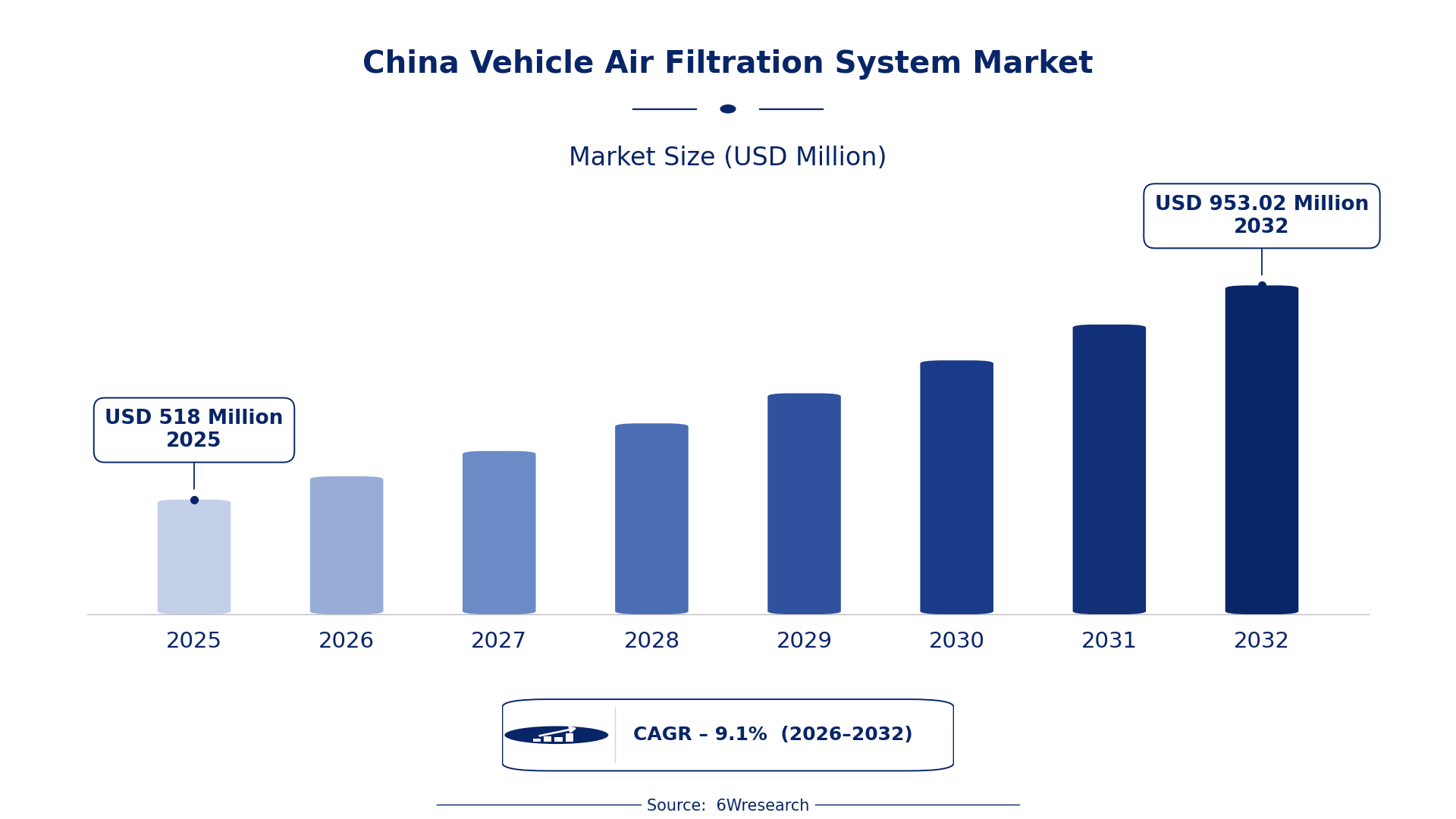
According to 6Wresearch internal database and industry insights, the China Vehicle Air Filtration System Market was valued at USD 518.0 million in 2025 and is projected to reach USD 953.02 million by 2032, growing at a CAGR of approximately 9.1% during 2026–2032.
China Vehicle Air Filtration System Market Highlights
| Report Metric | Details |
| Report Name | China Vehicle Air Filtration System Market |
| Market Size 2025 | USD 518.0 million |
| Market Size 2032 | USD 953.02 million |
| Absolute Growth 2025–2032 | USD 435.02 million |
| CAGR 2026–2032 | 9.1% |
| Peak Annual Growth | 11.4% in 2029 |
| Forecast Period | 2026–2032 |
| Historical Data | 2022–2025 |
| Base Year | 2025 |
| Leading Filter Type, 2025 | Cabin Air Filter (35% share) |
| Leading Filter Material, 2025 | HEPA (37% share) |
| Leading Functionality, 2025 | Pollen & Dust Filtration (43% share) |
| Leading End User, 2025 | OEMs (53% share) |
| Fastest-Growing Filter Type | Particulate Filter (10.9% CAGR) |
| Fastest-Growing Filter Material | Nanofiber (11.1% CAGR) |
| Fastest-Growing Functionality | Pollution Reduction (11.9% CAGR) |
| Fastest-Growing End User | EV & Hybrid Vehicles (11.2% CAGR) |
| Growing Sector | automotive aftermarket |
| Key End Users | OEMs, Auto Service Centers, EV & Hybrid Vehicles, Luxury Segment Automakers |
China Vehicle Air Filtration System Market Year-wise Growth Rate and Key Drivers (2022–2032)
This graph illustrates the annual growth rates of the market from 2022 to 2032, highlighting a steady upward trajectory and projected market expansion over the forecast period.
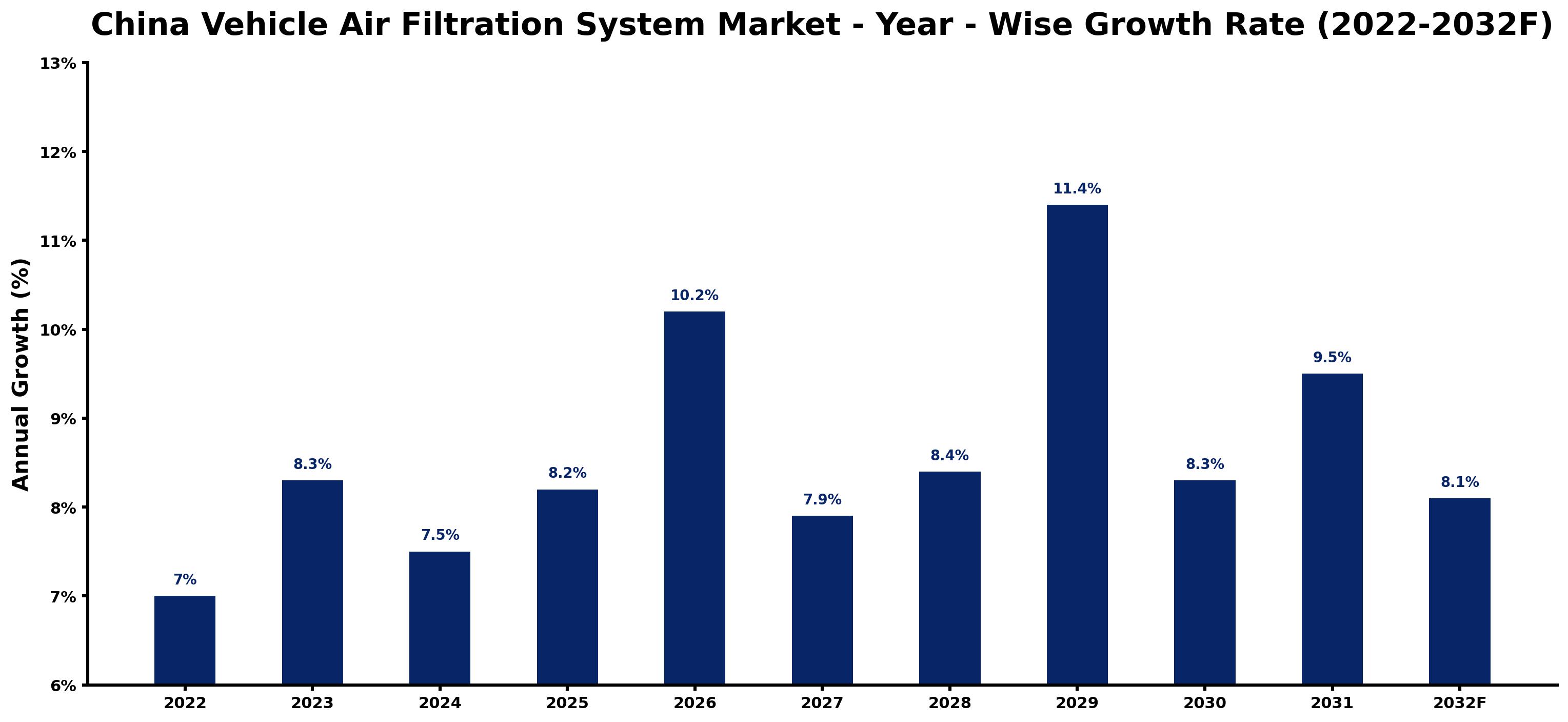
The following table presents the estimated annual growth rate for each year together with the principal factor influencing market performance.
| Year | Estimated Annual Growth (%) | Market Rationale |
| 2022 | 7.0 | The automotive market was stable, with strong sales figures indicating robust demand. |
| 2023 | 8.3 | Sales increased due to heightened awareness of air quality and health concerns among consumers. |
| 2024 | 7.5 | Growth slowed as supply chain disruptions affected filter production and availability. |
| 2025 | 8.2 | Demand surged with rising vehicle sales and urban pollution levels driving filter needs. |
| 2026 | 10.2 | The market is expected to grow as electric vehicle adoption accelerates filter technology advancements. |
| 2027 | 7.9 | Growth is projected to slow as manufacturers adjust to new emission regulations and market dynamics. |
| 2028 | 8.4 | Increased consumer focus on health and comfort will lead to a rebound in filter demand. |
| 2029 | 11.4 | The market is expected to peak as high-performance filtration systems gain traction in luxury vehicles. |
| 2030 | 8.3 | Growth is projected to slow as market saturation begins to affect new filter sales. |
| 2031 | 9.5 | Demand will increase again as environmental standards push for better filtration solutions. |
| 2032 | 8.1 | Growth is expected to slow as the market stabilises, reflecting a mature automotive sector. |
Note: Market size estimations and growth projections presented in this report are based on 6Wresearch's proprietary forecasting methodology, utilizing the latest available industry data, government publications, and primary research inputs.
China Vehicle Air Filtration System Market Synopsis
The China Vehicle Air Filtration System Market centres on filtering airborne particles in vehicles, enhancing air quality and driving comfort. This technology utilises materials such as HEPA and activated carbon to safeguard passenger health and protect engines. The market is expanding due to increasing vehicle sales, with over 26 million units sold in 2022, alongside rising urban pollution levels that heighten the need for effective filtration solutions. The push for electric vehicles drives investment in advanced filtration technologies, as highlighted by the New Energy Vehicle Industry Development Plan launched in 2023.
Market Dynamics Impact Analysis (2026–2032)
| Factor | Type | Impact | Primary Segment Affected |
| Rising vehicle sales and urban pollution levels drive demand for effective air filtration solutions. | Driver | High | Cabin Air Filter |
| Increasing adoption of electric vehicles leads to demand for advanced filtration technologies. | Driver | High | Particulate Filter |
| Growing automotive aftermarket valued at approximately 1 trillion CNY presents opportunities for suppliers. | Opportunity | High | Engine Air Filter |
| The demand for high-performance filtration systems in luxury vehicles creates new market segments. | Opportunity | High | Pollen & Dust Filtration |
| Supply chain disruptions have affected the availability of filtration materials. | Restraint | High | Activated Carbon |
| Stricter emission regulations require significant investments in compliance technologies. | Restraint | Medium | HEPA |
| The Vehicle Air Filtration System market in China faces challenges related to production costs and material availability. | Challenge | High | Cabin Air Filter |
| Competition from low-cost alternatives may impact premium product sales. | Challenge | Medium | Engine Air Filter |
Evaluation of Drivers in China Vehicle Air Filtration System Market (2026–2032)
Key forces behind demand, with the segment each one moves most, are listed below.
| Drivers | Primary Segment Affected | Why It Matters (Evidence) |
| Increased vehicle sales drive demand for cabin air filters, essential for passenger comfort. | Cabin Air Filter | In 2022, over 26 million vehicles were sold in China, boosting filter demand. |
| The rise of electric vehicles necessitates advanced filtration systems for improved air quality. | Particulate Filter | Electric vehicle sales accounted for 25% of total vehicle sales in 2022. |
| Urban pollution levels are prompting consumers to prioritise air quality in vehicles. | Pollen & Dust Filtration | Increasing urban pollution levels are driving demand for effective filtration solutions. |
| The automotive aftermarket's value of approximately 1 trillion CNY offers growth opportunities. | Engine Air Filter | This market size encourages investment in filtration technologies. |
| Stricter emission regulations are pushing manufacturers to adopt advanced filtration technologies. | HEPA | The use of activated carbon filters is increasing due to these regulations. |
Growth in the Vehicle Air Filtration System market in China is driven by rising vehicle sales, urban pollution levels, and the adoption of electric vehicles. In 2022, over 26 million vehicles were sold, which boosted demand for effective filtration systems. Urban pollution is prompting consumers to prioritise air quality, leading to increased interest in advanced filtration technologies. The automotive aftermarket, valued at approximately 1 trillion CNY, further fuels investment in filtration solutions.
Evaluation of Restraints in China Vehicle Air Filtration System Market
The key brakes on demand, and where they bite hardest, are shown below.
| Market Restraint | Primary Segment Affected | Why It Matters (Evidence) |
| Supply chain disruptions have impacted the availability of filtration materials, delaying production. | Activated Carbon | Manufacturers have faced challenges sourcing materials, affecting filter availability. |
| Stricter emission regulations require investments in compliance technologies, increasing costs. | HEPA | Compliance with these regulations demands advanced technology, raising operational costs. |
| Competition from low-cost alternatives may impact premium product sales, affecting market share. | Cabin Air Filter | Consumers may opt for cheaper options, reducing demand for high-end filters. |
| Rising production costs due to material shortages can limit profit margins for manufacturers. | Engine Air Filter | Increased costs may lead to higher prices, affecting consumer purchasing decisions. |
| Market saturation in urban areas may slow growth as demand stabilises. | Pollen & Dust Filtration | With many vehicles already equipped with filters, new sales may decline. |
China Vehicle Air Filtration System Market Challenges
The China Vehicle Air Filtration System market faces a few practical problems, and the first is supply chain disruptions. These disruptions arise from dependence on specific materials like HEPA and activated carbon, causing production delays for producers that can extend up to three months. A lack of skilled technicians in the automotive sector also hinders progress, as the industry employs over 5 million people, resulting in slower installation times for buyers. Rising raw material costs strain the market, with producers experiencing price increases of around 15%, ultimately raising expenses for consumers. Compliance with the National Standard GB/T 18801-2015 imposes additional financial pressure on manufacturers, requiring investments in quality control measures that squeeze profit margins for suppliers.
Trends in the China Vehicle Air Filtration System Market
Below mentioned are some of the trends shaping the China Vehicle Air Filtration System Market growth.
- Shift towards Advanced Filtration Technologies: The market is transitioning towards advanced filtration technologies, particularly in electric vehicles. The New Energy Vehicle Industry Development Plan promotes cleaner air solutions, with electric vehicle sales reaching 25% of total sales in 2022.
- Growing Demand for HEPA Filters: Consumers are increasingly opting for HEPA filters in vehicles to improve air quality. This trend is underscored by projections indicating significant growth in the HEPA filter market by 2025.
- Increased Focus on Indoor Air Quality: There is a heightened focus on indoor air quality in vehicles, driven by urban pollution. The National Standard GB/T 18801-2015 regulates indoor air quality, impacting manufacturers and suppliers.
- Emergence of Nanofiber Filters: Nanofiber filters are gaining traction as an emerging technology in vehicle air filtration. This segment is expected to grow rapidly, with a projected CAGR of 11.1% from 2026 to 2032.
Investment Opportunities in the China Vehicle Air Filtration System Market
Investors looking at the China Vehicle Air Filtration System Market should consider the following areas.
- Investment in Advanced Filtration Systems: There is a rising opportunity to supply advanced filtration systems, particularly in electric vehicles. The EV & Hybrid Vehicles segment is experiencing notable growth, with increasing demand for improved air quality solutions.
- Expansion in the Automotive Aftermarket: The automotive aftermarket, valued at approximately 1 trillion CNY, offers investment opportunities for suppliers. Auto Service Centers are key buyers of filtration products, driving demand for innovative solutions.
- Partnerships for Compliance Solutions: Local partnerships can facilitate market entry, especially for compliance solutions. Collaborating with OEMs can strengthen product offerings and enhance market presence.
- Focus on Luxury Segment Automakers: The demand for high-performance filtration systems in luxury vehicles presents significant opportunities. This segment is growing as consumers increasingly prioritise superior air quality.
Government Initiatives in the China Vehicle Air Filtration System Market
The "Automotive Industry Development Policy" updated in 2021 by the State Council promotes competitiveness in the automotive sector. This policy encourages innovation and investment in advanced technologies, impacting manufacturers and suppliers in the Vehicle Air Filtration System market. Additionally, the "National Standard for Automotive Cabin Air Filters" established in 2021 ensures better air quality in vehicles, requiring manufacturers to comply with stringent standards. The "Air Quality Improvement Action Plan" implemented in 2022 by the Ministry of Ecology and Environment sets stricter standards for vehicle emissions, impacting manufacturers and suppliers. Lastly, the "New Energy Vehicle Industry Development Plan" launched in 2023 aims to support the adoption of cleaner technologies and improve air quality.
The "New Energy Vehicle Industry Development Plan" launched in 2023 aims to promote electric vehicles and improve air quality. The Ministry of Industry and Information Technology oversees this initiative, which supports the adoption of cleaner technologies. The "Air Quality Improvement Action Plan" implemented in 2022 by the Ministry of Ecology and Environment sets stricter standards for vehicle emissions, impacting manufacturers and suppliers. Furthermore, the "National Standard for Automotive Cabin Air Filters" established in 2021 ensures better air quality in vehicles, requiring compliance from manufacturers. This regulatory framework improves the overall quality of air filtration systems in the market.
Future Insight of the China Vehicle Air Filtration System Market
The outlook for the China Vehicle Air Filtration System market is promising in the coming years, driven by several key factors. The "New Energy Vehicle Industry Development Plan" will boost demand for advanced filtration systems in electric vehicles, enhancing air quality inside vehicles. By 2025, the HEPA filter market in vehicles is projected to grow considerably, reflecting a heightened focus on indoor air quality. Stricter emission regulations will encourage producers to develop more efficient filtration technologies, while rising urban pollution levels will lead buyers to seek high-performance air filtration systems, influencing their purchasing decisions.
Market Segmentation Analysis
Each segment group is reviewed below, with the leader by share and the fastest grower by CAGR.
By Filter Type – Cabin Air Filter Dominated, Particulate Filter Expected to Grow Fastest
According to Bhawna Singh, Assistant Manager at 6Wresearch, Cabin Air Filter accounted for a 35% market share by filter type in 2025. The Cabin Air Filter holds the largest market share as it is essential for ensuring passenger comfort and health, especially in cities with high pollution levels. With over 26 million vehicles sold in 2022, the demand from both domestic users and OEMs is substantial. The quickest growth will come from Particulate Filter, forecast to expand at a CAGR of 10.9% between 2026 and 2032. The Particulate Filter is experiencing rapid growth due to stricter emission regulations that require manufacturers to implement advanced filtration solutions. This growth is further accelerated by the increasing sales of electric vehicles, which demand effective pollution control systems. Suppliers should focus on enhancing their particulate filtration solutions to align with regulatory requirements and leverage the growing market.
By Filter Material – HEPA Dominated, Nanofiber Expected to Grow Fastest
In 2025, HEPA led the filter material split with a 37% share. HEPA filters dominate the market share as they are integral to high-end vehicle filtration systems, providing superior air quality for passengers. Their prevalence in premium vehicles underscores their appeal to consumers who prioritise health and comfort. Nanofiber is projected to grow fastest, at a CAGR of 11.1% during 2026–2032. Nanofiber technology is emerging as a fast-growing segment due to its unique advantages in advanced filtration applications. As awareness of air quality challenges rises, this material is likely to gain traction among manufacturers looking to innovate. Buyers should prioritise vehicles equipped with HEPA filters to significantly improve air quality and overall comfort.
By Functionality – Pollen & Dust Filtration Dominated, Pollution Reduction Expected to Grow Fastest
The largest functionality category in 2025 was Pollen & Dust Filtration, with a 43% share of total revenue. Pollen & Dust Filtration holds the largest market share as it directly protects passengers from allergens, which is increasingly important in urban settings. This functionality is essential for ensuring a healthy driving experience, especially in cities with elevated pollution levels. Over 2026–2032, Pollution Reduction is expected to post the fastest growth, at a CAGR of 11.9%. Pollution Reduction is gaining traction as a key functionality due to rising regulatory pressure to comply with environmental standards. The increase in urban pollution levels is driving demand for effective filtration solutions that can alleviate these challenges. Manufacturers must focus on improving pollution reduction capabilities in their filtration systems to meet environmental regulations and consumer expectations.
By End User – OEMs Dominated, EV & Hybrid Vehicles Expected to Grow Fastest
With a 53% revenue share in 2025, OEMs was the largest end user category. OEMs capture the largest market share as they are the primary manufacturers of vehicle filters, supplying directly to the automotive market. Their established relationships with vehicle manufacturers ensure consistent demand for filtration systems. EV & Hybrid Vehicles are set to record the highest CAGR in this split, 11.2% over 2026–2032. The EV & Hybrid Vehicles segment is the fastest-growing end user category, reflecting the shift towards sustainable transportation solutions. As electric vehicle adoption rises, the need for specialised filtration systems tailored to these vehicles will increase. Suppliers should align their product development with the specific needs of the EV and hybrid vehicle market to capitalise on this growth opportunity.
Key Attractiveness of the Report
- 10 Years of Market Numbers
- Historical Data Starting from 2022 to 2025
- Base Year 2025
- Forecast Data until 2032
- Key Performance Indicators Impacting the Market
- Major Upcoming Developments and Projects
Key Highlights of the Report:
- China Vehicle Air Filtration System Market Outlook
- Market Size of China Vehicle Air Filtration System Market, 2025
- Forecast of China Vehicle Air Filtration System Market, 2032
- Historical Data and Forecast of China Vehicle Air Filtration System Revenues & Volume for the Period 2022 - 2032F
- China Vehicle Air Filtration System Market Trend Evolution
- China Vehicle Air Filtration System Market Drivers and Challenges
- China Vehicle Air Filtration System Price Trends
- China Vehicle Air Filtration System Porter's Five Forces
- China Vehicle Air Filtration System Industry Life Cycle
- Historical Data and Forecast of China Vehicle Air Filtration System Market Revenues & Volume By Filter Type for the Period 2022 - 2032F
- Historical Data and Forecast of China Vehicle Air Filtration System Market Revenues & Volume By Cabin Air Filter for the Period 2022 - 2032F
- Historical Data and Forecast of China Vehicle Air Filtration System Market Revenues & Volume By Engine Air Filter for the Period 2022 - 2032F
- Historical Data and Forecast of China Vehicle Air Filtration System Market Revenues & Volume By Particulate Filter for the Period 2022 - 2032F
- Historical Data and Forecast of China Vehicle Air Filtration System Market Revenues & Volume By Recirculation Filters for the Period 2022 - 2032F
- Historical Data and Forecast of China Vehicle Air Filtration System Market Revenues & Volume By Filter Material for the Period 2022 - 2032F
- Historical Data and Forecast of China Vehicle Air Filtration System Market Revenues & Volume By HEPA, Activated Carbon for the Period 2022 - 2032F
- Historical Data and Forecast of China Vehicle Air Filtration System Market Revenues & Volume By Synthetic Fiber for the Period 2022 - 2032F
- Historical Data and Forecast of China Vehicle Air Filtration System Market Revenues & Volume By Nanofiber, Paper for the Period 2022 - 2032F
- Historical Data and Forecast of China Vehicle Air Filtration System Market Revenues & Volume By Carbon-Embedded Media for the Period 2022 - 2032F
- Historical Data and Forecast of China Vehicle Air Filtration System Market Revenues & Volume By Functionality for the Period 2022 - 2032F
- Historical Data and Forecast of China Vehicle Air Filtration System Market Revenues & Volume By Pollen & Dust Filtration for the Period 2022 - 2032F
- Historical Data and Forecast of China Vehicle Air Filtration System Market Revenues & Volume By Engine Protection for the Period 2022 - 2032F
- Historical Data and Forecast of China Vehicle Air Filtration System Market Revenues & Volume By Pollution Reduction for the Period 2022 - 2032F
- Historical Data and Forecast of China Vehicle Air Filtration System Market Revenues & Volume By Interior Air Recycling for the Period 2022 - 2032F
- Historical Data and Forecast of China Vehicle Air Filtration System Market Revenues & Volume By End User for the Period 2022 - 2032F
- Historical Data and Forecast of China Vehicle Air Filtration System Market Revenues & Volume By Auto Service Centers for the Period 2022 - 2032F
- Historical Data and Forecast of China Vehicle Air Filtration System Market Revenues & Volume By OEMs for the Period 2022 - 2032F
- Historical Data and Forecast of China Vehicle Air Filtration System Market Revenues & Volume By EV & Hybrid Vehicles for the Period 2022 - 2032F
- Historical Data and Forecast of China Vehicle Air Filtration System Market Revenues & Volume By Luxury Segment Automakers for the Period 2022 - 2032F
- China Vehicle Air Filtration System Import Export Trade Statistics
- Market Opportunity Assessment By Filter Type
- Market Opportunity Assessment By Filter Material
- Market Opportunity Assessment By Functionality
- Market Opportunity Assessment By End User
- China Vehicle Air Filtration System Top Companies Market Share
- China Vehicle Air Filtration System Competitive Benchmarking By Technical and Operational Parameters
- China Vehicle Air Filtration System Company Profiles
- China Vehicle Air Filtration System Key Strategic Recommendations
Market Covered
The report offers an extensive study of the following market segments.
By Filter Type
- Cabin Air Filter
- Engine Air Filter
- Particulate Filter
- Recirculation Filters
By Filter Material
- HEPA
- Activated Carbon
- Synthetic Fiber
- Nanofiber
- Paper
- Carbon-Embedded Media
By Functionality
- Pollen & Dust Filtration
- Engine Protection
- Pollution Reduction
- Interior Air Recycling
By End User
- Auto Service Centers
- OEMs
- EV & Hybrid Vehicles
- Luxury Segment Automakers































