China Vehicle Alignment and Balancing Market Size & Growth Rate
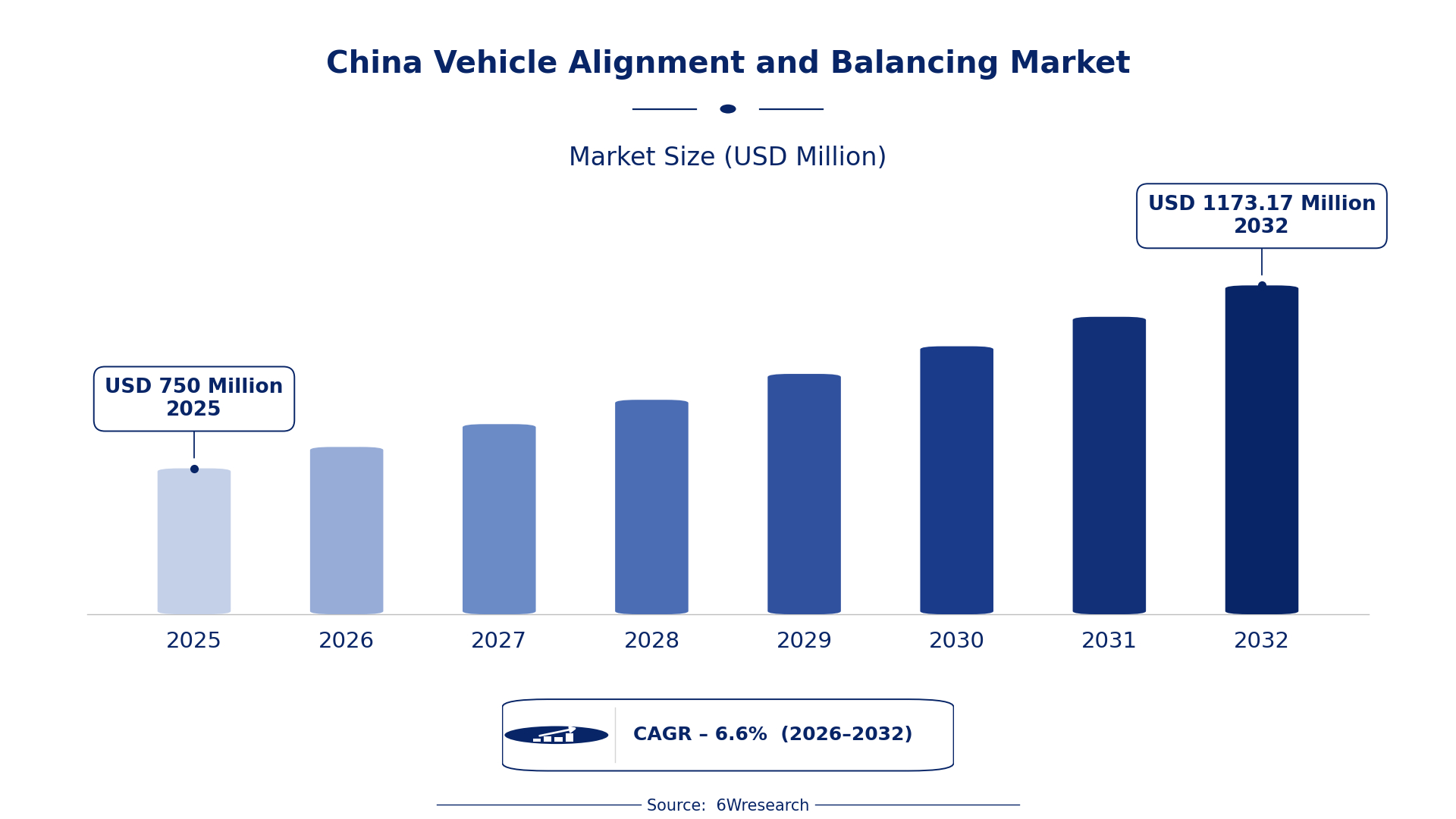
According to 6Wresearch internal database and industry insights, the China Vehicle Alignment and Balancing Market was valued at USD 750.0 million in 2025 and is projected to reach USD 1,173.17 million by 2032, growing at a CAGR of approximately 6.6% during 2026–2032.
China Vehicle Alignment and Balancing Market Highlights
| Report Metric | Details |
| Report Name | China Vehicle Alignment and Balancing Market |
| Market Size 2025 | USD 750.0 million |
| Market Size 2032 | USD 1,173.17 million |
| Absolute Growth 2025–2032 | USD 423.17 million |
| CAGR 2026–2032 | 6.6% |
| Peak Annual Growth | 8.4% in 2026 |
| Forecast Period | 2026–2032 |
| Historical Data | 2022–2025 |
| Base Year | 2025 |
| Leading Service Type, 2025 | Wheel Alignment (39% share) |
| Leading Equipment Used, 2025 | Laser/Camera Systems (40% share) |
| Leading Vehicle Class, 2025 | Passenger Cars (38% share) |
| Leading End User, 2025 | Service Centers (48% share) |
| Fastest-Growing Service Type | 3D Alignment (8.9% CAGR) |
| Fastest-Growing Vehicle Class | Light & Heavy Vehicles (9.0% CAGR) |
| Fastest-Growing End User | Mobile Mechanics (8.6% CAGR) |
| Growing Sector | automotive service sector |
| Key End Users | service centers, tire workshops, mobile mechanics, premium dealers |
China Vehicle Alignment and Balancing Market Year-wise Growth Rate and Key Drivers (2022–2032)
This graph illustrates the annual growth rates of the market from 2022 to 2032, highlighting a steady upward trajectory and projected market expansion over the forecast period.
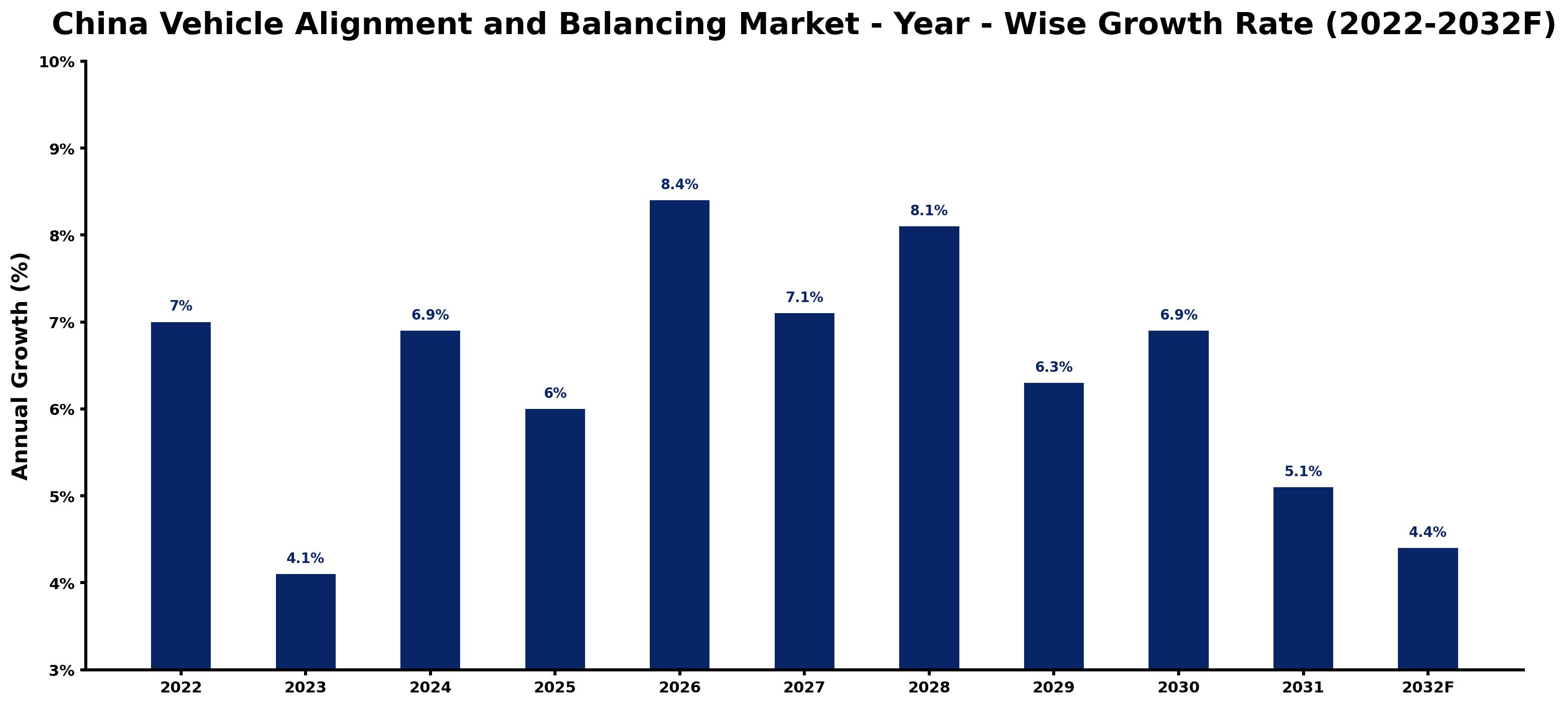
The following table presents the estimated annual growth rate for each year together with the principal factor influencing market performance.
| Year | Estimated Annual Growth (%) | Market Rationale |
| 2022 | 7.0 | The automotive service market experienced strong demand due to rising vehicle ownership. |
| 2023 | 4.1 | Service centers reported a slight slowdown in growth, attributed to the 'Automotive Service Industry Development Plan'. |
| 2024 | 6.9 | Increased vehicle age led to a faster growth rate as alignment services became more necessary. |
| 2025 | 6.0 | Demand continued to grow, although at a slower rate as service centers adapted to market conditions. |
| 2026 | 8.4 | A surge in alignment service requests is expected to drive growth to its peak, reflecting heightened consumer awareness. |
| 2027 | 7.1 | Growth is projected to slow as service centers adjust to the previous year's rapid increase in demand. |
| 2028 | 8.1 | The market is expected to rebound with renewed interest in advanced alignment technologies, boosting growth. |
| 2029 | 6.3 | A slight slowdown is anticipated as service centers face challenges in meeting rising demand. |
| 2030 | 6.9 | Growth is expected to pick up again, supported by ongoing investments in service quality and technology. |
| 2031 | 5.1 | The market is projected to see a further slowdown as competition intensifies among service providers. |
| 2032 | 4.4 | Growth is expected to continue to decelerate, reflecting a maturing market with established service standards. |
Note: Market size estimations and growth projections presented in this report are based on 6Wresearch's proprietary forecasting methodology, utilizing the latest available industry data, government publications, and primary research inputs.
China Vehicle Alignment and Balancing Market Synopsis
The Vehicle Alignment and Balancing Market in China involves adjusting wheel angles to optimise vehicle performance and extend tire life. Utilising advanced equipment such as laser systems and dynamic balancers, this market primarily serves domestic service centers and tire workshops. The China Vehicle Alignment and Balancing Market is expanding due to rising vehicle ownership and increasing average vehicle age, leading to greater demand for alignment services. The automotive service market is valued at approximately 200 billion CNY, with over 300 million registered vehicles as of 2023.
Market Dynamics Impact Analysis (2026–2032)
| Factor | Type | Impact | Primary Segment Affected |
| Rising vehicle ownership and increasing average vehicle age drive demand for alignment services. | Driver | High | Wheel Alignment |
| The adoption of advanced alignment technologies enhances service accuracy and efficiency. | Driver | High | Laser/Camera Systems |
| Growing demand for mobile alignment services presents an opportunity for service providers. | Opportunity | High | Mobile Alignment |
| The increasing number of tire workshops creates a demand for alignment services. | Opportunity | Medium | Tire Balancing |
| Limited awareness of alignment service benefits restrains market growth. | Restraint | Medium | 3D Alignment |
| High initial investment costs for advanced equipment can deter service center upgrades. | Restraint | High | Laser/Camera Systems |
| Competition among service providers can lead to price wars, affecting profitability. | Challenge | High | Service Centers |
| Technological advancements require continuous training, posing a challenge for workforce development. | Challenge | Medium | Service Centers |
Evaluation of Drivers in China Vehicle Alignment and Balancing Market (2026–2032)
The main growth drivers and the segments they affect most are set out below.
| Drivers | Primary Segment Affected | Why It Matters (Evidence) |
| Increasing vehicle age necessitates regular alignment services to maintain performance. | Wheel Alignment | With the average vehicle age around 6 years, service centers are seeing a rise in alignment requests. |
| The growing adoption of laser alignment systems improves service accuracy and efficiency. | Laser/Camera Systems | Urban service centers adopting these systems attract more customers by improving service quality. |
| The expansion of tire workshops increases the demand for alignment and balancing services. | Tire Balancing | Over 50,000 tire workshops in China actively seek alignment services to complement their offerings. |
| Mobile alignment services are becoming more popular, catering to customer convenience. | Mobile Alignment | Urban areas have seen a 15% growth in mobile alignment services, reflecting changing consumer preferences. |
| The automotive service industry is receiving investments to improve service quality. | 3D Alignment | Subsidy programs support advanced alignment technologies in service centers, enhancing service delivery. |
Growth in the Vehicle Alignment and Balancing market in China comes from rising vehicle age, which necessitates regular alignment services. The average vehicle age is around 6 years, leading to increased service requests from consumers. Adoption of laser alignment systems is also on the rise, with urban service centers improving offerings to attract more customers. The expansion of tire workshops, exceeding 50,000, boosts demand for alignment services.
Evaluation of Restraints in China Vehicle Alignment and Balancing Market
The key brakes on demand, and where they bite hardest, are shown below.
| Market Restraint | Primary Segment Affected | Why It Matters (Evidence) |
| Limited awareness of the benefits of regular alignment services restricts market growth. | Wheel Alignment | Many vehicle owners remain unaware of how alignment affects safety and tire longevity. |
| High initial costs for advanced alignment equipment deter service centers from upgrading. | Laser/Camera Systems | The investment required for advanced systems can be prohibitive for smaller service providers. |
| Competition among service centers can lead to price wars, impacting profitability. | Tire Balancing | Aggressive pricing strategies can erode margins for service providers. |
| Technological advancements necessitate ongoing training for service staff, posing challenges. | Mobile Alignment | Service centers must invest in continuous training to keep up with new technologies. |
| Regulatory compliance can be burdensome for smaller service providers, limiting their operations. | 3D Alignment | Meeting national standards requires additional resources that smaller centers may lack. |
China Vehicle Alignment and Balancing Market Challenges
The China Vehicle Alignment and Balancing Market still has to solve a few problems, starting with high equipment costs that burden service centers. Laser alignment systems and dynamic balancers can exceed 200,000 CNY, limiting access for smaller workshops and raising service prices for buyers. Next, supply chain disruptions often delay the availability of essential parts, causing service centers to face up to two weeks of downtime for repairs, which frustrates customers seeking timely service. Skills shortages in the automotive workforce hinder service quality, as training programmes may not keep pace with technological advancements, affecting the overall customer experience. Compliance with the National Standard GB/T 19056-2020 can impose additional costs on providers, complicating operations for those without ISO 9001 certification, leading to higher prices for consumers.
Trends in the China Vehicle Alignment and Balancing Market
Below mentioned are some of the trends shaping the China Vehicle Alignment and Balancing Market growth.
- Shift towards Advanced Alignment Technologies: The adoption of laser alignment systems is increasing in urban service centres, improving service accuracy. In 2023, over 10 million tire balancing services were performed, showcasing the growing reliance on technology.
- Growth in Mobile Alignment Services: Since 2023, mobile alignment services have experienced a 15% growth in urban areas, reflecting a shift towards convenience. This trend is reshaping service delivery models in the automotive sector.
- Increased Focus on Eco-Friendly Practices: The 'Green Vehicle Development Plan' initiated in 2023 promotes eco-friendly practices in automotive services. This aligns with consumer preferences for sustainable service options, influencing purchasing decisions.
- Rising Demand for 3D Alignment: The market for 3D alignment technology has been expanding, driven by its precision and efficiency. This segment is projected to grow at a CAGR of 8.9% from 2026 to 2032.
Investment Opportunities in the China Vehicle Alignment and Balancing Market
Several openings in the China Vehicle Alignment and Balancing Market merit attention from investors.
- Service Centers Expanding Offerings: Service centres are increasingly investing in advanced alignment technologies to meet rising demand. In 2023, service centres in Beijing reported a 20% increase in alignment service requests, indicating a strong market opportunity.
- Investment in Mobile Services: With mobile alignment services growing by 15% in urban areas, there is a clear investment opportunity. Service providers can partner with local mechanics to expand their reach and service capabilities.
- Tire Workshops Seeking Alignment Solutions: Tire workshops are looking to enhance their service offerings, creating a demand for alignment solutions. This presents an opportunity for suppliers to provide advanced equipment and training.
- Focus on Eco-Friendly Practices: The 'Green Vehicle Development Plan' encourages sustainable practices in automotive services, creating opportunities for suppliers of eco-friendly alignment technologies. This aligns with the growing consumer preference for sustainability.
Government Initiatives in the China Vehicle Alignment and Balancing Market
The 'Automotive Service Industry Development Plan' issued by the Ministry of Industry and Information Technology in 2021 aims to improve service quality across the sector. In 2022, the State Administration for Market Regulation updated national standards for vehicle maintenance, including alignment practices, to enhance safety and efficiency. The 'Green Vehicle Development Plan' initiated by the Ministry of Ecology and Environment in 2023 promotes eco-friendly practices in automotive services, including alignment and balancing, encouraging compliance among service providers. The National Development and Reform Commission's subsidy program launched in 2021 supports advanced alignment technologies in service centres, with a budget of 500 million CNY, aiding producers in upgrading their equipment and services.
The China Automotive Technology and Research Center oversees vehicle service standards, ensuring compliance with national regulations. The Ministry of Industry and Information Technology approves various automotive service initiatives, providing funding for training and technology adoption. The National Development and Reform Commission's subsidy program helps service providers implement advanced alignment technologies, improving service delivery and customer satisfaction.
Future Insight of the China Vehicle Alignment and Balancing Market
The China Vehicle Alignment and Balancing Market is expected to evolve by 2032, primarily due to advancements in technology and regulatory frameworks. The 'Digital Transformation in Automotive Services' initiative will likely improve service efficiency and customer engagement. In 2023, over 10 million tire balancing services were performed, indicating a growing demand for these essential offerings. The 'Automotive Service Industry Development Plan' will further standardise practices, ensuring quality across service centres. The rise in luxury vehicle service demands in regions like Guangdong will push providers to adopt higher standards and specialised equipment.
Market Segmentation Analysis
Each segment group is reviewed below, with the leader by share and the fastest grower by CAGR.
By Service Type – Wheel Alignment Dominated, 3D Alignment Expected to Grow Fastest
According to Bhawna Singh, Assistant Manager at 6Wresearch, Wheel Alignment accounted for a 39% market share by service type in 2025. Wheel alignment holds the largest share due to its crucial role in maintaining vehicle safety and performance, with many of the over 300 million registered vehicles in China requiring these services. The increase in alignment service requests, particularly in urban centres, underscores its importance among service providers. 3D Alignment is projected to grow fastest, at a CAGR of 8.9% during 2026–2032. 3D alignment is experiencing rapid growth as service centres adopt advanced technology for improved precision, supported by a 20% rise in alignment service requests reported in Beijing. This trend indicates that as technology advances, demand for sophisticated alignment solutions will continue to increase. Suppliers should focus on promoting advanced alignment technologies to meet the growing demand from service centres.
By Equipment Used – Laser/Camera Systems Dominated and Is Expected to Record the Fastest Growth
Laser/Camera Systems took a 40% share of equipment used in 2025, more than any other category. Laser and camera systems dominate the market share as they are essential for providing accurate measurements in vehicle alignment, which is vital for optimal vehicle performance. Their widespread adoption in urban service centres reflects the industry's commitment to quality and precision in service delivery. Laser/Camera Systems are also forecast to expand faster than any other category, at a CAGR of 8.7% over 2026–2032. The growth of laser and camera systems is propelled by their superior efficiency and accuracy, making them the preferred choice among service providers. As more service centres acknowledge their benefits, this segment's lead is expected to expand further. Suppliers must ensure a consistent supply of advanced laser and camera systems to capitalise on the rising demand from service centres.
By Vehicle Class – Passenger Cars Dominated, Light & Heavy Vehicles Expected to Grow Fastest
With a 38% revenue share in 2025, Passenger Cars was the largest vehicle class category. Passenger cars represent the largest share as they account for the majority of the 300 million registered vehicles in China, necessitating regular alignment services to maintain performance. The average vehicle age of around 6 years further drives the demand for these essential services. Light & Heavy Vehicles are set to record the highest CAGR in this split, 9.0% over 2026–2032. Light and heavy vehicles are growing rapidly due to their broad market application, especially as more service centres expand their offerings to cater to diverse vehicle types. This trend suggests a shift in focus towards servicing a wider range of vehicles. Suppliers should diversify their offerings to include solutions for light and heavy vehicles to capture this expanding market.
By End User – Service Centers Dominated, Mobile Mechanics Expected to Grow Fastest
Service Centers held a 48% share of the China Vehicle Alignment and Balancing Market by end user in 2025. Service centres capture the largest share as they are the primary users of vehicle alignment services, catering to the extensive automotive service market in China. With over 50,000 tire workshops, service centres play a pivotal role in addressing the alignment needs of the growing vehicle population. The quickest growth will come from Mobile Mechanics, forecast to expand at a CAGR of 8.6% between 2026 and 2032. Mobile mechanics are rapidly gaining traction as convenience becomes increasingly important to consumers, particularly in urban areas where demand for on-site services is rising. This shift indicates a growing preference for accessible service options among consumers. Suppliers should consider developing products specifically designed for mobile mechanics to align with changing consumer preferences.
Key Attractiveness of the Report
- 10 Years of Market Numbers
- Historical Data Starting from 2022 to 2025
- Base Year 2025
- Forecast Data until 2032
- Key Performance Indicators Impacting the Market
- Major Upcoming Developments and Projects
Key Highlights of the Report:
- China Vehicle Alignment and Balancing Market Outlook
- Market Size of China Vehicle Alignment and Balancing Market, 2025
- Forecast of China Vehicle Alignment and Balancing Market, 2032
- Historical Data and Forecast of China Vehicle Alignment and Balancing Revenues & Volume for the Period 2022 - 2032F
- China Vehicle Alignment and Balancing Market Trend Evolution
- China Vehicle Alignment and Balancing Market Drivers and Challenges
- China Vehicle Alignment and Balancing Price Trends
- China Vehicle Alignment and Balancing Porter's Five Forces
- China Vehicle Alignment and Balancing Industry Life Cycle
- Historical Data and Forecast of China Vehicle Alignment and Balancing Market Revenues & Volume By Service Type for the Period 2022 - 2032F
- Historical Data and Forecast of China Vehicle Alignment and Balancing Market Revenues & Volume By Wheel Alignment for the Period 2022 - 2032F
- Historical Data and Forecast of China Vehicle Alignment and Balancing Market Revenues & Volume By Tire Balancing for the Period 2022 - 2032F
- Historical Data and Forecast of China Vehicle Alignment and Balancing Market Revenues & Volume By 3D Alignment for the Period 2022 - 2032F
- Historical Data and Forecast of China Vehicle Alignment and Balancing Market Revenues & Volume By Mobile Alignment for the Period 2022 - 2032F
- Historical Data and Forecast of China Vehicle Alignment and Balancing Market Revenues & Volume By Equipment Used for the Period 2022 - 2032F
- Historical Data and Forecast of China Vehicle Alignment and Balancing Market Revenues & Volume By Laser/Camera Systems for the Period 2022 - 2032F
- Historical Data and Forecast of China Vehicle Alignment and Balancing Market Revenues & Volume By Dynamic Balancer for the Period 2022 - 2032F
- Historical Data and Forecast of China Vehicle Alignment and Balancing Market Revenues & Volume By Optical Scanners for the Period 2022 - 2032F
- Historical Data and Forecast of China Vehicle Alignment and Balancing Market Revenues & Volume By Portable Equipment for the Period 2022 - 2032F
- Historical Data and Forecast of China Vehicle Alignment and Balancing Market Revenues & Volume By Vehicle Class for the Period 2022 - 2032F
- Historical Data and Forecast of China Vehicle Alignment and Balancing Market Revenues & Volume By Light & Heavy Vehicles for the Period 2022 - 2032F
- Historical Data and Forecast of China Vehicle Alignment and Balancing Market Revenues & Volume By Passenger Cars for the Period 2022 - 2032F
- Historical Data and Forecast of China Vehicle Alignment and Balancing Market Revenues & Volume By Luxury & Sports Cars for the Period 2022 - 2032F
- Historical Data and Forecast of China Vehicle Alignment and Balancing Market Revenues & Volume By Commercial Fleets for the Period 2022 - 2032F
- Historical Data and Forecast of China Vehicle Alignment and Balancing Market Revenues & Volume By End User for the Period 2022 - 2032F
- Historical Data and Forecast of China Vehicle Alignment and Balancing Market Revenues & Volume By Service Centers for the Period 2022 - 2032F
- Historical Data and Forecast of China Vehicle Alignment and Balancing Market Revenues & Volume By Tire Workshops for the Period 2022 - 2032F
- Historical Data and Forecast of China Vehicle Alignment and Balancing Market Revenues & Volume By Premium Dealers for the Period 2022 - 2032F
- Historical Data and Forecast of China Vehicle Alignment and Balancing Market Revenues & Volume By Mobile Mechanics for the Period 2022 - 2032F
- China Vehicle Alignment and Balancing Import Export Trade Statistics
- Market Opportunity Assessment By Service Type
- Market Opportunity Assessment By Equipment Used
- Market Opportunity Assessment By Vehicle Class
- Market Opportunity Assessment By End User
- China Vehicle Alignment and Balancing Top Companies Market Share
- China Vehicle Alignment and Balancing Competitive Benchmarking By Technical and Operational Parameters
- China Vehicle Alignment and Balancing Company Profiles
- China Vehicle Alignment and Balancing Key Strategic Recommendations
Market Covered
The report offers an extensive study of the following market segments.
By Service Type
- Wheel Alignment
- Tire Balancing
- 3D Alignment
- Mobile Alignment
By Equipment Used
- Laser/Camera Systems
- Dynamic Balancer
- Optical Scanners
- Portable Equipment
By Vehicle Class
- Light & Heavy Vehicles
- Passenger Cars
- Luxury & Sports Cars
- Commercial Fleets
By End User
- Service Centers
- Tire Workshops
- Premium Dealers
- Mobile Mechanics































