China Vehicle Authentication System Market Size & Growth Rate
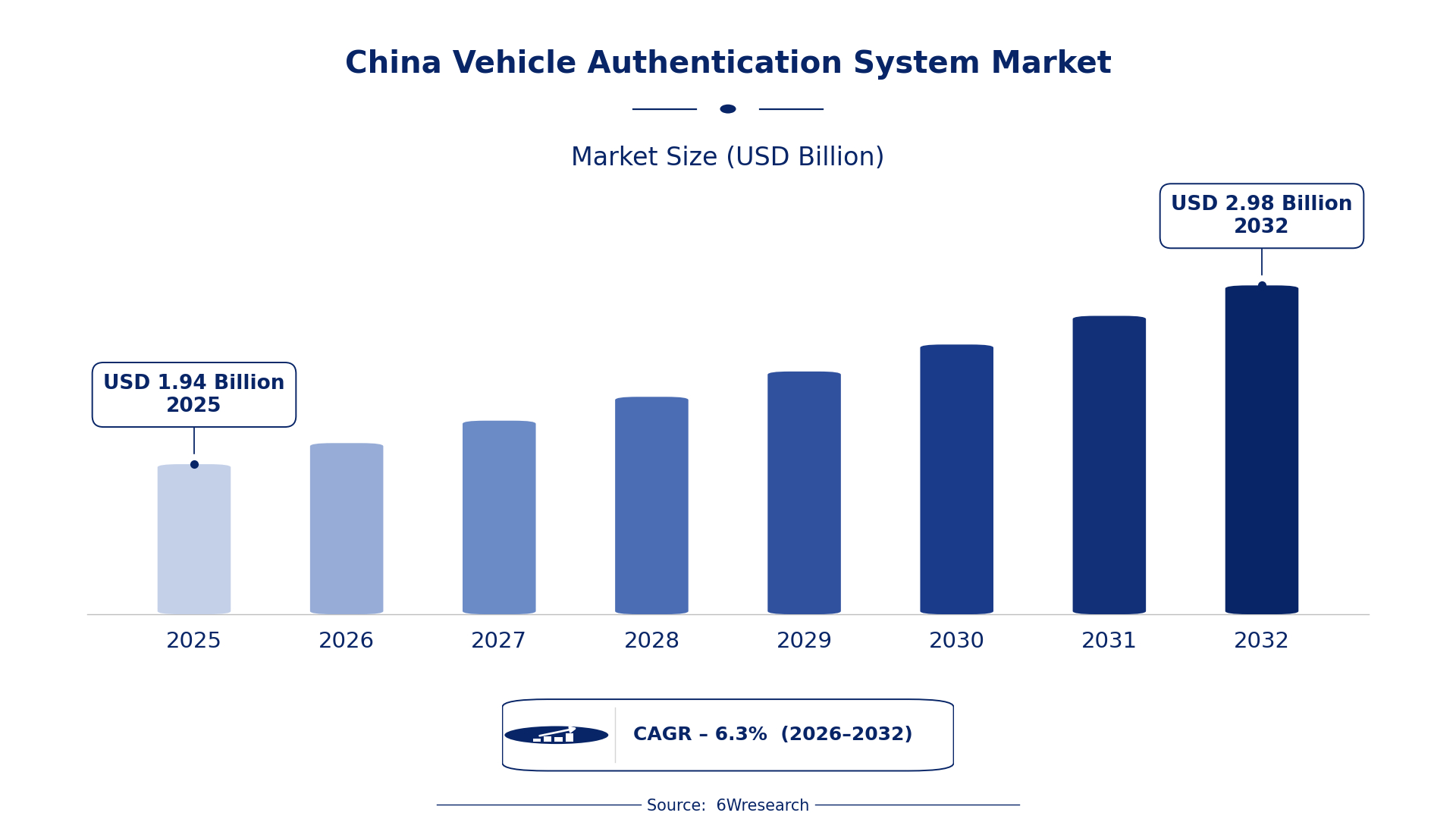
According to 6Wresearch internal database and industry insights, the China Vehicle Authentication System Market was valued at USD 1.94 billion in 2025 and is projected to reach USD 2.98 billion by 2032, growing at a CAGR of approximately 6.3% during 2026–2032.
China Vehicle Authentication System Market Highlights
| Report Metric | Details |
| Report Name | China Vehicle Authentication System Market |
| Market Size 2025 | USD 1.94 billion |
| Market Size 2032 | USD 2.98 billion |
| Absolute Growth 2025–2032 | USD 1.04 billion |
| CAGR 2026–2032 | 6.3% |
| Peak Annual Growth | 9.4% in 2032 |
| Forecast Period | 2026–2032 |
| Historical Data | 2022–2025 |
| Base Year | 2025 |
| Leading Authentication Type, 2025 | Biometric Authentication (45% share) |
| Leading Technology Used, 2025 | Fingerprint Recognition (42% share) |
| Leading Access Mode, 2025 | Touch-Based (37% share) |
| Leading End User, 2025 | Luxury Car OEMs (48% share) |
| Fastest-Growing Authentication Type | RFID-Based Entry (8.6% CAGR) |
| Fastest-Growing Technology Used | Camera-Based (7.7% CAGR) |
| Fastest-Growing Access Mode | Mobile-Based (8.4% CAGR) |
| Fastest-Growing End User | Smart Vehicle Manufacturers (9.0% CAGR) |
| Growing Sector | Smart Vehicle Manufacturers |
| Key End Users | Luxury Car OEMs, Fleet Operators, Smart Vehicle Manufacturers, Connected Vehicle Users |
China Vehicle Authentication System Market Year-wise Growth Rate and Key Drivers (2022–2032)
This graph illustrates the annual growth rates of the market from 2022 to 2032, highlighting a steady upward trajectory and projected market expansion over the forecast period.
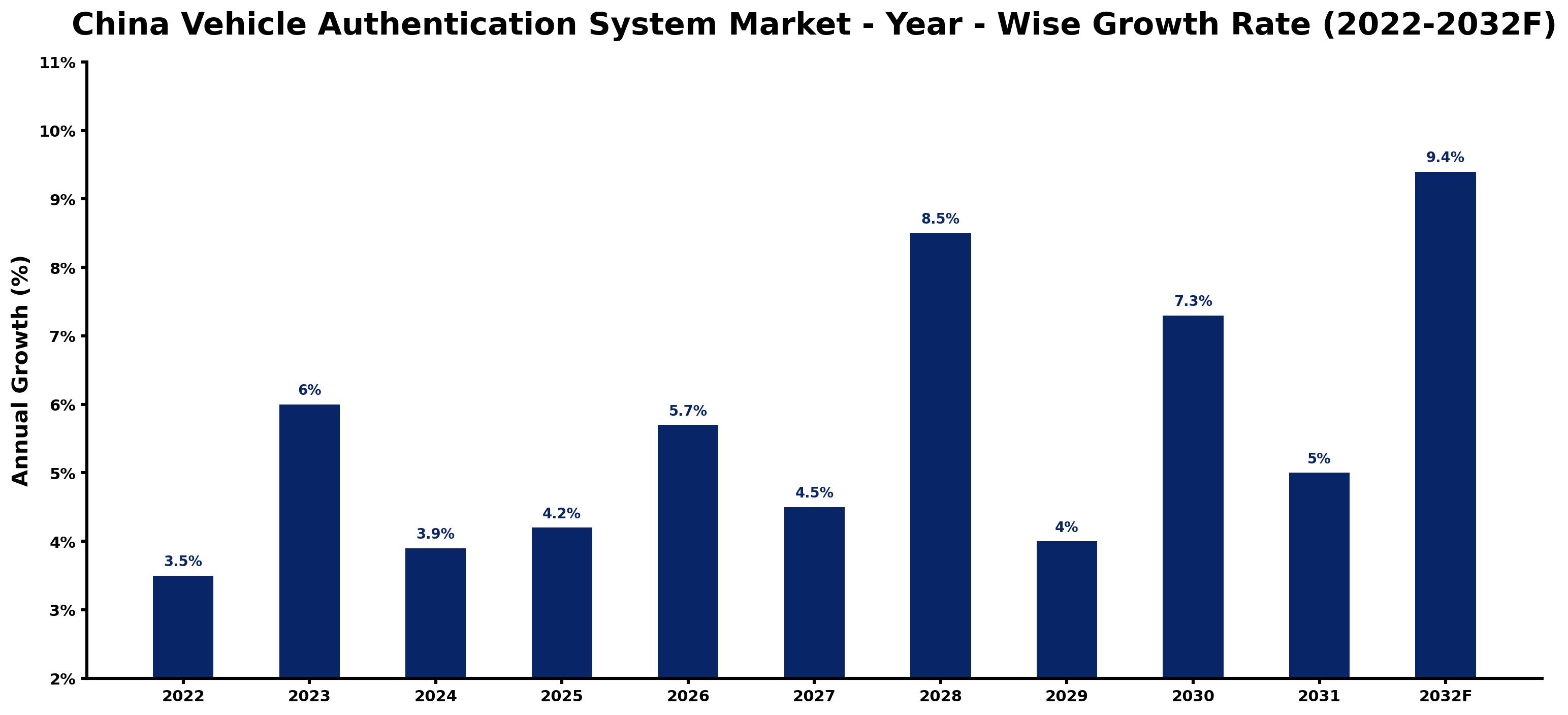
Each row of the following table gives one year's estimated growth and the event or demand shift that explains it.
| Year | Estimated Annual Growth (%) | Market Rationale |
| 2022 | 3.5 | The market experienced steady growth due to increasing vehicle production and demand for security systems. |
| 2023 | 6.0 | Growth accelerated as the automotive sector expanded and smart vehicle technologies gained traction. |
| 2024 | 3.9 | A slowdown occurred as market adjustments followed rapid growth in the previous year. |
| 2025 | 4.2 | Growth resumed as investments in smart vehicle technologies increased, driving demand for authentication systems. |
| 2026 | 5.7 | The market is expected to continue growing as the adoption of advanced vehicle technologies gains momentum. |
| 2027 | 4.5 | Growth is projected to slow as market saturation begins to affect new purchases in established segments. |
| 2028 | 8.5 | Demand is expected to surge as interest in smart transportation solutions expands significantly across the Beijing-Tianjin-Hebei region. |
| 2029 | 4.0 | The market is projected to experience a slowdown as growth rates adjust following the previous year's surge. |
| 2030 | 7.3 | Growth is expected to accelerate again as technological advancements in vehicle authentication attract new investments. |
| 2031 | 5.0 | A slowdown is projected as the market begins to stabilise after several years of rapid growth. |
| 2032 | 9.4 | The market is expected to peak as demand for advanced security solutions in vehicles reaches new heights. |
Note: Market size estimations and growth projections presented in this report are based on 6Wresearch's proprietary forecasting methodology, utilizing the latest available industry data, government publications, and primary research inputs.
China Vehicle Authentication System Market Synopsis
The Vehicle Authentication System Market in China includes technologies that verify vehicle identity and user access through methods like biometrics and RFID. These systems enhance vehicle security and simplify access for authorised users. The market is expanding quickly due to increasing demand from luxury car OEMs and fleet operators, along with substantial investments in smart vehicle technologies. By 2025, China's smart vehicle market is expected to reach 1 trillion yuan, indicating a growing integration of advanced authentication systems in the automotive industry.
Market Dynamics Impact Analysis (2026–2032)
| Factor | Type | Impact | Primary Segment Affected |
| Increasing vehicle production and sales drive demand for authentication systems. | Driver | High | Biometric Authentication |
| Growing smart vehicle market fuels the need for advanced security solutions. | Driver | High | RFID-Based Entry |
| The rise of connected vehicles presents opportunities for innovative authentication solutions. | Opportunity | High | Smart Vehicle Manufacturers |
| Expansion of fleet operations creates demand for efficient vehicle access management systems. | Opportunity | High | Fleet Operators |
| Regulatory compliance challenges may hinder the adoption of new technologies. | Restraint | Medium | Facial Recognition System |
| High initial investment costs can deter smaller manufacturers from adopting advanced systems. | Restraint | Medium | Smartphone App Unlock |
| Technological integration issues can complicate system deployment for buyers. | Challenge | High | Connected Vehicle Users |
| Competition among manufacturers may lead to pricing pressures affecting profitability. | Challenge | Medium | Luxury Car OEMs |
Evaluation of Drivers in China Vehicle Authentication System Market (2026–2032)
The main growth drivers and the segments they affect most are set out below.
| Drivers | Primary Segment Affected | Why It Matters (Evidence) |
| Rising vehicle production in China increases the need for authentication systems. | Biometric Authentication | In 2022, over 26 million vehicles were produced, driving demand for secure access solutions among manufacturers. |
| The smart vehicle market's growth fuels demand for advanced vehicle technologies. | RFID-Based Entry | China's smart vehicle market is expected to reach 1 trillion yuan by 2025, increasing security needs for manufacturers and buyers. |
| The proliferation of connected vehicles boosts the demand for sophisticated authentication methods. | Facial Recognition System | As of 2023, there are over 300 million connected vehicles in China, increasing security requirements for manufacturers. |
| Fleet operators require efficient vehicle access management to streamline operations. | Smartphone App Unlock | With over 1,000 registered fleet operators, the demand for streamlined access solutions is significant, creating opportunities for suppliers. |
| Government initiatives promote the adoption of smart vehicle technologies. | Fingerprint Recognition | The 'Smart Vehicle Innovation and Development Strategy' encourages advanced technology integration in vehicles, enhancing market prospects. |
Expansion of the Vehicle Authentication System market in China is driven by rising vehicle production, growing demand for smart vehicle technologies, and the increase of connected vehicles. In 2022, over 26 million vehicles were produced, creating a strong demand for secure access solutions. The smart vehicle market is projected to reach 1 trillion yuan by 2025, propelling the need for advanced authentication systems. Furthermore, the presence of over 300 million connected vehicles in 2023 requires sophisticated security measures. Suppliers are responding to the demand for efficient vehicle access management among fleet operators, with over 1,000 registered entities seeking streamlined solutions.
Evaluation of Restraints in China Vehicle Authentication System Market
The table below lists the restraints and the evidence behind each.
| Market Restraint | Primary Segment Affected | Why It Matters (Evidence) |
| Regulatory compliance challenges may hinder the adoption of new technologies. | Facial Recognition System | The National Standard GB/T 32960-2016 governs vehicle authentication technologies, complicating integration for manufacturers. |
| High initial investment costs can deter smaller manufacturers from adopting advanced systems. | Smartphone App Unlock | The cost of implementing advanced authentication technologies can be prohibitive for smaller players, limiting their market entry. |
| Integration issues can complicate system deployment for buyers. | Connected Vehicle Users | Complexity in integrating new systems with existing vehicle technologies can delay implementation, affecting user experience. |
| Market saturation in established segments may limit growth potential. | Luxury Car OEMs | As the market matures, growth rates may slow due to reduced demand for new systems, impacting future investments. |
| Consumer reluctance to adopt new technologies may impact market expansion. | RFID-Based Entry | Concerns over privacy and data security can hinder user acceptance of advanced authentication methods, slowing adoption. |
China Vehicle Authentication System Market Challenges
Fleet operators in the China Vehicle Authentication System market face rising costs due to the integration of advanced technologies. For instance, implementing RFID systems can increase operational expenses by 20%, impacting budgets for fleet management. Buyers encounter supply chain delays as demand for vehicle authentication components surpasses current production capacities, leading to lead times of up to six months. Additionally, the rapid pace of technological change complicates adherence to the National Standard GB/T 32960-2016, causing disruptions for manufacturers who must frequently update their systems to comply with evolving regulations.
Trends in the China Vehicle Authentication System Market
The trends below show where the China Vehicle Authentication System Market is heading.
- Shift from Traditional to Biometric Authentication: Luxury car OEMs are increasingly adopting biometric authentication methods for vehicle security. In 2022, the number of luxury vehicles sold in China exceeded 2 million units, reflecting this trend.
- Transition to Smart Vehicle Technologies: The automotive sector is moving towards integrating smart technologies, driven by the 'Smart Vehicle Innovation and Development Strategy'. By 2025, the smart vehicle market is expected to reach 1 trillion yuan.
- Emergence of Mobile-Based Access Solutions: Mobile-based access solutions are gaining traction among fleet operators for convenience and efficiency. The market for mobile-based authentication is projected to grow at a CAGR of 8.4% through 2032.
- Prioritisation of Security in Connected Vehicles: Connected vehicle users are increasingly prioritising security features, leading to a rise in demand for advanced authentication systems. As of 2023, there are over 300 million connected vehicles in China.
Investment Opportunities in the China Vehicle Authentication System Market
Several openings in the China Vehicle Authentication System Market merit attention from investors.
- Partnerships with Smart Vehicle Manufacturers: Collaborating with smart vehicle manufacturers offers opportunities to supply advanced authentication systems. With the smart vehicle market projected to reach 1 trillion yuan by 2025, this is a promising avenue.
- Investment in Biometric Authentication Technologies: Investing in biometric authentication technologies can address the growing need for secure vehicle access. Luxury car OEMs are primary users of these advanced systems, driving further investment.
- Expansion into Fleet Management Solutions: Fleet operators are looking for efficient vehicle access management systems, creating opportunities for suppliers. With over 1,000 registered fleet operators, this segment is ripe for investment.
- Development of Mobile-Based Authentication Applications: Creating mobile-based authentication applications for vehicle access can meet the increasing demand. The growing number of connected vehicles supports this opportunity.
Government Initiatives in the China Vehicle Authentication System Market
The 'Smart Vehicle Innovation and Development Strategy' launched by the Ministry of Industry and Information Technology in 2021 aims to promote vehicle technology adoption. This initiative encourages manufacturers to incorporate advanced authentication systems into their products. Additionally, the National Development and Reform Commission's 'New Energy Vehicle Industry Development Plan' initiated in 2020 supports advanced vehicle technologies, further strengthening the market. These measures aim to modernise the automotive sector and improve vehicle security standards.
The Ministry of Transport approved the 'National Intelligent Transportation System Development Plan' in 2022, which integrates smart technologies in vehicles. This plan supports the development and implementation of vehicle authentication systems. Furthermore, in 2023, the Ministry of Science and Technology announced a 30 billion yuan fund for smart vehicle research and development, facilitating advancements in vehicle technologies, including authentication systems.
Future Insight of the China Vehicle Authentication System Market
Several forward-looking factors should support the China Vehicle Authentication System market in the coming years. The Chinese government's allocation of 50 billion yuan for smart transportation initiatives will improve infrastructure and technology integration. By 2025, the smart vehicle market is projected to reach 1 trillion yuan, driving demand for advanced authentication solutions. The 'Smart Vehicle Innovation and Development Strategy' will encourage ongoing advancements, enabling suppliers to meet the specific needs of buyers in this evolving market.
Market Segmentation Analysis
The report offers a comprehensive study of the following market segments and their leading categories in the market.
By Authentication Type – Biometric Authentication Dominated, RFID-Based Entry Expected to Grow Fastest
According to Bhawna Singh, Assistant Manager at 6Wresearch, Biometric Authentication accounted for a 45% market share by authentication type in 2025. Biometric Authentication commands the largest share as it ensures secure user identification, which is essential for high-end automotive applications. This method is particularly sought after in luxury vehicles, where security is a top priority, aligning with the preferences of affluent buyers. The quickest growth will come from RFID-Based Entry, forecast to expand at a CAGR of 8.6% between 2026 and 2032. RFID-Based Entry is rapidly gaining traction due to its ability to facilitate quick and efficient vehicle entry and exit processes, particularly in urban environments with a growing number of connected vehicles. The government's investment in smart transportation initiatives is further propelling its adoption across various sectors. Suppliers should prioritise the development of RFID technologies to meet the increasing demand for efficient vehicle access solutions.
By Technology Used – Fingerprint Recognition Dominated, Camera-Based Expected to Grow Fastest
With a 42% revenue share in 2025, Fingerprint Recognition was the largest technology used category. Fingerprint Recognition holds the largest share due to its secure authentication capabilities, particularly appealing in the luxury vehicle segment. This method is increasingly adopted by manufacturers aiming to meet high security standards, as seen in the luxury vehicle market where over 2 million units were sold in 2022. Over 2026–2032, Camera-Based is expected to post the fastest growth, at a CAGR of 7.7%. Camera-Based technology is rapidly gaining traction as it allows for versatile authentication methods through image capture, making it suitable for various vehicle types. The growing demand for smart vehicle features is propelling this segment's swift growth, aligning with the government's push for smart transportation initiatives. Suppliers should prioritise the development of advanced authentication technologies to meet the rising demand for enhanced vehicle security.
By Access Mode – Touch-Based Dominated, Mobile-Based Expected to Grow Fastest
Touch-Based held a 37% share of the China Vehicle Authentication System Market by access mode in 2025. Touch-Based access maintains a strong share as it is specifically used in applications that require user interaction, particularly within luxury vehicles. This method appeals to consumers who value tactile engagement with their vehicle's technology, enhancing their overall driving experience. Mobile-Based is set to record the highest CAGR in this split, 8.4% over 2026–2032. Mobile-Based access is experiencing the fastest growth as it integrates seamlessly with mobile applications, providing users with convenient access to their vehicles. The increasing smartphone penetration among consumers is significantly driving this trend, aligning with the push for smart vehicle solutions. Suppliers need to focus on mobile integration to cater to the growing consumer preference for convenient and accessible vehicle technologies.
By End User – Luxury Car OEMs Dominated, Smart Vehicle Manufacturers Expected to Grow Fastest
In 2025, Luxury Car OEMs led the end user split with a 48% share. Luxury Car OEMs represent the largest share of the market as they are the primary users of advanced authentication systems for high-end vehicles, where security and technology are critical. This segment's focus on premium features drives the demand for sophisticated vehicle authentication solutions. Smart Vehicle Manufacturers are projected to grow fastest, at a CAGR of 9.0% during 2026–2032. Smart Vehicle Manufacturers are the fastest-growing segment as they integrate authentication systems into connected vehicles, aligning with the rapid expansion of the smart vehicle market. The push towards smart transportation systems accelerates this growth. Suppliers should target smart vehicle manufacturers to capitalise on the increasing integration of authentication systems in connected vehicles.
Key Attractiveness of the Report
- 10 Years of Market Numbers
- Historical Data Starting from 2022 to 2025
- Base Year 2025
- Forecast Data until 2032
- Key Performance Indicators Impacting the Market
- Major Upcoming Developments and Projects
Key Highlights of the Report:
- China Vehicle Authentication System Market Outlook
- Market Size of China Vehicle Authentication System Market, 2025
- Forecast of China Vehicle Authentication System Market, 2032
- Historical Data and Forecast of China Vehicle Authentication System Revenues & Volume for the Period 2022 - 2032F
- China Vehicle Authentication System Market Trend Evolution
- China Vehicle Authentication System Market Drivers and Challenges
- China Vehicle Authentication System Price Trends
- China Vehicle Authentication System Porter's Five Forces
- China Vehicle Authentication System Industry Life Cycle
- Historical Data and Forecast of China Vehicle Authentication System Market Revenues & Volume By Authentication Type for the Period 2022 - 2032F
- Historical Data and Forecast of China Vehicle Authentication System Market Revenues & Volume By Biometric Authentication for the Period 2022 - 2032F
- Historical Data and Forecast of China Vehicle Authentication System Market Revenues & Volume By RFID-Based Entry for the Period 2022 - 2032F
- Historical Data and Forecast of China Vehicle Authentication System Market Revenues & Volume By Facial Recognition System for the Period 2022 - 2032F
- Historical Data and Forecast of China Vehicle Authentication System Market Revenues & Volume By Smartphone App Unlock for the Period 2022 - 2032F
- Historical Data and Forecast of China Vehicle Authentication System Market Revenues & Volume By Technology Used for the Period 2022 - 2032F
- Historical Data and Forecast of China Vehicle Authentication System Market Revenues & Volume By Fingerprint Recognition for the Period 2022 - 2032F
- Historical Data and Forecast of China Vehicle Authentication System Market Revenues & Volume By RFID Tags for the Period 2022 - 2032F
- Historical Data and Forecast of China Vehicle Authentication System Market Revenues & Volume By Camera-Based for the Period 2022 - 2032F
- Historical Data and Forecast of China Vehicle Authentication System Market Revenues & Volume By Bluetooth/NFC for the Period 2022 - 2032F
- Historical Data and Forecast of China Vehicle Authentication System Market Revenues & Volume By Access Mode for the Period 2022 - 2032F
- Historical Data and Forecast of China Vehicle Authentication System Market Revenues & Volume By Touch-Based for the Period 2022 - 2032F
- Historical Data and Forecast of China Vehicle Authentication System Market Revenues & Volume By Proximity-Based for the Period 2022 - 2032F
- Historical Data and Forecast of China Vehicle Authentication System Market Revenues & Volume By Contactless for the Period 2022 - 2032F
- Historical Data and Forecast of China Vehicle Authentication System Market Revenues & Volume By Mobile-Based for the Period 2022 - 2032F
- Historical Data and Forecast of China Vehicle Authentication System Market Revenues & Volume By End User for the Period 2022 - 2032F
- Historical Data and Forecast of China Vehicle Authentication System Market Revenues & Volume By Luxury Car OEMs for the Period 2022 - 2032F
- Historical Data and Forecast of China Vehicle Authentication System Market Revenues & Volume By Fleet Operators for the Period 2022 - 2032F
- Historical Data and Forecast of China Vehicle Authentication System Market Revenues & Volume By Smart Vehicle Manufacturers for the Period 2022 - 2032F
- Historical Data and Forecast of China Vehicle Authentication System Market Revenues & Volume By Connected Vehicle Users for the Period 2022 - 2032F
- China Vehicle Authentication System Import Export Trade Statistics
- Market Opportunity Assessment By Authentication Type
- Market Opportunity Assessment By Technology Used
- Market Opportunity Assessment By Access Mode
- Market Opportunity Assessment By End User
- China Vehicle Authentication System Top Companies Market Share
- China Vehicle Authentication System Competitive Benchmarking By Technical and Operational Parameters
- China Vehicle Authentication System Company Profiles
- China Vehicle Authentication System Key Strategic Recommendations
Market Covered
The report offers an extensive study of the following market segments.
By Authentication Type
- Biometric Authentication
- RFID-Based Entry
- Facial Recognition System
- Smartphone App Unlock
By Technology Used
- Fingerprint Recognition
- RFID Tags
- Camera-Based
- Bluetooth/NFC
By Access Mode
- Touch-Based
- Proximity-Based
- Contactless
- Mobile-Based
By End User
- Luxury Car OEMs
- Fleet Operators
- Smart Vehicle Manufacturers
- Connected Vehicle Users































