China Vehicle Automation Control Systems Market Size & Growth Rate
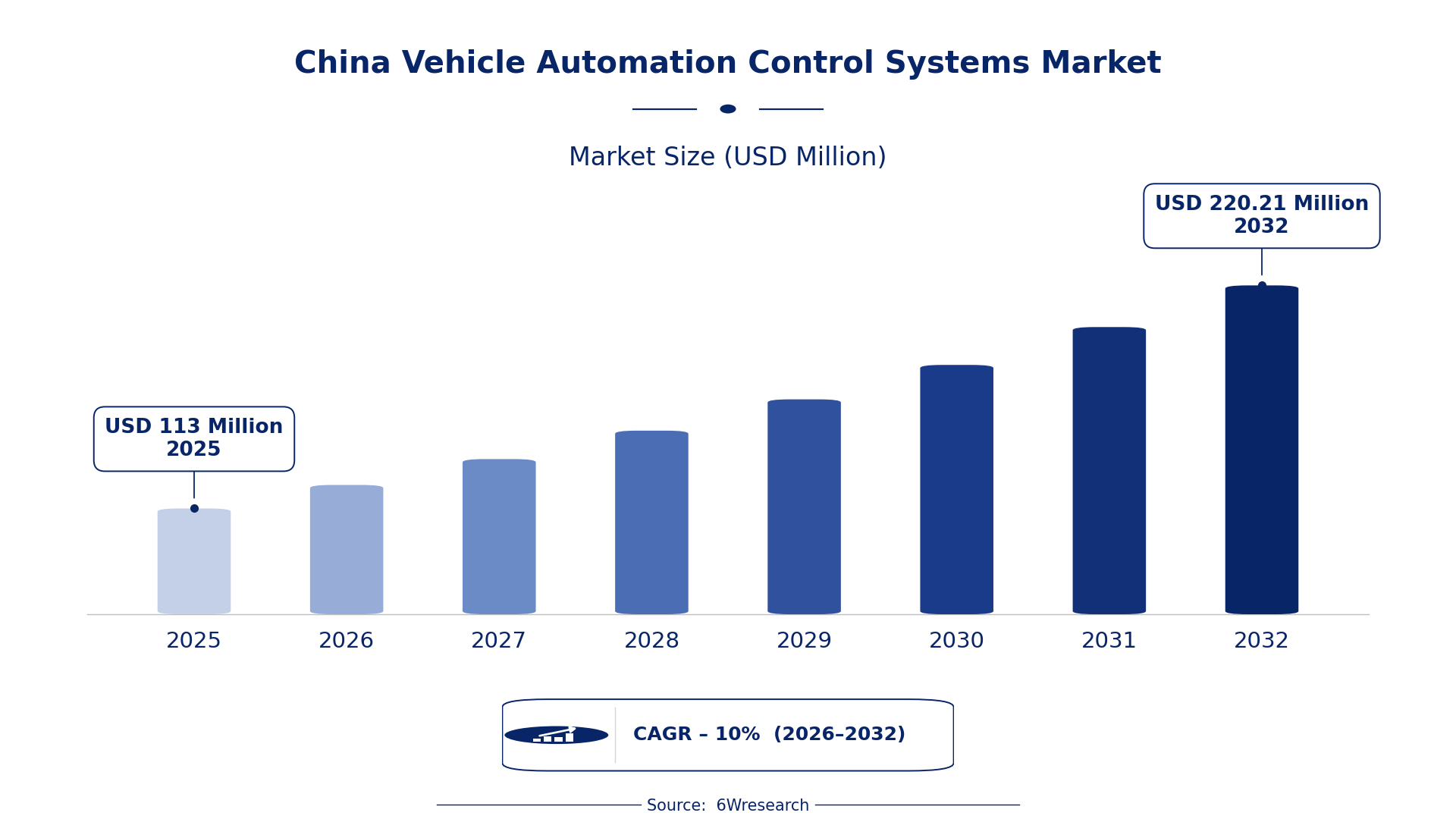
According to 6Wresearch internal database and industry insights, the China Vehicle Automation Control Systems Market was valued at USD 113.0 million in 2025 and is projected to reach USD 220.21 million by 2032, growing at a CAGR of approximately 10% during 2026–2032.
China Vehicle Automation Control Systems Market Highlights
| Report Metric | Details |
| Report Name | China Vehicle Automation Control Systems Market |
| Market Size 2025 | USD 113.0 million |
| Market Size 2032 | USD 220.21 million |
| Absolute Growth 2025–2032 | USD 107.21 million |
| CAGR 2026–2032 | 10% |
| Peak Annual Growth | 12.6% in 2026 |
| Forecast Period | 2026–2032 |
| Historical Data | 2022–2025 |
| Base Year | 2025 |
| Leading Control Type, 2025 | Adaptive Cruise Control (34% share) |
| Leading Vehicle Autonomy Level, 2025 | Level 1–2 (42% share) |
| Leading System Architecture, 2025 | ECU Based (48% share) |
| Leading End User, 2025 | Passenger Vehicle OEMs (33% share) |
| Fastest-Growing Control Type | Lane Keep Assist (12.6% CAGR) |
| Fastest-Growing Vehicle Autonomy Level | Level 2–3 (11.5% CAGR) |
| Fastest-Growing System Architecture | AI-Based Control Units (12.7% CAGR) |
| Fastest-Growing End User | EV Manufacturers (12.8% CAGR) |
| Growing Sector | EV Manufacturers |
| Key End Users | Passenger Vehicle OEMs, EV Manufacturers, Urban Car Makers, Autonomous Vehicle Developers |
China Vehicle Automation Control Systems Market Year-wise Growth Rate and Key Drivers (2022–2032)
This graph illustrates the annual growth rates of the market from 2022 to 2032, highlighting a steady upward trajectory and projected market expansion over the forecast period.
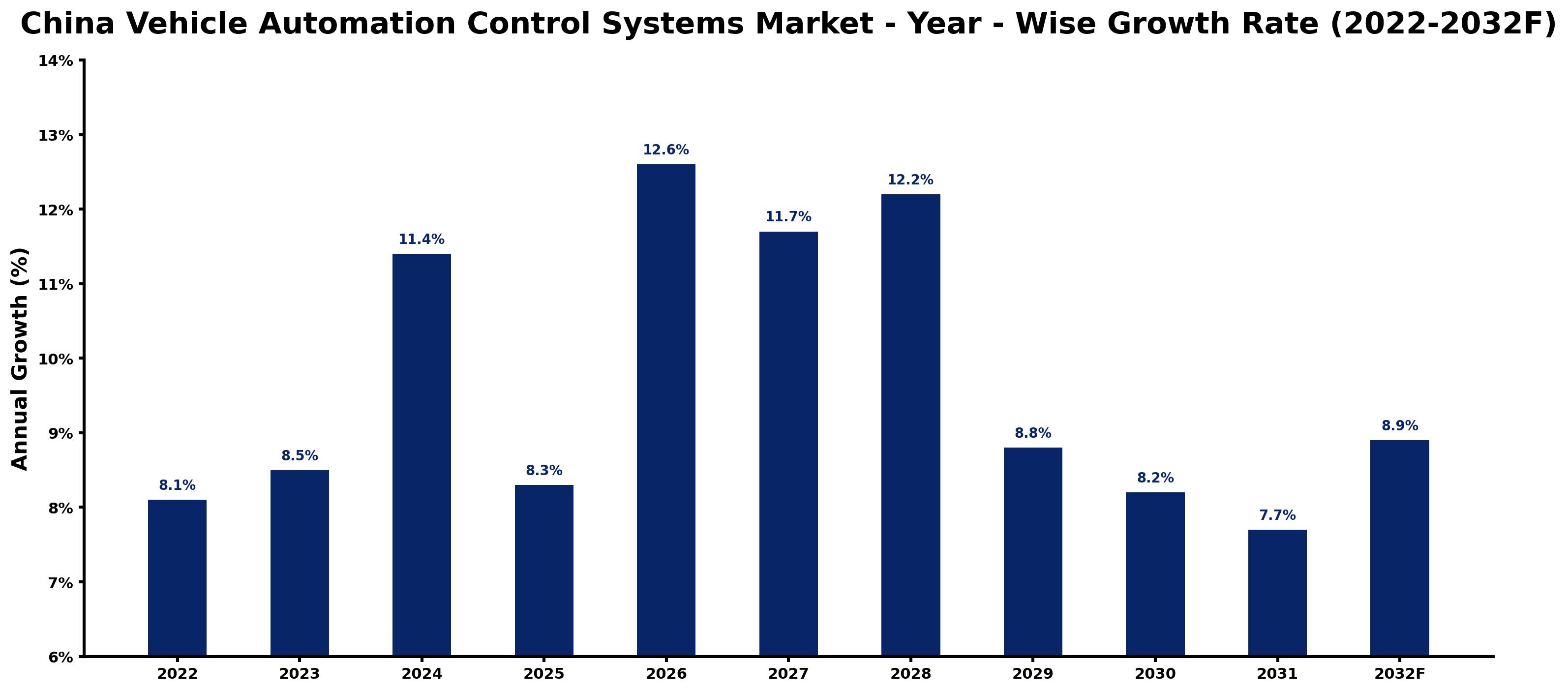
Year by year, the estimates below pair each growth rate with the development that shaped it.
| Year | Estimated Annual Growth (%) | Market Rationale |
| 2022 | 8.1 | The automotive industry produced over 25 million vehicles, driving demand for automation technologies. |
| 2023 | 8.5 | The adoption of advanced driver-assistance systems increased by 15%, reflecting growing interest in automation. |
| 2024 | 11.4 | The national standard GB/T 34590-2017 was implemented, improving safety requirements for automation systems. |
| 2025 | 8.3 | The market experienced a slowdown as manufacturers adjusted to new regulations and consumer preferences. |
| 2026 | 12.6 | The launch of the 'Intelligent Vehicle Innovation Action Plan' is expected to boost R&D in automation technologies. |
| 2027 | 11.7 | The automotive electronics industry is projected to reach 1 trillion yuan, increasing investment in automation. |
| 2028 | 12.2 | Growing pilot projects in the Guangdong province are expected to drive the development of autonomous technologies. |
| 2029 | 8.8 | The push for electric vehicles continues to drive demand for automation features in new models. |
| 2030 | 8.2 | The government aims for 30% of new vehicles to have automation by 2025, encouraging manufacturers to innovate. |
| 2031 | 7.7 | The market is expected to stabilise as manufacturers refine their automation offerings and consumer acceptance grows with the 'Made in China 2025' initiative. |
| 2032 | 8.9 | The anticipated production of electric vehicles with automation features is expected to drive further growth. |
Note: Market size estimations and growth projections presented in this report are based on 6Wresearch's proprietary forecasting methodology, utilizing the latest available industry data, government publications, and primary research inputs.
China Vehicle Automation Control Systems Market Synopsis
Vehicle Automation Control Systems in China encompass technologies that enable vehicles to perform tasks with minimal human intervention. These systems utilise advanced software algorithms, sensors, and control units to improve safety and driving efficiency. The China Vehicle Automation Control Systems Market is growing due to rising demand from domestic users and a strong push towards electric and autonomous vehicles. The government’s 'Intelligent Vehicle Innovation Action Plan' aims to promote smart vehicle technologies, further driving market expansion. With over 25 million vehicles produced in 2022, the market is positioned for substantial growth.
Market Dynamics Impact Analysis (2026–2032)
| Factor | Type | Impact | Primary Segment Affected |
| Increasing adoption of advanced driver-assistance systems is driving demand for automation technologies. | Driver | High | Adaptive Cruise Control |
| The rise in electric vehicle production is creating new opportunities for automation integration. | Driver | High | EV Manufacturers |
| The automotive electronics industry is projected to reach 1 trillion yuan by 2025, indicating a significant investment opportunity. | Opportunity | High | Passenger Vehicle OEMs |
| Pilot projects in the Guangdong province are paving the way for new automation technologies. | Opportunity | Medium | Urban Car Makers |
| Regulatory compliance costs can hinder the adoption of new automation technologies. | Restraint | High | Full Self-Drive Suite |
| Limited consumer awareness of automation benefits may slow market growth. | Restraint | Medium | Parking Assist Systems |
| High development costs for advanced automation systems can delay market entry for new technologies. | Challenge | High | Level 2–3 |
| The rapid pace of technological change can create uncertainty for manufacturers and developers. | Challenge | Medium | AI-Based Control Units |
Evaluation of Drivers in China Vehicle Automation Control Systems Market (2026–2032)
The main growth drivers and the segments they affect most are set out below.
| Drivers | Primary Segment Affected | Why It Matters (Evidence) |
| Growing consumer demand for safety features drives the adoption of Adaptive Cruise Control. | Adaptive Cruise Control | In 2022, over 25 million vehicles were produced, increasing demand for safety technologies. |
| The shift towards electric vehicles is boosting the integration of automation technologies. | EV Manufacturers | The Chinese government aims for 30% of new vehicles to be equipped with automation by 2025. |
| The implementation of GB/T 34590-2017 improves safety requirements, driving demand for compliant systems. | Full Self-Drive Suite | As of 2023, there are approximately 200,000 electric vehicles equipped with advanced automation features. |
| The 'Intelligent Vehicle Innovation Action Plan' promotes R&D in vehicle automation technologies. | Parking Assist Systems | The Beijing-Tianjin-Hebei region is a major hub for vehicle automation development. |
| Growing pilot projects in Guangdong are advancing automation technology development. | Level 2–3 | The automotive electronics industry is expected to reach a market size of 1 trillion yuan by 2025. |
Growth in the Vehicle Automation Control Systems market in China comes from rising consumer demand for safety features, the shift towards electric vehicles, and the implementation of new safety standards. In 2022, over 25 million vehicles were produced, increasing the need for safety technologies. Pilot projects in Guangdong are expected to advance the development of Level 2–3 automation technologies, supporting overall market growth. The automotive electronics industry is projected to reach 1 trillion yuan by 2025, encouraging manufacturers to invest in automation systems.
Evaluation of Restraints in China Vehicle Automation Control Systems Market
Below mentioned are some major restraints and their influence on market dynamics.
| Market Restraint | Primary Segment Affected | Why It Matters (Evidence) |
| High development costs for advanced automation systems can hinder market entry. | Level 2–3 | Developers face substantial investment requirements, which can delay product launches. |
| Limited consumer awareness of automation benefits may slow market growth. | Parking Assist Systems | Many consumers remain unaware of how these systems can improve safety and convenience. |
| Regulatory compliance costs can hinder the adoption of new automation technologies. | Full Self-Drive Suite | Manufacturers must invest in meeting stringent safety standards, impacting profitability. |
| Technological complexity can deter manufacturers from adopting new automation solutions. | AI-Based Control Units | The rapid pace of innovation creates challenges in keeping up with market demands. |
| Supply chain disruptions can affect the availability of critical components for automation systems. | Adaptive Cruise Control | Global shortages in semiconductor chips have impacted production timelines. |
China Vehicle Automation Control Systems Market Challenges
China's vehicle automation control systems market faces a technological challenge, as over 50% of new passenger vehicles still rely on Level 2 automation, limiting producers from progressing to fully autonomous systems. Importers encounter supply chain disruptions in the Beijing-Tianjin-Hebei region, where delays in essential component deliveries can extend project timelines by three months. A skills shortage remains, as the rapid sector expansion outpaces available training programmes, leaving manufacturers without enough qualified technicians. Compliance with the national standard GB/T 34590-2017 raises production costs by approximately 10%, complicating pricing strategies for buyers.
Trends in the China Vehicle Automation Control Systems Market
The trends below show where the China Vehicle Automation Control Systems Market is heading.
- Growth of Electric Vehicles with Automation Features: Approximately 200,000 electric vehicles equipped with advanced automation features were reported in Shanghai as of 2023. This growth indicates a strong market trend towards integrating automation in electric vehicle production.
- Shift from Basic to Advanced Automation: As of 2023, over 50% of new passenger vehicles incorporate Level 2 automation. This shift reflects the growing consumer demand for safety features and driving efficiency, prompting manufacturers to innovate further.
- Emergence of Autonomous Vehicle Pilot Projects: In Guangdong, numerous pilot projects are underway to develop autonomous vehicle technologies. These initiatives are expected to shape the future of urban mobility, focusing on integrating automation into public transport systems.
- Transition from Traditional to Smart Vehicle Technologies: The 'Intelligent Vehicle Innovation Action Plan' launched in 2023 is driving the transition towards smart vehicle technologies. This initiative aims to boost R&D, with funding allocated to support innovation in automation.
Investment Opportunities in the China Vehicle Automation Control Systems Market
Below are the investment opportunities with the strongest case in the China Vehicle Automation Control Systems Market.
- Investment in Advanced Driver-Assistance Systems: With the automotive electronics industry projected to reach 1 trillion yuan by 2025, there is an opportunity to invest in advanced driver-assistance systems. Collaborating with EV manufacturers in the Guangdong province can facilitate market entry.
- Supply of Automation Components: The growing demand for automation technologies presents an opportunity to supply critical components. Establishing partnerships with manufacturers in the Beijing-Tianjin-Hebei region can enhance market presence.
- Development of Smart Vehicle Technologies: The 'Intelligent Vehicle Innovation Action Plan' creates a demand for smart vehicle technologies. Engaging with local research institutions can support the development of innovative solutions.
- Expansion of Pilot Projects: The rise in autonomous vehicle pilot projects offers opportunities for investment in testing and development. Collaborating with urban car makers in Guangdong can accelerate growth.
Government Initiatives in the China Vehicle Automation Control Systems Market
In 2023, the Ministry of Industry and Information Technology launched the 'Intelligent Vehicle Innovation Action Plan', which aims to promote R&D in vehicle automation technologies. This initiative builds on previous laws, such as the 'Automotive Industry Development Policy' updated in 2021, which supports the growth of smart vehicle technologies. The new plan allocates funding to promote innovation and collaboration within the sector, ensuring compliance with safety standards and advancing automation. Additionally, the 'New Energy Vehicle Industry Development Plan' approved in 2022 encourages the production of electric and automated vehicles, enhancing market opportunities for producers.
The 'Intelligent Vehicle Innovation Action Plan' allows manufacturers to apply for funding to support R&D in automation technologies. This scheme encourages collaboration between industry players and research institutions, enabling the development of innovative solutions. Furthermore, the Ministry of Transport's 'Smart Transportation Development Strategy' integrates automation into public transport systems, providing further opportunities for manufacturers to innovate and expand their offerings. The National Intelligent Connected Vehicle Pilot Zone established in 2020 facilitates testing of new technologies, allowing companies to refine their products before market launch.
Future Insight of the China Vehicle Automation Control Systems Market
By 2032, the vehicle automation control systems market in China will transition towards higher automation levels, driven by the 'Intelligent Vehicle Innovation Action Plan' and the 'Made in China 2025' initiative. The automotive electronics market will reach 1 trillion yuan, spurred by the integration of advanced automation features in electric vehicles. Collaborative pilot projects in Guangdong province will accelerate the development of autonomous technologies. This shift will improve the adoption of advanced driver-assistance systems, ultimately enhancing vehicle safety and operational efficiency.
Market Segmentation Analysis
Each segment group is reviewed below, with the leader by share and the fastest grower by CAGR.
By Control Type – Adaptive Cruise Control Dominated, Lane Keep Assist Expected to Grow Fastest
According to Bhawna Singh, Assistant Manager at 6Wresearch, Adaptive Cruise Control took a 34% share of control type in 2025, more than any other category. Adaptive Cruise Control holds the largest market share due to its widespread use in maintaining speed and distance, appealing particularly to long-distance drivers. This feature is often standard in new vehicle models, reflecting its established presence and reliability in the automotive industry. Over 2026–2032, Lane Keep Assist is expected to post the fastest growth, at a CAGR of 12.6%. Lane Keep Assist is experiencing rapid growth because it significantly enhances driver safety and reduces accidents, with a notable increase in its integration into new vehicles. The recent 15% rise in advanced driver-assistance systems adoption underscores its rising importance in the automotive sector. Suppliers should focus on advancing Lane Keep Assist technologies to meet the growing demand for safety features in vehicles.
By Vehicle Autonomy Level – Level 1–2 Dominated, Level 2–3 Expected to Grow Fastest
Level 1–2 accounted for a 42% market share by vehicle autonomy level in 2025. Level 1–2 automation leads the market as it includes essential features that are widely adopted in modern vehicles, making it a standard choice for consumers. This level is critical for manufacturers to comply with safety regulations and meet consumer expectations effectively. Level 2–3 is projected to grow fastest, at a CAGR of 11.5% during 2026–2032. Level 2–3 automation is gaining traction as manufacturers develop more advanced systems that offer enhanced driving capabilities. This aligns with the government's target of increasing automation in new vehicle sales by 2025, driving further interest in this segment. Buyers should invest in Level 2–3 technologies as they become increasingly vital for maintaining a competitive edge in the automotive market.
By System Architecture – ECU Based Dominated, AI-Based Control Units Expected to Grow Fastest
In 2025, ECU Based led the system architecture split with a 48% share. ECU Based systems dominate the market as they represent the traditional architecture for vehicle control systems, widely implemented across various vehicle types. Their reliability and compatibility with existing vehicles contribute to their strong market share. The quickest growth will come from AI-Based Control Units, forecast to expand at a CAGR of 12.7% between 2026 and 2032. AI-Based Control Units are emerging as the fastest-growing segment, spurred by advancements in technology that promise to transform vehicle automation. As manufacturers aim to improve performance and efficiency, this architecture is expected to attract increased investment and development. Suppliers should explore opportunities in AI-Based Control Units to align with the automotive industry's shift towards more advanced vehicle technologies.
By End User – Passenger Vehicle OEMs Dominated, EV Manufacturers Expected to Grow Fastest
With a 33% revenue share in 2025, Passenger Vehicle OEMs was the largest end user category. Passenger Vehicle OEMs command the largest market share as they are the primary users of automation technologies in vehicle production, ensuring that automation features are integrated into their offerings. Their significant production volumes further reinforce their dominant market position in the vehicle automation control systems market. EV Manufacturers are set to record the highest CAGR in this split, 12.8% over 2026–2032. EV Manufacturers represent the fastest-growing segment as they increasingly incorporate automation features to enhance vehicle performance and attract tech-savvy consumers. The rising demand for electric vehicles is driving this growth, with automation becoming a key differentiator in this competitive landscape. Suppliers should tailor their solutions to meet the specific needs of EV Manufacturers to capitalise on the growth in this segment.
Key Attractiveness of the Report
- 10 Years of Market Numbers
- Historical Data Starting from 2022 to 2025
- Base Year 2025
- Forecast Data until 2032
- Key Performance Indicators Impacting the Market
- Major Upcoming Developments and Projects
Key Highlights of the Report:
- China Vehicle Automation Control Systems Market Outlook
- Market Size of China Vehicle Automation Control Systems Market, 2025
- Forecast of China Vehicle Automation Control Systems Market, 2032
- Historical Data and Forecast of China Vehicle Automation Control Systems Revenues & Volume for the Period 2022 - 2032F
- China Vehicle Automation Control Systems Market Trend Evolution
- China Vehicle Automation Control Systems Market Drivers and Challenges
- China Vehicle Automation Control Systems Price Trends
- China Vehicle Automation Control Systems Porter's Five Forces
- China Vehicle Automation Control Systems Industry Life Cycle
- Historical Data and Forecast of China Vehicle Automation Control Systems Market Revenues & Volume By Control Type for the Period 2022 - 2032F
- Historical Data and Forecast of China Vehicle Automation Control Systems Market Revenues & Volume By Adaptive Cruise Control for the Period 2022 - 2032F
- Historical Data and Forecast of China Vehicle Automation Control Systems Market Revenues & Volume By Lane Keep Assist for the Period 2022 - 2032F
- Historical Data and Forecast of China Vehicle Automation Control Systems Market Revenues & Volume By Full Self-Drive Suite for the Period 2022 - 2032F
- Historical Data and Forecast of China Vehicle Automation Control Systems Market Revenues & Volume By Parking Assist Systems for the Period 2022 - 2032F
- Historical Data and Forecast of China Vehicle Automation Control Systems Market Revenues & Volume By Vehicle Autonomy Level for the Period 2022 - 2032F
- Historical Data and Forecast of China Vehicle Automation Control Systems Market Revenues & Volume By Level 1 2 for the Period 2022 - 2032F
- Historical Data and Forecast of China Vehicle Automation Control Systems Market Revenues & Volume By Level 2 3 for the Period 2022 - 2032F
- Historical Data and Forecast of China Vehicle Automation Control Systems Market Revenues & Volume By Level 4 5 for the Period 2022 - 2032F
- Historical Data and Forecast of China Vehicle Automation Control Systems Market Revenues & Volume By Level 1 for the Period 2022 - 2032F
- Historical Data and Forecast of China Vehicle Automation Control Systems Market Revenues & Volume By System Architecture for the Period 2022 - 2032F
- Historical Data and Forecast of China Vehicle Automation Control Systems Market Revenues & Volume By ECU Based for the Period 2022 - 2032F
- Historical Data and Forecast of China Vehicle Automation Control Systems Market Revenues & Volume By Sensor Integrated for the Period 2022 - 2032F
- Historical Data and Forecast of China Vehicle Automation Control Systems Market Revenues & Volume By AI-Based Control Units for the Period 2022 - 2032F
- Historical Data and Forecast of China Vehicle Automation Control Systems Market Revenues & Volume By Ultrasonic Sensor Based for the Period 2022 - 2032F
- Historical Data and Forecast of China Vehicle Automation Control Systems Market Revenues & Volume By End User for the Period 2022 - 2032F
- Historical Data and Forecast of China Vehicle Automation Control Systems Market Revenues & Volume By Passenger Vehicle OEMs for the Period 2022 - 2032F
- Historical Data and Forecast of China Vehicle Automation Control Systems Market Revenues & Volume By EV Manufacturers for the Period 2022 - 2032F
- Historical Data and Forecast of China Vehicle Automation Control Systems Market Revenues & Volume By Autonomous Vehicle Developers for the Period 2022 - 2032F
- Historical Data and Forecast of China Vehicle Automation Control Systems Market Revenues & Volume By Urban Car Makers for the Period 2022 - 2032F
- China Vehicle Automation Control Systems Import Export Trade Statistics
- Market Opportunity Assessment By Control Type
- Market Opportunity Assessment By Vehicle Autonomy Level
- Market Opportunity Assessment By System Architecture
- Market Opportunity Assessment By End User
- China Vehicle Automation Control Systems Top Companies Market Share
- China Vehicle Automation Control Systems Competitive Benchmarking By Technical and Operational Parameters
- China Vehicle Automation Control Systems Company Profiles
- China Vehicle Automation Control Systems Key Strategic Recommendations
Market Covered
The report offers an extensive study of the following market segments.
By Control Type
- Adaptive Cruise Control
- Lane Keep Assist
- Full Self-Drive Suite
- Parking Assist Systems
By Vehicle Autonomy Level
- Level 1–2
- Level 2–3
- Level 4–5
- Level 1
By System Architecture
- ECU Based
- Sensor Integrated
- AI-Based Control Units
- Ultrasonic Sensor Based
By End User
- Passenger Vehicle OEMs
- EV Manufacturers
- Autonomous Vehicle Developers
- Urban Car Makers































