India Vehicle Automation Control Systems Market Size & Growth Rate
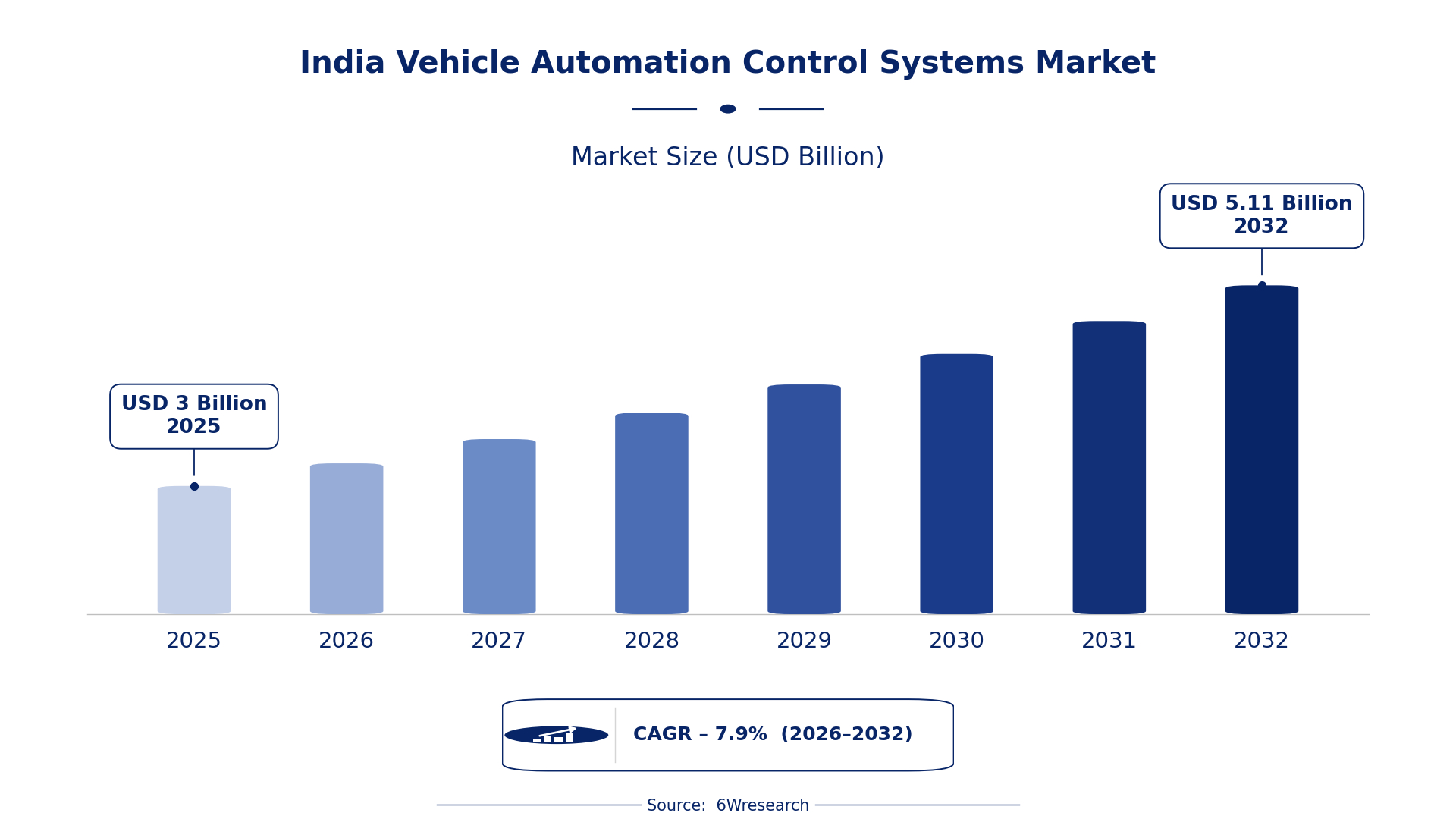
According to 6Wresearch internal database and industry insights, the India Vehicle Automation Control Systems Market was valued at USD 3.00 billion in 2025 and is projected to reach USD 5.11 billion by 2032, growing at a CAGR of approximately 7.9% during 2026–2032.
India Vehicle Automation Control Systems Market Highlights
| Report Metric | Details |
| Report Name | India Vehicle Automation Control Systems Market |
| Market Size 2025 | USD 3.00 billion |
| Market Size 2032 | USD 5.11 billion |
| Absolute Growth 2025–2032 | USD 2.11 billion |
| CAGR 2026–2032 | 7.9% |
| Peak Annual Growth | 10.4% in 2028 |
| Forecast Period | 2026–2032 |
| Historical Data | 2022–2025 |
| Base Year | 2025 |
| Leading Control Type, 2025 | Adaptive Cruise Control (42% share) |
| Leading Vehicle Autonomy Level, 2025 | Level 1–2 (37% share) |
| Leading System Architecture, 2025 | ECU Based (50% share) |
| Leading End User, 2025 | Passenger Vehicle OEMs (46% share) |
| Fastest-Growing Control Type | Lane Keep Assist (10.6% CAGR) |
| Fastest-Growing Vehicle Autonomy Level | Level 2–3 (10.4% CAGR) |
| Fastest-Growing System Architecture | AI-Based Control Units (9.7% CAGR) |
| Fastest-Growing End User | EV Manufacturers (8.9% CAGR) |
| Growing Sector | EV Manufacturers |
| Key End Users | Passenger Vehicle OEMs, EV Manufacturers, Urban Car Makers, Autonomous Vehicle Developers |
India Vehicle Automation Control Systems Market Year-wise Growth Rate and Key Drivers (2022–2032)
This graph illustrates the annual growth rates of the market from 2022 to 2032, highlighting a steady upward trajectory and projected market expansion over the forecast period.
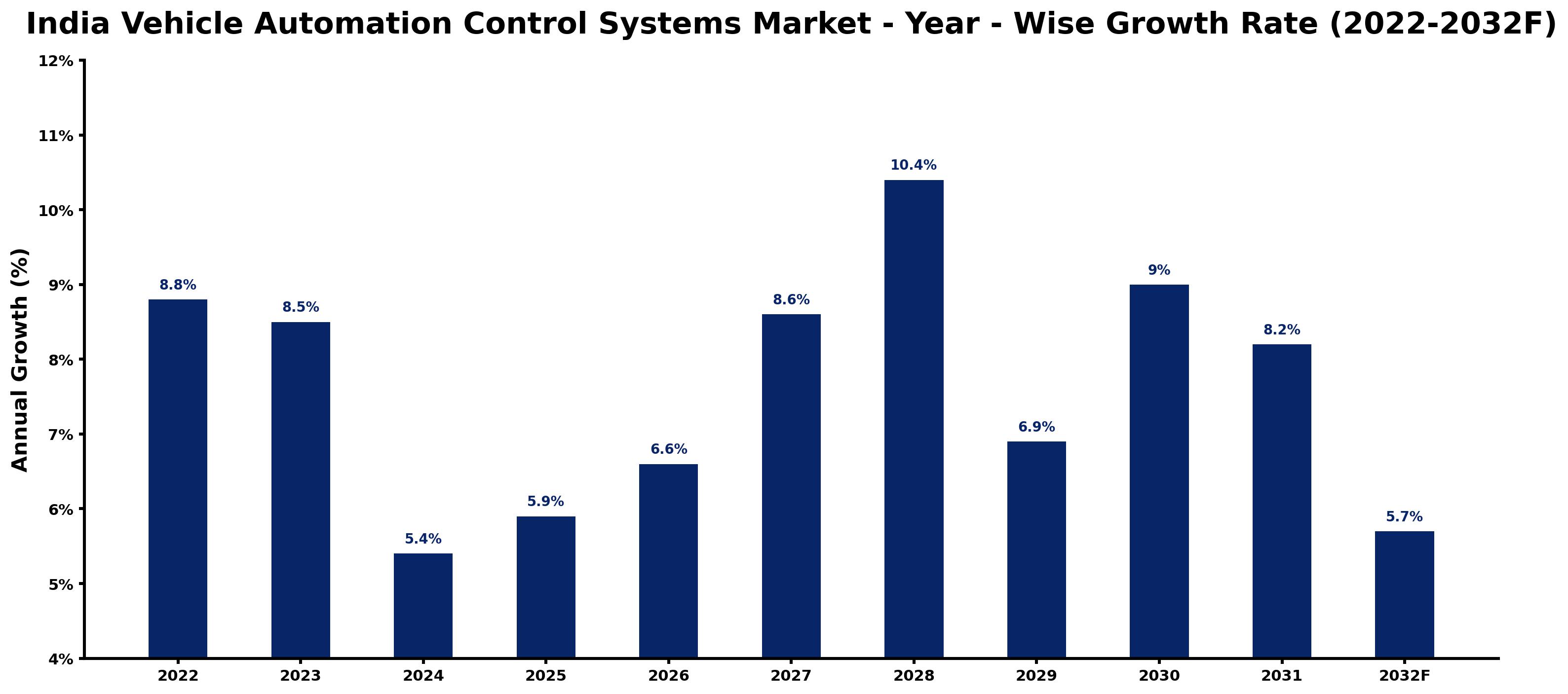
Below, each year's estimated growth is shown next to the factor that most influenced it.
| Year | Estimated Annual Growth (%) | Market Rationale |
| 2022 | 8.8 | The market experienced strong growth driven by increased demand for automation technologies in passenger vehicles. |
| 2023 | 8.5 | Growth slowed slightly due to ongoing supply chain disruptions affecting vehicle production schedules. |
| 2024 | 5.4 | The market continued to grow, albeit at a slower pace, as manufacturers adapted to changing consumer preferences. |
| 2025 | 5.9 | A rebound in growth occurred as new models featuring advanced automation were introduced to the market. |
| 2026 | 6.6 | Demand increased further as the adoption of electric vehicles began to rise in the country. |
| 2027 | 8.6 | The market saw a resurgence in growth, supported by investments in automation technologies by local manufacturers. |
| 2028 | 10.4 | Peak growth is expected as the market benefits from increased consumer acceptance of automation features in vehicles. |
| 2029 | 6.9 | Growth slowed again as the market began to stabilise following the peak in demand. |
| 2030 | 9.0 | Demand is projected to rise again as the government pushes for electric vehicle adoption through various initiatives. |
| 2031 | 8.2 | Growth is expected to slow as the market adjusts to the saturation of certain automation technologies. |
| 2032 | 5.7 | The market will continue to grow, driven by ongoing advancements in automation and electric vehicle integration. |
Note: Market size estimations and growth projections presented in this report are based on 6Wresearch's proprietary forecasting methodology, utilizing the latest available industry data, government publications, and primary research inputs.
India Vehicle Automation Control Systems Market Synopsis
Vehicle Automation Control Systems in India represent advanced technologies designed to improve vehicle safety and driving efficiency. These systems include features such as adaptive cruise control and lane keep assist, increasingly integrated into passenger vehicles. The India Vehicle Automation Control Systems Market is expanding due to rising demand from domestic manufacturers and a strong push towards electric vehicle adoption. The automotive industry is projected to reach $300 billion by 2026, supported by investments in automation technologies and government initiatives like the National Electric Mobility Mission Plan.
Market Dynamics Impact Analysis (2026–2032)
| Factor | Type | Impact | Primary Segment Affected |
| Growing demand for electric vehicles | Driver | High | Passenger Vehicle OEMs |
| Investment in advanced automation technologies | Driver | High | EV Manufacturers |
| Increased adoption of automation features | Opportunity | Medium | Urban Car Makers |
| Emerging market for autonomous vehicles | Opportunity | Medium | Autonomous Vehicle Developers |
| Skills shortage in the workforce | Restraint | High | Adaptive Cruise Control |
| Regulatory compliance costs | Restraint | Medium | Adaptive Cruise Control |
| High development costs for automation systems | Challenge | High | Adaptive Cruise Control |
| Integration of advanced technologies | Challenge | Medium | Adaptive Cruise Control |
Evaluation of Drivers in India Vehicle Automation Control Systems Market (2026–2032)
Below mentioned are some major drivers and their influence on market dynamics.
| Drivers | Primary Segment Affected | Why It Matters (Evidence) |
| Growing demand for electric vehicles | Passenger Vehicle OEMs | This demand drives the need for advanced automation systems to improve vehicle features and efficiency. |
| Investment in automation technologies | EV Manufacturers | Increased funding for R&D leads to the development of innovative automation solutions. |
| Consumer preference for safety features | Urban Car Makers | As consumers prioritise safety, manufacturers are integrating more automation technologies. |
| Government incentives for electric vehicles | EV Manufacturers | Incentives under the FAME India Scheme encourage the adoption of automation in electric vehicles. |
| Technological advancements in AI | AI-Based Control Units | The integration of AI-based control units improves automation capabilities in vehicles. |
Growth across the Vehicle Automation Control Systems market in India is anchored in increasing demand from domestic manufacturers and substantial investments in automation technologies. The automotive industry is projected to reach $300 billion by 2026, which is driving manufacturers to adopt advanced features. The adoption of Level 2 automation is expected to rise by 2025, creating new opportunities for suppliers. Consumer preference for safety features is prompting urban car makers to enhance their vehicles with automation systems.
Evaluation of Restraints in India Vehicle Automation Control Systems Market
The table below lists the restraints and the evidence behind each.
| Market Restraint | Primary Segment Affected | Why It Matters (Evidence) |
| Skills shortage in the workforce | Adaptive Cruise Control | The rapid advancement of technology outpaces workforce training, delaying project timelines for manufacturers. |
| Regulatory compliance costs | Adaptive Cruise Control | Compliance with the Bureau of Indian Standards can extend product development cycles, impacting time-to-market. |
| High development costs for automation systems | Adaptive Cruise Control | The investment required for developing advanced systems can deter smaller suppliers. |
| Integration challenges with existing systems | Adaptive Cruise Control | Integrating new automation technologies with legacy systems can complicate development processes. |
| Market saturation in certain automation features | Adaptive Cruise Control | As certain features become standard, the market may experience slower growth rates. |
India Vehicle Automation Control Systems Market Challenges
Buyers and suppliers in the India Vehicle Automation Control Systems market encounter a significant skills shortage, as the rapid pace of technological evolution outstrips workforce training, causing delays in project timelines for manufacturers. Compliance with regulations set by the Bureau of Indian Standards can prolong product development cycles, which affects time-to-market for new vehicle models and costs suppliers critical resources. The integration of advanced control units necessitates considerable investment, straining budgets for smaller suppliers and hindering their competitive edge. High development costs for vehicle automation systems can deter investment, limiting growth opportunities for both buyers and suppliers in the automotive sector.
Trends in the India Vehicle Automation Control Systems Market
Below mentioned are some of the trends shaping the India Vehicle Automation Control Systems Market growth.
- Shift towards Level 2 Automation: The adoption of Level 2 automation technologies is gaining momentum in India, with passenger vehicles increasingly featuring these systems. By 2025, the market for Level 2 automation is expected to expand, driven by consumer demand for enhanced safety features.
- Transition to Electric Vehicles: India's automotive industry is transitioning towards electric vehicles, with over 1.4 million registered EVs as of 2023. This shift is supported by government initiatives like the FAME II scheme, which encourages the adoption of electric and hybrid vehicles.
- Emergence of AI-Based Control Units: AI-based control units are becoming more prevalent in new vehicle models, improving automation capabilities. The integration of these units is expected to grow by 9.7% annually as manufacturers seek to improve vehicle performance.
- Increased Focus on Safety Features: There is a growing emphasis on safety features among urban car makers, leading to higher demand for automation systems. This trend is evident as manufacturers invest in technologies like lane keep assist and adaptive cruise control.
Investment Opportunities in the India Vehicle Automation Control Systems Market
Investors looking at the India Vehicle Automation Control Systems Market should consider the following areas.
- Market Gap for Advanced Automation: With the automotive industry projected to reach $300 billion by 2026, there is a market gap for advanced automation systems. Suppliers can target passenger vehicle OEMs to meet this demand.
- Investment in R&D Facilities: The National Automotive Testing and R&D Infrastructure Project aims to enhance testing facilities, presenting an opportunity for investment. Collaborating with local partners can facilitate entry into this growing market.
- Government Incentives for EV Adoption: The ₹10,000 crore budget under the FAME II scheme provides a strong incentive for suppliers to invest in electric vehicle automation technologies. Partnering with EV manufacturers can open new avenues for growth.
- Emerging Market for Autonomous Vehicles: As the market for autonomous vehicles develops, there is an opportunity for suppliers to innovate. Focusing on Level 2-3 automation technologies can position companies advantageously in this evolving market.
Government Initiatives in the India Vehicle Automation Control Systems Market
The National Electric Mobility Mission Plan 2020 aims for a substantial increase in electric vehicle adoption and infrastructure development. This policy encourages manufacturers to invest in automation technologies to improve vehicle efficiency and safety. By promoting sustainable mobility, it creates a conducive environment for the growth of vehicle automation control systems.
The FAME II scheme, initiated by the Ministry of Heavy Industries, allocates a budget of ₹10,000 crore until 2024 for the adoption of electric and hybrid vehicles. This funding supports manufacturers in integrating advanced automation systems into their vehicles, facilitating a smoother transition to electric mobility.
Future Insight of the India Vehicle Automation Control Systems Market
Several forward-looking factors should support the India Vehicle Automation Control Systems market over the coming years. The government's target of 30% electric vehicle penetration by 2030 will drive demand for advanced automation technologies, while the ₹10,000 crore budget under the FAME India Scheme will encourage further adoption. Enhanced testing facilities through the National Automotive Testing and R&D Infrastructure Project will improve safety standards. The anticipated increase in Level 2 automation adoption by 2025 will create new opportunities for suppliers to meet evolving market needs.
Market Segmentation Analysis
Each segment group is reviewed below, with the leader by share and the fastest grower by CAGR.
By Control Type – Adaptive Cruise Control Dominated, Lane Keep Assist Expected to Grow Fastest
According to Bhawna Singh, Assistant Manager at 6Wresearch, Adaptive Cruise Control accounted for a 42% market share by control type in 2025. Adaptive Cruise Control holds the largest share because it is extensively used in passenger vehicles, providing automated speed control based on traffic conditions. This technology is particularly appealing to drivers seeking comfort during long journeys, making it a staple in modern automotive design. Over 2026–2032, Lane Keep Assist is expected to post the fastest growth, at a CAGR of 10.6%. Lane Keep Assist is growing rapidly, propelled by the increasing demand for advanced driver assistance systems that enhance road safety. With the anticipated rise in adoption of semi-autonomous features by 2025, this technology is well-positioned for significant expansion. Suppliers should focus on developing advanced driver assistance systems to meet the rising market demand from vehicle manufacturers.
By Vehicle Autonomy Level – Level 1–2 Dominated, Level 2–3 Expected to Grow Fastest
The largest vehicle autonomy level category in 2025 was Level 1–2, with a 37% share of total revenue. Level 1–2 automation dominates the market as it is widely implemented in vehicles, providing essential features that enhance driving safety. This level appeals to consumers looking for improved driving experiences without the complexities associated with higher levels of autonomy. The quickest growth will come from Level 2–3, forecast to expand at a CAGR of 10.4% between 2026 and 2032. Level 2–3 automation is expected to grow rapidly, driven by advancements in technology and increasing consumer interest in semi-autonomous features. As manufacturers invest in these systems, the market for Level 2–3 automation will likely see significant expansion. Buyers should prepare for a shift towards more advanced automation features in vehicles, prompting suppliers to innovate and adapt their product offerings.
By System Architecture – ECU Based Dominated, AI-Based Control Units Expected to Grow Fastest
ECU Based held a 50% share of the India Vehicle Automation Control Systems Market by system architecture in 2025. ECU Based systems command the largest share as they are crucial for controlling various vehicle functions, ensuring both reliability and performance. Their established presence in the market makes them a preferred choice among automotive manufacturers, who rely on these systems for operational efficiency. AI-Based Control Units are set to record the highest CAGR in this split, 9.7% over 2026–2032. AI-Based Control Units are set to experience rapid growth due to their potential to enhance vehicle performance through advanced decision-making capabilities. As the industry increasingly integrates these technologies, adoption rates among manufacturers are expected to rise significantly. Suppliers need to concentrate on integrating advanced technologies to remain competitive in the evolving vehicle automation market.
By End User – Passenger Vehicle OEMs Dominated, EV Manufacturers Expected to Grow Fastest
With a 46% revenue share in 2025, Passenger Vehicle OEMs was the largest end user category. Passenger Vehicle OEMs hold the largest share as they are the primary users of automation systems, driving demand for safety and efficiency features. Their substantial production volumes create a steady market for vehicle automation technologies, making them critical players in this sector. EV Manufacturers are projected to grow fastest, at a CAGR of 8.9% during 2026–2032. EV Manufacturers are rapidly adopting automation technologies to enhance their offerings and meet consumer expectations for advanced features. With government incentives and a strong push for electric vehicles, this segment is poised for substantial growth in the coming years. Suppliers should target EV manufacturers to capitalise on the increasing demand for automation technologies in the electric vehicle sector.
Key Attractiveness of the Report
- 10 Years of Market Numbers
- Historical Data Starting from 2022 to 2025
- Base Year 2025
- Forecast Data until 2032
- Key Performance Indicators Impacting the Market
- Major Upcoming Developments and Projects
Key Highlights of the Report:
- India Vehicle Automation Control Systems Market Outlook
- Market Size of India Vehicle Automation Control Systems Market, 2025
- Forecast of India Vehicle Automation Control Systems Market, 2032
- Historical Data and Forecast of India Vehicle Automation Control Systems Revenues & Volume for the Period 2022 - 2032F
- India Vehicle Automation Control Systems Market Trend Evolution
- India Vehicle Automation Control Systems Market Drivers and Challenges
- India Vehicle Automation Control Systems Price Trends
- India Vehicle Automation Control Systems Porter's Five Forces
- India Vehicle Automation Control Systems Industry Life Cycle
- Historical Data and Forecast of India Vehicle Automation Control Systems Market Revenues & Volume By Control Type for the Period 2022 - 2032F
- Historical Data and Forecast of India Vehicle Automation Control Systems Market Revenues & Volume By Adaptive Cruise Control for the Period 2022 - 2032F
- Historical Data and Forecast of India Vehicle Automation Control Systems Market Revenues & Volume By Lane Keep Assist for the Period 2022 - 2032F
- Historical Data and Forecast of India Vehicle Automation Control Systems Market Revenues & Volume By Full Self-Drive Suite for the Period 2022 - 2032F
- Historical Data and Forecast of India Vehicle Automation Control Systems Market Revenues & Volume By Parking Assist Systems for the Period 2022 - 2032F
- Historical Data and Forecast of India Vehicle Automation Control Systems Market Revenues & Volume By Vehicle Autonomy Level for the Period 2022 - 2032F
- Historical Data and Forecast of India Vehicle Automation Control Systems Market Revenues & Volume By Level 1 2 for the Period 2022 - 2032F
- Historical Data and Forecast of India Vehicle Automation Control Systems Market Revenues & Volume By Level 2 3 for the Period 2022 - 2032F
- Historical Data and Forecast of India Vehicle Automation Control Systems Market Revenues & Volume By Level 4 5 for the Period 2022 - 2032F
- Historical Data and Forecast of India Vehicle Automation Control Systems Market Revenues & Volume By Level 1 for the Period 2022 - 2032F
- Historical Data and Forecast of India Vehicle Automation Control Systems Market Revenues & Volume By System Architecture for the Period 2022 - 2032F
- Historical Data and Forecast of India Vehicle Automation Control Systems Market Revenues & Volume By ECU Based for the Period 2022 - 2032F
- Historical Data and Forecast of India Vehicle Automation Control Systems Market Revenues & Volume By Sensor Integrated for the Period 2022 - 2032F
- Historical Data and Forecast of India Vehicle Automation Control Systems Market Revenues & Volume By AI-Based Control Units for the Period 2022 - 2032F
- Historical Data and Forecast of India Vehicle Automation Control Systems Market Revenues & Volume By Ultrasonic Sensor Based for the Period 2022 - 2032F
- Historical Data and Forecast of India Vehicle Automation Control Systems Market Revenues & Volume By End User for the Period 2022 - 2032F
- Historical Data and Forecast of India Vehicle Automation Control Systems Market Revenues & Volume By Passenger Vehicle OEMs for the Period 2022 - 2032F
- Historical Data and Forecast of India Vehicle Automation Control Systems Market Revenues & Volume By EV Manufacturers for the Period 2022 - 2032F
- Historical Data and Forecast of India Vehicle Automation Control Systems Market Revenues & Volume By Autonomous Vehicle Developers for the Period 2022 - 2032F
- Historical Data and Forecast of India Vehicle Automation Control Systems Market Revenues & Volume By Urban Car Makers for the Period 2022 - 2032F
- India Vehicle Automation Control Systems Import Export Trade Statistics
- Market Opportunity Assessment By Control Type
- Market Opportunity Assessment By Vehicle Autonomy Level
- Market Opportunity Assessment By System Architecture
- Market Opportunity Assessment By End User
- India Vehicle Automation Control Systems Top Companies Market Share
- India Vehicle Automation Control Systems Competitive Benchmarking By Technical and Operational Parameters
- India Vehicle Automation Control Systems Company Profiles
- India Vehicle Automation Control Systems Key Strategic Recommendations
Market Covered
The report offers an extensive study of the following market segments.
By Control Type
- Adaptive Cruise Control
- Lane Keep Assist
- Full Self-Drive Suite
- Parking Assist Systems
By Vehicle Autonomy Level
- Level 1–2
- Level 2–3
- Level 4–5
- Level 1
By System Architecture
- ECU Based
- Sensor Integrated
- AI-Based Control Units
- Ultrasonic Sensor Based
By End User
- Passenger Vehicle OEMs
- EV Manufacturers
- Autonomous Vehicle Developers
- Urban Car Makers































