China Vehicle Cabin Air Quality Systems Market Size & Growth Rate
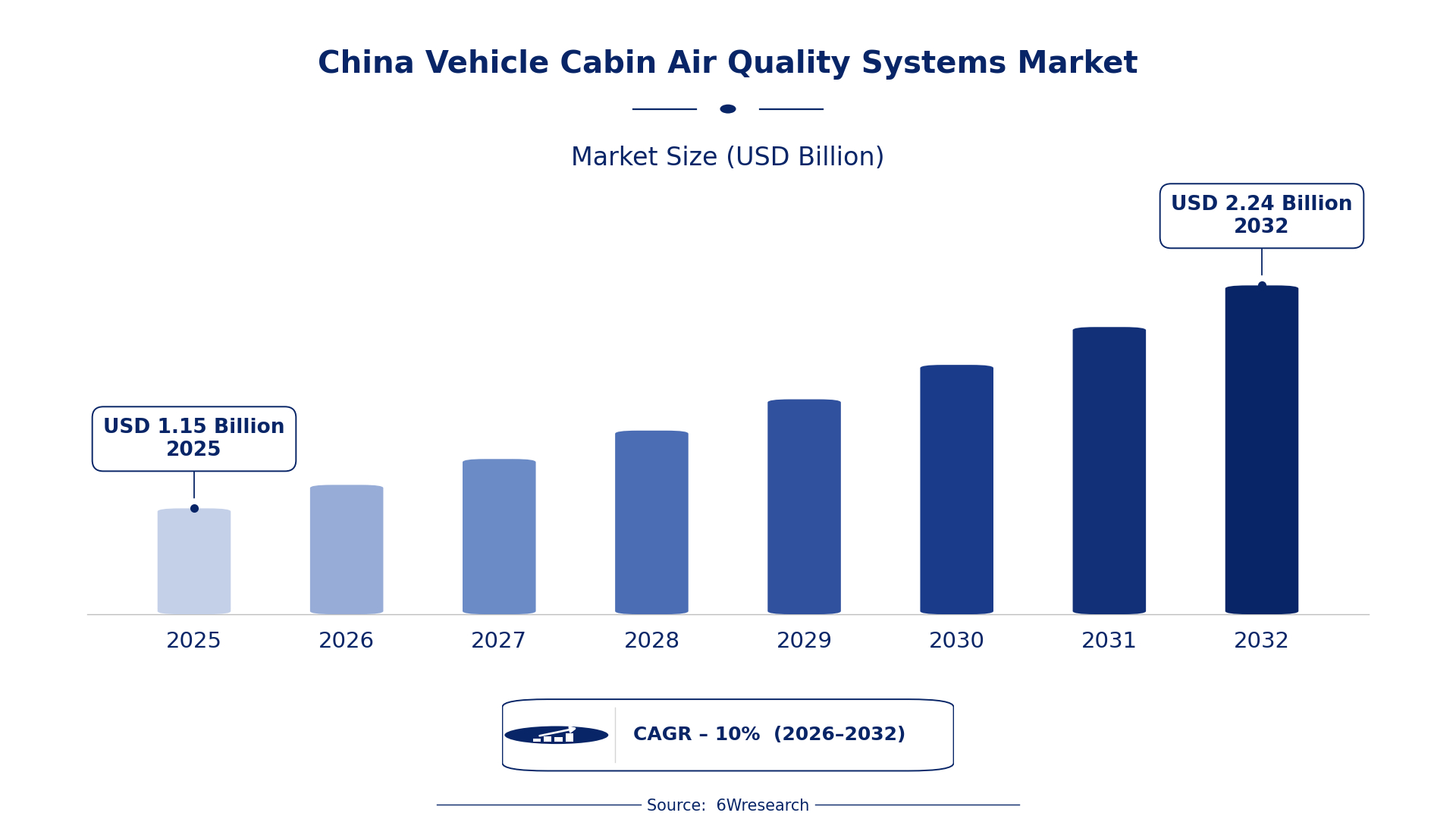
According to 6Wresearch internal database and industry insights, the China Vehicle Cabin Air Quality Systems Market was valued at USD 1.15 billion in 2025 and is projected to reach USD 2.24 billion by 2032, growing at a CAGR of approximately 10% during 2026–2032.
China Vehicle Cabin Air Quality Systems Market Highlights
| Report Metric | Details |
| Report Name | China Vehicle Cabin Air Quality Systems Market |
| Market Size 2025 | USD 1.15 billion |
| Market Size 2032 | USD 2.24 billion |
| Absolute Growth 2025–2032 | USD 1.09 billion |
| CAGR 2026–2032 | 10% |
| Peak Annual Growth | 11.6% in 2026 |
| Forecast Period | 2026–2032 |
| Historical Data | 2022–2025 |
| Base Year | 2025 |
| Leading System Type, 2025 | HVAC Integrated Systems (45% share) |
| Leading Filtration Technology, 2025 | HEPA Filter (42% share) |
| Leading Vehicle Class, 2025 | Passenger Cars (39% share) |
| Leading End User, 2025 | OEMs (38% share) |
| Fastest-Growing System Type | Standalone Air Purifiers (12.2% CAGR) |
| Fastest-Growing Filtration Technology | Optical Sensor-Based (11.6% CAGR) |
| Fastest-Growing Vehicle Class | EVs (12.7% CAGR) |
| Fastest-Growing End User | Smart Car OEMs (11.4% CAGR) |
| Growing Sector | Electric Vehicles |
| Key End Users | OEMs, Luxury Car Makers, Fleet Operators, Smart Car OEMs |
China Vehicle Cabin Air Quality Systems Market Year-wise Growth Rate and Key Drivers (2022–2032)
This graph illustrates the annual growth rates of the market from 2022 to 2032, highlighting a steady upward trajectory and projected market expansion over the forecast period.
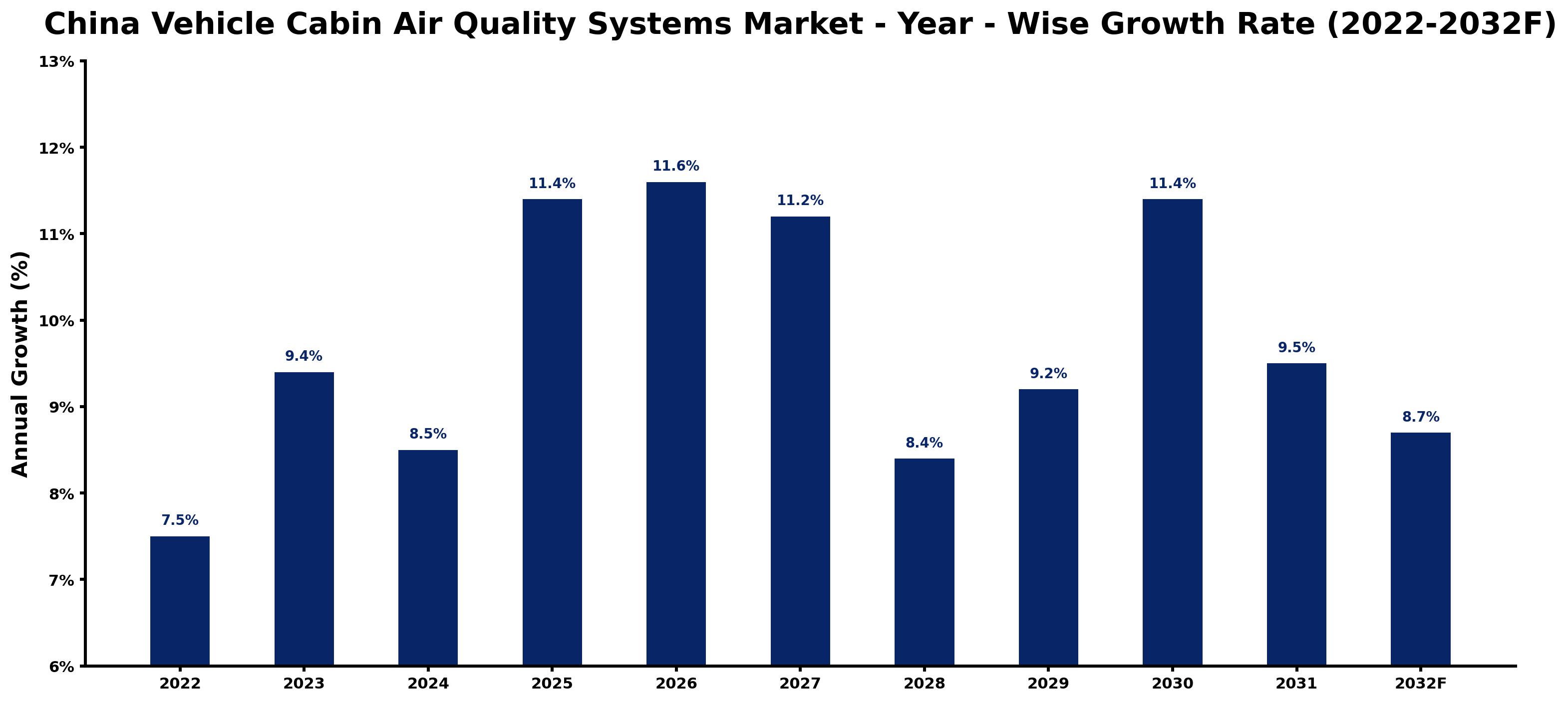
Year by year, the estimates below pair each growth rate with the development that shaped it.
| Year | Estimated Annual Growth (%) | Market Rationale |
| 2022 | 7.5 | The market experienced steady growth as vehicle production remained strong, with over 25 million units manufactured. |
| 2023 | 9.4 | Demand surged due to increased consumer awareness of air quality, particularly in urban areas like Beijing-Tianjin-Hebei with high pollution levels. |
| 2024 | 8.5 | Growth slowed slightly as the market adjusted to new air quality standards introduced by the Ministry of Ecology and Environment in 2023. |
| 2025 | 11.4 | A rise in luxury vehicle sales drove demand for advanced air quality features, boosting overall market performance. |
| 2026 | 11.6 | The peak growth is expected to be fuelled by the rapid adoption of electric vehicles, which require advanced cabin air quality systems. |
| 2027 | 11.2 | A slight slowdown is projected as the market matures and competition intensifies among manufacturers in the automotive sector. |
| 2028 | 8.4 | Continued growth is anticipated due to increasing urbanisation and the need for better air quality solutions in cities like Guangzhou. |
| 2029 | 9.2 | Demand is expected to accelerate again as more consumers prioritise health and comfort in their vehicle purchases, especially in urban areas. |
| 2030 | 11.4 | Growth is projected to rebound with renewed interest in premium features, particularly in the luxury car segment, driven by consumer preferences. |
| 2031 | 9.5 | A moderate slowdown in growth is anticipated as market saturation begins to set in among standard vehicle segments, particularly in passenger cars. |
| 2032 | 8.7 | The market is expected to continue growing, albeit at a slower pace, as consumers increasingly seek advanced filtration technologies in their vehicles. |
Note: Market size estimations and growth projections presented in this report are based on 6Wresearch's proprietary forecasting methodology, utilizing the latest available industry data, government publications, and primary research inputs.
China Vehicle Cabin Air Quality Systems Market Synopsis
Vehicle Cabin Air Quality Systems in China are technologies designed to improve air quality within vehicle interiors through filtration and purification processes. These systems, including HEPA filters and activated carbon, reduce pollutants and allergens, thereby improving passenger health and comfort. The China Vehicle Cabin Air Quality Systems Market is expanding due to robust vehicle production, with over 25 million units produced in 2022, and increased consumer demand for electric vehicles. Stricter air quality standards implemented by the government are prompting manufacturers to integrate advanced air quality systems into new models, driving overall market growth.
Market Dynamics Impact Analysis (2026–2032)
| Factor | Type | Impact | Primary Segment Affected |
| Growing urban population leading to higher pollution levels | Driver | High | Passenger Cars |
| Increased focus on health and wellness among consumers | Driver | High | Luxury Car Makers |
| OEMs seeking to enhance vehicle features for competitive advantage | Opportunity | High | OEMs |
| Rising electric vehicle adoption creating demand for integrated systems | Opportunity | High | EVs |
| High costs associated with advanced filtration technologies | Restraint | Medium | HVAC Integrated Systems |
| Limited consumer awareness about air quality systems | Restraint | Medium | Standalone Air Purifiers |
| The Vehicle Cabin Air Quality Systems market in China faces regulatory hurdles | Challenge | High | Carbon Filter Systems |
| Competition among manufacturers leading to price wars | Challenge | Medium | PM2.5 Sensors |
Evaluation of Drivers in China Vehicle Cabin Air Quality Systems Market (2026–2032)
Key forces behind demand, with the segment each one moves most, are listed below.
| Drivers | Primary Segment Affected | Why It Matters (Evidence) |
| Increased vehicle production driving demand for air quality systems | Passenger Cars | China's automotive market produced over 25 million vehicles in 2022, leading to higher demand for air quality systems. |
| Rising consumer awareness of health impacts from air pollution | Luxury Car Makers | Sales of luxury cars reached 2.3 million units in 2022, with buyers prioritising advanced air quality features. |
| Government regulations mandating air quality standards in vehicles | HVAC Integrated Systems | The National Standard for Vehicle Cabin Air Quality was approved in 2021, influencing system requirements. |
| Growth in the electric vehicle segment necessitating better air quality solutions | EVs | The National Development and Reform Commission's 2023 programme promotes electric vehicle adoption, including air quality technologies. |
| Technological advancements in filtration systems improving performance | HEPA Filter | HEPA filters are standard in over 60% of new passenger vehicles in China as of 2023. |
Over 25 million vehicles were produced in 2022, creating substantial demand for air quality systems. Luxury car sales reached 2.3 million units in 2022, with consumers prioritising advanced air quality features. The approval of the National Standard for Vehicle Cabin Air Quality in 2021 mandates specific filtration technologies, pushing manufacturers to comply. The promotion of electric vehicles in 2023 by the National Development and Reform Commission highlights the growing need for integrated air quality solutions, reflecting a shift in consumer expectations.
Evaluation of Restraints in China Vehicle Cabin Air Quality Systems Market
The key brakes on demand, and where they bite hardest, are shown below.
| Market Restraint | Primary Segment Affected | Why It Matters (Evidence) |
| High costs of implementing advanced air quality systems | HVAC Integrated Systems | The automotive industry in China has invested over $10 billion in air quality technologies from 2020 to 2023, impacting pricing. |
| Limited awareness among consumers regarding air quality systems | Standalone Air Purifiers | Despite the need for better air quality, many consumers remain unaware of the benefits of these systems. |
| Regulatory compliance costs for manufacturers | Carbon Filter Systems | Stricter regulations on vehicle emissions introduced by the State Administration for Market Regulation in 2023 increase compliance costs. |
| Intense competition among manufacturers affecting profitability | PM2.5 Sensors | Price wars among manufacturers can reduce margins and affect profitability in the market. |
| Supply chain disruptions impacting system availability | HEPA Filter | The automotive industry has faced supply chain challenges that delay the production of air quality systems. |
China Vehicle Cabin Air Quality Systems Market Challenges
Buyers in the China Vehicle Cabin Air Quality Systems market face rising costs due to the increasing demand for advanced filtration technologies, which can inflate prices by up to 15% annually. Competition among manufacturers intensifies as they strive to meet stringent air quality standards, leading to higher R&D expenditures that can delay product launches by six months. Skills shortages in the automotive sector hinder the development of effective air quality solutions, causing integration delays for producers. Rapid technological advancements create pressure for continuous upgrades, burdening suppliers with additional costs and complicating inventory management for distributors.
Trends in the China Vehicle Cabin Air Quality Systems Market
Buyers and suppliers in the China Vehicle Cabin Air Quality Systems Market are adjusting to the following trends.
- Shift towards Integrated Air Quality Systems in EVs: The Guangdong province is experiencing a shift towards integrated air quality systems in electric vehicles, with a projected growth rate of 12.7% for EVs from 2026 to 2032. This trend reflects the increasing focus on passenger comfort and health.
- Increasing Adoption of HEPA Filters in New Vehicles: As of 2023, HEPA filters are standard in over 60% of new passenger vehicles in China, reflecting a shift towards higher air quality standards. This change is driven by consumer demand for healthier driving environments.
- Focus on Advanced Filtration Technologies by Luxury Car Makers: Luxury car makers are prioritising advanced filtration technologies, with sales reaching 2.3 million units in 2022. This trend highlights the growing consumer expectation for superior air quality features in premium vehicles.
- Expansion of Air Quality Standards in the Automotive Sector: In 2021, the National Standard for Vehicle Cabin Air Quality was approved, mandating specific filtration technologies for new vehicles. This regulatory shift is shaping the development of air quality systems across the industry.
Investment Opportunities in the China Vehicle Cabin Air Quality Systems Market
Investors looking at the China Vehicle Cabin Air Quality Systems Market should consider the following areas.
- OEMs seeking advanced air quality solutions: OEMs are increasingly looking for advanced air quality solutions, with the market projected to reach USD 1.15 billion by 2025. Partnering with local manufacturers can facilitate entry into this growing segment.
- Growing demand for air quality systems in EVs: With EVs projected to grow at a rate of 12.7% from 2026 to 2032, there is an opportunity for suppliers to develop integrated air quality systems. Collaborating with electric vehicle manufacturers can enhance market presence.
- Luxury car makers focusing on air quality features: Luxury car makers are prioritising air quality features, with sales of 2.3 million units in 2022. Investing in innovative filtration technologies can capture this lucrative market segment.
- Increased focus on health and wellness among consumers: As consumers become more health-conscious, the demand for air quality systems is rising. Suppliers can enter the market by obtaining necessary certifications and partnering with local OEMs.
Government Initiatives in the China Vehicle Cabin Air Quality Systems Market
The 'Air Quality Improvement Action Plan' launched by the Ministry of Ecology and Environment in 2021 aims to reduce PM2.5 levels by 10% by 2025. This initiative directly impacts vehicle air quality systems, as manufacturers must comply with new standards to meet regulatory requirements. The plan encourages the adoption of advanced filtration technologies in vehicles, driving innovation in the sector. Additionally, the updated 'Automotive Industry Development Policy' by the Ministry of Industry and Information Technology in 2020 enhances air quality standards for new vehicles, further driving demand for improved systems.
In 2022, the National Development and Reform Commission initiated the 'New Energy Vehicle Industry Development Plan', which allocates significant funding to promote electric vehicles, including air quality technologies. This programme supports the integration of advanced air quality systems in new EV models. The China Automotive Technology and Research Center also plays a role in approving guidelines for air quality systems, ensuring compliance with national standards. These measures collectively enhance the market for vehicle cabin air quality systems.
Future Insight of the China Vehicle Cabin Air Quality Systems Market
The China Vehicle Cabin Air Quality Systems market will undergo significant changes by 2032, driven by the National Development and Reform Commission's initiative to promote electric vehicle adoption alongside improved air quality solutions. With the automotive industry investing over $10 billion in air quality technologies from 2020 to 2023, demand for advanced filtration systems will rise sharply. The establishment of national standards will streamline production processes and ensure compliance, benefiting both buyers and suppliers. Innovations showcased at industry exhibitions will likely improve product offerings, enhancing air quality for consumers.
Market Segmentation Analysis
The analysis below covers each segmentation, its leading category in 2025 and its fastest-growing category through 2032.
By System Type – HVAC Integrated Systems Dominated, Standalone Air Purifiers Expected to Grow Fastest
According to Bhawna Singh, Assistant Manager at 6Wresearch, in 2025, HVAC Integrated Systems led the system type split with a 45% share. HVAC Integrated Systems dominate the China Vehicle Cabin Air Quality Systems market due to their direct integration into vehicle designs, which is essential for effective air quality management. This is especially critical in high-emission areas like the Beijing-Tianjin-Hebei region, where the need for such systems is heightened. Standalone Air Purifiers are set to record the highest CAGR in this split, 12.2% over 2026–2032. Standalone Air Purifiers are experiencing rapid growth as they are increasingly featured in select vehicle models aimed at improving air quality. The surge in luxury vehicle sales, which reached 2.3 million units in 2022, significantly fuels this demand for enhanced air cleaning solutions. Suppliers should focus on developing advanced HVAC Integrated Systems to cater to the growing need for better vehicle cabin air quality.
By Filtration Technology – HEPA Filter Dominated, Optical Sensor-Based Expected to Grow Fastest
With a 42% revenue share in 2025, HEPA Filter was the largest filtration technology category. HEPA Filters dominate the market as they are standard in over 60% of new passenger vehicles, providing essential high-efficiency air filtration. Their widespread use is critical for compliance with the air quality standards established by the Ministry of Ecology and Environment. Optical Sensor-Based is projected to grow fastest, at a CAGR of 11.6% during 2026–2032. Optical Sensor-Based technologies are rapidly gaining traction due to their integration into advanced systems that monitor air quality in real-time. The increasing emphasis on smarter vehicle technologies is a key factor driving this segment's growth. Buyers should seek vehicles equipped with HEPA Filters and Optical Sensor-Based technologies to ensure effective air quality management.
By Vehicle Class – Passenger Cars Dominated, EVs Expected to Grow Fastest
Passenger Cars accounted for a 39% market share by vehicle class in 2025. Passenger Cars represent the largest market share as they are the main segment for air quality systems, driven by the production of over 25 million vehicles in 2022. The demand in this segment is closely tied to the emphasis on improving passenger comfort and health within vehicles. The quickest growth will come from EVs, forecast to expand at a CAGR of 12.7% between 2026 and 2032. EVs are the fastest-growing segment, reflecting the increasing popularity of electric vehicles and the corresponding demand for effective air quality systems. The initiative by the National Development and Reform Commission to promote EV adoption is a key factor in this growth. Suppliers must align their offerings with the expanding EV market to capitalise on new opportunities in vehicle cabin air quality systems.
By End User – OEMs Dominated, Smart Car OEMs Expected to Grow Fastest
OEMs took a 38% share of end user in 2025, more than any other category. OEMs represent the largest share as they are the primary manufacturers integrating air quality systems into their vehicles. Their substantial investment exceeding $10 billion in air quality technologies from 2020 to 2023 highlights their dedication to improving vehicle air quality. Over 2026–2032, Smart Car OEMs are expected to post the fastest growth, at a CAGR of 11.4%. Smart Car OEMs are the fastest-growing segment, as they incorporate advanced air quality technologies into smart vehicles. The increasing consumer demand for connected and intelligent vehicle features is a major driver of this growth. Suppliers should focus on OEMs and Smart Car OEMs to capitalise on the growing integration of advanced air quality systems in modern vehicles.
Key Attractiveness of the Report
- 10 Years of Market Numbers
- Historical Data Starting from 2022 to 2025
- Base Year 2025
- Forecast Data until 2032
- Key Performance Indicators Impacting the Market
- Major Upcoming Developments and Projects
Key Highlights of the Report:
- China Vehicle Cabin Air Quality Systems Market Outlook
- Market Size of China Vehicle Cabin Air Quality Systems Market, 2025
- Forecast of China Vehicle Cabin Air Quality Systems Market, 2032
- Historical Data and Forecast of China Vehicle Cabin Air Quality Systems Revenues & Volume for the Period 2022 - 2032F
- China Vehicle Cabin Air Quality Systems Market Trend Evolution
- China Vehicle Cabin Air Quality Systems Market Drivers and Challenges
- China Vehicle Cabin Air Quality Systems Price Trends
- China Vehicle Cabin Air Quality Systems Porter's Five Forces
- China Vehicle Cabin Air Quality Systems Industry Life Cycle
- Historical Data and Forecast of China Vehicle Cabin Air Quality Systems Market Revenues & Volume By System Type for the Period 2022 - 2032F
- Historical Data and Forecast of China Vehicle Cabin Air Quality Systems Market Revenues & Volume By HVAC Integrated Systems for the Period 2022 - 2032F
- Historical Data and Forecast of China Vehicle Cabin Air Quality Systems Market Revenues & Volume By Standalone Air Purifiers for the Period 2022 - 2032F
- Historical Data and Forecast of China Vehicle Cabin Air Quality Systems Market Revenues & Volume By Carbon Filter Systems for the Period 2022 - 2032F
- Historical Data and Forecast of China Vehicle Cabin Air Quality Systems Market Revenues & Volume By PM2.5 Sensors for the Period 2022 - 2032F
- Historical Data and Forecast of China Vehicle Cabin Air Quality Systems Market Revenues & Volume By Filtration Technology for the Period 2022 - 2032F
- Historical Data and Forecast of China Vehicle Cabin Air Quality Systems Market Revenues & Volume By HEPA Filter for the Period 2022 - 2032F
- Historical Data and Forecast of China Vehicle Cabin Air Quality Systems Market Revenues & Volume By Ionization for the Period 2022 - 2032F
- Historical Data and Forecast of China Vehicle Cabin Air Quality Systems Market Revenues & Volume By Activated Carbon for the Period 2022 - 2032F
- Historical Data and Forecast of China Vehicle Cabin Air Quality Systems Market Revenues & Volume By Optical Sensor-Based for the Period 2022 - 2032F
- Historical Data and Forecast of China Vehicle Cabin Air Quality Systems Market Revenues & Volume By Vehicle Class for the Period 2022 - 2032F
- Historical Data and Forecast of China Vehicle Cabin Air Quality Systems Market Revenues & Volume By Passenger Cars for the Period 2022 - 2032F
- Historical Data and Forecast of China Vehicle Cabin Air Quality Systems Market Revenues & Volume By SUVs for the Period 2022 - 2032F
- Historical Data and Forecast of China Vehicle Cabin Air Quality Systems Market Revenues & Volume By Commercial Vehicles for the Period 2022 - 2032F
- Historical Data and Forecast of China Vehicle Cabin Air Quality Systems Market Revenues & Volume By EVs for the Period 2022 - 2032F
- Historical Data and Forecast of China Vehicle Cabin Air Quality Systems Market Revenues & Volume By End User for the Period 2022 - 2032F
- Historical Data and Forecast of China Vehicle Cabin Air Quality Systems Market Revenues & Volume By OEMs for the Period 2022 - 2032F
- Historical Data and Forecast of China Vehicle Cabin Air Quality Systems Market Revenues & Volume By Luxury Car Makers for the Period 2022 - 2032F
- Historical Data and Forecast of China Vehicle Cabin Air Quality Systems Market Revenues & Volume By Fleet Operators for the Period 2022 - 2032F
- Historical Data and Forecast of China Vehicle Cabin Air Quality Systems Market Revenues & Volume By Smart Car OEMs for the Period 2022 - 2032F
- China Vehicle Cabin Air Quality Systems Import Export Trade Statistics
- Market Opportunity Assessment By System Type
- Market Opportunity Assessment By Filtration Technology
- Market Opportunity Assessment By Vehicle Class
- Market Opportunity Assessment By End User
- China Vehicle Cabin Air Quality Systems Top Companies Market Share
- China Vehicle Cabin Air Quality Systems Competitive Benchmarking By Technical and Operational Parameters
- China Vehicle Cabin Air Quality Systems Company Profiles
- China Vehicle Cabin Air Quality Systems Key Strategic Recommendations
Market Covered
The report offers an extensive study of the following market segments.
By System Type
- HVAC Integrated Systems
- Standalone Air Purifiers
- Carbon Filter Systems
- PM2.5 Sensors
By Filtration Technology
- HEPA Filter
- Ionization
- Activated Carbon
- Optical Sensor-Based
By Vehicle Class
- Passenger Cars
- SUVs
- Commercial Vehicles
- EVs
By End User
- OEMs
- Luxury Car Makers
- Fleet Operators
- Smart Car OEMs































