China Volleyball Equipment Market Size, Share & Growth Rate
The China Volleyball Equipment Market was estimated at USD 166 Million in 2025 and is projected to reach USD 191 Million by 2032, growing at a CAGR of 2.0% from 2026 to 2032. This steady growth trajectory is primarily fueled by the increasing enthusiasm for volleyball at grassroots and competitive levels, backed by enhanced sports infrastructure and community engagement. As health consciousness rises among consumers, volleyball is increasingly viewed as an accessible and beneficial physical activity, further propelling market demand.
China Volleyball Equipment Market Year-wise Growth Rate and Key Drivers
This graph highlights how the China Volleyball Equipment Market has steadily grown over the years, supported by major growth factors.
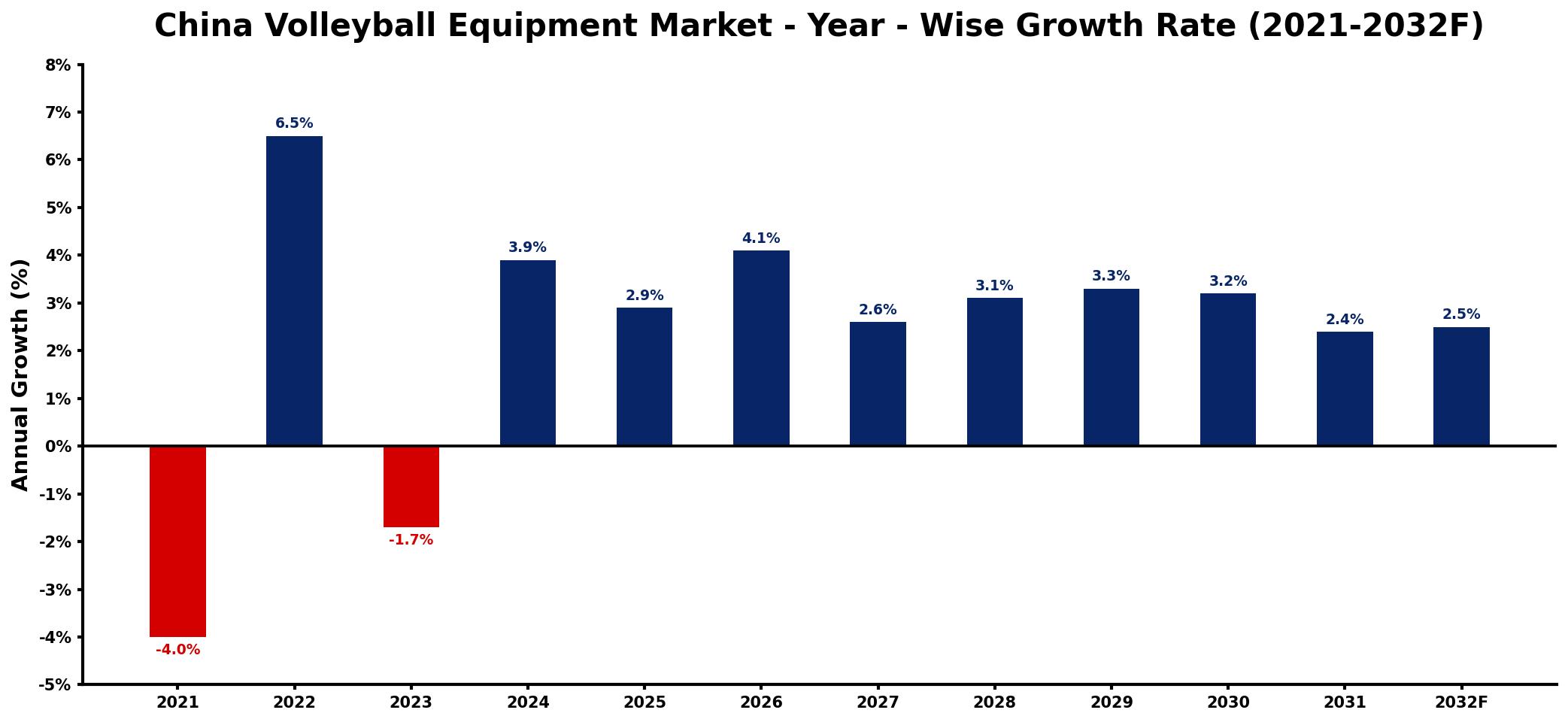
The table below presents the year‑wise growth rates along with the key drivers influencing the market
| Year | Growth Rate | Major Drivers |
| 2021 | -4.0% | shifts in consumer spending habits |
| 2022 | 6.5% | increased participation in sports |
| 2023 | -1.7% | decline in recreational activities |
| 2024 | 3.9% | growth in youth sports programs |
| 2025 | 2.9% | expansion of fitness facilities |
| 2026 | 4.1% | surge in online retail sales |
| 2027 | 2.6% | rising health consciousness trends |
| 2028 | 3.1% | enhanced community sports initiatives |
| 2029 | 3.3% | development of new training programs |
| 2030 | 3.2% | increased sponsorship in athletics |
| 2031 | 2.4% | growing interest in team sports |
| 2032 | 2.5% | rising demand for active lifestyles |
Note: Market size estimations and growth projections presented in this report are based on 6Wresearch's proprietary forecasting methodology, utilizing the latest available industry data, government publications, and primary research inputs.
China Volleyball Equipment Market Synopsis
While the market is currently on an upward trend, it is expected to evolve with a sharper focus on technological advancements and consumer preferences for sustainable practices. The increased participation in volleyball is fostering a diverse equipment market that caters to players needs, reflecting broader societal trends toward sports engagement.
With a notable shift towards high-quality products, the landscape is becoming increasingly competitive, with brands innovating to differentiate their offerings. As consumers seek more personalized and environmentally friendly options, the market is poised for transformation that aligns with both contemporary values and the growing love for the sport.
China Volleyball Equipment Market Key Takeaways
- The market is driven by rising health awareness and increased sports participation.
- Technological advancements are shaping equipment preferences, emphasizing durability and comfort.
- Customization and sustainability are key trends influencing consumer purchasing decisions.
- Investment opportunities abound in manufacturing, distribution, and online retail sectors.
- Government initiatives are bolstering grassroots involvement in volleyball, paving the way for market expansion.
Evaluation of Restraints in China Volleyball Equipment Market
The China Volleyball Equipment Market faces significant restraints primarily due to the proliferation of counterfeit products. These inferior goods not only tarnish the reputation of established brands but also pose safety concerns for consumers. Additionally, the competitive landscape is intense, leading to price wars that can erode profit margins. Fluctuations in raw material costs and evolving consumer preferences further complicate the market dynamics, necessitating brands to adopt robust quality control and brand protection measures.
China Volleyball Equipment Market Trends
Several key trends are shaping the China Volleyball Equipment Market. There is a noticeable shift towards advanced materials and innovative designs that enhance player performance, such as moisture-wicking fabrics and shock-absorbing technologies. Furthermore, the rising demand for eco-friendly products reflects a significant movement towards sustainability among consumers. Personalization has also emerged as a strong trend, with players increasingly seeking customized gear that reflects their identity and team spirit.
China Volleyball Equipment Market Opportunities
The growing passion for volleyball presents ample investment opportunities, particularly in the areas of product innovation and e-commerce. As participation rates climb, there is a robust market for high-quality equipment designed to meet the specific needs of Chinese consumers. Furthermore, leveraging online retail channels offers a promising avenue for manufacturers and retailers to connect with a broader audience, as digital shopping becomes the preferred method for many consumers.
Government Initiatives in the China Volleyball Equipment Market
The Chinese government has actively supported the volleyball equipment market through various policies aimed at enhancing product quality standards and fostering innovation. Initiatives focused on promoting volleyball at the grassroots level, such as investments in training facilities and coaching programs, have been implemented to cultivate interest in the sport. These efforts align with the overarching goal of increasing national sports participation and improving public health.
Future Insights of the China Volleyball Equipment Market
Looking ahead to 2026-2032, the China Volleyball Equipment Market appears set for continued growth driven by a combination of rising disposable income levels and increasing engagement in sports activities. The influence of international sporting events is likely to further enhance interest in volleyball, leading to greater demand for quality equipment. Companies that focus on innovative product development and expansive distribution strategies will be well-positioned to capitalize on these trends and capture a larger market share.
China Volleyball Equipment Market Latest Developments (2025 - 2026)
Recent developments in the China Volleyball Equipment Market reflect an increasing emphasis on quality and consumer preferences. Brands are actively investing in research and development to introduce state-of-the-art products that meet evolving player needs. Simultaneously, the expansion of online retail platforms has gained momentum, making it easier for consumers to access a wide range of volleyball gear. This dynamic environment suggests ongoing shifts in market direction as stakeholders adapt to changing demands.
China Volleyball Equipment Market - Key Attractiveness of the Report
- 10 Years of Market Numbers
- Historical Data Starting from 2022 to 2025
- Base Year: 2025
- Forecast Data until 2032
- Key Performance Indicators Impacting the Market
- Major Upcoming Developments and Projects
Key Highlights of the Report:
- China Volleyball Equipment Market Outlook
- Market Size of China Volleyball Equipment Market, 2025
- Forecast of China Volleyball Equipment Market, 2032
- Historical Data and Forecast of China Volleyball Equipment Revenues & Volume for the Period 2022-2032F
- China Volleyball Equipment Market Trend Evolution
- China Volleyball Equipment Market Drivers and Challenges
- China Volleyball Equipment Price Trends
- China Volleyball Equipment Porter's Five Forces
- China Volleyball Equipment Industry Life Cycle
- Historical Data and Forecast of China Volleyball Equipment Market Revenues & Volume By Product for the Period 2022-2032F
- Historical Data and Forecast of China Volleyball Equipment Market Revenues & Volume By Balls for the Period 2022-2032F
- Historical Data and Forecast of China Volleyball Equipment Market Revenues & Volume By Shoes for the Period 2022-2032F
- Historical Data and Forecast of China Volleyball Equipment Market Revenues & Volume By Protective Gear for the Period 2022-2032F
- Historical Data and Forecast of China Volleyball Equipment Market Revenues & Volume By Others for the Period 2022-2032F
- Historical Data and Forecast of China Volleyball Equipment Market Revenues & Volume By Distribution channel for the Period 2022-2032F
- Historical Data and Forecast of China Volleyball Equipment Market Revenues & Volume By Offline for the Period 2022-2032F
- Historical Data and Forecast of China Volleyball Equipment Market Revenues & Volume By Online for the Period 2022-2032F
- Historical Data and Forecast of China Volleyball Equipment Market Revenues & Volume By Sports Discipline for the Period 2022-2032F
- Historical Data and Forecast of China Volleyball Equipment Market Revenues & Volume By Indoor Volleyball for the Period 2022-2032F
- Historical Data and Forecast of China Volleyball Equipment Market Revenues & Volume By Beach Volleyball for the Period 2022-2032F
- China Volleyball Equipment Import Export Trade Statistics
- Market Opportunity Assessment By Product
- Market Opportunity Assessment By Distribution channel
- Market Opportunity Assessment By Sports Discipline
- China Volleyball Equipment Top Companies Market Share
- China Volleyball Equipment Competitive Benchmarking By Technical and Operational Parameters
- China Volleyball Equipment Company Profiles
- China Volleyball Equipment Key Strategic Recommendations






































