Colombia Industrial Machinery Market Size, Share & Growth Rate
The Colombia Industrial Machinery Market was estimated at USD 216 Million in 2025 and is projected to reach USD 237 Million by 2032, growing at a CAGR of 1.3% from 2026 to 2032. This growth trajectory is largely fueled by Colombias ongoing industrialization, increased demand for automated solutions, and significant investments in digital technologies. As industries adapt to modernization and efficiency requirements, the market is poised for a steady yet promising expansion.
Colombia Industrial Machinery Market Year-wise Growth Rate and Key Drivers
This graph highlights how the Colombia Industrial Machinery Market has steadily grown over the years, supported by major growth factors.
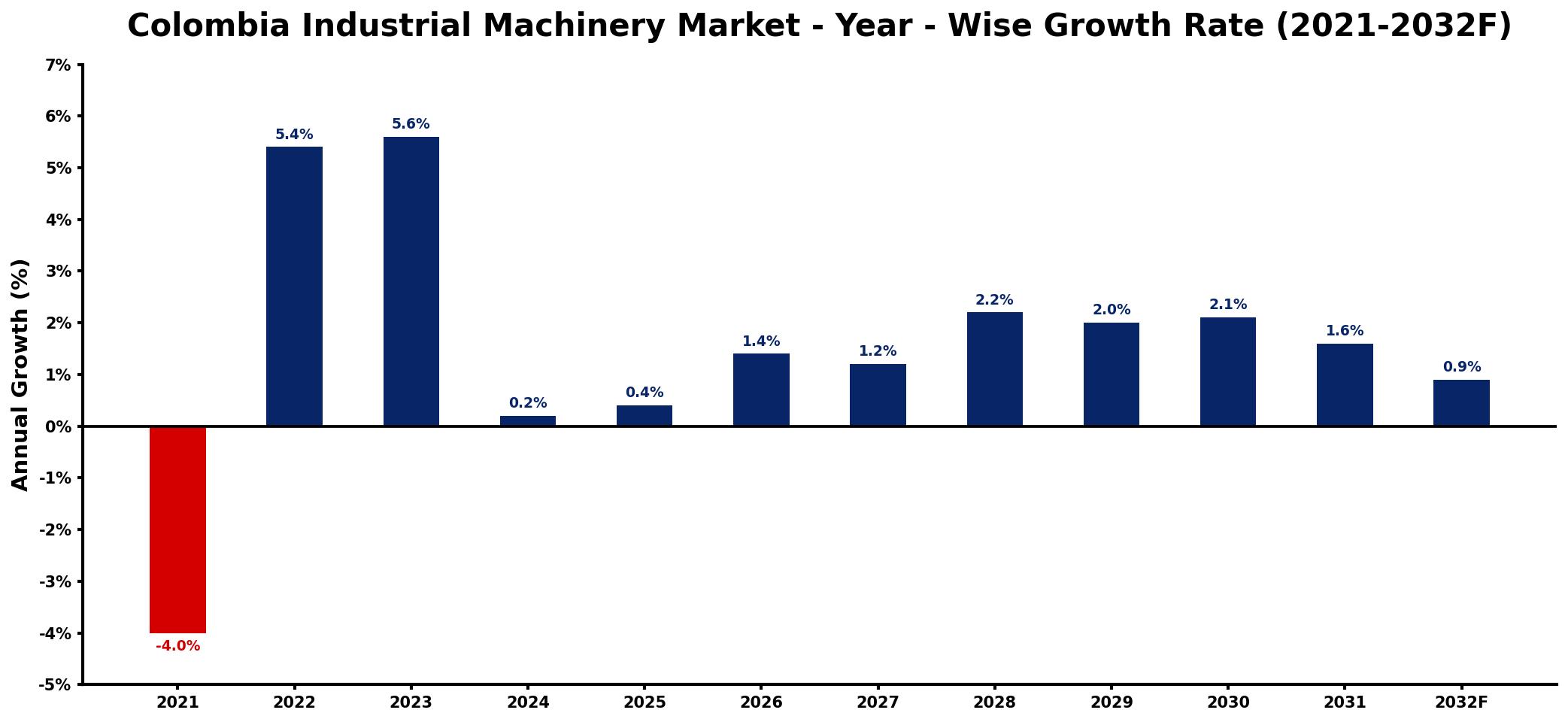
The table below presents the year‑wise growth rates along with the key drivers influencing the market
| Year | Growth Rate | Major Drivers |
| 2021 | -4.0% | decreased investment in construction projects |
| 2022 | 5.4% | expansion of renewable energy sector |
| 2023 | 5.6% | growth in manufacturing capabilities |
| 2024 | 0.2% | increased infrastructure development projects |
| 2025 | 0.4% | rising demand for automation solutions |
| 2026 | 1.4% | enhanced logistics and distribution networks |
| 2027 | 1.2% | investment in technological advancements |
| 2028 | 2.2% | expanding manufacturing base activity |
| 2029 | 2.0% | rising end-use demand growth |
| 2030 | 2.1% | increased focus on sustainability initiatives |
| 2031 | 1.6% | development of urbanization projects |
| 2032 | 0.9% | growing emerging market penetration |
Note: Market size estimations and growth projections presented in this report are based on 6Wresearch's proprietary forecasting methodology, utilizing the latest available industry data, government publications, and primary research inputs.
Colombia Industrial Machinery Market Synopsis
The industrial machinery sector in Colombia has become a pivotal player in the countrys economic transformation. Recent trends show a surge in demand for advanced machinery as manufacturers strive to improve productivity and meet the evolving needs of various industries.
Colombias unique geographic and economic landscape presents both challenges and opportunities within the industrial machinery market. Companies are increasingly investing in innovative machinery to enhance reliability and performance, catering to the growing emphasis on sustainability and efficiency.
Colombia Industrial Machinery Market Key Takeaways
- The market is driven by the push for automation and technological innovation.
- Investments in advanced manufacturing technologies are reshaping the industry.
- Market growth is influenced by fluctuations in raw material prices and competition from imports.
- Government initiatives play a crucial role in supporting industry advancements.
- Emerging trends highlight the importance of sustainability and digitalization in manufacturing processes.
Evaluation of Restraints in Colombia Industrial Machinery Market
The Colombia Industrial Machinery Market is currently grappling with several restraints that hinder its growth potential. One primary concern is the volatility in raw material prices, which creates uncertainty in manufacturing costs and ultimately affects product pricing. Furthermore, the competitive pressure from imported machinery adds to the challenges faced by local manufacturers, who must constantly innovate to keep pace with global advancements. Technological obsolescence also looms large, compelling businesses to invest continually in upgrading their equipment and processes to avoid falling behind.
Colombia Industrial Machinery Market Trends
Several current and emerging trends are significantly shaping the Colombia Industrial Machinery Market. The trend towards automation is profound, as industries strive to enhance operational efficiency through smart machines. Additionally, the integration of digital technologies, such as IoT and AI, into machinery is increasingly prevalent, facilitating better data analytics and predictive maintenance.
Sustainability is another critical trend driving demand. Manufacturers are actively seeking machinery that not only improves productivity but also aligns with eco-friendly practices. This dual focus on efficiency and sustainability is pushing the market towards innovative solutions that reduce waste and energy consumption.
Colombia Industrial Machinery Market Opportunities
There are promising growth and investment opportunities within the Colombia Industrial Machinery Market. As local manufacturers pivot towards automation and digitization, there is a significant need for suppliers of advanced machinery and technology solutions. Companies that can offer flexible and sustainable machinery options stand to gain a competitive edge. Additionally, partnerships focusing on technology transfer could foster innovation and expand capabilities in the sector, further enhancing market potential.
Government Initiatives in the Colombia Industrial Machinery Market
The Colombian government is taking an active role in supporting the industrial machinery sector through various initiatives. Policies are being implemented to encourage investments in advanced manufacturing technologies, creating a favorable environment for growth. Financing options for machinery purchases are also available, making it easier for companies to upgrade their equipment. Furthermore, the government is promoting partnerships aimed at technology transfer and innovation, enhancing the industry's capacity to adapt and thrive.
Future Insights of the Colombia Industrial Machinery Market
Looking ahead to 2026-2032, the Colombia Industrial Machinery Market is expected to evolve significantly. With ongoing industrialization and a strong emphasis on automation, the market will likely witness increased investments in cutting-edge technologies. The demand for flexible and smart machinery is anticipated to grow as companies strive to meet global standards of efficiency and sustainability. As Colombia continues to embrace modernization, the industrial machinery sector is set to become a cornerstone of economic growth and resilience.
Colombia Industrial Machinery Market Latest Developments (2025 - 2026)
Recent developments in the Colombia Industrial Machinery Market indicate a robust shift towards embracing advanced technologies. Manufacturers are increasingly adopting IoT-enabled machinery, allowing for greater operational efficiencies and data-driven insights. Moreover, industry players are collaborating with technology firms to enhance their product offerings and innovate in response to changing market demands. Additionally, sustainability initiatives are gaining traction as companies look to reduce their carbon footprint and align with global environmental standards.
Colombia Industrial Machinery Market - Key Attractiveness of the Report
- 10 Years of Market Numbers
- Historical Data Starting from 2022 to 2025
- Base Year: 2025
- Forecast Data until 2032
- Key Performance Indicators Impacting the Market
- Major Upcoming Developments and Projects
Key Highlights of the Report:
- Colombia Industrial Machinery Market Outlook
- Market Size of Colombia Industrial Machinery Market, 2025
- Forecast of Colombia Industrial Machinery Market, 2032
- Historical Data and Forecast of Colombia Industrial Machinery Revenues & Volume for the Period 2022-2032F
- Colombia Industrial Machinery Market Trend Evolution
- Colombia Industrial Machinery Market Drivers and Challenges
- Colombia Industrial Machinery Price Trends
- Colombia Industrial Machinery Porter's Five Forces
- Colombia Industrial Machinery Industry Life Cycle
- Historical Data and Forecast of Colombia Industrial Machinery Market Revenues & Volume By Application for the Period 2022-2032F
- Historical Data and Forecast of Colombia Industrial Machinery Market Revenues & Volume By Agriculture for the Period 2022-2032F
- Historical Data and Forecast of Colombia Industrial Machinery Market Revenues & Volume By Construction for the Period 2022-2032F
- Historical Data and Forecast of Colombia Industrial Machinery Market Revenues & Volume By Packaging for the Period 2022-2032F
- Historical Data and Forecast of Colombia Industrial Machinery Market Revenues & Volume By Food Processing for the Period 2022-2032F
- Historical Data and Forecast of Colombia Industrial Machinery Market Revenues & Volume By Mining for the Period 2022-2032F
- Historical Data and Forecast of Colombia Industrial Machinery Market Revenues & Volume By Semiconductor Manufacturing for the Period 2022-2032F
- Colombia Industrial Machinery Import Export Trade Statistics
- Market Opportunity Assessment By Application
- Colombia Industrial Machinery Top Companies Market Share
- Colombia Industrial Machinery Competitive Benchmarking By Technical and Operational Parameters
- Colombia Industrial Machinery Company Profiles
- Colombia Industrial Machinery Key Strategic Recommendations






































