Egypt Telecom Services Market Size, Share & Growth Rate
The Egypt Telecom Services Market was estimated at USD 413 Million in 2025 and is projected to reach USD 567 Million by 2032, growing at a CAGR of 4.6% from 2026 to 2032. This growth is primarily driven by increasing mobile penetration rates and a burgeoning demand for data services, reflecting the changing consumer habits toward mobile internet usage. Government initiatives aimed at expanding broadband infrastructure further bolster this trajectory, positioning the telecom sector as a pivotal component of Egypt's digital transformation efforts.
Egypt Telecom Services Market Year-wise Growth Rate and Key Drivers
This graph highlights how the Egypt Telecom Services Market has steadily grown over the years, supported by major growth factors.
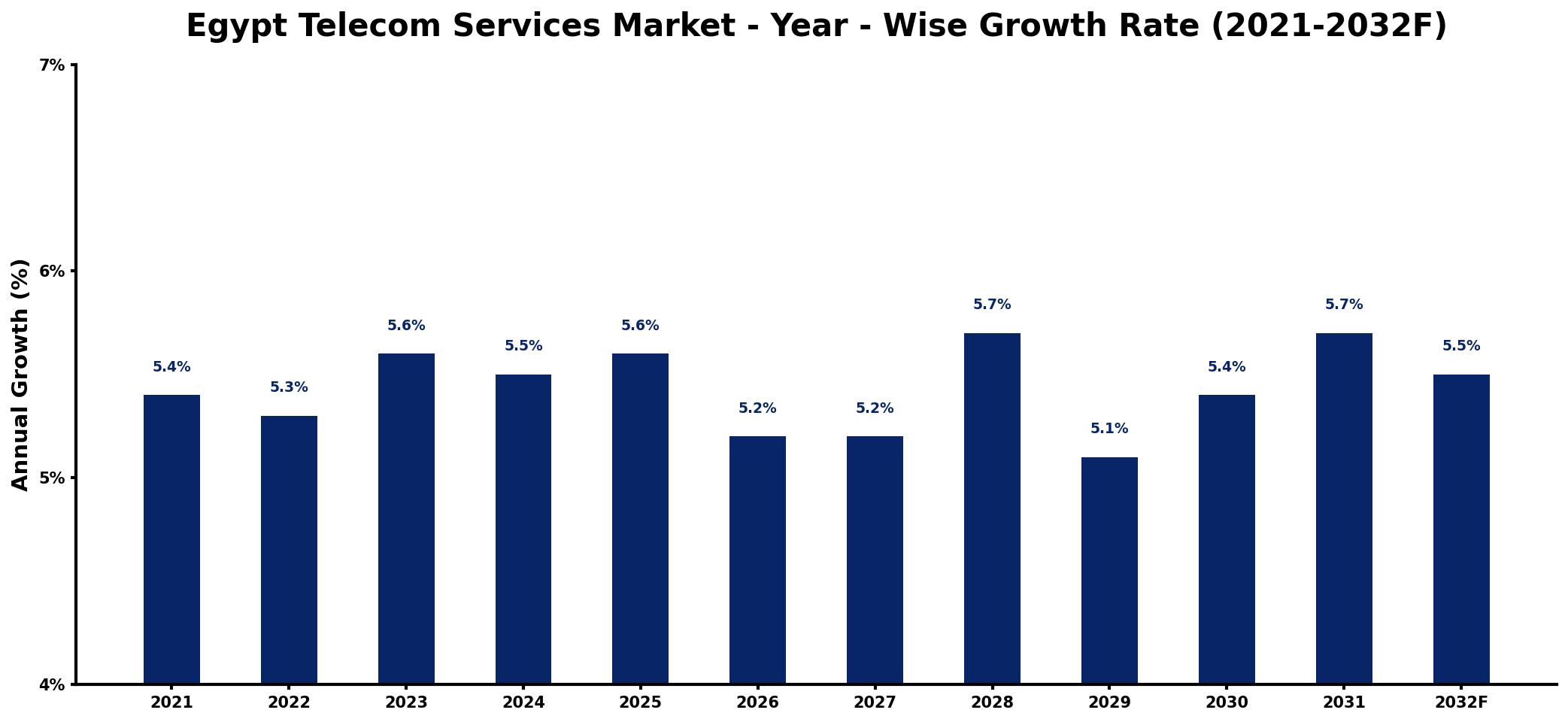
The table below presents the year‑wise growth rates along with the key drivers influencing the market
| Year | Growth Rate | Major Drivers |
| 2021 | 5.4% | rising smartphone penetration rates |
| 2022 | 5.3% | expansion of fiber optic networks |
| 2023 | 5.6% | increased mobile data consumption |
| 2024 | 5.5% | growth in digital payment adoption |
| 2025 | 5.6% | surge in cloud computing demand |
| 2026 | 5.2% | development of IoT applications |
| 2027 | 5.2% | investment in 5G infrastructure |
| 2028 | 5.7% | emergence of smart city projects |
| 2029 | 5.1% | rising demand from electronics |
| 2030 | 5.4% | strengthening international trade flows |
| 2031 | 5.7% | increased demand for streaming content |
| 2032 | 5.5% | enhanced product quality standards |
Note: Market size estimations and growth projections presented in this report are based on 6Wresearch's proprietary forecasting methodology, utilizing the latest available industry data, government publications, and primary research inputs.
Egypt Telecom Services Market Synopsis
The ongoing expansion of broadband infrastructure is the most influential factor currently shaping the Egypt Telecom Services Market. This government-led initiative seeks to enhance connectivity throughout urban and rural areas, thereby unlocking significant opportunities for telecom operators and consumers alike.
Coupled with a robust rise in mobile data consumption and smartphone adoption, there is a palpable shift in service offerings from traditional telephony to innovative digital services. This shift is further highlighted by the increasing consumer interest in mobile payments and e-commerce, revealing a market dynamic in constant evolution.
Egypt Telecom Services Market Key Takeaways
- The market is poised for growth, driven by a young, tech-savvy population increasingly reliant on digital services.
- Expansion of 4G and fiber optic networks is critical to meet the demands for high-speed internet access.
- Telecom operators are investing in IoT and cloud computing to enhance operational efficiency and customer experience.
- The shift toward mobile money services is gaining momentum, aligning with government efforts toward financial inclusion.
- Competitive pricing strategies and bundled offerings are becoming essential for customer retention in a crowded market.
Evaluation of Restraints in Egypt Telecom Services Market
Despite its robust growth potential, the Egypt Telecom Services Market faces significant restraints. Regulatory hurdles, particularly regarding government oversight, can stifle innovation and limit competitive dynamics among operators. Additionally, inadequate network infrastructure in rural regions leads to inconsistent service quality, presenting barriers for broader customer engagement. Rising operational costs combined with the necessity for ongoing investments in technological upgrades to keep pace with consumer demand also constrain market growth. The prevalence of prepaid services complicates revenue stability, reflecting fluctuating consumer spending patterns that can be challenging for telecom companies to navigate.
Egypt Telecom Services Market Trends
Several emerging trends are reshaping the Egypt Telecom Services Market. The rapid rollout of 4G and anticipated 5G networks promises to significantly enhance internet speed and connectivity. Additionally, telecom firms are increasingly focusing on digital transformation, leveraging innovative solutions like Internet of Things (IoT) services and cloud-based applications to improve both customer experience and operational workflows. The rising interest in digital payments and e-commerce services aligns with broader governmental initiatives aimed at promoting financial inclusivity, further signaling a shift toward a more interconnected economy.
Egypt Telecom Services Market Opportunities
Opportunities for investment abound in the Egypt Telecom Services Market, particularly in infrastructure development. Expanding and upgrading existing telecommunications frameworks to support 5G deployment and fiber optic networks will be crucial for meeting the burgeoning demand for high-speed internet. Moreover, as consumer preferences evolve, the rising need for value-added services—ranging from cloud computing to data analytics and IoT solutions—represents a promising area for companies seeking to differentiate themselves in a competitive landscape. Strategic partnerships with digital content providers could also yield lucrative returns as more consumers gravitate toward online entertainment and communication platforms.
Government Initiatives in the Egypt Telecom Services Market
The Egyptian government, through the National Telecommunications Regulatory Authority (NTRA), plays a pivotal role in shaping the Telecom Services Market. Regulatory policies have been established to enhance competition, ensuring a level playing field for various service providers. Ongoing initiatives focus on expanding broadband access nationwide, particularly in underserved regions. Furthermore, efforts to privatize state-owned telecom entities aim to enhance operational efficiency and attract foreign investment, ultimately driving progress in the sector.
Future Insights of the Egypt Telecom Services Market
Looking ahead to 2026-2032, the Egypt Telecom Services Market is set for transformative growth, bolstered by escalating demand for high-speed connectivity and an increasingly digital-native population. The integration of 5G technology will not only enhance service offerings but also pave the way for innovative applications in various sectors, including healthcare, transportation, and smart city initiatives. As competition intensifies among telecom operators, consumers can anticipate improvements in service quality and pricing, making this an attractive landscape for both investment and development in the near future.
Egypt Telecom Services Market Latest Developments (2025 - 2026)
In recent months, the telecom landscape in Egypt has seen significant movement towards greater digital transformation. Companies are increasingly rolling out advanced technology solutions to enhance customer experience and operational capabilities. Additionally, collaborations between telecom operators and tech innovators are becoming more common, signaling a shift towards integrated service models. These trends highlight a commitment to improving infrastructure and service offerings in alignment with evolving consumer needs.
Egypt Telecom Services Market - Key Attractiveness of the Report
- 10 Years of Market Numbers
- Historical Data Starting from 2022 to 2025
- Base Year: 2025
- Forecast Data until 2032
- Key Performance Indicators Impacting the Market
- Major Upcoming Developments and Projects
Key Highlights of the Report:
- Egypt Telecom Services Market Outlook
- Market Size of Egypt Telecom Services Market, 2025
- Forecast of Egypt Telecom Services Market, 2032
- Historical Data and Forecast of Egypt Telecom Services Revenues & Volume for the Period 2022-2032F
- Egypt Telecom Services Market Trend Evolution
- Egypt Telecom Services Market Drivers and Challenges
- Egypt Telecom Services Price Trends
- Egypt Telecom Services Porter's Five Forces
- Egypt Telecom Services Industry Life Cycle
- Historical Data and Forecast of Egypt Telecom Services Market Revenues & Volume By Service Type for the Period 2022-2032F
- Historical Data and Forecast of Egypt Telecom Services Market Revenues & Volume By Fixed Voice Services for the Period 2022-2032F
- Historical Data and Forecast of Egypt Telecom Services Market Revenues & Volume By Fixed Internet Access Services for the Period 2022-2032F
- Historical Data and Forecast of Egypt Telecom Services Market Revenues & Volume By Mobile Voice Services for the Period 2022-2032F
- Historical Data and Forecast of Egypt Telecom Services Market Revenues & Volume By Mobile Data Services for the Period 2022-2032F
- Historical Data and Forecast of Egypt Telecom Services Market Revenues & Volume By Pay-TV Services for the Period 2022-2032F
- Historical Data and Forecast of Egypt Telecom Services Market Revenues & Volume By Machine-to-Machine (Mobile IoT) Services for the Period 2022-2032F
- Historical Data and Forecast of Egypt Telecom Services Market Revenues & Volume By Transmission for the Period 2022-2032F
- Historical Data and Forecast of Egypt Telecom Services Market Revenues & Volume By Wireline for the Period 2022-2032F
- Historical Data and Forecast of Egypt Telecom Services Market Revenues & Volume By Wireless for the Period 2022-2032F
- Historical Data and Forecast of Egypt Telecom Services Market Revenues & Volume By End-use for the Period 2022-2032F
- Historical Data and Forecast of Egypt Telecom Services Market Revenues & Volume By Consumer/Residential for the Period 2022-2032F
- Historical Data and Forecast of Egypt Telecom Services Market Revenues & Volume By Business for the Period 2022-2032F
- Egypt Telecom Services Import Export Trade Statistics
- Market Opportunity Assessment By Service Type
- Market Opportunity Assessment By Transmission
- Market Opportunity Assessment By End-use
- Egypt Telecom Services Top Companies Market Share
- Egypt Telecom Services Competitive Benchmarking By Technical and Operational Parameters
- Egypt Telecom Services Company Profiles
- Egypt Telecom Services Key Strategic Recommendations






































