France Overhead Catenary System Market (2026-2032) Outlook | Companies, Size, Forecast, Analysis, Revenue, Trends, Industry, Share, Value, Growth
Market Forecast By Train Type (Metro, Light Rail, High-speed Rail), By Voltage (Low, Medium, High), By Catenary Type (Simple Catenary, Stitched Catenary, Compound Catenary), By Component (Contact Wire, Droppers, Insulators, Cantilevers, Connectors, Clamps, Steady Arm), By Material (Cu-Cd, Cu-Ag, Cu-Mg, Cu-Sn) And Competitive Landscape
| Product Code: ETC093269 | Publication Date: Jun 2021 | Updated Date: Jun 2026 | Product Type: Report | |
| Publisher: 6Wresearch | Author: Vasudha | No. of Pages: 70 | No. of Figures: 35 | No. of Tables: 5 |
France Overhead Catenary System Market Size, Share & Growth Rate
The France Overhead Catenary System Market was estimated at USD 82 Million in 2025 and is projected to reach USD 91 Million by 2032, growing at a CAGR of 1.5% from 2026 to 2032. This growth trajectory is driven by a combination of heightened governmental focus on sustainable transportation and the urgent need for infrastructure modernization. Investments in high-speed rail projects and electrification initiatives are fostering a favorable landscape for advanced catenary systems.
France Overhead Catenary System Market Growth Rate Analysis (2021-2032)
The Overhead Catenary System market in France has displayed notable fluctuations over the past few years. After a decline of 4.0% in 2021, the sector rebounded strongly with a growth of 6.5% in 2022, fueled by increased investment in public transportation infrastructure and a shift towards sustainable energy solutions. Growth is expected to moderate, settling at 3.3% in 2023 before tapering to around 2% in 2025. Factors such as ongoing urbanization, rising consumer demand for efficient transport, and advancements in technology contribute to this upward trend. However, the market faces pressures from potential policy changes and competition from alternative transport solutions, tempering future growth towards 2.1% by 2032.
France Overhead Catenary System Market Year-wise Growth Rate and Key Drivers
This graph highlights how the France Overhead Catenary System Market has steadily grown over the past five years, supported by major growth factors.
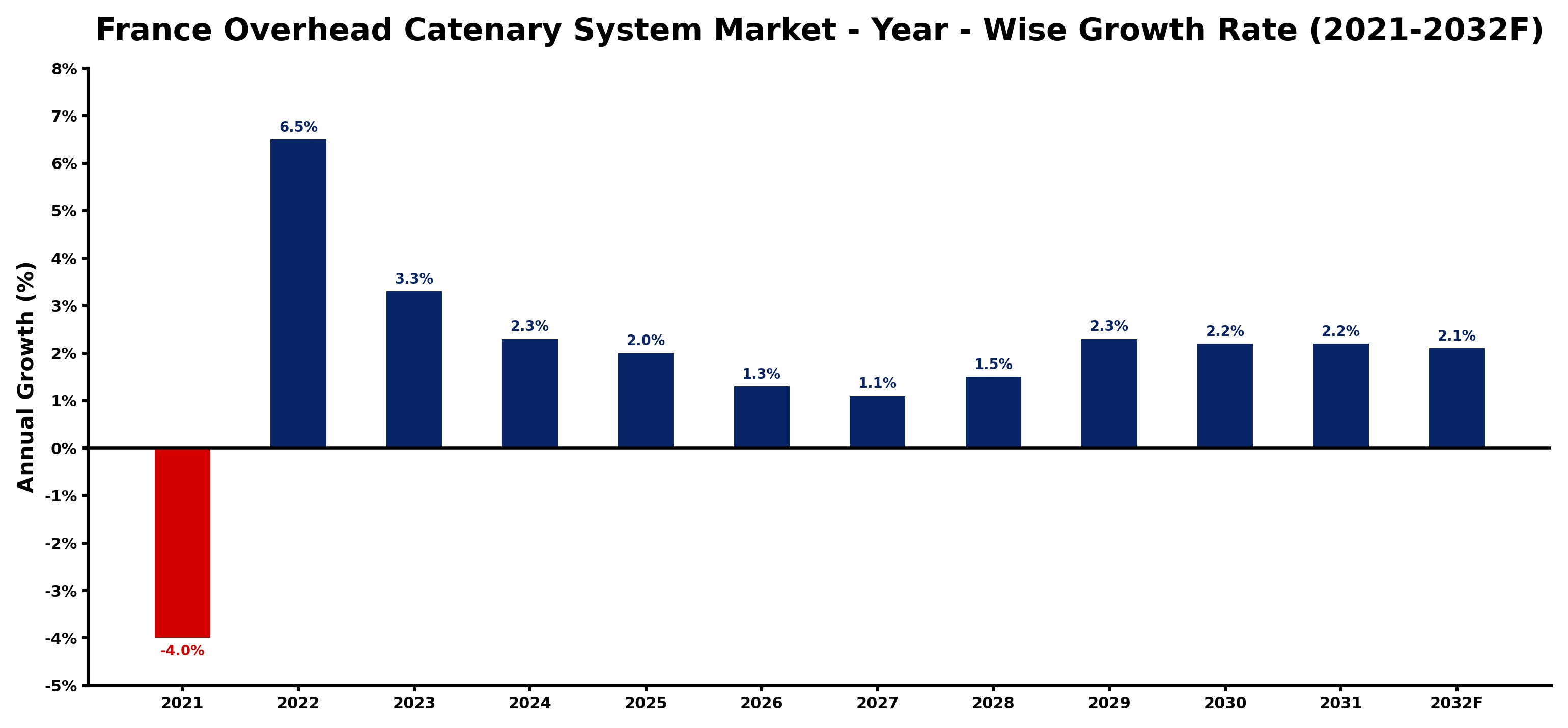
The table below presents the year‑wise growth rates along with the key drivers influencing the market
| Year | Growth Rate | Major Drivers |
| 2021 | -4.0% | Manufacturing slowdowns in automotive sectors decreased overhead catenary system demand |
| 2022 | 6.5% | Infrastructure upgrades drove demand for advanced overhead catenary systems |
| 2023 | 3.3% | Advanced signaling technology adoption boosts overhead catenary system reliability |
| 2024 | 2.3% | Manufacturing investments in railway infrastructure drive catenary system upgrades |
| 2025 | 2.0% | Higher public transit investments boost overhead catenary system deployments |
| 2026 | 1.3% | Export driven infrastructure upgrades boost demand for overhead catenary systems |
| 2027 | 1.1% | Rail network upgrades boosted demand for overhead catenary systems |
| 2028 | 1.5% | Improved public transport investments boosted overhead catenary system installations |
| 2029 | 2.3% | Railway electrification projects boosted overhead catenary system installations |
| 2030 | 2.2% | Infrastructure upgrades stimulate demand for catenary system components |
| 2031 | 2.2% | Strengthened technology integration optimized maintenance schedules for catenary systems |
| 2032 | 2.1% | Regional electrification projects stimulated demand for overhead catenary systems |
Note - Market size estimations and growth projections presented in this report are based on 6Wresearch’s advanced forecasting approach, validated with industry datasets as of June 2026.
France Overhead Catenary System Market Synopsis
The most potent force shaping the France Overhead Catenary System Market is the government’s push towards sustainable transportation solutions. As rail networks modernize and expand, the emphasis on electrification to curtail carbon emissions gains momentum, fostering growth in this sector.
Technological advancements are also pivotal in driving market dynamics. Innovations such as predictive maintenance and digital monitoring systems are becoming integral, enhancing efficiency and reliability while reducing operational costs. This technological shift indicates a broader transformation in how rail systems are managed and optimized across France.
France Overhead Catenary System Market Key Takeaways
- Government initiatives are significantly boosting investments in railway infrastructure.
- Technological advancements are improving efficiency, reliability, and safety within catenary systems.
- There is a growing demand for sustainable transportation solutions, particularly electric traction systems.
- Investment opportunities exist in maintenance services and R&D for innovative catenary systems.
- Aging infrastructure poses challenges, requiring strategic upgrades and maintenance to ensure safety and efficiency.
Evaluation of Restraints in France Overhead Catenary System Market
Despite its growth potential, the France Overhead Catenary System Market faces notable constraints. Aging infrastructure necessitates significant maintenance and upgrades to enhance operational safety and efficiency. The adoption of innovative technologies, while beneficial, requires overcoming financial barriers related to initial implementation costs. Additionally, complex regulatory frameworks can impede the swift adoption of new systems, affecting overall market progress. Addressing these issues demands collaborative efforts among stakeholders to innovate solutions that align with both fiscal and operational objectives.
France Overhead Catenary System Market Trends
The market is increasingly influenced by a shift towards electrification and sustainability, with stakeholders focusing on advanced overhead catenary systems that improve energy efficiency. Innovations like smart catenary solutions and automation are trending, enhancing system monitoring and operational control. There's also a movement towards utilizing innovative materials and design strategies that promote durability while reducing maintenance costs, contributing to the modernization of railway infrastructure.
France Overhead Catenary System Market Opportunities
Investment opportunities within the France Overhead Catenary System Market are plentiful, particularly in the realm of innovative system development. Companies can capitalize on the demand for advanced, energy-efficient catenary solutions that enhance the rail network's reliability. Additionally, providing maintenance and upgrade services for existing systems presents a lucrative avenue. Research and development into cost-effective and sustainable technologies will also prove beneficial as the market evolves to meet the increasing demands for efficient rail transport.
Government Initiatives in the France Overhead Catenary System Market
The French government is actively promoting sustainable transportation through policies that encourage the expansion and modernization of the Overhead Catenary System infrastructure. Initiatives aimed at enhancing high-speed rail networks and increasing the efficiency of existing systems are pivotal. The government also provides various incentives to support the transition towards electric trains powered by overhead systems, aligning with France’s environmental goals to reduce carbon emissions and enhance overall transportation reliability.
Future Insights of the France Overhead Catenary System Market
Looking ahead to 2026-2032, the France Overhead Catenary System Market is set for steady growth, primarily fueled by the ongoing push for sustainable transportation. Increased investments will support the electrification of rail lines and integrate high-speed trains, responding to the rising demand for greener rail solutions. Furthermore, advancements in technology, particularly smart systems and automation, will create avenues for enhanced operational efficiency, thus shaping a more robust future for the market.
France Overhead Catenary System Market Latest Developments (May 2025 - June 2026)
The industry is currently witnessing several developments aimed at enhancing the efficiency and reliability of overhead catenary systems. Recent initiatives focus on integrating advanced monitoring technologies and automation to streamline operations and maintenance. Collaborative efforts among stakeholders are fostering innovations that align with government sustainability goals, positioning the market for notable advancements in the coming years.
France Overhead Catenary System Market - Key Attractiveness of the Report
- 10 Years of Market Numbers
- Historical Data Starting from 2022 to 2025
- Base Year: 2025
- Forecast Data until 2032
- Key Performance Indicators Impacting the Market
- Major Upcoming Developments and Projects
Key Highlights of the Report:
- France Overhead Catenary System Market Outlook
- Market Size of France Overhead Catenary System Market, 2025
- Forecast of France Overhead Catenary System Market, 2032
- Historical Data and Forecast of France Overhead Catenary System Revenues & Volume for the Period 2022-2032F
- France Overhead Catenary System Market Trend Evolution
- France Overhead Catenary System Market Drivers and Challenges
- France Overhead Catenary System Price Trends
- France Overhead Catenary System Porter's Five Forces
- France Overhead Catenary System Industry Life Cycle
- Historical Data and Forecast of France Overhead Catenary System Market Revenues & Volume By Train Type for the Period 2022-2032F
- Historical Data and Forecast of France Overhead Catenary System Market Revenues & Volume By Metro for the Period 2022-2032F
- Historical Data and Forecast of France Overhead Catenary System Market Revenues & Volume By Light Rail for the Period 2022-2032F
- Historical Data and Forecast of France Overhead Catenary System Market Revenues & Volume By High-speed Rail for the Period 2022-2032F
- Historical Data and Forecast of France Overhead Catenary System Market Revenues & Volume By Voltage for the Period 2022-2032F
- Historical Data and Forecast of France Overhead Catenary System Market Revenues & Volume By Low for the Period 2022-2032F
- Historical Data and Forecast of France Overhead Catenary System Market Revenues & Volume By Medium for the Period 2022-2032F
- Historical Data and Forecast of France Overhead Catenary System Market Revenues & Volume By High for the Period 2022-2032F
- Historical Data and Forecast of France Overhead Catenary System Market Revenues & Volume By Catenary Type for the Period 2022-2032F
- Historical Data and Forecast of France Overhead Catenary System Market Revenues & Volume By Simple Catenary for the Period 2022-2032F
- Historical Data and Forecast of France Overhead Catenary System Market Revenues & Volume By Stitched Catenary for the Period 2022-2032F
- Historical Data and Forecast of France Overhead Catenary System Market Revenues & Volume By Compound Catenary for the Period 2022-2032F
- Historical Data and Forecast of France Overhead Catenary System Market Revenues & Volume By Component for the Period 2022-2032F
- Historical Data and Forecast of France Overhead Catenary System Market Revenues & Volume By Contact Wire for the Period 2022-2032F
- Historical Data and Forecast of France Overhead Catenary System Market Revenues & Volume By Droppers for the Period 2022-2032F
- Historical Data and Forecast of France Overhead Catenary System Market Revenues & Volume By Insulators for the Period 2022-2032F
- Historical Data and Forecast of France Overhead Catenary System Market Revenues & Volume By Cantilevers for the Period 2022-2032F
- Historical Data and Forecast of France Overhead Catenary System Market Revenues & Volume By Connectors for the Period 2022-2032F
- Historical Data and Forecast of France Overhead Catenary System Market Revenues & Volume By Clamps for the Period 2022-2032F
- Historical Data and Forecast of France Overhead Catenary System Market Revenues & Volume By Steady Arm for the Period 2022-2032F
- Historical Data and Forecast of France Overhead Catenary System Market Revenues & Volume By Material for the Period 2022-2032F
- Historical Data and Forecast of France Overhead Catenary System Market Revenues & Volume By Cu-Cd for the Period 2022-2032F
- Historical Data and Forecast of France Overhead Catenary System Market Revenues & Volume By Cu-Ag for the Period 2022-2032F
- Historical Data and Forecast of France Overhead Catenary System Market Revenues & Volume By Cu-Mg for the Period 2022-2032F
- Historical Data and Forecast of France Overhead Catenary System Market Revenues & Volume By Cu-Sn for the Period 2022-2032F
- France Overhead Catenary System Import Export Trade Statistics
- Market Opportunity Assessment By Train Type
- Market Opportunity Assessment By Voltage
- Market Opportunity Assessment By Catenary Type
- Market Opportunity Assessment By Component
- Market Opportunity Assessment By Material
- France Overhead Catenary System Top Companies Market Share
- France Overhead Catenary System Competitive Benchmarking By Technical and Operational Parameters
- France Overhead Catenary System Company Profiles
- France Overhead Catenary System Key Strategic Recommendations
France Overhead Catenary System Market - Frequently Asked Questions
The market is propelled by governmental investments in modernizing rail infrastructure and a strong push for sustainable, electrified transportation solutions. These factors are creating a demand for more efficient overhead catenary systems.
The France Overhead Catenary System Market was estimated at USD 82 Million in 2025, projected to reach USD 91 Million by 2032, with a CAGR of 1.5% from 2026 to 2032, reflecting the ongoing commitment to enhancing rail electrification.
The market is seeing the adoption of predictive maintenance, digital monitoring systems, and smart automation technologies, all aimed at improving the reliability and efficiency of overhead catenary systems.
Government policies are essential in promoting sustainable transportation, providing funding and incentives to enhance catenary system infrastructure, thereby supporting electrification initiatives throughout the rail network.
Investors can find opportunities in innovative overhead catenary systems, maintenance services for existing infrastructures, and R&D for next-generation technologies that focus on sustainability and cost-efficiency.
6Wresearch actively monitors the France Overhead Catenary System Market and publishes its comprehensive annual report, highlighting emerging trends, growth drivers, revenue analysis, and forecast outlook. Our insights help businesses to make data-backed strategic decisions with ongoing market dynamics. Our analysts track relevent industries related to the France Overhead Catenary System Market, allowing our clients with actionable intelligence and reliable forecasts tailored to emerging regional needs.
Yes, we provide customisation as per your requirements. To learn more, feel free to contact us on sales@6wresearch.com
Global Go To Market Strategy - 2030
Export potential enables firms to identify high-growth global markets with greater confidence by combining advanced trade intelligence with a structured quantitative methodology. The framework analyzes emerging demand trends and country-level import patterns while integrating macroeconomic and trade datasets such as GDP and population forecasts, bilateral import–export flows, tariff structures, elasticity differentials between developed and developing economies, geographic distance, and import demand projections. Using weighted trade values from 2020–2024 as the base period to project country-to-country export potential for 2030, these inputs are operationalized through calculated drivers such as gravity model parameters, tariff impact factors, and projected GDP per-capita growth. Through an analysis of hidden potentials, demand hotspots, and market conditions that are most favorable to success, this method enables firms to focus on target countries, maximize returns, and global expansion with data, backed by accuracy.
By factoring in the projected importer demand gap that is currently unmet and could be potential opportunity, it identifies the potential for the Exporter (Country) among 190 countries, against the general trade analysis, which identifies the biggest importer or exporter.
To discover high-growth global markets and optimize your business strategy:
Click Here
Pricing
- Single User License$ 1,995
- Department License$ 2,400
- Site License$ 3,120
- Global License$ 3,795

Leadership Perspectives from Industry Events
Search
Thought Leadership and Analyst Meet





Our Clients








6WResearch In News
- India Air Conditioner Market Set for Strong Rebound in 2026 After Weather-Led Correction and GST-Driven Recovery: 6Wresearch
- ADAS in India: How Automatic Emergency Braking, Blind Spot Detection & Driver Monitoring are Transforming Road Safety
- Doha a strategic location for EV manufacturing hub: IPA Qatar
- Demand for luxury TVs surging in the GCC, says Samsung
- Empowering Growth: The Thriving Journey of Bangladesh’s Cable Industry
- Demand for luxury TVs surging in the GCC, says Samsung
Latest Reports
- Poland Fire Protection Systems Market (2026-2032)
- Cape Verde Portable Hand-Thrown Extinguisher Market (2026-2032)
- Canada Portable Hand-Thrown Extinguisher Market (2026-2032)
- Cameroon Portable Hand-Thrown Extinguisher Market (2026-2032)
- Burundi Portable Hand-Thrown Extinguisher Market (2026-2032)
- Burkina Faso Portable Hand-Thrown Extinguisher Market (2026-2032)
- Bulgaria Portable Hand-Thrown Extinguisher Market (2026-2032)
- Brunei Portable Hand-Thrown Extinguisher Market (2026-2032)
- Botswana Portable Hand-Thrown Extinguisher Market (2026-2032)
- Bosnia and Herzegovina Portable Hand-Thrown Extinguisher Market (2026-2032)
Industry Events and Analyst Meet

HIMTEX 2026

India Refining Summit 2026

India EV Show 2026

EV tech India Expo 2026

Auto Tech Asia 2026
Whitepaper
- Middle East & Africa Commercial Security Market Click here to view more.
- Middle East & Africa Fire Safety Systems & Equipment Market Click here to view more.
- GCC Drone Market Click here to view more.
- Middle East Lighting Fixture Market Click here to view more.
- GCC Physical & Perimeter Security Market Click here to view more.


