Germany Business Intelligence and Analytics Software Market Size & Growth Rate (2026-2032)
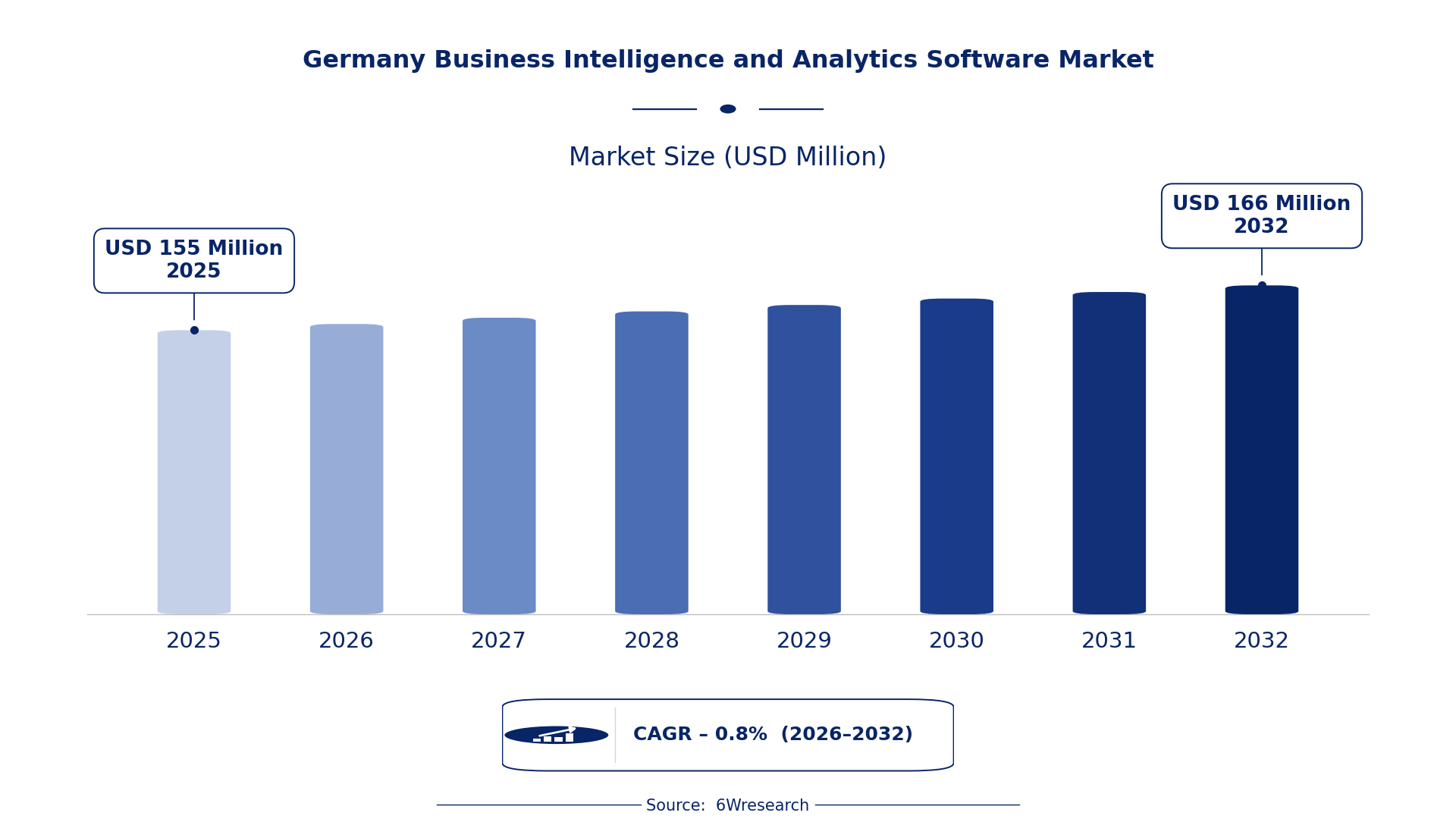
The Germany Business Intelligence and Analytics Software Market was estimated at USD 155 Million in 2025 and is projected to reach USD 166 Million by 2032, growing at a CAGR of 0.8% from 2026 to 2032.
Germany Business Intelligence and Analytics Software Market Synopsis
The Germany Business Intelligence and Analytics Software Market is experiencing a surge as organizations increasingly turn to analytics solutions for operational efficiency and competitive differentiation. This shift is propelled by an uptick in data generation across various sectors, underscoring the need for insightful analytics.
Looking ahead, the market is expected to evolve with the integration of advanced technologies such as AI and machine learning. As companies embrace cloud-based solutions, the demand for self-service analytics tools is on the rise, indicating a transformative phase in how businesses approach data-driven decision-making.
Germany Business Intelligence and Analytics Software Market Year-wise Growth Rate and Key Drivers
This graph illustrates the annual growth rates of the Germany Business Intelligence and Analytics Software Market from 2021 to 2032, highlighting a steady upward trajectory and projected expansion over the forecast period.
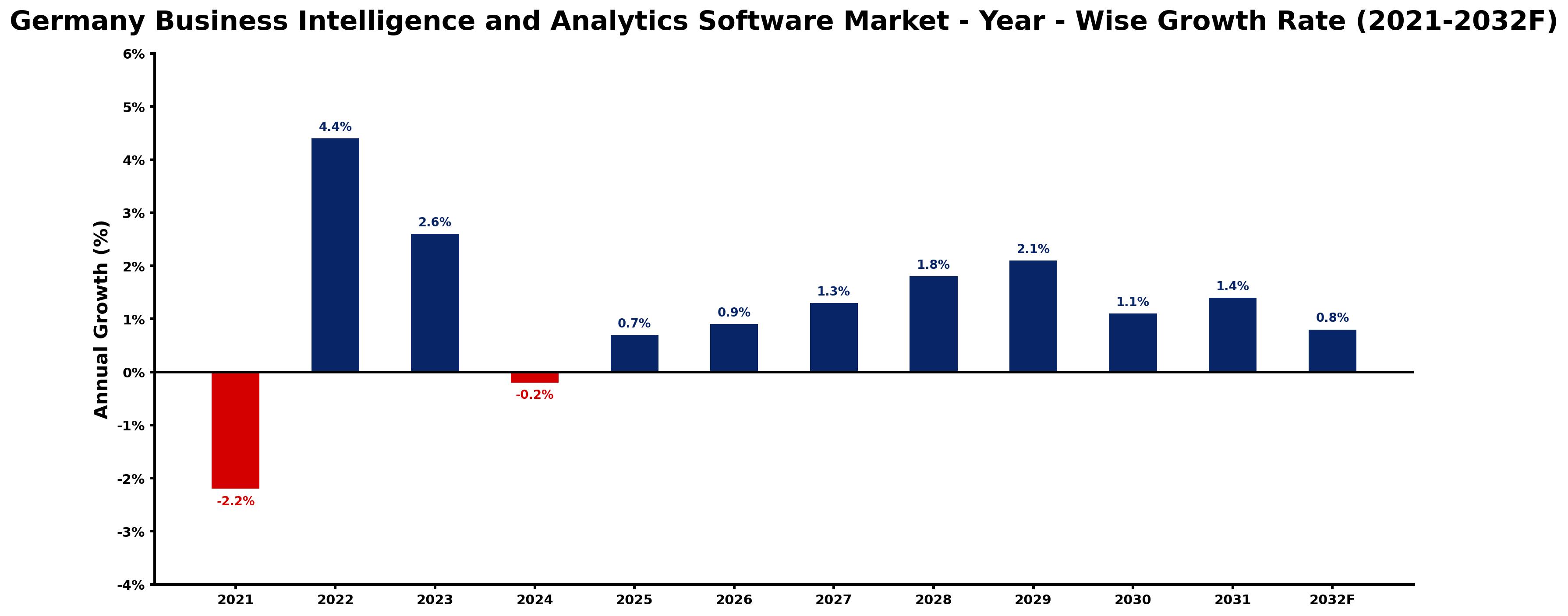
The table below presents the year‑wise growth rates along with the key drivers influencing the market
| Year | Growth Rate | Major Drivers |
| 2021 | -2.2% | Post-pandemic budget cuts by German enterprises |
| 2022 | 4.4% | Increased adoption of GDPR-compliant data analytics tools. |
| 2023 | 2.6% | Rise in demand for real-time business insights and reporting. |
| 2024 | -0.2% | Delayed adoption of cloud solutions in local businesses |
| 2025 | 0.7% | Emergence of AI-driven analytics solutions in enterprises. |
| 2026 | 0.9% | Growing emphasis on data transparency and accessibility. |
| 2027 | 1.3% | Investment in advanced analytics by mid-sized companies. |
| 2028 | 1.8% | Demand for predictive analytics in retail sector expansion. |
| 2029 | 2.1% | Rising need for data visualization among financial institutions. |
| 2030 | 1.1% | Focus on data-driven decision making post-pandemic recovery. |
| 2031 | 1.4% | Growth of cloud-based analytics solutions in Germany. |
| 2032 | 0.8% | Increasing integration of IoT data into business strategies. |
Note: Market size estimations and growth projections presented in this report are based on 6Wresearch's proprietary forecasting methodology, utilizing the latest available industry data, government publications, and primary research inputs.
Germany Business Intelligence and Analytics Software Market Key Takeaways
Below are some of the specific key takeaways from the market, including:
- Organizations are increasingly adopting cloud-based BI solutions for their flexibility and cost-effectiveness.
- The growing volume of data necessitates advanced analytics capabilities to drive actionable insights.
- Self-service analytics tools are gaining traction as businesses seek user-friendly data visualization options.
- AI and machine learning integrations are enhancing the analytical capabilities of BI software.
- Market fragmentation poses challenges in differentiation among numerous vendors and offerings.
Evaluation of Restraints in Germany Business Intelligence and Analytics Software Market
The Germany Business Intelligence and Analytics Software Market faces several real constraints. Rapid technological advancements require continuous innovation, which can strain resources for many companies. on top of that, concerns regarding data privacy and security, particularly with cloud-based solutions, can deter potential adoption. The fragmented market, characterized by numerous vendors providing similar services, complicates differentiation efforts, making it challenging for businesses to establish a strong market presence.
Germany Business Intelligence and Analytics Software Market Trends
Key trends are shaping the future of the Germany Business Intelligence and Analytics Software Market. The rise of self-service analytics reflects a shift towards empowering business users with direct access to data insights. Additionally, the integration of machine learning capabilities is enabling predictive analytics, allowing companies to anticipate market shifts effectively. Cloud-based solutions continue to dominate, offering scalability that aligns with business growth. Businesses are also prioritizing data governance and compliance, particularly in light of stringent regulations.
Germany Business Intelligence and Analytics Software Market Opportunities
There are genuine growth and investment opportunities within the Germany Business Intelligence and Analytics Software Market. The increasing demand for cloud-based analytics solutions offers significant potential for vendors to expand their service offerings. on top of that, the integration of advanced technologies, such as AI and machine learning, provides avenues for new product developments. Companies that focus on enhancing user experience through intuitive interfaces and self-service capabilities are likely to capture a larger share of the market. The ongoing digital transformation across various sectors creates a fertile ground for innovative analytics solutions.
Government Initiatives in the Germany Business Intelligence and Analytics Software Market
The German government plays a crucial role in shaping the Business Intelligence and Analytics Software Market through regulatory frameworks and initiatives that foster innovation and data security. With the implementation of GDPR, compliance is a top priority for organizations, influencing how data is managed and utilized. Government support for digital transformation initiatives also signals a commitment to enhancing the country’s analytics capabilities.
- A national initiative launched recently aims to boost data security measures within the analytics software sector.
- The current program focusing on public-private partnerships is underway to enhance digital infrastructure and analytics capabilities.
- A planned regulatory framework scheduled for 2026 will mandate transparency in data handling practices across software applications.
- In 2025, the government introduced research grants to encourage innovation in business intelligence technologies.
- Upcoming workshops are set to educate businesses on compliance with data protection regulations, expected to begin in early 2026.
Future Insights of the Germany Business Intelligence and Analytics Software Market
As we look toward 2026-2032, the Germany Business Intelligence and Analytics Software Market is poised for notable transformations. The demand for advanced analytics solutions will likely intensify as businesses become increasingly data-driven. The integration of AI and machine learning will continue to enhance analytical capabilities, allowing for deeper insights and predictive modeling. Companies that prioritize compliance with data privacy regulations will build trust and gain a competitive edge. This forward momentum will ensure that the market remains vibrant, reflecting the evolving needs of enterprises across all sectors.
Germany Business Intelligence and Analytics Software Market Latest Developments
Recent activity in the Germany Business Intelligence and Analytics Software Market indicates a strong push towards innovation and enhanced service offerings. Companies are actively launching new products and upgrading existing solutions to meet rising consumer demands. This trend reflects a broader commitment to improving data analytics capabilities within various industries.
- A major technology vendor launched an upgraded analytics platform in Q2 2025, enhancing user experience and functionality.
- Currently ongoing is a collaborative initiative among several software firms to develop a unified analytics framework for small to medium-sized enterprises.
- A regional operator is preparing for a rollout of an AI-driven analytics solution expected to begin in late 2025.
- In early 2025, a leading analytics provider completed a successful pilot program for a new self-service analytics tool.
- A planned expansion into new markets is set for mid-2026, targeting sectors with growing data needs.
Germany Business Intelligence and Analytics Software Market - Key Attractiveness of the Report
- 10 Years of Market Numbers
- Historical Data Starting from 2022 to 2025
- Base Year: 2025
- Forecast Data until 2032
- Key Performance Indicators Impacting the Market
- Major Upcoming Developments and Projects
Key Highlights of the Report:
- Germany Business Intelligence and Analytics Software Market Outlook
- Market Size of Germany Business Intelligence and Analytics Software Market, 2025
- Forecast of Germany Business Intelligence and Analytics Software Market, 2032
- Historical Data and Forecast of Germany Business Intelligence and Analytics Software Revenues & Volume for the Period 2022-2032F
- Germany Business Intelligence and Analytics Software Market Trend Evolution
- Germany Business Intelligence and Analytics Software Market Drivers and Challenges
- Germany Business Intelligence and Analytics Software Price Trends
- Germany Business Intelligence and Analytics Software Porter's Five Forces
- Germany Business Intelligence and Analytics Software Industry Life Cycle
- Historical Data and Forecast of Germany Business Intelligence and Analytics Software Market Revenues & Volume By Segment for the Period 2022-2032F
- Historical Data and Forecast of Germany Business Intelligence and Analytics Software Market Revenues & Volume By Business Intelligence (BI) Platforms for the Period 2022-2032F
- Historical Data and Forecast of Germany Business Intelligence and Analytics Software Market Revenues & Volume By Corporate Performance Management (CPM) Suite for the Period 2022-2032F
- Historical Data and Forecast of Germany Business Intelligence and Analytics Software Market Revenues & Volume By Advanced and Predictive Analytics for the Period 2022-2032F
- Historical Data and Forecast of Germany Business Intelligence and Analytics Software Market Revenues & Volume By Content Analytics for the Period 2022-2032F
- Historical Data and Forecast of Germany Business Intelligence and Analytics Software Market Revenues & Volume By Analytics Application for the Period 2022-2032F
- Historical Data and Forecast of Germany Business Intelligence and Analytics Software Market Revenues & Volume By Deployment Modes for the Period 2022-2032F
- Historical Data and Forecast of Germany Business Intelligence and Analytics Software Market Revenues & Volume By On-premise for the Period 2022-2032F
- Historical Data and Forecast of Germany Business Intelligence and Analytics Software Market Revenues & Volume By Cloud for the Period 2022-2032F
- Historical Data and Forecast of Germany Business Intelligence and Analytics Software Market Revenues & Volume By Organization Size for the Period 2022-2032F
- Historical Data and Forecast of Germany Business Intelligence and Analytics Software Market Revenues & Volume By Small Medium Business (SMB??s) for the Period 2022-2032F
- Historical Data and Forecast of Germany Business Intelligence and Analytics Software Market Revenues & Volume By Large enterprises for the Period 2022-2032F
- Historical Data and Forecast of Germany Business Intelligence and Analytics Software Market Revenues & Volume By Deployment Mode for the Period 2022-2032F
- Historical Data and Forecast of Germany Business Intelligence and Analytics Software Market Revenues & Volume By On-premise for the Period 2022-2032F
- Historical Data and Forecast of Germany Business Intelligence and Analytics Software Market Revenues & Volume By Cloud for the Period 2022-2032F
- Historical Data and Forecast of Germany Business Intelligence and Analytics Software Market Revenues & Volume By Verticals for the Period 2022-2032F
- Historical Data and Forecast of Germany Business Intelligence and Analytics Software Market Revenues & Volume By Banking, Financial Services, and Insurance (BFSI) for the Period 2022-2032F
- Historical Data and Forecast of Germany Business Intelligence and Analytics Software Market Revenues & Volume By Healthcare for the Period 2022-2032F
- Historical Data and Forecast of Germany Business Intelligence and Analytics Software Market Revenues & Volume By IT & Telecom for the Period 2022-2032F
- Historical Data and Forecast of Germany Business Intelligence and Analytics Software Market Revenues & Volume By Retail for the Period 2022-2032F
- Historical Data and Forecast of Germany Business Intelligence and Analytics Software Market Revenues & Volume By Manufacturing for the Period 2022-2032F
- Historical Data and Forecast of Germany Business Intelligence and Analytics Software Market Revenues & Volume By Education for the Period 2022-2032F
- Historical Data and Forecast of Germany Business Intelligence and Analytics Software Market Revenues & Volume By Government for the Period 2022-2032F
- Historical Data and Forecast of Germany Business Intelligence and Analytics Software Market Revenues & Volume By Energy and Power for the Period 2022-2032F
- Germany Business Intelligence and Analytics Software Import Export Trade Statistics
- Market Opportunity Assessment By Segment
- Market Opportunity Assessment By Deployment Modes
- Market Opportunity Assessment By Organization Size
- Market Opportunity Assessment By Deployment Mode
- Market Opportunity Assessment By Verticals
- Germany Business Intelligence and Analytics Software Top Companies Market Share
- Germany Business Intelligence and Analytics Software Competitive Benchmarking By Technical and Operational Parameters
- Germany Business Intelligence and Analytics Software Company Profiles
- Germany Business Intelligence and Analytics Software Key Strategic Recommendations






































