India 3D Stacked IC Market Size & Growth Rate
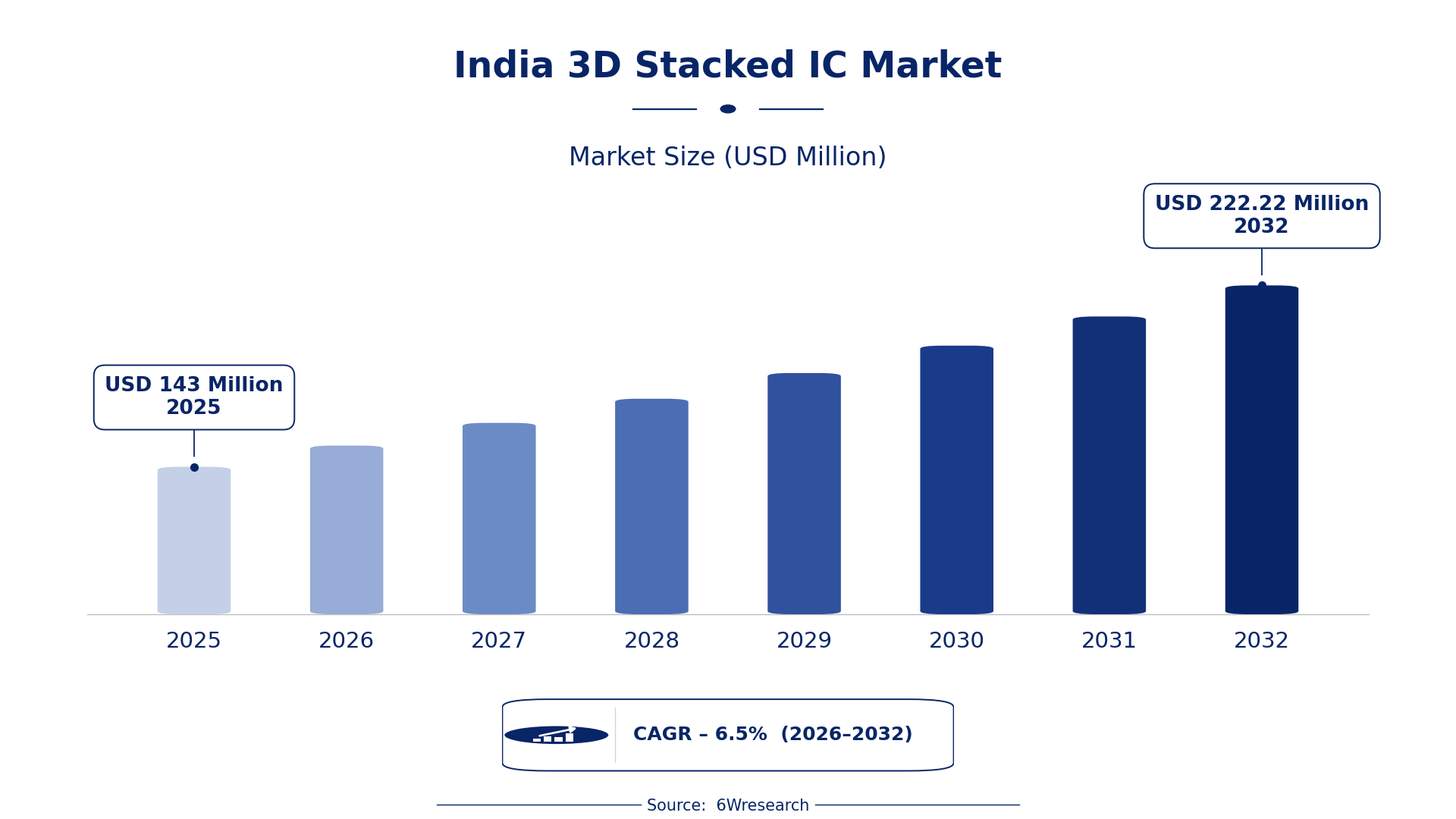
According to 6Wresearch internal database and industry insights, the India 3D Stacked IC Market was valued at USD 143.0 million in 2025 and is projected to reach USD 222.22 million by 2032, growing at a CAGR of approximately 6.5% during 2026–2032.
India 3D Stacked IC Market Highlights
| Report Metric | Details |
| Report Name | India 3D Stacked IC Market |
| Market Size 2025 | USD 143.0 million |
| Market Size 2032 | USD 222.22 million |
| Absolute Growth 2025–2032 | USD 79.22 million |
| CAGR 2026–2032 | 6.5% |
| Peak Annual Growth | 9.4% in 2032 |
| Forecast Period | 2026–2032 |
| Historical Data | 2022–2025 |
| Base Year | 2025 |
| Leading Packaging Technology, 2025 | Through Silicon Via (48% share) |
| Leading Integration Level, 2025 | Heterogeneous (48% share) |
| Leading Memory Type, 2025 | DRAM (51% share) |
| Leading Distribution Channel, 2025 | Semiconductor Distributors (51% share) |
| Leading End User Industry, 2025 | Mobile Devices (41% share) |
| Fastest-Growing Packaging Technology | 2.5D Stacking (8.5% CAGR) |
| Fastest-Growing Memory Type | NAND Flash (8.1% CAGR) |
| Fastest-Growing Distribution Channel | Direct Sales (7.9% CAGR) |
| Fastest-Growing End User Industry | Cloud Computing (9.0% CAGR) |
| Growing Sector | Cloud Computing |
| Key End Users | Mobile Devices, Cloud Computing, Telecom Infrastructure, Networking Equipment |
India 3D Stacked IC Market Year-wise Growth Rate and Key Drivers (2022–2032)
This graph illustrates the annual growth rates of the market from 2022 to 2032, highlighting a steady upward trajectory and projected market expansion over the forecast period.
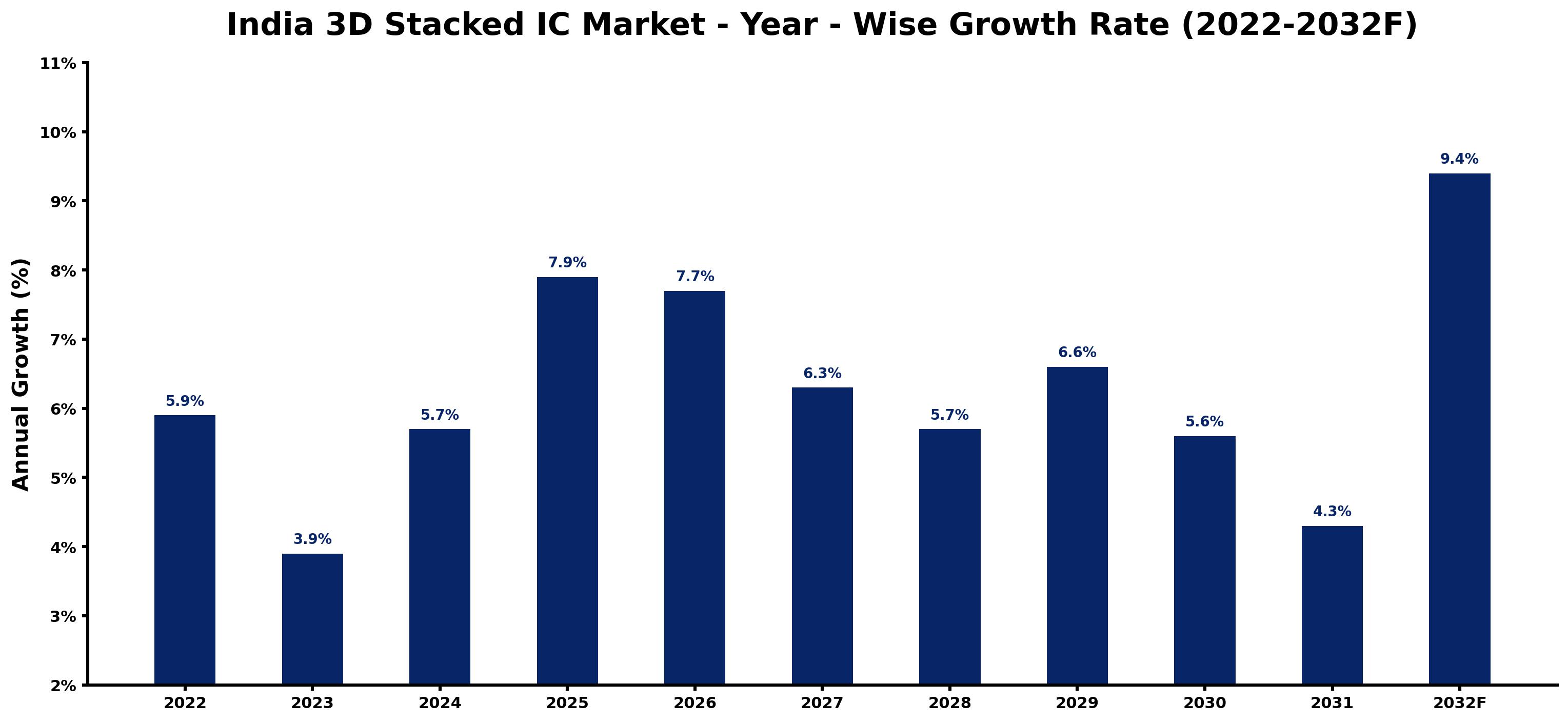
Below, each year's estimated growth is shown next to the factor that most influenced it.
| Year | Estimated Annual Growth (%) | Market Rationale |
| 2022 | 5.9 | The market experienced steady growth due to increasing mobile device adoption. |
| 2023 | 3.9 | Growth slowed as the market adjusted to supply chain challenges faced in 2022. |
| 2024 | 5.7 | Demand increased as mobile and cloud computing sectors expanded their needs. |
| 2025 | 7.9 | The market saw a rise driven by the Electronics Policy 2020. |
| 2026 | 7.7 | Growth is expected to slow slightly as manufacturers face production capacity constraints. |
| 2027 | 6.3 | Demand is projected to continue rising, supported by investments in semiconductor technologies. |
| 2028 | 5.7 | Growth is anticipated to decelerate as the market stabilises after previous rapid expansions. |
| 2029 | 6.6 | The market is expected to rebound with increased demand from the cloud computing sector. |
| 2030 | 5.6 | Growth is projected to slow as the market adjusts to new manufacturing standards. |
| 2031 | 4.3 | Demand is anticipated to moderate as the market reaches a more stable phase. |
| 2032 | 9.4 | The market is expected to peak due to anticipated growth in mobile and cloud sectors. |
Note: Market size estimations and growth projections presented in this report are based on 6Wresearch's proprietary forecasting methodology, utilizing the latest available industry data, government publications, and primary research inputs.
India 3D Stacked IC Market Synopsis
The India 3D Stacked IC Market includes advanced semiconductor devices that integrate multiple layers of integrated circuits to enhance performance and minimise space. These devices are produced using techniques such as Through Silicon Via and wafer bonding, primarily for mobile devices, cloud computing, and telecom infrastructure. Growth in the India 3D Stacked IC Market is driven by the country's extensive mobile subscriber base exceeding 1.3 billion and substantial investments in semiconductor manufacturing spurred by initiatives like the Electronics Policy 2020.
Market Dynamics Impact Analysis (2026–2032)
| Factor | Type | Impact | Primary Segment Affected |
| Rising mobile device adoption fuels demand for advanced semiconductor solutions. | Driver | High | Mobile Devices |
| The increasing need for efficient cloud computing solutions drives investment in semiconductor technologies. | Driver | High | Cloud Computing |
| The growing semiconductor manufacturing capabilities present opportunities for investment in new facilities. | Opportunity | High | Through Silicon Via |
| The demand for high-density memory solutions is rising, creating opportunities for suppliers. | Opportunity | Medium | DRAM |
| Production capacity constraints hinder manufacturers' ability to meet growing demand. | Restraint | High | Through Silicon Via |
| The high cost of advanced manufacturing technologies limits market entry for new players. | Restraint | Medium | Through Silicon Via |
| Supply chain disruptions affect timely delivery of components to buyers and suppliers. | Challenge | High | Mobile Devices |
| Competition from international manufacturers poses challenges for local producers. | Challenge | Medium | Through Silicon Via |
Evaluation of Drivers in India 3D Stacked IC Market (2026–2032)
The main growth drivers and the segments they affect most are set out below.
| Drivers | Primary Segment Affected | Why It Matters (Evidence) |
| Increasing mobile device sales drive demand for 3D Stacked ICs. | Mobile Devices | With over 1.3 billion mobile subscribers, demand for advanced ICs is surging. |
| Cloud computing expansion necessitates advanced semiconductor solutions. | Cloud Computing | The growth of cloud services is increasing the need for efficient 3D ICs. |
| Government initiatives are boosting semiconductor manufacturing capabilities. | Through Silicon Via | The Production-Linked Incentive scheme allocates $10 billion to support production. |
| Rising demand for high-performance applications fuels DRAM market growth. | DRAM | The expected growth in the DRAM market aligns with mobile and computing needs. |
| Investment in semiconductor skills development improves workforce capabilities. | Through Silicon Via | The Electronics Sector Skills Council of India focuses on training in semiconductor technologies. |
The mobile sector's growth is leading to heightened demand for advanced ICs, with over 1.3 billion subscribers contributing to this trend. The cloud computing sector's expansion requires efficient semiconductor solutions, further driving demand. Investment in semiconductor skills development is improving workforce capabilities, ensuring a skilled labour pool for manufacturers. The anticipated growth in the DRAM market aligns with mobile and computing requirements, indicating a promising future for 3D Stacked ICs.
Evaluation of Restraints in India 3D Stacked IC Market
The table below lists the restraints and the evidence behind each.
| Market Restraint | Primary Segment Affected | Why It Matters (Evidence) |
| Production capacity constraints hinder manufacturers' ability to meet demand. | Through Silicon Via | The rapid growth in demand has outpaced current production capabilities, causing delays. |
| High costs of advanced manufacturing technologies limit market entry. | Through Silicon Via | New entrants face financial barriers to adopting necessary technologies. |
| Supply chain disruptions affect timely delivery of components. | Mobile Devices | Global supply chain issues have caused delays in component availability for manufacturers. |
| Competition from international manufacturers poses challenges for local producers. | Through Silicon Via | Local players struggle to compete with established international companies with greater resources. |
| Regulatory hurdles slow down new project approvals. | Through Silicon Via | Complex regulatory requirements delay the establishment of new manufacturing units. |
India 3D Stacked IC Market Challenges
Buyers and suppliers in the India 3D Stacked IC market face a critical skills shortage, with over 500,000 trained professionals needed to meet industry demands. This gap exists because semiconductor education has not kept pace with rapid technological advancements, delaying product development timelines for producers. Many manufacturers struggle with technology adoption, as the high initial costs of implementing advanced techniques like Through Silicon Via can increase production expenses by 20%. Supply chain disruptions also plague the market, as reliance on imported raw materials can extend delivery schedules for buyers by several weeks, impacting their ability to meet customer demands.
Trends in the India 3D Stacked IC Market
Below mentioned are some of the trends shaping the India 3D Stacked IC Market growth.
- Shift Towards Advanced Memory Solutions: Mobile device manufacturers are increasingly adopting advanced memory solutions like DRAM to meet performance demands. The anticipated growth in India's DRAM market reflects this shift, with projections indicating significant increases in demand.
- Transition from Traditional to Advanced Semiconductor Manufacturing: Karnataka is emerging as a hub for advanced semiconductor manufacturing, with investments in new technologies. The state's focus on improving production capabilities is evident as it aims to support the growing electronics sector.
- Cloud Computing Driving Semiconductor Innovation: The rise of cloud computing is pushing manufacturers to innovate in semiconductor design. The anticipated growth in this sector is expected to drive demand for advanced 3D Stacked ICs, improving operational efficiency.
- Increased Focus on Skill Development: The Electronics Sector Skills Council of India is prioritising skill development in semiconductor technologies. With the Indian semiconductor industry expected to create 1 million jobs by 2025, this focus is essential for meeting future demand.
Investment Opportunities in the India 3D Stacked IC Market
The following opportunities in the India 3D Stacked IC Market pair current demand with a clear way in.
- Investment in Semiconductor Manufacturing Facilities: With the Indian semiconductor industry expected to grow, there is a $10 billion investment opportunity in manufacturing facilities. The Production-Linked Incentive scheme supports this growth, making it an ideal time for investors.
- Supply of Advanced Memory Solutions: The increasing demand for DRAM presents a strong opportunity for suppliers. Mobile device manufacturers, particularly in Karnataka, are seeking reliable sources to meet their growing needs.
- Partnerships in Cloud Computing Technologies: The cloud computing sector's growth necessitates partnerships for advanced semiconductor solutions. Collaborating with local firms can facilitate entry into this expanding market.
- Development of Training Programs for Semiconductor Skills: The need for skilled workers in the semiconductor industry is pressing, with the Electronics Sector Skills Council of India focusing on training. Investing in educational programs can help meet this demand.
Government Initiatives in the India 3D Stacked IC Market
The Production-Linked Incentive (PLI) Scheme for Large Scale Electronics Manufacturing, launched in 2020, promotes semiconductor manufacturing with an allocation of $10 billion. This initiative supports the existing National Policy on Electronics 2019, which aims for a $400 billion electronics manufacturing industry by 2025, thus driving growth in the semiconductor sector.
The Electronics Manufacturing Cluster Scheme, administered by the Ministry of Electronics and Information Technology, supports the establishment of semiconductor manufacturing units. This scheme provides financial assistance to projects that improve local production capabilities, ensuring a more reliable supply chain for the industry.
Future Insight of the India 3D Stacked IC Market
The India 3D Stacked IC market can expect substantial changes by 2032, driven by the Production-Linked Incentive scheme that will boost local manufacturing capabilities. The Electronics Policy 2020 will strengthen the semiconductor framework, encouraging innovation and reducing reliance on imports. Training initiatives from the National Institute of Electronics and Information Technology will effectively address the skills gap, preparing a workforce ready for industry challenges. The Indian semiconductor industry is projected to create 1 million jobs by 2025, resulting in a surge of talent and expertise in the sector.
Market Segmentation Analysis
The report offers a comprehensive study of the following market segments and their leading categories in the market.
By Packaging Technology – Through Silicon Via Dominated, 2.5D Stacking Expected to Grow Fastest
According to Shubham Deep, Research Manager at 6Wresearch, the largest packaging technology category in 2025 was Through Silicon Via, with a 48% share of total revenue. Through Silicon Via technology commands the largest share in the Indian 3D Stacked IC market, as it is vital for establishing vertical interconnections in advanced semiconductor devices. Its widespread application in mobile devices, particularly in Karnataka, a semiconductor manufacturing hub, reinforces its market position. Over 2026–2032, 2.5D Stacking is expected to post the fastest growth, at a CAGR of 8.5%. The 2.5D Stacking technique is witnessing rapid growth because it allows for the integration of various technologies on a single substrate, catering to the demand for compact and efficient designs. This growth is propelled by the increasing need for high-performance solutions in mobile devices, where space efficiency is paramount. Suppliers should focus on advancing 2.5D Stacking technologies to meet the rising demand for efficient semiconductor solutions.
By Integration Level – Heterogeneous Dominated and Is Expected to Record the Fastest Growth
Heterogeneous accounted for a 48% market share by integration level in 2025. Heterogeneous integration leads the market as it effectively combines different materials and functions in one package, addressing the complex needs of applications in mobile devices and cloud computing. This integration method is particularly suited to India's diverse semiconductor requirements, ensuring its dominant share. Heterogeneous is also forecast to expand faster than any other category, at a CAGR of 8.4% over 2026–2032. Heterogeneous integration is also the fastest-growing segment due to its flexibility, enabling manufacturers to swiftly adapt to the evolving demands of the electronics sector. As mobile and cloud applications continue to expand, this method will further solidify its market share. Buyers should prioritise suppliers skilled in Heterogeneous integration to leverage advanced semiconductor technologies.
By Memory Type – DRAM Dominated, NAND Flash Expected to Grow Fastest
DRAM held a 51% share of the India 3D Stacked IC Market by memory type in 2025. DRAM holds the largest share in the memory type segment as it is extensively used for memory in various electronic devices, driven by the massive market of over 1.3 billion mobile subscribers in India. This widespread adoption underscores the critical role DRAM plays in meeting consumer demands. NAND Flash is set to record the highest CAGR in this split, 8.1% over 2026–2032. NAND Flash is experiencing rapid growth as it is critical for storage in mobile and computing devices, which are seeing increased usage and demand. The surge in mobile applications and cloud computing needs is propelling this segment forward, indicating a shift in storage preferences. Suppliers should prioritise NAND Flash innovations to capture the growing demand for storage solutions in mobile and computing sectors.
By Distribution Channel – Semiconductor Distributors Dominated, Direct Sales Expected to Grow Fastest
In 2025, Semiconductor Distributors led the distribution channel split with a 51% share. Semiconductor Distributors dominate the distribution channel, playing a crucial role in the supply chain by ensuring the efficient movement of 3D ICs to various end-users. Their established networks are essential for servicing the rapidly growing electronics market in India. Direct Sales is projected to grow fastest, at a CAGR of 7.9% during 2026–2032. Direct Sales is the fastest-growing channel, as it facilitates large volume transactions, allowing manufacturers to connect directly with major clients in the mobile and cloud sectors. This trend signifies a shift towards more streamlined purchasing processes within the semiconductor market. Suppliers should enhance their direct sales strategies to capitalise on the increasing demand for large-scale semiconductor solutions.
By End User Industry – Mobile Devices Dominated, Cloud Computing Expected to Grow Fastest
Mobile Devices took a 41% share of end user industry in 2025, more than any other category. Mobile Devices represent the largest end-user segment, significantly driving demand for 3D ICs due to India's extensive mobile subscriber base exceeding 1.3 billion. The ongoing advancements in mobile technology further fuel this growth, making it a critical market for semiconductor manufacturers. Over 2026–2032, Cloud Computing is expected to post the fastest growth, at a CAGR of 9.0%. Cloud Computing is the fastest-growing end-user industry, necessitating advanced ICs to support its expanding infrastructure and services. The rising reliance on cloud solutions for data storage and processing is propelling this segment's rapid growth. Suppliers should concentrate on developing solutions tailored for the cloud computing sector to capture emerging opportunities in this fast-growing market.
Key Attractiveness of the Report
- 10 Years of Market Numbers
- Historical Data Starting from 2022 to 2025
- Base Year 2025
- Forecast Data until 2032
- Key Performance Indicators Impacting the Market
- Major Upcoming Developments and Projects
Key Highlights of the Report:
- India 3D Stacked IC Market Outlook
- Market Size of India 3D Stacked IC Market, 2025
- Forecast of India 3D Stacked IC Market, 2032
- Historical Data and Forecast of India 3D Stacked IC Revenues & Volume for the Period 2022 - 2032F
- India 3D Stacked IC Market Trend Evolution
- India 3D Stacked IC Market Drivers and Challenges
- India 3D Stacked IC Price Trends
- India 3D Stacked IC Porter's Five Forces
- India 3D Stacked IC Industry Life Cycle
- Historical Data and Forecast of India 3D Stacked IC Market Revenues & Volume By Packaging Technology for the Period 2022 - 2032F
- Historical Data and Forecast of India 3D Stacked IC Market Revenues & Volume By Through Silicon Via for the Period 2022 - 2032F
- Historical Data and Forecast of India 3D Stacked IC Market Revenues & Volume By Wafer-on-Wafer for the Period 2022 - 2032F
- Historical Data and Forecast of India 3D Stacked IC Market Revenues & Volume By Die-on-Die for the Period 2022 - 2032F
- Historical Data and Forecast of India 3D Stacked IC Market Revenues & Volume By 2.5D Stacking for the Period 2022 - 2032F
- Historical Data and Forecast of India 3D Stacked IC Market Revenues & Volume By Integration Level for the Period 2022 - 2032F
- Historical Data and Forecast of India 3D Stacked IC Market Revenues & Volume By Heterogeneous for the Period 2022 - 2032F
- Historical Data and Forecast of India 3D Stacked IC Market Revenues & Volume By Homogeneous for the Period 2022 - 2032F
- Historical Data and Forecast of India 3D Stacked IC Market Revenues & Volume By High-Density for the Period 2022 - 2032F
- Historical Data and Forecast of India 3D Stacked IC Market Revenues & Volume By Moderate Density for the Period 2022 - 2032F
- Historical Data and Forecast of India 3D Stacked IC Market Revenues & Volume By Memory Type for the Period 2022 - 2032F
- Historical Data and Forecast of India 3D Stacked IC Market Revenues & Volume By DRAM for the Period 2022 - 2032F
- Historical Data and Forecast of India 3D Stacked IC Market Revenues & Volume By NAND Flash for the Period 2022 - 2032F
- Historical Data and Forecast of India 3D Stacked IC Market Revenues & Volume By SRAM for the Period 2022 - 2032F
- Historical Data and Forecast of India 3D Stacked IC Market Revenues & Volume By eMMC for the Period 2022 - 2032F
- Historical Data and Forecast of India 3D Stacked IC Market Revenues & Volume By Distribution Channel for the Period 2022 - 2032F
- Historical Data and Forecast of India 3D Stacked IC Market Revenues & Volume By Semiconductor Distributors for the Period 2022 - 2032F
- Historical Data and Forecast of India 3D Stacked IC Market Revenues & Volume By Online Platforms for the Period 2022 - 2032F
- Historical Data and Forecast of India 3D Stacked IC Market Revenues & Volume By Direct Sales for the Period 2022 - 2032F
- Historical Data and Forecast of India 3D Stacked IC Market Revenues & Volume By OEM Partners for the Period 2022 - 2032F
- Historical Data and Forecast of India 3D Stacked IC Market Revenues & Volume By End User Industry for the Period 2022 - 2032F
- Historical Data and Forecast of India 3D Stacked IC Market Revenues & Volume By Mobile Devices for the Period 2022 - 2032F
- Historical Data and Forecast of India 3D Stacked IC Market Revenues & Volume By Cloud Computing for the Period 2022 - 2032F
- Historical Data and Forecast of India 3D Stacked IC Market Revenues & Volume By Telecom Infrastructure for the Period 2022 - 2032F
- Historical Data and Forecast of India 3D Stacked IC Market Revenues & Volume By Networking Equipment for the Period 2022 - 2032F
- India 3D Stacked IC Import Export Trade Statistics
- Market Opportunity Assessment By Packaging Technology
- Market Opportunity Assessment By Integration Level
- Market Opportunity Assessment By Memory Type
- Market Opportunity Assessment By Distribution Channel
- Market Opportunity Assessment By End User Industry
- India 3D Stacked IC Top Companies Market Share
- India 3D Stacked IC Competitive Benchmarking By Technical and Operational Parameters
- India 3D Stacked IC Company Profiles
- India 3D Stacked IC Key Strategic Recommendations
Market Covered
Segments analysed in this report are listed below.
By Packaging Technology
- Through Silicon Via
- Wafer-on-Wafer
- Die-on-Die
- 2.5D Stacking
By Integration Level
- Heterogeneous
- Homogeneous
- High-Density
- Moderate Density
By Memory Type
- DRAM
- NAND Flash
- SRAM
- eMMC
By Distribution Channel
- Semiconductor Distributors
- Online Platforms
- Direct Sales
- OEM Partners
By End User Industry
- Mobile Devices
- Cloud Computing
- Telecom Infrastructure
- Networking Equipment































