India 3D Vision Systems Market Size & Growth Rate
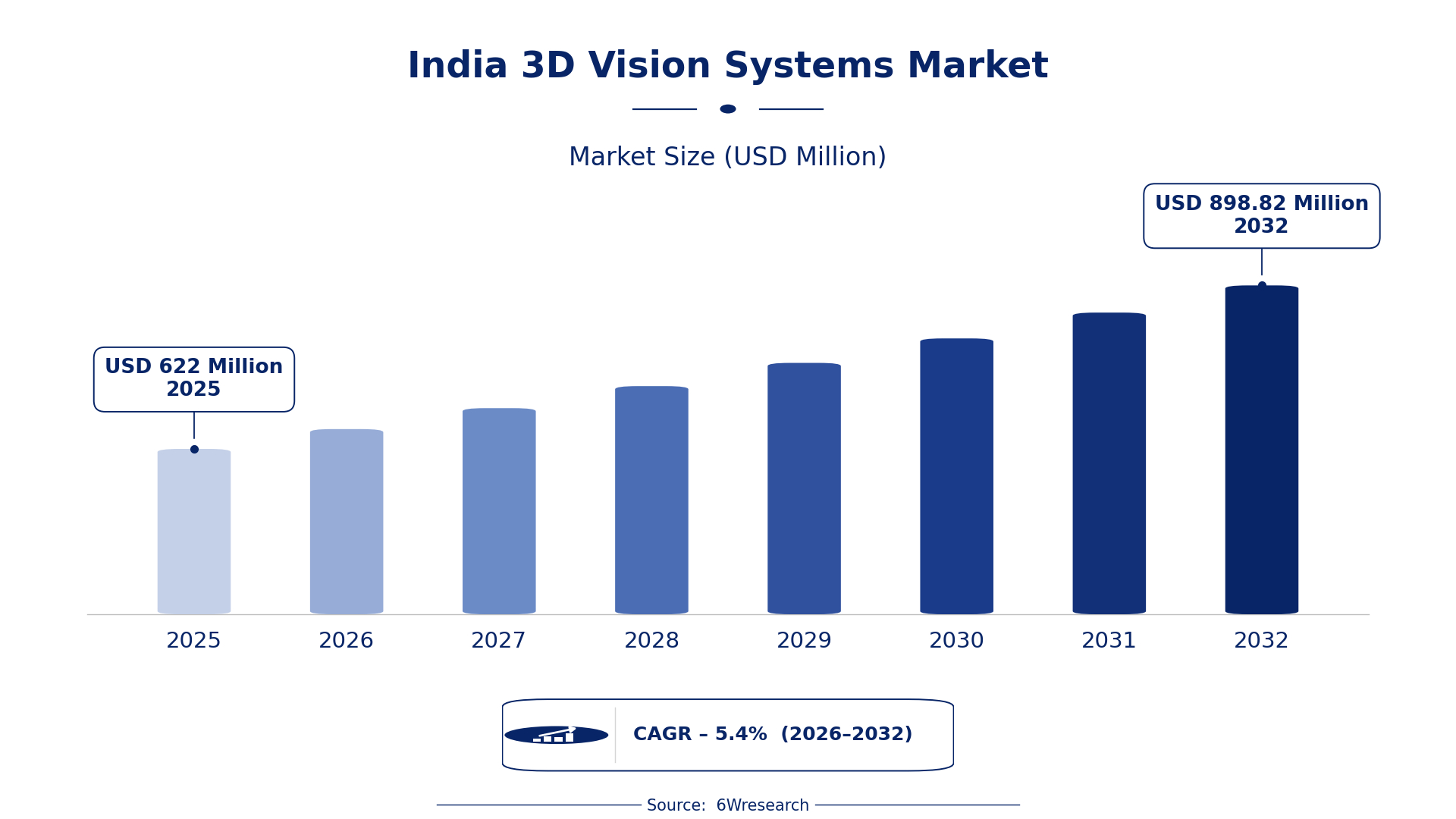
According to 6Wresearch internal database and industry insights, the India 3D Vision Systems Market was valued at USD 622.0 million in 2025 and is projected to reach USD 898.82 million by 2032, growing at a CAGR of approximately 5.4% during 2026–2032.
India 3D Vision Systems Market Highlights
| Report Metric | Details |
| Report Name | India 3D Vision Systems Market |
| Market Size 2025 | USD 622.0 million |
| Market Size 2032 | USD 898.82 million |
| Absolute Growth 2025–2032 | USD 276.82 million |
| CAGR 2026–2032 | 5.4% |
| Peak Annual Growth | 7.7% in 2026 |
| Forecast Period | 2026–2032 |
| Historical Data | 2022–2025 |
| Base Year | 2025 |
| Leading Component Type, 2025 | Hardware (39% share) |
| Leading Technology Type, 2025 | Stereoscopic Vision (41% share) |
| Leading Sensing Type, 2025 | Passive Sensing (37% share) |
| Leading Distribution Channel, 2025 | Online Platforms (38% share) |
| Leading End User Industry, 2025 | Industrial Automation (49% share) |
| Fastest-Growing Component Type | Software (8.1% CAGR) |
| Fastest-Growing Technology Type | Time-of-Flight (7.5% CAGR) |
| Fastest-Growing Sensing Type | Active Sensing (7.8% CAGR) |
| Fastest-Growing Distribution Channel | System Integrators (6.7% CAGR) |
| Fastest-Growing End User Industry | Robotics Industry (6.9% CAGR) |
| Growing Sector | Industrial Automation |
| Key End Users | Manufacturers, Automotive Assembly, Robotics Industry, System Integrators |
India 3D Vision Systems Market Year-wise Growth Rate and Key Drivers (2022–2032)
This graph illustrates the annual growth rates of the market from 2022 to 2032, highlighting a steady upward trajectory and projected market expansion over the forecast period.
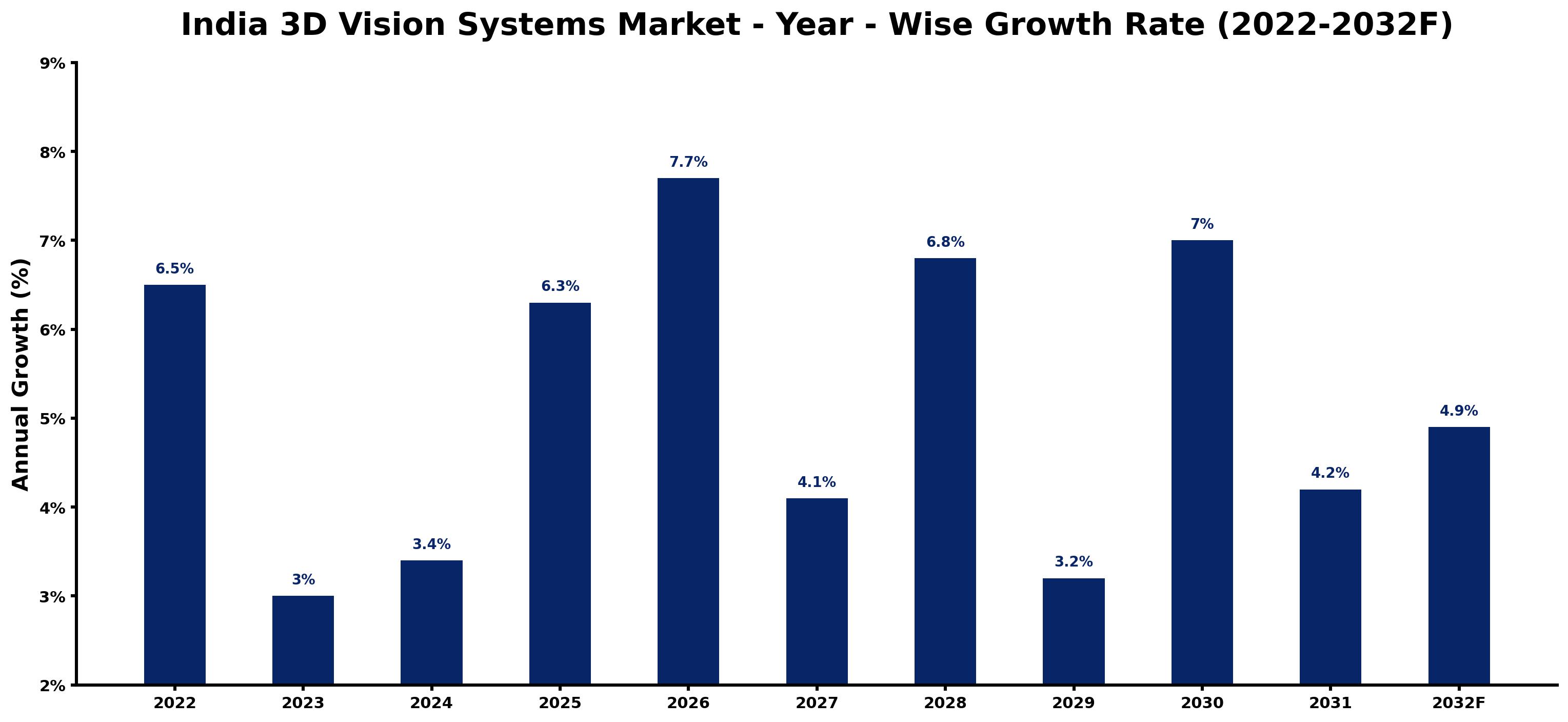
The table below sets out the estimated growth rate for each year and the main factor behind it.
| Year | Estimated Annual Growth (%) | Market Rationale |
| 2022 | 6.5 | The automotive industry produced over 4.4 million vehicles, driving demand for automation. |
| 2023 | 3.0 | Growth slowed as the market adjusted to high production levels from the previous year. |
| 2024 | 3.4 | Increased investments in manufacturing technologies boosted demand for advanced systems, particularly in robotics. |
| 2025 | 6.3 | The 'Make in India' initiative further accelerated automation adoption across various sectors. |
| 2026 | 7.7 | A surge in robotics applications is projected to peak demand for vision systems this year. |
| 2027 | 4.1 | The market is expected to slow as companies reassess their automation strategies after the peak. |
| 2028 | 6.8 | Growing adoption of robotics in manufacturing will spur renewed interest in 3D systems this year. |
| 2029 | 3.2 | Demand is anticipated to slow as firms face challenges in integrating new technologies effectively. |
| 2030 | 7.0 | Increased focus on quality control in automotive assembly will revive system purchases this year. |
| 2031 | 4.2 | The market is projected to slow as firms adapt to evolving manufacturing standards and practices. |
| 2032 | 4.9 | A growing emphasis on automation in manufacturing is expected to sustain demand for 3D vision systems. |
Note: Market size estimations and growth projections presented in this report are based on 6Wresearch's proprietary forecasting methodology, utilizing the latest available industry data, government publications, and primary research inputs.
India 3D Vision Systems Market Synopsis
The India 3D Vision Systems Market encompasses advanced imaging technologies that capture three-dimensional information from the environment. These systems are essential for applications such as automation in manufacturing, quality control, and robotics. The market is projected to grow, driven by the automotive industry, which produced over 4.4 million vehicles in 2022. The rise in robotics applications and the push for advanced manufacturing technologies further fuel this growth, particularly through initiatives like 'Make in India.'
Market Dynamics Impact Analysis (2026–2032)
| Factor | Type | Impact | Primary Segment Affected |
| Increasing adoption of automation technologies in manufacturing processes. | Driver | High | Industrial Automation |
| Growth in the robotics industry enhancing the need for 3D vision systems. | Driver | High | Robotics Industry |
| Investment in automation technologies due to government initiatives. | Opportunity | High | Manufacturing |
| Expansion of online platforms facilitating easier access to 3D vision systems. | Opportunity | Medium | Online Platforms |
| High initial investment costs for implementing 3D vision systems. | Restraint | High | Integrated Systems |
| Limited awareness among small manufacturers about the benefits of 3D systems. | Restraint | Medium | Industrial Automation |
| Challenges in integrating advanced technologies into existing systems. | Challenge | High | Manufacturing |
| Supply chain disruptions affecting the availability of components. | Challenge | Medium | Hardware |
Evaluation of Drivers in India 3D Vision Systems Market (2026–2032)
The factors lifting demand, and the evidence behind each, are summarised below.
| Drivers | Primary Segment Affected | Why It Matters (Evidence) |
| Rising investments in automation technologies. | Industrial Automation | The automotive industry produced over 4.4 million vehicles in 2022, creating a strong demand for automation solutions. |
| Growth in the robotics sector. | Robotics Industry | The total installed base of industrial robots is projected to reach 25,000 units by 2025, increasing the need for vision systems. |
| Government initiatives promoting advanced manufacturing. | Manufacturing | The 'Make in India' initiative supports the adoption of advanced technologies, boosting the need for 3D vision systems. |
| Expansion of online sales channels. | Online Platforms | With a projected 38% share in 2025, online platforms are facilitating easier access to 3D vision systems for manufacturers. |
| Increased focus on quality control in manufacturing. | Automotive Assembly | The automotive assembly sector relies heavily on 3D vision systems for quality assurance, driving demand. |
Market growth for 3D Vision Systems in India is underpinned by rising investments in automation technologies, particularly in the automotive sector. The automotive industry produced over 4.4 million vehicles in 2022, which increased the need for advanced automation solutions. The total installed base of industrial robots is projected to reach 25,000 units by 2025, driving further demand for vision systems. The expansion of online sales channels, expected to hold a 38% share in 2025, facilitates easier access to these systems, while the automotive assembly sector's focus on quality control continues to boost demand for 3D vision systems.
Evaluation of Restraints in India 3D Vision Systems Market
Below mentioned are some major restraints and their influence on market dynamics.
| Market Restraint | Primary Segment Affected | Why It Matters (Evidence) |
| High initial investment costs for 3D vision systems. | Integrated Systems | The cost of implementing advanced systems can deter small manufacturers from investing, limiting market growth. |
| Limited awareness about 3D vision benefits. | Industrial Automation | Many small manufacturers are unaware of how 3D systems can improve their operations, hindering adoption. |
| Integration challenges with existing technologies. | Manufacturing | Firms often face difficulties when incorporating new technologies into their processes, delaying implementation. |
| Supply chain disruptions affecting component availability. | Hardware | Delays in component supply can hinder timely implementation of 3D vision systems in various sectors. |
| Regulatory hurdles in technology adoption. | Robotics Industry | Compliance with standards can slow down the adoption of new technologies, impacting market growth. |
India 3D Vision Systems Market Challenges
Producers in the India 3D Vision Systems market face intense competition, compelling them to lower prices and diminishing profit margins, which restricts their ability to invest in new developments. A notable skills gap exists as the rapid pace of technological change surpasses available training, causing delays in project timelines for buyers in manufacturing. High compliance costs associated with ISO 9001 standards burden producers, leading to increased operational expenses that are often transferred to buyers, raising their costs. Regulatory hurdles regarding technology adoption result in lengthy approval processes, delaying the deployment of 3D vision systems in critical sectors such as automotive manufacturing.
Trends in the India 3D Vision Systems Market
The trends below show where the India 3D Vision Systems Market is heading.
- Shift towards Automation in Manufacturing: India is increasingly adopting automation technologies in manufacturing processes, supported by government initiatives. In 2022, the Ministry of Heavy Industries launched a scheme to promote automation technologies, which is expected to improve productivity across sectors.
- Growing Demand for Robotics Applications: Since 2020, the robotics industry has seen notable growth, with projections indicating a total installed base of 25,000 units by 2025. This trend is driving the demand for 3D vision systems across various sectors.
- Increase in Online Sales Channels: The distribution of 3D vision systems is shifting towards online platforms, which are projected to hold a 38% market share in 2025. This change allows for easier access to advanced technologies for manufacturers.
- Focus on Quality Control in Automotive Assembly: The automotive assembly sector is placing greater emphasis on quality control, leading to increased reliance on 3D vision systems. This sector produced over 4.4 million vehicles in 2022, highlighting the demand for precision in manufacturing.
Investment Opportunities in the India 3D Vision Systems Market
Below are the investment opportunities with the strongest case in the India 3D Vision Systems Market.
- Investment in Automation Technologies: With the Indian government targeting a 25% share of manufacturing in GDP by 2025, there is an opportunity to invest in automation technologies. Manufacturers in the automotive sector can benefit from this push for advanced systems.
- Expansion of Robotics in Manufacturing: The robotics industry is projected to grow significantly, creating a demand for 3D vision systems. Manufacturers should consider partnerships with system integrators to meet this need effectively.
- Growth of Online Platforms for Sales: With online platforms expected to capture a 38% market share in 2025, there is an opportunity to invest in e-commerce strategies. This shift can help suppliers reach a broader audience in the manufacturing sector.
- Government Support for Advanced Technologies: The 'Production Linked Incentive Scheme' launched in 2021 provides funding for electronics manufacturing, including automation technologies. Suppliers can engage with local manufacturers to benefit from this support and enhance their market presence.
Government Initiatives in the India 3D Vision Systems Market
The 'Production Linked Incentive Scheme' launched in 2021 by the Ministry of Electronics and Information Technology aims to boost electronics manufacturing, including automation technologies. This measure encourages manufacturers to adopt advanced systems, thus impacting the 3D vision systems market. Additionally, the 'National Robotics Mission' established in 2020 promotes robotics and related technologies, further supporting the integration of 3D vision systems in various sectors. These initiatives create a conducive environment for producers and buyers alike, facilitating technology adoption in India.
The 'Atmanirbhar Bharat' initiative encourages self-reliance in manufacturing, prompting buyers to invest in advanced technologies. The initiative aims to strengthen the local manufacturing sector, providing opportunities for producers of 3D vision systems. The 'Skill India' program continues to improve workforce skills in advanced manufacturing technologies, which benefits both producers and buyers by ensuring a skilled workforce for implementing these systems. Furthermore, the Department of Heavy Industry's budget of INR 1,000 crores for promoting automation technologies directly supports buyers in upgrading their systems.
Future Insight of the India 3D Vision Systems Market
The India 3D Vision Systems market is anticipated to evolve by 2032, propelled by initiatives such as 'Make in India' and 'Digital India' that advocate for advanced technology adoption. The automotive sector is projected to produce over 5 million vehicles annually, significantly increasing the demand for automation solutions. With the total installed base of industrial robots expected to reach 20,000 units by 2025, the need for 3D vision systems will correspondingly rise. Enhanced government support for automation technologies will further ease their integration across various industries, benefiting both buyers and suppliers.
Market Segmentation Analysis
Each segment group is reviewed below, with the leader by share and the fastest grower by CAGR.
By Component Type – Hardware Dominated, Software Expected to Grow Fastest
According to Shubham Deep, Research Manager at 6Wresearch, Hardware took a 39% share of component type in 2025, more than any other category. Hardware holds the largest share due to its critical function in capturing 3D data for various applications, especially in industrial settings. The automotive industry's production of over 4.4 million vehicles in 2022 highlights the growing reliance on hardware components for automation processes. Over 2026–2032, Software is expected to post the fastest growth, at a CAGR of 8.1%. Software is experiencing rapid growth as it is essential for processing and interpreting the data captured by hardware, particularly in advanced manufacturing environments. The government's initiatives promoting automation technologies are significantly boosting the demand for sophisticated software solutions. This trend suggests that suppliers must enhance their software offerings to meet the increasing market demands.
By Technology Type – Stereoscopic Vision Dominated, Time-of-Flight Expected to Grow Fastest
In 2025, Stereoscopic Vision led the technology type split with a 41% share. Stereoscopic Vision leads the market as it is extensively used for depth perception in various applications, including quality control in industrial settings. Its established presence in sectors such as automotive assembly highlights its importance in ensuring product quality. Time-of-Flight is set to record the highest CAGR in this split, 7.5% over 2026–2032. Time-of-Flight technology is experiencing the fastest growth due to its capability to provide precise distance measurements, essential for automation processes. The increasing adoption of automation technologies in various industries is a key factor propelling this demand. Suppliers must invest in Time-of-Flight technology to capitalise on its rapid growth and meet the industry's evolving requirements.
By Sensing Type – Passive Sensing Dominated, Active Sensing Expected to Grow Fastest
The largest sensing type category in 2025 was Passive Sensing, with a 37% share of total revenue. Passive Sensing commands a notable share as it is used in specific low-cost applications, appealing to budget-conscious sectors. Its targeted usage in niche markets contributes to its steady demand, despite being less prevalent than active sensing solutions. The quickest growth will come from Active Sensing, forecast to expand at a CAGR of 7.8% between 2026 and 2032. Active Sensing is growing rapidly because it is crucial for accurate 3D data acquisition, especially in high-precision environments like industrial automation. The push for automation across various sectors in India is a key factor driving this growth. Suppliers should prioritise the development of Active Sensing technologies to align with the rising demand for precision in 3D vision systems.
By Distribution Channel – Online Platforms Dominated, System Integrators Expected to Grow Fastest
Online Platforms accounted for a 38% market share by distribution channel in 2025. Online Platforms lead the market share as they facilitate the sale of 3D vision systems, making them accessible to a wider audience. Their role in supporting the growing trend of e-commerce in India enhances their significance in the distribution landscape. System Integrators are projected to grow fastest, at a CAGR of 6.7% during 2026–2032. System Integrators are witnessing the fastest growth due to their essential role in implementing 3D systems across diverse industries. The increasing complexity of automation technologies necessitates the expertise that system integrators provide. This indicates that suppliers should strengthen partnerships with system integrators to improve market penetration and implementation efficiency.
By End User Industry – Industrial Automation Dominated, Robotics Industry Expected to Grow Fastest
Industrial Automation held a 49% share of the India 3D Vision Systems Market by end user industry in 2025. Industrial Automation is the leading end user, significantly driving demand for 3D vision systems, particularly in quality assurance applications. The government's target to elevate the manufacturing share in GDP to 25% by 2025 supports this sector's growth trajectory. Over 2026–2032, Robotics Industry is expected to post the fastest growth, at a CAGR of 6.9%. The Robotics Industry is experiencing the fastest growth as it increasingly utilises 3D vision systems to enhance functionality and operational efficiency. The anticipated expansion of the robotics sector is a crucial factor contributing to this rapid growth. Suppliers should focus on tailoring solutions for the robotics industry to capitalise on its fast-paced growth and meet specific application needs.
Key Attractiveness of the Report
- 10 Years of Market Numbers
- Historical Data Starting from 2022 to 2025
- Base Year 2025
- Forecast Data until 2032
- Key Performance Indicators Impacting the Market
- Major Upcoming Developments and Projects
Key Highlights of the Report:
- India 3D Vision Systems Market Outlook
- Market Size of India 3D Vision Systems Market, 2025
- Forecast of India 3D Vision Systems Market, 2032
- Historical Data and Forecast of India 3D Vision Systems Revenues & Volume for the Period 2022 - 2032F
- India 3D Vision Systems Market Trend Evolution
- India 3D Vision Systems Market Drivers and Challenges
- India 3D Vision Systems Price Trends
- India 3D Vision Systems Porter's Five Forces
- India 3D Vision Systems Industry Life Cycle
- Historical Data and Forecast of India 3D Vision Systems Market Revenues & Volume By Component Type for the Period 2022 - 2032F
- Historical Data and Forecast of India 3D Vision Systems Market Revenues & Volume By Hardware for the Period 2022 - 2032F
- Historical Data and Forecast of India 3D Vision Systems Market Revenues & Volume By Software for the Period 2022 - 2032F
- Historical Data and Forecast of India 3D Vision Systems Market Revenues & Volume By Services for the Period 2022 - 2032F
- Historical Data and Forecast of India 3D Vision Systems Market Revenues & Volume By Integrated Systems for the Period 2022 - 2032F
- Historical Data and Forecast of India 3D Vision Systems Market Revenues & Volume By Technology Type for the Period 2022 - 2032F
- Historical Data and Forecast of India 3D Vision Systems Market Revenues & Volume By Stereoscopic Vision for the Period 2022 - 2032F
- Historical Data and Forecast of India 3D Vision Systems Market Revenues & Volume By Time-of-Flight for the Period 2022 - 2032F
- Historical Data and Forecast of India 3D Vision Systems Market Revenues & Volume By Structured Light for the Period 2022 - 2032F
- Historical Data and Forecast of India 3D Vision Systems Market Revenues & Volume By Laser Triangulation for the Period 2022 - 2032F
- Historical Data and Forecast of India 3D Vision Systems Market Revenues & Volume By Sensing Type for the Period 2022 - 2032F
- Historical Data and Forecast of India 3D Vision Systems Market Revenues & Volume By Passive Sensing for the Period 2022 - 2032F
- Historical Data and Forecast of India 3D Vision Systems Market Revenues & Volume By Active Sensing for the Period 2022 - 2032F
- Historical Data and Forecast of India 3D Vision Systems Market Revenues & Volume By Binocular Vision for the Period 2022 - 2032F
- Historical Data and Forecast of India 3D Vision Systems Market Revenues & Volume By Monocular Vision for the Period 2022 - 2032F
- Historical Data and Forecast of India 3D Vision Systems Market Revenues & Volume By Distribution Channel for the Period 2022 - 2032F
- Historical Data and Forecast of India 3D Vision Systems Market Revenues & Volume By Online Platforms for the Period 2022 - 2032F
- Historical Data and Forecast of India 3D Vision Systems Market Revenues & Volume By System Integrators for the Period 2022 - 2032F
- Historical Data and Forecast of India 3D Vision Systems Market Revenues & Volume By Direct Sales for the Period 2022 - 2032F
- Historical Data and Forecast of India 3D Vision Systems Market Revenues & Volume By OEMs for the Period 2022 - 2032F
- Historical Data and Forecast of India 3D Vision Systems Market Revenues & Volume By End User Industry for the Period 2022 - 2032F
- Historical Data and Forecast of India 3D Vision Systems Market Revenues & Volume By Industrial Automation for the Period 2022 - 2032F
- Historical Data and Forecast of India 3D Vision Systems Market Revenues & Volume By Robotics Industry for the Period 2022 - 2032F
- Historical Data and Forecast of India 3D Vision Systems Market Revenues & Volume By Manufacturing for the Period 2022 - 2032F
- Historical Data and Forecast of India 3D Vision Systems Market Revenues & Volume By Automotive Assembly for the Period 2022 - 2032F
- India 3D Vision Systems Import Export Trade Statistics
- Market Opportunity Assessment By Component Type
- Market Opportunity Assessment By Technology Type
- Market Opportunity Assessment By Sensing Type
- Market Opportunity Assessment By Distribution Channel
- Market Opportunity Assessment By End User Industry
- India 3D Vision Systems Top Companies Market Share
- India 3D Vision Systems Competitive Benchmarking By Technical and Operational Parameters
- India 3D Vision Systems Company Profiles
- India 3D Vision Systems Key Strategic Recommendations
Market Covered
Segments analysed in this report are listed below.
By Component Type
- Hardware
- Software
- Services
- Integrated Systems
By Technology Type
- Stereoscopic Vision
- Time-of-Flight
- Structured Light
- Laser Triangulation
By Sensing Type
- Passive Sensing
- Active Sensing
- Binocular Vision
- Monocular Vision
By Distribution Channel
- Online Platforms
- System Integrators
- Direct Sales
- OEMs
By End User Industry
- Industrial Automation
- Robotics Industry
- Manufacturing
- Automotive Assembly































