India 6-Axis Sensor Market Size & Growth Rate
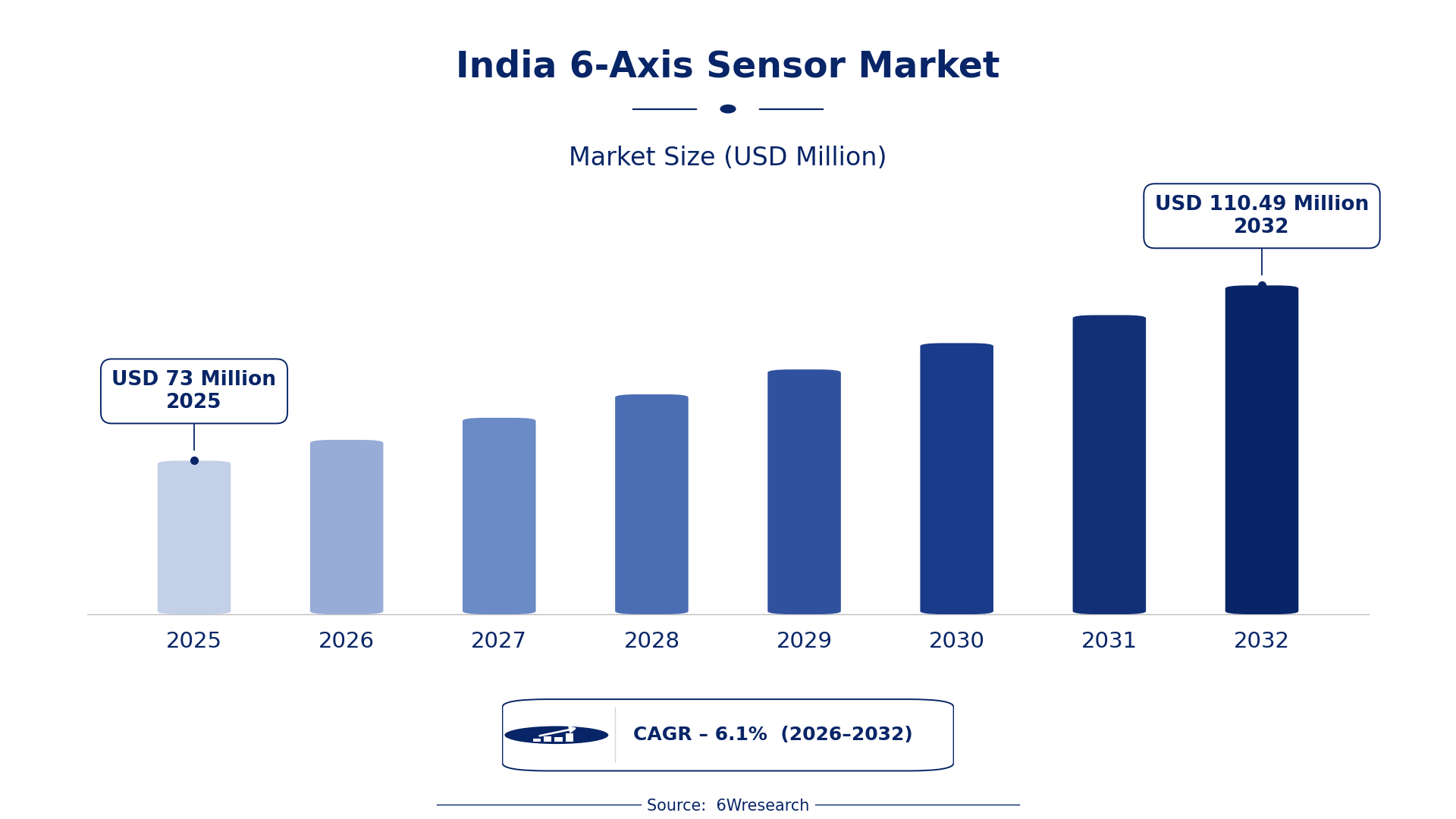
According to 6Wresearch internal database and industry insights, the India 6-Axis Sensor Market was valued at USD 73.0 million in 2025 and is projected to reach USD 110.49 million by 2032, growing at a CAGR of approximately 6.1% during 2026–2032.
India 6-Axis Sensor Market Highlights
| Report Metric | Details |
| Report Name | India 6-Axis Sensor Market |
| Market Size 2025 | USD 73.0 million |
| Market Size 2032 | USD 110.49 million |
| Absolute Growth 2025–2032 | USD 37.49 million |
| CAGR 2026–2032 | 6.1% |
| Peak Annual Growth | 8.1% in 2030 |
| Forecast Period | 2026–2032 |
| Historical Data | 2022–2025 |
| Base Year | 2025 |
| Leading Sensor Type, 2025 | MEMS Sensors (38% share) |
| Leading Technology, 2025 | Gyroscope + Accelerometer (47% share) |
| Leading Application, 2025 | Vehicle Stability Control (40% share) |
| Leading Distribution Channel, 2025 | OEM Automotive Suppliers (42% share) |
| Leading End User, 2025 | Automotive OEMs (38% share) |
| Fastest-Growing Sensor Type | Wearable Sensors (8.0% CAGR) |
| Fastest-Growing Technology | Compact Design (8.0% CAGR) |
| Fastest-Growing Application | Health Monitoring (8.7% CAGR) |
| Fastest-Growing Distribution Channel | Online B2B Platforms (8.6% CAGR) |
| Fastest-Growing End User | Healthcare Device Makers (8.6% CAGR) |
| Growing Sector | Healthcare sector |
| Key End Users | Automotive OEMs, Healthcare Device Makers, Aviation & Drone Makers, Smart Factory Operators |
India 6-Axis Sensor Market Year-wise Growth Rate and Key Drivers (2022–2032)
This graph illustrates the annual growth rates of the market from 2022 to 2032, highlighting a steady upward trajectory and projected market expansion over the forecast period.
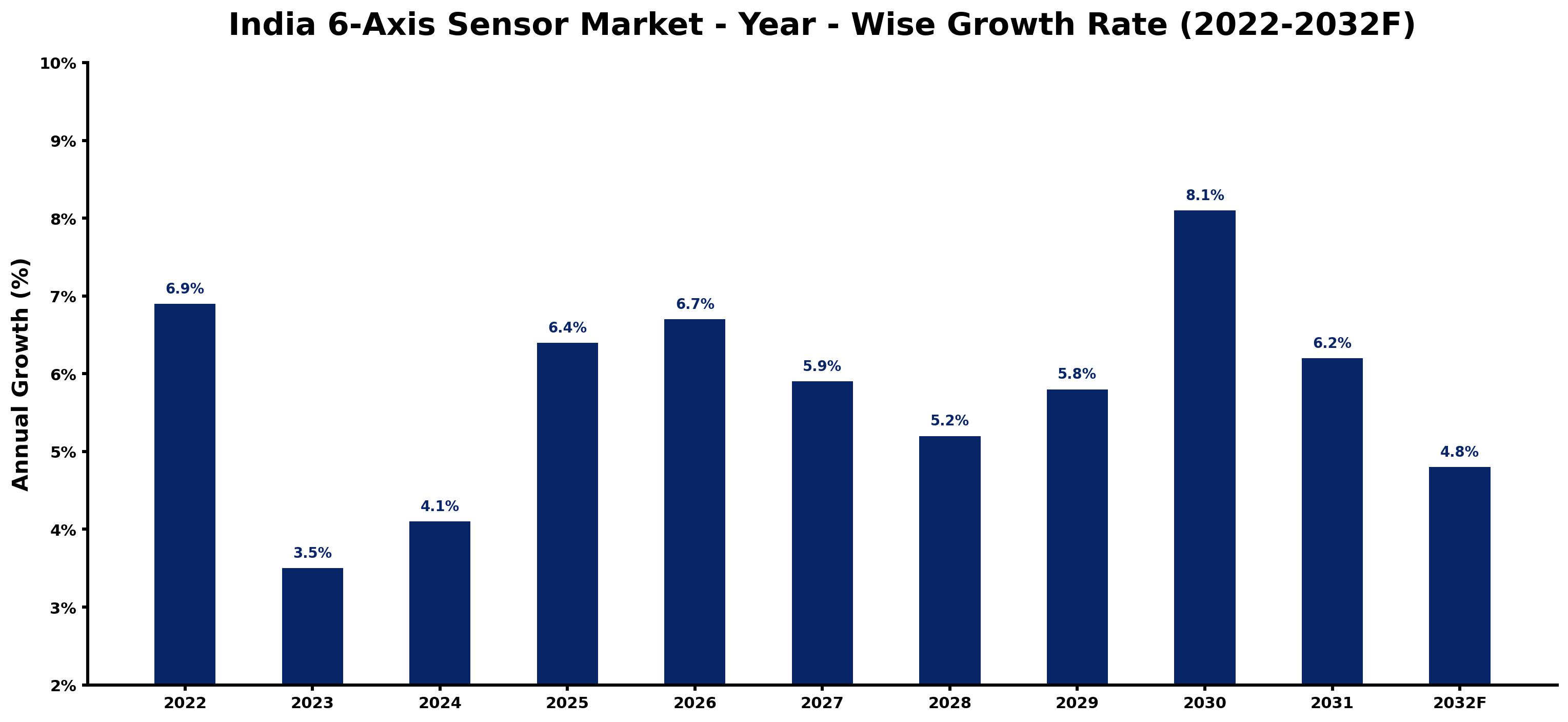
The table below sets out the estimated growth rate for each year and the main factor behind it.
| Year | Estimated Annual Growth (%) | Market Rationale |
| 2022 | 6.9 | The market experienced strong demand from automotive OEMs integrating advanced sensor technologies. |
| 2023 | 3.5 | Growth slowed as the automotive sector faced supply chain disruptions affecting sensor availability. |
| 2024 | 4.1 | Demand increased due to rising healthcare sector investments in wearable health monitoring devices. |
| 2025 | 6.4 | The automotive sector's expansion drove faster growth as more OEMs adopted 6-axis sensors. |
| 2026 | 6.7 | Increased automation initiatives in factories will contribute to a rise in sensor demand. |
| 2027 | 5.9 | Growth is expected to slow as the Smart Manufacturing initiative begins to influence market dynamics. |
| 2028 | 5.2 | Demand is projected to continue slowing as the Smart Manufacturing initiative stabilises market growth. |
| 2029 | 5.8 | A resurgence in the drone market will boost demand for IMUs and navigation systems. |
| 2030 | 8.1 | The market is expected to peak as automotive safety regulations mandate advanced sensor integration. |
| 2031 | 6.2 | Growth will slow as the market begins to stabilise after reaching its peak. |
| 2032 | 4.8 | The market continues to grow, driven by ongoing investments in healthcare and automotive sectors. |
Note: Market size estimations and growth projections presented in this report are based on 6Wresearch's proprietary forecasting methodology, utilizing the latest available industry data, government publications, and primary research inputs.
India 6-Axis Sensor Market Synopsis
The 6-Axis Sensor Market in India includes sophisticated devices that measure motion and orientation using MEMS technology. These sensors play a crucial role in automotive stability control, navigation systems, and health monitoring. The market is growing due to substantial investments from automotive manufacturers and healthcare device makers, alongside the National Policy on Electronics which aims to strengthen local manufacturing. This initiative is set to improve production capabilities for 6-axis sensors, thereby driving further demand.
Market Dynamics Impact Analysis (2026–2032)
| Factor | Type | Impact | Primary Segment Affected |
| Rising automotive safety regulations mandating advanced sensor integration | Driver | High | Vehicle Stability Control |
| Increased healthcare investments in wearable health monitoring devices | Driver | High | Wearable Sensors |
| Growing demand for IMUs in the expanding Indian drone market | Opportunity | High | IMUs |
| The Smart Manufacturing initiative's push for automation in factories | Opportunity | High | Industrial Sensors |
| Supply chain disruptions affecting sensor availability | Restraint | High | MEMS Sensors |
| High production costs for advanced sensor technologies | Restraint | Medium | Gyroscope + Accelerometer |
| Long approval times for new sensor technologies in the automotive sector | Challenge | Medium | Vehicle Stability Control |
| Limited awareness among smaller manufacturers about sensor benefits | Challenge | Medium | Wearable Sensors |
Evaluation of Drivers in India 6-Axis Sensor Market (2026–2032)
Below mentioned are some major drivers and their influence on market dynamics.
| Drivers | Primary Segment Affected | Why It Matters (Evidence) |
| Increased integration of advanced sensor technologies in vehicles | Vehicle Stability Control | Over 50% of Indian automotive OEMs are adopting advanced sensors to improve safety features. |
| Growing investments in wearable health monitoring solutions | Wearable Sensors | The healthcare sector in India is expected to reach $372 billion by 2022, driving sensor adoption. |
| Expansion of the Indian drone market increasing IMU demand | IMUs | The Indian drone market is projected to grow at a CAGR of 15% from 2023 to 2028. |
| The Smart Manufacturing initiative boosting automation | Industrial Sensors | This initiative aims to increase automation in Indian factories by 2025, increasing sensor demand. |
| Support from the National Policy on Electronics for local manufacturing | Gyroscope + Accelerometer | This policy aims to achieve $400 billion in electronics manufacturing by 2025, impacting sensor production. |
Growth across the 6-Axis Sensor market in India is anchored in rising end-use demand from the automotive and healthcare sectors, alongside a strong supply response. Over 50% of automotive OEMs are integrating advanced sensor technologies to improve vehicle safety. The Indian drone market is anticipated to expand significantly, further increasing demand for IMUs.
Evaluation of Restraints in India 6-Axis Sensor Market
Below mentioned are some major restraints and their influence on market dynamics.
| Market Restraint | Primary Segment Affected | Why It Matters (Evidence) |
| Supply chain disruptions affecting sensor availability | MEMS Sensors | These disruptions have led to delays in production timelines, impacting automotive and industrial applications. |
| High production costs for advanced sensor technologies | Gyroscope + Accelerometer | The costs associated with developing and manufacturing these sensors can limit accessibility for smaller manufacturers. |
| Long approval times for new sensor technologies in the automotive sector | Vehicle Stability Control | These lengthy processes can delay the introduction of safety features in vehicles. |
| Limited awareness among smaller manufacturers about sensor benefits | Wearable Sensors | This lack of knowledge can hinder the adoption of advanced health monitoring solutions. |
| Market saturation in certain sensor applications | Industrial Sensors | Increased competition and existing technologies can limit growth opportunities in mature segments. |
India 6-Axis Sensor Market Challenges
Producers in the India 6-Axis Sensor market struggle with outdated technology, which reduces production efficiency and raises costs by approximately 20% for manufacturers. A shortage of skilled workers limits the adoption of advanced manufacturing techniques, causing delays of up to six months in product development timelines for suppliers. Local producers face fierce competition from international manufacturers, which forces prices down and narrows profit margins. Buyers deal with inconsistent sensor quality due to varying standards, leading to increased warranty claims and additional costs, particularly in automotive and healthcare applications.
Trends in the India 6-Axis Sensor Market
Several trends are reshaping the India 6-Axis Sensor Market; the most important are set out below.
- Healthcare Device Makers Prioritising Wearable Sensors: Healthcare device manufacturers are focusing on wearable sensors for health monitoring, reflecting a shift towards personal health management. The Indian healthcare market, with over 1.3 billion patients, is driving this trend, leading to a projected growth of 8.7% in health monitoring applications.
- Shift Towards Automation in Factories: Indian factories are increasingly adopting automation technologies to improve efficiency and productivity. The Smart Manufacturing initiative aims to boost this trend, with a target of increasing automation levels by 2025, creating a demand for industrial sensors.
- Drone Market Expanding Demand for IMUs: The Indian drone market is experiencing rapid growth, leading to increased demand for Inertial Measurement Units (IMUs). With a projected CAGR of 15% from 2023 to 2028, this sector is vital for navigation and stability in drone applications.
- Automotive OEMs Integrating Advanced Sensor Technologies: Automotive OEMs are integrating advanced sensor technologies to comply with new safety regulations. Over 50% of these manufacturers are expected to adopt such technologies by 2025, boosting the demand for 6-axis sensors.
Investment Opportunities in the India 6-Axis Sensor Market
Investors looking at the India 6-Axis Sensor Market should consider the following areas.
- Timing is Right for Investment in Wearable Sensors: The healthcare sector is rapidly expanding, presenting an opportunity to invest in wearable health monitoring solutions. Healthcare device makers are increasingly seeking advanced sensors to enhance their product offerings, with the market expected to reach $372 billion by 2022.
- Growing Demand for IMUs in the Drone Sector: The anticipated growth of the Indian drone market offers an opportunity to supply IMUs. Collaborating with aviation and drone manufacturers can facilitate market entry, especially as the sector is projected to grow at a CAGR of 15% from 2023 to 2028.
- Automation Initiatives Boosting Industrial Sensor Demand: The Smart Manufacturing initiative aims to enhance factory automation by 2025, generating a demand for industrial sensors. Suppliers can engage with smart factory operators to address this need, as the initiative focuses on increasing automation levels.
- Support for Local Manufacturing of Sensors: The National Policy on Electronics seeks to boost electronics manufacturing, creating opportunities for local sensor production. Partnering with local manufacturers can ease entry into this expanding market, which targets $400 billion by 2025.
Government Initiatives in the India 6-Axis Sensor Market
The Production Linked Incentive Scheme for Electronics, launched in 2020, supports local production by offering incentives to manufacturers of sensors and components. This measure encourages investment in domestic manufacturing capabilities, directly impacting the 6-axis sensor market. Additionally, the National Electronics Policy 2020 aims to boost domestic manufacturing of electronic components, targeting $400 billion by 2025, which directly influences sensor production and availability.
Healthcare device makers are utilising the Atmanirbhar Bharat initiative to promote self-reliance in manufacturing. This initiative provides various support measures for local industries, including those producing 6-axis sensors. The National Drone Policy 2021 also plays a role by encouraging the use of drones across sectors, creating demand for IMUs and sensors in aviation. The government has allocated $1.5 billion for the development of the drone ecosystem by 2025, further enhancing opportunities for local manufacturers.
Future Insight of the India 6-Axis Sensor Market
The India 6-Axis Sensor market is set to evolve markedly by 2032, driven by the Smart Manufacturing initiative aimed at increasing factory automation. The healthcare sector will experience growth in wearable health monitoring devices, supported by the Indian healthcare market's expansion to $372 billion by 2022. The Indian drone market is projected to grow, leading to increased demand for 6-Axis Sensors in navigation systems. The government's $1.5 billion investment in the drone ecosystem will further stimulate the need for these sensors in stability control applications.
Market Segmentation Analysis
The analysis below covers each segmentation, its leading category in 2025 and its fastest-growing category through 2032.
By Sensor Type – MEMS Sensors Dominated, Wearable Sensors Expected to Grow Fastest
According to Shubham Deep, Research Manager at 6Wresearch, with a 38% revenue share in 2025, MEMS Sensors was the largest sensor type category. MEMS Sensors dominate the market due to their extensive use in automotive applications, where they are integral in over 70% of vehicles. Their compact design and efficiency are crucial for systems like vehicle stability control, making them indispensable for manufacturers. The quickest growth will come from Wearable Sensors, forecast to expand at a CAGR of 8.0% between 2026 and 2032. Wearable Sensors are rapidly gaining traction as the healthcare sector in India is projected to reach $372 billion by 2022, driving the demand for health monitoring devices. This growth will further solidify MEMS Sensors' lead as consumer interest in wearable technology continues to rise. Suppliers should focus on enhancing MEMS Sensor offerings while also investing in wearable technology to meet the increasing demand.
By Technology – Gyroscope + Accelerometer Dominated, Compact Design Expected to Grow Fastest
Gyroscope + Accelerometer held a 47% share of the India 6-Axis Sensor Market by technology in 2025. The combination of Gyroscope and Accelerometer technologies is vital for motion sensing, establishing them as the leading components in the 6-Axis Sensor market. Their essential role across various applications, especially in automotive and consumer electronics, ensures their widespread adoption. Compact Design is projected to grow fastest, at a CAGR of 8.0% during 2026–2032. Compact Design is becoming increasingly favoured in consumer electronics, where portability is essential, leading to its rapid growth. As demand for smaller, more efficient devices rises, this technology is set to see accelerated adoption. Manufacturers must prioritise developing compact designs to align with the evolving preferences of consumers and industries.
By Application – Vehicle Stability Control Dominated, Health Monitoring Expected to Grow Fastest
Vehicle Stability Control took a 40% share of application in 2025, more than any other category. Vehicle Stability Control is critical for enhancing safety in modern vehicles, making it the leading application segment for 6-Axis Sensors. This application is widely embraced by automotive OEMs to improve vehicle performance and safety features. Over 2026–2032, Health Monitoring is expected to post the fastest growth, at a CAGR of 8.7%. Health Monitoring is experiencing significant growth as wearable health devices gain popularity, driven by a heightened focus on health and fitness among consumers. This trend indicates a promising future for advanced sensors in this application area. Suppliers should consider diversifying their product lines to include sensors tailored for health monitoring applications to capitalise on this growth.
By Distribution Channel – OEM Automotive Suppliers Dominated, Online B2B Platforms Expected to Grow Fastest
In 2025, OEM Automotive Suppliers led the distribution channel split with a 42% share. OEM Automotive Suppliers serve as the primary distribution channel for automotive sensors, ensuring efficient supply to vehicle manufacturers. Their established relationships with automotive OEMs reinforce their leading position in the market. Online B2B Platforms are set to record the highest CAGR in this split, 8.6% over 2026–2032. Online B2B Platforms are becoming increasingly popular among industrial buyers, facilitating quicker access to a variety of sensor products. As businesses embrace digital transformation, this channel is poised for significant growth. Suppliers should enhance their online presence and distribution strategies to effectively reach industrial buyers through B2B platforms.
By End User – Automotive OEMs Dominated, Healthcare Device Makers Expected to Grow Fastest
Automotive OEMs accounted for a 38% market share by end user in 2025. Automotive OEMs are the largest end users of 6-Axis Sensors, integrating these devices into vehicles to enhance safety and performance. Their substantial market share underscores the critical role sensors play within the automotive industry. The quickest growth will come from Healthcare Device Makers, forecast to expand at a CAGR of 8.6% between 2026 and 2032. Healthcare Device Makers are witnessing a surge in demand for health monitoring solutions, spurred by the expanding healthcare market in India. This trend indicates a promising growth trajectory for sensors in the healthcare sector. Manufacturers should explore partnerships with healthcare device makers to tap into the growing market for health monitoring solutions.
Key Attractiveness of the Report
- 10 Years of Market Numbers
- Historical Data Starting from 2022 to 2025
- Base Year 2025
- Forecast Data until 2032
- Key Performance Indicators Impacting the Market
- Major Upcoming Developments and Projects
Key Highlights of the Report:
- India 6-Axis Sensor Market Outlook
- Market Size of India 6-Axis Sensor Market, 2025
- Forecast of India 6-Axis Sensor Market, 2032
- Historical Data and Forecast of India 6-Axis Sensor Revenues & Volume for the Period 2022 - 2032F
- India 6-Axis Sensor Market Trend Evolution
- India 6-Axis Sensor Market Drivers and Challenges
- India 6-Axis Sensor Price Trends
- India 6-Axis Sensor Porter's Five Forces
- India 6-Axis Sensor Industry Life Cycle
- Historical Data and Forecast of India 6-Axis Sensor Market Revenues & Volume By Sensor Type for the Period 2022 - 2032F
- Historical Data and Forecast of India 6-Axis Sensor Market Revenues & Volume By MEMS Sensors for the Period 2022 - 2032F
- Historical Data and Forecast of India 6-Axis Sensor Market Revenues & Volume By IMUs for the Period 2022 - 2032F
- Historical Data and Forecast of India 6-Axis Sensor Market Revenues & Volume By Wearable Sensors for the Period 2022 - 2032F
- Historical Data and Forecast of India 6-Axis Sensor Market Revenues & Volume By Industrial Sensors for the Period 2022 - 2032F
- Historical Data and Forecast of India 6-Axis Sensor Market Revenues & Volume By Technology for the Period 2022 - 2032F
- Historical Data and Forecast of India 6-Axis Sensor Market Revenues & Volume By Gyroscope + Accelerometer for the Period 2022 - 2032F
- Historical Data and Forecast of India 6-Axis Sensor Market Revenues & Volume By Inertial Measurement for the Period 2022 - 2032F
- Historical Data and Forecast of India 6-Axis Sensor Market Revenues & Volume By Compact Design for the Period 2022 - 2032F
- Historical Data and Forecast of India 6-Axis Sensor Market Revenues & Volume By Heavy-Duty Design for the Period 2022 - 2032F
- Historical Data and Forecast of India 6-Axis Sensor Market Revenues & Volume By Application for the Period 2022 - 2032F
- Historical Data and Forecast of India 6-Axis Sensor Market Revenues & Volume By Vehicle Stability Control for the Period 2022 - 2032F
- Historical Data and Forecast of India 6-Axis Sensor Market Revenues & Volume By Navigation Systems for the Period 2022 - 2032F
- Historical Data and Forecast of India 6-Axis Sensor Market Revenues & Volume By Health Monitoring for the Period 2022 - 2032F
- Historical Data and Forecast of India 6-Axis Sensor Market Revenues & Volume By Machine Monitoring for the Period 2022 - 2032F
- Historical Data and Forecast of India 6-Axis Sensor Market Revenues & Volume By Distribution Channel for the Period 2022 - 2032F
- Historical Data and Forecast of India 6-Axis Sensor Market Revenues & Volume By OEM Automotive Suppliers for the Period 2022 - 2032F
- Historical Data and Forecast of India 6-Axis Sensor Market Revenues & Volume By Online B2B Platforms for the Period 2022 - 2032F
- Historical Data and Forecast of India 6-Axis Sensor Market Revenues & Volume By Consumer Retailers for the Period 2022 - 2032F
- Historical Data and Forecast of India 6-Axis Sensor Market Revenues & Volume By Industrial Suppliers for the Period 2022 - 2032F
- Historical Data and Forecast of India 6-Axis Sensor Market Revenues & Volume By End User for the Period 2022 - 2032F
- Historical Data and Forecast of India 6-Axis Sensor Market Revenues & Volume By Automotive OEMs for the Period 2022 - 2032F
- Historical Data and Forecast of India 6-Axis Sensor Market Revenues & Volume By Aviation & Drone Makers for the Period 2022 - 2032F
- Historical Data and Forecast of India 6-Axis Sensor Market Revenues & Volume By Healthcare Device Makers for the Period 2022 - 2032F
- Historical Data and Forecast of India 6-Axis Sensor Market Revenues & Volume By Smart Factory Operators for the Period 2022 - 2032F
- India 6-Axis Sensor Import Export Trade Statistics
- Market Opportunity Assessment By Sensor Type
- Market Opportunity Assessment By Technology
- Market Opportunity Assessment By Application
- Market Opportunity Assessment By Distribution Channel
- Market Opportunity Assessment By End User
- India 6-Axis Sensor Top Companies Market Share
- India 6-Axis Sensor Competitive Benchmarking By Technical and Operational Parameters
- India 6-Axis Sensor Company Profiles
- India 6-Axis Sensor Key Strategic Recommendations
Market Covered
Segments analysed in this report are listed below.
By Sensor Type
- MEMS Sensors
- IMUs
- Wearable Sensors
- Industrial Sensors
By Technology
- Gyroscope + Accelerometer
- Inertial Measurement
- Compact Design
- Heavy-Duty Design
By Application
- Vehicle Stability Control
- Navigation Systems
- Health Monitoring
- Machine Monitoring
By Distribution Channel
- OEM Automotive Suppliers
- Online B2B Platforms
- Consumer Retailers
- Industrial Suppliers
By End User
- Automotive OEMs
- Aviation & Drone Makers
- Healthcare Device Makers
- Smart Factory Operators































