India ABS, EBS, and Hydraulic Brake Technologies Market Size & Growth Rate
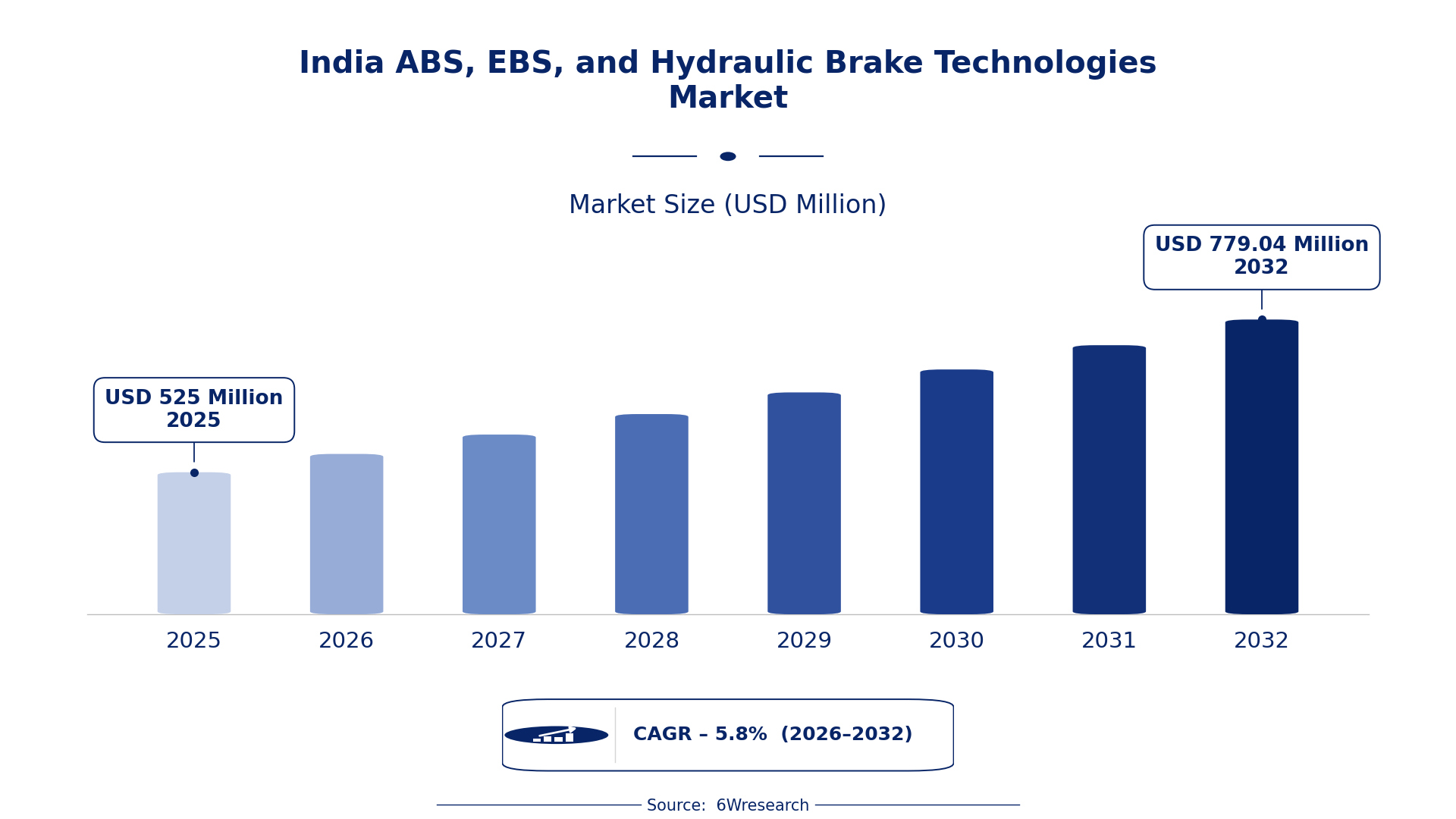
According to 6Wresearch internal database and industry insights, the India ABS, EBS, and Hydraulic Brake Technologies Market was valued at USD 525.0 million in 2025 and is projected to reach USD 779.04 million by 2032, growing at a CAGR of approximately 5.8% during 2026–2032.
India ABS, EBS, and Hydraulic Brake Technologies Market Highlights
| Report Metric | Details |
| Report Name | India ABS, EBS, and Hydraulic Brake Technologies Market |
| Market Size 2025 | USD 525.0 million |
| Market Size 2032 | USD 779.04 million |
| Absolute Growth 2025–2032 | USD 254.04 million |
| CAGR 2026–2032 | 5.8% |
| Peak Annual Growth | 8.2% in 2031 |
| Forecast Period | 2026–2032 |
| Historical Data | 2022–2025 |
| Base Year | 2025 |
| Leading Product Type, 2025 | ABS Systems (54% share) |
| Leading Vehicle Type, 2025 | Passenger Cars (44% share) |
| Leading Distribution Channel, 2025 | OEMs (46% share) |
| Leading End User, 2025 | Automotive Manufacturers (44% share) |
| Fastest-Growing Product Type | EBS Systems (8.4% CAGR) |
| Fastest-Growing Vehicle Type | Commercial Trucks (7.3% CAGR) |
| Fastest-Growing Distribution Channel | Aftermarket (7.8% CAGR) |
| Fastest-Growing End User | Logistics Companies (7.9% CAGR) |
| Growing Sector | Automotive manufacturing |
| Key End Users | OEMs, Automotive Manufacturers, Logistics Companies, Public Transport Providers |
India ABS, EBS, and Hydraulic Brake Technologies Market Year-wise Growth Rate and Key Drivers (2022–2032)
This graph illustrates the annual growth rates of the market from 2022 to 2032, highlighting a steady upward trajectory and projected market expansion over the forecast period.
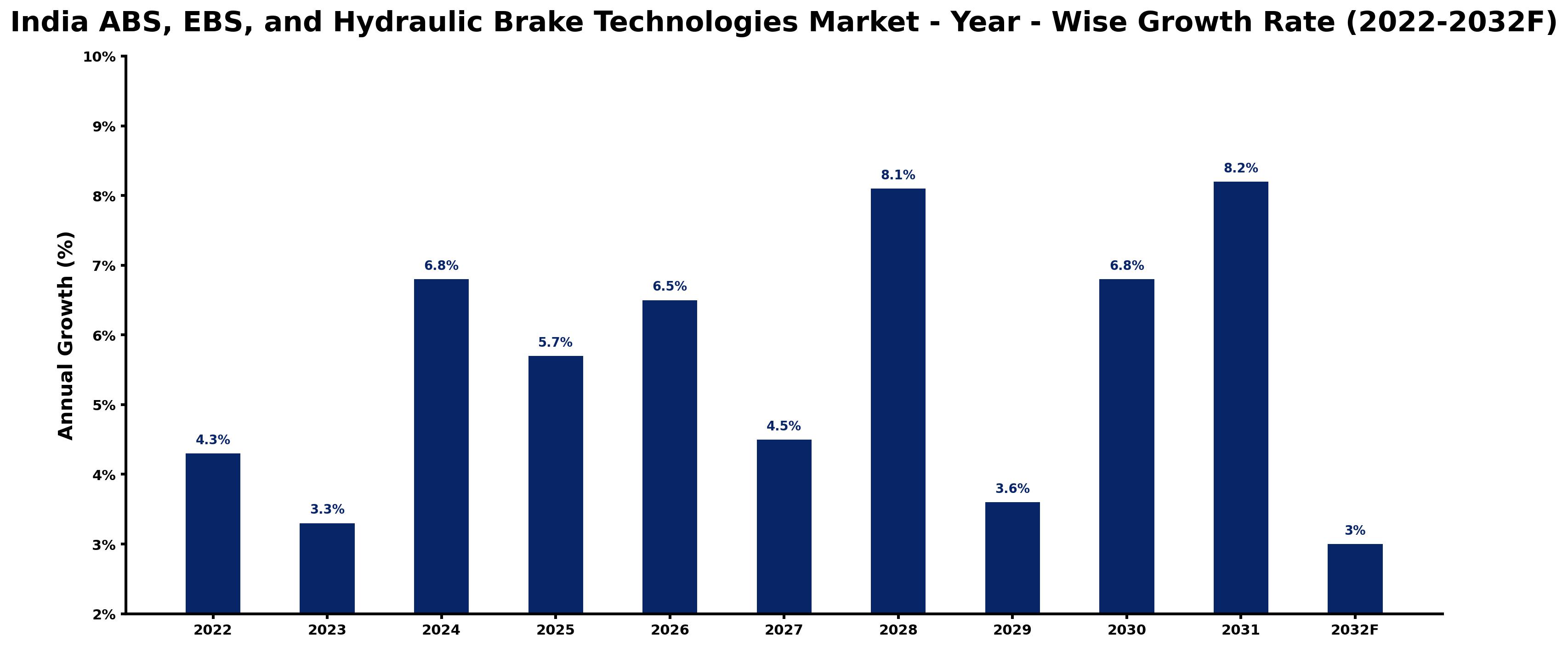
The following table presents the estimated annual growth rate for each year together with the principal factor influencing market performance.
| Year | Estimated Annual Growth (%) | Market Rationale |
| 2022 | 4.3 | The market experienced steady growth due to increasing vehicle production and demand for safety technologies. |
| 2023 | 3.3 | Growth slowed as manufacturers adjusted to Bharat Stage VI standards and emission regulations. |
| 2024 | 6.8 | Demand surged with the implementation of Bharat Stage VI standards requiring advanced braking systems. |
| 2025 | 5.7 | The market maintained growth as the automotive sector continued to expand and innovate. |
| 2026 | 6.5 | Growth is expected to accelerate with rising investments in electric vehicles and associated safety technologies. |
| 2027 | 4.5 | Demand is projected to moderate as the market adjusts to technological advancements and regulatory changes. |
| 2028 | 8.1 | The market is expected to rebound with heightened demand for EBS systems driven by safety compliance. |
| 2029 | 3.6 | Growth is projected to slow as manufacturers face challenges in meeting evolving safety standards. |
| 2030 | 6.8 | Demand will increase again as vehicle production ramps up in response to market needs. |
| 2031 | 8.2 | The market is expected to peak with strong growth driven by the adoption of advanced braking technologies. |
| 2032 | 3.0 | Growth will slow as the market stabilises following peak demand in previous years. |
Note: Market size estimations and growth projections presented in this report are based on 6Wresearch's proprietary forecasting methodology, utilizing the latest available industry data, government publications, and primary research inputs.
India ABS, EBS, and Hydraulic Brake Technologies Market Synopsis
The ABS, EBS, and Hydraulic Brake Technologies Market in India encompasses advanced braking systems that improve vehicle safety and performance. These technologies are essential for preventing wheel lock-up and ensuring overall braking efficiency. The market is expanding due to increasing demand from automotive manufacturers and logistics companies, driven by regulatory standards like Bharat Stage VI. With a population exceeding 1.4 billion, the need for reliable braking systems is more pressing than ever. The automotive sector's contribution to GDP underscores the importance of this market.
Market Dynamics Impact Analysis (2026–2032)
| Factor | Type | Impact | Primary Segment Affected |
| Rising vehicle production and safety regulations drive demand for advanced braking technologies. | Driver | High | ABS Systems |
| The transition to electric vehicles necessitates the integration of advanced braking systems. | Driver | High | EBS Systems |
| The aftermarket for braking components is expanding due to increasing vehicle ownership. | Opportunity | High | Aftermarket |
| Growing logistics operations require reliable braking systems for fleet safety. | Opportunity | High | Logistics Companies |
| Compliance with stringent safety standards can increase production costs for manufacturers. | Restraint | Medium | Automotive Manufacturers |
| Limited consumer awareness about advanced braking technologies may hinder adoption. | Restraint | Medium | Public Transport Providers |
| The ABS, EBS, and Hydraulic Brake Technologies market in India faces challenges from high production costs. | Challenge | High | OEMs |
| Technological integration issues can delay the adoption of advanced braking systems. | Challenge | Medium | Fleet Operators |
Evaluation of Drivers in India ABS, EBS, and Hydraulic Brake Technologies Market (2026–2032)
The factors lifting demand, and the evidence behind each, are summarised below.
| Drivers | Primary Segment Affected | Why It Matters (Evidence) |
| Increasing vehicle production rates create a higher demand for braking technologies. | ABS Systems | India's vehicle production reached 22.7 million units in 2022, leading to more purchases of braking systems to enhance safety. |
| The push for electric vehicles drives the need for advanced braking systems. | EBS Systems | Bharat Stage VI emission standards require all new vehicles to include advanced braking technologies, driving market growth. |
| Rising vehicle ownership boosts the aftermarket for braking components. | Aftermarket | The aftermarket for automotive components is projected to grow due to increasing vehicle ownership, creating demand for replacement parts. |
| Logistics companies require reliable braking systems for fleet safety. | Logistics Companies | Over 30 million registered commercial vehicles in India necessitate advanced braking systems for safety compliance and operational efficiency. |
| Regulatory compliance mandates advanced braking technologies in new vehicles. | Hydraulic Brake Technologies | Bharat Stage VI emission standards require all new vehicles to include advanced braking technologies, ensuring safety and compliance. |
The ABS, EBS, and Hydraulic Brake Technologies market in India is expanding as rising vehicle production, increasing investments in electric vehicles, and growing end-use demand from automotive manufacturers drive growth. The automotive sector contributes approximately 7.1% to India's GDP, creating a strong demand for advanced braking systems. The National Electric Mobility Mission Plan promotes electric vehicles, which require advanced braking technologies to ensure safety. In 2022, India produced 22.7 million vehicles, leading to an increase in the demand for braking systems. Compliance with Bharat Stage VI standards mandates the integration of these technologies in new vehicles, further boosting market demand and ensuring safety compliance.
Evaluation of Restraints in India ABS, EBS, and Hydraulic Brake Technologies Market
The key brakes on demand, and where they bite hardest, are shown below.
| Market Restraint | Primary Segment Affected | Why It Matters (Evidence) |
| High production costs associated with advanced braking technologies can limit profitability. | OEMs | The implementation of Bharat Stage VI standards increases manufacturing expenses, affecting OEMs' margins significantly. |
| Limited consumer awareness about the benefits of advanced braking systems may hinder market growth. | Public Transport Providers | Many public transport providers are unaware of the advantages of integrating ABS and EBS systems, impacting safety compliance. |
| Supply chain disruptions can delay the availability of critical components for braking systems. | Automotive Manufacturers | Global supply chain issues have impacted the timely delivery of electronic components needed for advanced braking technologies, causing delays. |
| Technological integration challenges can slow down the adoption of new braking systems. | Fleet Operators | Fleet operators face difficulties in upgrading existing vehicles to accommodate advanced braking technologies, delaying compliance efforts. |
| Competition from alternative safety technologies may divert investment from braking systems. | Logistics Companies | Logistics companies may consider investing in other safety technologies instead of advanced braking systems, affecting market growth. |
India ABS, EBS, and Hydraulic Brake Technologies Market Challenges
Over 30 million registered commercial vehicles in India face high costs due to compliance with Bharat Stage VI emission standards, which discourages fleet operators from upgrading their braking systems. Local producers encounter difficulties in integrating advanced braking technologies, resulting in delays that hinder timely delivery of competitive solutions to buyers. A shortage of skilled workers in automotive technology hampers production efficiency, leading to longer lead times for suppliers and increased costs. Fragmented supply chains complicate the procurement of essential components, causing delays that affect buyers' ability to meet safety standards in their vehicles.
Trends in the India ABS, EBS, and Hydraulic Brake Technologies Market
Buyers and suppliers in the India ABS, EBS, and Hydraulic Brake Technologies Market are adjusting to the following trends.
- Shift Towards Electric Vehicle Integration: India is increasingly integrating advanced braking technologies into electric vehicles, supported by the National Electric Mobility Mission Plan. This initiative aims to promote electric vehicles with safety features, reflecting a growing market need for reliable braking systems. The push for electric vehicles is expected to boost demand for advanced braking technologies.
- Transition to Advanced Safety Standards: The implementation of Bharat Stage VI standards is pushing manufacturers to adopt advanced braking systems. This regulatory change requires all new vehicles to include these technologies, impacting production strategies across the automotive sector. Compliance with these standards is essential for market growth.
- Growing Aftermarket Demand: The aftermarket for automotive components is projected to expand due to rising vehicle ownership. As more vehicles hit the roads, the demand for replacement and upgraded braking systems is expected to increase, creating opportunities for suppliers in this segment.
- Focus on Fleet Safety Compliance: Logistics companies are prioritising the adoption of advanced braking technologies to ensure fleet safety compliance. With over 30 million registered commercial vehicles, the need for reliable braking systems is paramount for operational efficiency and regulatory adherence.
Investment Opportunities in the India ABS, EBS, and Hydraulic Brake Technologies Market
Investors looking at the India ABS, EBS, and Hydraulic Brake Technologies Market should consider the following areas.
- Market Gap in Advanced Braking Systems: With over 30 million registered commercial vehicles in India, there is a gap in the availability of advanced braking systems. Investing in this segment can meet the growing demand for safety compliance and enhance market presence.
- Timing for Aftermarket Expansion: The aftermarket for braking components is set to grow due to increasing vehicle ownership. Suppliers can capitalise on this trend by providing high-quality replacement parts for existing vehicles, addressing the rising demand effectively.
- Supply of Advanced Braking Technologies: The demand for advanced braking technologies is rising, particularly in the logistics sector. Suppliers can enter this market by partnering with logistics companies to provide tailored solutions that meet safety and compliance needs.
- Investment in Electric Vehicle Components: The push for electric vehicles creates an opportunity for suppliers of advanced braking systems. Collaborating with automotive manufacturers focusing on electric vehicle production can yield mutual benefits and drive innovation.
Government Initiatives in the India ABS, EBS, and Hydraulic Brake Technologies Market
In 2022, the 'Automotive Mission Plan 2026' was updated to improve the competitiveness of the Indian automotive industry, focusing on safety technologies including braking systems. This measure enhances previous regulations by mandating the integration of advanced braking systems in new vehicles, ensuring compliance with safety standards. The 'National Electric Mobility Mission Plan 2020' promotes electric vehicles with advanced braking technologies, supporting the industry's transition towards safer vehicles and compliance with Bharat Stage VI standards.
The Ministry of Heavy Industries oversees the implementation of automotive safety regulations, approving projects that improve vehicle safety. The 'FAME India Phase II' scheme, launched in 2021 with a budget of ₹10,000 crore, supports electric vehicle adoption and boosts demand for modern braking technologies. Additionally, the Bureau of Indian Standards sets safety standards for braking technologies, ensuring that manufacturers comply with necessary regulations and enhancing overall vehicle safety.
Future Insight of the India ABS, EBS, and Hydraulic Brake Technologies Market
Several forward-looking factors should support the India ABS, EBS, and Hydraulic Brake Technologies market over the coming years. The 'FAME India Scheme' will promote electric vehicles, creating a greater need for advanced braking systems. By 2030, India is set to become the third largest automotive market, which will drive the demand for effective braking technologies. The National Automotive Testing and R&D Infrastructure Project will enhance the development of safer braking solutions, benefiting producers and ensuring compliance for buyers.
Market Segmentation Analysis
Each segment group is reviewed below, with the leader by share and the fastest grower by CAGR.
By Product Type – ABS Systems Dominated, EBS Systems Expected to Grow Fastest
According to Shubham Deep, Research Manager at 6Wresearch, ABS Systems took a 54% share of product type in 2025, more than any other category. ABS Systems hold the largest market share as they are essential for ensuring vehicle safety and performance, especially in passenger vehicles. The implementation of Bharat Stage VI emission standards has notably increased demand from automotive manufacturers for these critical systems. Over 2026–2032, EBS Systems are expected to post the fastest growth, at a CAGR of 8.4%. EBS Systems are experiencing rapid growth due to their seamless integration with electronic vehicle systems, enhancing overall control and safety features. The rise in electric vehicle production, supported by initiatives like the National Electric Mobility Mission Plan, is a key factor driving this growth. Suppliers should focus on advancing EBS technology to capitalise on the growing demand in the automotive sector.
By Vehicle Type – Passenger Cars Dominated, Commercial Trucks Expected to Grow Fastest
In 2025, Passenger Cars led the vehicle type split with a 44% share. Passenger Cars dominate the market share as they represent the majority of vehicles on Indian roads, necessitating advanced braking systems for safety compliance. The high vehicle production rate, reaching 22.7 million units in 2022, further reinforces this segment's prominence. Commercial Trucks are set to record the highest CAGR in this split, 7.3% over 2026–2032. Commercial Trucks are experiencing the fastest growth due to their critical need for advanced braking systems to ensure safety and compliance with regulations. The increasing number of registered commercial vehicles, exceeding 30 million, highlights the urgency for improved braking technologies in this segment. Manufacturers should prioritise innovations tailored for commercial trucks to meet the escalating safety standards and market demand.
By Distribution Channel – OEMs Dominated, Aftermarket Expected to Grow Fastest
OEMs accounted for a 46% market share by distribution channel in 2025. OEMs represent the largest share of the market as they are the main buyers of advanced braking technologies for new vehicle production. The concentration of automotive manufacturing in states like Maharashtra and Tamil Nadu solidifies the dominance of this distribution channel. The quickest growth will come from Aftermarket, forecast to expand at a CAGR of 7.8% between 2026 and 2032. The Aftermarket is growing rapidly as increasing vehicle ownership leads to a higher demand for replacement and upgrade parts. As the automotive industry expands, the need for reliable aftermarket solutions will continue to rise, creating substantial opportunities. Suppliers must enhance their aftermarket strategies to effectively meet the growing demand for replacement braking systems driven by rising vehicle ownership.
By End User – Automotive Manufacturers Dominated, Logistics Companies Expected to Grow Fastest
The largest end user category in 2025 was Automotive Manufacturers, with a 44% share of total revenue. Automotive Manufacturers command the largest market share as they are the primary consumers of braking technologies, driven by the need to comply with strict safety regulations. The automotive sector's contribution of approximately 7.1% to India's GDP highlights the strong demand for advanced braking systems. Logistics Companies are projected to grow fastest, at a CAGR of 7.9% during 2026–2032. Logistics Companies are the fastest-growing end users, motivated by their requirement for reliable braking systems to ensure fleet safety and compliance with regulations. The increasing emphasis on safety within logistics operations is significantly driving the demand for advanced braking technologies in this sector. Suppliers should tailor their products to meet the specific needs of logistics companies, ensuring safety and adherence to regulatory standards.
Key Attractiveness of the Report
- 10 Years of Market Numbers
- Historical Data Starting from 2022 to 2025
- Base Year 2025
- Forecast Data until 2032
- Key Performance Indicators Impacting the Market
- Major Upcoming Developments and Projects
Key Highlights of the Report:
- India ABS, EBS, and Hydraulic Brake Technologies Market Outlook
- Market Size of India ABS, EBS, and Hydraulic Brake Technologies Market, 2025
- Forecast of India ABS, EBS, and Hydraulic Brake Technologies Market, 2032
- Historical Data and Forecast of India ABS, EBS, and Hydraulic Brake Technologies Revenues & Volume for the Period 2022 - 2032F
- India ABS, EBS, and Hydraulic Brake Technologies Market Trend Evolution
- India ABS, EBS, and Hydraulic Brake Technologies Market Drivers and Challenges
- India ABS, EBS, and Hydraulic Brake Technologies Price Trends
- India ABS, EBS, and Hydraulic Brake Technologies Porter's Five Forces
- India ABS, EBS, and Hydraulic Brake Technologies Industry Life Cycle
- Historical Data and Forecast of India ABS, EBS, and Hydraulic Brake Technologies Market Revenues & Volume By Product Type for the Period 2022 - 2032F
- Historical Data and Forecast of India ABS, EBS, and Hydraulic Brake Technologies Market Revenues & Volume By ABS Systems for the Period 2022 - 2032F
- Historical Data and Forecast of India ABS, EBS, and Hydraulic Brake Technologies Market Revenues & Volume By EBS Systems for the Period 2022 - 2032F
- Historical Data and Forecast of India ABS, EBS, and Hydraulic Brake Technologies Market Revenues & Volume By Hydraulic Brake Technologies for the Period 2022 - 2032F
- Historical Data and Forecast of India ABS, EBS, and Hydraulic Brake Technologies Market Revenues & Volume By Integrated Braking Solutions for the Period 2022 - 2032F
- Historical Data and Forecast of India ABS, EBS, and Hydraulic Brake Technologies Market Revenues & Volume By Vehicle Type for the Period 2022 - 2032F
- Historical Data and Forecast of India ABS, EBS, and Hydraulic Brake Technologies Market Revenues & Volume By Passenger Cars for the Period 2022 - 2032F
- Historical Data and Forecast of India ABS, EBS, and Hydraulic Brake Technologies Market Revenues & Volume By Commercial Trucks for the Period 2022 - 2032F
- Historical Data and Forecast of India ABS, EBS, and Hydraulic Brake Technologies Market Revenues & Volume By Buses for the Period 2022 - 2032F
- Historical Data and Forecast of India ABS, EBS, and Hydraulic Brake Technologies Market Revenues & Volume By Trailers for the Period 2022 - 2032F
- Historical Data and Forecast of India ABS, EBS, and Hydraulic Brake Technologies Market Revenues & Volume By Distribution Channel for the Period 2022 - 2032F
- Historical Data and Forecast of India ABS, EBS, and Hydraulic Brake Technologies Market Revenues & Volume By OEMs for the Period 2022 - 2032F
- Historical Data and Forecast of India ABS, EBS, and Hydraulic Brake Technologies Market Revenues & Volume By Aftermarket for the Period 2022 - 2032F
- Historical Data and Forecast of India ABS, EBS, and Hydraulic Brake Technologies Market Revenues & Volume By Distributors for the Period 2022 - 2032F
- Historical Data and Forecast of India ABS, EBS, and Hydraulic Brake Technologies Market Revenues & Volume By Online Platforms for the Period 2022 - 2032F
- Historical Data and Forecast of India ABS, EBS, and Hydraulic Brake Technologies Market Revenues & Volume By End User for the Period 2022 - 2032F
- Historical Data and Forecast of India ABS, EBS, and Hydraulic Brake Technologies Market Revenues & Volume By Automotive Manufacturers for the Period 2022 - 2032F
- Historical Data and Forecast of India ABS, EBS, and Hydraulic Brake Technologies Market Revenues & Volume By Logistics Companies for the Period 2022 - 2032F
- Historical Data and Forecast of India ABS, EBS, and Hydraulic Brake Technologies Market Revenues & Volume By Public Transport Providers for the Period 2022 - 2032F
- Historical Data and Forecast of India ABS, EBS, and Hydraulic Brake Technologies Market Revenues & Volume By Fleet Operators for the Period 2022 - 2032F
- India ABS, EBS, and Hydraulic Brake Technologies Import Export Trade Statistics
- Market Opportunity Assessment By Product Type
- Market Opportunity Assessment By Vehicle Type
- Market Opportunity Assessment By Distribution Channel
- Market Opportunity Assessment By End User
- India ABS, EBS, and Hydraulic Brake Technologies Top Companies Market Share
- India ABS, EBS, and Hydraulic Brake Technologies Competitive Benchmarking By Technical and Operational Parameters
- India ABS, EBS, and Hydraulic Brake Technologies Company Profiles
- India ABS, EBS, and Hydraulic Brake Technologies Key Strategic Recommendations
Market Covered
The report offers an extensive study of the following market segments.
By Product Type
- ABS Systems
- EBS Systems
- Hydraulic Brake Technologies
- Integrated Braking Solutions
By Vehicle Type
- Passenger Cars
- Commercial Trucks
- Buses
- Trailers
By Distribution Channel
- OEMs
- Aftermarket
- Distributors
- Online Platforms
By End User
- Automotive Manufacturers
- Logistics Companies
- Public Transport Providers
- Fleet Operators































