India ABUS (Automated Breast Ultrasound System) Market Size & Growth Rate
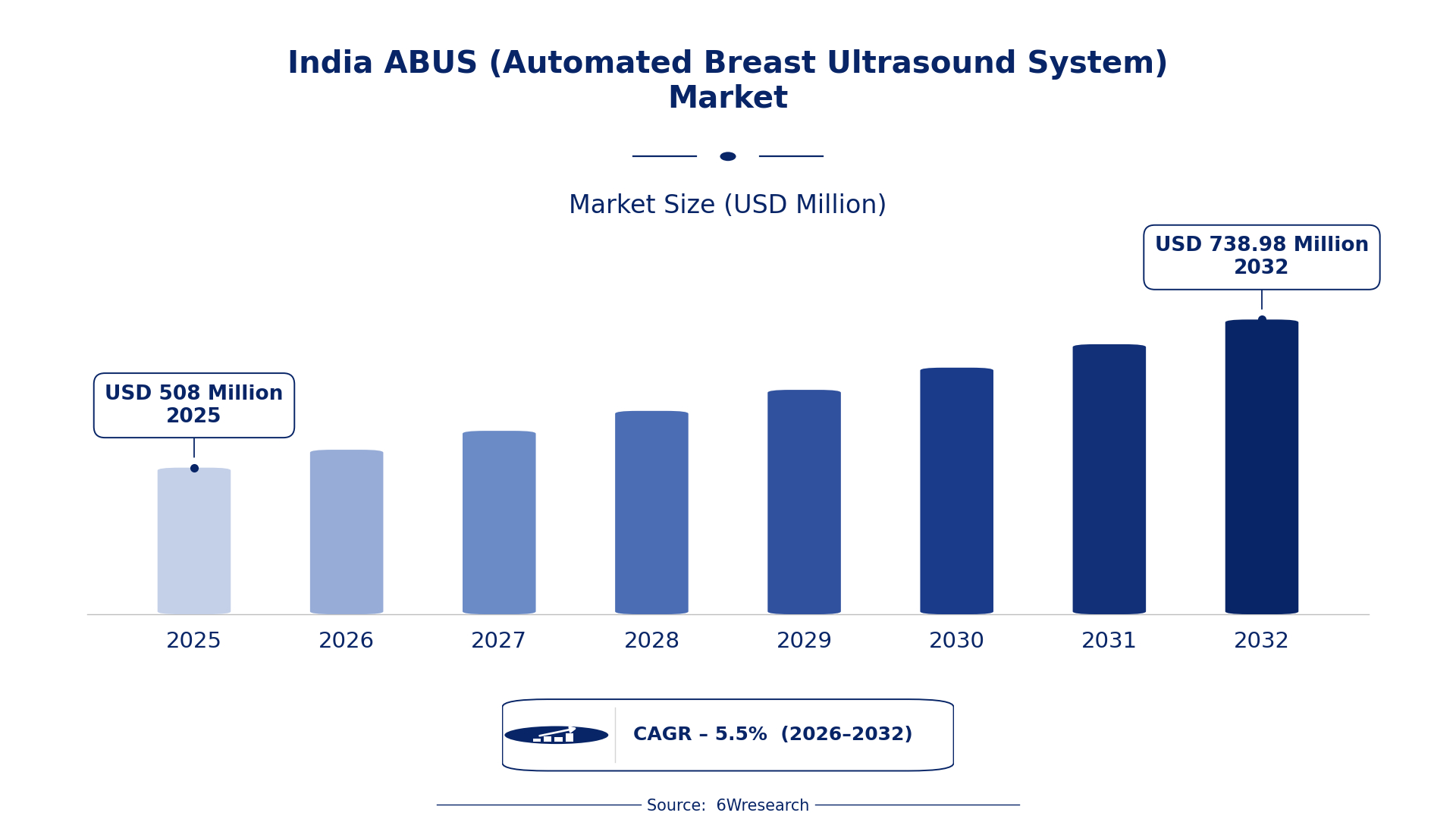
According to 6Wresearch internal database and industry insights, the India ABUS (Automated Breast Ultrasound System) Market was valued at USD 508.0 million in 2025 and is projected to reach USD 738.98 million by 2032, growing at a CAGR of approximately 5.5% during 2026–2032.
India ABUS (Automated Breast Ultrasound System) Market Highlights
| Report Metric | Details |
| Report Name | India ABUS (Automated Breast Ultrasound System) Market |
| Market Size 2025 | USD 508.0 million |
| Market Size 2032 | USD 738.98 million |
| Absolute Growth 2025–2032 | USD 230.98 million |
| CAGR 2026–2032 | 5.5% |
| Peak Annual Growth | 7.9% in 2028 |
| Forecast Period | 2026–2032 |
| Historical Data | 2022–2025 |
| Base Year | 2025 |
| Leading System Type, 2025 | 2D ABUS Systems (49% share) |
| Leading Imaging Technology, 2025 | Conventional Imaging (41% share) |
| Leading Distribution Channel, 2025 | Hospital Networks (49% share) |
| Leading End User, 2025 | Diagnostic Centers (35% share) |
| Fastest-Growing System Type | 3D ABUS Systems (6.9% CAGR) |
| Fastest-Growing Imaging Technology | Advanced Imaging (7.1% CAGR) |
| Fastest-Growing Distribution Channel | Direct Manufacturer Sales (7.6% CAGR) |
| Fastest-Growing End User | Breast Cancer Clinics (7.9% CAGR) |
| Growing Sector | Diagnostic Centers |
| Key End Users | Hospitals, Diagnostic Centers, Breast Cancer Clinics |
India ABUS (Automated Breast Ultrasound System) Market Year-wise Growth Rate and Key Drivers (2022–2032)
This graph illustrates the annual growth rates of the market from 2022 to 2032, highlighting a steady upward trajectory and projected market expansion over the forecast period.
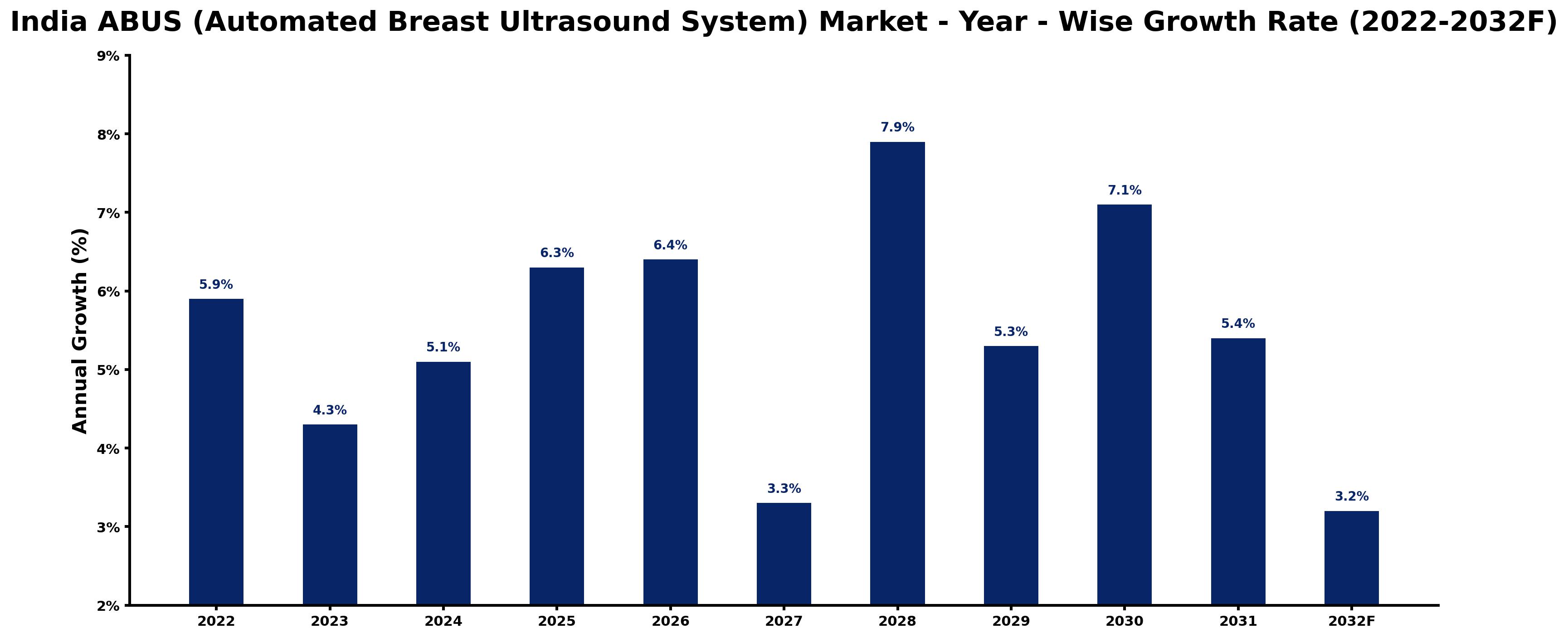
Below, each year's estimated growth is shown next to the factor that most influenced it.
| Year | Estimated Annual Growth (%) | Market Rationale |
| 2022 | 5.9 | The market experienced steady growth due to rising awareness of breast cancer screening. |
| 2023 | 4.3 | Growth slowed as hospitals adjusted to new ABUS technology and protocols. |
| 2024 | 5.1 | Demand increased as more diagnostic centers adopted ABUS systems for screenings. |
| 2025 | 6.3 | A peak in growth occurred as the Breast Cancer Screening Program gained traction. |
| 2026 | 6.4 | Investment in advanced imaging technologies continued, boosting market activity. |
| 2027 | 3.3 | Growth slowed as competition among diagnostic centers intensified. |
| 2028 | 7.9 | The market peaked as hospitals expanded their ABUS capabilities significantly. |
| 2029 | 5.3 | Demand slowed as market saturation began to affect growth rates. |
| 2030 | 7.1 | Growth resumed as AI-based imaging technology became more widely adopted. |
| 2031 | 5.4 | A slowdown occurred as hospitals focused on operational efficiencies. |
| 2032 | 3.2 | The market growth rate declined as competition and market maturity set in. |
Note: Market size estimations and growth projections presented in this report are based on 6Wresearch's proprietary forecasting methodology, utilizing the latest available industry data, government publications, and primary research inputs.
India ABUS (Automated Breast Ultrasound System) Market Synopsis
The ABUS (Automated Breast Ultrasound System) Market in India features advanced imaging technology designed for breast cancer screening. ABUS systems generate detailed images of breast tissue, primarily utilised in hospitals and diagnostic centres. The market is expanding in response to more than 1.5 million new breast cancer cases each year and increased investments in healthcare technology. The Breast Cancer Screening Program initiated in 2021 has further driven demand, resulting in a notable increase in screenings and technology adoption.
Market Dynamics Impact Analysis (2026–2032)
| Factor | Type | Impact | Primary Segment Affected |
| Increasing incidence of breast cancer drives demand for effective screening solutions. | Driver | High | 2D ABUS Systems |
| Investment in advanced imaging technology enhances diagnostic capabilities. | Driver | High | Advanced Imaging |
| Growing urban population density increases the need for breast cancer screening. | Opportunity | High | Diagnostic Centers |
| Rising awareness about breast cancer screening creates demand for ABUS systems. | Opportunity | High | Hospitals and Specialty Clinics |
| Limited availability of trained personnel hinders widespread adoption of ABUS technology. | Restraint | High | 2D ABUS Systems |
| High initial costs of ABUS systems can deter smaller healthcare facilities from investing. | Restraint | High | Diagnostic Centers |
| Regulatory approvals for new imaging technologies can delay market entry. | Challenge | Medium | 2D ABUS Systems |
| Competition among diagnostic centers may lead to price pressures on ABUS systems. | Challenge | Medium | Hospitals and Specialty Clinics |
Evaluation of Drivers in India ABUS (Automated Breast Ultrasound System) Market (2026–2032)
The factors lifting demand, and the evidence behind each, are summarised below.
| Drivers | Primary Segment Affected | Why It Matters (Evidence) |
| Rising breast cancer cases drive demand for advanced screening technologies. | 2D ABUS Systems | With over 1.5 million new cases annually, hospitals are purchasing more ABUS systems for effective diagnosis. |
| Investment in healthcare technology boosts ABUS adoption in hospitals. | 3D ABUS Systems | Hospitals in metropolitan areas are increasingly investing in advanced imaging technologies, improving screening capabilities. |
| Urban population density increases demand for breast cancer screenings. | Diagnostic Centers | The average population density in urban areas is 11,000 people per square kilometer, necessitating more screening facilities. |
| Government initiatives promote breast cancer awareness and screening. | Hospitals and Specialty Clinics | The National Program for Prevention and Control of Cancer supports breast cancer screening initiatives, driving demand for ABUS systems. |
| AI-based imaging technology improves diagnostic accuracy and efficiency. | AI-Based Imaging | AI technology is gaining traction in 40% of new ABUS installations, improving diagnostic outcomes. |
Growth across the ABUS (Automated Breast Ultrasound System) market in India is anchored in rising breast cancer cases, urban population density and increased investment in healthcare technology. Hospitals are purchasing more ABUS systems due to over 1.5 million new breast cancer cases annually. Urban areas, with a population density of 11,000 people per square kilometer, necessitate more screening facilities. AI technology is being integrated into 40% of new installations, improving diagnostic outcomes and efficiency in healthcare facilities.
Evaluation of Restraints in India ABUS (Automated Breast Ultrasound System) Market
The main factors holding the market back are set out below.
| Market Restraint | Primary Segment Affected | Why It Matters (Evidence) |
| Limited availability of trained personnel hinders widespread adoption of ABUS technology. | 2D ABUS Systems | A shortage of trained professionals affects the effective operation of ABUS systems in healthcare facilities. |
| High initial costs of ABUS systems can deter smaller healthcare facilities from investing. | Diagnostic Centers | Smaller diagnostic centers may struggle to afford the investment required for ABUS technology. |
| Regulatory approvals for new imaging technologies can delay market entry. | 3D ABUS Systems | Stringent regulatory processes can slow down the introduction of new ABUS solutions. |
| Competition among diagnostic centers may lead to price pressures on ABUS systems. | Hospitals and Specialty Clinics | Price competition can reduce profit margins for healthcare providers investing in ABUS technology. |
| Limited awareness of ABUS technology among healthcare providers can restrict market growth. | 2D ABUS Systems | A lack of knowledge about the benefits of ABUS can hinder adoption in some regions. |
India ABUS (Automated Breast Ultrasound System) Market Challenges
The India ABUS market contends with fierce competition from traditional imaging methods, compelling suppliers to lower prices and impacting profit margins. Regulatory challenges tied to ISO 13485 result in prolonged product approval processes, hindering hospitals' ability to adopt new technologies. The high cost of ABUS systems discourages smaller diagnostic centres from making investments, limiting patient access to crucial screening services. Furthermore, supply chain disruptions can delay the delivery of essential components, leading to installation setbacks for healthcare facilities dependent on these advanced systems.
Trends in the India ABUS (Automated Breast Ultrasound System) Market
Four trends stand out in the India ABUS (Automated Breast Ultrasound System) Market.
- Shift from Conventional to Advanced Imaging Technologies: India is moving away from conventional imaging methods towards advanced imaging technologies for breast cancer screening. The adoption of these techniques is expected to grow at a CAGR of 7.1%, enhancing diagnostic accuracy in hospitals.
- Increase in AI-Based Imaging Technology Adoption: In 2022, AI-based imaging technology constituted 40% of new ABUS installations in India. This trend demonstrates a growing preference for improved diagnostic capabilities among healthcare providers.
- Growth in Breast Cancer Screening Initiatives: The Breast Cancer Screening Program launched in 2021 has resulted in a marked increase in screening rates. Diagnostic centres report a 30% rise in screenings, reflecting heightened awareness and demand for advanced imaging solutions.
- Expansion of Hospital Networks Utilizing ABUS: Hospitals are progressively investing in ABUS systems to enhance patient care. The demand for ABUS technology is anticipated to rise as hospitals broaden their capabilities.
Investment Opportunities in the India ABUS (Automated Breast Ultrasound System) Market
Several openings in the India ABUS (Automated Breast Ultrasound System) Market merit attention from investors.
- Investment in Diagnostic Centers: With over 1.5 million new breast cancer cases each year, there is an increasing need for diagnostic centres. Investing in these facilities can address the growing demand for ABUS systems.
- Supply of AI-Based Imaging Solutions: The rising adoption of AI-based imaging technology offers an opportunity for suppliers. Hospitals are seeking advanced solutions that improve diagnostic accuracy and efficiency.
- Expansion of Hospital Networks: The growing number of hospitals investing in ABUS systems presents a substantial market opportunity. Partnering with hospital networks can facilitate entry into this expanding sector.
- Development of Portable ABUS Devices: There is a market gap for portable ABUS devices, especially for mobile health applications. Targeting this segment can meet specific healthcare needs.
Government Initiatives in the India ABUS (Automated Breast Ultrasound System) Market
The Breast Cancer Screening Program launched by the Ministry of Health in 2021 has impacted the ABUS market by increasing awareness and accessibility of breast cancer screenings across India. By allocating ₹200 crore for cancer control programs, the government supports the implementation of advanced screening technologies in healthcare facilities. Additionally, the National Program for Prevention and Control of Cancer, Diabetes, Cardiovascular Diseases & Stroke promotes effective screening methods, further driving demand for ABUS systems.
The Indian Medical Association promotes awareness about breast cancer screening. Funding for various cancer control initiatives is provided through government schemes, facilitating the integration of ABUS technology in diagnostic centers. The Ministry of Health oversees the implementation of these programs, ensuring that healthcare providers receive the necessary support and resources. Approvals for new imaging technologies are streamlined to encourage the adoption of advanced solutions in hospitals.
Future Insight of the India ABUS (Automated Breast Ultrasound System) Market
By 2032, transformative changes will reshape the India ABUS market, driven by AI-based imaging technology, which will feature in 40% of new installations. The government's ongoing support for the National Program for Prevention and Control of Cancer is likely to increase funding for breast cancer screening initiatives, improving access to ABUS systems nationwide. Hospitals will continue to invest in advanced imaging technologies, raising the standards of breast cancer detection. With over 30% growth in breast cancer screenings reported in 2022, the demand for effective screening solutions will create new opportunities for suppliers.
Market Segmentation Analysis
Each segment group is reviewed below, with the leader by share and the fastest grower by CAGR.
By System Type – 2D ABUS Systems Dominated, 3D ABUS Systems Expected to Grow Fastest
According to Shubham Deep, Research Manager at 6Wresearch, 2D ABUS Systems accounted for a 49% market share by system type in 2025. 2D ABUS Systems hold the largest market share as they are extensively used in urban clinics, particularly in metropolitan areas like Delhi and Mumbai, where breast cancer screening is a priority. This widespread adoption is supported by the high incidence of breast cancer cases in these regions, driving demand for effective imaging solutions. Over 2026–2032, 3D ABUS Systems are expected to post the fastest growth, at a CAGR of 6.9%. 3D ABUS Systems are rapidly gaining market share due to their enhanced imaging capabilities, which significantly improve diagnostic accuracy. The increasing investment in advanced imaging technologies by healthcare facilities is expected to further accelerate the adoption of 3D systems, widening the lead over 2D systems. Suppliers should focus on promoting 3D ABUS Systems to meet the rising demand for advanced imaging solutions in breast cancer screening.
By Imaging Technology – Conventional Imaging Dominated, Advanced Imaging Expected to Grow Fastest
In 2025, Conventional Imaging led the imaging technology split with a 41% share. Conventional Imaging maintains a strong market share as it has long been the standard method for breast imaging, widely adopted across various healthcare settings. Its established presence continues to be vital for breast cancer screening despite the emergence of newer technologies. Advanced Imaging is projected to grow fastest, at a CAGR of 7.1% during 2026–2032. Advanced Imaging is experiencing rapid growth as it complements ABUS technology, providing improved diagnostic outcomes that healthcare providers are increasingly seeking. This trend indicates a shift towards integrating advanced imaging techniques with existing systems, driving further adoption. Buyers should consider integrating advanced imaging technologies with ABUS systems to enhance the overall effectiveness of breast cancer screening.
By Distribution Channel – Hospital Networks Dominated, Direct Manufacturer Sales Expected to Grow Fastest
The largest distribution channel category in 2025 was Hospital Networks, with a 49% share of total revenue. Hospital Networks capture the largest share as they are the primary users of ABUS systems, providing critical patient care in urban areas. Their established infrastructure supports the widespread adoption of ABUS technology in breast cancer screening. The quickest growth will come from Direct Manufacturer Sales, forecast to expand at a CAGR of 7.6% between 2026 and 2032. Direct Manufacturer Sales are growing quickly as manufacturers seek to establish closer relationships with healthcare providers, ensuring better service and support. This shift reflects the increasing importance of direct engagement in the distribution of ABUS systems. Suppliers must strengthen direct sales strategies to meet the rising demand for ABUS systems in the market.
By End User – Diagnostic Centers Dominated, Breast Cancer Clinics Expected to Grow Fastest
Diagnostic Centers took a 35% share of end user in 2025, more than any other category. Diagnostic Centers dominate the market due to their crucial role in providing breast cancer screening services using ABUS technology. Their focus on early detection aligns with the rising incidence of breast cancer, ensuring a robust demand for these systems in urban areas. Breast Cancer Clinics are set to record the highest CAGR in this split, 7.9% over 2026–2032. Breast Cancer Clinics are witnessing rapid growth as they specialise in screening and diagnosis using ABUS technology, reflecting an increased awareness of breast cancer prevention. This growth is further supported by national initiatives aimed at improving screening rates among women. Suppliers should direct their marketing efforts towards breast cancer clinics to leverage their expanding role in the ABUS market.
Key Attractiveness of the Report
- 10 Years of Market Numbers
- Historical Data Starting from 2022 to 2025
- Base Year 2025
- Forecast Data until 2032
- Key Performance Indicators Impacting the Market
- Major Upcoming Developments and Projects
Key Highlights of the Report:
- India ABUS (Automated Breast Ultrasound System) Market Outlook
- Market Size of India ABUS (Automated Breast Ultrasound System) Market, 2025
- Forecast of India ABUS (Automated Breast Ultrasound System) Market, 2032
- Historical Data and Forecast of India ABUS (Automated Breast Ultrasound System) Revenues & Volume for the Period 2022 - 2032F
- India ABUS (Automated Breast Ultrasound System) Market Trend Evolution
- India ABUS (Automated Breast Ultrasound System) Market Drivers and Challenges
- India ABUS (Automated Breast Ultrasound System) Price Trends
- India ABUS (Automated Breast Ultrasound System) Porter's Five Forces
- India ABUS (Automated Breast Ultrasound System) Industry Life Cycle
- Historical Data and Forecast of India ABUS (Automated Breast Ultrasound System) Market Revenues & Volume By System Type for the Period 2022 - 2032F
- Historical Data and Forecast of India ABUS (Automated Breast Ultrasound System) Market Revenues & Volume By 2D ABUS Systems for the Period 2022 - 2032F
- Historical Data and Forecast of India ABUS (Automated Breast Ultrasound System) Market Revenues & Volume By 3D ABUS Systems for the Period 2022 - 2032F
- Historical Data and Forecast of India ABUS (Automated Breast Ultrasound System) Market Revenues & Volume By Portable ABUS Devices for the Period 2022 - 2032F
- Historical Data and Forecast of India ABUS (Automated Breast Ultrasound System) Market Revenues & Volume By Integrated ABUS Solutions for the Period 2022 - 2032F
- Historical Data and Forecast of India ABUS (Automated Breast Ultrasound System) Market Revenues & Volume By Imaging Technology for the Period 2022 - 2032F
- Historical Data and Forecast of India ABUS (Automated Breast Ultrasound System) Market Revenues & Volume By Conventional Imaging for the Period 2022 - 2032F
- Historical Data and Forecast of India ABUS (Automated Breast Ultrasound System) Market Revenues & Volume By Advanced Imaging for the Period 2022 - 2032F
- Historical Data and Forecast of India ABUS (Automated Breast Ultrasound System) Market Revenues & Volume By Handheld Units for the Period 2022 - 2032F
- Historical Data and Forecast of India ABUS (Automated Breast Ultrasound System) Market Revenues & Volume By AI-Based Imaging for the Period 2022 - 2032F
- Historical Data and Forecast of India ABUS (Automated Breast Ultrasound System) Market Revenues & Volume By Distribution Channel for the Period 2022 - 2032F
- Historical Data and Forecast of India ABUS (Automated Breast Ultrasound System) Market Revenues & Volume By Hospital Networks for the Period 2022 - 2032F
- Historical Data and Forecast of India ABUS (Automated Breast Ultrasound System) Market Revenues & Volume By Direct Manufacturer Sales for the Period 2022 - 2032F
- Historical Data and Forecast of India ABUS (Automated Breast Ultrasound System) Market Revenues & Volume By Medical Equipment Dealers for the Period 2022 - 2032F
- Historical Data and Forecast of India ABUS (Automated Breast Ultrasound System) Market Revenues & Volume By Online Platforms for the Period 2022 - 2032F
- Historical Data and Forecast of India ABUS (Automated Breast Ultrasound System) Market Revenues & Volume By End User for the Period 2022 - 2032F
- Historical Data and Forecast of India ABUS (Automated Breast Ultrasound System) Market Revenues & Volume By Diagnostic Centers for the Period 2022 - 2032F
- Historical Data and Forecast of India ABUS (Automated Breast Ultrasound System) Market Revenues & Volume By Breast Cancer Clinics for the Period 2022 - 2032F
- Historical Data and Forecast of India ABUS (Automated Breast Ultrasound System) Market Revenues & Volume By Mobile Health Units for the Period 2022 - 2032F
- Historical Data and Forecast of India ABUS (Automated Breast Ultrasound System) Market Revenues & Volume By Hospitals and Specialty Clinics for the Period 2022 - 2032F
- India ABUS (Automated Breast Ultrasound System) Import Export Trade Statistics
- Market Opportunity Assessment By System Type
- Market Opportunity Assessment By Imaging Technology
- Market Opportunity Assessment By Distribution Channel
- Market Opportunity Assessment By End User
- India ABUS (Automated Breast Ultrasound System) Top Companies Market Share
- India ABUS (Automated Breast Ultrasound System) Competitive Benchmarking By Technical and Operational Parameters
- India ABUS (Automated Breast Ultrasound System) Company Profiles
- India ABUS (Automated Breast Ultrasound System) Key Strategic Recommendations
Market Covered
Segments analysed in this report are listed below.
By System Type
- 2D ABUS Systems
- 3D ABUS Systems
- Portable ABUS Devices
- Integrated ABUS Solutions
By Imaging Technology
- Conventional Imaging
- Advanced Imaging
- Handheld Units
- AI-Based Imaging
By Distribution Channel
- Hospital Networks
- Direct Manufacturer Sales
- Medical Equipment Dealers
- Online Platforms
By End User
- Diagnostic Centers
- Breast Cancer Clinics
- Mobile Health Units
- Hospitals and Specialty Clinics































