India Academic Integrity Software Market Size & Growth Rate
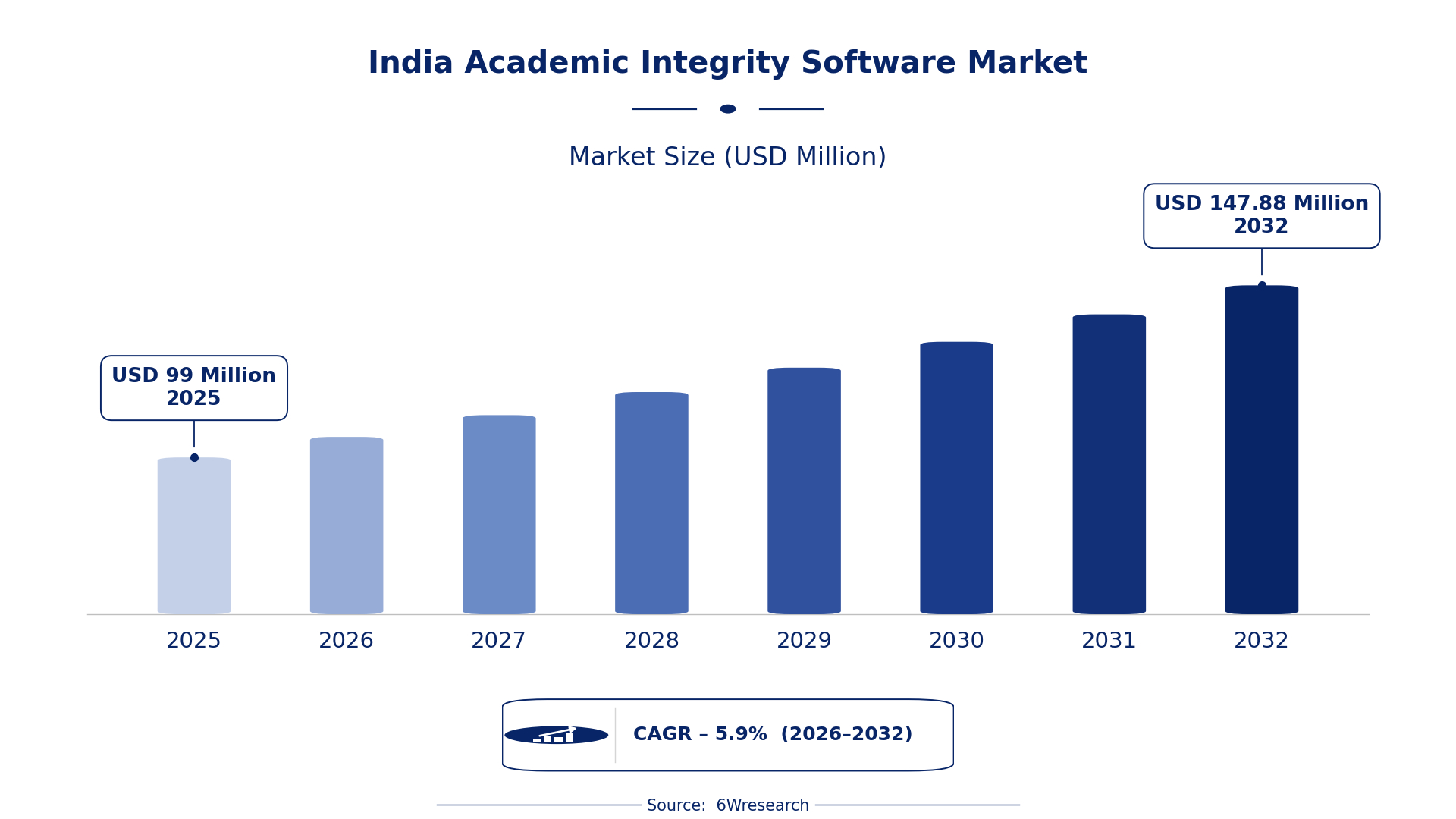
According to 6Wresearch internal database and industry insights, the India Academic Integrity Software Market was valued at USD 99.0 million in 2025 and is projected to reach USD 147.88 million by 2032, growing at a CAGR of approximately 5.9% during 2026–2032.
India Academic Integrity Software Market Highlights
| Report Metric | Details |
| Report Name | India Academic Integrity Software Market |
| Market Size 2025 | USD 99.0 million |
| Market Size 2032 | USD 147.88 million |
| Absolute Growth 2025–2032 | USD 48.88 million |
| CAGR 2026–2032 | 5.9% |
| Peak Annual Growth | 8.3% in 2030 |
| Forecast Period | 2026–2032 |
| Historical Data | 2022–2025 |
| Base Year | 2025 |
| Leading Software Type, 2025 | Plagiarism Detection (44% share) |
| Leading Deployment Model, 2025 | Cloud-Based (41% share) |
| Leading Distribution Channel, 2025 | Direct Sales (44% share) |
| Leading End User, 2025 | Universities (46% share) |
| Fastest-Growing Software Type | Exam Monitoring Tools (7.0% CAGR) |
| Fastest-Growing Deployment Model | On-Premise (7.5% CAGR) |
| Fastest-Growing Distribution Channel | EdTech Distributors (8.3% CAGR) |
| Fastest-Growing End User | Online Learning Platforms (7.0% CAGR) |
| Growing Sector | education |
| Key End Users | universities, online learning platforms, research institutions, testing agencies |
India Academic Integrity Software Market Year-wise Growth Rate and Key Drivers (2022–2032)
This graph illustrates the annual growth rates of the market from 2022 to 2032, highlighting a steady upward trajectory and projected market expansion over the forecast period.
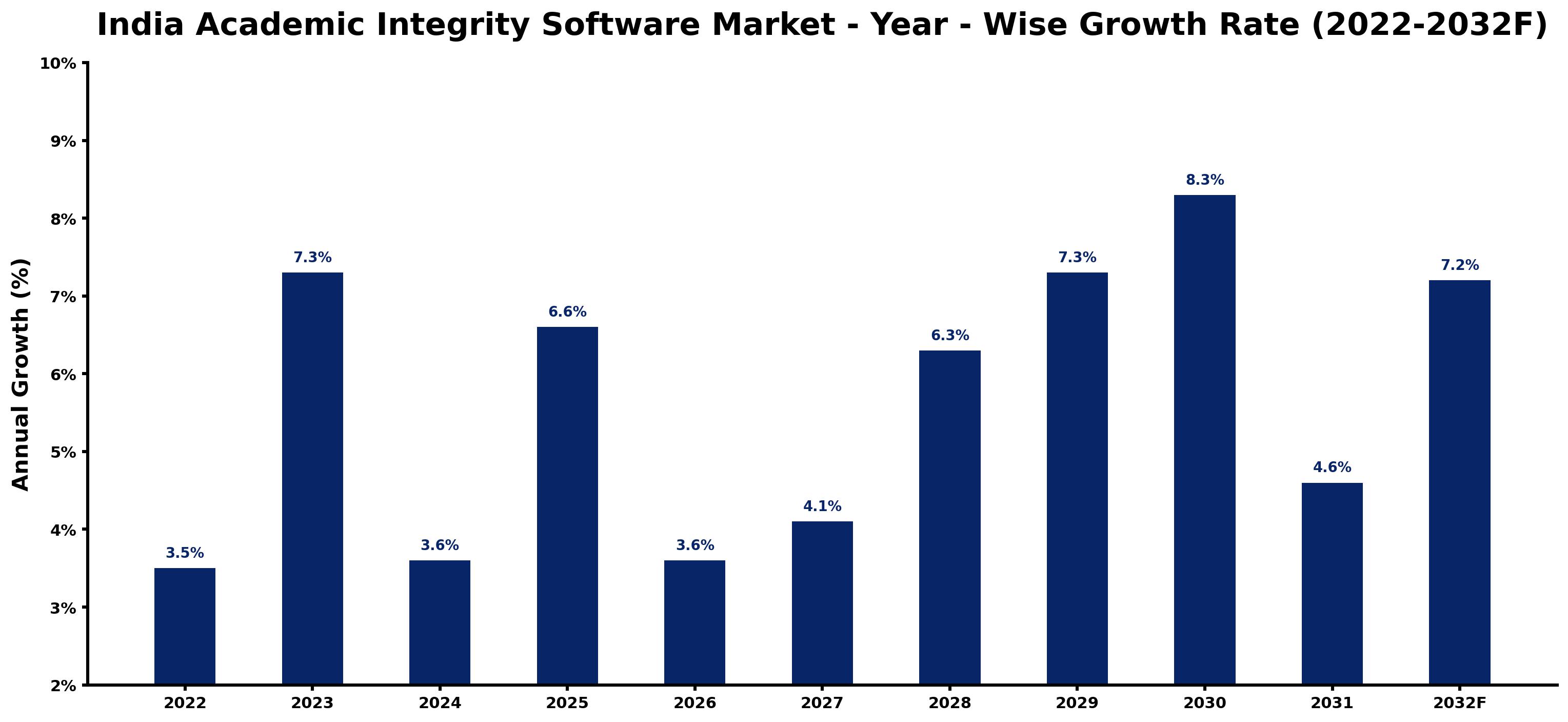
Year by year, the estimates below pair each growth rate with the development that shaped it.
| Year | Estimated Annual Growth (%) | Market Rationale |
| 2022 | 3.5 | The market experienced steady growth as educational institutions began adopting integrity software. |
| 2023 | 7.3 | Demand surged due to the University Grants Commission's emphasis on plagiarism detection tools. |
| 2024 | 3.6 | Growth slowed as institutions adjusted to the All India Council for Technical Education's guidelines. |
| 2025 | 6.6 | Increased adoption was driven by the National Assessment and Accreditation Council's recommendations. |
| 2026 | 3.6 | A slowdown occurred as institutions faced challenges in integrating new technologies. |
| 2027 | 4.1 | Growth picked up with rising enrolments in online learning platforms needing integrity solutions. |
| 2028 | 6.3 | Demand increased as AI-driven proctoring became more prevalent in remote assessments. |
| 2029 | 7.3 | The market continued to grow as universities sought to implement the National Institutional Ranking Framework's standards. |
| 2030 | 8.3 | Peak growth was driven by a significant rise in the adoption of exam monitoring tools. |
| 2031 | 4.6 | A slowdown in growth occurred as the market began to stabilise after rapid expansion. |
| 2032 | 7.2 | Demand accelerated again as educational institutions expanded their digital learning environments. |
Note: Market size estimations and growth projections presented in this report are based on 6Wresearch's proprietary forecasting methodology, utilizing the latest available industry data, government publications, and primary research inputs.
India Academic Integrity Software Market Synopsis
The Academic Integrity Software Market in India includes tools that promote academic honesty, such as plagiarism detection and exam monitoring. These software solutions utilise advanced algorithms to maintain integrity in educational submissions and assessments. The market is expanding, driven by rising enrolments in higher education, with over 30 million students currently registered. Key organisations like the University Grants Commission and National Assessment and Accreditation Council are advocating for the integration of these tools in academic institutions.
Market Dynamics Impact Analysis (2026–2032)
| Factor | Type | Impact | Primary Segment Affected |
| Growing emphasis on plagiarism detection in higher education institutions | Driver | High | Plagiarism Detection |
| Increased demand for remote assessment integrity solutions | Driver | High | Exam Monitoring Tools |
| Rising enrolments in online learning platforms needing integrity solutions | Opportunity | High | Online Learning Platforms |
| Significant growth in the EdTech sector, valued at $10 billion | Opportunity | High | EdTech Distributors |
| Limited awareness among smaller institutions about available solutions | Restraint | Medium | Authorship Verification |
| Higher implementation costs for advanced monitoring tools | Restraint | Medium | AI-Driven Proctoring |
| The Academic Integrity Software Market faces challenges in user adoption rates | Challenge | High | Exam Monitoring Tools |
| Integration issues with existing educational technologies hinder market growth | Challenge | High | Plagiarism Detection |
Evaluation of Drivers in India Academic Integrity Software Market (2026–2032)
Below mentioned are some major drivers and their influence on market dynamics.
| Drivers | Primary Segment Affected | Why It Matters (Evidence) |
| Increased funding for academic integrity initiatives | Plagiarism Detection | Over 1,000 universities in India utilise academic integrity software, driving demand for plagiarism detection tools. |
| Rising enrolments in higher education institutions | Exam Monitoring Tools | With over 30 million students enrolled, educational institutions are prioritising exam monitoring to maintain integrity. |
| Recommendations from accreditation bodies | AI-Driven Proctoring | The National Assessment and Accreditation Council encourages the use of AI-driven proctoring for online assessments. |
| Growth of online learning platforms | Online Learning Platforms | A 50% increase in exam monitoring tool usage since 2022 highlights the need for integrity solutions. |
| Popularity of SaaS models | Cloud-Based | 70% of educational institutions prefer cloud-based solutions for their scalability and ease of use. |
Over 30 million students enrolled in higher education drive demand for exam monitoring tools, while 70% of institutions prefer cloud-based solutions for their scalability. The push for AI-driven proctoring further fuels adoption, with a notable increase in usage since 2022. The integration of technology in assessments is becoming essential as educational institutions adapt to evolving standards, highlighting the critical need for integrity solutions.
Evaluation of Restraints in India Academic Integrity Software Market
The main factors holding the market back are set out below.
| Market Restraint | Primary Segment Affected | Why It Matters (Evidence) |
| Limited awareness among smaller institutions about available solutions | Authorship Verification | Many smaller institutions lack knowledge of authorship verification tools, limiting their adoption. |
| Higher implementation costs for advanced monitoring tools | AI-Driven Proctoring | The costs associated with implementing AI-driven proctoring can deter institutions from adopting these solutions. |
| Integration issues with existing educational technologies | Exam Monitoring Tools | Challenges in integrating new software with legacy systems can slow down the adoption process. |
| Inconsistent regulatory requirements across institutions | Plagiarism Detection | Varying standards for plagiarism detection can lead to confusion and inconsistent implementation. |
| Resistance to change among faculty and administration | Cloud-Based | Some educators may resist adopting new technologies due to comfort with traditional methods. |
India Academic Integrity Software Market Challenges
The India Academic Integrity Software market faces considerable costs for educational institutions, with implementation expenses consuming up to 20% of their IT budgets. This financial burden stems from limited funding for technology in many universities, which hinders the timely adoption of essential tools. Supply chain issues arise as numerous institutions depend on a small number of domestic developers, resulting in software updates and support taking over six months. Competition intensifies as new entrants offer lower-priced options, compelling established providers to reduce prices, which may compromise service quality for universities and colleges.
Trends in the India Academic Integrity Software Market
Buyers and suppliers in the India Academic Integrity Software Market are adjusting to the following trends.
- Shift towards AI-Driven Proctoring: Online learning platforms are increasingly adopting AI-driven proctoring tools to maintain exam integrity. In 2023, usage rose by 50%, indicating a strong trend towards technology integration in assessments.
- Growing Preference for Cloud-Based Solutions: Since 2021, educational institutions have shifted towards cloud-based deployment for academic integrity software, with 70% now opting for this model due to its scalability and accessibility.
- Increased Focus on Plagiarism Detection: The emphasis on plagiarism detection tools has intensified since 2022, driven by the University Grants Commission's guidelines, leading to a rise in software adoption among universities.
- Expansion of Online Learning Platforms: The number of online learning platforms has surged, with a 50% increase in exam monitoring tool usage since 2022, reflecting the growing demand for integrity solutions in remote education.
Investment Opportunities in the India Academic Integrity Software Market
Several openings in the India Academic Integrity Software Market merit attention from investors.
- Invest in Online Learning Platforms: With over 30 million students enrolled, there is an opportunity to supply integrity software to online learning platforms, which have reported a 50% increase in tool usage since 2022.
- Partner with Educational Institutions: The National Assessment and Accreditation Council's push for integrity software creates an opportunity for partnerships with universities looking to improve their academic standards.
- Focus on Cloud-Based Solutions: As 70% of educational institutions prefer cloud-based models, investing in scalable integrity software can meet the rising need for flexible solutions.
- Expand into Research Institutions: Research institutions are increasingly adopting authorship verification tools, presenting an opportunity to supply tailored solutions to combat academic fraud.
Government Initiatives in the India Academic Integrity Software Market
In 2021, the Ministry of Education launched the Digital Education Policy to promote technology use in education, including academic integrity software. The National Education Policy 2020 encourages the adoption of digital tools for assessment and integrity, implemented by the Ministry of Education. The All India Council for Technical Education issued guidelines in 2022 mandating the use of plagiarism detection software in technical education, ensuring that institutions maintain academic standards. In 2023, the University Grants Commission initiated a program to provide funding for universities to acquire integrity software, allowing them to enhance their compliance with academic integrity measures. The National Board of Accreditation updated its standards in 2022 to require integrity checks in all accredited institutions' assessments, ensuring adherence to quality measures.
The University Grants Commission oversees several initiatives that fund and approve the integration of academic integrity software. In 2023, it initiated a program to provide funding for universities to acquire integrity software, allowing them to improve their academic standards. The National Board of Accreditation updated its standards in 2022 to require integrity checks in all accredited institutions' assessments, ensuring compliance with quality measures. The All India Council for Technical Education continues to support institutions in implementing these measures, facilitating the adoption of necessary tools for maintaining academic integrity.
Future Insight of the India Academic Integrity Software Market
The India Academic Integrity Software market is set for transformative changes by 2032, influenced by several important factors. The National Assessment and Accreditation Council's requirement for all accredited institutions to implement integrity software by 2025 will significantly boost demand. The Ministry of Education's initiatives to improve digital learning environments will further encourage the use of these tools. With the Indian education sector projected to grow to $180 billion by 2025, educational institutions will increasingly invest in academic integrity solutions, benefiting both buyers and suppliers.
Market Segmentation Analysis
The analysis below covers each segmentation, its leading category in 2025 and its fastest-growing category through 2032.
By Software Type – Plagiarism Detection Dominated, Exam Monitoring Tools Expected to Grow Fastest
According to Shubham Deep, Research Manager at 6Wresearch, with a 44% revenue share in 2025, Plagiarism Detection was the largest software type category. Plagiarism detection holds the largest share in India due to its widespread adoption among over 1,000 universities that rely on it for ensuring originality in academic submissions. The University Grants Commission's emphasis on plagiarism detection tools further solidifies its essential role in maintaining academic integrity. Exam Monitoring Tools are projected to grow fastest, at a CAGR of 7.0% during 2026–2032. Exam monitoring tools are experiencing rapid growth, evidenced by a 50% increase in their usage reported by online learning platforms since 2022, highlighting their critical role in ensuring assessment integrity. As more institutions integrate these tools, their market share is likely to expand significantly. This trend indicates that suppliers should focus on enhancing features in exam monitoring tools to cater to the increasing demand from educational institutions.
By Deployment Model – Cloud-Based Dominated, On-Premise Expected to Grow Fastest
Cloud-Based took a 41% share of deployment model in 2025, more than any other category. Cloud-based deployment captures the largest share in the Indian market, preferred by 70% of educational institutions for its scalability and ease of access. This model allows institutions to efficiently manage resources and adapt to changing needs without heavy upfront investments. The quickest growth will come from On-Premise, forecast to expand at a CAGR of 7.5% between 2026 and 2032. On-premise solutions are projected to grow as institutions seek greater control over their data and compliance with specific regulations. Although less common, the need for tailored solutions will drive this segment's expansion in the coming years. Buyers may benefit from exploring both cloud-based and on-premise options to find the best fit for their operational requirements.
By Distribution Channel – Direct Sales Dominated, EdTech Distributors Expected to Grow Fastest
The largest distribution channel category in 2025 was Direct Sales, with a 44% share of total revenue. Direct sales dominate the distribution channel for academic integrity software, as educational institutions prefer this method for its tailored support and service. This approach builds strong relationships and ensures a better understanding of the unique needs of each institution. Over 2026–2032, EdTech Distributors are expected to post the fastest growth, at a CAGR of 8.3%. EdTech distributors are rapidly emerging as a key channel, enabling software providers to access wider markets through established partnerships. Their growth reflects a strategic shift towards collaboration between technology firms and educational institutions. Suppliers should consider strengthening partnerships with EdTech distributors to enhance market reach and accessibility.
By End User – Universities Dominated, Online Learning Platforms Expected to Grow Fastest
Universities accounted for a 46% market share by end user in 2025. Universities represent the largest share of end users for academic integrity software, utilising these tools to uphold academic standards among millions of students enrolled in higher education. Their commitment to maintaining integrity in submissions drives consistent demand for such solutions. Online Learning Platforms are set to record the highest CAGR in this split, 7.0% over 2026–2032. Online learning platforms are rapidly increasing their use of academic integrity software, essential for ensuring honesty in remote assessments, as evidenced by a reported 50% increase since 2022. This trend indicates a shift towards more rigorous integrity measures in digital education. Suppliers should tailor their offerings to meet the specific needs of online learning platforms, which are becoming critical players in the education sector.
Key Attractiveness of the Report
- 10 Years of Market Numbers
- Historical Data Starting from 2022 to 2025
- Base Year 2025
- Forecast Data until 2032
- Key Performance Indicators Impacting the Market
- Major Upcoming Developments and Projects
Key Highlights of the Report:
- India Academic Integrity Software Market Outlook
- Market Size of India Academic Integrity Software Market, 2025
- Forecast of India Academic Integrity Software Market, 2032
- Historical Data and Forecast of India Academic Integrity Software Revenues & Volume for the Period 2022 - 2032F
- India Academic Integrity Software Market Trend Evolution
- India Academic Integrity Software Market Drivers and Challenges
- India Academic Integrity Software Price Trends
- India Academic Integrity Software Porter's Five Forces
- India Academic Integrity Software Industry Life Cycle
- Historical Data and Forecast of India Academic Integrity Software Market Revenues & Volume By Software Type for the Period 2022 - 2032F
- Historical Data and Forecast of India Academic Integrity Software Market Revenues & Volume By Plagiarism Detection for the Period 2022 - 2032F
- Historical Data and Forecast of India Academic Integrity Software Market Revenues & Volume By Exam Monitoring Tools for the Period 2022 - 2032F
- Historical Data and Forecast of India Academic Integrity Software Market Revenues & Volume By Authorship Verification for the Period 2022 - 2032F
- Historical Data and Forecast of India Academic Integrity Software Market Revenues & Volume By AI-Driven Proctoring for the Period 2022 - 2032F
- Historical Data and Forecast of India Academic Integrity Software Market Revenues & Volume By Deployment Model for the Period 2022 - 2032F
- Historical Data and Forecast of India Academic Integrity Software Market Revenues & Volume By Cloud-Based for the Period 2022 - 2032F
- Historical Data and Forecast of India Academic Integrity Software Market Revenues & Volume By On-Premise for the Period 2022 - 2032F
- Historical Data and Forecast of India Academic Integrity Software Market Revenues & Volume By SaaS for the Period 2022 - 2032F
- Historical Data and Forecast of India Academic Integrity Software Market Revenues & Volume By Hybrid for the Period 2022 - 2032F
- Historical Data and Forecast of India Academic Integrity Software Market Revenues & Volume By Distribution Channel for the Period 2022 - 2032F
- Historical Data and Forecast of India Academic Integrity Software Market Revenues & Volume By Direct Sales for the Period 2022 - 2032F
- Historical Data and Forecast of India Academic Integrity Software Market Revenues & Volume By EdTech Distributors for the Period 2022 - 2032F
- Historical Data and Forecast of India Academic Integrity Software Market Revenues & Volume By Online Subscriptions for the Period 2022 - 2032F
- Historical Data and Forecast of India Academic Integrity Software Market Revenues & Volume By Partner Networks for the Period 2022 - 2032F
- Historical Data and Forecast of India Academic Integrity Software Market Revenues & Volume By End User for the Period 2022 - 2032F
- Historical Data and Forecast of India Academic Integrity Software Market Revenues & Volume By Universities for the Period 2022 - 2032F
- Historical Data and Forecast of India Academic Integrity Software Market Revenues & Volume By Online Learning Platforms for the Period 2022 - 2032F
- Historical Data and Forecast of India Academic Integrity Software Market Revenues & Volume By Research Institutions for the Period 2022 - 2032F
- Historical Data and Forecast of India Academic Integrity Software Market Revenues & Volume By Testing Agencies for the Period 2022 - 2032F
- India Academic Integrity Software Import Export Trade Statistics
- Market Opportunity Assessment By Software Type
- Market Opportunity Assessment By Deployment Model
- Market Opportunity Assessment By Distribution Channel
- Market Opportunity Assessment By End User
- India Academic Integrity Software Top Companies Market Share
- India Academic Integrity Software Competitive Benchmarking By Technical and Operational Parameters
- India Academic Integrity Software Company Profiles
- India Academic Integrity Software Key Strategic Recommendations
Market Covered
This report examines the market across the segments below.
By Software Type
- Plagiarism Detection
- Exam Monitoring Tools
- Authorship Verification
- AI-Driven Proctoring
By Deployment Model
- Cloud-Based
- On-Premise
- SaaS
- Hybrid
By Distribution Channel
- Direct Sales
- EdTech Distributors
- Online Subscriptions
- Partner Networks
By End User
- Universities
- Online Learning Platforms
- Research Institutions
- Testing Agencies































