India Academic Software Market Size & Growth Rate
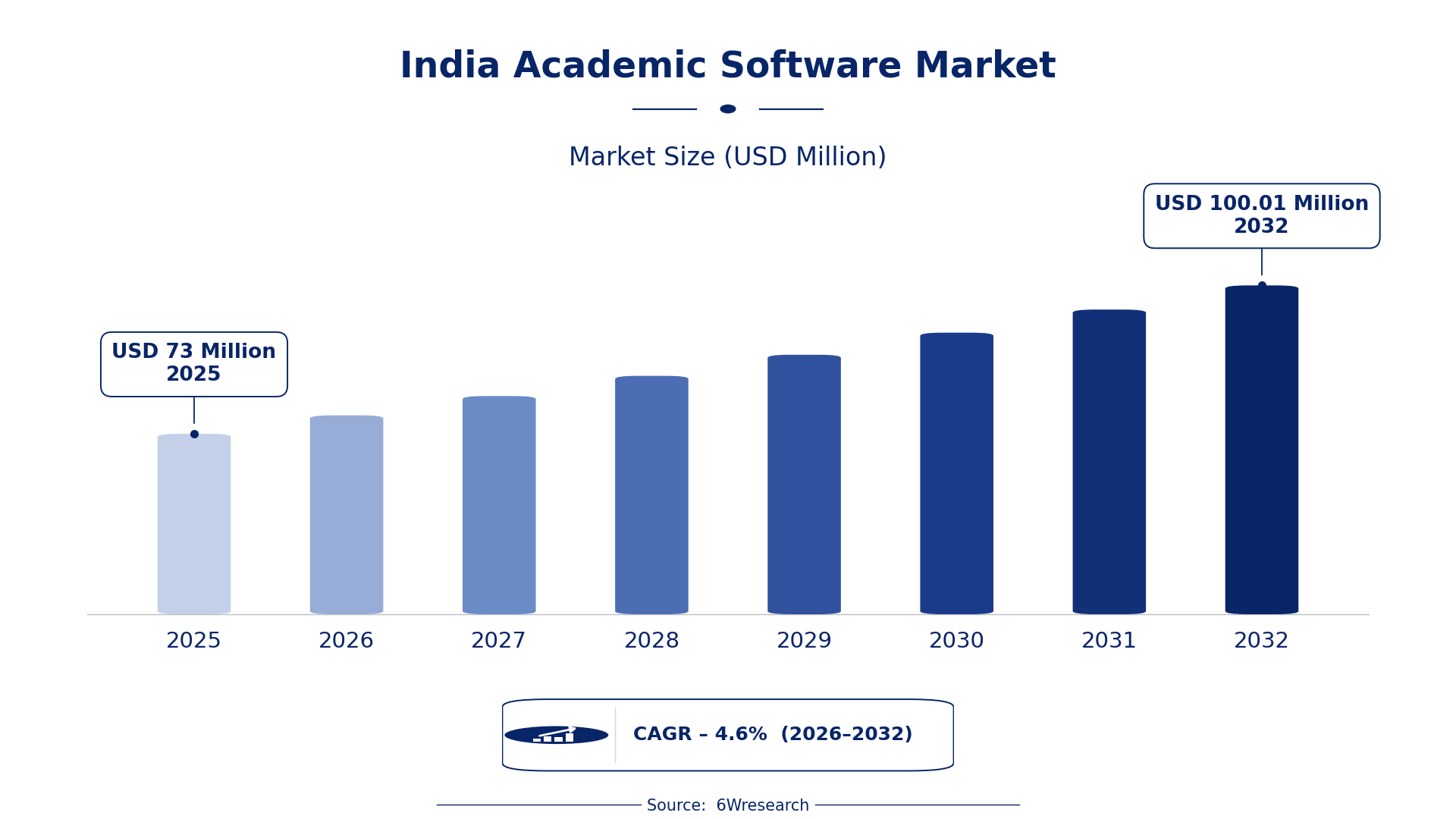
According to 6Wresearch internal database and industry insights, the India Academic Software Market was valued at USD 73.0 million in 2025 and is projected to reach USD 100.01 million by 2032, growing at a CAGR of approximately 4.6% during 2026–2032.
India Academic Software Market Highlights
| Report Metric | Details |
| Report Name | India Academic Software Market |
| Market Size 2025 | USD 73.0 million |
| Market Size 2032 | USD 100.01 million |
| Absolute Growth 2025–2032 | USD 27.01 million |
| CAGR 2026–2032 | 4.6% |
| Peak Annual Growth | 6.6% in 2028 |
| Forecast Period | 2026–2032 |
| Historical Data | 2022–2025 |
| Base Year | 2025 |
| Leading Software Type, 2025 | Learning Management Systems (36% share) |
| Leading User Category, 2025 | Higher Education (48% share) |
| Leading Distribution Channel, 2025 | SaaS Providers (41% share) |
| Leading End User, 2025 | Universities and Colleges (42% share) |
| Fastest-Growing Software Type | Virtual Labs Software (5.6% CAGR) |
| Fastest-Growing User Category | Institutions (6.5% CAGR) |
| Fastest-Growing Distribution Channel | EdTech Companies (6.3% CAGR) |
| Fastest-Growing End User | Online Educators (6.1% CAGR) |
| Growing Sector | Online Educators |
| Key End Users | Universities and Colleges, Educational Boards, School and College Admin Offices, Online Educators |
India Academic Software Market Year-wise Growth Rate and Key Drivers (2022–2032)
This graph illustrates the annual growth rates of the market from 2022 to 2032, highlighting a steady upward trajectory and projected market expansion over the forecast period.
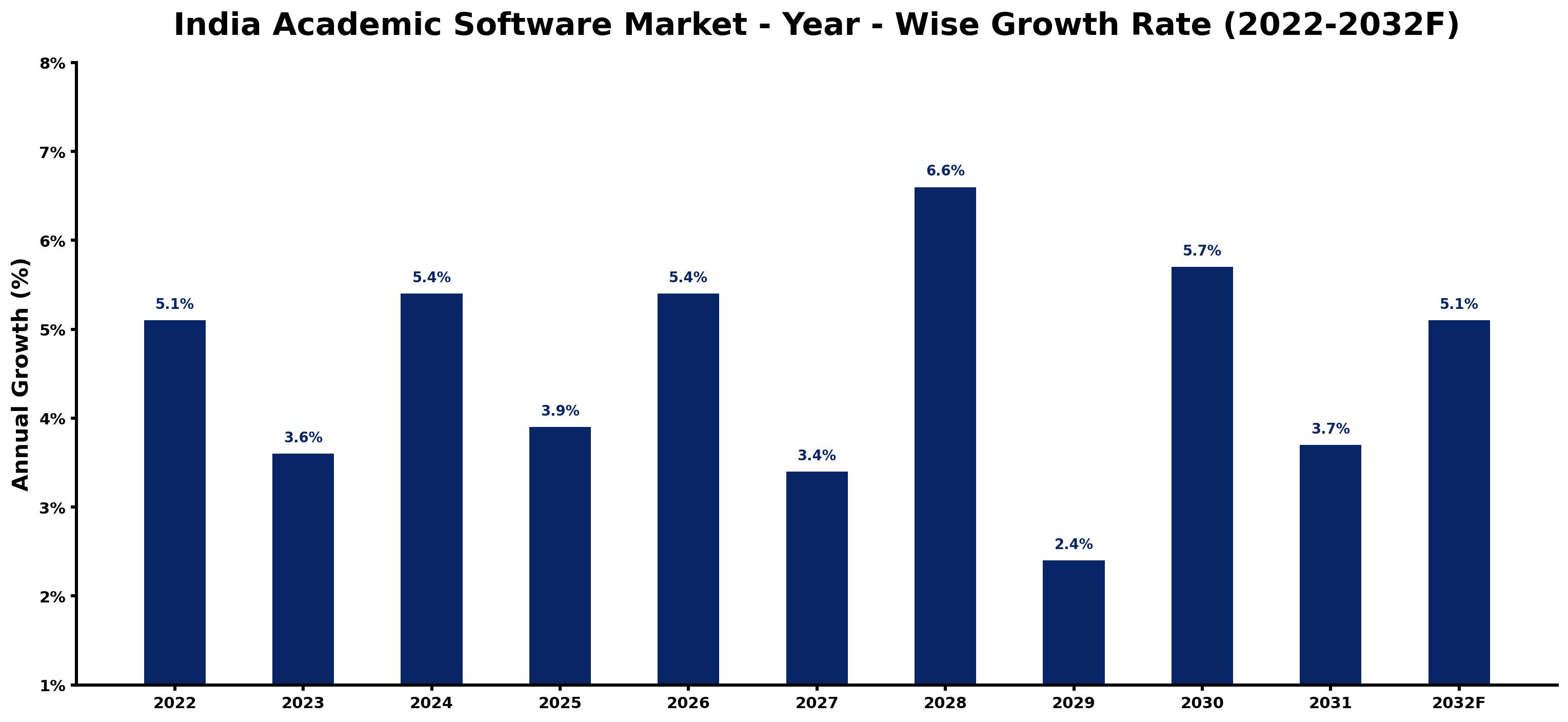
The following table presents the estimated annual growth rate for each year together with the principal factor influencing market performance.
| Year | Estimated Annual Growth (%) | Market Rationale |
| 2022 | 5.1 | The market experienced steady growth due to the PM eVIDYA programme promoting online education resources. |
| 2023 | 3.6 | Growth slowed as educational institutions adjusted to the integration of new technologies. |
| 2024 | 5.4 | Demand surged with the full implementation of the National Education Policy 2020. |
| 2025 | 3.9 | Growth decelerated as institutions faced challenges in integrating new software solutions. |
| 2026 | 5.4 | A renewed focus on digital education is expected to drive growth as institutions upgrade their systems. |
| 2027 | 3.4 | Growth slowed as competition among software providers intensified, impacting pricing strategies. |
| 2028 | 6.6 | The peak growth year will see increased investment in educational technology and infrastructure. |
| 2029 | 2.4 | Growth will slow as market saturation begins to impact new software adoption rates. |
| 2030 | 5.7 | Demand will rise again due to ongoing improvements in digital infrastructure. |
| 2031 | 3.7 | Growth will decelerate as the market stabilises and matures, with established players dominating. |
| 2032 | 5.1 | The market will see renewed interest as educational needs evolve and new technologies emerge. |
Note: Market size estimations and growth projections presented in this report are based on 6Wresearch's proprietary forecasting methodology, utilizing the latest available industry data, government publications, and primary research inputs.
India Academic Software Market Synopsis
The India Academic Software Market includes digital tools tailored for educational use, such as Learning Management Systems, virtual labs, and content authoring tools. These products support online learning and streamline administrative tasks within educational institutions. The market is expanding, driven by the needs of over 1.5 million K-12 schools and more than 1,000 universities. Key drivers consist of the National Education Policy 2020 and the PM eVIDYA programme, which promote technology integration in education.
Market Dynamics Impact Analysis (2026–2032)
| Factor | Type | Impact | Primary Segment Affected |
| Increasing digital adoption in education institutions | Driver | High | Learning Management Systems |
| Growth in the EdTech sector providing innovative solutions | Driver | High | Virtual Labs Software |
| Rising number of online educators seeking effective tools | Opportunity | High | Content Authoring Tools |
| The expanding K-12 sector requiring curriculum management solutions | Opportunity | High | ERP for Education |
| Limited digital infrastructure in rural areas hindering access | Restraint | High | Higher Education |
| Budget constraints within educational institutions affecting software purchases | Restraint | Medium | Universities and Colleges |
| The Academic Software Market in India faces significant integration challenges | Challenge | High | Institutions |
| Competition among software providers is increasing pressure on pricing | Challenge | Medium | SaaS Providers |
Evaluation of Drivers in India Academic Software Market (2026–2032)
The main growth drivers and the segments they affect most are set out below.
| Drivers | Primary Segment Affected | Why It Matters (Evidence) |
| Growing investment in educational technology by institutions | Learning Management Systems | Over 60% of higher education institutions in India rely on these systems for effective content delivery. |
| Increased demand for practical learning experiences | Virtual Labs Software | The National Institute of Open Schooling promotes virtual labs, facilitating practical learning for over 250 million school-aged children. |
| Need for efficient content creation tools by educators | Content Authoring Tools | Teachers increasingly require digital materials for effective lesson delivery, driving demand for these tools. |
| Administrative efficiency needs in educational institutions | ERP for Education | The All India Council for Technical Education encourages ERP adoption to streamline management processes in over 40,000 colleges. |
| Rising online course offerings by universities | Higher Education | The higher education sector consists of over 1,000 universities, increasing the need for academic software. |
Growth in the Academic Software market in India comes from rising investment in educational technology, increased demand for practical learning experiences, and the need for efficient content creation tools. The higher education sector, with over 1,000 universities, drives demand for academic software, particularly Learning Management Systems, which manage educational content effectively. The National Institute of Open Schooling promotes virtual labs, facilitating practical learning for students. The All India Council for Technical Education encourages ERP adoption, streamlining administrative processes in colleges. As universities expand their online course offerings, demand for academic software continues to rise, reflecting the growing need for digital solutions.
Evaluation of Restraints in India Academic Software Market
The following restraints limit how fast demand can grow.
| Market Restraint | Primary Segment Affected | Why It Matters (Evidence) |
| High costs of localised content | Higher Education | Localised content can increase prices by up to 30%, limiting access for educational institutions. |
| Skills shortages among educators | K–12 Schools | Over 50% of teachers in rural areas lack adequate training, delaying software adoption. |
| Outdated technology systems | Institutions | Many institutions still rely on outdated systems, causing administrative inefficiencies that can extend processes by several weeks. |
| Compliance with ISO standards | Universities and Colleges | Meeting ISO 21001:2018 standards imposes financial burdens on educational organisations. |
| Limited digital infrastructure | Online Educators | Inadequate digital infrastructure hampers effective software utilisation and access to resources. |
India Academic Software Market Challenges
In the India Academic Software Market, buyers encounter inflated costs due to the scarcity of localised content, which can raise prices by up to 30% for educational institutions. Skills shortages impede effective software utilisation, as over 50% of teachers in rural areas lack sufficient training, delaying the adoption of necessary tools. Technology gaps persist, with many institutions still depending on outdated systems, leading to administrative inefficiencies that can prolong processes by several weeks. Regulatory challenges arise from the need to comply with ISO 21001:2018 standards, imposing additional financial burdens on educational organisations striving to improve their digital capabilities.
Trends in the India Academic Software Market
The trends below show where the India Academic Software Market is heading.
- Shift towards Cloud-Based Learning Platforms: Educational institutions are increasingly adopting cloud-based learning platforms to improve accessibility for students. The PM eVIDYA programme supports this shift, with approximately 10 million students accessing online resources.
- Growing Adoption of Virtual Labs in Education: India is integrating virtual labs to provide practical experiences in science education. The National Institute of Open Schooling promotes this trend, with over 500 schools implementing virtual lab solutions.
- Increase in Customised Learning Solutions: There is a rising trend towards customised learning solutions tailored to individual student needs. This is evident in the growing number of institutions adopting Learning Management Systems, which are used by over 60% of higher education institutions.
- Expansion of Online Learning Initiatives: Online learning initiatives are expanding rapidly, driven by the need for flexible education. The higher education sector now offers over 1,000 online courses, catering to diverse student needs.
Investment Opportunities in the India Academic Software Market
Some of the investment opportunities in the India Academic Software Market are mentioned below.
- Gap in Digital Infrastructure Investment: With a projected USD 10 billion valuation for the EdTech market, there exists a considerable opportunity to invest in digital infrastructure. Educational boards are actively seeking solutions to improve access, especially in rural areas.
- Timing for Enhanced EdTech Solutions: The Digital India initiative aims to bolster digital infrastructure by 2025, creating a prime opportunity for investment in academic software solutions. Educational institutions are on the lookout for new tools to facilitate this transformation.
- Partnerships with Educational Institutions: Collaborating with universities and colleges offers a strong entry point for software providers. These institutions are increasingly in search of effective solutions to enhance educational outcomes.
- Demand from Online Educators: The rise of online educators generates a pressing need for effective academic software. With over 70% of urban teachers employing such tools, suppliers can capitalise on this expanding market.
Government Initiatives in the India Academic Software Market
The National Education Policy 2020, implemented by the Ministry of Education, seeks to integrate technology into education, improving digital learning across institutions. This policy encourages the adoption of academic software, ensuring that educational institutions are equipped with modern tools. The PM eVIDYA programme, launched in 2020, focuses on providing online education resources, further driving the demand for academic software solutions. Additionally, the Digital India initiative, initiated in 2015, aims to transform India into a digitally empowered society, significantly impacting educational software usage. The National Skill Development Mission promotes skill development through digital platforms, enhancing the use of academic software in vocational education.
The Ministry of Education oversees the implementation of various educational initiatives, including funding for digital education projects. The PM eVIDYA programme allocates resources to improve online education access, while the National Digital Educational Architecture (NDEAR) framework, proposed in 2023, aims to establish a robust digital infrastructure for education in India. These initiatives support the integration of technology in educational institutions, ensuring they can effectively adopt academic software solutions.
Future Insight of the India Academic Software Market
By 2032, buyers and suppliers in the India Academic Software Market can expect substantial advancements driven by the Digital India initiative, which aims to improve digital infrastructure in education. The National Education Policy 2020 will further encourage technology integration, enhancing learning experiences across schools and colleges. With around 250 million school-aged children, demand for academic software will surge, leading to the development of tailored solutions. The PM eVIDYA programme will also support digital education initiatives, ensuring institutions access modern and effective tools.
Market Segmentation Analysis
Each segment group is reviewed below, with the leader by share and the fastest grower by CAGR.
By Software Type – Learning Management Systems Dominated, Virtual Labs Software Expected to Grow Fastest
According to Shubham Deep, Research Manager at 6Wresearch, in 2025, Learning Management Systems led the software type split with a 36% share. Learning Management Systems dominate the market share due to their critical role in over 60% of higher education institutions in India, facilitating course management and tracking student progress. This extensive usage illustrates their importance in enhancing educational delivery across universities and colleges. Virtual Labs Software is projected to grow fastest, at a CAGR of 5.6% during 2026–2032. The surge in Virtual Labs Software is propelled by the rising need for practical lab experiences in science subjects, as evidenced by initiatives from the National Institute of Open Schooling. This growth trajectory is expected to continue as educational institutions enhance their online learning environments. Suppliers should focus on creating effective virtual lab solutions to address the rising demand from educational institutions.
By User Category – Higher Education Dominated, Institutions Expected to Grow Fastest
Higher Education took a 48% share of user category in 2025, more than any other category. Higher Education leads the market share as the primary user of academic software, with over 1,000 universities and 40,000 colleges in India utilising these tools for online courses and administrative management. This substantial user base underscores the importance of tailored solutions for this sector. Over 2026–2032, Institutions are expected to post the fastest growth, at a CAGR of 6.5%. The Institutions category is experiencing the fastest growth, driven by a broad range of educational setups increasingly adopting academic software to streamline operations. As more institutions recognise the benefits of digital tools, this segment is set to expand rapidly. Suppliers must tailor their offerings to meet the diverse needs of various educational institutions to capture this growing market.
By Distribution Channel – SaaS Providers Dominated, EdTech Companies Expected to Grow Fastest
SaaS Providers accounted for a 41% market share by distribution channel in 2025. SaaS Providers hold the largest market share by offering essential academic software solutions that meet diverse educational needs. Their ability to provide scalable and accessible solutions makes them a preferred choice for numerous educational institutions across India. EdTech Companies are set to record the highest CAGR in this split, 6.3% over 2026–2032. EdTech Companies are the fastest-growing segment, rapidly developing and marketing academic software solutions to meet the escalating demand from educational institutions. Their agility in responding to market trends positions them well for sustained growth in this competitive landscape. Suppliers should explore partnerships with EdTech Companies to strengthen their distribution strategies and expand their market reach.
By End User – Universities and Colleges Dominated, Online Educators Expected to Grow Fastest
Universities and Colleges held a 42% share of the India Academic Software Market by end user in 2025. Universities and Colleges account for the largest market share, being significant users of academic software for managing courses and student data. Their reliance on these tools for effective educational delivery underscores the essential need for comprehensive solutions in the higher education sector. The quickest growth will come from Online Educators, forecast to expand at a CAGR of 6.1% between 2026 and 2032. Online Educators are experiencing the fastest growth, driven by the shift towards online learning and the increasing necessity for reliable academic software to facilitate course delivery. This trend indicates a burgeoning market for tools specifically designed to support online education. Suppliers should prioritise developing features tailored to the needs of online educators to capitalise on this expanding market segment.
Key Attractiveness of the Report
- 10 Years of Market Numbers
- Historical Data Starting from 2022 to 2025
- Base Year 2025
- Forecast Data until 2032
- Key Performance Indicators Impacting the Market
- Major Upcoming Developments and Projects
Key Highlights of the Report:
- India Academic Software Market Outlook
- Market Size of India Academic Software Market, 2025
- Forecast of India Academic Software Market, 2032
- Historical Data and Forecast of India Academic Software Revenues & Volume for the Period 2022 - 2032F
- India Academic Software Market Trend Evolution
- India Academic Software Market Drivers and Challenges
- India Academic Software Price Trends
- India Academic Software Porter's Five Forces
- India Academic Software Industry Life Cycle
- Historical Data and Forecast of India Academic Software Market Revenues & Volume By Software Type for the Period 2022 - 2032F
- Historical Data and Forecast of India Academic Software Market Revenues & Volume By Learning Management Systems for the Period 2022 - 2032F
- Historical Data and Forecast of India Academic Software Market Revenues & Volume By Virtual Labs Software for the Period 2022 - 2032F
- Historical Data and Forecast of India Academic Software Market Revenues & Volume By Content Authoring Tools for the Period 2022 - 2032F
- Historical Data and Forecast of India Academic Software Market Revenues & Volume By ERP for Education for the Period 2022 - 2032F
- Historical Data and Forecast of India Academic Software Market Revenues & Volume By User Category for the Period 2022 - 2032F
- Historical Data and Forecast of India Academic Software Market Revenues & Volume By K 12 Schools for the Period 2022 - 2032F
- Historical Data and Forecast of India Academic Software Market Revenues & Volume By Higher Education for the Period 2022 - 2032F
- Historical Data and Forecast of India Academic Software Market Revenues & Volume By Teachers & Trainers for the Period 2022 - 2032F
- Historical Data and Forecast of India Academic Software Market Revenues & Volume By Institutions for the Period 2022 - 2032F
- Historical Data and Forecast of India Academic Software Market Revenues & Volume By Distribution Channel for the Period 2022 - 2032F
- Historical Data and Forecast of India Academic Software Market Revenues & Volume By SaaS Providers for the Period 2022 - 2032F
- Historical Data and Forecast of India Academic Software Market Revenues & Volume By EdTech Companies for the Period 2022 - 2032F
- Historical Data and Forecast of India Academic Software Market Revenues & Volume By Direct Subscriptions for the Period 2022 - 2032F
- Historical Data and Forecast of India Academic Software Market Revenues & Volume By Software Integrators for the Period 2022 - 2032F
- Historical Data and Forecast of India Academic Software Market Revenues & Volume By End User for the Period 2022 - 2032F
- Historical Data and Forecast of India Academic Software Market Revenues & Volume By Educational Boards for the Period 2022 - 2032F
- Historical Data and Forecast of India Academic Software Market Revenues & Volume By Universities and Colleges for the Period 2022 - 2032F
- Historical Data and Forecast of India Academic Software Market Revenues & Volume By Online Educators for the Period 2022 - 2032F
- Historical Data and Forecast of India Academic Software Market Revenues & Volume By School and College Admin Offices for the Period 2022 - 2032F
- India Academic Software Import Export Trade Statistics
- Market Opportunity Assessment By Software Type
- Market Opportunity Assessment By User Category
- Market Opportunity Assessment By Distribution Channel
- Market Opportunity Assessment By End User
- India Academic Software Top Companies Market Share
- India Academic Software Competitive Benchmarking By Technical and Operational Parameters
- India Academic Software Company Profiles
- India Academic Software Key Strategic Recommendations
Market Covered
This report examines the market across the segments below.
By Software Type
- Learning Management Systems
- Virtual Labs Software
- Content Authoring Tools
- ERP for Education
By User Category
- K–12 Schools
- Higher Education
- Teachers & Trainers
- Institutions
By Distribution Channel
- SaaS Providers
- EdTech Companies
- Direct Subscriptions
- Software Integrators
By End User
- Educational Boards
- Universities and Colleges
- Online Educators
- School and College Admin Offices































