India Accounting Automation Market Size & Growth Rate
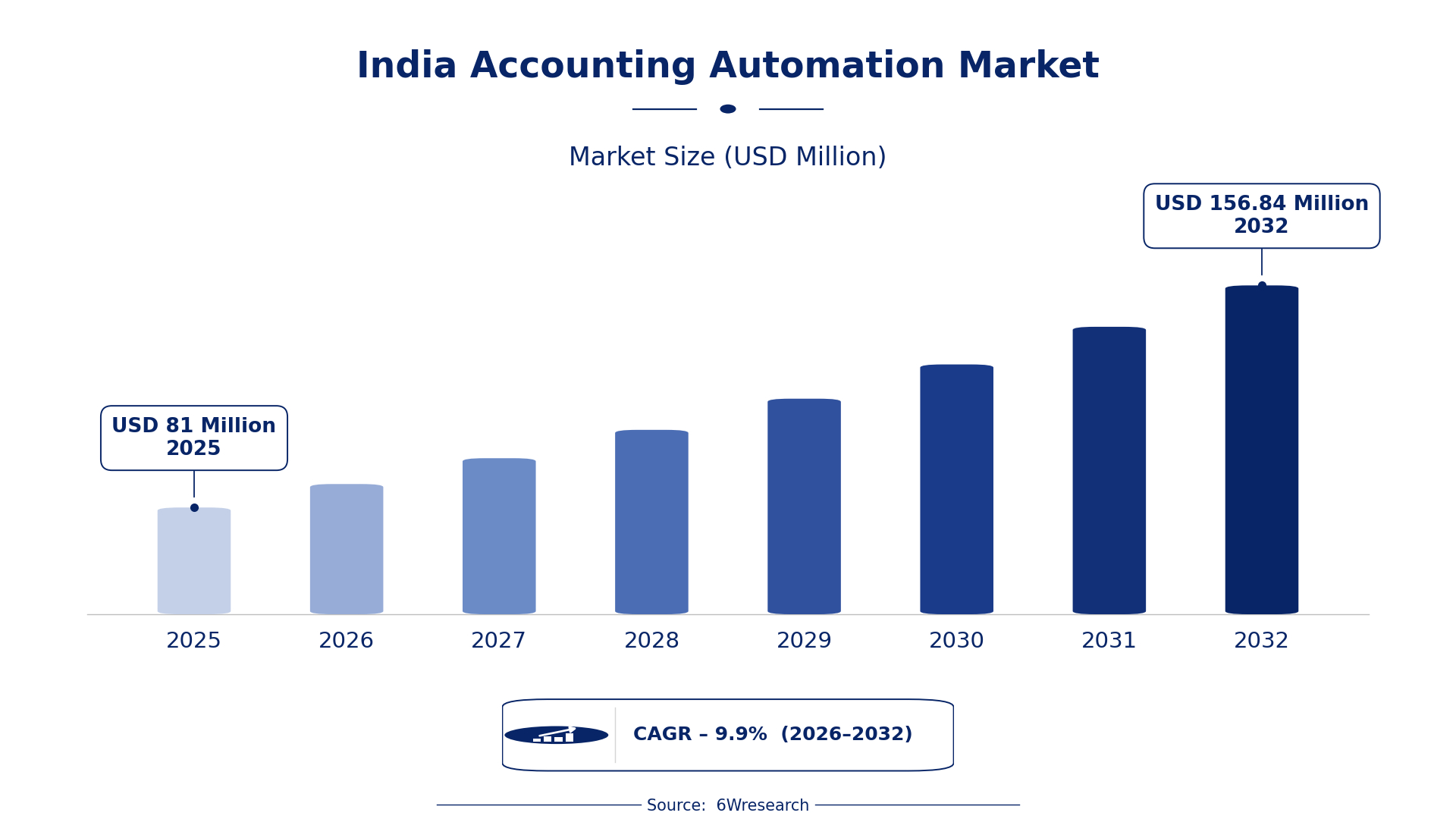
According to 6Wresearch internal database and industry insights, the India Accounting Automation Market was valued at USD 81.0 million in 2025 and is projected to reach USD 156.84 million by 2032, growing at a CAGR of approximately 9.9% during 2026–2032.
India Accounting Automation Market Highlights
| Report Metric | Details |
| Report Name | India Accounting Automation Market |
| Market Size 2025 | USD 81.0 million |
| Market Size 2032 | USD 156.84 million |
| Absolute Growth 2025–2032 | USD 75.84 million |
| CAGR 2026–2032 | 9.9% |
| Peak Annual Growth | 12.1% in 2030 |
| Forecast Period | 2026–2032 |
| Historical Data | 2022–2025 |
| Base Year | 2025 |
| Leading Solution Type, 2025 | Invoice Automation (38% share) |
| Leading Technology Used, 2025 | AI & OCR (38% share) |
| Leading Functionality Area, 2025 | Accounts Payable (46% share) |
| Leading End User, 2025 | Banking Institutions (43% share) |
| Leading Distribution Channel, 2025 | Direct Sales (39% share) |
| Fastest-Growing Solution Type | Expense Management (12.0% CAGR) |
| Fastest-Growing Technology Used | Cloud (12.4% CAGR) |
| Fastest-Growing Functionality Area | Reimbursement Tracking (12.4% CAGR) |
| Fastest-Growing End User | Legal Firms (12.0% CAGR) |
| Fastest-Growing Distribution Channel | Online Platforms (11.6% CAGR) |
| Growing Sector | Financial Services |
| Key End Users | Banking Institutions, Financial Institutions, Legal Firms, Insurance Companies |
India Accounting Automation Market Year-wise Growth Rate and Key Drivers (2022–2032)
This graph illustrates the annual growth rates of the market from 2022 to 2032, highlighting a steady upward trajectory and projected market expansion over the forecast period.
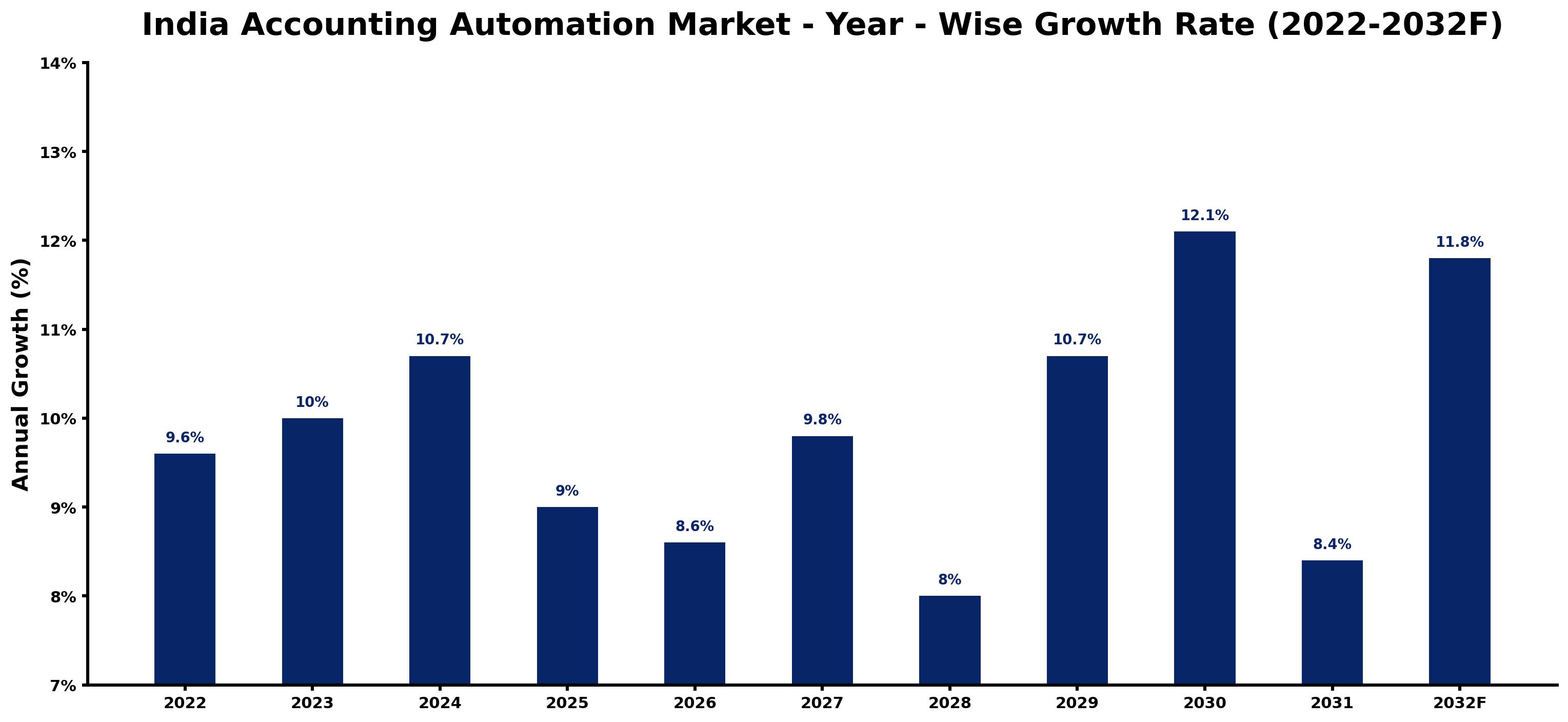
The table below sets out the estimated growth rate for each year and the main factor behind it.
| Year | Estimated Annual Growth (%) | Market Rationale |
| 2022 | 9.6 | The market exhibited steady growth as digitalisation in finance gained momentum. |
| 2023 | 10.0 | Growth accelerated due to increased adoption of accounting automation by financial institutions. |
| 2024 | 10.7 | The market continued to expand with more firms integrating automation into their processes. |
| 2025 | 9.0 | Growth slowed as some firms faced challenges in fully implementing automation solutions. |
| 2026 | 8.6 | A further slowdown occurred as companies adjusted to new digital accounting practices. |
| 2027 | 9.8 | Growth picked up again as the demand for efficient accounting solutions increased. |
| 2028 | 8.0 | The market experienced another slowdown as firms consolidated their automation strategies. |
| 2029 | 10.7 | Growth resumed with rising interest in advanced accounting technologies. |
| 2030 | 12.1 | The peak growth year saw significant demand driven by digital payment guidelines. |
| 2031 | 8.4 | Growth slowed again as the market matured and competition intensified. |
| 2032 | 11.8 | The market rebounded with renewed interest in automation solutions among financial institutions. |
Note: Market size estimations and growth projections presented in this report are based on 6Wresearch's proprietary forecasting methodology, utilizing the latest available industry data, government publications, and primary research inputs.
India Accounting Automation Market Synopsis
Accounting Automation in India involves leveraging technology to optimise processes such as invoicing and payroll. This approach improves efficiency and accuracy while minimising manual errors. The Indian Accounting Automation Market is expanding due to the growing digitalisation in finance and increasing demand from banking institutions. As of 2023, more than 70% of financial institutions have implemented some form of accounting automation. The Digital India initiative has further stimulated this demand, encouraging companies to adopt digital solutions.
Market Dynamics Impact Analysis (2026–2032)
| Factor | Type | Impact | Primary Segment Affected |
| Increasing adoption of digital accounting practices due to regulatory requirements | Driver | High | Invoice Automation |
| Rising demand for efficiency in financial processes among banking institutions | Driver | High | Accounts Payable |
| Growing need for automation solutions in the financial services sector | Opportunity | High | Invoice Automation |
| Expansion of training programs for accounting professionals to enhance skills | Opportunity | Medium | Payroll Automation |
| Intense competition among over 500 accounting software firms driving down prices | Restraint | High | Accounting Software Firms |
| Skills shortages in automation technologies leading to project delays | Restraint | Medium | Financial Institutions |
| Regulatory compliance costs increasing operational expenses for firms | Challenge | High | Legal Firms |
| Uneven technology adoption hindering competitiveness of smaller firms | Challenge | Medium | Insurance Companies |
Evaluation of Drivers in India Accounting Automation Market (2026–2032)
Key forces behind demand, with the segment each one moves most, are listed below.
| Drivers | Primary Segment Affected | Why It Matters (Evidence) |
| Growing adoption of digital accounting practices by financial institutions increases demand. | Invoice Automation | As of 2023, over 70% of financial institutions have adopted some form of accounting automation. |
| The Digital India initiative promotes the use of digital solutions in accounting. | Invoice Automation | Launched in 2020, this initiative encourages firms to adopt automation technologies. |
| The GST compliance requirement drives businesses to implement accounting automation solutions. | Invoice Automation | This requirement has led many firms to seek efficient automation tools for compliance. |
| The increase in automation training programs expands the skilled workforce available. | Invoice Automation | The Indian Institute of Chartered Accountants has promoted automation training since 2021. |
| The rise in demand for SaaS-based accounting solutions expands market opportunities. | SaaS | NASSCOM reported a rise in demand for SaaS solutions in 2023. |
Growth in the Accounting Automation market in India comes from the increasing adoption of digital accounting practices, compliance needs, and the rise in advanced solutions. As of 2023, over 70% of financial institutions have automated their processes, driving demand for efficient solutions. The GST compliance requirement has led many businesses to seek automation tools to ensure adherence.
Evaluation of Restraints in India Accounting Automation Market
The main factors holding the market back are set out below.
| Market Restraint | Primary Segment Affected | Why It Matters (Evidence) |
| Limited awareness among small businesses about automation benefits restricts adoption. | Invoice Automation | Many small businesses remain unaware of the efficiency gains from automation. |
| High initial investment costs deter some firms from adopting automation solutions. | Invoice Automation | Many businesses find the upfront costs of automation software prohibitive. |
| Integration challenges with existing systems hinder smooth transitions to automation. | Invoice Automation | Firms often struggle to integrate new automation tools with legacy systems. |
| Concerns over data security in automated systems limit adoption rates. | Invoice Automation | Businesses worry about the risks associated with storing financial data digitally. |
| The fast pace of technological change makes it hard for firms to keep up. | Invoice Automation | Many companies find it challenging to stay updated with the latest automation technologies. |
India Accounting Automation Market Challenges
Buyers and suppliers in the India Accounting Automation market face intense competition, with over 500 software firms vying for market share, which drives down prices and squeezes profit margins for providers. Many companies struggle with skills shortages, as there is a lack of qualified professionals trained in automation technologies, leading to project delays and increased costs for businesses attempting to implement these solutions. Technology adoption remains uneven; while over 70% of financial institutions have adopted automation, many smaller firms lag, hindering their efficiency and competitiveness. Regulatory compliance poses additional challenges; since the Ministry of Corporate Affairs mandated digital accounting practices in 2021, firms must invest heavily in new systems, raising operational expenses significantly.
Trends in the India Accounting Automation Market
Several trends are reshaping the India Accounting Automation Market; the most important are set out below.
- Shift from Manual to Automated Processes: The trend towards automation in accounting processes has gained traction since 2020, driven by the Digital India initiative. As of 2023, over 70% of financial institutions have adopted automation, which has led to increased efficiency.
- Increased Adoption of Cloud Solutions: Cloud-based accounting solutions have become more popular, particularly since 2021, as firms seek scalability and remote access. The fastest-growing segment, Cloud, is projected to grow at a CAGR of 12.4% through 2032.
- Focus on Compliance and Regulatory Automation: Since the introduction of GST compliance requirements in 2017, businesses have prioritised automation to meet regulatory standards. This shift has increased the demand for accounting automation solutions.
- Growing Demand for Training in Automation Technologies: The Skill India Mission, initiated in 2020, has led to a rise in training programs for accounting professionals. This effort aims to equip the workforce with necessary skills, supporting the growing automation market.
Investment Opportunities in the India Accounting Automation Market
Investors looking at the India Accounting Automation Market should consider the following areas.
- Banking Institutions Seeking Automation: Banking institutions are increasingly looking for automation solutions to improve operational efficiency. With over 70% adoption as of 2023, there is an opportunity to supply advanced accounting software.
- Financial Hubs in Major Cities: The population of India, approximately 1.4 billion, creates a vast market for accounting automation. Focusing on financial hubs like Mumbai can yield high returns for suppliers.
- Gap in Automation Training: With a 40% increase in automation adoption since 2020, there is a gap in training for accounting professionals. Investing in training programs can effectively meet this growing need.
- Entry through Local Partnerships: Establishing partnerships with local firms can facilitate entry into the Indian accounting automation market. Collaborating with accounting software firms can improve market reach and credibility.
Government Initiatives in the India Accounting Automation Market
The Companies (Accounts) Amendment Rules, introduced by the Ministry of Corporate Affairs in 2021, mandates digital accounting practices for companies. This regulation compels firms to adopt automation solutions to comply with modern standards. The Digital India Programme, initiated in 2020, aims to transform India into a digitally empowered society, further encouraging the adoption of accounting automation technologies across various sectors.
The Ministry of Electronics and Information Technology oversees the Digital India initiative, which funds projects aimed at improving digital infrastructure. Additionally, the Reserve Bank of India issued guidelines in 2022 to promote digital payments, urging financial institutions to adopt automation in their accounting processes.
Future Insight of the India Accounting Automation Market
Several forward-looking factors are anticipated to support the growth of the India Accounting Automation market through 2032. The Digital India initiative will continue to expand access to digital solutions, simplifying the adoption of automation for businesses. Guidelines from the Reserve Bank of India regarding digital payments will improve the efficiency of accounting processes. By 2025, the Financial Services sector is expected to experience a 40% increase in automation adoption, indicating a deeper reliance on technology. Training programmes from the Indian Institute of Chartered Accountants will prepare professionals with essential skills, resulting in a more competent workforce.
Market Segmentation Analysis
Each segment group is reviewed below, with the leader by share and the fastest grower by CAGR.
By Solution Type – Invoice Automation Dominated, Expense Management Expected to Grow Fastest
According to Shubham Deep, Research Manager at 6Wresearch, with a 38% revenue share in 2025, Invoice Automation was the largest solution type category. Invoice automation leads the market share in India's accounting automation sector as it is essential for streamlining invoicing processes across various sectors. This solution is particularly crucial for the over 70% of financial institutions that have adopted it, ensuring operational efficiency. The quickest growth will come from Expense Management, forecast to expand at a CAGR of 12.0% between 2026 and 2032. Expense management is experiencing the highest growth rate as businesses increasingly seek effective methods to track and manage expenses. The 40% rise in automation adoption within the Financial Services sector since 2020 underscores this trend, driving demand for efficient solutions. Suppliers must enhance their expense management offerings to meet the rising demand from businesses seeking efficiency.
By Technology Used – AI & OCR Dominated, Cloud Expected to Grow Fastest
In 2025, AI & OCR led the technology used split with a 38% share. AI and OCR technology holds the largest market share as it significantly supports automation across various accounting processes, improving accuracy and operational efficiency. Many firms in India have adopted ISO 9001:2015 standards, which often incorporate these technologies for quality management. Cloud is projected to grow fastest, at a CAGR of 12.4% during 2026–2032. Cloud technology is growing the fastest, providing essential remote access and scalability for accounting solutions, which are increasingly critical in today's digital environment. The Digital India initiative launched in 2020 has further accelerated the adoption of cloud-based solutions. Buyers should embrace cloud technologies to maintain competitiveness and agility in their accounting operations.
By Functionality Area – Accounts Payable Dominated, Reimbursement Tracking Expected to Grow Fastest
Accounts Payable took a 46% share of functionality area in 2025, more than any other category. Accounts payable commands the largest market share as it is crucial for effectively managing outgoing payments within organisations. This functionality is a primary focus for many businesses aiming to automate their financial processes and enhance cash flow management. Reimbursement Tracking is set to record the highest CAGR in this split, 12.4% over 2026–2032. Reimbursement tracking is the fastest-growing area, as companies increasingly recognise the importance of accurately managing employee reimbursements. This need is amplified by the growing middle class in India, which demands better financial services and transparency. Suppliers should prioritise developing strong reimbursement tracking features to align with the rising expectations of businesses.
By End User – Banking Institutions Dominated, Legal Firms Expected to Grow Fastest
The largest end user category in 2025 was Banking Institutions, with a 43% share of total revenue. Banking institutions represent the largest market share, being the primary users of accounting automation to enhance operational efficiency. Their substantial investment in technology highlights the critical need for accurate and timely financial management. Over 2026–2032, Legal Firms are expected to post the fastest growth, at a CAGR of 12.0%. Legal firms are the fastest-growing end-users, utilising automation to manage financial records and billing processes more effectively. This shift is driven by the increasing complexity of legal financial transactions and the need for streamlined operations. Suppliers should customise their solutions to cater to the specific needs of legal firms as they increasingly adopt automation.
By Distribution Channel – Direct Sales Dominated, Online Platforms Expected to Grow Fastest
Direct Sales accounted for a 39% market share by distribution channel in 2025. Direct sales dominate the distribution channel for accounting automation solutions, as this method allows for personalised engagement with clients. This approach is particularly effective in building trust and understanding client needs in the financial sector. The quickest growth will come from Online Platforms, forecast to expand at a CAGR of 11.6% between 2026 and 2032. Online platforms are the fastest-growing channel, providing a convenient way for businesses to access and purchase accounting software. The rise in demand for SaaS-based solutions has made online distribution increasingly attractive to suppliers. Suppliers must invest in their online presence to effectively reach and serve the growing number of clients seeking accounting automation solutions.
Key Attractiveness of the Report
- 10 Years of Market Numbers
- Historical Data Starting from 2022 to 2025
- Base Year 2025
- Forecast Data until 2032
- Key Performance Indicators Impacting the Market
- Major Upcoming Developments and Projects
Key Highlights of the Report:
- India Accounting Automation Market Outlook
- Market Size of India Accounting Automation Market, 2025
- Forecast of India Accounting Automation Market, 2032
- Historical Data and Forecast of India Accounting Automation Revenues & Volume for the Period 2022 - 2032F
- India Accounting Automation Market Trend Evolution
- India Accounting Automation Market Drivers and Challenges
- India Accounting Automation Price Trends
- India Accounting Automation Porter's Five Forces
- India Accounting Automation Industry Life Cycle
- Historical Data and Forecast of India Accounting Automation Market Revenues & Volume By Solution Type for the Period 2022 - 2032F
- Historical Data and Forecast of India Accounting Automation Market Revenues & Volume By Invoice Automation for the Period 2022 - 2032F
- Historical Data and Forecast of India Accounting Automation Market Revenues & Volume By Expense Management for the Period 2022 - 2032F
- Historical Data and Forecast of India Accounting Automation Market Revenues & Volume By Payroll Automation for the Period 2022 - 2032F
- Historical Data and Forecast of India Accounting Automation Market Revenues & Volume By Reconciliation Systems for the Period 2022 - 2032F
- Historical Data and Forecast of India Accounting Automation Market Revenues & Volume By Technology Used for the Period 2022 - 2032F
- Historical Data and Forecast of India Accounting Automation Market Revenues & Volume By AI & OCR for the Period 2022 - 2032F
- Historical Data and Forecast of India Accounting Automation Market Revenues & Volume By Cloud for the Period 2022 - 2032F
- Historical Data and Forecast of India Accounting Automation Market Revenues & Volume By SaaS for the Period 2022 - 2032F
- Historical Data and Forecast of India Accounting Automation Market Revenues & Volume By Machine Learning for the Period 2022 - 2032F
- Historical Data and Forecast of India Accounting Automation Market Revenues & Volume By Functionality Area for the Period 2022 - 2032F
- Historical Data and Forecast of India Accounting Automation Market Revenues & Volume By Accounts Payable for the Period 2022 - 2032F
- Historical Data and Forecast of India Accounting Automation Market Revenues & Volume By Reimbursement Tracking for the Period 2022 - 2032F
- Historical Data and Forecast of India Accounting Automation Market Revenues & Volume By Employee Management for the Period 2022 - 2032F
- Historical Data and Forecast of India Accounting Automation Market Revenues & Volume By Bank Account Reconciliation for the Period 2022 - 2032F
- Historical Data and Forecast of India Accounting Automation Market Revenues & Volume By End User for the Period 2022 - 2032F
- Historical Data and Forecast of India Accounting Automation Market Revenues & Volume By Banking Institutions for the Period 2022 - 2032F
- Historical Data and Forecast of India Accounting Automation Market Revenues & Volume By Legal Firms for the Period 2022 - 2032F
- Historical Data and Forecast of India Accounting Automation Market Revenues & Volume By Financial Institutions for the Period 2022 - 2032F
- Historical Data and Forecast of India Accounting Automation Market Revenues & Volume By Insurance Companies for the Period 2022 - 2032F
- Historical Data and Forecast of India Accounting Automation Market Revenues & Volume By Distribution Channel for the Period 2022 - 2032F
- Historical Data and Forecast of India Accounting Automation Market Revenues & Volume By Direct Sales for the Period 2022 - 2032F
- Historical Data and Forecast of India Accounting Automation Market Revenues & Volume By Online Platforms for the Period 2022 - 2032F
- Historical Data and Forecast of India Accounting Automation Market Revenues & Volume By Payroll Service Vendors for the Period 2022 - 2032F
- Historical Data and Forecast of India Accounting Automation Market Revenues & Volume By Accounting Software Firms for the Period 2022 - 2032F
- India Accounting Automation Import Export Trade Statistics
- Market Opportunity Assessment By Solution Type
- Market Opportunity Assessment By Technology Used
- Market Opportunity Assessment By Functionality Area
- Market Opportunity Assessment By End User
- Market Opportunity Assessment By Distribution Channel
- India Accounting Automation Top Companies Market Share
- India Accounting Automation Competitive Benchmarking By Technical and Operational Parameters
- India Accounting Automation Company Profiles
- India Accounting Automation Key Strategic Recommendations
Market Covered
Segments analysed in this report are listed below.
By Solution Type
- Invoice Automation
- Expense Management
- Payroll Automation
- Reconciliation Systems
By Technology Used
- AI & OCR
- Cloud
- SaaS
- Machine Learning
By Functionality Area
- Accounts Payable
- Reimbursement Tracking
- Employee Management
- Bank Account Reconciliation
By End User
- Banking Institutions
- Legal Firms
- Financial Institutions
- Insurance Companies
By Distribution Channel
- Direct Sales
- Online Platforms
- Payroll Service Vendors
- Accounting Software Firms































