India Agri-Waste Handling Market Size & Growth Rate
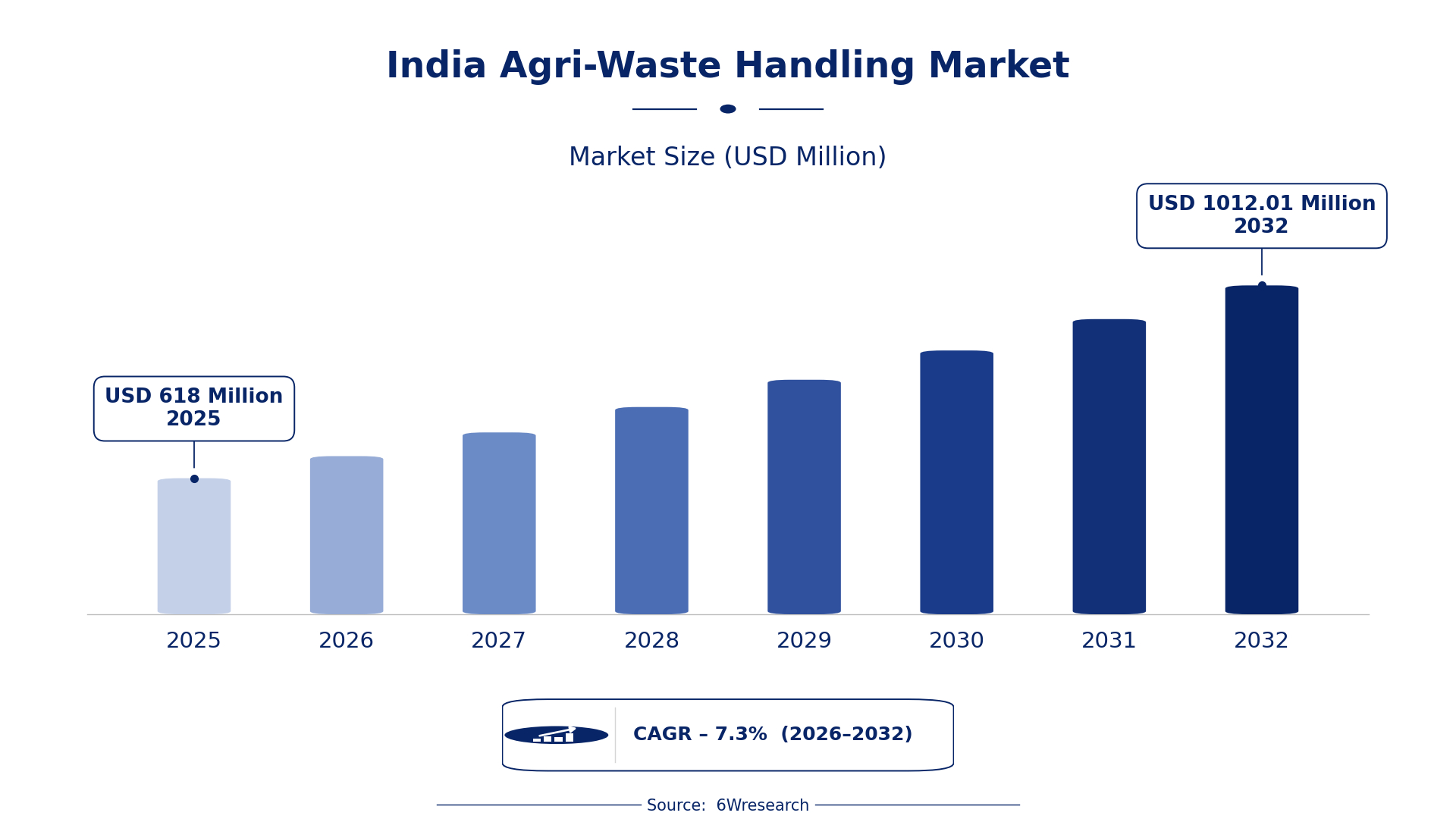
According to 6Wresearch internal database and industry insights, the India Agri-Waste Handling Market was valued at USD 618.0 million in 2025 and is projected to reach USD 1,012.01 million by 2032, growing at a CAGR of approximately 7.3% during 2026–2032.
India Agri-Waste Handling Market Highlights
| Report Metric | Details |
| Report Name | India Agri-Waste Handling Market |
| Market Size 2025 | USD 618.0 million |
| Market Size 2032 | USD 1,012.01 million |
| Absolute Growth 2025–2032 | USD 394.01 million |
| CAGR 2026–2032 | 7.3% |
| Peak Annual Growth | 9.8% in 2029 |
| Forecast Period | 2026–2032 |
| Historical Data | 2022–2025 |
| Base Year | 2025 |
| Leading Waste Handling Type, 2025 | Composting Systems (41% share) |
| Leading Processing Technique, 2025 | Anaerobic Digestion (51% share) |
| Leading Distribution Channel, 2025 | Government Schemes (35% share) |
| Leading End User, 2025 | Organic Fertilizer Producers (37% share) |
| Fastest-Growing Waste Handling Type | Biogas Units (9.3% CAGR) |
| Fastest-Growing Distribution Channel | Direct Sales (8.9% CAGR) |
| Fastest-Growing End User | Rural Community Plants (9.6% CAGR) |
| Growing Sector | Organic Fertilizer Production |
| Key End Users | Organic Fertilizer Producers, Rural Community Plants, Small-scale Farmers, Municipal Agri Agencies |
India Agri-Waste Handling Market Year-wise Growth Rate and Key Drivers (2022–2032)
This graph illustrates the annual growth rates of the market from 2022 to 2032, highlighting a steady upward trajectory and projected market expansion over the forecast period.
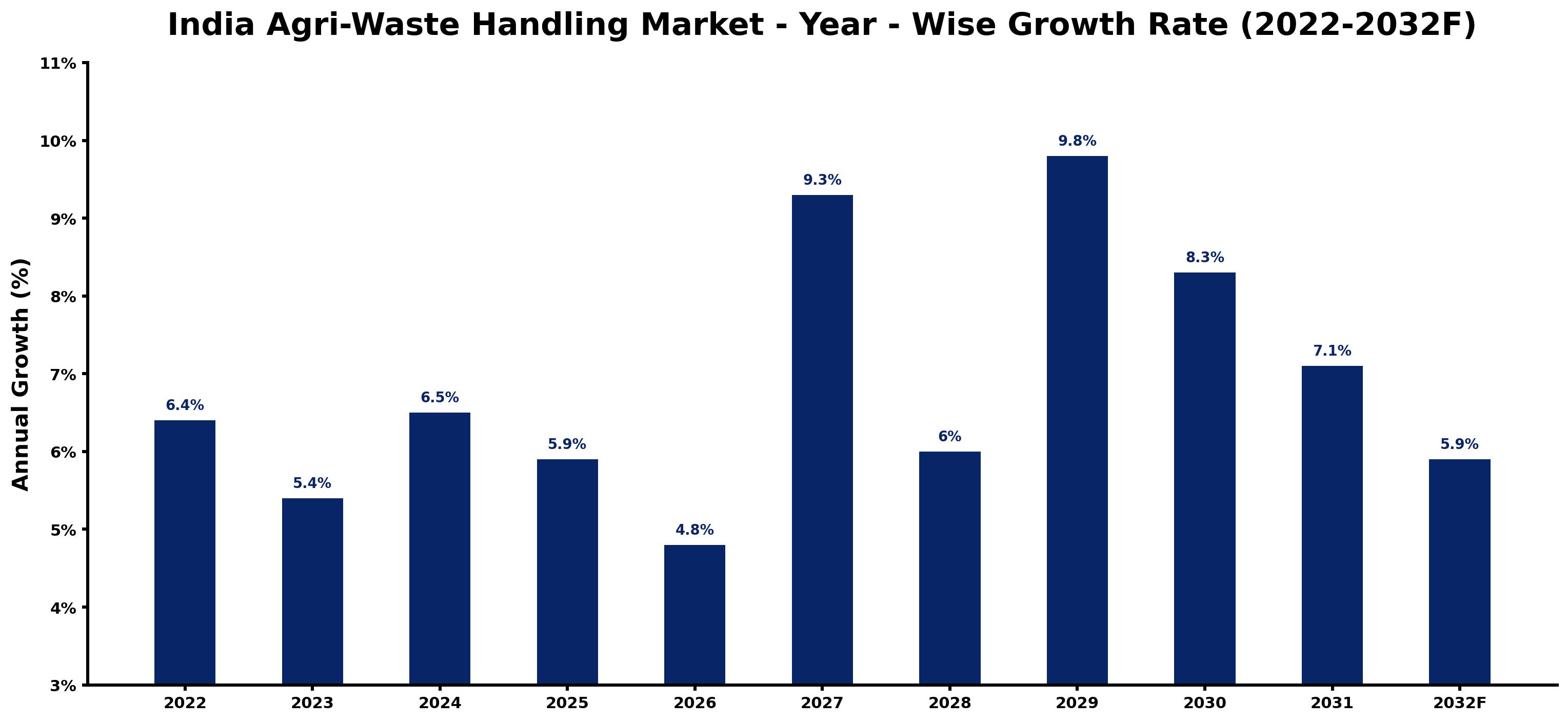
Below, each year's estimated growth is shown next to the factor that most influenced it.
| Year | Estimated Annual Growth (%) | Market Rationale |
| 2022 | 6.4 | The market experienced steady growth due to the Pradhan Mantri Kisan Samman Nidhi encouraging better waste management practices. |
| 2023 | 5.4 | Growth slowed as many farmers faced challenges in financing new waste handling technologies. |
| 2024 | 6.5 | Demand rose as more farmers implemented composting systems to manage agricultural waste effectively. |
| 2025 | 5.9 | The market continued to grow, driven by government initiatives supporting sustainable waste management practices. |
| 2026 | 4.8 | Growth slowed as competition increased among providers of waste handling solutions. |
| 2027 | 9.3 | Demand surged with the introduction of new biogas units in rural areas, enhancing energy production. |
| 2028 | 6.0 | Growth decelerated as the market adjusted to new regulatory standards for waste management. |
| 2029 | 9.8 | The market peaked due to heightened investments in biogas production facilities across rural communities. |
| 2030 | 8.3 | Growth slowed as market saturation began in certain regions, affecting new investments. |
| 2031 | 7.1 | The market continued to grow, supported by ongoing government funding for waste management initiatives. |
| 2032 | 5.9 | Growth slowed as the market stabilised, focusing on improving existing waste handling technologies. |
Note: Market size estimations and growth projections presented in this report are based on 6Wresearch's proprietary forecasting methodology, utilizing the latest available industry data, government publications, and primary research inputs.
India Agri-Waste Handling Market Synopsis
Agri-Waste Handling in India encompasses the management and processing of agricultural waste through methods such as composting and anaerobic digestion. This sector is essential for converting waste into organic fertilizers and energy production. The India Agri-Waste Handling Market is expanding, driven by the generation of approximately 500 million tons of agricultural waste annually. Government initiatives, including the Pradhan Mantri Kisan Samman Nidhi and the National Biofuel Policy, are promoting sustainable practices and increasing demand for effective waste handling solutions.
Market Dynamics Impact Analysis (2026–2032)
| Factor | Type | Impact | Primary Segment Affected |
| Increased government support for waste management initiatives | Driver | High | Biogas Units |
| Growing adoption of composting systems among farmers | Driver | High | Composting Systems |
| Rising demand for organic fertilizers in rural areas | Opportunity | High | Organic Fertilizer Producers |
| Expansion of biogas production facilities in rural communities | Opportunity | High | Rural Community Plants |
| Limited awareness of advanced waste handling technologies | Restraint | Medium | Waste Collection Units |
| Challenges in financing waste management projects for small farmers | Restraint | Medium | Small-scale Farmers |
| Infrastructure limitations in rural areas affecting waste collection | Challenge | High | Waste Collection Units |
| Competition from alternative waste management solutions | Challenge | Medium | Biogas Units |
Evaluation of Drivers in India Agri-Waste Handling Market (2026–2032)
Key forces behind demand, with the segment each one moves most, are listed below.
| Drivers | Primary Segment Affected | Why It Matters (Evidence) |
| Government initiatives promoting biogas production | Biogas Units | The National Biofuel Policy aims to promote energy sustainability, driving demand for biogas units across rural areas. |
| Increasing adoption of composting systems | Composting Systems | Approximately 30% of farmers are now using composting systems to manage waste efficiently, boosting fertilizer production. |
| Demand for organic fertilizers from rural communities | Organic Fertilizer Producers | The average rural population of around 900 million relies heavily on agriculture, increasing the demand for organic fertilizers. |
| Investment in waste management technologies | Waste Collection Units | The government allocated INR 1,000 crore in 2022 to promote organic farming and improve waste management practices. |
| Growing awareness of sustainable practices among farmers | Rural Community Plants | The Swachh Bharat Mission encourages local initiatives for better waste management in agriculture, enhancing community engagement. |
Market growth in India for Agri-Waste Handling rests on increasing adoption of composting systems, government initiatives, and rising demand for organic fertilizers. Approximately 30% of farmers are now using composting systems to manage waste efficiently, boosting fertilizer production. The government allocated INR 1,000 crore in 2022 for organic farming, which has improved investments in waste management technologies. Local initiatives supported by the Swachh Bharat Mission are increasing awareness and implementation of sustainable practices among farmers, leading to greater efficiency in waste handling.
Evaluation of Restraints in India Agri-Waste Handling Market
The table below lists the restraints and the evidence behind each.
| Market Restraint | Primary Segment Affected | Why It Matters (Evidence) |
| Limited awareness of advanced waste handling technologies | Waste Collection Units | Many farmers are unaware of the latest technologies, hindering efficient waste management and resulting in missed opportunities for improvement. |
| Challenges in financing waste management projects for small farmers | Small-scale Farmers | Access to funding remains a barrier for small farmers looking to implement effective waste solutions, restricting their operational capabilities. |
| Infrastructure limitations in rural areas affecting waste collection | Waste Collection Units | Poor infrastructure in rural regions complicates the efficient collection of agricultural waste, raising operational costs for farmers. |
| Competition from alternative waste management solutions | Biogas Units | Alternative methods may be perceived as more cost-effective, affecting the adoption of biogas units among farmers. |
| Regulatory compliance costs for waste handling | Composting Systems | Farmers face challenges in meeting compliance standards, which increases operational costs and complicates waste management. |
India Agri-Waste Handling Market Challenges
Buyers in the India agri-waste handling market still face several pressing issues, starting with regulatory challenges. Compliance with the National Policy on Biofuels can delay project approvals, leading to an estimated 15% increase in operational costs for producers. Skills shortages also hinder progress, as only about 30% of farmers have adopted composting systems, limiting effective waste management practices. Supply chain disruptions arise from inconsistent access to processing technology, which can inflate costs by up to 20% for producers. Lastly, limited availability of advanced waste handling technologies restricts buyers' options, reducing their ability to convert waste into valuable organic fertilisers.
Trends in the India Agri-Waste Handling Market
Buyers and suppliers in the India Agri-Waste Handling Market are adjusting to the following trends.
- Shift towards Biogas Production: India is increasingly focusing on biogas production from agricultural waste, driven by the National Biofuel Policy. In 2021, this policy aimed to promote energy sustainability, resulting in a rise in biogas unit installations.
- Growing Adoption of Composting Systems: In 2022, about 30% of farmers adopted composting systems, reflecting a shift towards sustainable waste management practices. This trend is expected to increase as awareness of organic farming benefits grows.
- Enhanced Government Support for Waste Management: The Swachh Bharat Mission, updated in 2022, now includes agricultural waste management, promoting cleanliness and sustainability in rural areas. This initiative aims to significantly improve waste handling practices.
- Increase in Organic Fertilizer Demand: With rising awareness of sustainable agriculture, the demand for organic fertilisers is surging. In 2022, the market for organic fertilisers saw substantial growth, reflecting changing consumer preferences.
Investment Opportunities in the India Agri-Waste Handling Market
Several openings in the India Agri-Waste Handling Market merit attention from investors.
- Agri-Waste Handling Technologies: Investing in advanced agri-waste handling technologies is essential, with the market projected to reach USD 1,012.01 million by 2032. Rural community plants are seeking effective solutions to manage waste efficiently.
- Biogas Units for Energy Production: The demand for biogas units is increasing, supported by government initiatives. With a projected growth rate of 9.3%, rural areas present an ideal market for these solutions.
- Composting Systems for Organic Fertilizers: The composting systems market is expanding, with approximately 30% of farmers adopting these solutions. Investing in this area can meet the rising demand for organic fertilisers effectively.
- Waste Collection Units for Efficient Management: There is a growing need for efficient waste collection units, particularly in rural regions. With the average rural population around 900 million, this presents a significant investment opportunity.
Government Initiatives in the India Agri-Waste Handling Market
The Pradhan Mantri Kisan Samman Nidhi, launched in 2019, provides financial support to farmers, encouraging the adoption of waste management practices. Additionally, the National Biofuel Policy, established in 2021, promotes the use of agricultural waste for biofuel production, supporting energy sustainability and waste management initiatives. The updated Swachh Bharat Mission in 2022 focuses on agricultural waste management, providing resources for local initiatives to improve waste handling practices.
The Ministry of Agriculture and Farmers' Welfare oversees various waste management initiatives, funding projects that enhance agricultural practices. The Swachh Bharat Mission, updated in 2022, focuses on agricultural waste management, providing resources for local initiatives. Furthermore, the Ministry of Environment, Forest and Climate Change introduced the Waste Management Rules in 2020, mandating proper disposal of agricultural waste, which improves compliance among producers.
Future Insight of the India Agri-Waste Handling Market
The agri-waste handling market in India is set to evolve by 2032, driven by significant advancements in processing technologies. Government initiatives like the Swachh Bharat Mission will enhance waste management practices across rural communities. By 2025, the budget for promoting organic farming will rise to INR 1,000 crore, encouraging wider adoption of sustainable practices among farmers. Research from the Indian Agricultural Research Institute will lead to innovative solutions that improve waste conversion efficiency, ultimately benefiting both producers and buyers.
Market Segmentation Analysis
Each segment group is reviewed below, with the leader by share and the fastest grower by CAGR.
By Waste Handling Type – Composting Systems Dominated, Biogas Units Expected to Grow Fastest
According to Ravi Bhandari, Research Head at 6Wresearch, with a 41% revenue share in 2025, Composting Systems was the largest waste handling type category. Composting systems command the largest market share as they are extensively adopted by farmers across India, especially in Punjab, where agricultural waste is abundant. This method efficiently converts organic waste into fertilisers, meeting the needs of both smallholders and larger agricultural operations. Biogas Units are set to record the highest CAGR in this split, 9.3% over 2026–2032. Biogas units are experiencing rapid growth due to heightened awareness of their potential for energy generation, particularly driven by government initiatives like the National Policy on Biofuels. This increasing focus on sustainable energy solutions is expected to accelerate the market's overall expansion. Suppliers should focus on advancing biogas technologies to capitalise on this growing interest among farmers.
By Processing Technique – Anaerobic Digestion Dominated and Is Expected to Record the Fastest Growth
The largest processing technique category in 2025 was Anaerobic Digestion, with a 51% share of total revenue. Anaerobic digestion commands the largest market share as it is essential for biogas production from agricultural waste, aligning with national energy objectives. Its established role in waste handling guarantees consistent demand across various agricultural sectors. The same category is also set to grow fastest, at a CAGR of 9.5% during 2026–2032. Anaerobic digestion is also the fastest-growing segment, as its efficiency in energy production gains recognition, especially with government support for biofuel initiatives. This dual position as both leader and fastest will likely reinforce its market dominance. Investments in anaerobic digestion technologies will be vital for suppliers aiming to satisfy the increasing demand for sustainable energy solutions.
By Distribution Channel – Government Schemes Dominated, Direct Sales Expected to Grow Fastest
Government Schemes accounted for a 35% market share by distribution channel in 2025. Government schemes lead the market share by providing farmers with essential access to waste handling technologies, ensuring effective waste management practices are widely adopted. These initiatives are critical in regions with high agricultural activity, such as Punjab, where support is vital for farmers. Over 2026–2032, Direct Sales is expected to post the fastest growth, at a CAGR of 8.9%. Direct sales are growing swiftly as suppliers seek to establish closer connections with end users, enabling tailored solutions that meet specific requirements. This trend reflects a shift towards more personalised engagement in the distribution of waste handling products. Suppliers should refine their direct sales approaches to better connect with farmers and rural communities.
By End User – Organic Fertilizer Producers Dominated, Rural Community Plants Expected to Grow Fastest
In 2025, Organic Fertilizer Producers led the end user split with a 37% share. Organic fertilizer producers lead the market share as they are the primary consumers of processed agri-waste, utilising it to create high-demand products. Their established networks and production capabilities ensure a consistent need for waste handling solutions. The quickest growth will come from Rural Community Plants, forecast to expand at a CAGR of 9.6% between 2026 and 2032. Rural community plants are the fastest-growing segment, driven by rising local energy and fertilizer needs as communities pursue self-sufficiency. This growth reflects a wider trend towards sustainable practices in rural areas, likely increasing their market influence. Suppliers should focus on targeting rural community plants to capitalise on this emerging market segment.
Key Attractiveness of the Report
- 10 Years of Market Numbers
- Historical Data Starting from 2022 to 2025
- Base Year 2025
- Forecast Data until 2032
- Key Performance Indicators Impacting the Market
- Major Upcoming Developments and Projects
Key Highlights of the Report:
- India Agri-Waste Handling Market Outlook
- Market Size of India Agri-Waste Handling Market, 2025
- Forecast of India Agri-Waste Handling Market, 2032
- Historical Data and Forecast of India Agri-Waste Handling Revenues & Volume for the Period 2022 - 2032F
- India Agri-Waste Handling Market Trend Evolution
- India Agri-Waste Handling Market Drivers and Challenges
- India Agri-Waste Handling Price Trends
- India Agri-Waste Handling Porter's Five Forces
- India Agri-Waste Handling Industry Life Cycle
- Historical Data and Forecast of India Agri-Waste Handling Market Revenues & Volume By Waste Handling Type for the Period 2022 - 2032F
- Historical Data and Forecast of India Agri-Waste Handling Market Revenues & Volume By Composting Systems for the Period 2022 - 2032F
- Historical Data and Forecast of India Agri-Waste Handling Market Revenues & Volume By Biogas Units for the Period 2022 - 2032F
- Historical Data and Forecast of India Agri-Waste Handling Market Revenues & Volume By Mulching Tools for the Period 2022 - 2032F
- Historical Data and Forecast of India Agri-Waste Handling Market Revenues & Volume By Waste Collection Units for the Period 2022 - 2032F
- Historical Data and Forecast of India Agri-Waste Handling Market Revenues & Volume By Processing Technique for the Period 2022 - 2032F
- Historical Data and Forecast of India Agri-Waste Handling Market Revenues & Volume By Aerobic Decomposition for the Period 2022 - 2032F
- Historical Data and Forecast of India Agri-Waste Handling Market Revenues & Volume By Anaerobic Digestion for the Period 2022 - 2032F
- Historical Data and Forecast of India Agri-Waste Handling Market Revenues & Volume By Mechanical Processing for the Period 2022 - 2032F
- Historical Data and Forecast of India Agri-Waste Handling Market Revenues & Volume By Collection & Sorting for the Period 2022 - 2032F
- Historical Data and Forecast of India Agri-Waste Handling Market Revenues & Volume By Distribution Channel for the Period 2022 - 2032F
- Historical Data and Forecast of India Agri-Waste Handling Market Revenues & Volume By Direct Sales for the Period 2022 - 2032F
- Historical Data and Forecast of India Agri-Waste Handling Market Revenues & Volume By Government Schemes for the Period 2022 - 2032F
- Historical Data and Forecast of India Agri-Waste Handling Market Revenues & Volume By Agri Dealers for the Period 2022 - 2032F
- Historical Data and Forecast of India Agri-Waste Handling Market Revenues & Volume By Local Distributors for the Period 2022 - 2032F
- Historical Data and Forecast of India Agri-Waste Handling Market Revenues & Volume By End User for the Period 2022 - 2032F
- Historical Data and Forecast of India Agri-Waste Handling Market Revenues & Volume By Organic Fertilizer Producers for the Period 2022 - 2032F
- Historical Data and Forecast of India Agri-Waste Handling Market Revenues & Volume By Rural Community Plants for the Period 2022 - 2032F
- Historical Data and Forecast of India Agri-Waste Handling Market Revenues & Volume By Small-scale Farmers for the Period 2022 - 2032F
- Historical Data and Forecast of India Agri-Waste Handling Market Revenues & Volume By Municipal Agri Agencies for the Period 2022 - 2032F
- India Agri-Waste Handling Import Export Trade Statistics
- Market Opportunity Assessment By Waste Handling Type
- Market Opportunity Assessment By Processing Technique
- Market Opportunity Assessment By Distribution Channel
- Market Opportunity Assessment By End User
- India Agri-Waste Handling Top Companies Market Share
- India Agri-Waste Handling Competitive Benchmarking By Technical and Operational Parameters
- India Agri-Waste Handling Company Profiles
- India Agri-Waste Handling Key Strategic Recommendations
Market Covered
This report examines the market across the segments below.
By Waste Handling Type
- Composting Systems
- Biogas Units
- Mulching Tools
- Waste Collection Units
By Processing Technique
- Aerobic Decomposition
- Anaerobic Digestion
- Mechanical Processing
- Collection & Sorting
By Distribution Channel
- Direct Sales
- Government Schemes
- Agri Dealers
- Local Distributors
By End User
- Organic Fertilizer Producers
- Rural Community Plants
- Small-scale Farmers
- Municipal Agri Agencies































