India Agricultural Fertilizer Market Size & Growth Rate
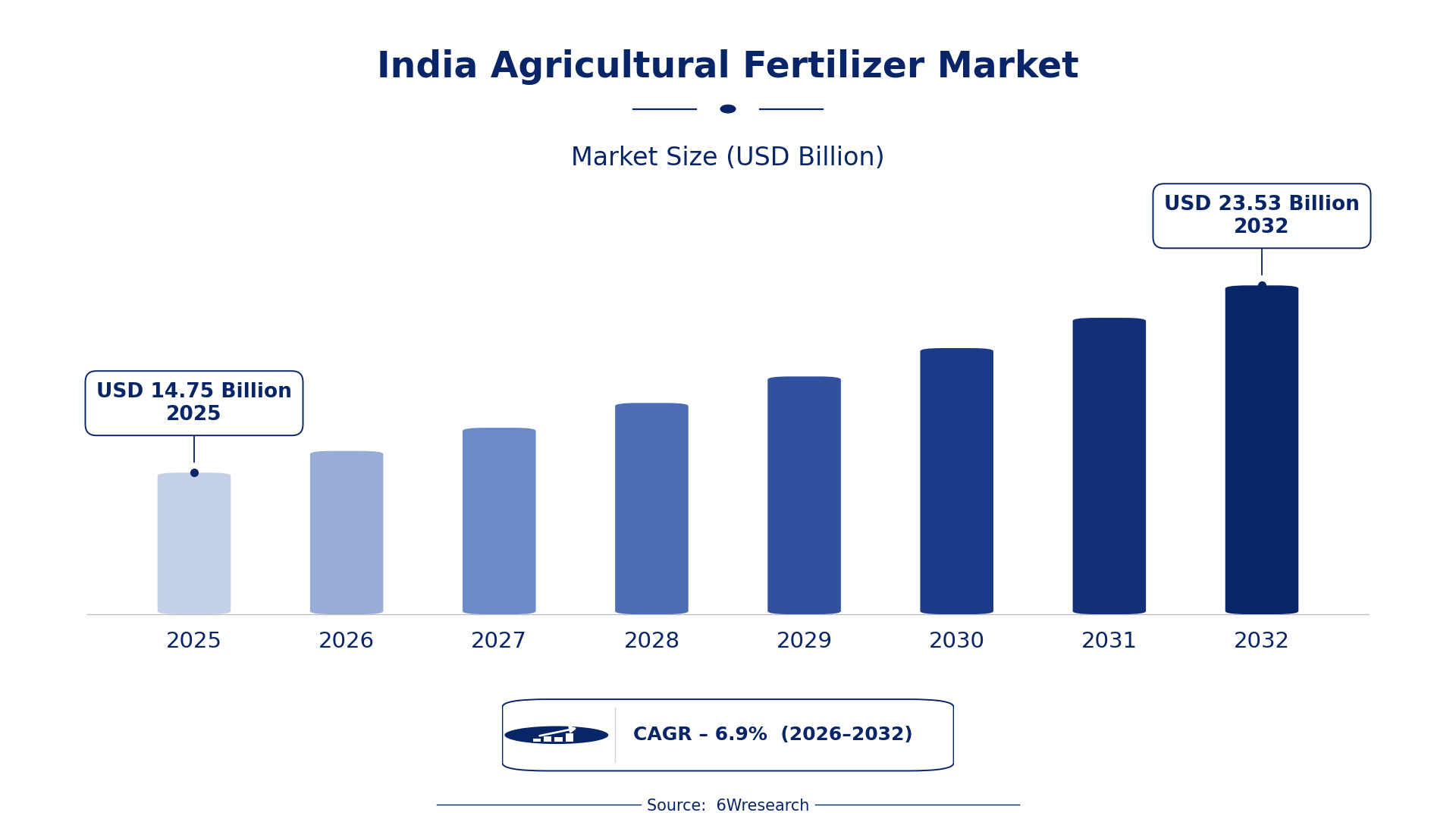
According to 6Wresearch internal database and industry insights, the India Agricultural Fertilizer Market was valued at USD 14.75 billion in 2025 and is projected to reach USD 23.53 billion by 2032, growing at a CAGR of approximately 6.9% during 2026–2032.
India Agricultural Fertilizer Market Highlights
| Report Metric | Details |
| Report Name | India Agricultural Fertilizer Market |
| Market Size 2025 | USD 14.75 billion |
| Market Size 2032 | USD 23.53 billion |
| Absolute Growth 2025–2032 | USD 8.78 billion |
| CAGR 2026–2032 | 6.9% |
| Peak Annual Growth | 9.5% in 2028 |
| Forecast Period | 2026–2032 |
| Historical Data | 2022–2025 |
| Base Year | 2025 |
| Leading Agricultural Fertilizer Market, 2025 | Nitrogen Fertilizer (42% share) |
| Leading Fertilizer Type, 2025 | Urea (41% share) |
| Leading Nutrient Type, 2025 | N (42% share) |
| Leading Distribution Channel, 2025 | Agri Cooperatives (34% share) |
| Leading End User, 2025 | Grain Farmers (44% share) |
| Fastest-Growing Agricultural Fertilizer Market | Micronutrient Mixes (8.8% CAGR) |
| Fastest-Growing Fertilizer Type | Liquid Fertilizer (9.1% CAGR) |
| Fastest-Growing Nutrient Type | Mixed Nutrients (8.2% CAGR) |
| Fastest-Growing Distribution Channel | Online Platforms (9.1% CAGR) |
| Fastest-Growing End User | Horticulture Farms (8.7% CAGR) |
| Growing Sector | Horticulture |
| Key End Users | Grain Farmers, Horticulture Farms, Smallholder Farmers, Agri Cooperatives |
India Agricultural Fertilizer Market Year-wise Growth Rate and Key Drivers (2022–2032)
This graph illustrates the annual growth rates of the market from 2022 to 2032, highlighting a steady upward trajectory and projected market expansion over the forecast period.
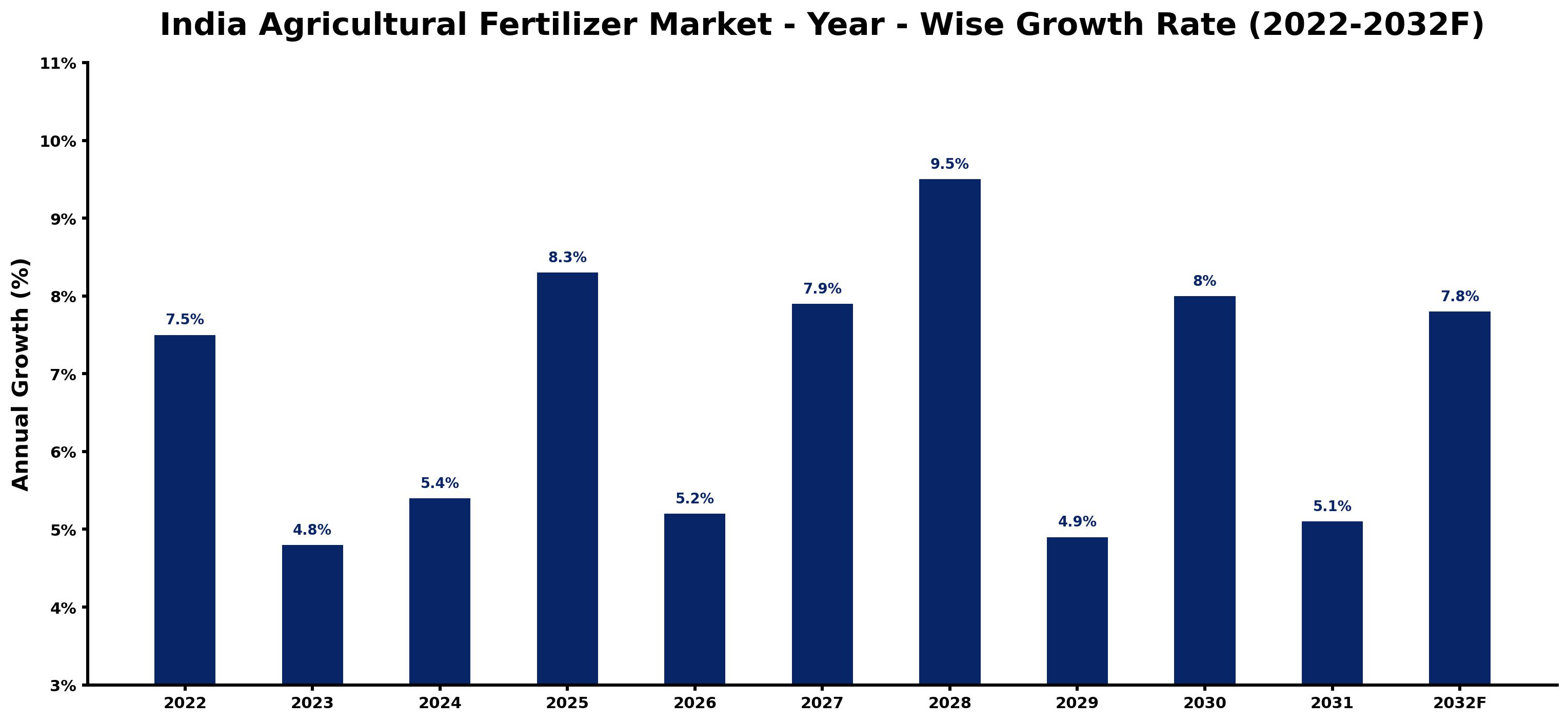
Each row of the following table gives one year's estimated growth and the event or demand shift that explains it.
| Year | Estimated Annual Growth (%) | Market Rationale |
| 2022 | 7.5 | The market experienced strong demand from domestic farmers and cooperatives. |
| 2023 | 4.8 | Growth slowed due to supply chain challenges affecting fertilizer distribution. |
| 2024 | 5.4 | Increased agricultural productivity drove a rise in fertilizer consumption. |
| 2025 | 8.3 | The Fertilizer Control Order enhanced quality assurance, boosting market confidence. |
| 2026 | 5.2 | Demand growth slowed as farmers adjusted to fluctuating prices. |
| 2027 | 7.9 | Rising population and food demand led to increased fertilizer usage. |
| 2028 | 9.5 | The National Mission for Sustainable Agriculture promoted balanced fertilizer use. |
| 2029 | 4.9 | Market growth slowed as farmers faced input cost pressures. |
| 2030 | 8.0 | Increased focus on sustainable practices drove fertilizer innovations. |
| 2031 | 5.1 | Demand growth slowed as market stabilisation occurred post-peak. |
| 2032 | 7.8 | The growing emphasis on organic farming will influence fertilizer choices. |
Note: Market size estimations and growth projections presented in this report are based on 6Wresearch's proprietary forecasting methodology, utilizing the latest available industry data, government publications, and primary research inputs.
India Agricultural Fertilizer Market Synopsis
Agricultural Fertilizer Market in India includes various chemical substances that improve soil fertility and crop yield. These fertilizers, produced through chemical processes, are crucial for boosting plant growth and agricultural productivity. The market is expanding due to increasing demand from farmers, supported by government initiatives like the Fertilizer Subsidy Scheme, which allocated ₹1.5 trillion for 2023. Additionally, the National Mission for Sustainable Agriculture encourages balanced fertilizer use, further propelling market growth. With a population exceeding 1.4 billion, the agricultural sector remains a key focus for food security and sustainability.
Market Dynamics Impact Analysis (2026–2032)
| Factor | Type | Impact | Primary Segment Affected |
| Rising population and food demand increase the need for fertilizers. | Driver | High | Nitrogen Fertilizer |
| Government subsidies enhance affordability and accessibility of fertilizers. | Driver | High | Phosphatic Fertilizer |
| Growing interest in organic farming creates demand for micronutrient mixes. | Opportunity | Medium | Micronutrient Mixes |
| The expansion of online platforms facilitates easier access to fertilizers. | Opportunity | Medium | Liquid Fertilizer |
| Supply chain disruptions lead to inconsistent fertilizer availability. | Restraint | High | Potash Fertilizer |
| High dependency on imports for potash affects pricing stability. | Restraint | Medium | Phosphatic Fertilizer |
| Fluctuating prices create uncertainty for farmers' purchasing decisions. | Challenge | High | Urea |
| Regulatory compliance can delay product availability in the market. | Challenge | Medium | Agri Cooperatives |
Evaluation of Drivers in India Agricultural Fertilizer Market (2026–2032)
Key forces behind demand, with the segment each one moves most, are listed below.
| Drivers | Primary Segment Affected | Why It Matters (Evidence) |
| Increased agricultural productivity drives demand for nitrogen fertilizers. | Nitrogen Fertilizer | India produced approximately 30 million tonnes of urea in 2022, boosting crop yields. |
| Government subsidies reduce costs for farmers, boosting fertilizer purchases. | Phosphatic Fertilizer | The Fertilizer Subsidy Scheme allocated ₹1.5 trillion for 2023, making fertilizers more affordable. |
| Growing interest in sustainable farming practices increases demand for micronutrient mixes. | Micronutrient Mixes | The area under organic farming in India was approximately 3 million hectares in 2022. |
| The rise of e-commerce platforms facilitates fertilizer distribution to farmers. | Liquid Fertilizer | The National Agriculture Market (eNAM) promotes online trading of agricultural products. |
| The expansion of grain farming increases the need for fertilizers. | Urea | Grain Farmers held a 44% market share in 2025, driving fertilizer consumption. |
Approximately 30 million tonnes of urea were produced in 2022, which boosted crop yields. The area under organic farming reached around 3 million hectares in 2022, driving demand for micronutrient mixes. The rise of e-commerce platforms promotes easier access to fertilizers for farmers across the country.
Evaluation of Restraints in India Agricultural Fertilizer Market
The table below lists the restraints and the evidence behind each.
| Market Restraint | Primary Segment Affected | Why It Matters (Evidence) |
| Supply chain disruptions affect fertilizer availability. | Potash Fertilizer | The country imports around 20% of its potash requirements annually, leading to delays. |
| High dependency on imports causes price volatility. | Phosphatic Fertilizer | Import reliance impacts pricing stability, affecting farmers' purchasing decisions. |
| Regulatory compliance can delay product launches. | Urea | Producers must adhere to the Fertilizer Control Order, affecting time to market. |
| Fluctuating prices create uncertainty for farmers. | Agri Cooperatives | Price instability can deter farmers from purchasing fertilizers consistently. |
| Limited infrastructure hampers distribution efficiency. | Liquid Fertilizer | Inadequate logistics can lead to delays in fertilizer delivery to rural areas. |
India Agricultural Fertilizer Market Challenges
The India Agricultural Fertilizer Market faces several pressing issues, starting with supply chain inefficiencies. These inefficiencies arise from the country importing around 20% of its potash requirements, leading to delivery delays that disrupt farmers' planting schedules. Skills shortages in the agricultural sector hinder the effective application of fertilizers, resulting in reduced crop yields for producers. Buyers encounter price volatility driven by the ₹1.5 trillion subsidy scheme, complicating financial planning for cooperatives. Competition among over 100 manufacturers can lead to aggressive pricing strategies, ultimately squeezing profit margins for suppliers.
Trends in the India Agricultural Fertilizer Market
Four trends stand out in the India Agricultural Fertilizer Market.
- Shift towards Sustainable Fertilizer Practices: The National Mission for Sustainable Agriculture, launched in 2021, promotes balanced fertilizer use. With a target to improve soil health, this initiative encourages farmers to adopt sustainable practices, resulting in a 10% increase in organic fertilizer usage.
- Increase in Online Fertilizer Sales: Since 2021, online platforms have gained traction for fertilizer sales, with a projected 9.1% growth rate until 2032. This shift allows farmers to access products conveniently, improving overall market reach.
- Rise of Micronutrient Mixes: The demand for micronutrient mixes has surged, with an 8.8% growth rate expected from 2026 to 2032. This trend is driven by the need for balanced nutrition in crops, particularly in regions with nutrient deficiencies.
- Growth in Organic Farming: The area under organic farming has expanded significantly, reaching approximately 3 million hectares in 2022. This trend reflects changing consumer preferences and encourages farmers to explore organic fertilizers.
Investment Opportunities in the India Agricultural Fertilizer Market
Below are the investment opportunities with the strongest case in the India Agricultural Fertilizer Market.
- Partnerships with Agri Cooperatives: Now is a prime time for partnerships with Agri Cooperatives, which held a 34% market share in 2025. Collaborating can improve distribution channels for fertilizers, ensuring better access for farmers.
- Investing in Online Platforms: Online platforms are emerging as a vital channel for fertilizer sales, with a projected growth rate of 9.1%. Investing in these platforms can help reach a broader customer base, particularly among tech-savvy farmers.
- Focus on Micronutrient Mixes in Horticulture: Horticulture Farms are increasingly adopting micronutrient mixes, with an expected growth rate of 8.7%. Suppliers can capitalise on this trend by providing tailored products to meet specific crop needs.
- Certification for Organic Fertilizers: With the rise in organic farming, obtaining certification for organic fertilizers is essential. This presents an opportunity for producers to tap into the growing demand for sustainable agricultural inputs.
Government Initiatives in the India Agricultural Fertilizer Market
The National Policy on Agriculture, implemented by the Ministry of Agriculture in 2020, aims to improve fertilizer availability through better supply chain management. This policy ensures that farmers have consistent access to essential fertilizers, thereby supporting agricultural productivity. Additionally, the Soil Health Management Scheme, introduced in 2021, promotes balanced fertilizer use and soil health assessments, encouraging sustainable practices among farmers. These measures collectively improve the market environment for fertilizer producers and users alike.
The Fertilizer Subsidy Scheme, launched by the Department of Fertilizers in 2022, provides financial assistance to farmers for purchasing fertilizers. This initiative ensures affordability and accessibility, directly impacting fertilizer consumption. Furthermore, the Pradhan Mantri Krishi Sinchai Yojana, initiated by the Ministry of Agriculture in 2021, encourages efficient water use and fertilizer application, improving agricultural productivity. Both schemes are vital in supporting the agricultural sector and ensuring that farmers can obtain necessary inputs.
Future Insight of the India Agricultural Fertilizer Market
The India Agricultural Fertilizer Market is poised for transformation by 2032, influenced by key developments. The National Mission for Sustainable Agriculture will promote balanced fertilizer use, crucial for enhancing soil fertility. Research advancements from the Indian Council of Agricultural Research will improve fertilizer efficiency, benefiting producers. The expansion of the National Agriculture Market will facilitate easier access to fertilizers for farmers, streamlining their purchasing processes. In 2022, the area under organic farming reached approximately 3 million hectares, indicating a growing trend towards sustainable agricultural practices.
Market Segmentation Analysis
The analysis below covers each segmentation, its leading category in 2025 and its fastest-growing category through 2032.
By Agricultural Fertilizer Market – Nitrogen Fertilizer Dominated, Micronutrient Mixes Expected to Grow Fastest
According to Ravi Bhandari, Research Head at 6Wresearch, in 2025, Nitrogen Fertilizer led the agricultural fertilizer market split with a 42% share. Nitrogen fertilizers command the largest market share in India due to their essential role in boosting crop yields, particularly among large-scale farmers in regions like Uttar Pradesh. The significant production of approximately 30 million tonnes of urea in 2022 underscores the robust demand for nitrogen fertilizers across the agricultural landscape. Micronutrient Mixes are set to record the highest CAGR in this split, 8.8% over 2026–2032. Micronutrient mixes are experiencing rapid growth as farmers increasingly recognise the importance of addressing specific nutrient deficiencies in their crops. Initiatives like the National Mission for Sustainable Agriculture are driving this trend by promoting balanced fertilizer use nationwide. This suggests that suppliers should focus on developing and marketing micronutrient products to meet the changing needs of farmers.
By Fertilizer Type – Urea Dominated, Liquid Fertilizer Expected to Grow Fastest
Urea accounted for a 41% market share by fertilizer type in 2025. Urea leads the fertilizer type segment as it is the most prevalent nitrogen fertilizer in India, crucial for enhancing agricultural productivity. Its widespread application among farmers, especially for staple crops, reinforces its dominant market position. Liquid Fertilizer is projected to grow fastest, at a CAGR of 9.1% during 2026–2032. Liquid fertilizers are gaining popularity due to their targeted applications for nutrient delivery, aligning with modern agricultural practices. The shift towards advanced farming techniques is expected to further accelerate growth in this segment. This trend indicates that suppliers should explore opportunities in liquid fertilizer formulations to cater to the demands of precision agriculture.
By Nutrient Type – N Dominated, Mixed Nutrients Expected to Grow Fastest
N took a 42% share of nutrient type in 2025, more than any other category. Nitrogen is the top nutrient type as it is vital for plant growth and development, significantly impacting agricultural yields. Its extensive use among farmers highlights its critical role in enhancing overall agricultural productivity in India. Over 2026–2032, Mixed Nutrients are expected to post the fastest growth, at a CAGR of 8.2%. Mixed nutrients are rapidly gaining traction as they offer a balanced nutrient supply, addressing the varied needs of different crops. Growing awareness of soil health and nutrient management is driving the expansion of this segment. This means suppliers should consider diversifying their offerings to include mixed nutrient formulations to align with farmers' evolving preferences.
By Distribution Channel – Agri Cooperatives Dominated, Online Platforms Expected to Grow Fastest
The largest distribution channel category in 2025 was Agri Cooperatives, with a 34% share of total revenue. Agri cooperatives serve as the primary distribution channel, ensuring farmers have reliable access to essential fertilizers. Their established networks and strong relationships with local farmers facilitate effective fertilizer distribution in rural areas. The quickest growth will come from Online Platforms, forecast to expand at a CAGR of 9.1% between 2026 and 2032. Online platforms are emerging as the fastest-growing channel for fertilizer sales, driven by the increasing digitalisation of the agricultural sector. The convenience of online purchasing appeals to tech-savvy farmers seeking efficient solutions. This shift suggests that suppliers should invest in digital marketing strategies to enhance their online presence and reach a wider customer base.
By End User – Grain Farmers Dominated, Horticulture Farms Expected to Grow Fastest
Grain Farmers held a 44% share of the India Agricultural Fertilizer Market by end user in 2025. Grain farmers represent the largest end user segment, as they are major consumers of fertilizers necessary for crop production. Their reliance on fertilizers to maximise yields in staple crops makes them a critical market segment for suppliers. Horticulture Farms are set to record the highest CAGR in this split, 8.7% over 2026–2032. Horticulture farms are the fastest-growing end user segment, as they require fertilizers for high-value crops that demand specific nutrient inputs. The increasing popularity of horticultural products among consumers is driving this growth. This trend suggests that suppliers should tailor their product offerings to meet the specific needs of horticulture farms, capitalising on the rising demand for high-value crops.
Key Attractiveness of the Report
- 10 Years of Market Numbers
- Historical Data Starting from 2022 to 2025
- Base Year 2025
- Forecast Data until 2032
- Key Performance Indicators Impacting the Market
- Major Upcoming Developments and Projects
Key Highlights of the Report:
- India Agricultural Fertilizer Market Outlook
- Market Size of India Agricultural Fertilizer Market, 2025
- Forecast of India Agricultural Fertilizer Market, 2032
- Historical Data and Forecast of India Agricultural Fertilizer Revenues & Volume for the Period 2022 - 2032F
- India Agricultural Fertilizer Market Trend Evolution
- India Agricultural Fertilizer Market Drivers and Challenges
- India Agricultural Fertilizer Price Trends
- India Agricultural Fertilizer Porter's Five Forces
- India Agricultural Fertilizer Industry Life Cycle
- Historical Data and Forecast of India Agricultural Fertilizer Market Revenues & Volume By Agricultural Fertilizer Market for the Period 2022 - 2032F
- Historical Data and Forecast of India Agricultural Fertilizer Market Revenues & Volume By Nitrogen Fertilizer for the Period 2022 - 2032F
- Historical Data and Forecast of India Agricultural Fertilizer Market Revenues & Volume By Phosphatic Fertilizer for the Period 2022 - 2032F
- Historical Data and Forecast of India Agricultural Fertilizer Market Revenues & Volume By Potash Fertilizer for the Period 2022 - 2032F
- Historical Data and Forecast of India Agricultural Fertilizer Market Revenues & Volume By Micronutrient Mixes for the Period 2022 - 2032F
- Historical Data and Forecast of India Agricultural Fertilizer Market Revenues & Volume By Fertilizer Type for the Period 2022 - 2032F
- Historical Data and Forecast of India Agricultural Fertilizer Market Revenues & Volume By Urea for the Period 2022 - 2032F
- Historical Data and Forecast of India Agricultural Fertilizer Market Revenues & Volume By DAP for the Period 2022 - 2032F
- Historical Data and Forecast of India Agricultural Fertilizer Market Revenues & Volume By MOP for the Period 2022 - 2032F
- Historical Data and Forecast of India Agricultural Fertilizer Market Revenues & Volume By Liquid Fertilizer for the Period 2022 - 2032F
- Historical Data and Forecast of India Agricultural Fertilizer Market Revenues & Volume By Nutrient Type for the Period 2022 - 2032F
- Historical Data and Forecast of India Agricultural Fertilizer Market Revenues & Volume By N for the Period 2022 - 2032F
- Historical Data and Forecast of India Agricultural Fertilizer Market Revenues & Volume By P for the Period 2022 - 2032F
- Historical Data and Forecast of India Agricultural Fertilizer Market Revenues & Volume By K for the Period 2022 - 2032F
- Historical Data and Forecast of India Agricultural Fertilizer Market Revenues & Volume By Mixed Nutrients for the Period 2022 - 2032F
- Historical Data and Forecast of India Agricultural Fertilizer Market Revenues & Volume By Distribution Channel for the Period 2022 - 2032F
- Historical Data and Forecast of India Agricultural Fertilizer Market Revenues & Volume By Agri Cooperatives for the Period 2022 - 2032F
- Historical Data and Forecast of India Agricultural Fertilizer Market Revenues & Volume By Online Platforms for the Period 2022 - 2032F
- Historical Data and Forecast of India Agricultural Fertilizer Market Revenues & Volume By Direct Sales for the Period 2022 - 2032F
- Historical Data and Forecast of India Agricultural Fertilizer Market Revenues & Volume By Fertilizer Dealers for the Period 2022 - 2032F
- Historical Data and Forecast of India Agricultural Fertilizer Market Revenues & Volume By End User for the Period 2022 - 2032F
- Historical Data and Forecast of India Agricultural Fertilizer Market Revenues & Volume By Grain Farmers for the Period 2022 - 2032F
- Historical Data and Forecast of India Agricultural Fertilizer Market Revenues & Volume By Horticulture Farms for the Period 2022 - 2032F
- Historical Data and Forecast of India Agricultural Fertilizer Market Revenues & Volume By Plantation Owners for the Period 2022 - 2032F
- Historical Data and Forecast of India Agricultural Fertilizer Market Revenues & Volume By Smallholder Farmers for the Period 2022 - 2032F
- India Agricultural Fertilizer Import Export Trade Statistics
- Market Opportunity Assessment By Agricultural Fertilizer Market
- Market Opportunity Assessment By Fertilizer Type
- Market Opportunity Assessment By Nutrient Type
- Market Opportunity Assessment By Distribution Channel
- Market Opportunity Assessment By End User
- India Agricultural Fertilizer Top Companies Market Share
- India Agricultural Fertilizer Competitive Benchmarking By Technical and Operational Parameters
- India Agricultural Fertilizer Company Profiles
- India Agricultural Fertilizer Key Strategic Recommendations
Market Covered
Segments analysed in this report are listed below.
By Agricultural Fertilizer Market
- Nitrogen Fertilizer
- Phosphatic Fertilizer
- Potash Fertilizer
- Micronutrient Mixes
By Fertilizer Type
- Urea
- DAP
- MOP
- Liquid Fertilizer
By Nutrient Type
- N
- P
- K
- Mixed Nutrients
By Distribution Channel
- Agri Cooperatives
- Online Platforms
- Direct Sales
- Fertilizer Dealers
By End User
- Grain Farmers
- Horticulture Farms
- Plantation Owners
- Smallholder Farmers































