India Agricultural Waste Management Market Size & Growth Rate
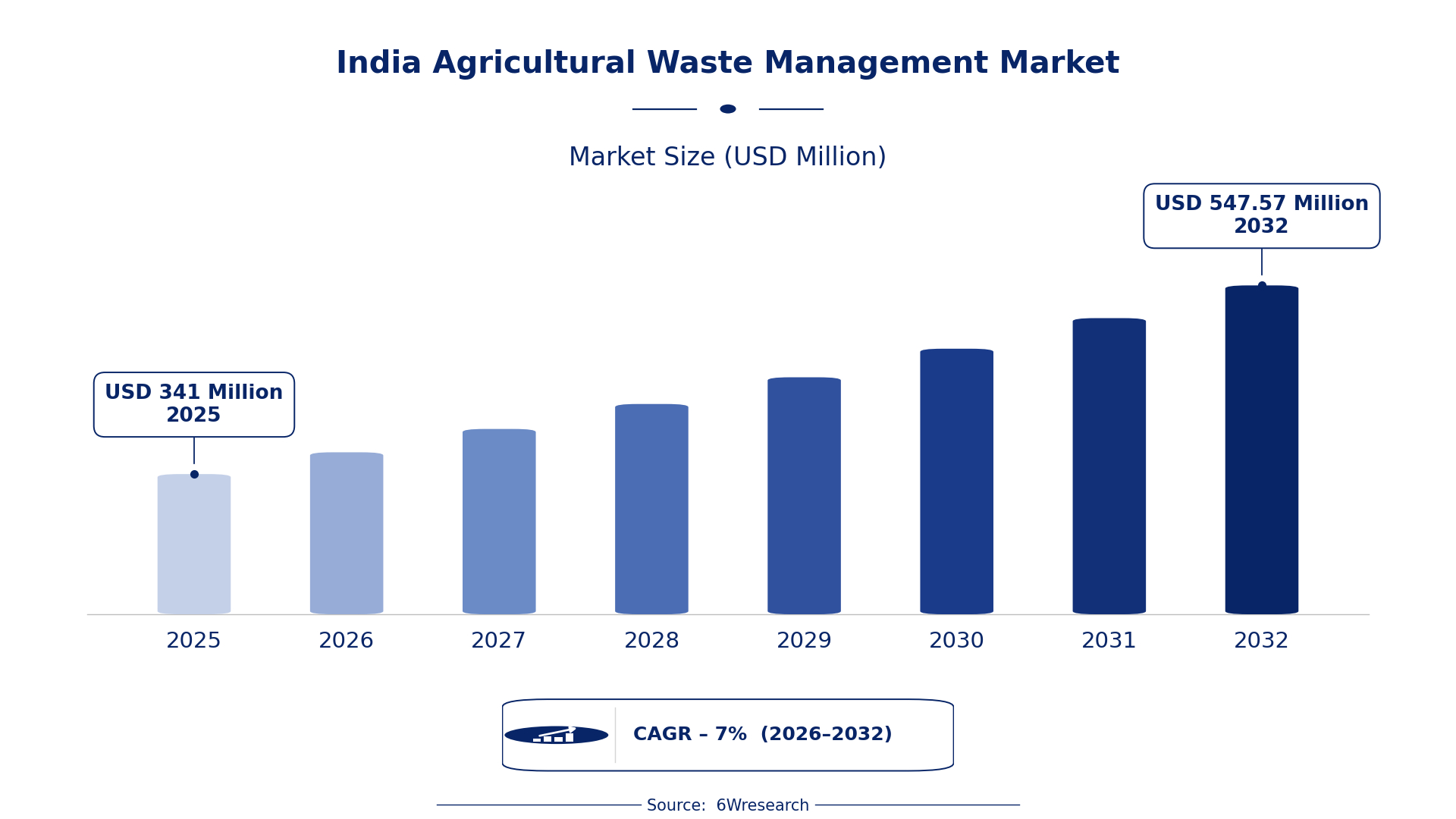
According to 6Wresearch internal database and industry insights, the India Agricultural Waste Management Market was valued at USD 341.0 million in 2025 and is projected to reach USD 547.57 million by 2032, growing at a CAGR of approximately 7% during 2026–2032.
India Agricultural Waste Management Market Highlights
| Report Metric | Details |
| Report Name | India Agricultural Waste Management Market |
| Market Size 2025 | USD 341.0 million |
| Market Size 2032 | USD 547.57 million |
| Absolute Growth 2025–2032 | USD 206.57 million |
| CAGR 2026–2032 | 7% |
| Peak Annual Growth | 9.3% in 2029 |
| Forecast Period | 2026–2032 |
| Historical Data | 2022–2025 |
| Base Year | 2025 |
| Leading Agricultural Waste Management Market, 2025 | Crop Residue (46% share) |
| Leading Waste Type, 2025 | Composting (46% share) |
| Leading Treatment Method, 2025 | Direct Sales (43% share) |
| Leading Distribution Channel, 2025 | Fertilizer Producers (49% share) |
| Fastest-Growing Agricultural Waste Management Market | Organic Waste (8.0% CAGR) |
| Fastest-Growing Waste Type | Biogas Generation (8.8% CAGR) |
| Fastest-Growing Treatment Method | Waste Management Firms (9.0% CAGR) |
| Growing Sector | Organic Fertilizers |
| Key End Users | Farmers, Fertilizer Producers, Waste Management Firms, Livestock Farms |
India Agricultural Waste Management Market Year-wise Growth Rate and Key Drivers (2022–2032)
This graph illustrates the annual growth rates of the market from 2022 to 2032, highlighting a steady upward trajectory and projected market expansion over the forecast period.
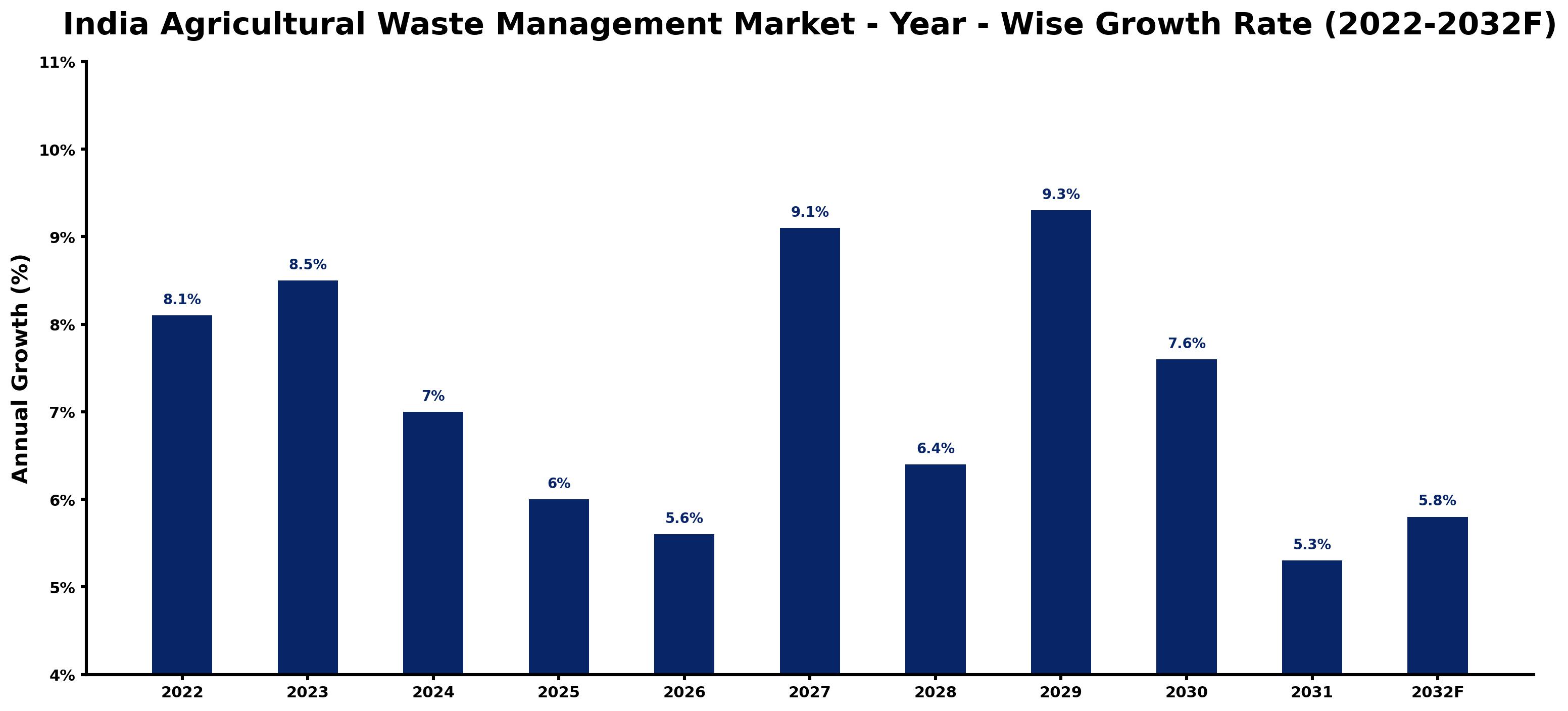
The following table presents the estimated annual growth rate for each year together with the principal factor influencing market performance.
| Year | Estimated Annual Growth (%) | Market Rationale |
| 2022 | 8.1 | The market experienced steady growth driven by increased awareness of waste management practices. |
| 2023 | 8.5 | Growth accelerated due to the implementation of the Pradhan Mantri Kisan Samman Nidhi Yojana promoting sustainable practices. |
| 2024 | 7.0 | A slowdown occurred as the market adjusted to the previous year's rapid expansion. |
| 2025 | 6.0 | Continued investment in waste management infrastructure contributed to further growth, albeit at a slower rate. |
| 2026 | 5.6 | The market is expected to face a slowdown as competition among waste management firms increases. |
| 2027 | 9.1 | A resurgence in growth is projected, driven by heightened demand for biogas production. |
| 2028 | 6.4 | The market is expected to slow as the focus shifts towards improving existing waste management systems. |
| 2029 | 9.3 | Peak growth is anticipated, supported by investments in biogas plants and composting facilities. |
| 2030 | 7.6 | Growth is projected to moderate as the market stabilises following peak levels of investment and activity. |
| 2031 | 5.3 | A further slowdown is expected, reflecting market adjustments after years of rapid expansion. |
| 2032 | 5.8 | The market is expected to grow as new initiatives for organic farming gain traction. |
Note: Market size estimations and growth projections presented in this report are based on 6Wresearch's proprietary forecasting methodology, utilizing the latest available industry data, government publications, and primary research inputs.
India Agricultural Waste Management Market Synopsis
The India Agricultural Waste Management Market encompasses the collection, treatment, and recycling of waste produced from agricultural activities. This includes processes such as composting, biogas generation, and safe disposal methods, primarily aimed at producing organic fertilisers and generating energy. The market is growing due to heightened domestic demand, government initiatives that encourage sustainable practices, and increasing awareness among farmers. Approximately 500 million tons of agricultural waste are generated each year, presenting opportunities for effective waste management solutions. Key buyer groups include fertiliser producers and livestock farms, who gain from these sustainable practices.
Market Dynamics Impact Analysis (2026–2032)
| Factor | Type | Impact | Primary Segment Affected |
| Government initiatives promoting sustainable practices are driving demand for efficient waste management solutions. | Driver | High | Composting |
| Growing awareness among farmers about the benefits of waste recycling is boosting market growth. | Driver | High | Biogas Generation |
| The increasing need for organic fertilizers presents an opportunity for suppliers to expand their offerings. | Opportunity | High | Organic Waste |
| The rising demand for energy from biogas generation creates new avenues for investment in waste management. | Opportunity | High | Animal Waste |
| Limited infrastructure for waste management hampers the growth of the market in rural areas. | Restraint | High | Chemical Waste |
| The high cost of setting up biogas plants restricts access for small farmers. | Restraint | Medium | Biogas Generation |
| The Agricultural Waste Management market in India faces challenges from inadequate technology adoption. | Challenge | High | Composting |
| Competition from informal waste management practices poses a threat to organized firms. | Challenge | Medium | Waste Management Firms |
Evaluation of Drivers in India Agricultural Waste Management Market (2026–2032)
Key forces behind demand, with the segment each one moves most, are listed below.
| Drivers | Primary Segment Affected | Why It Matters (Evidence) |
| Government support for biogas plants through subsidies. | Biogas Generation | The Indian government has allocated funds under the National Biogas and Manure Management Programme, promoting the installation of over 5 million biogas units. |
| Increased adoption of composting practices among farmers. | Composting | Over 30% of farmers in India practice composting, leading to higher demand for composting solutions. |
| Growing investment in sustainable agricultural practices. | Organic Waste | The National Biofuel Policy 2022 aims to increase the use of agricultural waste in biofuel production, improving energy security. |
| Rising demand for organic fertilizers derived from agricultural waste. | Fertilizer Producers | The Fertilizer Control Order regulates organic fertilizers, increasing their market presence and demand. |
| Implementation of the Pradhan Mantri Krishi Sinchai Yojana. | Crop Residue | This initiative promotes sustainable farming practices across various states, enhancing waste recycling. |
The adoption of composting practices among farmers has risen, with over 30% engaging in this method, leading to higher demand for composting solutions. The implementation of the Pradhan Mantri Krishi Sinchai Yojana further supports waste recycling efforts, promoting sustainable farming across various states. This combination of factors is enhancing the overall market dynamics.
Evaluation of Restraints in India Agricultural Waste Management Market
The following restraints limit how fast demand can grow.
| Market Restraint | Primary Segment Affected | Why It Matters (Evidence) |
| Limited infrastructure for waste management in rural areas. | Chemical Waste | Many rural regions lack adequate facilities for managing chemical waste, hindering effective disposal. |
| High costs associated with biogas plant installation. | Biogas Generation | Small farmers often cannot afford the initial investment required for biogas plants, limiting their participation. |
| Inadequate technology adoption among farmers. | Composting | Many farmers are unaware of advanced composting techniques, resulting in inefficient waste management practices. |
| Competition from informal waste management practices. | Waste Management Firms | Informal practices often undercut organized firms, affecting their market share and profitability. |
| Lack of awareness regarding the benefits of waste recycling. | Organic Waste | Many farmers do not fully understand the advantages of recycling agricultural waste, limiting demand. |
India Agricultural Waste Management Market Challenges
The India Agricultural Waste Management Market encounters supply chain inefficiencies, particularly in Punjab, where crop residue contributes to the annual generation of around 500 million tons of agricultural waste. This inefficiency leads to high disposal costs for farmers, restricting their ability to invest in effective waste management solutions. Intense competition among waste management firms results in price wars, diminishing profitability and hindering innovation. Furthermore, only 30% of farmers practice composting, highlighting a technological gap that delays effective recycling and limits the production of organic fertilisers, affecting overall sustainability efforts.
Trends in the India Agricultural Waste Management Market
Four trends stand out in the India Agricultural Waste Management Market.
- Shift towards Sustainable Practices in Punjab: Punjab is increasingly adopting sustainable agricultural waste management practices, with over 500 million tons of agricultural waste generated annually. This shift is driven by government initiatives and awareness campaigns.
- Emergence of Biogas as a Key Energy Source: Since 2022, biogas generation from agricultural waste has gained prominence, with over 5 million biogas plants installed. This trend highlights the growing recognition of biogas as a renewable energy source.
- Increased Adoption of Composting Techniques: The year 2023 marked a rise in composting practices among farmers, with over 30% engaging in this method. This shift supports soil enrichment and sustainable farming.
- Focus on Organic Fertilizers Gaining Momentum: Fertilizer Producers are increasingly prioritising organic fertilisers derived from agricultural waste, driven by the Fertilizer Control Order. This trend reflects the growing demand for sustainable farming inputs.
Investment Opportunities in the India Agricultural Waste Management Market
Several openings in the India Agricultural Waste Management Market merit attention from investors.
- Current Demand for Organic Fertilizers: With over 30% of farmers practising composting, there is an opportunity for suppliers of organic fertilisers to meet this demand. Engaging with Fertilizer Producers can facilitate market entry.
- Investment in Biogas Infrastructure: The installed base of over 5 million biogas plants indicates a growing need for biogas infrastructure. Suppliers can collaborate with Livestock Farms to enhance energy production from waste.
- Expanding Market for Composting Solutions: The increasing awareness of composting presents an opportunity for firms to supply composting equipment and services. Collaborating with Agricultural Contractors can enhance outreach efforts.
- Government Support for Sustainable Practices: The Pradhan Mantri Kisan Samman Nidhi Yojana provides financial support for sustainable practices, creating opportunities for firms to offer waste management solutions to farmers.
Government Initiatives in the India Agricultural Waste Management Market
The National Biofuel Policy 2022 aims to increase the use of agricultural waste in biofuel production, enhancing energy security and environmental sustainability. This policy supports the establishment of biogas plants, which are essential for converting agricultural waste into energy. The Pradhan Mantri Kisan Samman Nidhi Yojana, initiated by the Ministry of Agriculture in 2020, provides financial support to farmers for sustainable practices, including waste management. This measure encourages farmers to adopt effective waste management techniques, improving productivity and sustainability.
The Ministry of Agriculture oversees the implementation of the Pradhan Mantri Kisan Samman Nidhi Yojana, which funds sustainable agricultural practices. Additionally, the National Mission for Sustainable Agriculture promotes efficient waste management techniques to improve soil health and productivity. This mission supports various projects aimed at enhancing waste recycling and management across states, benefiting farmers and agricultural producers. The Swachh Bharat Mission also includes initiatives for managing agricultural waste, promoting cleanliness and sanitation in rural areas.
Future Insight of the India Agricultural Waste Management Market
By 2032, the India Agricultural Waste Management Market will undergo notable changes, influenced by several government initiatives. The National Policy on Biofuels aims to increase biogas generation, leveraging the existing base of over 5 million biogas plants to enhance energy production. Increased funding for organic farming practices will promote sustainable methods, while the Pradhan Mantri Krishi Sinchai Yojana will improve waste recycling efforts. The adoption of ISO 14001 standards will elevate environmental management practices, ensuring compliance and boosting competitiveness in the sector.
Market Segmentation Analysis
The report offers a comprehensive study of the following market segments and their leading categories in the market.
By Agricultural Waste Management Market – Crop Residue Dominated, Organic Waste Expected to Grow Fastest
According to Ravi Bhandari, Research Head at 6Wresearch, Crop Residue accounted for a 46% market share by agricultural waste management market in 2025. Crop residue holds the largest share in India due to its extensive use for mulching and soil management, particularly in Punjab, a significant contributor to agricultural waste. With the country generating approximately 500 million tons of agricultural waste annually, crop residue is integral to sustainable farming practices. Organic Waste is set to record the highest CAGR in this split, 8.0% over 2026–2032. Organic waste is experiencing rapid growth, with over 30% of farmers adopting composting techniques to enrich their soil. This trend is supported by government initiatives aimed at promoting organic farming practices across various states, ensuring a steady rise in demand. Suppliers should enhance their offerings in organic waste management to meet the increasing demand from farmers.
By Waste Type – Composting Dominated, Biogas Generation Expected to Grow Fastest
Composting took a 46% share of waste type in 2025, more than any other category. Composting is the leading waste type in India, as it serves as a primary method for recycling organic waste, allowing farmers to produce organic fertilizers efficiently. This method is widely embraced, supported by government policies that encourage sustainable agricultural practices. Over 2026–2032, Biogas Generation is expected to post the fastest growth, at a CAGR of 8.8%. Biogas generation is the fastest-growing segment, driven by the National Policy on Biofuels, which promotes energy production from agricultural waste. The installed base of biogas plants, exceeding 5 million units, indicates a strong shift towards renewable energy solutions in agriculture. Buyers should consider investing in biogas technologies to capitalise on the increasing energy demands and government support.
By Treatment Method – Direct Sales Dominated, Waste Management Firms Expected to Grow Fastest
Direct Sales held a 43% share of the India Agricultural Waste Management Market by treatment method in 2025. Direct sales lead the treatment method segment as they facilitate the sale of essential waste management products directly to farmers and businesses. This approach ensures that agricultural waste management solutions are readily accessible, promoting effective waste handling across the sector. Waste Management Firms are projected to grow fastest, at a CAGR of 9.0% during 2026–2032. Waste management firms are the fastest-growing treatment method, providing comprehensive services for managing and processing agricultural waste efficiently. Their significance is rising as the demand for sustainable waste solutions in agriculture continues to increase. Suppliers must align their strategies with waste management firms to capitalise on the growing market for efficient waste treatment solutions.
By Distribution Channel – Fertilizer Producers Dominated and Is Expected to Record the Fastest Growth
The largest distribution channel category in 2025 was Fertilizer Producers, with a 49% share of total revenue. Fertilizer producers dominate the distribution channel segment, utilising organic waste for fertilizer production, which is crucial for enhancing soil fertility. Their established networks enable efficient distribution of organic fertilizers derived from agricultural waste, solidifying their market share. Its lead should widen, with a projected CAGR of 8.2% during 2026–2032, the highest in this split. Fertilizer producers are also the fastest-growing distribution channel, driven by rising demand for organic fertilizers in line with sustainable farming practices. Their dual role as producers and distributors positions them advantageously in the market, ensuring continued growth. Buyers should engage with fertilizer producers to access high-quality organic fertilizers that meet their agricultural needs.
Key Attractiveness of the Report
- 10 Years of Market Numbers
- Historical Data Starting from 2022 to 2025
- Base Year 2025
- Forecast Data until 2032
- Key Performance Indicators Impacting the Market
- Major Upcoming Developments and Projects
Key Highlights of the Report:
- India Agricultural Waste Management Market Outlook
- Market Size of India Agricultural Waste Management Market, 2025
- Forecast of India Agricultural Waste Management Market, 2032
- Historical Data and Forecast of India Agricultural Waste Management Revenues & Volume for the Period 2022 - 2032F
- India Agricultural Waste Management Market Trend Evolution
- India Agricultural Waste Management Market Drivers and Challenges
- India Agricultural Waste Management Price Trends
- India Agricultural Waste Management Porter's Five Forces
- India Agricultural Waste Management Industry Life Cycle
- Historical Data and Forecast of India Agricultural Waste Management Market Revenues & Volume By Agricultural Waste Management Market for the Period 2022 - 2032F
- Historical Data and Forecast of India Agricultural Waste Management Market Revenues & Volume By Organic Waste for the Period 2022 - 2032F
- Historical Data and Forecast of India Agricultural Waste Management Market Revenues & Volume By Animal Waste for the Period 2022 - 2032F
- Historical Data and Forecast of India Agricultural Waste Management Market Revenues & Volume By Crop Residue for the Period 2022 - 2032F
- Historical Data and Forecast of India Agricultural Waste Management Market Revenues & Volume By Chemical Waste for the Period 2022 - 2032F
- Historical Data and Forecast of India Agricultural Waste Management Market Revenues & Volume By Waste Type for the Period 2022 - 2032F
- Historical Data and Forecast of India Agricultural Waste Management Market Revenues & Volume By Composting for the Period 2022 - 2032F
- Historical Data and Forecast of India Agricultural Waste Management Market Revenues & Volume By Biogas Generation for the Period 2022 - 2032F
- Historical Data and Forecast of India Agricultural Waste Management Market Revenues & Volume By Mulching for the Period 2022 - 2032F
- Historical Data and Forecast of India Agricultural Waste Management Market Revenues & Volume By Safe Disposal for the Period 2022 - 2032F
- Historical Data and Forecast of India Agricultural Waste Management Market Revenues & Volume By Treatment Method for the Period 2022 - 2032F
- Historical Data and Forecast of India Agricultural Waste Management Market Revenues & Volume By Direct Sales for the Period 2022 - 2032F
- Historical Data and Forecast of India Agricultural Waste Management Market Revenues & Volume By Equipment Dealers for the Period 2022 - 2032F
- Historical Data and Forecast of India Agricultural Waste Management Market Revenues & Volume By Online Platforms for the Period 2022 - 2032F
- Historical Data and Forecast of India Agricultural Waste Management Market Revenues & Volume By Waste Management Firms for the Period 2022 - 2032F
- Historical Data and Forecast of India Agricultural Waste Management Market Revenues & Volume By Distribution Channel for the Period 2022 - 2032F
- Historical Data and Forecast of India Agricultural Waste Management Market Revenues & Volume By Fertilizer Producers for the Period 2022 - 2032F
- Historical Data and Forecast of India Agricultural Waste Management Market Revenues & Volume By Livestock Farms for the Period 2022 - 2032F
- Historical Data and Forecast of India Agricultural Waste Management Market Revenues & Volume By Agri Contractors for the Period 2022 - 2032F
- Historical Data and Forecast of India Agricultural Waste Management Market Revenues & Volume By Agri Chem Producers for the Period 2022 - 2032F
- India Agricultural Waste Management Import Export Trade Statistics
- Market Opportunity Assessment By Agricultural Waste Management Market
- Market Opportunity Assessment By Waste Type
- Market Opportunity Assessment By Treatment Method
- Market Opportunity Assessment By Distribution Channel
- India Agricultural Waste Management Top Companies Market Share
- India Agricultural Waste Management Competitive Benchmarking By Technical and Operational Parameters
- India Agricultural Waste Management Company Profiles
- India Agricultural Waste Management Key Strategic Recommendations
Market Covered
The report offers an extensive study of the following market segments.
By Agricultural Waste Management Market
- Organic Waste
- Animal Waste
- Crop Residue
- Chemical Waste
By Waste Type
- Composting
- Biogas Generation
- Mulching
- Safe Disposal
By Treatment Method
- Direct Sales
- Equipment Dealers
- Online Platforms
- Waste Management Firms
By Distribution Channel
- Fertilizer Producers
- Livestock Farms
- Agri Contractors
- Agri Chem Producers































