India Agro Commodities Market Size & Growth Rate
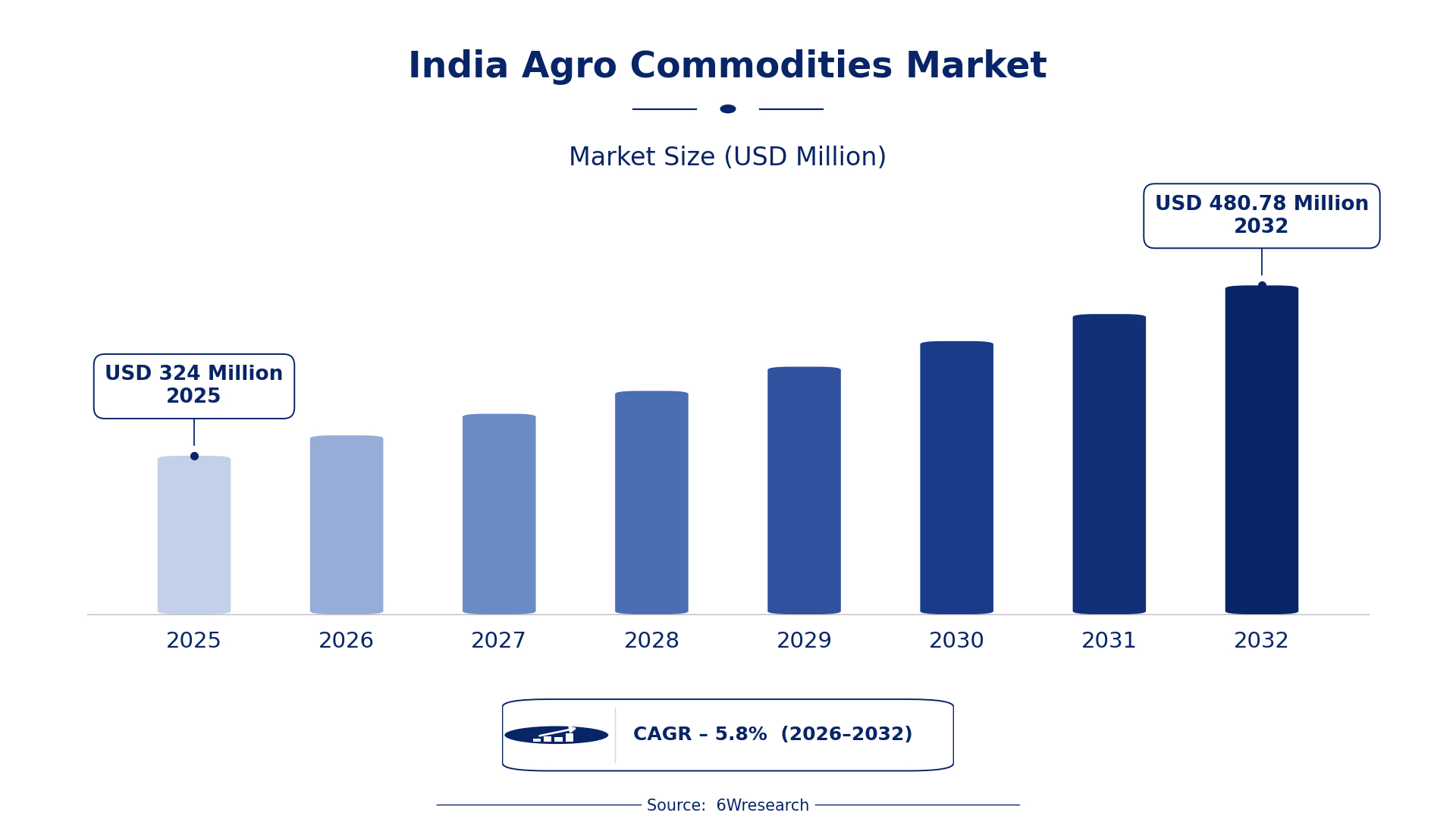
According to 6Wresearch internal database and industry insights, the India Agro Commodities Market was valued at USD 324.0 million in 2025 and is projected to reach USD 480.78 million by 2032, growing at a CAGR of approximately 5.8% during 2026–2032.
India Agro Commodities Market Highlights
| Report Metric | Details |
| Report Name | India Agro Commodities Market |
| Market Size 2025 | USD 324.0 million |
| Market Size 2032 | USD 480.78 million |
| Absolute Growth 2025–2032 | USD 156.78 million |
| CAGR 2026–2032 | 5.8% |
| Peak Annual Growth | 7.6% in 2031 |
| Forecast Period | 2026–2032 |
| Historical Data | 2022–2025 |
| Base Year | 2025 |
| Leading Commodity Type, 2025 | Wheat (51% share) |
| Leading Trade Form, 2025 | Raw Grains (45% share) |
| Leading Distribution Channel, 2025 | Mandis & Exchanges (38% share) |
| Leading End User, 2025 | Food Processing Companies (43% share) |
| Fastest-Growing Commodity Type | Spices (7.4% CAGR) |
| Fastest-Growing Trade Form | Whole/Dried (6.9% CAGR) |
| Fastest-Growing Distribution Channel | Export Houses (7.5% CAGR) |
| Fastest-Growing End User | International Retail Chains (7.6% CAGR) |
| Growing Sector | Food Processing |
| Key End Users | Food Processing Companies, Export Houses, Retail Consumers |
India Agro Commodities Market Year-wise Growth Rate and Key Drivers (2022–2032)
This graph illustrates the annual growth rates of the market from 2022 to 2032, highlighting a steady upward trajectory and projected market expansion over the forecast period.
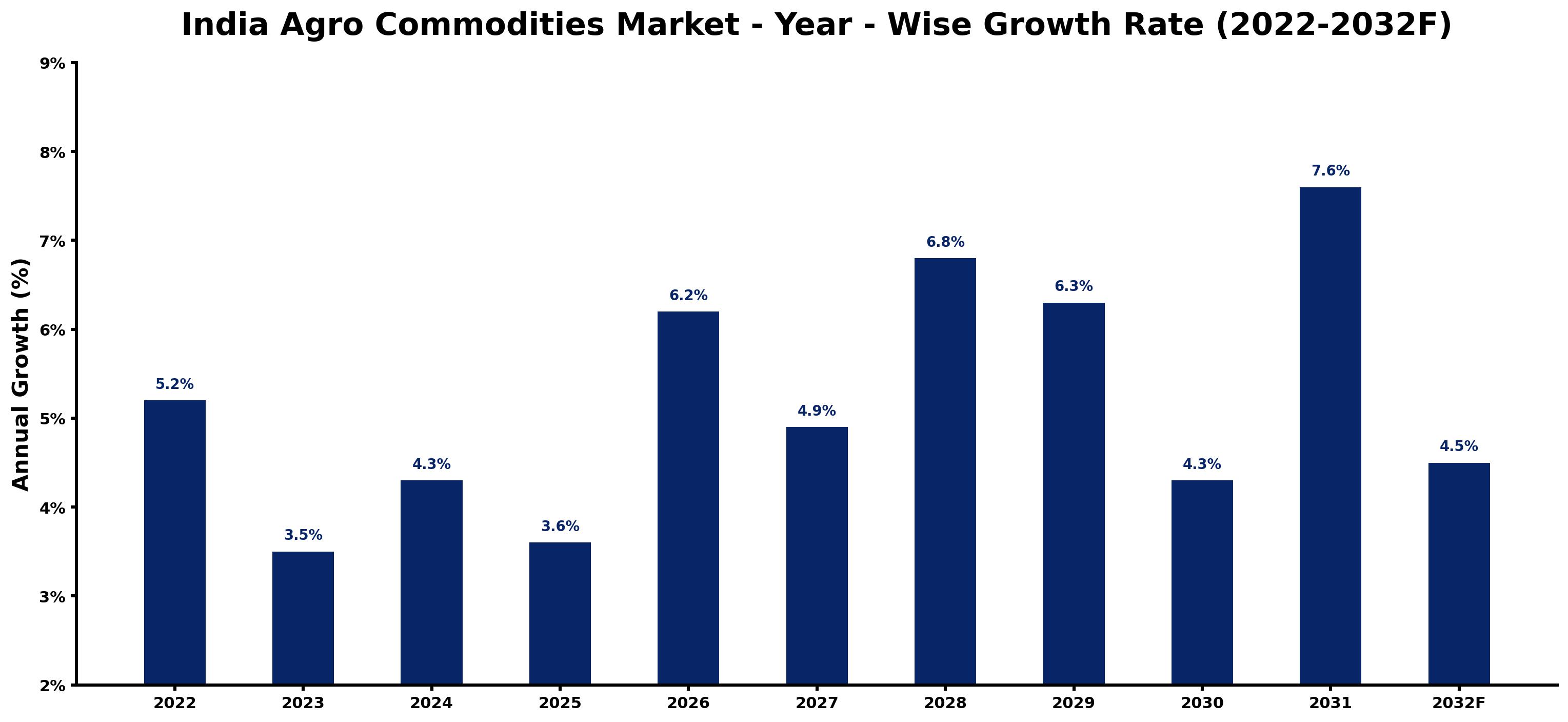
Year by year, the estimates below pair each growth rate with the development that shaped it.
| Year | Estimated Annual Growth (%) | Market Rationale |
| 2022 | 5.2 | The market experienced steady growth due to strong domestic demand for food commodities. |
| 2023 | 3.5 | Growth slowed as adverse weather conditions affected agricultural output in several regions. |
| 2024 | 4.3 | An increase in food processing activities spurred demand for agro commodities. |
| 2025 | 3.6 | Market growth slowed again as inflationary pressures impacted consumer spending. |
| 2026 | 6.2 | Demand surged with the launch of new agricultural support schemes boosting farmer incomes. |
| 2027 | 4.9 | A slight slowdown occurred as market adjustments took place following rapid growth. |
| 2028 | 6.8 | Increased exports of spices contributed to a rebound in market growth. |
| 2029 | 6.3 | Growth slowed as the market stabilised after a period of rapid expansion. |
| 2030 | 4.3 | Demand moderated as the market adjusted to changing consumer preferences. |
| 2031 | 7.6 | The peak growth year saw a surge in demand driven by food processing expansion. |
| 2032 | 4.5 | Growth slowed as the market reached a more sustainable pace following peak demand. |
Note: Market size estimations and growth projections presented in this report are based on 6Wresearch's proprietary forecasting methodology, utilizing the latest available industry data, government publications, and primary research inputs.
India Agro Commodities Market Synopsis
The Agro Commodities Market in India includes raw agricultural products such as grains, pulses, and oilseeds, which are crucial for food processing and export. This market is expanding due to rising domestic demand, especially from the food processing sector. With India's population expected to hit 1.5 billion by 2030, the need for food commodities is growing rapidly. The Food Processing Industry is projected to reach $470 billion by 2025, further increasing the demand for agro commodities. Government initiatives like the Pradhan Mantri Kisan Samman Nidhi scheme support farmers and improve production capabilities.
Market Dynamics Impact Analysis (2026–2032)
| Factor | Type | Impact | Primary Segment Affected |
| Strong domestic demand for food processing drives purchases of raw grains. | Driver | High | Raw Grains |
| Rising international demand for spices boosts exports. | Driver | High | Spices |
| Increased agricultural exports are creating opportunities for commodity brokers. | Opportunity | High | Export Houses |
| The rise of e-commerce is expanding distribution channels for agro commodities. | Opportunity | Medium | E-commerce & Warehouses |
| High compliance costs for food safety standards can limit market entry. | Restraint | High | Oilseeds |
| Market volatility can deter investments in agro commodities. | Restraint | Medium | Spices |
| Weather fluctuations can disrupt production and affect supply chains. | Challenge | High | Pulses |
| Labour shortages in agriculture can hinder production capabilities. | Challenge | Medium | Wheat |
Evaluation of Drivers in India Agro Commodities Market (2026–2032)
The main growth drivers and the segments they affect most are set out below.
| Drivers | Primary Segment Affected | Why It Matters (Evidence) |
| Growing food processing sector increases demand for raw grains. | Raw Grains | The Food Processing Industry is expected to reach $470 billion by 2025, driving demand for raw materials. |
| Rising international demand for spices boosts exports. | Spices | In 2022, India exported spices worth over $3 billion, increasing purchases from exporters. |
| Government support for farmers boosts production of oilseeds. | Oilseeds | The National Mission on Oilseeds and Oil Palm aims to increase domestic oilseed production by 2025. |
| Increasing population drives demand for pulses as a protein source. | Pulses | India's population is projected to reach 1.5 billion by 2030, increasing the demand for protein-rich foods. |
| Expansion of online trading platforms facilitates market access. | E-commerce & Warehouses | The National Agriculture Market (eNAM) facilitates online trading of agro commodities across states. |
The Food Processing Industry is anticipated to reach $470 billion by 2025, driving the need for raw grains. In 2022, India exported spices valued at over $3 billion, leading to higher purchases from exporters. The National Mission on Oilseeds and Oil Palm aims to boost domestic oilseed production by 2025, further increasing demand. Population growth in India will also elevate the need for protein-rich pulses.
Evaluation of Restraints in India Agro Commodities Market
The main factors holding the market back are set out below.
| Market Restraint | Primary Segment Affected | Why It Matters (Evidence) |
| High compliance costs for food safety standards can limit market entry. | Oilseeds | The Food Safety and Standards Authority of India (FSSAI) regulates food safety standards, increasing compliance costs. |
| Weather fluctuations can disrupt agricultural output and supply chains. | Pulses | Adverse weather conditions in certain regions can lead to reduced pulse production. |
| Market volatility can deter investments in agro commodities. | Spices | Fluctuating prices can create uncertainty for investors in the spice market. |
| High transportation costs can affect pricing and access to markets. | Food Processing Companies | Rising fuel prices increase logistics costs, impacting the final product pricing. |
| Limited access to modern farming technology can restrict productivity. | Wheat | Many farmers still rely on traditional methods, limiting yield potential. |
India Agro Commodities Market Challenges
The India Agro Commodities Market faces several practical problems, starting with a skills shortage among farmers. Many agricultural workers lack training in modern farming techniques, leading to lower yields and affecting food supply for 800 million people dependent on subsidised grains. Technology adoption presents another challenge, as outdated practices result in a 20% gap in potential output for suppliers. Local producers also contend with intense competition from international markets, which can cause price volatility that reduces profit margins by up to 15%. Regulatory compliance with the Food Safety and Standards Authority complicates operations, often delaying product approvals and hindering market entry for new suppliers.
Trends in the India Agro Commodities Market
Several trends are reshaping the India Agro Commodities Market; the most important are set out below.
- Shift towards E-commerce for Agro Commodities: In 2023, the rise of e-commerce platforms is changing how agro commodities are traded. The National Agriculture Market (eNAM) enables online trading across states, enhancing market access for farmers.
- Growing Demand for Organic Agro Commodities: Food Processing Companies are increasingly sourcing organic agro commodities to align with consumer preferences. The organic market has expanded, with a marked increase in demand for organic pulses and grains.
- Increase in Export of Spices: Since 2022, India has experienced a surge in spice exports, with black pepper and cardamom leading the market. The export value surpassed $3 billion, reflecting rising international demand.
- Focus on Sustainable Farming Practices: The year 2023 saw a shift towards sustainable farming practices among farmers. Initiatives like the Pradhan Mantri Kisan Samman Nidhi scheme encourage eco-friendly farming methods.
Investment Opportunities in the India Agro Commodities Market
Some of the investment opportunities in the India Agro Commodities Market are mentioned below.
- Investment in Modern Farming Equipment: With the agricultural sector employing nearly 42% of the workforce, there is an opportunity to supply modern farming equipment. The projected growth in agricultural productivity can drive demand for advanced machinery.
- Supply of Organic Agro Commodities: As consumer preferences shift towards organic products, there is a gap in the supply of organic agro commodities. Food Processing Companies are increasingly looking for organic grains and pulses.
- Expansion of Export Capabilities: The government aims for $5 billion in agricultural exports by 2025, creating opportunities for exporters. Collaborating with local partners can facilitate entry into international markets.
- Development of E-commerce Platforms: The rise of e-commerce is creating opportunities for suppliers to reach broader markets. Investing in technology and partnerships with online platforms can improve distribution.
Government Initiatives in the India Agro Commodities Market
The Pradhan Mantri Kisan Samman Nidhi scheme, launched in 2023, offers income support to farmers, improving their financial stability. This initiative builds on the National Food Security Act, 2013, which aims to ensure food security for around 800 million people in India. Together, these measures strengthen the agricultural sector and support agro commodities production.
In 2023, the Agricultural and Processed Food Products Export Development Authority (APEDA) approved funding for various agricultural projects. This agency plays a crucial role in supporting the export of agricultural products, facilitating international trade and improving market access for Indian farmers.
Future Insight of the India Agro Commodities Market
The India Agro Commodities Market is poised for substantial changes by 2032, driven by advancements in agricultural practices. The National Mission on Oilseeds and Oil Palm aims to enhance domestic oilseed production, addressing the growing need for edible oils. By 2025, agricultural exports are projected to reach $5 billion, creating new opportunities for suppliers. The Pradhan Mantri Kisan Samman Nidhi scheme will continue to provide vital income support to farmers, promoting stability and encouraging increased agricultural output.
Market Segmentation Analysis
The report offers a comprehensive study of the following market segments and their leading categories in the market.
By Commodity Type – Wheat Dominated, Spices Expected to Grow Fastest
According to Ravi Bhandari, Research Head at 6Wresearch, Wheat took a 51% share of commodity type in 2025, more than any other category. Wheat holds the largest market share as it is extensively used in food production and animal feed, with India being the second-largest global producer. The National Food Security Act guarantees a steady demand for wheat, addressing the needs of around 800 million people in India. Over 2026–2032, Spices are expected to post the fastest growth, at a CAGR of 7.4%. Spices are experiencing rapid growth due to increasing global demand, with India exporting spices worth over $3 billion in 2022. The culinary popularity of Indian spices is driving this surge, solidifying their market position. Suppliers should focus on expanding their spice offerings to capitalise on the growing export opportunities.
By Trade Form – Raw Grains Dominated, Whole/Dried Expected to Grow Fastest
With a 45% revenue share in 2025, Raw Grains was the largest trade form category. Raw Grains hold the largest market share due to their critical role as essential ingredients in various food products, ensuring consistent demand across sectors. Their widespread use in staple foods reinforces their position in the agro commodities market. Whole/Dried is set to record the highest CAGR in this split, 6.9% over 2026–2032. Whole/Dried products are experiencing rapid growth, fuelled by a shift towards healthier cooking practices and food processing. This trend is highlighted by the increasing consumer preference for minimally processed ingredients, which enhances their appeal in the market. Buyers should prioritise sourcing whole/dried products to align with the rising consumer demand for healthier food options.
By Distribution Channel – Mandis & Exchanges Dominated, Export Houses Expected to Grow Fastest
Mandis & Exchanges held a 38% share of the India Agro Commodities Market by distribution channel in 2025. Mandis & Exchanges dominate the market share as the primary trading platforms for agro commodities, facilitating essential transactions between farmers and buyers. Their established infrastructure supports a reliable supply chain for a diverse range of agricultural products. Export Houses are projected to grow fastest, at a CAGR of 7.5% during 2026–2032. Export Houses are rapidly gaining traction due to heightened focus on international trade, with the government targeting $5 billion in agricultural exports by 2025. This growth is driven by the increasing global demand for Indian agro commodities, enhancing their market presence. Suppliers should strengthen collaborations with export houses to capitalise on international market opportunities.
By End User – Food Processing Companies Dominated, International Retail Chains Expected to Grow Fastest
In 2025, Food Processing Companies led the end user split with a 43% share. Food Processing Companies represent the largest market share as they are the primary consumers of raw agricultural materials, essential for producing a wide array of food products. Their pivotal role in the food supply chain guarantees a steady demand for agro commodities. The quickest growth will come from International Retail Chains, forecast to expand at a CAGR of 7.6% between 2026 and 2032. International Retail Chains are expanding swiftly, propelled by the growing consumer interest in diverse product offerings worldwide. Their rapid growth reflects an increasing demand for international food products, thereby enhancing their purchasing power in the market. Suppliers should adapt their product offerings to cater to the specific requirements of international retail chains to maximise their market reach.
Key Attractiveness of the Report
- 10 Years of Market Numbers
- Historical Data Starting from 2022 to 2025
- Base Year 2025
- Forecast Data until 2032
- Key Performance Indicators Impacting the Market
- Major Upcoming Developments and Projects
Key Highlights of the Report:
- India Agro Commodities Market Outlook
- Market Size of India Agro Commodities Market, 2025
- Forecast of India Agro Commodities Market, 2032
- Historical Data and Forecast of India Agro Commodities Revenues & Volume for the Period 2022 - 2032F
- India Agro Commodities Market Trend Evolution
- India Agro Commodities Market Drivers and Challenges
- India Agro Commodities Price Trends
- India Agro Commodities Porter's Five Forces
- India Agro Commodities Industry Life Cycle
- Historical Data and Forecast of India Agro Commodities Market Revenues & Volume By Commodity Type for the Period 2022 - 2032F
- Historical Data and Forecast of India Agro Commodities Market Revenues & Volume By Wheat for the Period 2022 - 2032F
- Historical Data and Forecast of India Agro Commodities Market Revenues & Volume By Spices for the Period 2022 - 2032F
- Historical Data and Forecast of India Agro Commodities Market Revenues & Volume By Oilseeds for the Period 2022 - 2032F
- Historical Data and Forecast of India Agro Commodities Market Revenues & Volume By Pulses for the Period 2022 - 2032F
- Historical Data and Forecast of India Agro Commodities Market Revenues & Volume By Trade Form for the Period 2022 - 2032F
- Historical Data and Forecast of India Agro Commodities Market Revenues & Volume By Raw Grains for the Period 2022 - 2032F
- Historical Data and Forecast of India Agro Commodities Market Revenues & Volume By Whole/Dried for the Period 2022 - 2032F
- Historical Data and Forecast of India Agro Commodities Market Revenues & Volume By Crushed/Refined for the Period 2022 - 2032F
- Historical Data and Forecast of India Agro Commodities Market Revenues & Volume By Packed Grains for the Period 2022 - 2032F
- Historical Data and Forecast of India Agro Commodities Market Revenues & Volume By Distribution Channel for the Period 2022 - 2032F
- Historical Data and Forecast of India Agro Commodities Market Revenues & Volume By Mandis & Exchanges for the Period 2022 - 2032F
- Historical Data and Forecast of India Agro Commodities Market Revenues & Volume By Export Houses for the Period 2022 - 2032F
- Historical Data and Forecast of India Agro Commodities Market Revenues & Volume By Commodity Brokers for the Period 2022 - 2032F
- Historical Data and Forecast of India Agro Commodities Market Revenues & Volume By E-commerce & Warehouses for the Period 2022 - 2032F
- Historical Data and Forecast of India Agro Commodities Market Revenues & Volume By End User for the Period 2022 - 2032F
- Historical Data and Forecast of India Agro Commodities Market Revenues & Volume By Food Processing Companies for the Period 2022 - 2032F
- Historical Data and Forecast of India Agro Commodities Market Revenues & Volume By International Retail Chains for the Period 2022 - 2032F
- Historical Data and Forecast of India Agro Commodities Market Revenues & Volume By Edible Oil Manufacturers for the Period 2022 - 2032F
- Historical Data and Forecast of India Agro Commodities Market Revenues & Volume By Retail Consumers for the Period 2022 - 2032F
- India Agro Commodities Import Export Trade Statistics
- Market Opportunity Assessment By Commodity Type
- Market Opportunity Assessment By Trade Form
- Market Opportunity Assessment By Distribution Channel
- Market Opportunity Assessment By End User
- India Agro Commodities Top Companies Market Share
- India Agro Commodities Competitive Benchmarking By Technical and Operational Parameters
- India Agro Commodities Company Profiles
- India Agro Commodities Key Strategic Recommendations
Market Covered
Segments analysed in this report are listed below.
By Commodity Type
- Wheat
- Spices
- Oilseeds
- Pulses
By Trade Form
- Raw Grains
- Whole/Dried
- Crushed/Refined
- Packed Grains
By Distribution Channel
- Mandis & Exchanges
- Export Houses
- Commodity Brokers
- E-commerce & Warehouses
By End User
- Food Processing Companies
- International Retail Chains
- Edible Oil Manufacturers
- Retail Consumers































