India Agrochemical Ingredients Market Size & Growth Rate
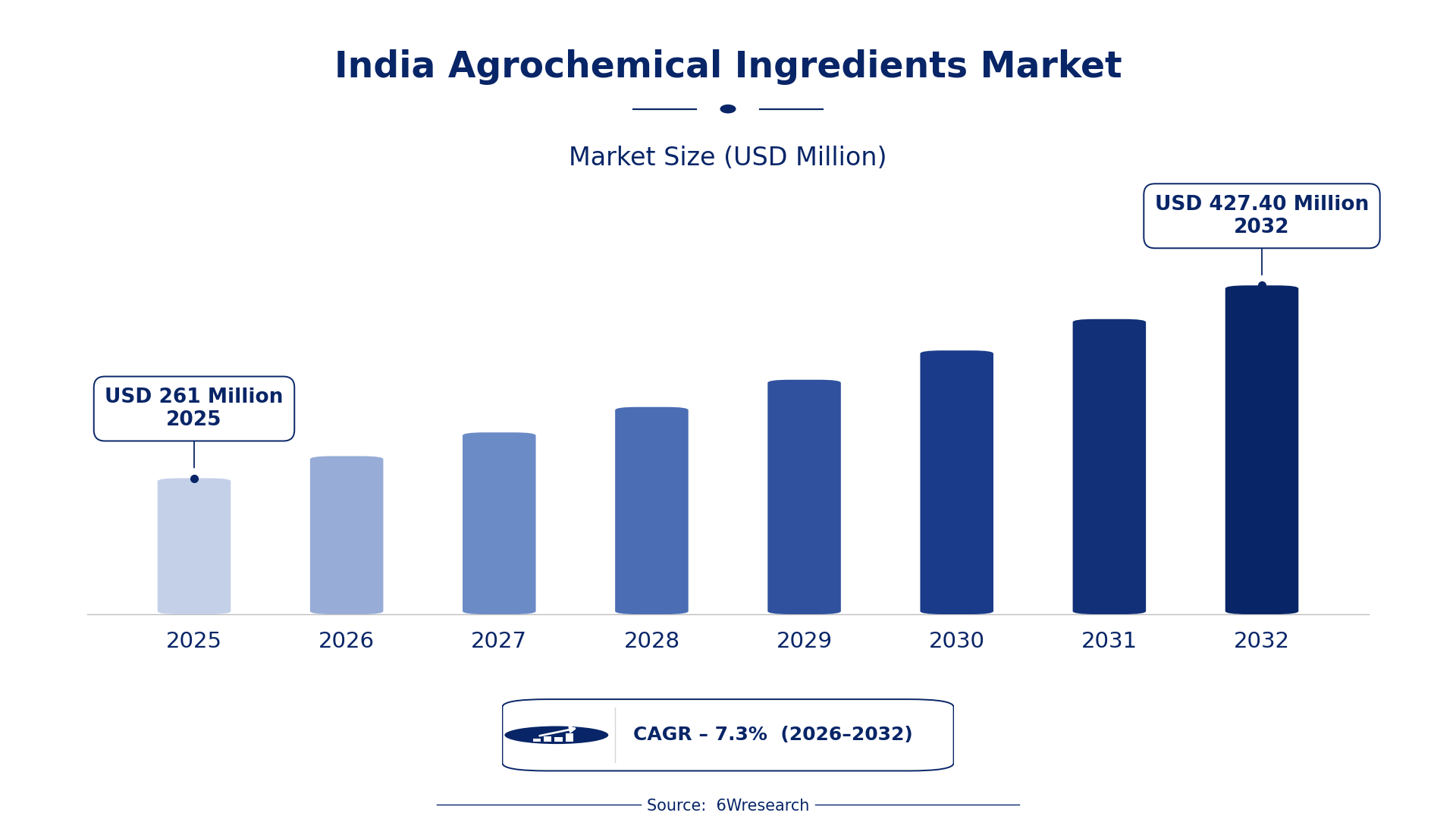
According to 6Wresearch internal database and industry insights, the India Agrochemical Ingredients Market was valued at USD 261.0 million in 2025 and is projected to reach USD 427.40 million by 2032, growing at a CAGR of approximately 7.3% during 2026–2032.
India Agrochemical Ingredients Market Highlights
| Report Metric | Details |
| Report Name | India Agrochemical Ingredients Market |
| Market Size 2025 | USD 261.0 million |
| Market Size 2032 | USD 427.40 million |
| Absolute Growth 2025–2032 | USD 166.40 million |
| CAGR 2026–2032 | 7.3% |
| Peak Annual Growth | 9.0% in 2031 |
| Forecast Period | 2026–2032 |
| Historical Data | 2022–2025 |
| Base Year | 2025 |
| Leading Ingredient Type, 2025 | Surfactants (47% share) |
| Leading Usage Area, 2025 | Herbicide Blends (45% share) |
| Leading Distribution Channel, 2025 | Industrial Suppliers (38% share) |
| Leading End User, 2025 | Pesticide Manufacturers (38% share) |
| Fastest-Growing Ingredient Type | Solvents (8.6% CAGR) |
| Fastest-Growing Usage Area | Liquid Formulations (9.9% CAGR) |
| Fastest-Growing Distribution Channel | Direct Sales (8.9% CAGR) |
| Fastest-Growing End User | Agrochemical Blenders (9.8% CAGR) |
| Growing Sector | Agrochemical Blenders |
| Key End Users | Pesticide Manufacturers, Agrochemical Blenders, Crop Protection Firms, Foliar Spray Producers |
India Agrochemical Ingredients Market Year-wise Growth Rate and Key Drivers (2022–2032)
This graph illustrates the annual growth rates of the market from 2022 to 2032, highlighting a steady upward trajectory and projected market expansion over the forecast period.
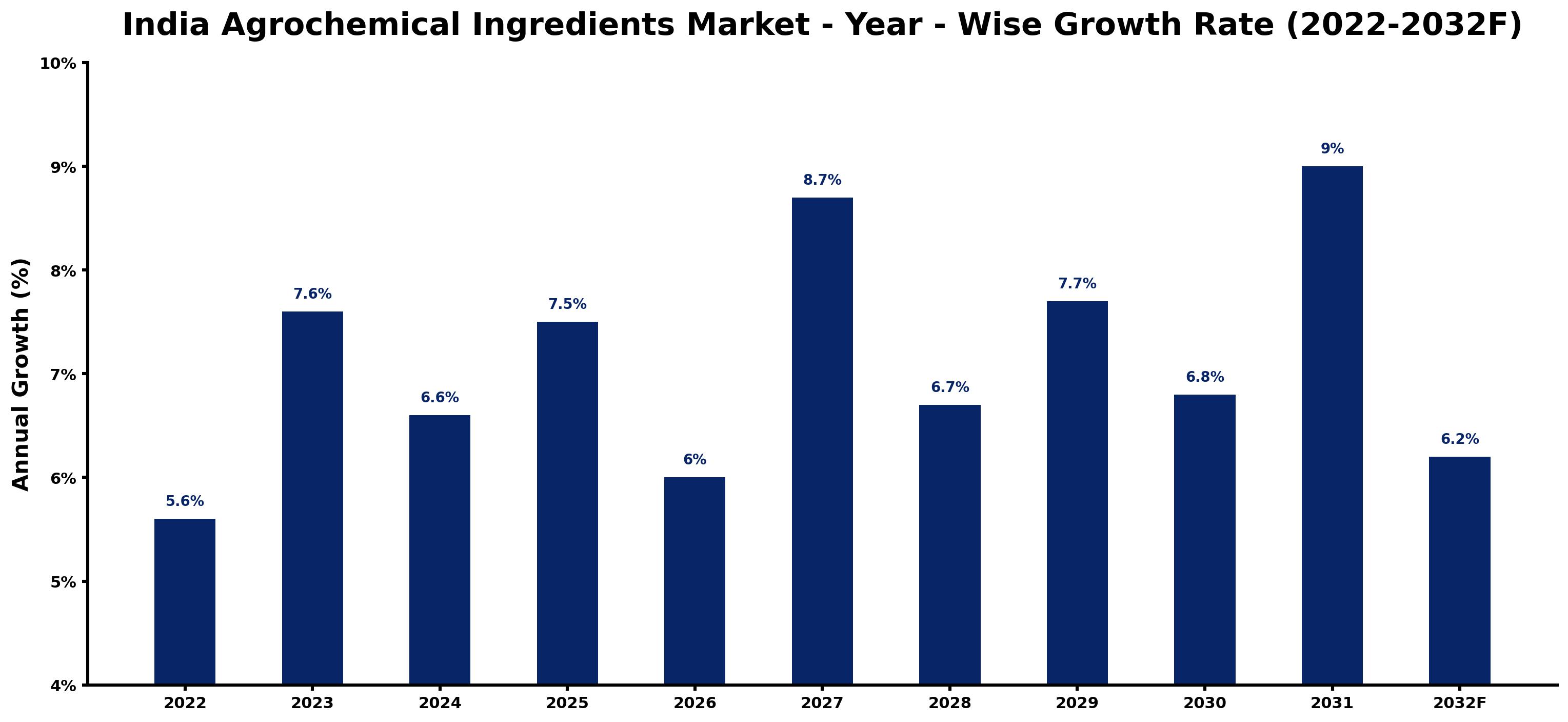
Annual growth estimates for each year appear below with the principal reason behind them, explaining the shifts that set the pace of the market.
| Year | Estimated Annual Growth (%) | Market Rationale |
| 2022 | 5.6 | The market experienced steady growth, driven by increased agricultural activity and demand for crop protection. |
| 2023 | 7.6 | Growth accelerated due to the implementation of the Pesticides Management Bill and rising exports. |
| 2024 | 6.6 | The market saw a slowdown as manufacturers adjusted to regulatory changes affecting production. |
| 2025 | 7.5 | Demand increased as pesticide manufacturers sought effective formulations for diverse crops. |
| 2026 | 6.0 | Growth is expected to slow as producers face challenges in sourcing raw materials amid rising costs. |
| 2027 | 8.7 | The market is projected to rebound with higher demand for eco-friendly agrochemical solutions and formulations. |
| 2028 | 6.7 | Growth is expected to decelerate as market saturation begins to impact new product introductions. |
| 2029 | 7.7 | Increased adoption of sustainable practices is expected to boost demand for eco-friendly agrochemical ingredients. |
| 2030 | 6.8 | The market is projected to slow as competition intensifies among local manufacturers and suppliers. |
| 2031 | 9.0 | Demand is expected to surge as new agricultural initiatives promote the use of advanced agrochemical technologies. |
| 2032 | 6.2 | Growth is projected to slow as the market stabilises following rapid expansions in previous years. |
Note: Market size estimations and growth projections presented in this report are based on 6Wresearch's proprietary forecasting methodology, utilizing the latest available industry data, government publications, and primary research inputs.
India Agrochemical Ingredients Market Synopsis
The Agrochemical Ingredients Market in India includes chemical compounds used in pesticides and fertilizers, produced through synthesis or extraction. These ingredients protect plants from pests and diseases while improving crop yield. The India Agrochemical Ingredients Market is expanding due to increasing agricultural demands and export opportunities, with India exporting agrochemicals worth 2.5 billion USD in 2022. The National Mission on Sustainable Agriculture and the Pesticides Management Bill are influencing industry standards and practices, driving further demand. Key buyers encompass pesticide manufacturers and agrochemical blenders, who are looking for effective formulations to boost productivity.
Market Dynamics Impact Analysis (2026–2032)
| Factor | Type | Impact | Primary Segment Affected |
| Rising agricultural productivity through advanced formulations | Driver | High | Herbicide Blends |
| Increased export opportunities for agrochemical products | Driver | High | Pesticide Manufacturers |
| Growing demand for eco-friendly agrochemical solutions | Opportunity | High | Liquid Formulations |
| Investment in research and development for innovative agrochemicals | Opportunity | High | Agrochemical Blenders |
| Regulatory compliance costs affecting production efficiency | Restraint | High | Surfactants |
| Limited access to advanced technologies for small manufacturers | Restraint | Medium | Chelating Agents |
| The Agrochemical Ingredients market in India faces significant regulatory hurdles | Challenge | High | Emulsifiers |
| Competition from alternative pest control methods is increasing | Challenge | Medium | Insecticides |
Evaluation of Drivers in India Agrochemical Ingredients Market (2026–2032)
The table below links each growth driver to the segment it affects and the evidence for it.
| Drivers | Primary Segment Affected | Why It Matters (Evidence) |
| Increased agricultural productivity through effective formulations | Herbicide Blends | Production in Maharashtra contributes significantly, driving demand as farmers seek solutions to improve yields. |
| Rising export opportunities for agrochemical products | Pesticide Manufacturers | India's agrochemical exports reached 2.5 billion USD in 2022, prompting manufacturers to boost production. |
| Growing demand for eco-friendly agrochemical solutions | Liquid Formulations | The National Mission on Sustainable Agriculture promotes sustainable practices, increasing purchases of organic-compatible products. |
| Investment in research and development for new agrochemicals | Agrochemical Blenders | The government allocated 500 million INR for research in agrochemical technologies, encouraging product development. |
| Expansion of distribution channels through direct sales | Direct Sales | With a projected 8.9% CAGR, direct sales are becoming a preferred channel for reaching end-users effectively. |
The Agrochemical Ingredients market in India is growing on the back of rising agricultural productivity, increased export opportunities and investment in new formulations. The state of Maharashtra serves as a major hub for agrochemical manufacturing, contributing to the sector's growth. In 2022, agrochemical exports reached 2.5 billion USD, prompting manufacturers to scale up production. As a result, pesticide manufacturers are increasingly seeking effective formulations to improve crop yields and meet evolving market demands.
Evaluation of Restraints in India Agrochemical Ingredients Market
The table below lists the restraints and the evidence behind each.
| Market Restraint | Primary Segment Affected | Why It Matters (Evidence) |
| Regulatory compliance costs affecting production efficiency | Surfactants | Compliance with the Pesticides Management Bill increases operational costs for manufacturers, impacting pricing strategies. |
| Limited access to advanced technologies for small manufacturers | Chelating Agents | Smaller firms struggle to invest in new technologies, limiting their ability to compete effectively. |
| Market saturation leading to intensified competition | Emulsifiers | As more players enter the market, profit margins are pressured, affecting sustainability for existing firms. |
| High raw material costs impacting pricing strategies | Insecticides | Rising costs of key ingredients force manufacturers to raise prices, potentially reducing demand. |
| Stringent quality standards limiting market entry | Liquid Formulations | The Bureau of Indian Standards enforces strict regulations, making it challenging for new entrants. |
India Agrochemical Ingredients Market Challenges
In the India Agrochemical Ingredients Market, buyers contend with rising costs stemming from fluctuating raw material prices, which can inflate production expenses by up to 15% for manufacturers. Suppliers in Maharashtra face supply chain disruptions due to regional concentration, resulting in delays that can extend lead times by three weeks. Compliance with the Fertilizer Control Order adds further burdens, slowing product launches and costing suppliers potential revenue losses of 10% annually. Growing competition from organic alternatives, propelled by the government's new organic farming scheme, pressures producers to adjust, risking market share in traditional agrochemical sales.
Trends in the India Agrochemical Ingredients Market
Four trends stand out in the India Agrochemical Ingredients Market.
- Shift towards Organic Agrochemical Solutions: The Indian agrochemical market is increasingly leaning towards organic solutions, driven by consumer demand for sustainable farming. The government’s 2023 initiative promoting organic farming is set to reshape product formulations, with a projected investment of 500 million INR.
- Increase in Direct Sales Channels: Direct sales channels are gaining momentum, with an expected share of 38% in 2025. This shift enables pesticide manufacturers to connect directly with farmers, improving distribution efficiency and market reach.
- Emergence of Eco-Friendly Formulations: The trend towards eco-friendly formulations began with the National Mission on Sustainable Agriculture in 2020. This initiative encourages the development of sustainable agrochemical products, creating new market opportunities.
- Growing Use of Digital Platforms for Sales: Digital platforms for purchasing agrochemicals are becoming more common, facilitating transactions between suppliers and end-users. The rise of online trade channels is transforming distribution, with significant growth anticipated.
Investment Opportunities in the India Agrochemical Ingredients Market
Investors looking at the India Agrochemical Ingredients Market should consider the following areas.
- Investment in Agrochemical R&D Facilities: Maharashtra is becoming a hub for agrochemical R&D, with significant investment opportunities. The government’s allocation of 500 million INR for research presents a chance for partnerships and innovation.
- Expansion of Organic Fertilizer Production: With the government’s subsidy program for organic fertilizers, there is a growing opportunity for manufacturers to diversify their product lines. This shift is important for pesticide manufacturers seeking sustainable alternatives.
- Development of Sustainable Agrochemical Products: The rising demand for eco-friendly solutions presents a lucrative opportunity for agrochemical blenders. Collaborating with research institutions can improve product offerings and market competitiveness.
- Growth in Direct Sales Channels: The increasing share of direct sales channels offers opportunities for manufacturers to engage directly with end-users. Establishing partnerships with local distributors can facilitate market entry.
Government Initiatives in the India Agrochemical Ingredients Market
The Pesticides Management Bill, 2020, regulates the manufacturing and sale of agrochemicals, ensuring safety and efficacy. This law mandates producers to adhere to strict quality standards, impacting their operational practices. Additionally, the Soil Health Card Scheme, administered by the Ministry of Agriculture, provides farmers with tailored recommendations for agrochemical usage, improving their decision-making. This scheme has benefitted millions of farmers by enhancing soil health and crop productivity.
The National Mission on Sustainable Agriculture, launched in 2020, promotes eco-friendly agrochemical practices and sustainable farming methods. The Indian Council of Agricultural Research (ICAR) conducts research on agrochemical efficacy and safety, ensuring that products meet quality standards. The government’s investment in these initiatives supports the development of solutions that benefit both producers and consumers.
Future Insight of the India Agrochemical Ingredients Market
The India Agrochemical Ingredients Market will undergo notable changes by 2032, primarily driven by advancements in research and technology. The government has allocated 500 million INR for agrochemical technology research, which will lead to the development of more efficient formulations. The National Mission on Sustainable Agriculture aims to enhance productivity through improved agrochemical use. Stricter adherence to the Pesticides Management Bill will ensure safer usage, benefiting buyers who demand higher quality and safety in agrochemical products.
Market Segmentation Analysis
The report offers a comprehensive study of the following market segments and their leading categories in the market.
By Ingredient Type – Surfactants Dominated, Solvents Expected to Grow Fastest
According to Ravi Bhandari, Research Head at 6Wresearch, Surfactants accounted for a 47% market share by ingredient type in 2025. Surfactants maintain the largest share in the India Agrochemical Ingredients Market as they are crucial for enhancing the effectiveness of pesticides. Their widespread use in formulations, particularly in Maharashtra, highlights their significance in improving agricultural outcomes. Solvents are set to record the highest CAGR in this split, 8.6% over 2026–2032. Solvents are growing rapidly due to their essential role in the formulation processes of agrochemicals. The increasing emphasis on efficient production methods, backed by government funding for agrochemical technologies, is driving this segment's expansion. Suppliers should focus on developing solvent formulations to meet the rising demands in the agrochemical ingredients market.
By Usage Area – Herbicide Blends Dominated, Liquid Formulations Expected to Grow Fastest
Herbicide Blends took a 45% share of usage area in 2025, more than any other category. Herbicide Blends dominate the market share as they are directly applied for effective weed control, making them indispensable for farmers. Their established usage in various agricultural practices solidifies their leading position in the India Agrochemical Ingredients Market. Over 2026–2032, Liquid Formulations are expected to post the fastest growth, at a CAGR of 9.9%. Liquid Formulations are growing rapidly due to their ease of application, which appeals to modern agricultural practices. This trend is supported by the increasing preference for user-friendly products among farmers. Buyers are likely to benefit from the growing availability of liquid formulations that simplify application processes.
By Distribution Channel – Industrial Suppliers Dominated, Direct Sales Expected to Grow Fastest
Industrial Suppliers held a 38% share of the India Agrochemical Ingredients Market by distribution channel in 2025. Industrial Suppliers hold a significant market share as they provide essential materials to agrochemical manufacturers, ensuring a reliable supply chain. Their established relationships with manufacturers across India reinforce their dominant position in the distribution sector. Direct Sales is projected to grow fastest, at a CAGR of 8.9% during 2026–2032. Direct Sales are witnessing the fastest growth because they create direct links between manufacturers and end users, improving the purchasing experience. This growth is driven by the rising demand for tailored service and immediate product access. Suppliers should refine their direct sales strategies to effectively cater to the needs of end users in the agrochemical ingredients market.
By End User – Pesticide Manufacturers Dominated, Agrochemical Blenders Expected to Grow Fastest
With a 38% revenue share in 2025, Pesticide Manufacturers was the largest end user category. Pesticide Manufacturers hold the largest share in the market as they are the primary users of agrochemical ingredients, directly impacting crop protection efforts. Their established presence in the industry ensures a steady demand for these ingredients across India. The quickest growth will come from Agrochemical Blenders, forecast to expand at a CAGR of 9.8% between 2026 and 2032. Agrochemical Blenders are experiencing rapid growth as they blend various ingredients for tailored formulations, meeting the specific needs of farmers. The focus on customised solutions is propelling this segment forward. Buyers can expect a wider range of tailored agrochemical solutions as the blending segment continues to expand.
Key Attractiveness of the Report
- 10 Years of Market Numbers
- Historical Data Starting from 2022 to 2025
- Base Year 2025
- Forecast Data until 2032
- Key Performance Indicators Impacting the Market
- Major Upcoming Developments and Projects
Key Highlights of the Report:
- India Agrochemical Ingredients Market Outlook
- Market Size of India Agrochemical Ingredients Market, 2025
- Forecast of India Agrochemical Ingredients Market, 2032
- Historical Data and Forecast of India Agrochemical Ingredients Revenues & Volume for the Period 2022 - 2032F
- India Agrochemical Ingredients Market Trend Evolution
- India Agrochemical Ingredients Market Drivers and Challenges
- India Agrochemical Ingredients Price Trends
- India Agrochemical Ingredients Porter's Five Forces
- India Agrochemical Ingredients Industry Life Cycle
- Historical Data and Forecast of India Agrochemical Ingredients Market Revenues & Volume By Ingredient Type for the Period 2022 - 2032F
- Historical Data and Forecast of India Agrochemical Ingredients Market Revenues & Volume By Surfactants for the Period 2022 - 2032F
- Historical Data and Forecast of India Agrochemical Ingredients Market Revenues & Volume By Solvents for the Period 2022 - 2032F
- Historical Data and Forecast of India Agrochemical Ingredients Market Revenues & Volume By Emulsifiers for the Period 2022 - 2032F
- Historical Data and Forecast of India Agrochemical Ingredients Market Revenues & Volume By Chelating Agents for the Period 2022 - 2032F
- Historical Data and Forecast of India Agrochemical Ingredients Market Revenues & Volume By Usage Area for the Period 2022 - 2032F
- Historical Data and Forecast of India Agrochemical Ingredients Market Revenues & Volume By Herbicide Blends for the Period 2022 - 2032F
- Historical Data and Forecast of India Agrochemical Ingredients Market Revenues & Volume By Liquid Formulations for the Period 2022 - 2032F
- Historical Data and Forecast of India Agrochemical Ingredients Market Revenues & Volume By Insecticides for the Period 2022 - 2032F
- Historical Data and Forecast of India Agrochemical Ingredients Market Revenues & Volume By Micronutrients for the Period 2022 - 2032F
- Historical Data and Forecast of India Agrochemical Ingredients Market Revenues & Volume By Distribution Channel for the Period 2022 - 2032F
- Historical Data and Forecast of India Agrochemical Ingredients Market Revenues & Volume By Industrial Suppliers for the Period 2022 - 2032F
- Historical Data and Forecast of India Agrochemical Ingredients Market Revenues & Volume By Direct Sales for the Period 2022 - 2032F
- Historical Data and Forecast of India Agrochemical Ingredients Market Revenues & Volume By B2B Marketplace for the Period 2022 - 2032F
- Historical Data and Forecast of India Agrochemical Ingredients Market Revenues & Volume By Online Trade Channels for the Period 2022 - 2032F
- Historical Data and Forecast of India Agrochemical Ingredients Market Revenues & Volume By End User for the Period 2022 - 2032F
- Historical Data and Forecast of India Agrochemical Ingredients Market Revenues & Volume By Pesticide Manufacturers for the Period 2022 - 2032F
- Historical Data and Forecast of India Agrochemical Ingredients Market Revenues & Volume By Agrochemical Blenders for the Period 2022 - 2032F
- Historical Data and Forecast of India Agrochemical Ingredients Market Revenues & Volume By Crop Protection Firms for the Period 2022 - 2032F
- Historical Data and Forecast of India Agrochemical Ingredients Market Revenues & Volume By Foliar Spray Producers for the Period 2022 - 2032F
- India Agrochemical Ingredients Import Export Trade Statistics
- Market Opportunity Assessment By Ingredient Type
- Market Opportunity Assessment By Usage Area
- Market Opportunity Assessment By Distribution Channel
- Market Opportunity Assessment By End User
- India Agrochemical Ingredients Top Companies Market Share
- India Agrochemical Ingredients Competitive Benchmarking By Technical and Operational Parameters
- India Agrochemical Ingredients Company Profiles
- India Agrochemical Ingredients Key Strategic Recommendations
Market Covered
This report examines the market across the segments below.
By Ingredient Type
- Surfactants
- Solvents
- Emulsifiers
- Chelating Agents
By Usage Area
- Herbicide Blends
- Liquid Formulations
- Insecticides
- Micronutrients
By Distribution Channel
- Industrial Suppliers
- Direct Sales
- B2B Marketplace
- Online Trade Channels
By End User
- Pesticide Manufacturers
- Agrochemical Blenders
- Crop Protection Firms
- Foliar Spray Producers































