India AGVs and AMRs Market Size & Growth Rate
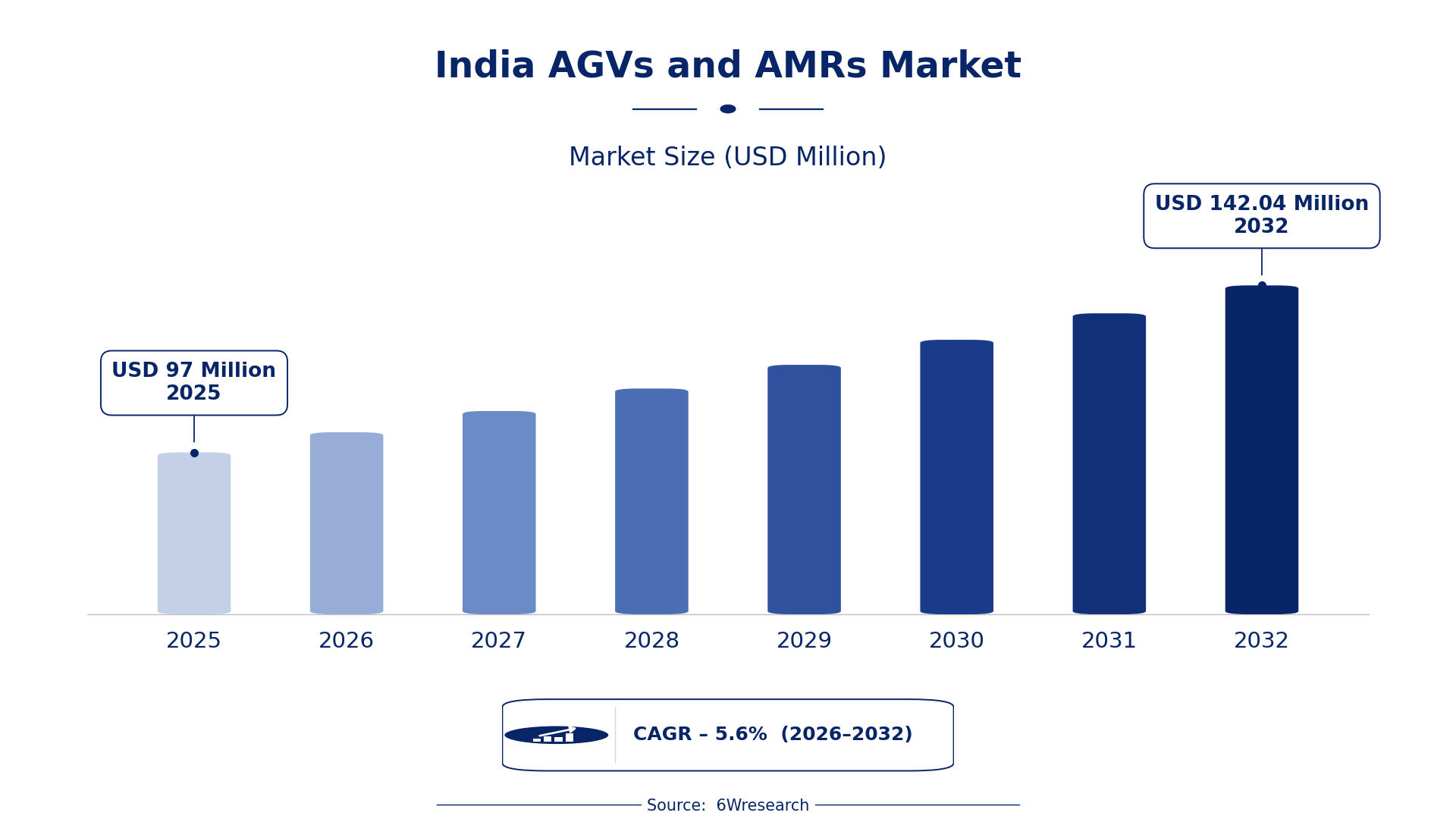
According to 6Wresearch internal database and industry insights, the India AGVs and AMRs Market was valued at USD 97.0 million in 2025 and is projected to reach USD 142.04 million by 2032, growing at a CAGR of approximately 5.6% during 2026–2032.
India AGVs and AMRs Market Highlights
| Report Metric | Details |
| Report Name | India AGVs and AMRs Market |
| Market Size 2025 | USD 97.0 million |
| Market Size 2032 | USD 142.04 million |
| Absolute Growth 2025–2032 | USD 45.04 million |
| CAGR 2026–2032 | 5.6% |
| Peak Annual Growth | 7.7% in 2030 |
| Forecast Period | 2026–2032 |
| Historical Data | 2022–2025 |
| Base Year | 2025 |
| Leading Robot Type, 2025 | AMRs (Autonomous Mobile Robots) (40% share) |
| Leading Mobility Type, 2025 | Free-Navigation (45% share) |
| Leading Distribution Channel, 2025 | Industrial Integrators (42% share) |
| Leading End User, 2025 | Automotive Plants (38% share) |
| Fastest-Growing Robot Type | Pallet Movers (7.2% CAGR) |
| Fastest-Growing Distribution Channel | OEM Dealers (7.9% CAGR) |
| Fastest-Growing End User | FMCG Distribution Centers (7.9% CAGR) |
| Growing Sector | automotive manufacturing |
| Key End Users | automotive plants, electronics warehouses, FMCG distribution centers |
India AGVs and AMRs Market Year-wise Growth Rate and Key Drivers (2022–2032)
This graph illustrates the annual growth rates of the market from 2022 to 2032, highlighting a steady upward trajectory and projected market expansion over the forecast period.
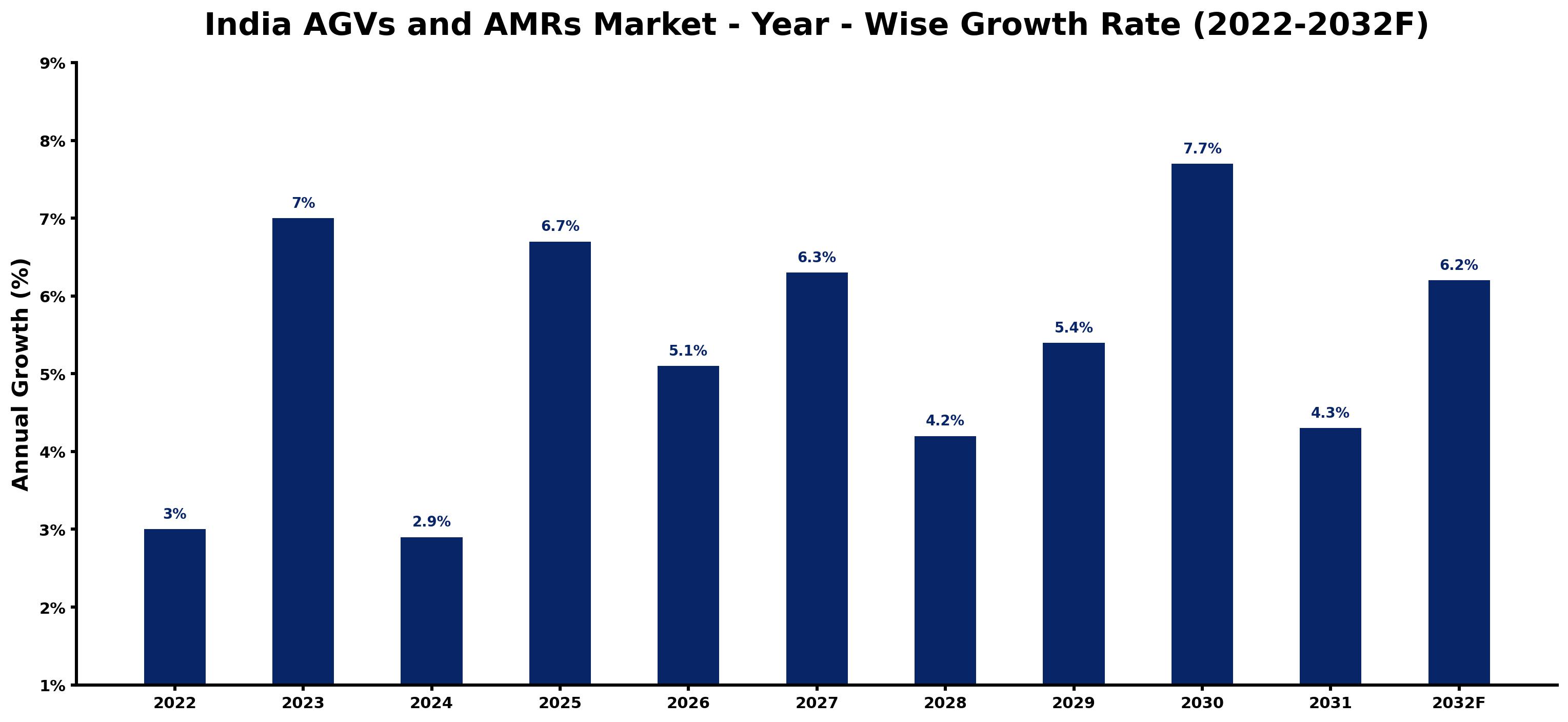
Annual growth estimates for each year appear below with the principal reason behind them, explaining the shifts that set the pace of the market.
| Year | Estimated Annual Growth (%) | Market Rationale |
| 2022 | 3.0 | The market exhibited steady growth, driven by increased automation in manufacturing processes. |
| 2023 | 7.0 | Demand surged due to the automotive sector's production levels exceeding 4 million vehicles annually. |
| 2024 | 2.9 | Growth slowed as the market adjusted to previous highs in demand for AGVs and AMRs. |
| 2025 | 6.7 | A resurgence in growth was seen, fueled by logistics efficiency needs in FMCG distribution centers. |
| 2026 | 5.1 | Growth decelerated as the market began to stabilise after rapid expansion in the automotive sector. |
| 2027 | 6.3 | Demand increased again, supported by rising automation in the electronics manufacturing sector. |
| 2028 | 4.2 | Growth slowed as the market matured and demand stabilised due to increased competition. |
| 2029 | 5.4 | A renewed growth phase emerged, driven by technological advancements in robotics. |
| 2030 | 7.7 | The peak growth rate was achieved, reflecting strong demand across various sectors. |
| 2031 | 4.3 | Growth moderated as the market began to normalise after peak levels in demand. |
| 2032 | 6.2 | Demand is projected to rise again, driven by ongoing automation trends and government initiatives. |
Note: Market size estimations and growth projections presented in this report are based on 6Wresearch's proprietary forecasting methodology, utilizing the latest available industry data, government publications, and primary research inputs.
India AGVs and AMRs Market Synopsis
AGVs and AMRs in India encompass advanced robotic systems for material handling and transportation in industrial settings. These technologies are manufactured using sophisticated sensors and software, primarily automating logistics in warehouses and manufacturing plants. The India AGVs and AMRs Market is expanding due to strong demand from the automotive and electronics sectors, supported by initiatives like 'Make in India' and the National Robotics Mission. With over 4 million vehicles produced annually, the automotive industry is a major user, while the electronics sector is expected to drive further demand for automation solutions.
Market Dynamics Impact Analysis (2026–2032)
| Factor | Type | Impact | Primary Segment Affected |
| Growing demand for automation in logistics and manufacturing processes | Driver | High | AMRs (Autonomous Mobile Robots) |
| Rising production levels in the automotive sector | Driver | High | AMRs (Autonomous Mobile Robots) |
| Increased investment in robotics technology by manufacturers | Opportunity | High | Pallet Movers |
| Expansion of logistics facilities in urban areas | Opportunity | High | FMCG Distribution Centers |
| High initial investment costs for AGV and AMR systems | Restraint | Medium | Forklift AGVs |
| Limited availability of skilled workforce for operation and maintenance | Restraint | Medium | AMRs (Autonomous Mobile Robots) |
| Supply chain disruptions affecting component availability | Challenge | High | Tugger AGVs |
| Technological advancements outpacing current market offerings | Challenge | Medium | Free-Navigation |
Evaluation of Drivers in India AGVs and AMRs Market (2026–2032)
The table below links each growth driver to the segment it affects and the evidence for it.
| Drivers | Primary Segment Affected | Why It Matters (Evidence) |
| Increased automation in manufacturing processes | AMRs (Autonomous Mobile Robots) | This trend drives demand as manufacturers seek to improve efficiency and reduce labor costs, with the automotive sector producing over 4 million vehicles annually. |
| Growing logistics efficiency needs in the FMCG sector | FMCG Distribution Centers | FMCG distribution centers are adopting AGVs to improve order fulfillment, with many centers reporting throughput improvements of up to 30%. |
| Rising investments in robotics technology | Pallet Movers | Investment in advanced robotics is increasing, particularly in urban logistics hubs, leading to operational capabilities and efficiency gains of 20%. |
| Expansion of the electronics manufacturing sector | Forklift AGVs | With the electronics sector projected to reach $300 billion by 2025, demand for AGVs is anticipated to rise significantly, increasing production capabilities. |
| Government initiatives promoting local manufacturing | Tugger AGVs | The 'Make in India' initiative encourages domestic production of robotics, driving demand for local AGV solutions and reducing import reliance. |
The AGVs and AMRs market in India is expanding as companies in the automotive and electronics sectors increasingly embrace automation technologies. The automotive industry, which produces over 4 million vehicles annually, drives the need for AGVs to optimise assembly line operations. At the same time, the electronics manufacturing sector is on the rise, creating a greater demand for efficient logistics solutions. FMCG distribution centres are adopting AGVs to enhance order fulfilment processes, achieving throughput improvements of up to 30%. Investment in robotics technology is also on the rise, particularly in urban logistics hubs, likely improving operational capabilities across various industries.
Evaluation of Restraints in India AGVs and AMRs Market
The key brakes on demand, and where they bite hardest, are shown below.
| Market Restraint | Primary Segment Affected | Why It Matters (Evidence) |
| High initial costs associated with AGV and AMR systems | Forklift AGVs | The upfront investment required can deter potential buyers, particularly in smaller enterprises, resulting in slower adoption rates. |
| Limited skilled workforce for operation and maintenance | Tugger AGVs | The ongoing global supply chain issues can delay production and delivery of critical components for AGVs, increasing lead times. |
| Technological advancements outpacing current market offerings | Pallet Movers | The absence of finalized safety standards complicates compliance for manufacturers and users, delaying product launches. |
| Supply chain disruptions affecting component availability | AMRs (Autonomous Mobile Robots) | Dependence on international suppliers can lead to increased costs and extended lead times for producers. |
| Regulatory uncertainties surrounding robotics standards | Forklift AGVs | The lack of established guidelines creates challenges for manufacturers in ensuring compliance and safety. |
India AGVs and AMRs Market Challenges
Buyers and suppliers in the India AGVs and AMRs market encounter regulatory hurdles as the Bureau of Indian Standards finalises guidelines for robotics, delaying compliance for manufacturers and increasing costs by up to 15%. Supply chain disruptions stem from dependence on international components, which can inflate production costs by 20% and extend lead times for producers. A skills gap persists as the Electronics Sector Skill Council of India struggles to train sufficient workers, resulting in operational inefficiencies for companies that rely on automation. Buyers in the automotive and electronics sectors experience logistics delays due to the slow adoption of automation technologies, reducing productivity by approximately 10%.
Trends in the India AGVs and AMRs Market
Buyers and suppliers in the India AGVs and AMRs Market are adjusting to the following trends.
- Shift towards Autonomous Mobile Robots: The adoption of AMRs has surged, particularly in logistics. In 2023, the adoption rate is expected to increase by 25%, driven by the need for efficient cargo handling in sectors such as FMCG.
- Transition from Manual to Automated Systems: Since 2020, numerous automotive plants have begun replacing manual processes with AGVs. This transition is evident as the sector produces over 4 million vehicles annually, improving productivity and safety.
- Emergence of Robotics Safety Standards: The Bureau of Indian Standards is working on national safety standards for robotics, anticipated to be finalised by 2024. This initiative aims to enhance safety and compliance in AGV and AMR operations.
- Growing Focus on Local Manufacturing: The 'Make in India' initiative has driven local production of robotics technologies since 2014. With ₹10,000 crores allocated in 2023, this emphasis is expected to strengthen domestic capabilities.
Investment Opportunities in the India AGVs and AMRs Market
Several openings in the India AGVs and AMRs Market merit attention from investors.
- Increased Demand for Logistics Automation: With FMCG distribution centres increasingly adopting AGVs, there is an opportunity to provide advanced robotics solutions. The sector is projected to grow rapidly, driven by efficiency needs and expected throughput improvements of 30%.
- Investment in Robotics Training Programs: The Electronics Sector Skill Council of India aims to train over 1 million workers by 2025 for automation roles. This initiative offers a chance for educational institutions to create specialised training programmes to meet industry demands.
- Expansion of Automotive Manufacturing Facilities: As automotive plants expand, the need for AGVs to streamline operations is growing. Suppliers can enter this market by collaborating with local manufacturers to offer tailored solutions for assembly lines.
- Development of Advanced Robotics Technologies: The ongoing research at the Indian Institute of Technology presents opportunities for advancements in AGVs and AMRs. Partnering with research institutions can lead to new product development and improved operational efficiencies.
Government Initiatives in the India AGVs and AMRs Market
The 'Make in India' initiative, launched in 2014, influences AGV and AMR manufacturers by promoting local production. This policy encourages investment in robotics technologies, aiming to enhance domestic manufacturing capabilities. Additionally, the National Robotics Mission, initiated in 2020, allocates ₹500 crores over five years to support research and development in robotics, directly benefiting producers in this sector.
In 2021, the Ministry of Heavy Industries and Public Enterprises launched the 'Production Linked Incentive Scheme' with a target of ₹1,500 crores to boost manufacturing in robotics. This scheme incentivises companies to increase production, thereby supporting AGV and AMR manufacturers. Furthermore, the Bureau of Indian Standards is developing a national standard for robotics safety, expected to be finalised by 2024, which will affect design and compliance for AGVs and AMRs.
Future Insight of the India AGVs and AMRs Market
Several forward-looking factors should support the India AGVs and AMRs market in the coming years. The 'Make in India' initiative will strengthen local manufacturing capabilities, reducing reliance on imports. The National Robotics Mission will encourage research in advanced robotics technologies, promoting innovation across the sector. Training programmes from the Electronics Sector Skill Council will help close the skills gap, ensuring a more prepared workforce.
Market Segmentation Analysis
The report offers a comprehensive study of the following market segments and their leading categories in the market.
By Robot Type – AMRs (Autonomous Mobile Robots) Dominated, Pallet Movers Expected to Grow Fastest
According to Ravi Bhandari, Research Head at 6Wresearch, with a 40% revenue share in 2025, AMRs (Autonomous Mobile Robots) was the largest robot type category. AMRs command the largest share in India due to their flexibility in automating material handling across various settings, particularly in automotive plants. Their ability to adapt to different tasks is essential for industries aiming to enhance operational efficiency. Pallet Movers are projected to grow fastest, at a CAGR of 7.2% during 2026–2032. Pallet Movers are witnessing rapid growth, fuelled by the rising demand for efficient pallet handling in storage areas, especially within the FMCG sector. As logistics operations expand, the need for specialised solutions like Pallet Movers is becoming increasingly evident. This trend suggests that suppliers should enhance their offerings in AMRs and Pallet Movers to align with the growing market demand.
By Mobility Type – Free-Navigation Dominated and Is Expected to Record the Fastest Growth
The largest mobility type category in 2025 was Free-Navigation, with a 45% share of total revenue. Free-Navigation technology leads the market because it enables dynamic movement in complex environments, making it suitable for diverse industrial applications. This capability is particularly important for sectors like automotive and electronics, where operational flexibility is crucial. The same category is also set to grow fastest, at a CAGR of 8.0% during 2026–2032. The ongoing adoption of Free-Navigation is expected to accelerate as industries recognise its benefits in improving operational efficiency and adaptability. This growth will likely solidify Free-Navigation's position as more facilities seek to modernise their logistics processes. Suppliers should focus on advancing Free-Navigation technology to leverage its increasing acceptance in the market.
By Distribution Channel – Industrial Integrators Dominated, OEM Dealers Expected to Grow Fastest
Industrial Integrators took a 42% share of distribution channel in 2025, more than any other category. Industrial Integrators hold the largest market share as they are essential for seamlessly incorporating AGVs and AMRs into existing operational frameworks. Their expertise is particularly vital for industries like automotive that require customised automation solutions. Over 2026–2032, OEM Dealers are expected to post the fastest growth, at a CAGR of 7.9%. OEM Dealers are experiencing the fastest growth as they supply AGVs and AMRs as part of larger systems, catering to the increasing demand for comprehensive automation solutions. This trend indicates a shift towards more integrated supply chains across various sectors. This suggests that suppliers need to strengthen collaborations with OEM Dealers to enhance their market reach and service offerings.
By End User – Automotive Plants Dominated, FMCG Distribution Centers Expected to Grow Fastest
Automotive Plants accounted for a 38% market share by end user in 2025. Automotive Plants account for the largest share of the market, primarily due to their extensive use of AGVs for assembly line operations, with over 4 million vehicles produced annually in India. The sector's reliance on automation for efficiency drives substantial demand. The quickest growth will come from FMCG Distribution Centers, forecast to expand at a CAGR of 7.9% between 2026 and 2032. FMCG Distribution Centers are witnessing the highest growth rate as they increasingly utilise AGVs for rapid order fulfillment, reflecting the sector's need for efficiency in logistics. The rise of e-commerce is further accelerating this demand. This indicates that suppliers should concentrate on developing tailored solutions for FMCG Distribution Centers to capture this expanding segment.
Key Attractiveness of the Report
- 10 Years of Market Numbers
- Historical Data Starting from 2022 to 2025
- Base Year 2025
- Forecast Data until 2032
- Key Performance Indicators Impacting the Market
- Major Upcoming Developments and Projects
Key Highlights of the Report:
- India AGVs and AMRs Market Outlook
- Market Size of India AGVs and AMRs Market, 2025
- Forecast of India AGVs and AMRs Market, 2032
- Historical Data and Forecast of India AGVs and AMRs Revenues & Volume for the Period 2022 - 2032F
- India AGVs and AMRs Market Trend Evolution
- India AGVs and AMRs Market Drivers and Challenges
- India AGVs and AMRs Price Trends
- India AGVs and AMRs Porter's Five Forces
- India AGVs and AMRs Industry Life Cycle
- Historical Data and Forecast of India AGVs and AMRs Market Revenues & Volume By Robot Type for the Period 2022 - 2032F
- Historical Data and Forecast of India AGVs and AMRs Market Revenues & Volume By Forklift AGVs for the Period 2022 - 2032F
- Historical Data and Forecast of India AGVs and AMRs Market Revenues & Volume By AMRs (Autonomous Mobile Robots) for the Period 2022 - 2032F
- Historical Data and Forecast of India AGVs and AMRs Market Revenues & Volume By Pallet Movers for the Period 2022 - 2032F
- Historical Data and Forecast of India AGVs and AMRs Market Revenues & Volume By Tugger AGVs for the Period 2022 - 2032F
- Historical Data and Forecast of India AGVs and AMRs Market Revenues & Volume By Mobility Type for the Period 2022 - 2032F
- Historical Data and Forecast of India AGVs and AMRs Market Revenues & Volume By Track-based Movement for the Period 2022 - 2032F
- Historical Data and Forecast of India AGVs and AMRs Market Revenues & Volume By Free-Navigation for the Period 2022 - 2032F
- Historical Data and Forecast of India AGVs and AMRs Market Revenues & Volume By Omni-directional Wheels for the Period 2022 - 2032F
- Historical Data and Forecast of India AGVs and AMRs Market Revenues & Volume By Line-following for the Period 2022 - 2032F
- Historical Data and Forecast of India AGVs and AMRs Market Revenues & Volume By Distribution Channel for the Period 2022 - 2032F
- Historical Data and Forecast of India AGVs and AMRs Market Revenues & Volume By Industrial Integrators for the Period 2022 - 2032F
- Historical Data and Forecast of India AGVs and AMRs Market Revenues & Volume By Online Tech Distributors for the Period 2022 - 2032F
- Historical Data and Forecast of India AGVs and AMRs Market Revenues & Volume By OEM Dealers for the Period 2022 - 2032F
- Historical Data and Forecast of India AGVs and AMRs Market Revenues & Volume By Automation Partners for the Period 2022 - 2032F
- Historical Data and Forecast of India AGVs and AMRs Market Revenues & Volume By End User for the Period 2022 - 2032F
- Historical Data and Forecast of India AGVs and AMRs Market Revenues & Volume By Automotive Plants for the Period 2022 - 2032F
- Historical Data and Forecast of India AGVs and AMRs Market Revenues & Volume By Electronics Warehouses for the Period 2022 - 2032F
- Historical Data and Forecast of India AGVs and AMRs Market Revenues & Volume By FMCG Distribution Centers for the Period 2022 - 2032F
- Historical Data and Forecast of India AGVs and AMRs Market Revenues & Volume By Airport Cargo Facilities for the Period 2022 - 2032F
- India AGVs and AMRs Import Export Trade Statistics
- Market Opportunity Assessment By Robot Type
- Market Opportunity Assessment By Mobility Type
- Market Opportunity Assessment By Distribution Channel
- Market Opportunity Assessment By End User
- India AGVs and AMRs Top Companies Market Share
- India AGVs and AMRs Competitive Benchmarking By Technical and Operational Parameters
- India AGVs and AMRs Company Profiles
- India AGVs and AMRs Key Strategic Recommendations
Market Covered
This report examines the market across the segments below.
By Robot Type
- Forklift AGVs
- AMRs (Autonomous Mobile Robots)
- Pallet Movers
- Tugger AGVs
By Mobility Type
- Track-based Movement
- Free-Navigation
- Omni-directional Wheels
- Line-following
By Distribution Channel
- Industrial Integrators
- Online Tech Distributors
- OEM Dealers
- Automation Partners
By End User
- Automotive Plants
- Electronics Warehouses
- FMCG Distribution Centers
- Airport Cargo Facilities































