India AI in Electronics Market Size & Growth Rate
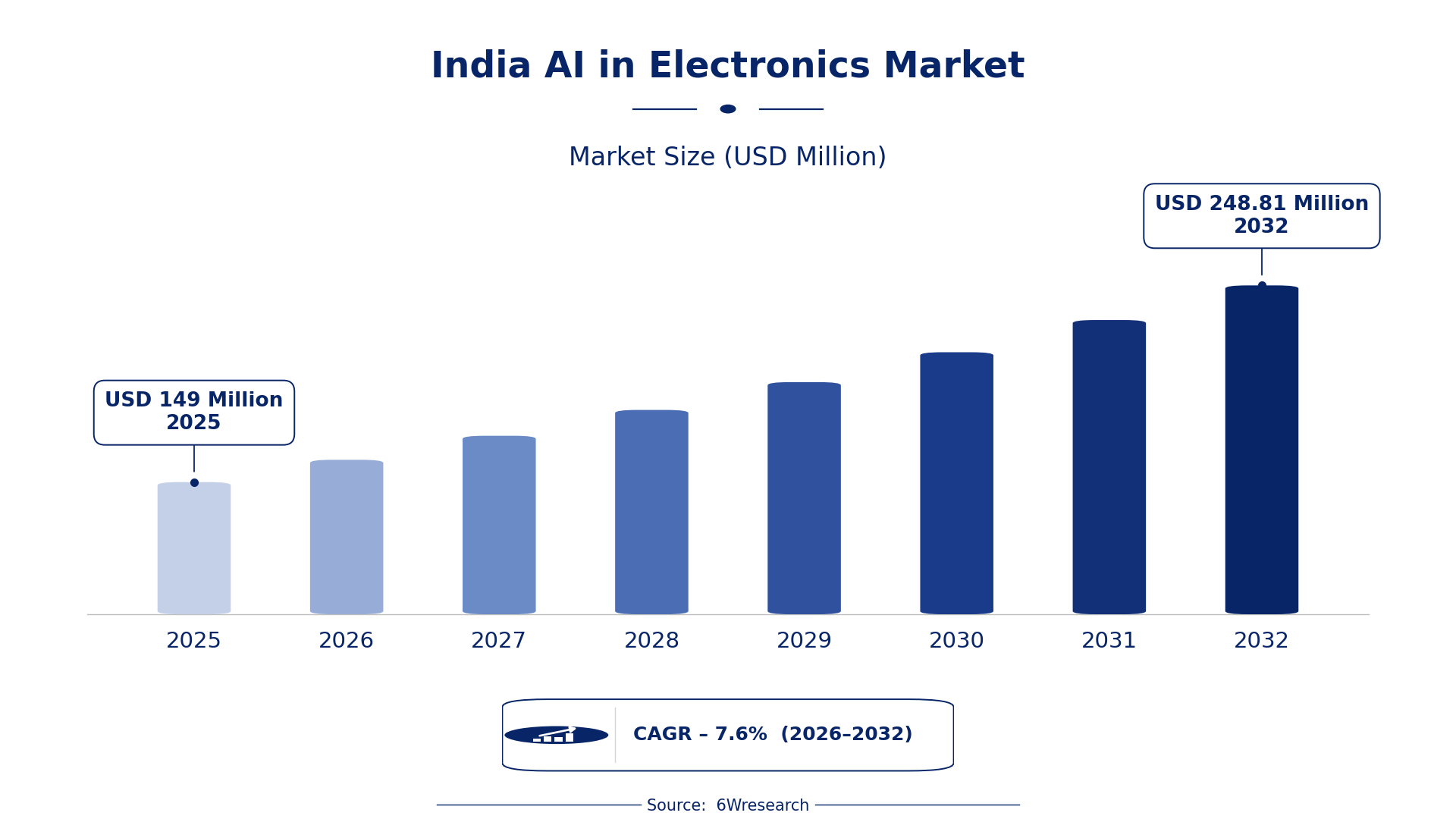
According to 6Wresearch internal database and industry insights, the India AI in Electronics Market was valued at USD 149.0 million in 2025 and is projected to reach USD 248.81 million by 2032, growing at a CAGR of approximately 7.6% during 2026–2032.
India AI in Electronics Market Highlights
| Report Metric | Details |
| Report Name | India AI in Electronics Market |
| Market Size 2025 | USD 149.0 million |
| Market Size 2032 | USD 248.81 million |
| Absolute Growth 2025–2032 | USD 99.81 million |
| CAGR 2026–2032 | 7.6% |
| Peak Annual Growth | 10.2% in 2031 |
| Forecast Period | 2026–2032 |
| Historical Data | 2022–2025 |
| Base Year | 2025 |
| Leading Application Area, 2025 | Smart Home Devices (55% share) |
| Leading AI Component, 2025 | Voice Assistants (36% share) |
| Leading Distribution Channel, 2025 | Consumer Electronics Stores (45% share) |
| Leading End User, 2025 | IoT Product Developers (37% share) |
| Fastest-Growing Application Area | Predictive Maintenance (10.1% CAGR) |
| Fastest-Growing AI Component | Sensor + AI (9.5% CAGR) |
| Fastest-Growing End User | Device Manufacturers (9.9% CAGR) |
| Growing Sector | Smart Home Devices |
| Key End Users | IoT Product Developers, Device Manufacturers, Consumer Electronics Companies, Smart Appliance Producers |
India AI in Electronics Market Year-wise Growth Rate and Key Drivers (2022–2032)
This graph illustrates the annual growth rates of the market from 2022 to 2032, highlighting a steady upward trajectory and projected market expansion over the forecast period.
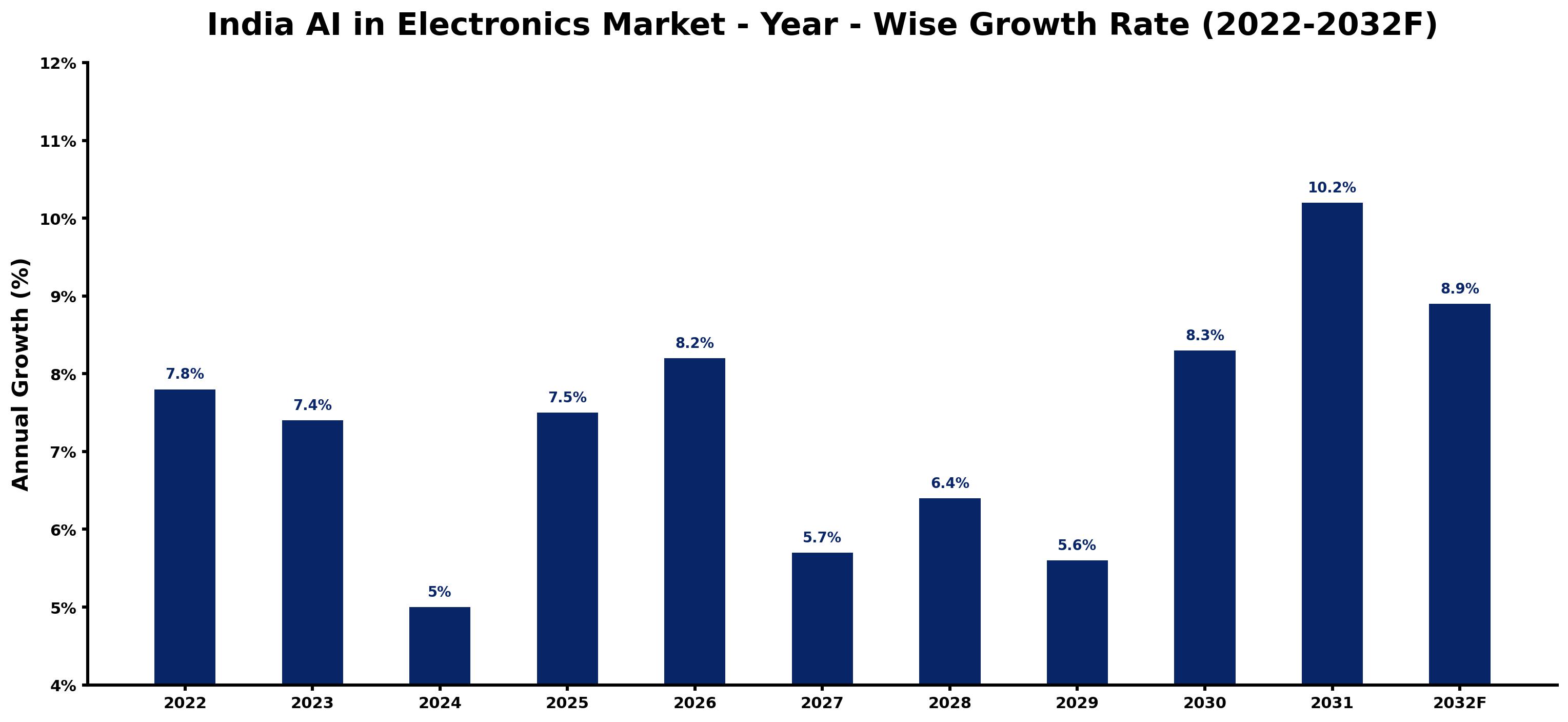
The table below sets out the estimated growth rate for each year and the main factor behind it.
| Year | Estimated Annual Growth (%) | Market Rationale |
| 2022 | 7.8 | The market showed strong growth due to increased adoption of AI technologies in consumer electronics. |
| 2023 | 7.4 | Growth slowed as manufacturers adjusted to supply chain challenges affecting production timelines. |
| 2024 | 5.0 | Market expansion continued to slow as demand stabilised following previous years' rapid increases. |
| 2025 | 7.5 | A resurgence in growth occurred as consumer interest in smart home devices surged again. |
| 2026 | 8.2 | Investment in AI research and development is expected to yield new products, boosting demand. |
| 2027 | 5.7 | Growth is expected to slow as competition intensifies among local manufacturers. |
| 2028 | 6.4 | A renewed focus on energy optimization in electronics is projected to spur demand for AI solutions. |
| 2029 | 5.6 | Growth is expected to slow as the market matures, requiring innovation to sustain interest. |
| 2030 | 8.3 | Increased government support for AI initiatives will drive market growth. |
| 2031 | 10.2 | The market will peak with substantial investments in AI technologies across sectors. |
| 2032 | 8.9 | Growth will slow as the market stabilizes after reaching its peak. |
Note: Market size estimations and growth projections presented in this report are based on 6Wresearch's proprietary forecasting methodology, utilizing the latest available industry data, government publications, and primary research inputs.
India AI in Electronics Market Synopsis
The AI in Electronics Market in India encompasses the integration of artificial intelligence technologies into electronic devices, improving their functionality and efficiency. This includes applications such as smart home automation and predictive maintenance. The market is growing due to rising domestic demand and investments in the electronics sector. For instance, over 50% of electronic devices in India are expected to integrate AI by 2025. The Indian semiconductor market is projected to grow to $70 billion by 2026, further driving growth.
Market Dynamics Impact Analysis (2026–2032)
| Factor | Type | Impact | Primary Segment Affected |
| Increasing domestic demand for smart home devices | Driver | High | Smart Home Devices |
| Rising investment in AI research and development | Driver | High | Embedded AI Chips |
| Growing need for energy-efficient solutions | Opportunity | High | Energy Optimization |
| Expansion of IoT applications in various sectors | Opportunity | High | Predictive Maintenance |
| Supply chain disruptions affecting component availability | Restraint | High | Embedded AI Chips |
| High costs of AI technology integration for manufacturers | Restraint | Medium | Smart Home Devices |
| Limited skilled workforce in AI technologies | Challenge | High | Device Manufacturers |
| Regulatory hurdles in AI product approvals | Challenge | Medium | Consumer Electronics Companies |
Evaluation of Drivers in India AI in Electronics Market (2026–2032)
The table below links each growth driver to the segment it affects and the evidence for it.
| Drivers | Primary Segment Affected | Why It Matters (Evidence) |
| Increased investment in AI research and development | Embedded AI Chips | The Indian government announced a $1 billion fund for AI research in electronics, leading to more chip innovations. |
| Surge in smart home device adoption | Smart Home Devices | Over 50% of electronic devices in India are expected to integrate AI by 2025, driving demand for smart devices. |
| Expansion of IoT applications | Predictive Maintenance | India's IoT market is projected to grow to $15 billion by 2025, increasing demand for AI-enabled solutions. |
| Focus on energy efficiency | Energy Optimization | AI algorithms are being adopted to manage energy consumption, appealing to industries seeking cost savings. |
| Consumer electronics growth | Consumer Electronics Stores | The rise in AI-enabled products is boosting sales through consumer electronics retail channels. |
Growth across the AI in Electronics market in India is anchored in rising investment in AI research and development, expanding end-use demand, and increasing consumer interest. As over 50% of electronic devices are expected to integrate AI by 2025, manufacturers are ramping up production of smart home devices. The projected growth of India's IoT market to $15 billion by 2025 is driving demand for predictive maintenance solutions. This combination of factors is creating greater purchases across the electronics sector.
Evaluation of Restraints in India AI in Electronics Market
The following restraints limit how fast demand can grow.
| Market Restraint | Primary Segment Affected | Why It Matters (Evidence) |
| Supply chain disruptions affecting component availability | Embedded AI Chips | Recent global supply chain issues have delayed the availability of critical components, impacting production timelines. |
| High costs of AI technology integration for manufacturers | Smart Home Devices | The expense associated with integrating AI technologies can deter manufacturers from adopting these innovations. |
| Limited skilled workforce in AI technologies | Device Manufacturers | A shortage of trained professionals in AI and machine learning hinders the growth of manufacturers. |
| Regulatory hurdles in AI product approvals | Consumer Electronics Companies | Stringent regulations can delay product launches, affecting market entry for new AI-enabled devices. |
| Market maturity leading to slower innovation | Predictive Maintenance | As the market matures, the pace of innovation may slow, affecting new product development. |
India AI in Electronics Market Challenges
The India AI in Electronics market encounters challenges that hinder its growth. Limited technology infrastructure restricts AI integration, as many electronic devices lack necessary capabilities, causing delays for developers launching new products. Intense competition from global markets pressures local producers to innovate quickly, often resulting in subpar products that fail to meet consumer expectations. Low consumer awareness of AI applications limits adoption rates, leading to decreased sales for electronics companies.
Trends in the India AI in Electronics Market
Several trends are reshaping the India AI in Electronics Market; the most important are set out below.
- Shift towards Smart Home Automation: India is experiencing a shift towards smart home automation, driven by increasing consumer demand for convenience. The market for smart home devices is expected to grow, with over 50% of electronic devices integrating AI by 2025.
- Emergence of AI-Enabled Predictive Maintenance: The trend of predictive maintenance is gaining traction in India, particularly in industrial sectors. This shift is supported by the projected growth of India's IoT market to $15 billion by 2025, enhancing operational efficiencies.
- Focus on Energy Optimization Solutions: There is a growing emphasis on energy optimization in electronics, with AI algorithms playing a key role. The push for energy-efficient solutions aligns with India's sustainability goals, resulting in increased adoption of AI technologies.
- Expansion of AI Research and Development: The Indian government is prioritising AI research and development, as seen in the establishment of the $1 billion fund for AI initiatives. This investment is expected to promote innovation and growth in the electronics sector.
Investment Opportunities in the India AI in Electronics Market
The following opportunities in the India AI in Electronics Market pair current demand with a clear way in.
- IoT Product Developers seeking AI solutions: With India's IoT market projected to reach $15 billion by 2025, there is an opportunity for suppliers of AI technologies. Collaborating with IoT product developers can facilitate market entry and growth.
- Growing demand for energy-efficient electronics: The increasing need for energy optimization presents a $70 billion opportunity in the semiconductor market by 2026. Suppliers can focus on AI algorithms that improve energy management solutions.
- Consumer Electronics Companies investing in AI: As over 50% of electronic devices are expected to integrate AI by 2025, there is strong demand for AI-enabled products. Partnering with consumer electronics companies can yield substantial returns.
- Manufacturers looking to enhance product functionality: The push for smarter electronics provides an opportunity for suppliers of AI components. Engaging with device manufacturers can lead to fruitful collaborations in product development.
Government Initiatives in the India AI in Electronics Market
The 'National Policy on Electronics 2019' by the Ministry of Electronics and Information Technology aims to create a $400 billion electronics manufacturing industry by 2025. This policy encourages the integration of AI technologies into electronic devices, promoting innovation and local manufacturing. The 'Digital India Programme' launched in 2020 focuses on promoting AI and electronics innovation across various sectors, further supporting the growth of AI in electronics.
The 'Atmanirbhar Bharat Abhiyan' initiative, introduced in 2020, includes measures to boost local manufacturing of AI components, allowing manufacturers to benefit from government support. The 'National AI Mission' established in 2021 by NITI Aayog aims to promote research and development in AI technologies, including in electronics. Furthermore, the 'Production Linked Incentive Scheme' for electronics, with a budget of $6 billion, incentivizes domestic production of AI-enabled devices, supporting market growth.
Future Insight of the India AI in Electronics Market
The India AI in Electronics market is set for substantial evolution by 2032, with a projected growth in the IoT market to $15 billion by 2025 driving AI adoption. The government's $1 billion fund for AI research and development will stimulate innovation, allowing suppliers to offer more sophisticated products. Initiatives from the Electronics Sector Skill Council aim to train one million professionals by 2025, ensuring a robust talent pool for the industry. The establishment of AI-focused manufacturing hubs will improve production efficiency, making advanced electronics more accessible to consumers.
Market Segmentation Analysis
Each segment group is reviewed below, with the leader by share and the fastest grower by CAGR.
By Application Area – Smart Home Devices Dominated, Predictive Maintenance Expected to Grow Fastest
According to Shubham Padhi, Research Analyst at 6Wresearch, with a 55% revenue share in 2025, Smart Home Devices was the largest application area category. Smart home devices capture the largest share as they meet consumer demand for convenience and automation in daily activities. The expected integration of AI into over 50% of electronic devices by 2025 highlights the robust interest in these products. Over 2026–2032, Predictive Maintenance is expected to post the fastest growth, at a CAGR of 10.1%. Predictive maintenance is experiencing rapid growth as industries increasingly adopt technologies to enhance operational efficiency and reduce downtime. The anticipated rise of India's IoT market to $15 billion by 2025 is a key factor driving this segment's expansion. Suppliers should focus on creating tailored solutions for predictive maintenance to tap into emerging market opportunities.
By AI Component – Voice Assistants Dominated, Sensor + AI Expected to Grow Fastest
In 2025, Voice Assistants led the ai component split with a 36% share. Voice assistants dominate the market share due to their essential role in enabling user interaction within smart devices, making them highly desirable among consumers. Their extensive integration across various electronic products significantly boosts usability and engagement. Sensor + AI is set to record the highest CAGR in this split, 9.5% over 2026–2032. The integration of sensors with AI is gaining traction as it facilitates more intelligent responses through enhanced data collection and analysis. The growing number of AI-focused courses offered by over 100 universities in India is propelling this segment's growth. Suppliers should invest in advanced sensor technologies combined with AI to address the increasing demand for smarter electronic devices.
By Distribution Channel – Consumer Electronics Stores Dominated and Is Expected to Record the Fastest Growth
Consumer Electronics Stores accounted for a 45% market share by distribution channel in 2025. Consumer electronics stores lead the market share as they serve as the primary retail outlet for AI-enabled products, providing consumers direct access to the latest technologies. This accessibility is crucial for encouraging adoption among tech-savvy buyers. Its lead should widen, with a projected CAGR of 9.5% during 2026–2032, the highest in this split. Consumer electronics stores are also the fastest-growing channel, benefiting from rising consumer interest in AI products and the expansion of retail networks. The ongoing growth in the electronics sector further supports this trend. Retailers should enhance their inventory of AI-enabled products to capitalise on the increasing consumer interest in smart technologies.
By End User – IoT Product Developers Dominated, Device Manufacturers Expected to Grow Fastest
The largest end user category in 2025 was IoT Product Developers, with a 37% share of total revenue. IoT product developers hold the largest share as they spearhead the creation of innovative solutions that leverage advanced technologies for improved functionality. Their critical role in India's expanding tech ecosystem positions them as key players in the market. Device Manufacturers are projected to grow fastest, at a CAGR of 9.9% during 2026–2032. Device manufacturers are experiencing rapid growth as they increasingly integrate advanced technologies into their product designs, responding to consumer demand for smarter electronics. Government initiatives for AI research and development are further accelerating this trend. Manufacturers should prioritise the integration of advanced technologies in their product lines to stay competitive in the evolving electronics market.
Key Attractiveness of the Report
- 10 Years of Market Numbers
- Historical Data Starting from 2022 to 2025
- Base Year 2025
- Forecast Data until 2032
- Key Performance Indicators Impacting the Market
- Major Upcoming Developments and Projects
Key Highlights of the Report:
- India AI in Electronics Market Outlook
- Market Size of India AI in Electronics Market, 2025
- Forecast of India AI in Electronics Market, 2032
- Historical Data and Forecast of India AI in Electronics Revenues & Volume for the Period 2022 - 2032F
- India AI in Electronics Market Trend Evolution
- India AI in Electronics Market Drivers and Challenges
- India AI in Electronics Price Trends
- India AI in Electronics Porter's Five Forces
- India AI in Electronics Industry Life Cycle
- Historical Data and Forecast of India AI in Electronics Market Revenues & Volume By Application Area for the Period 2022 - 2032F
- Historical Data and Forecast of India AI in Electronics Market Revenues & Volume By Smart Home Devices for the Period 2022 - 2032F
- Historical Data and Forecast of India AI in Electronics Market Revenues & Volume By Embedded AI Chips for the Period 2022 - 2032F
- Historical Data and Forecast of India AI in Electronics Market Revenues & Volume By Predictive Maintenance for the Period 2022 - 2032F
- Historical Data and Forecast of India AI in Electronics Market Revenues & Volume By Energy Optimization for the Period 2022 - 2032F
- Historical Data and Forecast of India AI in Electronics Market Revenues & Volume By AI Component for the Period 2022 - 2032F
- Historical Data and Forecast of India AI in Electronics Market Revenues & Volume By Voice Assistants for the Period 2022 - 2032F
- Historical Data and Forecast of India AI in Electronics Market Revenues & Volume By SoC with ML Cores for the Period 2022 - 2032F
- Historical Data and Forecast of India AI in Electronics Market Revenues & Volume By Sensor + AI for the Period 2022 - 2032F
- Historical Data and Forecast of India AI in Electronics Market Revenues & Volume By ML Algorithms for the Period 2022 - 2032F
- Historical Data and Forecast of India AI in Electronics Market Revenues & Volume By Distribution Channel for the Period 2022 - 2032F
- Historical Data and Forecast of India AI in Electronics Market Revenues & Volume By Consumer Electronics Stores for the Period 2022 - 2032F
- Historical Data and Forecast of India AI in Electronics Market Revenues & Volume By Semiconductor Platforms for the Period 2022 - 2032F
- Historical Data and Forecast of India AI in Electronics Market Revenues & Volume By Industrial Supply Chains for the Period 2022 - 2032F
- Historical Data and Forecast of India AI in Electronics Market Revenues & Volume By OEM Direct Sales for the Period 2022 - 2032F
- Historical Data and Forecast of India AI in Electronics Market Revenues & Volume By End User for the Period 2022 - 2032F
- Historical Data and Forecast of India AI in Electronics Market Revenues & Volume By IoT Product Developers for the Period 2022 - 2032F
- Historical Data and Forecast of India AI in Electronics Market Revenues & Volume By Device Manufacturers for the Period 2022 - 2032F
- Historical Data and Forecast of India AI in Electronics Market Revenues & Volume By Smart Appliance Producers for the Period 2022 - 2032F
- Historical Data and Forecast of India AI in Electronics Market Revenues & Volume By Consumer Electronics Companies for the Period 2022 - 2032F
- India AI in Electronics Import Export Trade Statistics
- Market Opportunity Assessment By Application Area
- Market Opportunity Assessment By AI Component
- Market Opportunity Assessment By Distribution Channel
- Market Opportunity Assessment By End User
- India AI in Electronics Top Companies Market Share
- India AI in Electronics Competitive Benchmarking By Technical and Operational Parameters
- India AI in Electronics Company Profiles
- India AI in Electronics Key Strategic Recommendations
Market Covered
The report offers an extensive study of the following market segments.
By Application Area
- Smart Home Devices
- Embedded AI Chips
- Predictive Maintenance
- Energy Optimization
By AI Component
- Voice Assistants
- SoC with ML Cores
- Sensor + AI
- ML Algorithms
By Distribution Channel
- Consumer Electronics Stores
- Semiconductor Platforms
- Industrial Supply Chains
- OEM Direct Sales
By End User
- IoT Product Developers
- Device Manufacturers
- Smart Appliance Producers
- Consumer Electronics Companies































